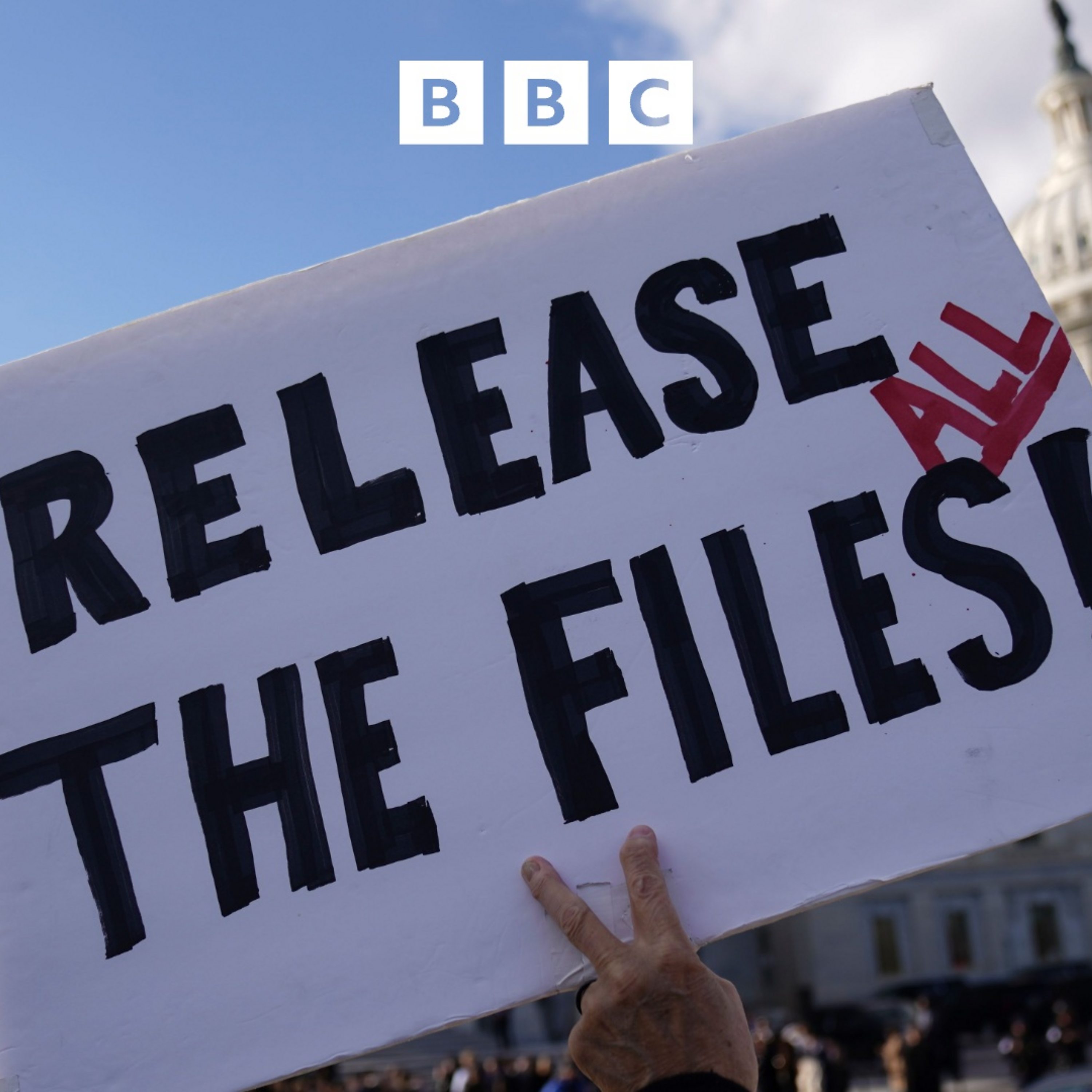
This BBC podcast is supported by ads outside the UK. Available now on the documentary from the BBC World Service. I'm Charlotte Pritchard and I'm in Northern Argentina's impenetrable forest looking for jaguars. Last month, a new baby was spotted here on the banks of a muddy river. Until now, they were extinct for 35 years. Listen now by searching for the documentary, wherever you get to your BBC podcasts. We live in a world where the news is on our fingertips. But how often do we stop scrolling and just listen? I'm Malika Bilal and this is The Take. I'll just hear a daily news podcast where we bring you the context and the people behind the global stories that matter. Subscribe wherever you listen to podcasts. This is The Global News Podcast from The BBC World Service. I'm Paul Moss and in the early hours of Saturday, the 20th of December, these are our main stories. The US has released 300,000 official documents, photographs and video recordings relating to Jeffrey Epstein. American forces have struck suspected Islamic state targets in Syria. And the BBC has heard claims from Palestinian prisoners that they were sexually abused while in Israeli custody. Also in this program. He's going upstairs without a light. Yes, he likes to move around in the dark, poor man. More than four decades after his death, a radio play written by Tennessee Williams is heard for the first time. So Bill Clinton is in a hot tub. Britain's former Prince Andrew is stretched across the laps of what looked to be five women. And the photographs released as part of the Epstein files also show Mick Jagger and Galein Maxwell at a dinner table while Michael Jackson and Diana Ross also put in an appearance. The US Justice Department released more than 300,000 pages from its investigations into Epstein. The late financier and convicted sex offender, not just photographs, but also audio recordings and documents about the original criminal case against Epstein. Now, to be very clear, being in a photograph with someone or being close friends with them does not in itself constitute wrongdoing. And indeed, that's the argument that's been made consistently by President Trump. He of course appears in that much viewed video clip, apparently laughing and joking with Epstein at a social event. But he dismissed the importance of a previous batch of photographs released just a week ago. I haven't seen it, but I mean, everybody knew this man. He was all over Palm Beach, his photos with everybody. I mean, almost there are hundreds and hundreds of people that are photos with him. So that's no big deal. I know nothing about it. What's frustrating for those trying to learn anything from these files is that the photographs have no dates or locations, no context at all. And much of it is, in any case, redacted faces covered up whole chunks of text blacked out. The Justice Department says it's identified more than 1,200 Epstein victims or their relatives. And that explains it says why the files have been so heavily redacted to protect these people's identities. Democrats have blasted this limited release, saying the Justice Department's choice is unlawful. And Epstein's victims have expressed similar frustrations. Marina Lassada was just 14 when she was first groomed and abused by Epstein in New York. She's chosen to waive her right to anonymity and express her doubts. We waited for this day. We waited for this moment. And we are a little bit disappointed that they're now still lingering on. And, you know, distracting us with other things. Some of the survivors are, you know, still nervous and skeptical about how they are going to release the rest of the files. We are very worried that it will still be redacted in the same way that it was today. It's very nerve-wracking for all of us. Within the thousands of files, one Epstein accuser found a sense of vindication. Maria Farmer, who reported on him as early as 1996 for child pornography, found her complaint to the FBI in the files made years before any investigation into the financier began. Jennifer Freeman is her lawyer. At the FBI just listened to her and paid attention that over a thousand victims could have been spared. And 30 years of trauma avoided. It really is tragic. So what have we actually learned so far from these documents? And all the America correspondent Peter Boes is one of many who've been sifting through them. I've got to say, first of all, it has been quite a task sifting through these documents. There are many, many pages to go through and that process is still ongoing. I think one thing that really did draw my attention was this focus on Bill Clinton. As you've mentioned, several photographs, one of them languishing in a hot tub. It's been notable how the White House or at least some of its officials have actually responded posting online. The White House press secretary just commenting, oh, my. And the reason that the mention of Bill Clinton's name jumps out is the timing. A few weeks ago, President Trump called on his justice department to look into Bill Clinton's involvement and relationship with Epstein, the attorney general, Pambondi announced a formal government investigation shortly thereafter. Now a spokesperson for Bill Clinton has responded to this saying that it isn't about Bill Clinton. Never hasn't never will be and goes on to say that there are two types of people. The first group knew nothing and cut Epstein off before his crimes came to light. The second group continued relationships with him afterwards. We're in the first statement, says. And I think more generally some of the other photographs that are published here, reminders of the star-studded circles that Epstein moved in. One other thing I'll mention, it's one of the more chilling lines of text from phone messages, phone logs from 2004 and 2005, a caller whose name remains redacted, left two messages for Epstein, identical, saying, I have a female for him. Now we have no further context to that, but the words knowing what we know now clearly are deeply disturbing. There is also a reference to Donald Trump being introduced to a 14-year-old girl. I should stress, no suggestion of anything more than that of anything I'm proper or illegal, but what did you make of that? Well, yes, he allegedly introduced a 14-year-old girl to Donald Trump at Mar-a-Lago, the president's home in Florida. This is according to court documents, which were part of this huge batch of materials just released. And during the alleged encounter in the 1990s, Epstein allegedly elbowed Donald Trump and playfully asked him in a reference to the girl, this is a good one, writes. Now, this quotation and this information has previously been made public because it was part of a lawsuit against Epstein's estate and Guilain Maxwell back in 2020. And as you say, there is no suggestion that Donald Trump did anything wrong and hasn't been accused of anything. But it is certainly a reference to the current sitting president. We heard earlier the reaction of disappointment, I suppose, from the victims of Jeffrey Epstein. Is that the general tenor of reaction to this release in political circles as well? Yeah, disappointment might be putting it mildly. I would say there's a lot of anger with the way that this has unfolded. And I just mentioned a few of those sort of political responses. A spokesperson for Senator Dick Durbin, who is the top Democrat on the Senate Judiciary Committee, has accused the Justice Department of failing to fully comply with the law, the law being the Epstein Files Transparency Act, by not releasing everything. Democratic Senator Adam Schiff says, "I think we ought to bring Pambondi, the Attorney General, before the Senate Judiciary Committee to demand answers." And then, perhaps even more significantly, the Republican Congressman Thomas Massey, who co-authored the order that ordered the release of these files in full, he says the Justice Department has grossly violated its legal obligations. Donald Trump was under a lot of pressure to really get these documents released by his own people, his own supporters, many of whom are perhaps, I could say, conspiracy theorists who were convinced there was a cover-up going on. Do you think they're going to be satisfied by the release that's happened now? I don't think they're going to be satisfied at all, and they've been increasingly outspoken in recent weeks and months. It's noticeable that, since the release, President Trump has had nothing to say, and generally that's what he does, as he's leaving the White House getting onto a helicopter. He usually has a few words with the press. He didn't have anything to say over the last few hours when he was given the opportunity. Peter Bose, while many were still pouring through the contents of those newly released files, the U.S. announced it had launched a wave of strikes against the Islamic State Group in Syria. This, President Trump says, was it retaliation for the killing of two American soldiers in the country last week? The U.S. Defense Secretary Pete Hegseth said the operation was not the beginning of a war, instead calling it a declaration of vengeance, intended to eliminate fighters and weapons. The military said northern 70 targets had been hit. Muiz Mustafa is the executive director of the U.S.-based organization, the Syrian Emergency Task Force. He told the BBC's Claire Richardson that the American's response came as no surprise. I think that this was something that was being built up for over the past week, as soon as the terrorist attack by the ISIS lone wolf happened on the 13th on that Saturday. The next day, joint Syrian American military and security operations started. They did about 10 at least. In those, they were able to arrest or kill 23 ISIS terrorists, but also confiscate a lot of computers, phones, electronic equipment. With those that were detained, they were interrogated, and with that intel that came out of these raids. And today we see the strikes based on the intel that was collected in all of these over a dozen raids that happened during this time period. So do you think this is a one in done? This strike is the retaliation that Donald Trump says it is, or will we continue to see U.S. action? I think we will definitely continue to see continued U.S. action and Syrian government forces action, especially in the Badia area. So the Badia area, which is also this desert area in Syria, it goes over multiple governance, including Palmyra where the terrorist attack happened. In this area are the last remnants of ISIS. And so I think what we're going to see is continued raids and continued strike against any ISIS targets based on all the intel that they get in. I think an important point we should just note is that ISIS itself has not actually claimed responsibility for the attack on the soldiers, but U.S. intelligence pointing in that direction. How has the fall of the Assad regime in Syria influenced the way that the group is able to operate? The Assad regime's presence in Syria was really important to ISIS, in the sense it was a great propaganda recruiting tool, right? People are being tortured to death and civilians are getting bombed, come join us. But when people came, they realized ISIS is a terrorist organization that wanted to kill everybody that didn't believe in its insane ideology. With Assad falling, the Damascus, which was an enemy in adversary of the United States and in the sphere of influence of Russia, China, Iran, North Korea, has below it, have you, became an ally of the United States and a partner in the fight against ISIS. Another thing that's important to note is that the current Syrian government and Syrian government forces, they've had to fight against ISIS for years without U.S. weapons, intelligence, funding, air power. Today you have people that have the expertise and experience in fighting ISIS and understand their thinking, combined with the greatest military in the world, which is the United States military. So I think ISIS really fears what's happening. That's why they lashed out. Muaz Mustafa from the Syrian Emergency Task Force. When South Korea is then President Yun Su-gyul declared martial law a year ago, many in the country feared for the future of its democracy. In the end, the coup failed. Mr. Yun ended up in prison rather than in office. And yet, 12 months on, he seems to be finding new fans, particularly among young, disaffected people. Earlier in December, thousands in their 20s and 30s came out on the street defending Mr. Yun's actions and demanding his release from prison, a sole correspondent Jake Kwon sent us this report. He made baseless claims that Chinese spies have stolen past elections and that the opposition party was complicit. When Mr. Yun was eventually removed from the office and jailed, it was considered his political death. But now he has a new life among these young people, as a hero who opposed the Chinese takeover. This is Park Jun-young, the leader of Freedom University. He and his group of far-right students are behind these pro-Yoon anti-China rallies. Their claims were refuted over and over by the government. The police stats show in fact that the crime rate among Chinese is lower than among South Koreans, but that hadn't stopped the group. Their protests are more energized and provocative than any other this country has seen in a long time. Most people joined us because of a simple message. Korea is for Koreans. Park is only 24, but his group had already gained quite a notoriety. The new President E.J. Myeong had ordered his cabinet to end what he called hate and violence filled rallies. Today Park's message, spread through social media, is drawing in young people who share his suspicion on China. I'm 27 years old. There are times when I don't hear Korean on the street. Even when I go to the corner store, I only hear Chinese. That really scares me. For Park and his group, the success of Make America Great Again movement in the U.S. is an inspiration. Here in Seoul, they wear red hats with the words Make Korea Great Again. And if the American youth voters swung over to bring back an impeached President, why not in Korea? For years, these people have held a deep grudge for what they saw as lack of opportunities and overbearing woke politics. And when Mr. Yoon named the enemy, they signed up to fight. This is the rebellion. It's in their songs and speeches. Their signs say never surrender. Once he promises, he will heal the wound Mr. Yoon had left. But it will not be an easy task. Chek Kwon reporting. Still to come in this podcast, I think it's a shame because it should be a free attraction, being one of the most important monuments in Rome. I think it's fine to pay. It will add to cleanliness. As Rome tries to manage over tourism, visitors to the city tell us their thoughts on a new entrance fee for the capital's most famous fountain. Subscribe where ever you listen to podcasts. The con invites you to enter a world where nothing is as it seems. There was somebody out there who was faking pregnancies. What does she have to gain from this? And CyberHack investigates alleged cyber gangs and the heists and hacks they're accused of committing. The largest cyber criminal case in the FBI. Sirich, for 13 minutes, the con and CyberHack, wherever you get to your BBC podcasts. Hello, Greg Jenner here, host of Your Dead To Me. In my new family-friendly podcast series, Dead Funny History, historical figures come back to life just about long enough to argue with me, tell us their life stories and sometimes get on my nerves. There's 15 lovely episodes through unwrapped, including the life of Ramsey's The Great, Josephine Baker and the history of football plus much much more. So this Christmas give your ears a treat with Dead Funny History. You can find it in the Your Dead To Me feed on BBC.com or wherever you get your podcasts. This is The Global News Podcast. It was last month that the United Nations Committee against torture said it was worried about reports coming out of Israel, reports which suggested the country had a de facto policy of torturing Palestinian detainees. Israel rejected that claim, but now two Palestinian men have told the BBC they were beaten and sexually abused by prison guards while in Israeli detention. I got responding to Jerusalem John Donerson has this report and I should warn you it contains graphic descriptions of sexual violence. This is Sami Al Sa'i in a promotional video for the furniture shop where he now works in the Israeli occupied West Bank. But he used to be a journalist. He's a free man now, but earlier this year the 46 year old Palestinian was released from an Israeli prison after 16 months in detention without charge. He was arrested after working with reporters to arrange interviews with members of Hamas. While in jail he alleges the guards raped him with a baton. They were laughing and enjoying it, the guard asked me, are you enjoying this? We want to play with you and bring your wife, your sister, your mother and friends here too. I was hoping to die and be done from that as the pain was not only caused by the rape, but also from the severe and painful beating. In the year on, Sami Al Sa'i tells me he still feels ashamed. My wife is the one who comforts me the most and the one who understands the most what happened with me. She's my only shelter in the whole of this unjust world. She's my only shelter for anything that may happen with me. We asked the Israeli prison service for a response. It sent us this statement. We operate in full accordance with the law. It went on. We're not aware of the claims described and to the best of our knowledge, no such incidents have occurred under IPS responsibility. Welcome to NewsHour. It's live from the BBC. It's not the only such allegation. The Israeli army's former top lawyer has been reminded in custody of leaking a video which allegedly showed Israeli soldiers torturing a Palestinian prisoner. This summer, elite CCTV footage emerged showing an incident where a Palestinian detainee from Gaza was allegedly raped with a sharp object by guards at an Israeli military prison in July last year, leaving the man with a pierced rectum. This was a press conference by four of the five Israeli reservist soldiers who've been subsequently charged with abuse. The case has led to heated debate and divided Israel. Supporters of the far right have held protests backing the soldiers who've been accused. Here an MP from Prime Minister Benjamin Netanyahu's Lecude party is challenged in a parliamentary committee over whether anally raping a detainee is acceptable. Shut up, yeels. Yes, everything is legitimate if their Hamas fighters from October the 7th. A recent opinion poll indicates the majority of Israelis don't think soldiers suspected of abusing Palestinian detainees should be investigated. And these are far from the only allegations of abuse of Palestinian prisoners in Israeli jails. I'm just driving back now through the occupied West Bank and I've been speaking to a Palestinian man who was jailed for 12 months in January last year for praising on social media the Hamas attack on October the 7th. Now he says that while he was in prison he was regularly beaten by the guards and that on one occasion the guards used a prison dog to humiliate him. Now he doesn't want his identity to be public so his words are voiced by a BBC producer. They put my head in the toilet bowl and the massive man stood on my head so I was bent over. Then I heard the voice of someone talking to the dog and the dog was named Messi like the footballer. The dog started to advance and I could feel its breath on my back so I started to scream. The more I screamed, the more they beat me until I almost lost consciousness. We contacted the Israeli prison service to ask for a response but it did not reply. My client has been in prison since 2002. In Tel Aviv I met Ben Marmerelli and Israeli lawyer who represents a Palestinian security detainee. He told me he believed sexual abuse was systematic in Israeli jails. I'm sure it's systematic. My client says that every time I come to see him he's been raped with a mob stick. I would. Brumstick. Brumstick, mob stick, whatever they have there. I think that it's been done in order to limit the lawyer's visitation because they are torturing him every time. He actually asked me not to come anymore. The BBC has seen Israeli court documents from earlier this year outlining Mr Marmerelli's claims. In a statement, the Israeli prison service again denied the allegations. Before I leave Sami al-Sai, who says he was raped by Israeli prison guards, he shows me photos of his six children on his phone. He tells me the hardest moment in detention came when another prisoner's lawyer let him know that his wife, pregnant when he was arrested, had had the couple's baby girl. But he found out only almost a year after the child was born. And now, Sami al-Sai is crying again, wiping the tears from his eyes. His ordeal is over. The trauma is not. John Donerson reporting from Jerusalem. It was very much a plan B. Ukraine's president Vladimir Zelensky had hoped that the European Union would agree to lend his country, perhaps close to $200 billion, using frozen Russian assets as collateral, instead, as you heard on an earlier edition of this podcast, he's getting just over 100 billion to fight Russia's invasion and the Russian assets are not involved. Now, Mr Zelensky has thanked EU leaders, and he did so just as Kyiv claimed a new and perhaps controversial success on the battlefield, attacking and badly damaging a Russian oil tanker in the Mediterranean. And that marks a significant shift, according to Elizabeth Brewer, a senior fellow at the Atlantic Council that she told my colleague, Leyna Nathou. "It's a very significant strike, so the ones we've seen, we had seen so far were in the Black Sea, and the Ukraine is clearly a country in the Black Sea region, and this is in the Mediterranean, far from Ukraine. So what Ukraine is doing is showing that it can strike far from its own territory, far from its own waters, and that is going to put the fear of God into Shadow Vessel owners. The company is using the Shadow Vessels to transport sanction oil, and into the Russian Treasury, because this is how Russia makes money." How have they been able to reach further this time? "So what Ukraine has demonstrated several times already is that it can strike hit targets far from Ukraine territory, we have seen Ukraine strike Russia, so that's part of what's not a surprise," what was the surprise was that Ukraine was willing to use that capability to strike a merchant vessel, and so the surprising part is not the capability, but the willingness to conduct this strike, because this is a merchant vessel, it's a vessel that is violating maritime rules, but it is a merchant vessel, and it's also not in a war zone, but Ukraine seems to have calculated it is that considering that Russia has violated most rules known to man, Ukraine has the right, or indeed the urgency, to do this because it needs to show that it can harm Russia if this war continues." Right, so they've had the capability, but it's more about choosing this particular moment to go for it. How damaging is this going to be for Russia's oil export operations? "So one missile strike against the shadow vessel is not important in itself, but Ukraine is demonstrating with this that it's willing to strike merchant vessels, ie shadow vessels transporting Russian oil above the price cap, in waters that they pass through on their way from Russian ports to their final destinations, which are often in India, Turkey, or China, and so what this does is show Russia and shadow fleet owners and oil exporters and importers that there is no certainty that that oil will reach its destination, and if I were a shadow vessel owner or oil exporter or oil aid porter or the Russian Treasury, I would say, "Well, this is a risky enterprise now that Ukraine is willing to interfere with it in this really dramatic fashion." Elizabeth Braw speaking to Leyla Nathoo. It's one of the highlights for any tourist visiting Rome, the majestic Trevi fountain, but that's just the problem. Being a highlight, the fountain is often severely overcrowded, and it's become a focal point for the more general debate in Italy about the problem of overtourism. Rome City officials do have an idea for how to deal with the Trevi crowds, charging people for visiting, but critics fear this would turn a public square into a ticketed attraction. Rom is putting a price on getting close to one of its best-known landmarks. From the 1st of February, 2026, tourists who want to step down to the stone basin of the Trevi fountain will have to pay two euros. City officials say the aim is crowd control and cash for upkeep. Rom's mayor, Roberto Gueltieri, says two euros isn't very much and should make visitor flows less chaotic. The city estimates it can raise around six and a half million euros a year. More than 9 million people have visited the area in front of the fountain so far this year that's around 30,000 a day, and the site is also a known hotspot for pickpockets. Tourists will still be able to see the fountain for free from the square, but paid access will apply during set hours. Residents will be exempt, along with young children and disabled visitors with a carer. Some tourists say it's fair if it protects the monument. I think it's fine to pay because it will add to cleanliness, it will help them, the money will help them. If it means that money is used to keep it maintained, then yeah, that's fine. While others argue it shouldn't cost anything because it's a public space. I think it's a shame because it should be a free attraction. One of the most important monuments in Rome. The move is part of a wider shake-up of ticketing across some of Rome's museums and monuments, as the city tries to manage overtourism and protect its historic sites. Karla Conti It was nearly 90 years ago that the then-unknown writer Tennessee Williams wrote a letter to his mother, in which he mentioned a radio play he'd sent to a local radio station in the hope they might consider broadcasting it, it may lead to something he wrote, hopefully. Well, Williams did, of course, become something, with works like a street car named Desire and cat on a hot tin roof becoming huge hits on stage, and later famous as critically-acclaimed films. And now, all these decades later, the script for that early radio play has been discovered. "He's going upstairs without a light." "Yes, he likes to move around in the dark, poor man." "He stopped on the landing." "Yes." "What's he standing there for, I wonder?" "Goodness knows." "What's that? What?" "I thought I heard." "Lessly! Lessly! Oh, Mrs. Franklin, what do you think's happened?" Well, the script was found by Andrew Gully, editor at the Literary Journal Strand magazine. During what was a fairly random troll through the Tennessee Williams archives, as he explained to my colleague, Sean Lay. "Well, I was doing a search of the catalog at the ransom library, and I found many things that looked unfamiliar. Unfortunately, they all were either published or unfinished or fragments, and when I found this one, I said to myself, "I think I hit the jackpot because it was complete. It was fantastic, a great work of horror, and I contacted the professor about this who's an expert in Tennessee Williams, and I said, "Look, this must have been produced or must have been published." And he said, "No, it has not." "What is it about the strangers that we do?" "No." "Well, what we do know is that he wrote it when he was 28. He was in the University of Iowa, trying to make a name for himself. He was very happy that he would get something on the radio medium because they would be a better paying market than a lot of the literary markets at that time. In the 1930s and 1940s, that was the golden age of radio drama. I'm very happy to see that it was something that helped form him as a playwright." Andrew Garley speaking to Sean Lay. And that's all from us for now, but there'll be a new addition of the Global Use Podcast later. If you want to comment on this podcast or the topics covered in it, you can send us an email. The address is
[email protected]. You can also find us on X at BBC World Service, use the hashtag #globalnewspod. This edition was mixed by Lee Wilson and the producer was Carla Conti. The editor is Karen Martin. I'm Paul Moss. Until next time, goodbye. Until now, they were extinct for 35 years.
 PodcastTranscript AI