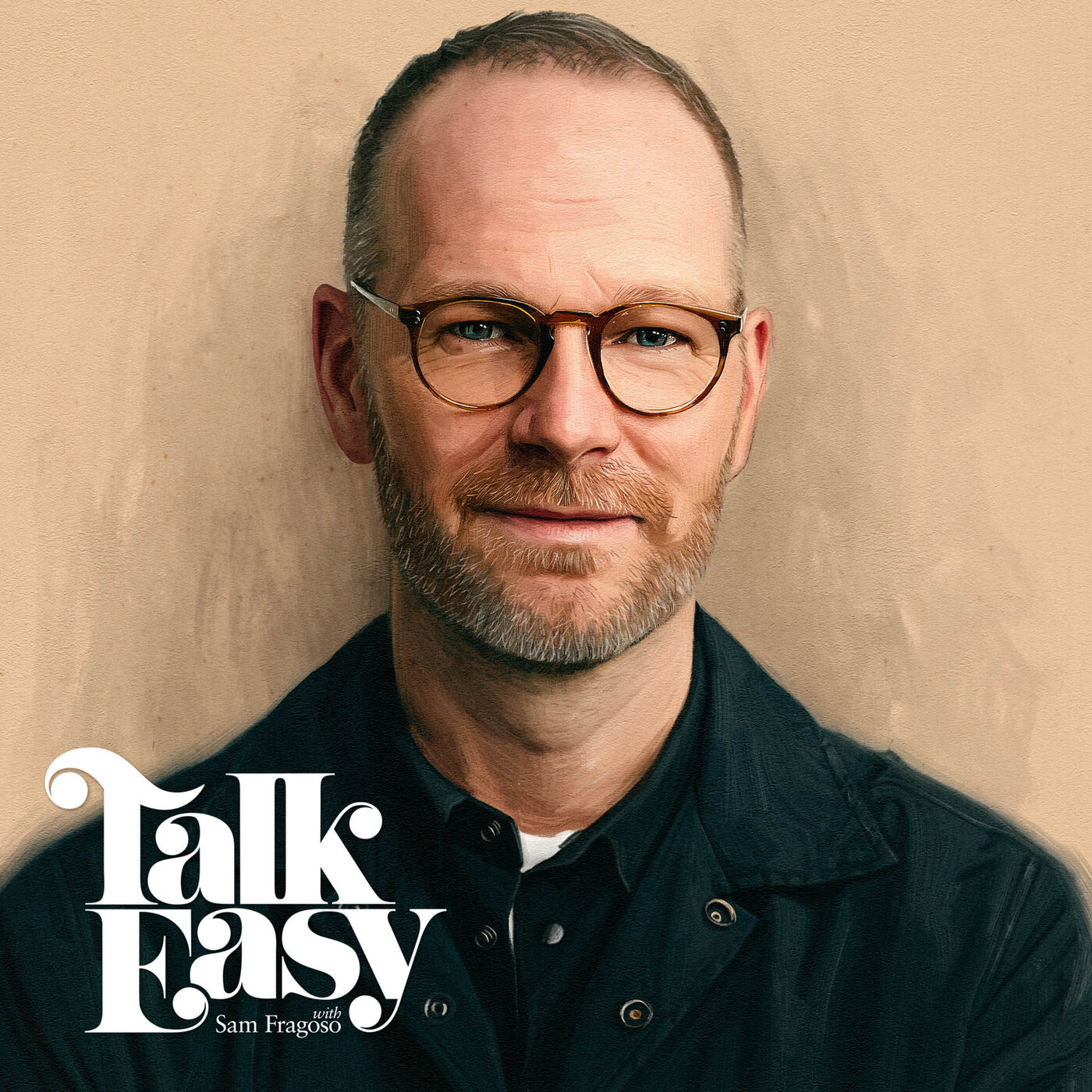
Filmmaker Joachim Trier’s ‘Sentimental’ Family Affair
63m 23s
The transcription begins with a promotional segment for Quince, highlighting its premium, affordable winter wear. The core content is an interview with filmmaker Joachim Trier on the podcast "Talk Easy." The discussion centers on Trier's latest film, "Sentimental Value," which follows a Norwegian author and filmmaker attempting to reconnect with his estranged adult daughter by offering her a lead role in his new movie. Trier explains the film explores themes of familial disconnect, reconciliation, and the tension between professional ambition and personal life. He details his collaborative writing process with Eskil Vogt, describing the initial uncertainty and pressure they felt after the success of their previous film. Trier also reflects personally on his own drive, his Norwegian cultural background which sometimes views ambition negatively, and how becoming a father has influenced his perspective on work-life balance. The conversation touches on the challenges of filmmaking, the interpretation of art, and how Trier's personal experiences inform stories about characters struggling to connect.
As the weather gets colder this new year, your winter wardrobe really has to deliver. That's why I turned to Quince. They bring together premium materials, thoughtful design, and everything quality so you can stay warm, look great, and feel your best all season long. Quince has everything you need. Winter staples like wool coats, leather, and suede outerwear. I've been wearing my Mongolian cashmere crew next sweater since I got it back in October, which is held up great and looks and feels exactly like the pieces I've owned that cost double triple the cost. That's because Quince cuts out the middlemen and traditional markups to deliver the same quality as luxury brands at a fraction of the price. I also like that they work with trusted factories that meet rigorous standards for craftsmanship and production. The result is classic styles that you love that hold up year after year. Refresh your winter wardrobe with Quince, go to Quince.com/talkeasy for free shipping on your order in 365 day returns, now available in Canada too. That's quince.com/talkeasy, free shipping, and 365 day returns. Quince.com/talkeasy. This is talkeasy, I'm Sam Fregoso, welcome to the show. Today, writer-director Jo Kim Trier. Last week we spoke with Noah Bombak about his latest film, Jay Kelly. You can imagine a pretty good double feature with Jay Kelly and Trier's latest sentimental value. Both are inside Hollywood ruminations on memory, movies, and regret, especially of the male variety. Well, actually, of the father of variety. Each movie orbits around a man who was too busy making movies to raise his daughters, and sentimental value that man is Norwegian author Gustav Borg, who attempts to reconnect with his two estranged daughters after the death of their mother, his ex-wife. Although the attempt is a little selfishly motivated, because Borg, who hasn't made a new film in decades, has a promising script to use Ready to Direct, and so in turn, he offers the lead role to his daughter, Nora, played by Renata Reinswe, who's a working actor in Oslo. When she rejects his offer for a variety of reasons, Borg casts an American movie star, played by Elle Fanning. Here's a moment from the film where Fanning's character, Rachel, wonders why Nora didn't take the part originally written for her. Why didn't you want to do the role? Do you wanted you to do it? I can't work with him. We can't really talk. My father is a very difficult person. That was from the new film, "Sentimental Value", now playing in select theaters across the country. Trier II comes from a filmmaking family of his own. His grandfather was a celebrated director, his mother made some documentaries, and his father worked as a sound designer. He grew up in a way like a Norwegian Spike Jones, a skater turned filmmaker who channeled the kinetic energy of the former into the latter. And through his six features with his longtime co-writer, Eskiel Vogt, he's built the body of work often featuring young people trying to connect and make sense of their past, sometimes than not too distant past. As Trier says early in our talk, "Nora is a very accomplished stage actor, but she has no clue how to create a sense of home or family outside of work. She realizes my god, her father is exactly the same." And so today, our very meta conversation, it's actually our second conversation on this show, is about making movies. It's also about the years between the worst person in the world and sentimental value, his evolving relationship to work-life balance, and his longtime collaboration with actor Renata Reinsvay. Speaking of him, he'll hear us allude to it a couple of times in this talk, but I sat with Renata to talk about the worst person in the world, sentimental value, her creative process, and everything that led to her kind of winding journey into movies. That's coming out on Wednesday. Until then, here is my conversation with writer-director Yokeem Trier. Welcome back to the show. Thank you. It's been, uh, apparently eight years since we did this podcast. You were episode 79, according to the archives. My goodness. And you're so young, you must have been what, 12 at the time? I think I just turned 13. Yeah. But you're still very articulate. And I'm just now 21, just started drinking. It's a big day for me. How was drinking? Um, it's good. I did it for the first time last night. How have you been? I've been good, my friend. It's interesting because I think growing up in the 80s, there was this thing about being a bit hardcore and not selling out. And to give us both a compliment at the top of this, I think we both have just done I think since last time, and we are still allowed to do it, which I think is a nice sign that the world is accepting us. I think both of us in our very different fields, but both trying to tell stories, we kind of have been doing it. And it now seems like, especially for you, I think maybe a little more so than our show. People are catching up to what you've been doing for a long time. It seems that people are still going to the movie theaters to watch my stuff, which is an honor these days, not all films are getting seen. And more people are seeing them than the early ones, which is a wonderful thing. I'm very grateful for that. I mean, your last guest, if I looked at Spotify correctly, was Salman Rushdie, so I think you're doing pretty good, my friend. I remember in our earlier conversations, and I'll be a bit meta. I'm a bit on the road at the moment. I've been releasing the film in France and in Norway in a few other countries, and now it's coming out in America. And so I've done a couple of interviews. Some have been great and some you don't really connect so much. Your thing is that I feel that you're really good at connecting to people. That's a real gift. But there's a theme there because what I'm interested in is human connection at the moment. It's what I'm interested in making movies about. I'm making a family story and sentimental value. Those people are not really connecting. But my subject matter is how this connectedness works, therefore I'm curious about connection. When you and Eskiel, when the two of you are in a room, spending your days like sharing music, talking about films, talking about your lives, was connection the thing that you two kept circling and writing this film? What was happening at the time was that we had just come off the run of "Worst Person in the World", which I must say went beyond our expectations. That film was delayed several times because of COVID. We were making it with masks on our faces and suddenly we were spat out. Main competition can. The first moment where we were all allowed to be in a cinema together again. I haven't really even test screened it. I usually do to a lot of people. I had to do groups of five times ten to get a real audience to talk to them about my edits. Suddenly I was there in the theater showing it to people for the first time. It went down pretty well and it traveled and all these things happened. We were very grateful, but we were also a bit overwhelmed. When Eskiel and I got back into the writing room after a while, how should I put it? We were not panicking, but we were having this feeling like we'll let everyone down now. So let's be hardcore and figure out what we want to talk about. You've done this now for six films and you would think, "Okay, the two of you know what you're doing, but I was reminded of this quote from Philip Roth who said, "Each time I begin a book, I don't know how to do it." There are no rules laid down for that book, there's no story, there's no rules for these people, and so each time you attack a book or it attacks you, you're looking for the voice in which to tell it. Yeah, actually I'm familiar with that quote and it's taking great comfort and the fact that really one of my favorite writers in the world, Philip Roths, even he, with one of the most prolific varied intellectually poignant, emotionally exploring careers in modern writing history, felt that way between books. Isn't that marvelous? It's amazing. Yeah. If he's going to panic, then the two of you are going to panic. Exactly. Or rather, at least it's comforting to know that some people have come out of that hole and made something. That's has value. So tell me the two of you in the hole, what does that look like? It looks like this, very, very specifically, it looks like showing up in the morning at nine o'clock. Who gets there first? I skill. It's his office. He writes his own stuff without me as well, he's a much better writer. He directs as well? He directs as well, absolutely, a wonderful director. And I have the luxury of having him co-write with me for the films that I direct. So he's there first, I come in and for this new film sentimental value, I have had two kids, two young girls since worst person in the world. So I then go, I've delivered the kids to kindergarten, as we say in Norway, a child care, which is the Norwegian government. So generously guarantees all our citizens. And I go from there and run, and sometimes I'm five, ten minutes late. I used to be a very own point, but now as a dad, it's more confusing, and I get in there, and we have a lot of coffee, and we try not to procrastinate so much that we don't use the morning energy for something productive. So when you two land on something, tell me what that first looked like. So in this case, with sentimental value, we had this small idea, like what about talking about sisters, siblings? How come people are so different, even though they grow up in the same roof? How come that you trigger your parents differently? You're born first or second or third, or like the order of things, and your parents have grown and changed. So it's not the same experience as like walking into a river. It's never the same water kind of feeling. So that was one point. And then I guess my point of mentioning that I have kids, as well as kids, like suddenly we're in the middle of life, and we are coming up with this family story where we can't only look from the sisters that are in their thirties on to the difficult relationship to a difficult father. We also, as fathers, ourselves, I guess, on some level have to take him serious. And at this point, we don't know quite what the story is. We know we have some scenes. We are starting to develop characters, but we do have Renata Reinsweigh, for sure, as one of the first aspects of faith or belief that there will be another film. And because we wanted to work with her again. So knowing that the older sister Nora has these and these issues, these things, to explore someone who's rather a bit the opposite, but yet the same as Julie in the worst person in the world. Nora is a very accomplished stage actor. She is very good at what she does, but she has no clue of how to create a sense of home or family or connection outside of her work. And then we realized, my God, her father is the same and they are so similar. And yet they don't know how to talk. That's an interesting conflict. So the father is a famous filmmaker who has a retrospective in the beginning of the film. But also a pretty strange relationship to his kids. And then sort of hatches a plot to cast his daughter in his new film, both because it will help with the funding of that film. And second, so that he could spend any kind of real time with her. You told the DGA recently, there's the movie you make and then the film you discover that you're making two weeks in the shooting. So tell me about the A and the B there. So the A is all your thematic ideas, the writing, all that stuff. B is the realization of getting all these wonderful people involved and having them, particularly the actors and cinematographer, production designer, costume, all these people are giving their personal treatment and input and showing you stuff that's better than you could imagine. But then you also have rainy days when you need sun. You have restrictions of economy and you have a difficult location owner suddenly changes their mind. You have to change locations the night before you shoot it like stuff happens. Did that happen on this one? Yeah, we had a couple of tough things there. And I think basically that the dialectic of all these compromises and all that wonderful creative input from others creates the film. And my job as director I think is to steer and try to create the best out of that. And do you think the film locked in for you? It did already in the writing room because I got to have faith. My job in the writing room is both Escal and I work on the story and the characters. But it's also deciding ultimately that this is what I want to spend three years doing. And Escal and I have never had a conflict. When he sees that thing happen when he also gets it, we're very in sync like that. But what do you mean by it, what do you think that is? That is something that we haven't resolved but that we're aiming for. That's some sort of hidden aspect of thematic treatment. I can now sit and tell you that sentimental value is about reconciliation and it's about parent child dynamics and all this stuff and I can describe it almost in a secondary nature because I've made the film and I've met an audience. But as you're making it, you're focusing on all the pieces and you don't quite know how it will all stick together. And on set is your faith in the project? Does it remain throughout or do you have those moments where you go? I cannot believe that we put all this time into this and it's not working the way I want it to. You've got to keep your eye on the ball on the details. So tell me dad, how do you do that? Especially like you said in the beginning, people really loved the last movie and does add an added layer of expectation. I think that's kind of the talent is to go add it every day with focus on each scene so that you don't fall into this remote perspective where you look at it all from above or from afar, which is just terrible because then all the evil voices in your head about all your failures and what will be like anyone who's made anything creative, I'm sure could actually if they're forced to it, make the best parody of themselves because it's what they're scared of ending up. You know what I mean? I'm sure I could do a terribly cruel parody of myself. What would that look like? With me? No, I think it would be an exaggeration of certain themes of a lot of Todd Rungrin's songs. Like Todd Rungrin, to such extent, but well, you know, that wouldn't be a parody because he's wonderful. So let's keep it to me. I don't want to make fun of Todd Rungrin. I love his music. So I think it's about like exaggeration, no interest in mortality and time passing and the melancholic. So like maybe it's a film entirely set at a graveyard. Exactly. That could be a parody or something where it breaks rather than to create something where people are interpreting it and bringing something. I try always to keep it in interpretative space for the audience. But hey, man, let's be honest, there are some naysayers out there who already felt that I'm sure every film I've done is a parody of itself. So this is life, you know, you do your best. You know, when we spoke about a decade ago, it was on the heels of your two American films and I was listening back to the tape and it was before worst person. You weren't pleased with the reception to those movies. Yeah, it was particularly one. It wasn't too. It was louder than bombs. Yeah, that one. In the tape I could hear, you were hurt by it. And the irony now is that the same paper that gave it the worst review, which I thought was a guardian at the time, not only did the same reviewer give five out of five stars to worst person in the world, but also now another journalist on that same paper has done a revival piece on louder than bombs. So it's because it's also a family story, not so thematically removed from sentimental value, even though they're quite different in other ways. I think that time will ultimately judge your work. Does reading reviews help you make movies? I don't read reviews. But you know about someone's told you. Yeah, yeah. You get your front. You meet your, you know, someone in your family and they're like, "Oh, that was a terrible one. How are you feeling?" Or you have, I have people around me who say, "Well, it's going pretty well. Relax." I must know why I'd read something, but I don't, I already know the parody on myself. I already find it hard to create something and I already have all my doubts. So I, it just, I don't know. I already know I could have done better. Coming back to this new one, in recent interview, you said in making it that you were trying to exercise something. What do you think that is or was now that you've made the film? That's a good question. I think I've grappled a lot in my life with what in the American vernacular is called the work-life balance. I've been very driven, it's another American world, isn't it? I think in my culture, if you're saying you're ambitious in Norway or have a drive, it's a negative connotation because it means that you're albowing your way forward. So it's a very Protestant culture in Norway. It shouldn't, shouldn't work too hard, shouldn't try too hard, you know. So I grew up with a bit of that shame around that. At the same time, I always really, really, really wanted to make movies since I was a kid. I really loved doing it. It was just something that if I had a hard time at some level in my childhood, I think I just did something. I break dance, I skated or I shot something with a camera. So it's always been a coping mechanism since I was very young. I mean, for context, you were a great break dancer. When you skated, you were the national champion two times over. You went to school in London, made shorts that were celebrated and played all over the world. So this feels like you're very different from the upbringing or from the culture that you raised in. Did that make you uncomfortable that your instincts were so different than the people around you? Yeah, but I always found my gang, my band. I always found that group of people who loved what I loved and that was the blessing of my life. I still feel that when I'm doing films and when I'm with a bunch of actors trying to sort out a scene, I feel very connected to the world and myself through that work. So that's the blessing part of it. But going back to your question of what if I exercised or what have become good at as an adult, which I'm very happy about is that I am now able to have a life outside of that also that's maybe more functioning. It's not like I was a complete wreck and I've had wonderful relationships. I've never had drug abuse or alcoholism. So I'm very lucky like that, but I'm also someone who has really devoted myself 120% to stuff sometimes. And it's made it hard for me to have different levels in my life of things to do or places to be. So I think that's something that this film, sentimental value is about, in a way the two sisters represent two different versions of a life. And in a way they're negotiating this, what is a good life? How do you see the two versions of the characters? I think that Nora, the older sister, has a slight contempt for the younger sister because the younger sister lives a conventional life as a mom and a wife and she has a job, but it's not super ambitious. She's an academic that's interested in history. Whereas Nora, the older sister is someone who is a great success as a stage actor and very, very driven. We seem to begin with the film that she has stage fright on top of it all, but when she gets on stage and goes over the threshold, she's really amazing. In terms of work-life balance, the father character, who we talked about earlier, Gustav Borg, has put his films before his family since forever. And it struck me, watching your movie, how infrequently men make art about work-life balance. And when they do, it's often about how genius, male genius, comes at a cost. And the cost is usually family, wives, women, their dating, etc. Why do you think that is? Well, in this case, we have both a man and a woman who has the same issues, still the daughter and the father, and there are two generations as well. Whereas she talks about psychodynamic perspectives on her life. Maybe that is also avoiding, but the father has no social language to discuss or talk about that difficulty of being that lonely man, who somehow hasn't been able to be present in the way that he now has wished. And I don't think he feels like such a genius when we come into the film. He hasn't made a film for 15 years, and I think he feels clumsy and kind of low. But his persona is of such a nature that is kind of charisma, and you know, it's a wonderful style of scars that are playing this man. But that's also why we cast him, because he's so funny and large in a life and wonderful, such a great actor. But the interesting thing is to peel off the layers and get to the vulnerability of it. So your general question is about men and genius. Yeah, no, I've seen a lot of those stories too, but I'm hoping that I'm offering something with some complexity. I think so. And it's interesting to see the daughter clearly reflected in her father and vice versa. And the interplay of that, do you remember when your mother stopped directing movies? Yes. I remember it. And I remember that my mom was sad about that at the same time. I know that she was very happy going on to becoming someone who worked in news for the Norwegian BBC. What age was that when that happened? It was during the 80s and early 90s, I believe. Okay. So you're like a teenager. Yeah. When she left it behind, you said some more like, oh, she felt like it just, it was too much time. It was too hard to do both. It's very complex why that happened to my mom where she stopped doing films. I mean, it's also, it's not quite like she stopped something and began something else. Remember, she was also doing great documentary work. She did a wonderful film about women's liberation and symbabla in Harada, which has spent a lot of time. And so she was already doing kind of documentaries that were political or oriented about subject matters of the social nature. And so to move in to news journalist, becoming a news producer, the natural pivot. I think so. But I also know that she did some fiction work and that she found it hard to be a woman in that world. I think it's the social setting of being a female director. I think it's her leanings towards journalism and an opportunity for work. And it's also about having three kids and, you know, making a living. Yeah. That's a lot stacked against many women of that era who are making a living. Yeah. When we come back, why don't we dive into a little bit of your origin story, which I believe begins in Oslo. That's coming up next with writer director Yokeem Trier. This episode is brought to you by Mooby, the global film company that champions great cinema. From iconic directors to emerging authors, there's always something new to discover. With Mooby, each and every film is hand-selected so you can explore the best of cinema. One movie that's been on my mind recently is Father, Mother, Sister, Brother, the eagerly awaited new project from Jim Jarmusch, now in US theaters. It recently won the Golden Lion for Best Film at the 2025 Menace Film Festival and it's easy to see why. It's a funny, tender, and gently moving exploration of the universal intricacies of family dynamics. The film is told as a triptych, with chapters set in New Jersey, Dublin, and Paris, each one circling the relationships between adult children, their somewhat distant parents, and each other. And the cast, well, speaks for itself, Tom Weitz, Adam Driver, Charlotte Rampling, K. Blanchett, Vicky Creeps, India Moore, and Luca Sabat. Visit Mooby.com/fmsb for showtimes and tickets. In the stream, great films at home, you can try Mooby Free for 30 days at Mooby.com/talkeasy. That's MoobyMUBI.com/talkeasy for a whole month of great cinema for free. Growing up in Oslo in the '70s and '80s, and a family that made films, and your mom made work, your grandfather made work, your father, I think, did a lot of work in sound. Absolutely. Did your fascination with memory and permanence, did it coincide with your love of recording snippets of your family on the super eight-millimeter camera? I think so. Looking back, it must have, to quote, "care to guard." You can only understand life backwards, but you have to live it forwards, along those lines. I remember, since you asked, that I was a child already at the age of 3, 4, 5, that was very interested in the idea of memory, and I learned to use a tape recorder to record sounds, and I filmed super eight at the same time, so it's a little bit what came first. I know that I was geared towards that, and I see now that I was interested in reporting. I remember I was a kid who actually, once when my parents were arguing, I recorded them secretly on a tape recorder, because one day I would use that for something I thought, and the tape was lost, and it was all forgotten, but I can tell you about it still. I mean, I cared about recording and keeping things, and I also, at the time, as a child, my mother was young, so there was a lot of the older people, my great grandparents, were around, and my grandfather and Denmark passed away, and they passed away, and there was all this, like, where did they go, and all that stuff, and I was brought up in an atheist home. So of course, as a kid, you ask what happens to those who aren't here anymore, and all that stuff, and that at the same time as you're learning to grab onto things with a still camera, with a super eight camera, early video cameras, and tape recorder, suddenly all that comes into play. What was on the tape? The argument? I can't remember. It was just probably as stupid as if I'm having an argument with my wife now, where you look at each other and you say, "Why are we arguing about a dishwasher thing?" Because it's never really about the dishwasher thing. It's always about something else, and that's something that you could use when telling stories in cinema. How do you talk about what they don't talk about while they're talking about it? But what I'm interested in in this film, Sentimental Value, is transference, all the stuff that we transfer to our kids or parents, and even our grandparents affect us with without it ever being spoken or articulated. That space of the non-spoken in close relationships interests me a lot. And I think ultimately that's what the film is about, is that that space of the non-spoken of the father's world, for example, those places he did not meet or see his daughter has a possibility for some sense of a meeting in the creative work that he does. And I think that, therefore, there is a connection between trauma and the sublime. Let's say more on that. So there is a connection between the inexplicable, unrepresented trauma, the things that hurt you in that area of your identity or your relationships or your history. I mean, in your case, your grandfather, who I mentioned earlier, was in World War II. And he came back, as you said, traumatizing and made work as a survival mechanism. I think so. I think playing jazz and making movies made him able to live and exist and have a place to be. And I've talked into a lot of people who are creative. And someone who articulates this very well as a friend of mine, Carl Lovick Nalskard, who wrote the wonderful My Struggle series of novels, for example. And he says to write is a place to be. And he doesn't talk about the intention or the result. He talks about the process. And I think that is interesting to me. So that's the trauma and the sublime. It sounds like big words. But my point, I guess, is that there is a relationship between the unspokenness of an emotional pain or difficulty or grief or woundedness, but there's also a possibility of saying something that can have a sense of beauty or purpose in another language, which is not spoken either. So there's an era in our life and our identity that we're continually dealing with that has possibilities for many things. We're always thinking that words will solve everything and maybe they don't. But do you think writing is also a place to hide? Is any form of communication, it could be a meeting or it could be an avoidance? You feel like some people you meet, they talk a lot and you feel that they share and other people that talk a lot, you feel that they're avoiding. And it's not about the talking in itself. It's about what is being conveyed and what's happening for real, what is really going on. And I think of course it is. And I think in this film and sentimental value, you see how this clumsy and difficult father has probably avoided a lot of things because he seems like he has a purpose on set where people value him. I heard that in auditions, when you try to cast people, you sometimes ask actors to name one cultural artifact that they love and describe what it means to them. Can you show me something that would be your cultural artifact and you describe it? Yeah, yeah, of course. This was a specific task I gave the boys that I tried to cast for a reprise. They're a bunch of friends and I needed to see that they could convey enthusiasm. They're smiling as I brought this up. Yeah, yeah, no, no, it's sweet. I haven't thought about it for a long time. So from my childhood, I think a big break away from great music that I still love like The Beatles and Stevie Wonder and Brazilian jazz and jazz music, all the stuff for my parents' music. And I heard Planet Rock by Africa Bambata, which was bought in a record store in Copenhagen that I was in during the summer holiday and they had called the record stores then we did in Oslo where I spent most of my year, something happened. The 808 drum machine, the way that it had synth sounds I hadn't heard before, the way that it seemed cut up and messy and hard and yet beautiful and you could move to it. And it had a groove even though it was kind of cold and then getting into that hip-hop of the early 80s, which was really like electronic hip-hop, you know, that was something that meant to change me. Your obsession with music comes across I think in each of the projects and I was wondering music aside, how do you think being a skater affected your filmmaking? For kind of, you were national champ two times over some of my time? Yeah, yeah, yeah, it was. I was my life and you broke your arm and they healed and you got up again. So you learned how to remember when we healed quickly? Yeah. I had a really, really bad ski injury about six, seven years ago and it healed but it took a year to learn to walk again and everything but it did after five operations stuff. So my point is just, it's an optimistic story. It's that you can heal. It's okay. Don't worry. You're a very young man. Don't worry about it. Yeah. So back to skating. How did it affect me? It all comes back to healing with you. Now it does. I don't think, when we spoke about Oslo August 31st, that was a real tragic story. That wasn't about healing. Yeah, you weren't, I don't think you were healed yet. Maybe not. Do you feel that in your interviews with people? Is that your talent, Sam? Is that that you feel the vibe of people? I'm a little bit shocked about your observations of me not being super happy talking about a lot of the bumps and being hurt by that. That you remember and that you felt that, that's interesting. Yeah, I felt it because you were a pained and I remembered it because it was meaningful to you. And that's in psychodynamic terms, what they call transference. That's what we're talking about and that comes into also how a director works with actors. Tell me about that. I sit next to the camera and I believe that if I look with my own eyes and not through a monitor in the back of the room, all the actors in a recent New Yorker profile that came out said he does not look at the monitor and he's interested in what you do not say. Yeah, no, but I think that's the magic of movies is that the camera sees the behavioural detailing and the emotional state of people in a very intimate way, possibly if that's what you're interested in films to be about other things, but that's what I'm very interested in. So I got to sit next to the camera and try to get away from my restlessness, which I then do because it's such a big deal to make a movie. So I'm more present than almost any other moment in my life except for me when I'm with my kids. It's so important. It's so dear and I believe that if you look and sit with them, the camera will feel the same thing. The audience will potentially feel that thing going on. So the only way to judge it and to support them and to stimulate the performance going different interesting places, not that they always need that. Great actress like these can figure out a lot without me getting in the way, but at least I'm there to monitor what do we got? What can I use? So the goal is for your gaze to sync up with the gaze of the camera, to get as close to it as possible, what your vision, what you see in that moment, things that make them special, to line that up as closely as possible with whatever is captured and refracted through these cameras. Yeah. And I have all that kind of understanding that things can be manipulated and structured and form is such an important aspect to create emotional that, but the raw material of these emotional events that the actress create in themselves because they're good, the discoveries, the unexpectedness, the messiness, that stuff, I need to be attentive to because that's the most interesting material. And it's wonderfully liberating. I mean, again, it's a big meal to be direct to you. You get lots of different things. It's fascinating because yes, I have the anxiety. You talk to me like, "Oh, it's going to be good. You're writing. You feel that you've got nothing. You've got to build a different scratch every time." But actually shooting is really enjoyable because you are present, beat by beats, shot by shots moment by moment. That approach also seems to be combating this restlessness in you. Yes. It's a way of focusing. And your wife said recently in regards to you being a skater. She said, "Being a skater, you're moving around in the city and finding places where you can do your tricks." So it's an incredible way of getting to know a city. That kind of relationship to place has played a major role in how he treats Oslo as a character. That's something that almost has a skin. Yeah, that's a beautiful state by my wife, Helen. I think she's on to something, because I as a skater, no, but it's interesting. God, this woman, this wife, I guess I should marry her. She seems really smart. She's fantastic. I think that you seem almost surprised. No, no. When you read it like that in English, she says amazing, beautiful things to me every day. So I'm not surprised by that, but when you're close to someone, and the most romantic thing is when they observe something in you, that you haven't really discussed in detail. It's not like I've told her, "Hey, listen, I wasn't skater." And this is why I'm like, "This is something that she's observed." So anyway, to get to her point about the skin, which is an interesting metaphor, I find that I got to know a handrail and a staircase and a piece of asphalt and some a bank up towards the walls. You could try to ride that wall with your skateboard. Those details, your wheels are small on the skateboard and they're hard. And if the surface doesn't have the right transitions, you can't really use, you know, you can see the most beautiful staircase you want to jump down and do a 360 flip. But there's some weird bricks in front of it that makes it impossible to all the, unless you pop your alley like, you know, three feet before the staircase and then it gets too long. And all this stuff you notice is skater immediately. So you know the material. And I think for movies, texture and tactility and all that stuff matters, too. Speaking of tactility, when you're 19 years old on a Norwegian quiz show, "Pull and Cables," is this where you meet your co-writer and lifelong best friend? I skill. And what happens? So what happens is it's called all or nothing or something like that. You might have had it in the U.S. as well. You come there to the game show with a subject. So you know Greek mythology or you know Walt Disney. You know, if I had been, I would go there and talk about Stanley Kubrick or something. Okay. The films of Paul Thomas Attenham. Oh, I would love that. So we were sitting in a green room with grown men wearing Mickey Mouse ties crying because they got kicked out of the game show on the last question or something, right? And Eskil is behind another camera. I'm behind one. It's live TV. And there's suddenly this break before we go on live. And I noticed, yeah, there's the new guy. And he has Doc Mardin's and Black Jeans and you know, long, beautiful curly hair. And he looked kind of cool. He looked more grungy. I was a skater. And then we start talking. It turns out we both film geeks. We love movies. We even, you know, oh, wow. You saw that Takishikita no Japanese gangster movies on a teen at the festival last year. There were only four of us in the room. Jesus. Really? That was you. You know, so we became friends like that. And when do you figure out that the two of you are meant to write together? That's panic. That's me doing a short film. I worked all summer to make enough money to buy over some roles of 16 back in the day if you did a film then. This was like the mid 90s. You had to like shoot on 16. That's a real film. And I got some friends to get. I borrowed a camera. I got a DP that had done some films and been an assistant and so forth. But I needed like some structure to the whole thing. And I remember Esko and I sitting down and he helped me create kind of a mixture between a storyboard and a screenplay. And then when I went to National Film School a few years later and I couldn't connect with any of the people writing there, I went home for Christmas and I said, I have two weeks. You want to help me make a short film script? And I'll try to get the school to have that script being made as my next film. And we did that. So as we talk about the six films, the two of you have made. What do you think he brings to the equation? And what do you think you bring to the equation? Because you both must have something that the other is not totally doing themselves. Many things Esko is extremely, how do you say like in a computer, you have a RAM power like the capacity to hold a lot of things at once? Encyclopedic maybe? Yeah, but it's not even about wisdom and knowledge. He has that too. He's very encyclopedic, but he can hold live information there and then to an tremendous extent in his brain. Right. The story of it all. The ideas of the detailing and the word and that line of dialogue and that structural implication if we change this and that and he has a real ability for that. And he's also funny and creative and we open up to each other. I think the clue is at the beginning, it was clear that he was a better writer than me. And I'm somehow dyslexic. I do wrong spelling, but I kind of write something about a spell check a lot and I have low self-esteem and I'm a restless guy. And Esko is like, okay, he can do an academic dissertation that's perfect. He's really a good writer. But beyond that, I think we really connect over our fascination for movies and that we trust each other. All right. I'm going to take one more break and when we come back, we'll talk about everything that that trust produced between the two of you, which I believe are these six films. We'll be right back with "Yo Came Dre." With these movies, when you and I scale right, you said that you approached the film in total, like it's an album and the scenes are individual songs. So when it comes to Oslo, August 31st, how would you describe the album? It's an album that's pretty focused on one sonic universe. It's a single story of one man and the idea of the album is more about set pieces that I think if you're interested in plot, you use a lot of scenes to transport the plot. But if you're interested in more like character or moments, movements, as we are, then very often you try to push story forward through how people engage with the individual scenes. So for example, in Oslo, August 31st, there's the event of someone trying to drown themselves and he doesn't know how to. And then there's a contrast event of him being in group therapy and pretending everything is great. And then there's a long conversation with a friend where he opens up, but we know more than he's saying. So we see that there's a conflict inside of him and then he goes to a cafe and we know now that he's considering killing himself and he's listening to normal people talking in a cafe environment when they're talking about there every day and he's completely disconnected from it. And he's always longing for the boredom of the trivial, normal scene that he's incapable of living in. So all of those pieces are bits you think when you make the film ideal that people want to be interested in that bit, that scene, that moment, rather than, for example, thinking that we need to play a series of dialogue scenes where there's like an entry, attorney point and then an exit that enters a new one. I do some of that too. We love dialogues and stuff, but there's more about trying to find these moments that like worse person in the world. Suddenly they've run around and the time is frozen like, or they're sending loud on the bombs. There's all these essays. A young boy of 16 is in love with the girl in his class and she reads aloud from a book and suddenly her voice turns into a voiceover of a sequence of him imagining how his mother really died. So that's almost a set piece like in an action movie. Yeah. And both of those, the cafe sequence and Oslo August 31st and the essayistic imagining how the young boy lost his mother, there's an interplay that you're working with in a really fascinating way. But in both cases, it's two characters who do not have their own language. They actually need the language of other people to help them understand their own lives. Yes. But isn't that how it is? We need each other. We need the other. We need to listen. We can't do it alone. And speaking about dyslexia, one thing I know is that I love working with other people and that's been the blessing of my life and my career is that I've been allowed to work with really, really great people that where I lose that sense of separation from what we're doing because we're doing it together. The emphasis you have on connection, that seems to be the thing that is on your mind the most, at least in this conversation today and in this new movie, because when you're making Oslo, the thing that people keep asking you about is like, in Oslo, louder than bombs, this one. There's a lot of conversation about suicidal ideation that comes up again and again. I have to say, having spoken to you now for, I think it's been 12 years of my life or something like that, you do not strike me as someone that that would come into play for. And I know you lost a lot of friends in that punk rock scene, the heroine and all that. We've talked about that. But that is something you keep coming back to, it seems. Yeah, I do. Is there something you're trying to figure out or something you're trying to hold in these movies with that? I think there are different things for different films. Yes, I have that experience of having seen that happen. I think that is also an existential thing, but it's not only that. I think it's a negotiation in one case about mortality. I think it could also be an existential questioning of the ultimate act of choosing yourself away from what you're offered. It could be the ultimate feeling of disconnectiness. Like in Oslo, August 31st, for example, I also think it's a story of deep shame and someone like Andrews' character in that film, he's dealing with kind of a double shame. Not only is he not functioning and doesn't know how to figure his life out, but also in the context of the Norwegian cultural middle class where you're being offered so many great solutions and everyone wants you well and you're privileged yet you have this kind of spiritual sense that you don't know where to place yourself. I think in sentimental value, it's a very specific sense of post-war grief that has that implication on the family story without revealing too much to those who haven't seen it, but it's dealing with the ultimate act of separation and loneliness in a story about that exact theme, that we learn about how historical grief travels through generations. And I know in Norway, for example, how many, many families are terribly affected still by the Second World War and when you were brought up, like in my generation and your third generation after the war, you think, "Oh, that's happened so long ago." And then you realize that your parents grew up in a time when everyone went a bit stiff upper lip and let's move forward and let's embrace the material values of the 50s and early 60s of building a new society and let's not talk about the past and all that stuff, which is very complicated. I think ultimately, this is a part of stories in different ways, but there is a recurring theme, you're right. The way you're describing it is probably the reason I fell in love with your work when I was a teenager, your hyper-focus on time passing and that it is running out. You're talking about characters with suicidal ideation, but it's as much about that as it is, I think about you at five years old on that bike, remembering, "I want to remember this." Yeah, and cleaning to life. When you hold that memory, what does it look like? It's hyper-present, it's hyper-aware of the here and now in a subit, the almost sensuous experience of being there and then that I think we all possibly had as children as you're discovering the self away from the others. There's a mixture of separation anxiety, but there's also a great joy of identity and autonomy that starts arriving, which is at the core of our sense of self, but the idea of separation also plays into the idea of separation from your parents out of view and the disappearance of them. Yeah, but but also the sense of being and not being, which is, I mean, all art through the times has been about, you know, aerosontanatosis, about the sense of mortality or the sense of the erotic or the joy of togetherness. In this new film, there's a monologue that comes up a couple times, and the first time it's performed by L-fanning, and the second time it's sort of experienced, I think, by. Right off the run. Yeah, exactly. And I was thinking I would like for us to hold it here if you're open to it. You mean to read the text? This is the monologue. You know, I don't believe in God at all. We came from a home where all that was irrelevant. We weren't baptized, my sister and I had a civil confirmation, just for the money. Then I had this kind of crisis. I was alone in the house again, lying in bed crying. I know everyone lies in bed crying at some point, but someone said praying isn't really talking to God. It's acknowledging this pair to throw yourself on the ground because that's all you can do. Nothing like heartbreak thinking, "Call me, please forgive me, please take me back." There it was. I drooled everything. I was alone and crying, and then for the first time I sat down on the floor and prayed. I don't know who I said it to, but I said it out loud, "Help me. I can't do this. I can't do it alone. I want a home. I want a home." It means different things to different people, I think, in the film. I think this monologue is about the transcendence of the subject into understanding that you need the others. In the movie, it's an important piece, and how it plays is very special. But I think, for the sake of our conversation, how does it play to you? I think, for me, it's one of the climactic aspects of the film when we understand that the father is trying to see his daughter in an honest light, which cannot only be about seeing her as another, but he sees himself in her, which is his way of creation, his way of being a director. So he offers her this part. And I think this is written from an honest, placed in Gustav, where he also realizes something deep about his daughter. It's funny because we're having a meta conversation about a filmmaker and a film that you directed but is not like you at all, but that you put a lot of yourself into, but isn't you, but as parts of you, and it's what makes the interplay so interesting. Thank you, my, my shy, forgive me, maybe neurotic, nervousness about talking so detailed about it. It's just that I, I ultimately want people to forget me and see the film, and I want them to feel that we have put these things into play in a movie where they can bring themselves into it. I agree. But I think that you're on to something about connectedness and disconnectionness, and this monologue is about that. I remember doing a lot of research for Oslo, August 31 about what you in AA and NA called bottoming out when people really reach that point of understanding that you cannot do it alone, when you connect to the need of the other. And whether you take that into a existential philosophical sense, being for the other sucked, you know, or whether it's just a simple thing that we've all felt at times of despair that we are primed to be in groups or in connection, and the big, big, big, big complication is shame. And it's not getting diminished by social media as about isolation and loneliness. It's a huge theme. I know very few people who don't have that as a theme at some point in their life. It seems to be the dominant theme in our day to day at this point. And what are those mechanisms and modes of language and modes of communication? And how do they feed back to us about our connection to the other? That's a big subject at the moment I feel. So to bring it back to this film, you know, when you shot Oslo, August 31, I remember you telling me that Anders Donnellson Lee, who's in this new film as well, was so distraught during the shoot that it was terrible for him. It was terrible for his girlfriend at the time. It was terrible for everyone in his life. And it took him months to recover afterward. I'm thinking now about this new movie, what was Renata's experience in making sentimental value when you get to the end of it? Can you play that day for us? I think you should ask her about taking on this role. But my observations were that, first of all, it's written for her and we know each other very well. And there's both that personal idea that she would understand Nora without being Nora. She can do despair and drama, but she also has this levity. And the character of Nora, that dynamic, became very interesting. But I remember on the last day of shoots, I always went when actors leave set for the last day. I do speech in front of everyone and thank them and say something about what it meant to me to work with them because I'm genuinely grateful and it's a wonderful thing to send them off within applause from the team and some joy, you know. And the final day I had both Inga, Ips, Toto Lilo, so plays the younger sister. Her head's still in Scar Score who plays the dad and the older sister and not the Ryan Sway to thank off one after the other. And I remember to Renata, I said, thank you for being Nora or for caring Nora. And I said, that's what you get how to translate that you that you could handle being her that you took that upon you as a task because she's really heavy to carry. Grapple with. Grapple. Thank you for grappling with Nora or something would be the best translation I can come up with. So it's on so much better in your language, but the point was just that she, she said, yeah, I'm so happy that I can let her go now. And I think we both teared up a bit there. It was very, very emotional and but it was a valuable and wonderful thing to do that together I think for both of us. I'm curious what she tells you. We're going to talk about it on Wednesday's episode before we go, I have two or three more things for us to bring it back to your wife. She said in the New Yorker that you were, quote, endlessly fascinated by other people's psychology, quote, penetrating the top layer of big emotions and trying to understand why people are the way they are. That is a constant conversation at our home and with our friends. Aren't we all to some extent? I mean, it is intriguing. It is deeply interesting to ask all the fundamental, what's the meaning of it all? Why are we like this? And why is psychology teaching us that life feels more like a Greek myth that you have the gods against you and I don't believe in God? And hey, you know what? Maybe it's me. Maybe it's me destroying my own life or something. You know, all those discoveries we do as you grow up of those things and how does that play into individual experiences? I'm always interested in the specific. I think everyone who's creating something is interested in the specific. Well, in speaking of specific, you've said sentimental value is you going acoustic instead of electric? Did I say that? What? You're so well researched, you're throwing up all these weird things, I've said. Yeah. I think I know where that comes from. I think it comes from the idea that I wanted there to be less of a filter and more of a presence of intimacy between the camera and the actors and the formal structure of the film. Therefore, contrast that a bit by making it quite elliptical and fragment in the first half so that the form puts a little bit of lime in the sauce. You know, so it doesn't all become this identification and intimacy all the time. It actually jumps out into objective mode sometimes. And we see pieces of the films of Gustav. We see an essay about the house like we tried to create a bigger thematic scope to the story around the characters so that we can go really, really close to them when we want to. So there's a dynamic to it. A contrast. So the thing that the film keeps getting at and the thing I think that we keep circling in this conversation is the work life balance conversation of it all. Where are you at on that? I'm really enjoying doing other things to making movies as well. And that's great and I am prioritizing that very highly both during the shoot but also now that I am doing these, I came in here on their plane late last night and I'm leaving in not so many days I'm doing these little trips so I can stay at home a lot and I think that's a great joy. And also at the moment I'm interested in stories from life. So it's not as if I'm hindered in any way and creatively by being in my own life. Have you seen the new documentary about Martin Scorsese? Yeah. I just finished it a couple days ago. There's a moment in it that really stuck with me and I feel like there's something in it that's in sentiment of value as well in a big way. But Scorsese, you know, he has a few kids and one of the daughters that he had early very clearly is said in the documentary has a very different relationship with her father than the youngest Francesca does. And she says something like, you know, my dad wasn't around a lot and she said the only time I felt really seen by him and this ties into sentiment of value is when he asked me to be in his film, I think it was the age of innocence and she goes on to explain that like for the few days that she was on the set with the focused attention of a director trying to get something out of her performer. She felt seen cared for and she reveled in that glow of her father slash director. And I get the sense that as a third generation filmmaker, you know, it's two daughters of his own, that that has been on your mind. Absolutely. It's taking me a long time to create a family and for many reasons, but obviously also to want to be present in myself in a way where I was able to be present as a father. And that's, you know, it's hard to sit and talk in public like this because this is also public about trying to be a good father. But I'm very attentive to what you're bringing up in my life. And I think that there are some occupational hazards to being a director, which are about your unconscious manipulations of your surroundings and your self imposed importance through the fact that everyone needs you at work and how you portion and structure that becomes very important to be something outside of that job. And that's been an important thing in my life to try to work on and achieve. So I think you're right to be very personal here at the end. This film is personal for that reason, not because I'm telling you a biographical story, but I'm thematically, as you're pointing out, I think you're making a good point. I'm thematically showing different variations on a theme of trying to find a place for the art and a place for the life outside of it in a family home, the home. Yeah. Did you take from that documentary so much? It gave shape and language to an admiration I felt since I was very young for Martin Scorsese's work. I told him this when I met him once, and I was fortunate enough to meet him. And I said that you are the bridge to film history for all of us in a way, because he's of his knowledge, his preservation of cinema, literally watching out for old movies so they don't disappear, but also conveying them through in subtle ways through his own cinema. But to me, watching that documentary, I felt that I saw someone who opened up and was vulnerable and honest in a very particular way about what it takes to have that creative life that he's had. And I think it was a generous documentary. I felt like I had learned something I had in insights. My last question on the subject of Martin Scorsese, to bring us back to the beginning of this episode, you and Esco, in that realm. One of the films you do return to, I've heard, is Goodfillis, and the two of you batted around and talk about the influence of that film and the impact it's had on both of you. But also it feels, I think, sort of aspirational. Like how do we make something that's even one penthouse good is that. And so as we leave, I'm curious what is it about movies now at this age, Father Two, that brings you back to that room at 903 in the morning. I think one thing I'm glad is that I was allowed to make films that felt honest to me at the time I made them. I never made films for anyone else than who I imagined to be a friend out there in the cinema darkness, someone that I spoke honestly with through a form that I grew up admiring. And that's it. Like honesty sounds maybe cheesy, but to me honesty just means that you have a musical, a thematic, a human connection to the movements of the camera, the gaze, what you look at, who you look at, how you look at, you know, there's something about that. And I think to end with a bit of praise for Martin Scorsese, it's the reason some of his films, like for example, Goodfillis has been so important. I think not only to me, but to my whole generation and future generation of filmmakers, it's the freedom of it, the feeling that as a band he's doing almost sonically, the vibe of it, the movements of it, the whole coke sequence, you know, towards the end before Henry Hill gets arrested, that whole section, all the music that comes into the movements, all the shots, all the, and stir the sauce, stir the pasta sauce. When I saw one battle after another and a whole chase sequence of Leonardo DiCaprio, when he goes into the sensei and it's trace around, it ends with a taser, I just lend over to Escal, he was sitting next to me, and I adore that film, and I just said to him, stir the sauce, and he looks at me and he nodded, and said, that's the sequence, God damn it, you know, like I can see how Paul is doing that inspiration as well, that of being the film, like you feel it's almost physical, the gaze, the movement, the whole vibe of it is like someone holding a guitar, you feel that they're not doing it for the grownups, they're not doing it right, they're doing it their way, their style, and that's what I love about movies. And I feel in my own strange and a reason way I've been allowed to do things in my style, and I look up to people like Paul Thomas Anderson, Martin Scorsese, that even in the context of even more commercial pressure manages to bring the form to that personal place. It's like someone standing next to the camera. You feel that these guys, they are the camera, we're looking at what they want us to look at. I know, last time we spoke, it was, I guess, eight years ago we did this, and may you continue staring the pot because this film is really, really special. Oh, thank you. You came true, thank you very much. Thank you, Sam. Wow. Is that okay? Thank you for a good 12 point friends. [Music] And that's our show. If you enjoyed today's episode with Gil Keam Trier, be sure to share the program on social media, tag us @talkeasypod, I want to give a special thanks to speak to Brooke Bloomberg and the team at Sunshine Sacks, I also want to thank Neon, Adam McKay, HyperObject, and our guest, Yo Keam Trier. His new film, Sentimental Value, is now playing in select theaters across the country. For more episodes with other great filmmakers, I'd recommend Noah Bombak, Richard Link later, and Lulu Wong. To hear those and more, Lemonada Podcast, listen on Apple, Spotify, whatever you like to listen. You can also subscribe to Lemonada Premium for exclusive bonus content and ad-free listening. Just hit subscribe on Apple, or head to lemonadapremium.com. TalkEasy is produced by Caroline Reebok. Our executive producer is Janik Subravo. Today's talk was edited by Finn Nallan and Corey Etad, it was mixed by Andrew Vastola. He was engineered by Nick Hines out of HyperObject Industries in Los Angeles, California. Video is by Red and Green Gaskell, and Alex Leo Garcia. Our music is by Dylan Peck, our illustrations, or by Krish Hashanami. Photographs today come from Ethan Newmeyer, with research assistants from Callie Seringus. This episode was made in partnership with the good people at Lemonada Media, and I'm San Francisco. Thank you again for listening to TalkEasy, I'll see you back here on Wednesday for the second part of the two-part sentimental value series with the lead actress of the film. We're not a Ryan's Bay, until then happy holidays to you and yours, and stay safe and so long.
Podcast Summary
Key Points:
The speaker promotes Quince, a brand offering affordable, high-quality winter apparel by eliminating middlemen and markups.
The main content is an interview with writer-director Joachim Trier about his film "Sentimental Value," which explores themes of family, connection, and work-life balance through a story of a filmmaker reconnecting with his estranged daughter.
Trier discusses his collaborative writing process with Eskil Vogt, the pressure following the success of "The Worst Person in the World," and his personal reflections on ambition, creativity, and fatherhood.
Summary:
The transcription begins with a promotional segment for Quince, highlighting its premium, affordable winter wear. " The discussion centers on Trier's latest film, "Sentimental Value," which follows a Norwegian author and filmmaker attempting to reconnect with his estranged adult daughter by offering her a lead role in his new movie. Trier explains the film explores themes of familial disconnect, reconciliation, and the tension between professional ambition and personal life.
He details his collaborative writing process with Eskil Vogt, describing the initial uncertainty and pressure they felt after the success of their previous film. Trier also reflects personally on his own drive, his Norwegian cultural background which sometimes views ambition negatively, and how becoming a father has influenced his perspective on work-life balance. The conversation touches on the challenges of filmmaking, the interpretation of art, and how Trier's personal experiences inform stories about characters struggling to connect.
FAQs
Quince is a brand that provides premium winter wardrobe essentials like wool coats, leather outerwear, and cashmere sweaters at affordable prices by cutting out middlemen and traditional markups.
Quince works with trusted factories that meet rigorous craftsmanship standards and eliminates intermediaries, allowing them to deliver luxury-quality items at a fraction of the cost.
It's a film about a Norwegian author, Gustav Borg, who attempts to reconnect with his estranged daughters after their mother's death, partly motivated by wanting to cast one daughter in his new movie.
Jo Kim Trier is a writer-director from a filmmaking family; his grandfather was a celebrated director, his mother made documentaries, and his father worked as a sound designer.
His films often focus on young people trying to connect and make sense of their past, as well as themes like memory, regret, and family dynamics, particularly parent-child relationships.
They start with thematic ideas and characters, often drawing from personal experiences like fatherhood, and work collaboratively in a writing room, focusing on daily productivity and creative synergy.
Chat with AI
Loading...
Pro features
Go deeper with this episode
Unlock creator-grade tools that turn any transcript into show notes and subtitle files.
 PodcastTranscript AI