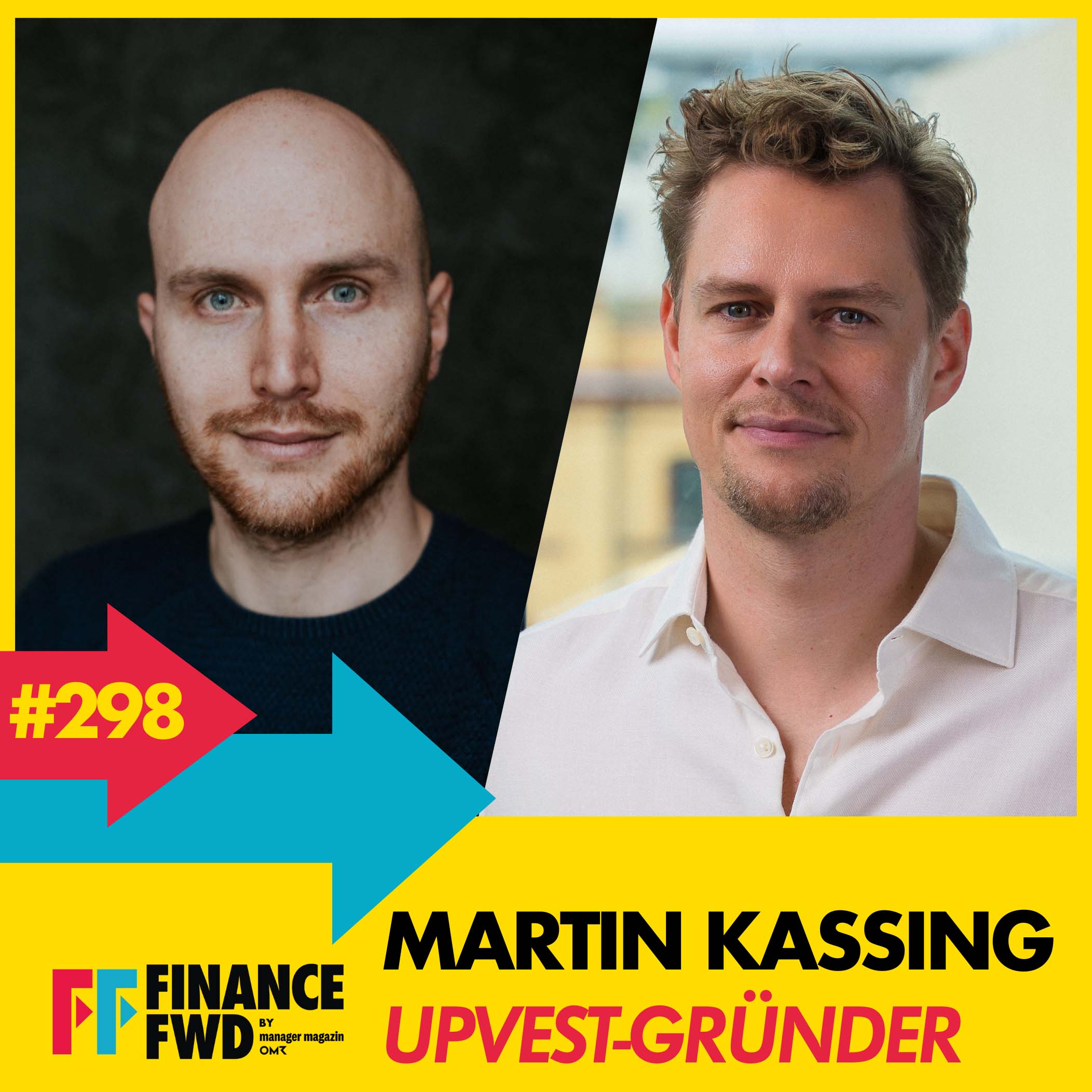
In a recent podcast, Martin Kassen, the founder of Abwes, highlighted the success of the company in the German fintech scene. Abwes acts as an infrastructure provider for prominent investment companies and emphasizes scalability, sustainable infrastructure, and high service quality to serve large banks and financial institutions efficiently. By focusing on offering a wide range of products, maintaining customer satisfaction through quarterly reviews, and ensuring transparency during incidents, Abwes has managed to differentiate itself in the market. The company's strategic planning involves rejecting customers that do not align with their long-term goals and ensuring that they are always prepared for market fluctuations and unexpected events. Abwes's approach has led to substantial growth, with over 30 partners and a significant impact on the European investment landscape.
Transcription
6736 Words, 38137 Characters
Hello and welcome to a new episode of Finance Forward.
My name is Kasper Schlenk and I am a director at Manager Magazine.
I have spoken to the founder Martin Kassen for this podcast edition.
Martin belongs to the big hopes of the German fintech scene with Abwes.
He is the investment partner of Neobank and Revolute in 2016 or RAISEN.
At the moment, the company has won a big deal with the DirectBank DKB.
How the business model of Abwes works in the background, how the prominent companies can win
and why Revolute and Trade Republic are currently working on the banking market.
I have spoken to Martin in the podcast about this. Have fun with it.
Hello Martin, welcome to Finance Forward.
Hi Kasper, nice to see you and to hear you.
Martin, you are a trading provider in the background of Neobank, for example, like Antoinistics, Revolute or investment providers like RAISEN.
Right now you are reading a lot of news, AI blase here, somehow it's a lot going on in the capital markets.
Does this actually work for you as well? What happens in the background?
There are various elements, maybe very briefly about Abwes.
There are leading investment providers, investment infrastructure for Neobank, Neobroker and also for estate developers.
And of course we see a large demand on the one hand that many banks and brokers want to modernize their investment business now to be competitive.
On the other hand, we also see very volatile markets.
Because of all the rates of Donald Trump, they go up to five to ten times as high in our order volume as originally thought.
Of course they are prepared for this.
And of course we have to deal with this as infrastructure providers very well.
Okay, and then sometimes you have a critical phase, you have a meeting in the morning and look, okay, what's happening now?
Are you preparing for this situation a bit?
Yes, so the infrastructure has to be built beforehand so that you can prognostize these elasticities.
That means that if the market goes up to five to ten times, then the systems must be prepared beforehand so that you can carry out this.
And we often do stress tests and scenario analysis so that we can see that our infrastructure can handle this.
Internally, we always calculate with 20 to 30x for the following month and look at one side technically so that it can be carried out.
On the other hand, we also look at the partners so that they can carry out this, so the various bursts.
So far, nothing has gone wrong.
So far, nothing has gone wrong.
We are now with a total of 120 million trades this year.
So already quite large.
I would certainly call ourselves more than a startup, but rather than really important infrastructure in our market.
And I think a good example was the February.
Many competitors and other infrastructure providers could not carry out.
We were able to carry out the volume according to the tariff announcement by Donald Trump on the day and also prove that our infrastructure is scalable and sustainable.
You have just said that you have grown very quickly in the last few years, just to get a feeling of how big you are now.
Yes, I find that very exciting.
We once talked about Corona, I think it was 2020, we were around 50 employees.
We are now almost 300.
We have about 120 million trades that we carry out this year, 20 billion trading volume and about 30 customers that we operate.
And these are over 20 markets in Europe and also in Great Britain.
We have grown very strongly and the amazing and the good thing about it is that we actually went live in 2022 after getting the licenses and have doubled or doubled our business every year.
How did that work?
There are competitors, DVP, FNZ, Lemon Markets were sold.
I think that shouldn't have been such a big exit.
How do you differentiate yourself in the market?
How do you win the contracts?
I think that we are an API product first company.
That means for us it was always extremely important to build the product as it should be built.
On the cloud, not on-premise, logically.
With an API infrastructure with microservices and above all so that it grows as a platform.
That means we started in 2022 a very simple offer of auctions and ETFs.
But we have now expanded it very much with other products such as Vifons and the others.
Now the next one is also eltifs, derivatives and online.
And we actually built the infrastructure from day one so that it can be scaled through.
That took a little longer than just a quick crypto product to launch or a derivative product.
But that helps us now to gain bigger customers and to grow with them.
Would the other providers such as FNZ and LemonMarkets not also basically argue?
We are somehow totally technically ahead of the API and so on.
FNZ probably not.
LemonMarkets would probably argue.
You have to say that we started much earlier with the business model
and probably also won very valuable cash early on.
Our second customer in 2022 was already Revolute.
Accordingly, we had direct growth on the platform and we could not only prove that we are good at launching products,
but that we are also very good at scaling the products, also in Europe.
And let's say to name other competition firms without a name.
They actually have a sales focus, an operations focus, but have never reduced the technology.
That means some providers have in every country their own core banking system, which does not talk to each other.
We have a codebase, a core banking system for the whole of Europe, also in Great Britain.
And that is mainly built so that it is sustainable, but also modulated enough to operate various use cases.
Now comes advertising.
Buy crypto, sell, sell and that's just safe and transparent?
That's exactly what Bitvabo offers, one of the leading trading platforms in Europe.
More than 2 million users in Europe have over 400 crypto currencies per app or desktop.
The prices are transparent, at a maximum of 0.25%.
And even when it comes to security, Bitvabo sets standards.
With activated two-factor authentication, there is an account guarantee of up to 100,000 euros.
Your benefits are one-on-one. Every time you can check.
Of course, but also, or here in a short disclaimer, crypto currencies are volatile.
Investments in them are risky and can lead to partial or complete losses of investment.
So, if you want to get into crypto, or if you are looking for a platform that is easy and reliable,
check out bitvabo.com/de.
That's it with advertising.
Let's get into it right away.
When you are in negotiations with such a player as Revolute or Antony Six,
what are the arguments that they say, "Okay, we're going to pick a very specific one"?
I think that every bank, every broker and of course every financial provider
has to offer a very good investment product.
Banks and neobanks, in particular, because it is an important component
to make additional investments, to engage customers.
That's why the decision that an investment product has to be offered is always quite clear.
Then the question is, with whom do you do that?
Do you build it yourself or do you get a partner?
And we were able to present to many other customers at Revolute, Antony Six,
that they can go faster live with our API,
but that they can also quickly pack new products on their platform
and can scale internationally very quickly.
At Antony Six, we are active in more than 20 markets in Europe
within 12 months.
To build that yourself takes a long time and the whole thing to manage is also quite complex.
Meanwhile, we have come to the point that we can launch new products every month,
which also means additional utility channels for these customers.
And of course we can also prove that we can scale.
What is also a very important component, because at some point you come to the point,
what is my grandfather's ring in America,
that Fintech could possibly build it himself or wants to do it.
For us, it is so that we can prove that our costs are significantly lower
than what the customers could reach themselves in the meantime.
That is a bit like with Solaris, the question is,
many have grown with the bank license of Solaris
and then have decided to get one themselves at some point.
The big difference between Solaris as a business model
and Abvest is that our business model is actually getting better and better.
The more volume we have on the platform, the more assets,
the cheaper we can produce and the more cost-effective we can give our customers.
That means if you want to launch a new product like L-Tips or Derivate,
it usually takes us one to three months to launch it
and that is available to all our partners and that is also in Europe.
That means it is quite difficult to get it up.
You can do that and for some big customers it makes sense.
For most, we have calculated that,
even for some of our customers, it doesn't really make sense
for the cost of the product and the speed.
How did the players, like Trade Republic,
agree that the market standard
and the things people expect as bank customers have changed?
I would say there are two players in Europe
who feel the bank market and broker market quite well.
One name is Revolute and the other name is Trade Republic.
The market is quite advanced
when you look at how many people are investing on their platform,
how strong the asset growth is with Trade Republic,
how many customers they actually earn per month in different countries.
That leads to the fact that the 10,000 other banks in Europe
have to look at how we can keep our customers,
because they often see that the customers are changing,
there are spare plans to open somewhere else,
sometimes they change completely.
How can we be competitive and how can we attack again?
So that the business model is more sustainable
in the western sector for the larger banks and above all profitable.
Many banks that offer the investment business today
do that with a negative contribution margin.
And of course you have to turn that around
to have the desire to attack.
You have now won big established banks
with a volume of assets of 35 billion,
which are gone from the DVP, a traditional provider.
There is certainly a different pitch than with a Revolute N26.
How do you convince someone to invest in a startup?
You would be surprised, but the pitch is not so fundamentally different.
It is about offering a very good investment business
which is sustainable, which is profitable
and which can grow quickly.
And the product palette for a DKB is much wider
than with Revolute or Trade Republic.
There are many more products, many more assets in the offer.
Pre-business is included, derivatives are included,
the lines are included.
But at the same time we have to offer more to maintain big migrations.
The big migration is now planned for 2027.
We are talking about over 100,000 Isins.
If you look at it, what do you think?
It is the numbers that are assigned to the World Paper.
Exactly.
And now we support about 10,000 Isins for shares and ETFs.
But of course there is the whole derivative business,
the whole online business,
the whole front business,
which we also offer now over a partner.
That is extremely important.
That means you have to offer a wider palette.
And additionally, what is very important for a DKB
and generally bigger banks and financial institutions
is that you need a very high service quality
for compliance and regulatory.
That means you go very, very deep.
You can imagine that.
If you want to win a bigger bank,
it is not only about growth, but also about risk.
And you are a significant outsourcing partner for them.
That means you take over the investment business
from the infrastructure, from the development.
And if you have 6 million end-courts and 40 million assets,
you want to make sure that there are no accidents,
that it is regulatory clean.
And with bigger funds, it is usually the case
that we have at least 10 to 15 detail workshops
with larger teams to discuss these topics in detail
and to prove to us that we can do that.
That is often the case that the CTO of these banks
sits with you in the room and asks you,
"Show me your systems. When was the last incident?
How did you react to it? How was the turnaround
of this incident?"
That goes deeper into the conversation with Fintechs
because they can lose more with the big business.
Of course, of course, there is a lot to the game,
because they have these established brands.
How do you deal with this size?
You actually have two components,
that the markets are very volatile,
a lot of different things are being handled.
At the same time, new partners are coming up,
the platforms that grow in themselves.
What is trading?
How do you deal with the burden
that is prepared for you?
Because if there is a revolution tomorrow,
you don't know exactly how it is going to be taken,
it will be approved.
There is even a crypto hype.
How do you manage that,
that you are well prepared there as an infrastructure provider?
You need a very good strategy as a company
to define exactly what you are doing today,
what you are doing tomorrow, what you are doing tomorrow
and above all, what you are not doing.
That means you have to define which customers
you are not taking now,
to make the customers you are now serving happy.
And there we are very explicit.
We have three year plans that we are going to implement,
which are of course also agile,
but in itself it is very important to ...
Or you are actually detaining people, right?
Yes.
We have rejected a lot of customers in the last 12 months.
Among other things,
because in the countries where we don't have a competitive product,
or because they want to work too much extra loops
into the product,
accordingly, we believe that it is very important
as a company to have a long-term perspective
and above all to take the whole team with us
for the next three years,
what products we are building,
which countries we are going to go into,
which customers we also want to serve.
The second component is if you take a customer,
it is extremely important to us
that this customer is very happy.
That means we have quarterly business reviews
with the customers
and then discuss with the customer,
in the top ten people at the customer,
how well have we performed,
on quality, service quality, product quality,
how well could we fulfill your expectations
and then we always try to reach a score
of at least eight out of ten
and have now managed to do that through our customers,
whereas in the other hand,
the competition is more at four to five.
And then, of course, there are certain unknowns.
Yes, but they probably always remain the same, right?
That shrinks.
Yes, it shrinks,
but it shrinks in the upper,
upper segment.
That means you have,
they rarely had customers who were under five,
actually never.
You have, of course, incidents that can occur, right?
Not necessarily to us,
but partly to our partner.
And it is very important
that you then speak openly,
very transparent, explain what you did
about this incident to the world.
Did you raise it?
Incidents are practically technical problems, right?
That are partly operational, technical topics,
that, among other things,
no, one and a half hours
when an address is not executed
and you have to switch to another address automatically.
And then it can be that some orders
were not executed at that time.
And then you have to be executed afterwards.
Such topics can happen
because the bursons also have topics, right?
That means we have to work
interactively with multiple bursons.
And that is, of course, very important for a customer
when you sit in a cubic year,
what do you do better in the future?
How do you make sure that something like that
can't happen in the future?
And we are very transparent, very open
and show that really on a system level,
what we have changed
and why we can do this better in the future.
Exactly.
And I think that's important, too.
Because if you offer an infrastructure,
it's often about trust.
And we try to be very transparent
with our customers,
even if things may not go as well
as originally planned.
But so far they are doing very well.
Okay.
I mean, it's only anecdotal now,
but I had seen in the preparation on Reddit
that there were a few critical posts
about what is going on in 26.
Somehow the slow execution of savings plans,
slow tax evasion,
calculation problems.
How do you deal with something like that?
I mean, you are always together with the partner.
How do you deal with something like that?
Well, I'm not on Reddit every day.
I actually rarely manage that.
So you have to, of course,
our business model is B2B per se.
That means we are in the background.
And the business model that we offer
has very often no end customer access.
Yes, there is a difference between the end customer access
and the end customer access.
But that is an exception.
In most customers, we don't offer the end customer access.
And so we are directly affected by it
when customers complain.
And I would break it down like this.
You have 50% of the requests that come to us.
We can't solve them at all,
because, among other things,
an action was listed here.
That is just regulatory-based
when the company has gone bankrupt.
Then, of course, people complain,
because they can't handle their shares anymore
or because the company has gone bankrupt.
But you can't solve that.
And then there is certainly a part that you can solve.
And what is important to us is
to educate our customers
so that they can always prove themselves
in the future.
So the banks and brokers and neighbors.
Exactly. For example,
it is often a topic that you have edge cases.
Customers who live in Germany
but who are not German citizens
and want to have other controls.
Then you just have to explain to the customers
how to communicate this to customers.
And how can you
imagine the control development
so that it is also aimed for the end customer.
You have topics about corporate actions.
There are over 400 different corporate actions.
So an action split, for example.
Action split, dividend, reverse,
merger and so on.
So there are really many topics.
They sometimes go into the controls,
sometimes into the cash flow,
sometimes into the actions themselves.
That is partly complex,
you have to say.
And then you can imagine
that the customer support team
of a customer has now not understood
the end-to-end.
And then we have to see
that we will bring it to the customer.
How do you deal with this
again, so to speak,
to come to the topic of burden?
If there is any promo action
with the individual players
to apply this offer strongly,
then you already
adjust a little bit to it.
If someone like Revolut Antony Six
says, here, free trading
and you know, okay,
there is already a burden,
then you already prepare yourself for it.
That would be good, if you would always know that.
There was also a situation where we were not informed beforehand.
And the theme is always
elastic on 10 to 20x.
You actually have to go out.
But it can also be that
Donald Trump announces something again
and then he realizes that he is going up again.
Or sometimes down.
Sometimes it is sold a lot
and bought a lot again a week later.
That means you try
to agree with the customer as closely as possible
and that helps that you are then
connected to the customer on Slack.
And often they write a week before
or a few days before, hey, there is a big announcement
or we reduce the prices.
And we
actually have the premise
that we always want to be prepared.
Even if the customers do not inform us.
Okay.
You have now about 30 partners.
What I would be interested in
with banks that are partners with you
that, so to speak, where Jiro could
be the main business.
How high is the number of people
who actually put money back
in products with you?
That is a fundamental business model
for most banks.
You can actually say that
from the one who leads a account
to invest at least
medium-term 10 to 15 percent.
With established banks
that also offer long-term investment
business, you can
exceed 20 to 30 percent.
Okay.
And then you also notice
in the course of time
that the amount just increases.
The amount increases, especially
with the providers that do not
offer pure trading,
but more
long-term investments
on savings plans.
It then builds over the years,
as well as long-term investment
plans in various
tax wrappers or private
life insurance products.
Then it is something that is actually
very good and very constant
over the years.
That is a very good quote.
I think it will be a game changer.
Private life insurance
is extremely important in Germany.
Especially our generation
and younger generation
do not believe in the current trend.
I think it will be a game changer.
Private life insurance
is extremely important in Germany.
Especially our generation
and younger generation
do not believe in the current trend.
We do not believe in the current trend.
We do not believe in the current trend.
We do not believe in the current trend.
We do not believe in the current trend.
And what you can earn there.
I got this letter a few days ago,
where you will find out how much
you would get.
And you are absolutely delighted, right?
Well, I mean, you just have to
see inflation-oriented.
And then it is not much.
Then it is usually not so much.
And I think it is very important
that the private investors
have an option
because it is an important product.
And the old-fashioned product
is very similar to products
that you already know in the exhibition.
Sips in Great Britain
or PEAs in France
or in some cases in America.
And we looked at it in detail
and looked at how long it will take
until such a product is really adapted.
And we especially saw
in Great Britain
as a comparable product
that it took less than 8 years
until it came to 500 billion assets.
In the USA, it has even grown even faster
with the Fobon K product
and other old-fashioned products.
And what I find
extremely exciting is that
in the USA
there are about 30
billions in these private
old-fashioned products.
That is almost as much or is actually
just like the whole Bruttoinland product.
And in Germany it is just
a small fraction. Rista has about
200 to 200 billion.
It is a fraction of the Bruttoinland product.
And there is also
no good product in the market.
It was not a good product
only for those who sold it.
But not for the users.
It was quite expensive and was
not really good
for rendite with the insurance wrappers.
And what I find also very exciting
with the approach, there are some
but also not always,
that the state wants
you to get
600 to 700 euros
from the start
per year. And if you
calculate that from 18 to 65
with a target rate of 7 percent
then you get a profit
of about 100,000 euros
from the start.
Now comes advertising.
Private markets.
For many it sounds abstract for the first time.
But for family offices, institutional
investors or just people
who think long-term, they have
become a central construction site
of the estate system.
In the second season of the
Cambridge Associates podcast,
Alex Koriath, director of the office in Munich,
talks with experts about
exactly this world.
The venture capital ecosystem in
Germany, impact investing
and how to make strategic,
strategic decisions in a complex
market environment.
The whole thing is founded, close
associated with the resources
of a global player with the
individual credit of a boutique company.
And that's exactly what you hear in the podcast.
So who wants to understand
better how private markets
really tick today, should listen in now.
Everywhere where there are podcasts
or under Cambridge Associates
.com/perspective.
That was it with advertising.
Sure, you can always look at it
but what exactly do you think
that will have an effect here?
The first step would be that those
who have a Riester product
want to change that into Riester 2.0
as an old supply depot.
I think every family
who has a child
will open a child depot
from 6 to 18.
Because it will be included with 10 Euro per month.
It's a bit like child money, you just take it.
And the children
who are 18 probably will transfer it
to an old supply depot
or will pay it out
for the university or for a car.
Or for a world trip.
Or for a world trip, all the cool topics.
I think that
many actually want to save in Germany.
You can also see that on the savings plan.
Germany has a very high
adoption of ETFs
and savings plans.
That means that people actually want to save
and want to diversify and make it long-term.
And now they can make it even more expensive
with savings from the government.
I think that will be a great success.
We internally...
With savings from the government,
Germany is always very good.
It always works very well.
In general, products that will be provided by the government
always work very well.
I think there are also few who want
to borrow child money.
I can already imagine
that we plan internally
that there will be 1 billion
and I don't think you should forget that.
We have extremely strong...
The whole product, you mean?
Not for us.
We will probably get a break from that.
I think it's also very exciting
that on the whole topic, Germany has
an extremely strong FinTech market.
You have TradeRepublic here, you have Skateable,
you have N26.
Those are in Europe with the strongest FinTechs.
Of course, there is Revolute.
But they are also very strong among others in Germany.
And of course they will push the product
to build a long-term investment base.
Yes.
Because of course you have
a crazy log-in effect
with people.
The customer lifetime value of this product
is the longest you can have.
But I think you can change it
theoretically, right?
Yes, you can change it.
But I don't think many will do that
if they can already get
a very good product at the beginning.
Yes.
There is the choice of the assets,
the costs, the user experience.
Yes.
Let's stay with the new products.
There is a big discussion
about LTIFs.
That is the possibility
to invest in private markets
among others.
Private Equity-Force to invest.
TradeRepublic has introduced
Skateable.
There is also a topic with many banks.
I think the German bank has also
introduced Skateable.
You mentioned it before,
that you also work on it.
How big is it from your point of view?
That is always hard to say.
I think it is important
for a private person to invest
in private market assets.
And I think that is part of the portfolio.
Whether it should be 1%,
5%, 10%, you have to look at that.
I think private investors
like to invest in things
that are sold by service providers.
And
invest in high-endita.
Cryptocurrencies.
Cryptocurrencies are not at 5%
in Germany.
If you look at the volume
of the assets,
you need a bit
to get a higher percentage.
Personally,
I think it is a cool product
because you have a certain liquidity.
The question is, if you want to sell it,
what kind of sales you have to pay.
Do customers really keep it long-term?
Or just for a year?
Because the value development happens
over 10-15 years.
And you have to deal
with the details more precisely.
It is different if you buy
a widely distributed ETF
where it is pretty established.
These are well-known brands
that do not make a lot of money.
Versus, you really have to go into the small print,
see if they are expensive
or not expensive.
What kind of brands are behind it?
I think it is more complex.
I don't think the end customers
want to look at the details.
They invest in small money.
They should actually do it.
I think the platforms should meet
the choice beforehand.
That these are good products
and that they don't choose a product
where they get good kickbacks.
I think it is important.
And I think the fintechs in Germany
are the same.
They choose the ones that are diversified,
that have low costs
and also products
where you can invest with one euro.
That is what the Tribal Public offers.
And then it will show over time
whether it is a winner
or a raw creeper.
Because at least there was
the criticism on the relatively high prices.
So there is a market
a bit cheaper.
Yes, although it is also more complex
to put it in such a wrapper
than the private market.
There is still a lot of manual work
to be done in the background.
Because it is not treated directly
at the stock market,
not completely transparent
with regulatory requirements
that you have to list at the stock market.
Accordingly, that is already justified.
You have to look at what you get
for a target currency,
what are the costs.
I think it is generally a product
that should no longer be on the market.
Those who have a lower profit than ETFs
still have quite a lot of charges.
So 50 to 100 base points
that you partially see.
That should actually be a product.
So your base point is 1%.
That is, in principle,
these products should no longer exist.
Okay, okay.
Where do you develop?
You already have a relatively large name
in your customer base.
Who can you still win?
What is the next big step for you?
Exactly for us.
In the strategy of 2020,
we have clearly defined
that we want to offer all assets,
all currencies and all products
located in Europe.
That is the base layer
for our product spectrum.
What then becomes quite important
for our customers is that
our customers can achieve
better investment results for their end customers.
That means?
It is especially about the fact that
you can make discretionary portfolio
for end customers who have
a long-term perspective,
who are considered to be the risk-prone
profile of the end customers.
So a lot of individuals.
Individuals and much more in the portfolio context.
We actually don't want to,
or you shouldn't just invest in Bitcoin
or just invest in one asset.
You should diversify that in the best
case.
And we can also support our customers
by having further integration
scenario analysis.
For inflation,
for value development of the portfolio,
so that you can
integrate certain information,
such as dividends.
When will they be paid?
How are the correlations between
individual investments?
What risks are hiding behind that?
So that you can actually
make every platform
more available.
And that is also at scale.
There is a problem in the market
that good financial assets
are relatively expensive
and are not accessible to many.
You have to imagine that if you want
to go to a private bank, you have to
have at least one million investments.
Generally, you get
individual financial advice
from 200,000 euros.
It is also very important that people
get this advice with less money.
And above all... Probably even more important.
Probably even more important,
to get to know each other
more often with the topic.
And at the same time,
the costs should also go down.
So if you look at what is still
charged with private banks
and financial resources, that is so much.
And if you look at it long-term,
you have to pay 1% every year
only for this service performance.
And you do that over 30, 40 years,
you lose a huge amount of money
and an investment result.
And there we see a huge potential
to make our API
and our technology
more accessible and cheaper.
Okay, and then there would be
a kind of advice component
or would you prepare it
so that the bank can build on it?
Exactly, that depends
on the bank product. Some
like to do that personally.
Personally digital or personally
even in the office.
And the information they get from the customer
they can eat in the system
and then cut certain portfolios
based on that.
You can imagine that quite digitally.
For certain target groups
that maybe just want to invest
a few thousand euros long-term.
I always call it the example that
it can work with a native AI broker
that you
actually have the context
in the broker
and in the dialogue
what is the right
investment portfolio for the next 10, 15 years.
That is often also mathematically
and often there are also full questions.
Often there are also therapeutic approaches.
But generally you can
actually create a first portfolio
in purely digital flow.
And what I find quite exciting
with the 24/7 native broker
I call it that
you can actually
communicate permanently with it
and you don't forget it.
You don't forget it and it can
best of all cut the AI
that is suitable for you and your risk
or your depravity.
But then it is
in the direction of finance advice
which is again
partly justified
then that would be the question
how do you regulate the AI
in this case?
I suspect that there will be
such an intermediate step
and that it is completely legitimate
that a broker is available at the end
to look at the portfolio
But the broker doesn't have to document everything
when it comes to digital format.
It is a huge topic when you have a meeting
where everything is drawn on paper
and then applied
and above all it has to happen independently.
I think this whole digitalization
of the finance advice
is still at the beginning and there will be a lot going on.
If you zoom out
a little bit
how will this investment market
change in Germany?
As you said before
it is available which are
relatively strong in the European market
Revolute is on the way
Robin Hood in the USA
is very successful
looks at the European market
with an offer
how will this investment market
change in your opinion
when you zoom out a little bit?
The investment market is currently
20 billion grand
for private business
in Germany
you can say about 20 billion
and it grows
by the market growth
the capital markets grow
about 5%
you can actually calculate the market value
plus
by the whole private supply
products it grows really strong
we are currently at about 15 to 20%
in Western adoption Europe
I think that everything will run well
maybe reach a level of 30-40%
in the next 10-20 years
you can't prognosticate it
but it is a very strong growth market
there are a lot of drivers
who accelerate this growth
if you break it down
you have
roughly 10,000 banks in Europe
and
they expand
about 99% of the assets
so bank brokers
have to simplify
to look at it
and I think that the top 10 fintechs
are going to win in the next 10 years
you can imagine that
the 5-10% may reach the market
in the next 5-10 years
especially the growth rates
of the top 10 fintechs
are still very high
we are still talking about 50-100% growth per year
compared to 5-10%
with the best banks and brokers
I also think that
the other 10,000
traditional players
want to digitalize
and have to
there are players
who have product teams
engineering teams
and also have good apps
they are probably the first
to get in
you can assume that
those who are the most efficient
will also win in the next 10-15 years
a good example
is JP Morgan
he is the biggest bank in the world
but he is also called fintech
and it is very successful
with his approach
there will be no
winner techs at most
market but
very fragmented
it will remain fragmented
you already have a gigantic fintech
so if you assume
that the 10% of the investment market
will work, then we are talking about
2 billion s-hits alone
and probably in 10 years 30%
due to the entire market development
I can already assume
that the biggest bank in the world
can become a revolution
I can also assume that the biggest broker
in the world will be in 5-10 years
interesting
to conclude I would like to know
what are digital companies
and startups
that you pay attention to
that you look at
that you follow
to learn something
I am looking at a lot
I read a lot of newspapers
and then I am
an economist
I have to say
I am not that
rarely inspired by other fintechs
or other banks
I find it
more interesting
to be inspired by the industry
I look at sport teams
professional basketball players
I look at what they do in the summer break
to get better
for example Wemby
the french top star
who plays in the NBA
I found it interesting
that he went to a buddhist camp
and played football
with the buddhist
in 2020
so you plan to go to the buddhist club next year
right?
you can still see me with long hair
but that will go away soon
there are already parallels to professional sports
I used to play a lot of basketball
besides that
I find it inspiring
what they do
because they have more pressure
than the company
but there is always
more pressure on the physical
performance
if you have to play
2-3 times before 60.000 people
live
and watch from 1 million people online
then you have more pressure
than a company
and they are
in the top
if it is
mental power
but also physical power
that's why I like to look at
the Wagner Brothers
from Berlin
and I found it interesting
how they prepare for big events
and how they want to get better
what do they do?
they have very special training
for example how they play
physical laws
how they have to play
with Dr. Witzki
how they have peace of mind
how they deal with the negotiations
for new contracts
there are many parallels
to the business
it always goes around
that you have to
make a lot of time
and have to go through a lot of compromises
ok
then let's see
if you go under the Buddhists
thank you Martin for your time
and see you next time at Fansport
thank you
[music]
[music]
[music]
[music]
[music]
[music]
[music]
[music]
[music]
[music]
[music]
[music]
[music]
[music]
Podcast Summary
Key Points:
Martin Kassen, founder of Abwes, discussed in a podcast about their success in the German fintech scene.
Abwes is an infrastructure provider for leading investment companies like Neobanks and Neobrokers.
Abwes focuses on scalability, sustainable infrastructure, and high service quality to cater to large banks and financial institutions.
Summary:
In a recent podcast, Martin Kassen, the founder of Abwes, highlighted the success of the company in the German fintech scene. Abwes acts as an infrastructure provider for prominent investment companies and emphasizes scalability, sustainable infrastructure, and high service quality to serve large banks and financial institutions efficiently. By focusing on offering a wide range of products, maintaining customer satisfaction through quarterly reviews, and ensuring transparency during incidents, Abwes has managed to differentiate itself in the market.
The company's strategic planning involves rejecting customers that do not align with their long-term goals and ensuring that they are always prepared for market fluctuations and unexpected events. Abwes's approach has led to substantial growth, with over 30 partners and a significant impact on the European investment landscape.
FAQs
Abwes provides investment infrastructure for Neobank, Neobroker, and estate developers, meeting the demand for modernizing investment businesses.
Abwes conducts stress tests and scenario analysis to ensure infrastructure readiness for market fluctuations, preparing for up to 20 to 30 times the order volume.
Abwes has expanded to almost 300 employees, handling 120 million trades and 20 billion trading volume with over 30 customers across 20 European markets.
Abwes focuses on being an API product first company, building scalable infrastructure for various investment products, offering wider palette to attract and retain customers.
Abwes highlights the speed, scalability, and cost-effectiveness of their API platform, enabling partners to quickly launch new products and expand internationally.
Abwes defines long-term strategies, rejects customers that do not align with their plans, and ensures high service quality and transparency to maintain customer satisfaction.
Chat with AI
Loading...
Pro features
Go deeper with this episode
Unlock creator-grade tools that turn any transcript into show notes and subtitle files.
 PodcastTranscript AI