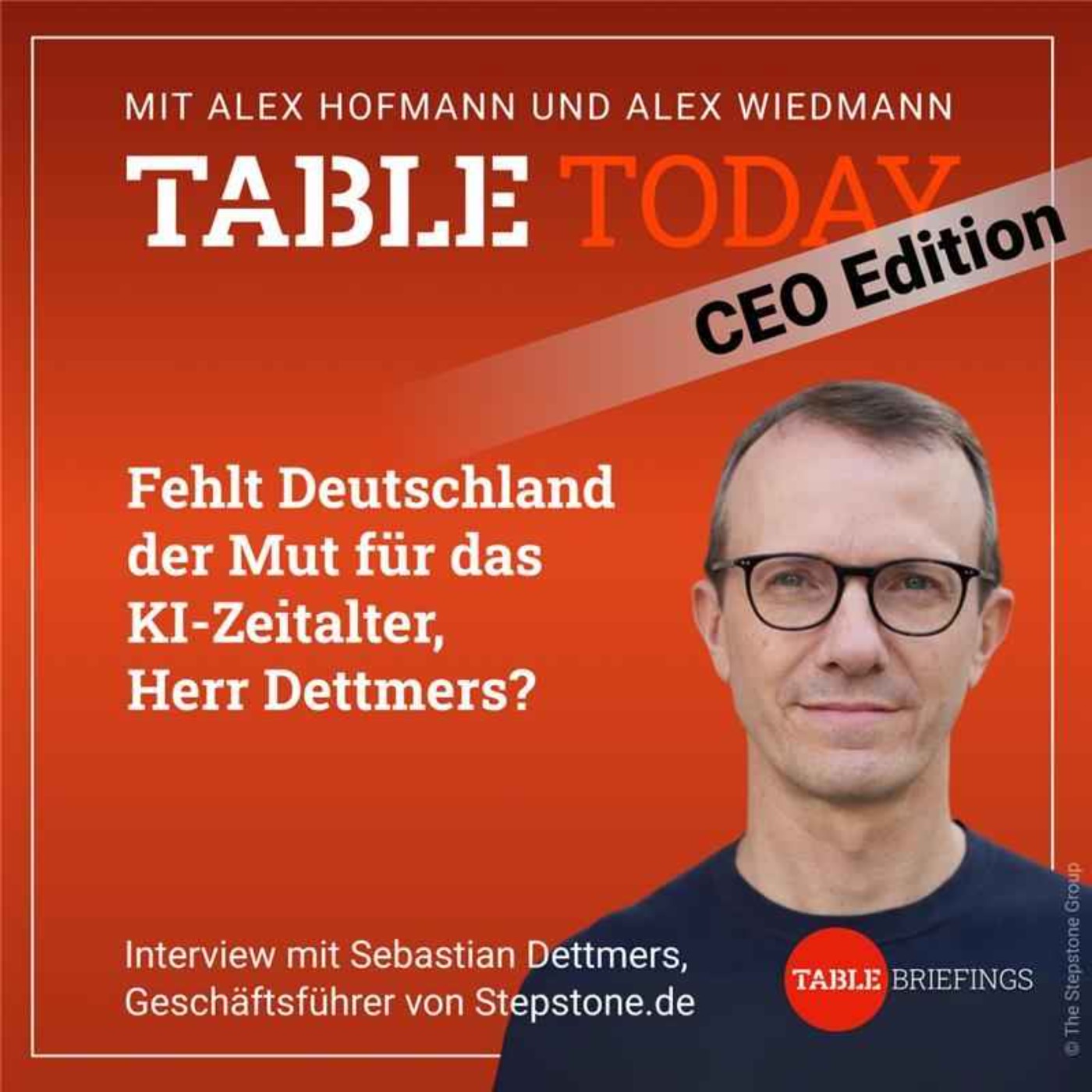
Fehlt Deutschland der Mut für das KI-Zeitalter, Herr Dettmers?
24m 44s
The transcription discusses an interview with Sebastian Detmers, CEO of Stepstone, focusing on the role of artificial intelligence (AI) in the changing labor market landscape in Germany. Detmers emphasizes the significance of AI in improving productivity and addressing the scarcity of skilled workers. The conversation delves into the potential of AI to streamline job matching processes and enhance decision-making in recruitment. Moreover, the discussion touches upon the issue of biases in AI algorithms and the need for ethical considerations in their development and deployment. Detmers also reflects on the regulatory framework in Europe, particularly the EU AI Act, aimed at ensuring fair competition and preventing monopolistic practices in the digital space. The dialogue concludes with considerations on the development of AI in Europe, highlighting the importance of data sovereignty and the integration of AI algorithms with business processes to leverage Germany's strong industrial base.
Transcription
4213 Words, 24218 Characters
Hello on Saturday, also this week, about our CEO edition of Table Today.
It's nice that you're here.
Today we're talking about an interesting company,
more specifically with the CEO of a really interesting company,
called Stepstone.
The CEO is called Sebastian Detmers.
The labor market has changed a lot in Germany
and also the way we find our jobs.
In the past, when the older people remember it,
the weekly expenses of the newspaper were always so big
that they hardly fit into the mailboxes.
And the main reason was that the workshops
had blown up the newspapers like this.
Also a bit of the housing market,
but above all the workshops were searched
and offers were placed there.
Meanwhile, this business is of course running digitally
and Stepstone is something like the Amazon of Jobbörse.
The labor market is of course a huge topic in Germany
and the problem is no longer that we used to have too many unemployed,
but the problem is much more that there are not enough qualified workers
and there are no workers.
And if there is a lack of manpower,
then this is a main obstacle for the growth in this country,
in which we all wait to finance this,
where we talked about it yesterday in our podcast,
we talked about the "Torre Gesundheitssystem".
But there is hope and that is what Sebastian Detmers of Stepstone says
and hope is based on artificial intelligence.
Because the more processes are automated,
the more productive a company can be
without having to deal with more people.
The labor market is changing
and the reason for this is that Stepstone
has placed the issue of AI at the very beginning
in the priority scale.
The editorial director of our CEO Tabels Alex Hoffmann
talked to Sebastian Detmers about how AI
will continue to change the labor market
and what German companies have to do to be able to do so in the future.
Hello Sebastian, welcome to the Tabel Podcast Studio.
Thank you very much.
Sebastian, in your book,
the great worklessness, not unemployment,
worklessness,
you write from the lack of labor force in Germany
that will lead to massive changes in the working world.
The book is 2022.
Since then, a lot has changed.
AI has become a subject for all managers.
The unemployment numbers have gone up again,
from good over 2, now almost over 3 million people in Germany
who don't have any work.
The book was very well known back then,
because you already made a few announcements.
At least a loan of 20 euros, for example,
comes in the book.
Are the thesis still in your book today
or are there even more sharp measures necessary?
Yes, I also thought about it.
I looked into the book again
and asked myself what it actually was.
And in many things,
I don't think I just said well before what happened,
but I was almost too conservative in the drastic development.
Because the book really deals with two things.
One is the demographic, i.e. the birth rate
and the development of the population in Germany and all over the world.
But also with the question of productivity.
So what actually creates the people who then still work?
Because there we have a phenomenon
that productivity has gone back over the years or decades
and we have a stagnating or even decreasing productivity per head.
I wrote it like this.
If a stagnating or decreasing population rate
hits a stagnating productivity,
we may experience decades of recession
and I thought it was a bit controversial at the time.
It could be a century of industrial revolution,
a century of industrial step back.
Of course, I didn't say that as a prognosis.
I said that it was a danger if we don't control it.
And we have to ask ourselves
how do we function as a society
with an now-alternate, soon-spirited population
and how do we create productivity again?
About three years later, we experienced a 22-year economic rise,
we stick to this decline.
The population continues to stagnate.
We realize that we will have big problems in the future
on the labor market when we look at what is happening there
and what is happening at the top, at the pension age.
And we simply don't get the issue of productivity in the attack.
But we still have so many tools.
Now there is still AI.
What is it that makes us so unproductive?
That is a question about which scientists break down.
Interestingly, especially outside Germany,
they call it productivity paradox or puzzle.
There is not a single big explanation,
but there are many small ones.
First of all, the biggest part of the human history
was actually no progress.
Productivity increase, as we know it from the last decades,
is a total exception.
And what happens first?
Is there still enough innovation?
Can we talk about that?
I think the second question is,
is this innovation adapted quickly enough?
We have started with all great innovations,
starting with a steam engine, telephone, internet.
Smartphones, as we have always seen,
take about a generation,
until great innovation actually arrives in the wide range.
Alternative societies have longer adaptation cycles
than new technologies.
Is that a problem?
Then the price is very low in Germany,
almost at the lowest level.
That is a disbalance
that leads to less innovation
from young companies and startups.
I have mentioned a few reasons.
There are other reasons.
There is not a single reason for it.
The question you have to ask as a country,
as a society,
is where will the next productivity turbo come from?
Just like it was always the case in the past.
With the automation of the industry,
with the introduction of computers,
how do we do it?
For example, in such a dirty analogy,
how do we manage the work
for which we need eight hours today,
tomorrow maybe four or two hours to do it?
Those were the progressments
that our ancestors experienced,
and we have to reach that again.
And is AI the answer to the question?
AI is, I think, the most important answer
that we have on this topic today.
I hardly see any other answer,
because the economy is part
of the service sector.
And the automation industry
has long been hacked,
just like in agriculture.
There, machines are used everywhere.
In a modern factory, we no longer see many people.
But we see these people in the office.
And there, they still work to a large extent,
repetitively, they do the same every day.
And of course, we don't need a robot or a machine,
but we need algorithms,
so artificial intelligence.
And the core question will now be,
do we really set artificial intelligence
so that it automates work,
so that it makes us more productive?
That's true, and we rely on
other countries and other companies
to use the productivity gains
that are certainly possible with artificial intelligence.
There are several studies
that find fewer and fewer employees
and increase their jobs directly.
You probably have the largest
job data bank in Europe.
Do you see that in your data too?
Yes, we see that in our data.
We see that the entry-level jobs
are currently 45 percent,
45 percent under five years' average.
Of course, we also have
these super strong years in 2022,
where we have experienced this enormous
job boom. But we observe that.
But you have to make a distinction.
There are two trends that overlap there.
One is the conjecture. We stick to the recession.
Because of that, companies
are generally less involved
and are currently suffering from entry-level jobs.
The second is actually the question,
how do companies prepare themselves
especially before the age of artificial intelligence?
Because it's not just that
companies take jobs or
have a conjecture crisis,
but we see differences there.
Especially the jobs are affected
where in the future
I can fully automate work
with artificial intelligence.
So what is that, for example?
That's bookkeeping, that's jobs in staff,
jobs in marketing.
Things that I can actually
automate with artificial intelligence
today, we don't observe
where artificial intelligence
is not automated.
In the handwork, in the care.
In this case, it's a differentiated picture
and it fits well to our assessment
of where artificial intelligence
is usually changed.
But I also heard that many companies
don't prepare well enough
for this situation.
That can be read in simple numbers.
Because in the end it's not about
whether I use artificial intelligence
or not, but it's about
being productive as a company.
Whether I use it more or more
with the same number of employees
or if I can't use it
I can do that with fewer people.
That's the reality. That was always a progress.
And that has also contributed
to the prosperity we experience
in this country today.
Let's take a look at it. Productivity stagnates.
We have been working in the city since 2019,
prosperity even since 2018.
So yes, we see a lot of exercises,
but in the broad mass
it doesn't lead to the prosperity
we would have to do.
And I think there are many different roles.
First of all, it just takes a while
until I have implemented these algorithms
and really made sure
that they make me more productive.
Second of all, we actually go
with the will
to, I say it in a more aggressive way
to this point,
we are ready
to think in a completely different way
in private economy
but also in public administration.
So I would like to say,
is it about
giving a employee a tool
that makes my everyday life a little easier
or is it really about
automating the whole business process?
And so, we still have a lot of work to do.
Stepstone is a tech company.
You should go as a good example.
What are the big
AI developments
that you are currently working on
that can make you more productive?
Stepstone is a platform
where we can form
people with people
who want to work together.
And with this, we form
a deep human decision on our platform.
So if we would now decide
to work with each other,
then of course it's about qualifications.
What did I do before? Which experiences do I bring with me?
But we actually also fit together.
We can work together.
And that is a complex decision.
We notice, even if we have to make this decision,
how much we have to deal with it,
it is not easy to
form a data model.
And here, artificial intelligence helps
to understand people
in all their versatility,
to understand how different jobs are.
Of course, it makes a big difference
whether I am a doctor, a caretaker
or if there is a job
or an opportunity
where it is only about that
I have a driver's license and an employment permit.
And in all this versatility,
artificial intelligence simply manages
to answer questions that we
cannot answer humanly at all.
So what does this mean in practice now?
The artificial intelligence will be a big matchmaker.
We will soon have a tool,
a small agent in our pocket
who actually keeps an eye on us permanently.
There is a better job there.
Which always means better for you.
More money, less pendulum,
maybe even shorter work, whatever it is,
being more attractive to your employer
and which also helps companies permanently
to find the right employees.
Because it is also an irreplaceable puzzle
that we are constantly trying to solve there
with tens of millions of employees
and millions of jobs
and hundreds of thousands of companies.
And artificial intelligence will simply
know this puzzle much, much better.
And with that, it is also very likely
to contribute that the economy works better
and that people are happier in their jobs.
What does "bald" mean?
What you said yourself,
it comes pretty quickly.
If you say we have the "bald" in our pocket,
can you give us a timeline?
First of all, we already have the "bald" in our pocket.
We have built long-term algorithms
that actually train with tens of millions of jobs
in historical and user behavior
to prevent people from doing the right job.
So today we send our users
with a push notification
a job on smartphone if we believe
or if the algorithm thinks
that this is the right job.
We can tell our users how good you actually fit
on this job and how high is the probability
that you actually get this job.
And of course it also works for the employer.
In the past, I published a statement
and waited for someone to comment.
Maybe no one commented.
Today, I publish a statement
and I immediately get selected candidates
with the help of artificial intelligence.
They can invite them to the interview.
They can invite them to apply.
They can directly address them.
Those are the prerequisites
until the last step that the whole thing
really runs autonomously.
That I actually only press "yes"
and the intelligence tells me
that I found a suitable job
and I should get in touch with the recruiter.
Of course, this will not lead
to people being automated.
At the end of this process,
at least in most cases,
you should still get to know
a personal conversation.
But this is much, much faster
and also much more suitable
so that we don't have to waste time
with the sent out applications
on not suitable jobs,
not at all suitable.
The AI is becoming a big matchmaker
and we have built the algorithms.
Now we have to make sure that the companies
adapt to their processes.
Because of course we realize
that a lot is still going on
like in the last 30-40 years.
But I think the profit of employees
is probably the biggest technical revolution
in their history.
But we also know that artificial intelligence
always brings a bias.
How do you deal with it?
I will briefly mention
the EU AI Act,
the regulation of artificial intelligence
on the European level,
which many of our applications
described as a high risk system.
This is the highest form of regulation.
Why? Of course, A is about very important processes,
i.e. the selection of employees.
And there is this issue
of the injustice of the bias.
But it is not made by machines,
it is made by people.
When we talk about discrimination
in the working world,
it is not about discriminating
machines or algorithms,
it is about discriminating people.
That means, when we assume
that the machine advantages have biases,
it is not the concern that they really have,
but that these machines
learn from our bad decision-making.
And the task is
not to regulate artificial intelligence
per se, but to ensure
that they do not look too much
at the bad decision-making of people.
Of course, we can say that this is a big risk.
In reality, this is a huge chance.
Artificial intelligence is, of course,
an ability to prevent these biases
and to make us aware
of the biases that we
have in our decision-making.
If you go there and say,
"I'm charging 100 potential applicants
again and again the same
according to certain demographic details,
people to introduce a proposal
or put them in, then artificial intelligence
will be found at some point and say,
"You don't know the best decisions
for your company."
As a company,
and this is very important
to understand in a market,
we have no interest
in letting biases in our algorithm.
We earn money
to help our users,
help all users find a job
and help companies
to implement the best possible.
That's why we invest a lot in it.
We have ethical AI teams
to find ways to avoid these biases
and also to prevent
the algorithm from finding a way
around these biases, which is made by people.
First of all, to somehow build
into the algorithms.
In this respect, we can say
that our algorithms are
never 100% bias-free.
We're trying to do that.
But they are much more
and more neutral than human behavior.
If you are traveling in many other countries,
if you compare it internationally,
does the law in Germany and Europe
limit you?
I think that the EUAEI, as it is now,
and how he thinks that
the European Union is good,
because he creates a legal framework
that is reliable
and is also usable for us.
I think that what is very important
is then also in the implementation
and in the national application
not to let a flicking carpet
arise, such as when we had
data protection regulations
that were reliable,
so that you as a company
can not only act uniquely in Germany,
but ideally uniquely in Europe.
But I think the big regulations
as we have today, the EUAEI Act,
the Digital Markets Act, the Service Act,
are all good legislation
that first create a legal framework
in the digital space
within Europe, which is unique
and which can also be used by all countries
uniquely. And that's what we do
in Germany and in other countries.
The Digital Services Act,
there were a bit of turbulence
in the negotiations with the US
in principle, should be sacrificed
that big US tech companies
are allowed to participate in Germany.
You certainly voted against
some others massively.
What is a demand that you would
put on the politics,
that is not to be given too much
in order to come forward
at other places in the cells?
So now we are discussing
the Digital Services Act,
which is what I have made
for myself, the discussion that we had
before the Summerfane, the Digital Markets Act,
where, in fact,
which was also part of the negotiation
in Zollstreit, the Digital Markets Act
rules a fair competition
in the digital space in Europe.
And that does not mean anything
other than that in the digital space
it is exactly the right thing to do,
even if it is in the economy. We have free markets.
Everyone can freely try
to speak freely, but we are not allowed
to use the monopoly situation.
We have always had that.
In Germany we had the monopoly commission.
In the digital space there are so-called
gatekeepers, i.e. services,
through which almost all Internet users
have to use for the first time
in order to get into the Internet
where this competition exists.
And the concern is that a gatekeeper,
and to count on this, such as Google,
Microsoft, Apple, that the gatekeeper
uses their position to put
in the foreground. And the Digital Markets Act
rules that. That is why it is
an important legal instrumentarium.
That was also taken before the summer break
again from the negotiating table.
In this respect, I am very satisfied with it.
How do you generally see the development
of AI in Europe,
Germany and Europe? It is often criticized
that Europe
in principle only has one
own large language model
that can participate internationally.
That very little happens on the national level.
Digital sovereignty.
Do we need it in Europe?
Do we need a own large
language model? Or are there
so many AI applications that
everyone can already build their tools?
Yes, that is a bit of a look
in the glass ball. What will happen?
How do these markets develop?
It seems so to be that there are
many competing large language models
that also bring up fast technical
prospects. My opinion
and also our opinion is current.
For example, if we take a commodity,
it sounds weird for such an
incredibly innovative application
that is presented as a basis technology
for a lot of applications
that are built on it.
I don't think that you can
cut the discussions about artificial intelligence
on large language models.
There are many other applications
that are also artificial intelligence that
have nothing to do with large language models
or build on large language models.
Where we need sovereignty is the data sovereignty.
It will only be done if I connect
the intelligence with data,
with business processes.
We also have a huge chance in Germany.
We have this very, very strong
industry. Of course, we also have
many strong national champions.
It is important that we
connect artificial intelligence algorithms
with the data.
So the company is not a requirement
for politics, but for the economy.
It is not easy to give these data out of hand,
but to build your own AI application.
As I said, the actual value
comes from the data.
The value does not come from
large language models,
but the fact that we can train them
with millions of job decisions,
with millions of jobs,
with millions of lives.
That's why we are able
to really offer a good matchmaking.
That can't be artificial intelligence,
but you have to contribute to it
and you have to contribute to it
in an ethically correct way.
There is now a economy that
gives gas, that asks itself
what kind of data I have,
with which I can really build
unique things.
By the way, I encourage
many companies that this is happening.
We may need a bit of patience,
but we also need a bit of patience
when we are just watching. We definitely need
patience when we are just changing it.
But there I am good at things.
What does that mean for the companies?
For example, in the field of leadership.
To go through the changed conditions
through KI.
Yes, there are two things that are very important.
The first is, how do I actually lead
through this transformation?
Because maybe we are all excited
about the possibilities that KI offers,
but at the same time we have a lot of people
afraid of artificial intelligence.
And that is not a very abstract fear,
but we have just talked about the work market data.
Also a very specific fear,
namely, will there still be my job in this form?
And I believe that as feedback,
we are fighting right now so that
a latent enthusiasm and an abstract enthusiasm
is there for it.
But if it is about the specific application,
KI is not used consistently enough.
That is also no wonder, because no one
likes disrupting his own workplace.
So that means I need a good mix.
Of course, I have to take my employees
on the journey.
And carry out training
for them, so that they can use
artificial intelligence.
But I also have to make decisions.
What are the processes, the business processes
that I now digitalize?
Where will I deal with more people in the future?
Where less?
And where maybe no more people?
And these are the decisions that I have to make today.
They are not always just nice and comfortable decisions,
but they belong to uncomfortable decisions.
Just like that in the industry,
in the many decades to this day,
it was also the case.
So that it is a transformation of successful people.
The second topic is,
how do I not only lead people,
but also the artificial intelligence?
These algorithms basically work
as employees.
But as inexperienced employees.
So I have to train them
to do their job.
I have to understand how they think.
And I have to understand what chances there are.
But I also have to understand
where I should perhaps control,
where I should push back.
And to understand
that an artificial intelligence
that makes me more productive
and that I have to invest time there,
that is very important.
In this case, to lead a hybrid,
I lead a team of employees,
but I also lead a team of algorithms.
That is very important.
In this case, I did not have to
become a large-language model engineer,
but I had to become an experienced user.
I had to know what they could do
and what they could not do.
In this case, it will be a hybrid model
of human and technical leadership.
And is there already the right understanding
of the company?
Yes, in the USA, there is a current trend
where the topic is started to be discussed.
I would say that it still has this hype phase.
So at the moment it is a cool topic.
It is experimented.
Then it will probably disappear
in the classical hype cycle in the next months.
It will be bad experiences.
But in a very natural way,
it will probably belong to the very normal tool boxes
of leadership powers of all employees,
but also to the leadership powers.
So yes, as you can see, there are beginnings in Germany.
In the beginning and in the surface,
the topic is discussed, but not in depth.
I think that we still have to learn a lot
about AI.
We also have to be brave
to enter existing structures.
Sebastian, thank you very much for
being in the Table Podcast today.
Thank you for the invitation.
Podcast Summary
Key Points:
Discussion about the CEO of Stepstone, Sebastian Detmers, and the impact of AI on the labor market.
Importance of AI in increasing productivity and addressing labor shortages.
Considerations about biases in AI and the regulatory framework in Europe.
Summary:
The transcription discusses an interview with Sebastian Detmers, CEO of Stepstone, focusing on the role of artificial intelligence (AI) in the changing labor market landscape in Germany. Detmers emphasizes the significance of AI in improving productivity and addressing the scarcity of skilled workers. The conversation delves into the potential of AI to streamline job matching processes and enhance decision-making in recruitment.
Moreover, the discussion touches upon the issue of biases in AI algorithms and the need for ethical considerations in their development and deployment. Detmers also reflects on the regulatory framework in Europe, particularly the EU AI Act, aimed at ensuring fair competition and preventing monopolistic practices in the digital space. The dialogue concludes with considerations on the development of AI in Europe, highlighting the importance of data sovereignty and the integration of AI algorithms with business processes to leverage Germany's strong industrial base.
FAQs
Stepstone is a company known as the Amazon of Jobbörse, operating in the digital job market.
Germany is facing a shortage of qualified workers, hindering growth and productivity.
AI is automating processes, increasing productivity without necessarily requiring more human resources.
Stepstone uses AI to match job seekers and employers more effectively by understanding qualifications and job requirements.
Efforts are made to ensure that AI algorithms are less biased than human behavior, with ethical AI teams working to mitigate biases.
Regulations like the EU AI Act are establishing legal frameworks for AI use, aiming to ensure fair competition and prevent monopolistic practices.
Chat with AI
Loading...
Pro features
Go deeper with this episode
Unlock creator-grade tools that turn any transcript into show notes and subtitle files.
 PodcastTranscript AI