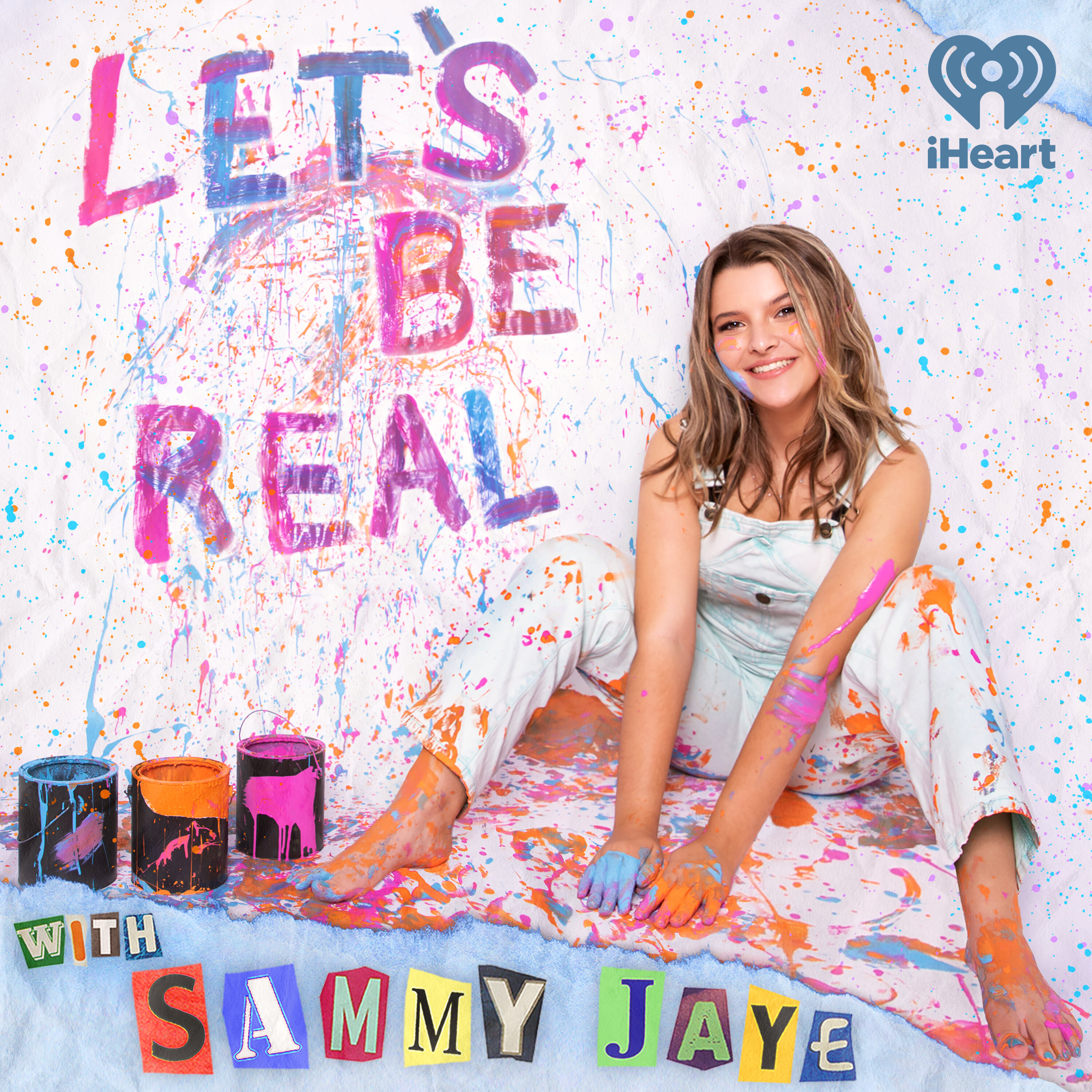
This transcription features multiple podcast promotions, starting with the Jonas Brothers announcing their new show "Hey Jonas" on the iHeartRadio network. Other promoted shows include "Humor Me with Robert Smigel and Friends," "Pod Meets World," "Inner Cosmos" for mental health awareness, and "Soccer Moms." The main content is an interview on "The Let's Be Real Podcast" between host Sammy J and Amanda Zuckerman, co-founder of Dormify. Amanda recounts how she identified a market gap in 2009 while shopping for her freshman dorm room: cute, functional bedding for college students was hard to find. With her mom, she started a blog to build a proof of concept, then launched the business without prior textile experience by attending trade shows and networking. She stresses the importance of solving a real problem rather than just following passion, and advises pitching ideas effectively to grab attention. Amanda also recommends leveraging campus life for market research, organizing contacts in a system like a Google Sheet, and using academic projects to test business ideas. The interview covers balancing school and business, building a brand slowly, and the value of early networking.
This is an I Heart Podcast. Guaranteed Human. Hey guys, it's us, the Jonas Brothers, I'm Joe. I'm Kevin. And I'm Nick and guess what? We created our own podcast called Hey Jonas. We invented a podcast. Well, we didn't invent it. We just contorted to it. We're the first people to do podcasts. We get to ask other people questions because we're sick and tired of being asked questions. Well, sick and tired is a strong way to put it, but you know, tired and sick. Tired and sick. Listen to Hey Jonas on America's number one podcast network. I Heart Follow Hey Jonas and start listening on the free I Heart Radio app today. Another podcast from some SNL late night comedy guy, not quite, on humor me with Robert Smigel and friends. Me and hilarious guests from Bob Odin Kirk to David Letterman helped make you funnier. This week my guest, SNL's Mikey Day and head writer, Streeterside L, helped an Aka Pella band with their between songs banter. Where does your group perform? We do some retirement homes. Those people are starving for banter. Listen to humor me with Robert Smigel and friends on the I Heart Radio app, Apple Podcasts or wherever you get your podcasts. Hey everyone, it's Ryder Strong and Wilford L from Podmeets World and now the Podmeets twirl to podcast. We're two men who were completely clueless to reality TV and we're gearing up for the season finale of Survivor. I know we annoyed a lot of our listeners. Our severe lack of survivor knowledge. That is the point of the show. I'm just going to remind you. Oh, again, we are experts. Listen to Podmeets twirl on the I Heart Radio app, Apple Podcasts or wherever you get your podcasts. There are times when the mind becomes a difficult place to live. This is David Eaglen with the Inner Cosmos Podcast and for mental health awareness month, we'll talk with singer songwriter Jewel about anxiety. I started living in my car and then my car got stolen. I was having panic attacks. I was a Gora Fobick. This is a month of deeply personal and honest conversations about what happens when the brain goes off course. Listen to Inner Cosmos on the I Heart Radio app, Apple Podcasts or wherever you get your podcasts. Hey guys, it's Sammy J and welcome back to this week's episode of The Let's Be Row Podcast. I hope your day is going well. The holidays are approaching and I just, I'm very grateful for all of you and this week I got to chat with the incredible Amanda Zuckerman, who is the co-founder of Dormify. She's Forbes 30 under 30 and her story is really inspiring and if you don't know Dormify is, it's essentially your one stop shop for everything college. We talk about building a business, being an entrepreneur and so much more in this episode. I love you guys and thank you for listening. Amanda, thank you so much for taking the time to come on my podcast. I am so excited about this episode because I really want to talk about growing a business, being an entrepreneur and also starting at any age because I feel like that's something that's so accessible to us now in the age of Google. But I haven't seen you in so long. How are you? I'm doing well. It's been forever. I miss you and hopefully we can see each other soon when you're back in New York. But I think they're good. Time is flying. When you are an entrepreneur on that topic, we always laugh because it's like dog years in terms of days over here. So every day just feels like it's times 10. So something that happens last week, we're like, oh my god, is that a month ago? But all is good. I'm very excited to have this conversation. I know you co-founded Dormify what year? It's funny because it's a couple of different answers depending on how you are. I don't want to slice it, but technically in 2011. But I came up with the idea in 2009 when I was starting my freshman year. And then we really started to kind of like soft concept it in my sophomore year and then technically launched it by my junior year. And that was the year that I actually had Dormify betting in my apartment on campus. Coming up with a business, I know the main thing that's always important is to be passionate about the main topic that you're in. So how did you choose Dorms and making Dorms cute? Because it's a problem that has been going around for a while and you're the one who really took the step to make a dissolution. So I appreciate that. Of course. Okay, so a couple of things here. So it's not only about passion actually. I would start with like centering a business idea around solving a problem. Because sometimes you might not be passionate about the business that you're building in terms of the subject matter. You might be passionate about like solving that problem. So I think the common misconception in starting a business is you have to like love whatever that is. Yeah. So I could have said like, I'm not that passionate about interior design, but I love being creative. I love finding something that you can latch on to. But I have seen a lot of successful people who are not technically passionate about a certain sport or an activity, but they see an opportunity that they're passionate about solving for. So without going down that rabbit hole, I can tell you about my own experience. And my experience is that I was shopping for my freshman year dorm room like everyone gets excited to do. And back then, which was a different world than now. And it wasn't that long ago. No, I know. It's crazy though, but try to like think about a world where Instagram and Pinterest did not exist. Social media did not exist when this was going on. So kind of like try to put yourself in my shoes there where you're going to physical stores. Online shopping wasn't what it is today. You couldn't just find like an Etsy maker to find something very specific based on TikTok or you saw on Pinterest or whatever. So it was really challenging to find twin Excel bedding that's required for college in styles that were really neat for someone might age. And we, meaning my mom and I quickly saw an opportunity and a white space in the market to totally like grab hold on because we were literally in bed, bath and beyond. I remember it clear as day. I was in New York City shopping because I had one day to do it. I was a camp counselor and I literally like on an off day came to the city to shop for my dorm room. And I was in the Chelsea bed, bath and beyond. And looking at the shelves, I was like, this is crazy. Why isn't there anyone who's making cute bedding for your dorm room? So I was kind of nuts and I decided to curate a look based upon pulling tons of different items from different places and really mixing and matching my future room look, which most people do today. It's just a lot more accessible to be able to find one thing from urban and one thing from dorm up by. So there's just so much more access. But I ended up mixing and matching a ton of stuff that I liked. And it all started with a urban outfit or pillowcase that I was really drawn to and I built the entire room around it. And it ended up being a really fun, easy-ish process for my mom and I because we're both creative. But we quickly saw when I went to move in day that many other students and their parents were dealing with the struggles of how to set up a room and not only how to make it cute, but also like functionally, what do you need in your space? How do you rearrange the furniture to maximize the space? What are your hacks? So we wanted to sort of bring what we knew we were good at to other students and other families that were struggling and hence the idea for dormify was boring. But really it goes back to that shopping trip at the bath where I was standing there and I really set out loud to my mom. We should design our own line of bed thing and she was like, okay, let's do it. So that's amazing. I know. It's crazy. That doesn't always happen, but you might be standing next to a friend or like a classmate and you see an opportunity to solve a problem and you're like, well, this is a horrible, horrible experience. Let me figure out how to make it better and let me solve it and then someone bigger with might say, oh, that's really interesting. Like, I'd love to think about that with you or something along those lines, but happened to be my mom. Anyway, so that was my freshman year. And my sophomore year, we actually put a blog of all things dorm, all things college. It was students like myself, friends of mine, friends of friends who were writing for the blog so that we could have some online presence that gave us some credibility to be talking about dorm decor. And most importantly, this actually served as our proof of concept. Of course, we quickly saw that people did care about what the rooms looked like. We got to gather tons of great images from these brand ambassadors that joined the brand. And they ended up being a network of hundreds and hundreds of college students that I knew or were complete strangers to me because it just became this viral, like friends of friends of friends type of community, which was exactly what we were trying to do. So once we had that proof of concept, we started working on what that brand was going to look like how we were going to actually make product because neither of us had any experience in textiles. And we weren't just going to go find some vendors that we could buy products from and put it on a website. It didn't exist. So we had to go make bedding ourselves. How do you go about making bedding? No experience. So I can speak to some of the more tactical ways that we did this, but more generally, it's about learning from experts in the space and immersing yourself.
in environments where you can really learn. So what I mean by that and how we did it, there's a few different trade shows that happen all over the country, but there's plenty in New York. And we just walked the aisles and started asking questions, getting contact information. We didn't even have business cards, I don't think at the time, but we were sharing the idea and selling the idea and people were really interested in the fact that we were filling a niche and we were putting a brand around a very pivotal life moment and there was a lot of interest because they knew that the back to school shopping moment is so huge, but no one was really owning that space. So I think the takeaway here is even if you don't have anything formal to share with someone, they'll remember your story. And it's important to be like pitching at all times. So if you come across someone who could help you down the line, whether it's with an introduction to a future contact that you need to meet or just like someone who has a lot of great historical knowledge on a certain subject matter, make sure that you're making those connections and you have a way of staying in touch with people and we were just selling the idea. Which is hard to do, which is a skill and an art in itself. What was your elevator pitch? Well, I think this all goes back to my original point of if you are not solving a problem, it's hard to get someone to care. So if it's kind of like a nice to have, I believe in this because it's a nice to have I'm totally generalizing. It's a lot harder to explain why someone should care than if you have identified a problem and you are creating a solution even if it doesn't exist yet. So that's why I think the elevator pitch to your point is really, really important because you have to grab someone's attention within, I don't know, less than 30 seconds, probably within the first 10 seconds, five seconds in which you're talking to them. Why should they care? How is this going to benefit them? And what does this look like? Is there a timeline? Is this real? So as you're building this company in your in college, how did you balance the schoolwork as well as, you know, this is something it fills a need and that you're creating a business and you can see potential with it. So how do you compartmentalize and be a student as well? If you talk to a group of founders, I'm sure people would have very different perspectives on this question, but I think it depends on what you're doing, right? So there's lots of people who have started incredible businesses where they have to just move really quickly in order to not lose the opportunity to be the market leader in whatever they're doing, right? So people might drop out, people might totally prioritize their business because if they don't do it now, someone's going to beat them to it. I wasn't in one of those scenarios where I felt like it was important to move fast, it was actually more important to build the brand slowly, take advantage of the fact that I was on a college campus and like immerse myself in the audience that I was trying to connect to. Yeah, being in college was working for you. Right. It was market research. For me, I would never not take advantage of being on a college campus. And like my senior thesis was actually something that I totally based off of a future endeavor for the business that was all based on like the gift-back component of the business. So I tried to connect everything that I was doing on campus with what would help my business. Now, I think what would be important to share here is what I would do today if I were going to go back in time and redo it. Something that I did not take as full advantage of that I wish I did was just making connections on campus. So building my network while being a college student is like the number one thing that I think no matter what you're going to do, whether you're starting your own business or going to work for someone else. Like you hear it all the time, but it's so real. And having a mechanism to house your contacts, LinkedIn just doesn't cut it for me. Like I don't have a way to mentally organize and LinkedIn, all these people that I know. You can come up with your own system, whether it's just a Google sheet, and I have this now. I literally have a Google sheet called Amanda's Network. And I have people that I meet, their contact info, who introduced me to them. Like I even have a drop down of, are they an investor? Are they a founder? Are they an operator? Like I just record this for myself so that when I'm thinking, oh shoot, I need to call someone to help me with this. Let me go reference my sheet and see who I could tap. Because otherwise I will not remember these people. Did you color code this Google sheet too? - Oh, it's not like that level of OCD. Okay, because that's just not me. I'm actually really unorganized, but this is my attempt to be organized. It sounds pretty organized. - It's functional. Yeah, it's definitely functional. But my advice to this group listening is, do this as soon as possible. My point is that I didn't do it early enough because I started this in the last couple of years. Now imagine if all of the connections that I've been building as a young founder have been captured in one place, I would probably have the right people to go to for every single problem that I need to solve. That's all really important habit to just get into at a very young age. - Yeah. - That would be my first takeaway. And then other things that you can do on campus is just utilizing and leveraging the opportunity to test out ideas. - Yeah. - I'm just thinking of my own university experience. We had a class where you could actually build your own business and it wasn't real, but it ended with a pitch. And just take advantage of those chances on campus because you don't have that type of built-in opportunity once you've graduated. So even if it's something that doesn't end up coming to fruition, at least you had the practice of like building a business plan or a pitch deck, and then you can apply that to something in the future. - Absolutely. We have to take a quick break, but when we come back, I want to talk about burnout, how you created so many different types of products without any prior experience, the future of Dormify and so much more. We'll be right back. - Hey, it's us, the Jonas Brothers. And guess what? We have some big news. - What's the news, Nune? - News news. We created our own podcast called, "Hey Jonas, we invented a podcast." Well, we didn't invent it. We just concluded first. - We heard people to do podcasts. - Pretty wide range of podcasts. - We're getting it trend. - But this one's extra special. So how do we actually come up with the name, "Hey Jonas, guys?" - I honestly don't remember. - I think it was on a call about what we should call it. And, - Well, we were thinking, I'm originally calling it one of the early names of our band before Jonas Brothers. - Mm-hmm. - Well, this is how you guys remember it going down. - Yes. - I have a very different memory of this. - We were talking about a thing, a bit for the podcast, we could call in and say, "Hey Jonas." And then I broke down on my little note pad, "Hey Jonas," and offered it up as a potential title for the podcast. But thanks for remembering that, guys. - Listen to, "Hey Jonas, on the I Heart Radio app, Apple Podcasts, or wherever you get your podcasts." Just listen, we don't care where you hear it. - Another podcast from some SNL late night comedy guy, not quite on humor me with Robert Smigel and friends. Me and hilarious guests from Bob Odin Kirk to David Letterman help make you funnier. This week my guest, SNL's Mikey Day and head writer, Streeters Side L, helped an acapella band with their between songs banter. - Where does your group perform? - We do some retirement homes. - Those people are starving for banter. - Listen to humor me with Robert Smigel and friends on the I Heart Radio app, Apple Podcasts, or wherever you get your podcasts. - Will Ferrell's Big Money Players and I Heart Podcasts presents Sucker Moms. - So I'm Leanne. - Yeah. - This is my best friend Janet. - And we have been joined at the Hipson Sight School. - Absolutely. - A redacted amount of years later. We're still joined at the Hipson Sight School. Just a little bit bigger hips, wider. This is the podcast where recording it as we tailgate our youth soccer games in the back of my Honda Odyssey with all the snacks and drinks sidebar. Why did you get heart-seltzer instead of beer? - Oh, they had a bogey. Well, then you got them. - Do you want a white collar stuff here? Just say, "What are y'all doing?" - Microphones are you making a rap album? - I will not. - I'm not. - I'm too bold. - I would buy it. - Cuts through the deep ends like a hot knife. - For a sponge cake. - That sounds delicious. - Oh, you're lucky. I'm not a drug addict. You're lucky. - You're not an alcoholic. You're lucky. I'm not a killer. - I love this team and I'm really trying to be a figure in their lives that they can rely on. - Oh. Listen to soccer moms on the iHeartRadio app, Apple Podcasts, or wherever you get your podcasts. - Hi, everyone. I'm Cheryl Stray, author of Wild and Tiny Beautiful Things. I'm excited to share that I have a new podcast called Mind over Mountain. In each episode, I interview athletes, adventurers, and adrenaline seekers to discuss the inner landscapes and life experiences that informed and inspired their extraordinary feeds. I also bring a bit of advice into the mix. So we too can better understand how to face our own seemingly insurmountable challenges. - Do you know what I'm gonna do? I'm gonna pull out what you already have inside. We come into this world. Fighting for our lives, all I'm gonna do is pull out what you already got inside. - We're there to support and celebrate each other. And that is not like your story versus my story. - You're gonna walk up and over that dang mountain. You're not just gonna put your mind over it. - Yeah, exactly. And if I can't walk up and over it, I'm gonna go through it. - Listen to Mind over Mountain every Thursday on the iHeartRadio app, Apple Podcasts, or wherever you get your podcasts. - And we're back.
Something that I'm going through and I don't know if you ever went through was being a student and you wanting to take advantage of all of those opportunities and stay creative and keep building but also navigating burnout. Yeah. Because you know when you're operating on different deadlines for different people like how do you not in this day and age? So I guess I was wondering if that's something you've ever gone through and how you've navigated that. I mean it's definitely something that I still deal with today. So I'll put myself in the college environment for a second and I'll talk about how I navigate this in just my professional life. But in college I think it's so easy to want to do a million things or literally told go try everything this is your time to do all of these different things are never going to have the opportunity to do it again and you can instruct yourself really thin. I think that's fine to cast a wide net to at least understand like what the opportunities are. But I do think it's really important to try to like hone in on one or two things that you want to focus on because especially when it comes time to reflect on your college experience in an interview setting you don't want to say like I touched all of these things that I haven't gotten deep anywhere. It's always more attractive when a candidate can speak to something that they really sung their teeth into and invested their time in rather than saying like oh I just wanted to put all these things on my resume so I tried all these things. I think balance is important and no one's expecting you to do it all. Have you always had the entrepreneurial bug at heart or did this come about when you were going to college? I don't really know how to answer that question because I think it could be subconscious but no I was not the type of person who said I want to be my own boss. I want to be an entrepreneur. I want to figure out what I can do in order to do that. It happens just more organically. There's a couple of different paths. So you might be someone who goes to the college experience. They go into a training program or you know an entry-level job and they learn quickly. I really don't like working for someone else. That definitely happens all the time and they might say okay how can I work for myself? That's one path. Then there's someone who is like determined to be an entrepreneur and that person could be searching for an idea to pursue. So even if you are one of those like entrepreneurial type people you don't have to be the one that comes up with the idea necessarily. That's where your network comes in because you need to be in the right environments or ecosystems to be introduced to people who could use someone like you as a partner. All it takes is execution. Totally. For me personally like I grew up in an entrepreneurial family. So my parents owned a business together. It's kind of second nature to me so it wasn't as daunting or intimidating to me because I just had that own. It's in your blood. Yeah right it's in my blood. That's how you say it. I'm very curious about product development because you guys have expanded and are creating a variety of things whether it's bedding, posters, lights. Yeah. What does that process been like and how do you go about navigating something when you didn't have any background in it? It's a pretty crazy world. We've learned everything along the way from great partners who have held our hands where when we didn't know anything and I think that's really the most important point here is you develop relationships and relationships are the most important thing in taking your business from one step to the other. This manifests in so many different ways whether it's vendors that you build a relationship with that will help you when you're struggling whether that's financially or operationally and then you also have partners that will walk you through the ropes when you have no idea what you're doing which was exactly the position that we were in. So the way that we did this we actually talked to many different vendors because we had to essentially knock on doors and explain what we were trying to build until someone said like okay I'll take a chance and work with you as you can imagine we got a lot of nose. That's intimidating. We don't want to know it's like we didn't have a website. All we had was a pitch and that's fine like you can totally approach these situations like that but it's the same way that you approach fundraising like you might not have many results that prove out your concept just yet but someone's going to take a chance on you because they believe in you and that's all about building relationships selling your pitch and personality really. So we had someone agree to work with us and we only worked with them for a year. They were not the right partner to take us to where we are today but they at least got our foot in the door so perfection is the enemy of progress. I know comparison is the thief of joy so progress would make sense for that one. I was thinking that free as well I was trying to say it but my point is something that I get on a lot of the time is we're not trying to be 100% perfect. We're going to try to be 80% perfect and it's all about making progress and actually getting things done that's more important. Something that's interesting that we did is we didn't have money to invest in the product that we wanted to order. Inventory we wanted to order. So what we started with was a product line of posters where we didn't actually have to invest in inventory upfront. We found a printer that was going to just print the pieces on demand as they got ordered so that we only had to pay after something this sold. Amazing. So that's a really great way to get started especially in low quantities is almost like testing a small quantity of pieces and having someone who is willing to make like a small group of samples even just to get some product feedback and you know talking to your customers at all times especially in the early days is really really important. If you didn't have that bedbath and beyond moment. Yeah. What do you think you would be doing now? I think that I would probably I think I would probably have gone into something in the hospitality world like I was always into creative and I was a graphic design and marketing major so I already kind of knew that outside of Dormify because I decided I was going to do these majors before Dormify started. I wanted to do something that was creative, art oriented and then I wanted to also back that up with like the business understanding that I wasn't you know just an artist or a designer but I understood the business behind it but I've always loved like hospitality meaning restaurant totals like any sort of hospitality environment bringing those spaces to life so it is kind of similar to Dormify in a way of transforming a space to create an experience. It is I probably be doing something like that or I would have taken over my parents advertising agency that was definitely something that was intriguing to me but I was unsure if I wanted to do it. Wow it's it's so interesting how that one moment changed your entire life I find that so fascinating. Can I add a fun fact because please even even though I was always interested in design the truth is when I was little what I wanted to be I wanted to be a meteorologist on the way that's so specific I know I wanted to be like a storm chaser in hurricanes and tornadoes and like I love the movie Twister so why this is funny it's because that's like my fun fact whenever people ask me what I wanted to be when I was little but then when I was in college the one like random class that I could take because I was a double major I didn't have a lot of time for like elected type classes I took a natural disasters class and it was like exactly what I needed to fulfill that desire that I had so in college take the fun classes that like could just kind of satisfy any sort of interest that you have because it was fun yeah random we have to take one more quick break but when we come back I wouldn't talk to you about the future of germify the art of decision making and so much more we'll be right back hey it's us the Jonas Brothers and guess what we have some big news what's the news news we created our own podcast called hey Jonas we invented a podcast well we didn't invent it we just contributed to it people to do podcasts pretty yeah pretty wide range of podcast right there but this one's extra special so how do we how do we actually come up with the name hey Jonas guys I honestly don't remember I think it was on a call about what we should call it and well we are thinking I'm originally calling it one of the early names of our band before Jonas Brothers what this is how you guys remember going down yes I have a very different memory of this we were talking about a thing a bit for the podcast we could call in and say hey Jonas and then I broke down in my little notepad hey Jonas and offered it up as a potential title hot podcast but thanks for remembering that guys listen to hey Jonas on the iHeart Radio app Apple podcasts or wherever you get your podcast just listen we don't care where you hear it another podcast from some snl late night comedy guy not quite on humor me with Robert smigel and friends me and hilarious guests from Bob Odin Kirk to David Letterman
and help make you funnier. This week, my guest, SNL's Mikey Day and head writer, Streeter Side L, helped an acapella band with their between songs banter. - Hi everyone, I'm Cheryl Strayed, author of Wild and Tiny Beautiful Things. I also bring a bit of advice into the mix, so we too can better understand how to face our own seemingly insurmountable challenges. We come into this world fighting for our lives. All I'm gonna do is pull out what you already got inside. We're there to support and celebrate each other. - Yeah, exactly. - Listen to Mind Over Mountain every Thursday on the I Heart Radio app, Apple Podcasts, or wherever you get your podcasts. - Wild Fares big money players and I Heart Podcasts presents Sucker Moms. - So I'm Leanne. - Yeah, this is my best friend Janet. - Hey. - And we have been joined at the hips and size school. - Absolutely. - Now a redacted amount of years later, we're still joined at the hip. This is the podcast where recording it as we tailgate our youth soccer games in the back of my Honda Odyssey with all the snacks and drinks. Sidebar, why did you get heart-seltzer instead of beer? - Well, they had a bogey. Well, then you got it. - Do you want a white color sub here? Just hit it. - What are y'all doing? Microphones are you making a rap album? - I wish. - I wish. - I wish you both. - I wish you both would buy it. - Cuts through the deep, that's like a hot knife through sponge cake. - Oh, you're lucky. You're lucky. - You're not an alcohol addict. You're lucky. I'm not a killer. - Oh. Listen to Sucker Moms on the iHeartRadio app, Apple Podcasts or wherever you get your podcasts. And we're back. - What are your goals and plans for Dormify in the future? How do you hope it to grow and expand in a world? - There's so much that we want to do with Dormify. I think first and foremost, being able to offer a wider assortment is kind of like, yes, of course, it's not like a huge idea, but we want to have more of a selection for guys, for more of a gender neutral, type of aesthetic. We want to collaborate with more brands and with more artists that we really have the most unique and exclusive assortment of products that you can't find elsewhere. We also want to get back into the pop-up shop world and be able to bring experiences in person to our customers. So whether that in a store that's open for a few weeks or something that pops up for the weekend, we really want to connect in person. And ultimately, where I want to take it is having a shop and shop experience at a great retailer. So some of the ones on the top of the hit list are Nordstrom, the container store we actually partnered with last year. So that was a huge check off. The list was a major accomplishment. - That's a big one. - Yeah, and we're continuing that partnership this year, which I'm really excited about. But to be able to be like a store with an issue store where a brand is featured in a huge retailer that doesn't have a big like home assortment that's dedicated to Gen Z. That would be ultimate. There's a lot. That's just the beginning. - You're still at the beginning of it. And I'm so excited to see where Dormify evolves and grows and 'cause frankly, learning about this and getting your thoughts and guidance on what your story was is super helpful. Not just for me, but for the other people listening because it can be so intimidating knowing where to start or how to start. But it's really just finding a problem that you can fix and it starts there and knowing that is super helpful. - Totally. And also keep in mind that like bad phrase that I coined about perfection, I need to have a better way of saying it. But the more that you strive to be perfect or to get something done perfectly, the slower that you're gonna move and time is money. You have to feel okay and secure about the fact that it's not gonna be to your highest standards of perfection. But that's just gonna hold you back. - And what advice do you have for making decisions? That is something that I personally struggle with 'cause I'm an indecisive person. - Okay, I'm a very indecisive person too. - Okay, that makes me feel better. - I am a very indecisive. Like I'm telling you when I'm out to dinner or something, I like really struggle to make a decision on what I'm gonna eat. Like that's how bad it is. - Okay, good. But tell me more specifically like where you struggle and I can try to help impart some advice. - I think it's the part of being confident within a decision and knowing that that's the right one I could have made for that time. And not like not going back being like, well that was that the decision? I think that's one of the things that I struggle with most. - Got it. Okay, so you're saying that like you might be able to make the decision but you almost have like and guided over whether you made the right decision. - Correct. - So then that flows you down from actually making the decision because you're so afraid of like what if it's the wrong decision? - Yes. - Yeah, I mean that's like a really important skill to work on throughout your early professional career because being decisive is powerful, very, very powerful. And I think I've learned a lot about that over the last few years but making decisions equals progress. So overthinking something is just going to like way down on everything that's going on in your head. So it almost like inflates the importance of the decision a little bit. - Yeah. - You just need to learn from your decisions. So make the decision, don't over think it, try to practice this with like things that are not a huge deal. So practice the quick decision making with things that aren't gonna like make or break something big. And then once you got like the easy stuff out of the way, then at least you're creating more brain space for the things that are more involved decision making. Think about the worst thing that will happen if you choose X over Y. And then if you're like, oh, the worst thing that's gonna happen is only this like, okay, then I can at least make the decision, learn from that not being the right decision, but the more you kind of have that practice, you're gonna say, okay, well, I'm comfortable with the fact that yes, I learned now this decision might not have been the best approach, but I learned from it. And I'm gonna move forward and I'm gonna use that in my decision making down the road. - That's very helpful advice. - I'm glad. - I just need to do the mini ones, the little mini trials to get me through the big ones. - Right, I have to all the time, all the time. Like, and I think like if you're feeling stuck on what to do, like walk away from it, come back to it once you've put your head a little bit, but psychologically, we compound so much stuff inside our heads, should I think start crossing things off a list? - I've survived off a list. You have no idea. Am I right? Everything down. It's the only way it gets done. - Well, I hope you take my networking Google Sheet to heart and start that now. - I am starting this on my way back to school. I am going to be working on this. - Good. And put me on it. I'm very excited. - You're on my list, by the way, Sammy. You're on my list. - Oh my goodness. - First of all, I'm honored. And I am going to go the extra mile in color code it. And I will send you a photo. - And I really appreciate you giving all this advice because I think mentorship is so important. And having that guidance is so knowledgeable. So I really appreciate you sharing and just being so candid about everything. - Of course. I mean, I talk to college students all the time. And I just want to help in any way I can. And that's really, I mean, when I think about what's next for Dormify, that's really where we want to take our ambassador program. So we have about 900 or 900 ambassadors across the country. And I want to build this into a network where you're making connections at all times. So maybe you're a part of the Dormify theme and you're applying all these internships for the summer between junior and senior year and you're trying to find someone who has a connection to X. And how great would it be if you could just leverage this community of people that are like-minded, but diverse and you can find connections to the jobs, internships, the contacts that you need. So that's what we're hoping to build. - That's amazing. You're really building a community and it's really cool to see just how it's evolving and how it's growing and how cute it's all getting. - Thank you. Thank you. And if anyone who's listening wants to join the program, you can apply on our website and we'd love to have you. - Go shop at Dormify, support them. They're amazing. You know, it's a very full circle that you said that you made your entire room after that urban pillow because I made my entire room freshman year around a Dormify rug. So I did that exact same thing. - I remember it well. - Yep. - Sammy came into our showroom and she was like, "There's this centerpiece in my room.
How do we build something around it? And we totally mix and match things and create something really fun and unique. And that's why it was so fun to work with you. And it was just so memorable because you had such a distinct style and aesthetic and I loved how passionate you were about it. So, glad you liked your first freshman year. (laughs) - Of memories and I'm excited to visit and hopefully see you soon in person to our catch up. - I know, I know, I'd love to. - Thank you for taking the time. I know how busy you are with your schedule. So, thank you for making this happen. - Of course, happy to do it. - So good to talk to you. - Yay! - Hey guys, it's us, the Jonas Brothers, I'm Joe. - I'm Kevin. - And I'm Nick and guess what? - We created our own podcast called, Hey Jonas, we invented a podcast. - Well, we didn't invent it. We just contributed to our first people to do podcasts. - We get to ask other people questions 'cause we're sick and tired of being asked questions. - Well, sick and tired is a strong way to put it, but you know, tired and sick. - Tired and sick. - Listen to Hey Jonas on America's number one podcast network, I Heart, follow Hey Jonas and start listening on the free I Heart Radio app today. - Listen to humor me with Robert Smigel and friends on the I Heart Radio app, Apple Podcasts or wherever you get your podcasts. - There are times when the mind becomes a difficult place to live. This is David Eaglenin with the Inner Cosmos podcast and for Mental Health Awareness Month, we'll talk with singer songwriter, Jewel, about anxiety. - I started living in my car and then my car got stolen. I was a Gora Fobick. - This is a month of deeply personal and honest conversations about what happens when the brain goes off course. - Hey everyone, it's writer strong and Wilford L from PodMeets Whirl. And now the PodMeets twirl to podcast. - I know we annoyed a lot of our listeners by our severe lack of survivor knowledge. (laughing) That is the point of the show. I'm just gonna remind you. (laughing) Again, we are experts. - This is an I Heart Podcast. Guaranteed Human.
Podcast Summary
Key Points:
The Jonas Brothers announce their podcast "Hey Jonas," humorously claiming to have invented podcasting.
Various podcast promotions follow, including "Humor Me with Robert Smigel and Friends," "Pod Meets World," and "Inner Cosmos" focusing on mental health.
Sammy J hosts "The Let's Be Real Podcast," interviewing Amanda Zuckerman, co-founder of Dormify, about entrepreneurship.
Amanda shares her journey
Key advice includes solving a problem, pitching ideas, networking, and using campus experiences for market research.
Amanda emphasizes organizing contacts early and testing ideas through classes or campus opportunities.
Summary:
This transcription features multiple podcast promotions, starting with the Jonas Brothers announcing their new show "Hey Jonas" on the iHeartRadio network. " The main content is an interview on "The Let's Be Real Podcast" between host Sammy J and Amanda Zuckerman, co-founder of Dormify. Amanda recounts how she identified a market gap in 2009 while shopping for her freshman dorm room: cute, functional bedding for college students was hard to find.
With her mom, she started a blog to build a proof of concept, then launched the business without prior textile experience by attending trade shows and networking. She stresses the importance of solving a real problem rather than just following passion, and advises pitching ideas effectively to grab attention. Amanda also recommends leveraging campus life for market research, organizing contacts in a system like a Google Sheet, and using academic projects to test business ideas.
The interview covers balancing school and business, building a brand slowly, and the value of early networking.
FAQs
It's a podcast created by the Jonas Brothers where they ask questions to guests, flipping the usual interview dynamic.
The guest is Amanda Zuckerman, co-founder of Dormify and a Forbes 30 Under 30 honoree.
She noticed a lack of stylish twin XL bedding for college dorms while shopping with her mom at Bed Bath & Beyond, and they decided to create their own line.
She emphasizes solving a problem rather than just being passionate, and recommends networking, testing ideas on campus, and keeping a contact sheet.
She used her college campus as market research and integrated business projects into her coursework, like her senior thesis.
It's hosted by David Eagleman and features conversations about mental health, including an episode with singer Jewel discussing anxiety.
Chat with AI
Loading...
Pro features
Go deeper with this episode
Unlock creator-grade tools that turn any transcript into show notes and subtitle files.
 PodcastTranscript AI