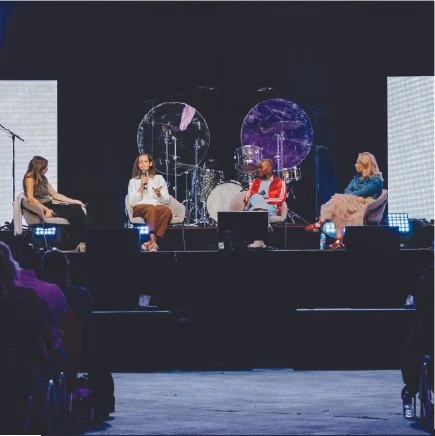
Father Heart of God - Amy Hughes, Jo Hargeaves, Hope Plumb, Sahar Twesigye - Live at The Orchard Conference 2025
from The Orchard Podcast
58m 54s
This seminar, led by Amy Hughes and a panel including psychotherapist Joe Hargreaves, Hope, and Sahar, explores how to experience God as a good father despite limited earthly fathers. Joe discusses how early father relationships affect the nervous system, often trapping individuals in survival states like fight, flight, freeze, or fawn, which distort perceptions of God’s safety and love. She explains that attachment styles from earthly fathers can be projected onto God, but practical tools like deep breathing, body-based safety practices, and reframing narratives can help restore a sense of being safe and loved. Hope shares her adoption story, highlighting how her parents’ consistent message of being chosen and unconditionally loved shaped her understanding of God’s adoption, yet she struggled with striving to earn that love. The panel concludes that walking in this reality requires actively retraining the mind and body to accept God’s unconditional love, letting go of the need to be perfect, and trusting God’s faithful narrative. The session ends with a call to stop fighting and simply rest in being enough through Christ’s gift.
(upbeat music) Hey everyone, welcome to the Orchid Podcast with Amy Hughes and Rachel Hughes. We hope this episode encourages and inspires you today. Good afternoon, I hope you've had a good lunch and all that good stuff. I haven't got Rachel here to banter with me about where to go for lunch, so maybe later. But I'm just gonna read the seminar blurbout just so you know that you're in the right one, okay? So this seminar is, how do we walk in the reality of having a good father when our earthly fathers are limited? This seminar is for anyone who finds the idea of God as father a bit challenging and wants to dig into how to engage this part of God's character. This could be because of your own experience or lack of your own father and because you've always wrestled with the image of God being a good father. So that's what we're gonna tackle in the next hour. If you're in the wrong seminar and you actually meant to be in the one about being a good parent, that's in hall two or the other hall basically. But I'm just gonna pray for us if you wanna, those close your eyes, let's just invite the Holy Spirit to come and to speak to us and then I'm gonna introduce these wonderful ladies here next to me. Okay, well, Holy Spirit, oh, again, we just thank you for your presence here with us this day. We thank you for everything that you did this morning. We thank you that you are cultivating the soil in our hearts. And, Lord, we invite your tender spirit. Father, where this stuff is hard to begin to grapple with at times. We pray now that you would bring an ease and a safety to this room. A pray Lord that you would give insight to where insight is needed. We pray that you would speak and open us to the reality of how love we are by you. So leaders now, Holy Spirit, in Jesus' name. Amen. Amen. So I'm just gonna introduce the panel. Why don't you introduce yourself over to write to them and I'm left and all the way over. Yes. Hello. Hi, I am Joe. My name is Joe Hargreaves and I am a psychotherapist. I'm based in Lincoln, so I live in Lincoln. My husband and I lead a church together. We have three children together. And the thing that I feel really passionate about is about intersecting neuroscience and scripture. Well, actually, I used to say that. Now I say submitting neuroscience to scripture. So everything that we're learning in about the brain and then submitting it to God's word when it comes to wholeness and wellbeing. Hi, everyone. My name is Hope. And. Hello. I'm. Okay, let me just say this. I'm Perry Manipausal, so I like. Forget what I'm saying. Half we do. And that leads to just. (SIRENS) (SIRENS) That makes everyone feel bad. Yeah, we all feel suddenly better now, hope. Oh my gosh. I don't know what I was saying. I've got three kids. Yeah, I'm. I sit on an adoption panel and I sat up at. I was the co-director of a charity that provided support for vulnerable women. Yeah. Yes! You got a cheer. They really like you, hope, they do. Hi, everybody. My name is Sahar. I recently started co-leading a church with my husband in London and the church is called St. James Kidbrook, so we're in Southeast London. Also, mum, two four, two boys, two girls. Yeah. And then. That's me. Very good. Well, thank you so much for. We're going to pick these guys. We're going to pick your brains. But I mean, I read the seminar, blah, blah. But I mean, the heart of this conversation that we're going to have is that obviously this morning, you know, I sort of painted this. this wonderful view, right, of God the Father and that he wants to lavish his love upon us and that we're adopted and all of these amazing truths. But the reality is that it can be incredibly difficult to walk into that reality, right? Maybe because of earthly parents, you know, authority figures, you know, we sort of project that, potentially. And so, I guess what we want to discuss here is how do you even practically begin to walk into the truth that we are beloved daughters? How do we experience that freedom from what I told you about this morning? So that's kind of the hope. I hope that there is some insights that come, that there is a fresh, I guess, practical help to walk away with from this time. And then we're going to have a bit of a time of prayer ministry and then we've got half an hour of the band coming back and we're just going to have some acoustic worship and prayer ministry all happening. People might come in from other seminars as well, just to join in this space for half an hour until half past four before we go for tea. So that's kind of the plan going forward. But we're going to start with you, Joe. With your psychotherapist hat on, you know, we do talk about how our earthly fathers or earthly sort of authoritative figures they do affect our view of God. Is that true? What's happening here? Can you speak into that a little bit? Yeah, I'd love to. I think one thing that when you look at the brain and your wider nervous system, so that's like the thinking that your brain is the CEO of your nervous system and then you have all of that wider nervous system that you feel the shifts in it when you feel safe and don't feel safe. That nervous system and your whole being is really created to know two things, one that you're incredibly safe and two that you're incredibly loved. And that's a wonderful intersection between neuroscience and Scripture that really agree on those things, that in order to feel grounded, in order to feel safe, they're two really key components. And I think with the farther things, if you haven't grown up feeling particularly safe in that love, in that unconditional love that God offers us, if our earthly father wasn't able to offer us that, it has a profound impact on our wiring. And when you don't feel safe, you go out of, to use the language, the parasympathetic part of your nervous system, the part in which you feel grounded, and you which you feel peaceful, the part in which even your digestion works well. And that's why a lot of people often have digestion issues and when you trace it back, there's often some stuff around early childhood things. And so we get knocked out of that part of our nervous system and we become very hyper-vigilant. And we tend to go into four states, and I know these are really quite well talked about now, but fight and flight, freeze and fawn. Fight or flight is kind of two sides of the same coin, of where flight, flight is about feeling very action-oriented. So often you can see that overachieving, feeling very hyper-vigilant. The flight is just the kind of wanting to disappear. The freeze is just feeling very kind of shut down and numb, and the fawn is very much around people pleasing and trying to get safety. All of these things are about trying to gain a sense of safety. And if we're not offered that sense or that sense of safety, or we don't have it, it's not really clear for us when we're growing up with a father figure. It impacts us at every level. And then your nervous system just kind of just gets stuck. They get stuck and can cycle in those. And then that impacts how we feel. I mean, for many years, I work with women who I would say have been cycling in and out of fight or flight for decades, or a sense of forning, you know, trying to keep everybody happy. I see that a lot, particularly with women in church, because church kind of loves to build on that narrative a little bit. Don't we have like a good woman should just put everybody else before themselves, keep everybody happy, and that can really play into that fawn state. So I would say it's really kind of that lack of perceived safety, or lack of actual safety. And then then being introduced to a father in which you feel incredibly safe, in which you are actually incredibly safe with. Sometimes you can know that spiritually, or you can even know it in your soul, in your mind, your will, in your emotions, but you don't feel it in your body. Because your body has been very used to that self-protective high for the vigilant state. So you can feel, I know that God loves me, I know that he's good, I know it in my mind, I feel like I know it in my emotions, but why do I have this sense of fear still living in my body? So I'd say those things are really real for people. And what you say is the same for any, for an authority, authority figure. Like, is that the same idea of, you know, not just a father, that could be a parent, anything we project? Can you speak into that? Yeah, I do, I think it can be, yeah, key figures in our life. But there's something isn't there about a mother and a father role. But yeah, key figures or a carer, whoever we've grown up and whoever's spoken into our life. And it teaches us about early attachments. So I always say our attachment style, how we learn to attach to people, impacts how we connect with God. Because I found with my own dad, I just became very avoidant in my attachment style. He wasn't really around physically and I love my dad. He's a good guy, but he wasn't around. And so I learned that really showed up for me.
and me probably in the first 10 years of my marriage, of me just thinking, knowing that I was safe, emotionally and physically, but something in my body, I was just very, very defensive and very avoidant of the mobility of any affection, and we can so easily project that onto God. So our different attachment styles, we can be really anxiously attached, if like, please don't leave me, I'll do anything to try and keep you and not annoy you and try and be attached to you or avoidant of, I'm just going to disconnect for you, from you, or sometimes switching between the two. And if that's been our experience with our earthly father, it's very easy to project that onto our heavenly father, I think. Yeah. So just, I'm going to say with you just for a moment, I know this isn't on our notes here, but. How. Can you just give us a whilst we're with you? How did you begin to walk that out? Like you were saying, relating to your husband, what has that practically looked like for you to disassociate? Yeah. I think understanding this narrative about safety, that actually the reason why I'm overreacting towards my husband about this issue is because actually the story I'm feeling is I don't feel safe. So you just think that you've done this small thing and to somebody else, it could be totally insignificant, but I have gone off the handle at this, and I am irrational. I don't like that phrase, because I think everything makes sense. So I just want to offer as like a sense of validation that if you think you behave in ways that feel outrageous and don't make sense, they make total sense given the wider narrative of your story, of your history and your wiring and your early wiring, according to what was safe and what was not. And there's this great phrase, say, if it's hysterical, it's historical. And I quite like, as there were oftentimes that I would be hysterical about things of like you haven't strapped the car seat in right, or like you didn't put the batteries in the fire alarm, and me rather than just saying that, I'd be off the handle, because the message I'm hearing is I'm not safe, you're not going to look after me. And so the narrative I've had to work with between myself and God is being safe. And not just telling myself that, offering that sense of safety to my body. So things like deep breathing. I know that can often be seen as like quite a new age practice, but breath is God's idea, so we'll claim it back. And so that deep sense of breathing shows our body, okay, we're not running away from anything, we're not under threat. So deep breathing, making your exhale longer than your inhale. Even offering things like physical sense of safety of like hands on the shoulders, that kind of thing, a narrative of, I'm safe and I'm loved. And there's just lots of things throughout scripture. The one I particularly love is there's something about when you're feeling anxious or fearful. If you lift up your eyes, it does something to close that thought loop. And I remember studying that and thinking, Psalm 1-2-1, I lift up my eyes to the mountains, where does my help come from? My help comes from the Lord, the maker of heaven and earth. And so many ways in which God offers this safety and kind of tools all the way through His Word. So I think offering yourself that somatic body safety, rather than I've prayed about it and I still am behaving badly, I must be a terrible Christian. You know, I must be a bad woman or maybe this is, I've got a demon and all that kind of narrative, which can sometimes be the case, but more often than not, it's pain and trauma, isn't it, that people are experiencing. So offering safety, reframing your narrative, breath work, that kind of thing, I think, helps. So good, that is so helpful. Yeah, I sort of want to go into pre-ministry now, but I'm holding back. So hope you've had a different experience. Could you just tell us a little bit about your story, your experience? Yeah. I could listen to you, Joe, for like hours, or like, tell us more. Yes, definitely, people. I am adopted. I am an adopted child. I might be 45, but I still refer to myself as an adopted child. And my story is that my birth mum came to the UK from Zimbabwe when she was 17. So she was coming over to study, but she obviously found herself pregnant, but her family didn't know that she was pregnant at all. And she had been to a Christian school in Zimbabwe. And when she realised that she was pregnant, she knew that she wouldn't be able to keep the baby me, and she knew that she wanted me to be raised by Christians. And so she somehow found people who had had their friends of friends, children, fostered by my adopted mum and dad. Stay with me here. So my adopted mum and dad had fostered over 70 children in their lifetime. And so they were really well known for fostering. And yeah, that was how my birth mum came in contact with them, someone was just like, "Oh, yeah, we know these people, they foster." So she went to them herself without the help of an agency or anything like that and just said, "I am having this baby. I can't keep this baby. Would you consider raising this baby?" And so my adopted mum and dad were in their 50s at the time, and they are white. And I think they had never. They'd had two of their own birth children, and then they adopted my sister from another family and then adopted. They ended up adopting me like years and years later. But I think before I came along, they were like, "Yeah, we're good with the adopting thing. I think we've finished." But then I came along and I think my birth mum presented such a compelling case that they decided, "Yes, actually, we will. We'll do our best for this baby." So I was actually handed over to them when I was two weeks old. So I have no recollection of my birth mum, but I do really clearly remember social workers coming in and out of the house. I remember a conversation where my mum said to me, "What do you want to call us? You can call us whatever you want." And I was so confused by that question. I was like, "You're my mum. Why wouldn't I call you mum?" Because that was all I'd known. But I think kind of having the agency, me being able to choose, so I have to commend my mum and dad and say, "That's incredible." I think this was not pre-google, I guess. Yeah, pre-google. So they were really relying on the church network to help them parent a black child as a white family and just any questions that I had, they would make sure to try and find out the answers in the best way they could. And I think I really have to say that I think there weren't that many examples of translational adoption at the time, and I have to go, "Do you know what? You guys, you did a. " Can I say I think they did a great job, even though I'm the one they did a good job with? Such a good job. Yeah, that's my story. So being adopted then, how has that impacted your. or has it impacted your relationship with your heavenly father? Has there been any challenges? It's been solely positive. You talk about your earthly father being wonderful. Yeah. Yeah, let us in a little bit. I've been fine. Every time someone's like, "I T1 talking about this." I'm like, "No, of course not, and I really don't." But I think kind of talking about how amazing I think my mum and dad are is. Yeah, has gotten to me. I think I. Well, I know that I was. My mum and dad were really intentional about. instilling in me the narrative that I had been chosen by them. And so. to grow up in a Christian home, knowing that God chooses us, that for me was a living example of that. And as I was thinking about this seminar today, it's. There was nothing that I could have done to have been chosen by my mum and dad. I came to them as a baby. I came with nothing. I've got nothing to offer. And that's how we are when it comes to our relationship. With God, there's nothing that we can possibly give to offer ourselves or make ourselves worthy of adoption. And I think it's Ephesians 1 verse 5 that says, "He's predestined us for adoption as his sons and daughters, obviously." But I think we almost come. We come to God, almost in debt. We're in, like, minus figures, because he has called us. I think when you think at your heads around that, for me, God has called us. My parents chose me, so I was kind of. him in minus figures and yet it just is because that's what he's done and it's through Jesus, it's through what Jesus is done for us. That's what makes us worthy. That gift of righteousness, again, he gives to us. We can't earn that gift of righteousness. So I just had a living example of that and I think maybe the challenging thing for me was that I wanted to be perfect to say thank you. I just wanted to do the right thing all the time and you just can't possibly carry that weight as a child, as a team. But again, that's just an example. I think us as humans who want to do things to say thank you to God, but we can't. We just are. It's just you just need to be. You just come as you are and that's enough because of the gift that his son has given us. It's kind of mind blowing me. So in that spot then, it's so helpful. The feeling of like I am sort of an unworthy. Like how can I pay back, you know, isn't it? How then how practically, like, how practically have you let go of that weight? What has that looked like for you? I think letting go of that for me has been that constant reassurance from my mum and dad that I don't need to strive for it. I don't need to earn it. I can't earn it. That was the narrative. Like there's nothing you can do that will make us love you any less than we do already. And there's nothing that you can do that will make us love you any more. That's just not possible. So it was just this kind of I just sent hat to believe it. Okay, you keep saying it. And actually, I keep messing up. So I can't be this perfect person that I want to, you know, I'm like trying to be perfect for you. I actually can't do that. But your narrative is consistent with me. It's not empty promises. I'm not hearing I'm not hearing something and then something else is happening. And I think that constant narrative just growing up like you are enough, you are enough. Just who you are, you know, you are enough. Just kind of makes you, okay, I just need to stop striving. I just need to relax into that. And at some point I need to stop believing what you're telling me. And I think that's that's the same with our relationship we've got. I need to just stop fighting it and thinking I need to earn this. Like you say I'm enough. Okay. Yeah, so it's so interesting. We're going to come to you in a second. I just just sit here for just two more minutes. Because in some ways there's a choice involved. Isn't there? Joe, would you speak into that? Like, because in some ways we need to retrain our mind, don't we? Like how do we, because it isn't just that God's going to zap us one day. And we're like, oh, Bing, we're like, we know we're loved. It is a, it is a choice what you're saying, hope, isn't it? So could you speak into that? How do we begin to even choose and rewire the brain? Does that make sense? Yeah, it makes so much sense. And we can do that because what we read in Romans 12 to have be transformed by the renewing of your mind, you can actually do that because your brain is neuroplastic. So it's, it isn't fixed. You're able to rewire it at any point. And this is why like wiring, what we've just been talking about this with the youth, wiring your brain according to God's word and the truth of God's word is so important because we can't be trusted to wire it according to our own thoughts. We have to take those cut thoughts captive and make them obedient to the truth of Jesus, like we read in two Corinthians 10, 5. So I think the fact that when you're a plastic anyway that we're able to rewire our brain is God's grace knitted into us at a cellular level, like grace right there in every cell in our body that we don't just because we thought a certain way and you may have shown up today having thought a certain way for decades and decades and you think it's never going to be any different for me. But that God's given the possibility of a very real, beautiful, hopeful possibility for you to rewire. And also your biology is so responsive to the word of the love of God. So this is one of my favourite facts that I've ever found out and I felt like it was the Holy Spirit that taught me and then I went and did the research and was like, wow, this is exactly it. You mentioned it earlier about safety and one John 14 of perfect love, curse out fear. And that when you're fearful and when you have a narrative of I have to strive or that kind of thing, we get filled with cortisol, that fear and adrenaline. So cortisol becomes too much cortisol causes dis ease in us, that physically or emotionally, mentally. But when we meditate on the love of God and we get into Romans and look at the fact that nothing can separate us from the love of God that's in Christ Jesus, when we look at Ephesians that the love of God is high and wide and deep and long, when we meditate on those truths and we choose, like you said, that we make that choice to meditate on the love of God, our body begins to produce oxytocin, the love and the bonding hormone. Now oxytocin is the very hormone and neurotransmitter that gets rid of cortisol, almost like a pack man. There were two young in the youth to understand what I said when I met a pack man, they were like, what? I was like, Roblox, grow a garden. But anyway, so it literally oxytocin eats up cortisol, but it's one John 14, perfect love, oxytocin, curse out fear, cortisol. And that's the truth that lives in our physical body. So you have physically been made to make those choices, God wired it into you, but just meditating on His love doesn't just have a difference on your spirit or your soul. It changes the physiology of your body. It's so good. I'm just going to, like, I'm diving into like real practical, practical. So, so how do you, what does it, what does that look like for you? How, like, is it like, you know, a candle and meditation? Because some of us are like the thoughts in my mind are like, like, oppressive. Yeah, absolutely. The lies are like, intense. I can't, I can't even get that in. Like, what, can you speak into that? How would you help us? Yeah. So I think two Corinthians 10.5 is really key of taking your thoughts captive. So when you're rehearsing things in the shower and going over your worst case scenarios or when you're driving around and you've gone to a dark place in your mind, is knowing that just because you think something doesn't mean you have to continue thinking about that, but it's difficult. It's really difficult because we get so used to our own way of thinking. But also this is where the word of God is just so incredibly powerful because biblical meditation, whatever that looks like, for some people, it looks like sitting with a candle and reading, for some people it looks like doing it while you're knitting, for some people you're boxing in the gym, for some people you're going for a run, and it's literally taking a truth out of the word of God and churning it around your mind. That's literally the Hebrew Horgorff and meditate is to churn, to chew, to put it over again and again in your mind because the more you do that, the more your brain will wire recording to that truth. So it's about catching your thoughts and just beginning to gently rewire them according to God's truth. And I think being really compassionate because sometimes I'm able to do that, sometimes I go really far down the dark alley and I find myself not a great place and sometimes I catch it really quickly. So I've got to be compassionate, but knowing that just taking that phrase, I'm loved with an everlasting love, even pairing it with a breath prayer, like inhaling thank you Jesus, exhaling that your love will never leave me. You can do that when you're in Aldeys or wait trays if you're doing wealth yourself, you know, whatever, or like, you know, wherever you shop, like on the school run, whatever it might be in the staff room, you can do those things and it creates a sense of safety. It not only that, it brings you into the prefrontal cortex, which is where you do all of your best thinking and where you think logically and empathically. So you can shift your wiring, you can shift your state and once you shift your state, you can begin to change the story you've told yourself. So change your state and then change your story. And the state comes from the feeling safe, the breath prayers, the rewiring, taking your thoughts captive. So good, thank you. Sahar. Yes, ma'am. Yes ma'am. Tell us your story. It's an amazing story. Well, I think God is so kind. So I was born and raised in the Emirates and I moved to England when I was 17. But my parents and I'm ethnically from Sudan. So North Africa and we had a great childhood. I'm the youngest of five. And yeah, we had a great childhood in the Emirates. Like, it really is a bubble. If any of you have been to Dubai or Abu Dhabi, I grew up in Abu Dhabi. And you have everything. The sun, it's an island, a beach, great schools, super safe. And I grew up Muslim. My parents were conservative, but they weren't radicalized. And they raised us to really honor God.
They made sure that we went to schools where we were taught, you know, Islam and we were taught how to pray and to follow the faith, but they never forced me or my sister. So we're four girls and one brother and I'm the youngest. And they never forced me or my sisters to cover our hair. They basically created the foundation of, you know, here's what we believe. These are our values, you know, but at some point you'll have to take responsibility and, you know, you know, stop to take the, your faith has, it's your responsibility. And, yeah, so I grew up with that, but they were also quite protective and strict by Western standards, but not so much by Middle Eastern standards. So we lived in a bubble, was very protected. And then the other flipside to that growing up in the Emirates was growing up as a young Muslim woman. I was used to seeing the double standards in society. How men like the misogyny was real. And it was to your face. The thing though is that when you grow up in a culture like that where you're experiencing it together, that becomes the norm. No one's speaking up and saying we're oppressed. Nobody's saying that because you're all experiencing it together. And how I internalized that my view of God or Allah was that he was a distant tyrant. And the relationship in Islam is actually that God is, you know, he is Lord and we are his servants to call God a father was actually blasphemous. And then I moved here to the UK where I had my first year lived in Unihol's, came here to London. And I had freedom for the first time. And not too long after experiencing that freedom because, you know, I being the youngest doesn't help. It felt like I had seven parents. And or six parents, you do the math, the math is not math. But I could not wait to let loose because everyone told me how to live my life. And so by the end of first year, no one could tell when I was sober or not because I discovered alcohol and partying and everything that comes with that. And so I carried on with that. And in my second year, my family finds out about my drinking. And, you know, if you're not familiar with Islam, drinking is one of the highest sins you can commit. More so if you're a woman, not that that's written down, but that's how it's culturally experienced. And, and I had gone out drinking with my cousin, male cousin, who then accidentally tells my brother while they were drinking. So because they got tipsy, then they he leaked it and then it went up to my parents. And my family was so upset and disappointed with me that my father was actually thinking of pulling me out of university because he said to me, I would rather have a daughter with morals than a daughter within education. And in my second year, I had moved in with my sister by that point. And she really felt bad for me. So she said, Dad, you know what, let's give her another chance. I'll advocate for her as in I'll watch out for her. And I was pretty much under house arrest. I couldn't socialize. I couldn't go out. I just had to go to uni and come back. They knew my timetable when I started when I finished. So a lot of control. And I had a crisis at that point because I felt like I was the worst human being on the planet. So Ramadan came and I thought, this is my time to get right with God. So I fasted, I read the Quran, you know, front to cover it back to back. And I felt even more depressed by the end of it because Islam is a religion of works. You know, you you go to heaven if you do more good deeds and if you do more bad deeds, you go to hell. And during that time, my sister had a flatmate who was a Christian who loved Jesus and was very vocal about it. So much so that before I moved in, my sister told her, keep your religion to yourself. Please don't preach to my sister, right? So when I went through that crisis, I would go into her room and I didn't know I was doing this. I was constantly interrupting her quiet time with God. So she would be praying and I would just knock on the door and sit in. And I would do that because that was the only place in my life where I felt loved and safe and seen. And I didn't know that I was experiencing the presence of the Holy Spirit. And so one day I come in in despair and I said to her, "Dina, choose this Brazilian woman," I said to her, "I feel like all of us Muslims are going to go to hell because no matter how hard I try to get right with God, I just can't." And then I leave the room and later she tells me that night she hit the floor and prayed for me and she said, "Father, I cannot reach the gospel to this young woman, but you're more powerful than I would you please reach her." A year later, this is now around coming to my final year or so or maybe it was maybe second year. I meet with a friend who was Catholic, not practicing and we're both talking about religion. And I just said, "You know what, I hear you have, you know, I see you've got a Bible, can I borrow it?" I'm just curious. So she gives me her Bible and so on my train journey from university back home vice versa. I start reading the gospels and I meet the person of Jesus. And that was it. And I was struck by the kindness and the love of God. And it was the story of the woman that was caught in adultery because I saw myself in her. And how, and also I could relate to that story because that is exactly what would happen in my culture. And how she was caught in the act and the double standards are seen there where the man is nowhere inside. It was her that was being condemned. And Jesus, God made visible. Look, Sarah, and says, "Go and sin no more. No one accuses you." And I just said to myself, "Who? What kind of God is this? And why hasn't anyone told me about this?" Like, "No one told me that God was like this. I didn't know." And so from that moment, you know, I knew I just fell in love with Jesus and I wanted to follow him. And yeah, I knew there was this weird Christian guy at my uni and I knew he was weird because when I'd ask him about a popular song, he'd be like, "Oh, I don't know. I just listened to gospel." I'm like, "Okay." Basically, of course, I end up marrying him. That's why I was banandru. And the rest is history. You know, I became a Christian and then I knew I had the difficult decision to make to tell my family. I knew that my family wanted me to go back home. My mom had a job set up for me. My life is waiting for me back home. But I just knew that I knew that I was supposed to stay here and that I wanted to serve Jesus. And I couldn't do that if I went back. I just wouldn't have the freedom to practice my faith. And so I made the decision the day after I graduate because African child and those of you that have Middle Eastern or African parents will know you have to give your parents that degree to make them proud. You were born to give them a degree. And so I waited to give them the honor of saying, "I've paid for my education. I got that degree. But I knew that I was going to tell them the day after." And that was one of the worst days of my life. And yeah, like it's a very, very long story. But long story short, I was estranged from my family. My sister kicked me out. And that began a very complicated relationship with my parents so with my siblings, which led to my parents not turning up to our wedding. I was held on the house arrest hostage again. My father took my passport when I wanted to marry Andrew. I had to escape from Abu Dhabi to fly back here. And yeah, very, very difficult. My father, you know, I didn't have a, had a, it's especially fractured relationship with him. Being the youngest, then we were the most alike. So I really was daddy's girl. I loved him. And then I just saw this flip side of my parents that I just couldn't recognize who they were. Yeah. Yeah. It's just, it's so interesting. Because in some ways, what, even, I mean, thanks for sharing all of that. Yeah, I mean, there's so many questions. But In some ways it's like you met the father.
through reading about Jesus, right? We see the Father by how we know Jesus, right? And so in some ways it's like, do you feel that because of the extreme difference between Allah and what you read about Jesus, is that been in some ways easy to see God the Father, but then you've got earthly Father that you've obviously got, there's pain there. Can you help us, what has that looked like for you? I guess associating, like how is your view of God in all of your story? What has that looked like over the years? Yeah, what has that, what's the journey been? - So also a journey. Jesus I understood and loved with all my heart, but in my mind coming from Islam to Christianity, especially at the beginning when I was in that, before I prayed that prayer and made that commitment, I was in this between place of God, if you're out there in your Jesus, please be Jesus. I can't, I please, I want you to be Jesus, but I'm so afraid of leaving Islam because all we've been told from a young age is, like a fire. So there was a real fear there. And I saw God the Father like I did Allah, and I thought he was far away and distant. I didn't understand the connection, and actually that's something that my husband Andrew helped me with. Remember one time calling him and saying, "Can you teach me about the Father? What's he like?" 'Cause I get Jesus, and that's when I began to learn that Jesus is the Father, and he made the invisible God visible so that we can understand what he's like. And so I had that, but I came in, I still came in with the baggage of how I viewed myself as a Christian from Islam, which is I still felt disempowered. I still felt like I had no voice. I still felt oppressed, but I knew God was amazing, and I couldn't make that connection. And that journey for me, the healing started actually, not both my parents have passed away. And after my father died, that was a very difficult time for me. When my mother died, I was there with her in the hospital and she allowed me to pray for her. And I just felt the presence of God in that room, but when dad died, it was around COVID and he was all the way in Sedan, and I couldn't see him. And it was very complicated 'cause after he died, then the family gathered to kind of start sharing the estate and in the will, and this is something he told me when I became Christian, he was like, there's two things I won't do for you if you make this decision. I won't marry off, so he didn't come to my wedding, and he said, you will inherit nothing from me. And so we got to a point before he passed away where we made peace, and he met the children. He didn't want to see them for years, but he did. And so there was this beautiful coming together as a family, but also the will came, and he had written it at the height of his anger. And so it was almost like a slap. The enemy came and brought this slap from the past, a blast from the past, and just. And to hear those words after he's passed was so painful. And after he died, I think that's when I struggled, I really struggled. Part of our upbringing and culture in also in Islam is, when your brainwashed to be subservient and obedient, you do things because it's the right thing to do. You don't acknowledge or listen to your body. And so when my father treated me that way, and when he said those painful things, and the words times when he said, "I will never forgive you even when I go down to the grave." I had already leaped and said, "I forgive him. I hold nothing against him. He's been an amazing father to me." But after he died, I started to realize that my body was seeing something different. And I actually, funnily enough, the trigger point came was during a safeguarding training, funnily enough, I was working at my previous church and we were doing the safeguarding training, and it talked about, it was talking about healthy communities and started to talk about abuse. And what abuse looks like? And as I started to read, and I remember a phrase that said, "Victims of abuse are usually the last "to acknowledge that they've been abused." And I completely fell apart. And so much so I wasn't okay, and that's when my husband said, "Baves, "I think we need to get you some help. "You're not okay." And all the pain had festered into resentment towards men and I felt disconnected from the father and all of it came out. And so I started a journey of healing where I would meet with my therapist who really helped me actually change my life. And yeah, and after I did that, the thing then the next part of my healing was God began to speak to me about what it means to be a woman. And how much He loves us as women. And He took me right back to Genesis and it's the verse that says, "I made them, "made the male and female in his image." And He started to speak to me about, "You are made in my image full stop. "You have a voice, I've called you to lead, "and I've called you, you are called, and I love you." And that's that. And so I started to unpack that further along the journey as well. - Thank you. - Yeah, I just, just sort of, for all of you actually, I guess the thing that's coming into my mind is this idea of, we talked a little bit about choosing to walk it. I mean, taking the courage to begin to, I guess pursue healing and the idea, where you've been a victim of abuse is courageous to begin to step into that. I guess my question to you all is, where is the role of repentance as a gift where we have just shaken hands, right, with our projected associations, fears, whatever it is? Where is the role of repentance and where is the role of warfare in where the enemy, like you said, you've been slapped, you know, you've got slapped in the face, you know, it felt like with the enemy after. Like, can any of you speak into, like, where's the role of, like, just warfare because the enemy's coming after you and the place of repentance? Is that really heavy? And I didn't prime any of you for this. But can any of you step into that? I can't, I mean, just to give us some practice, I'm trying to give, like, practical, yeah, outworking. I'm looking at Joe because I think therapists and psychotherapists are a gift from God. And I actually think that me doing therapy was my process of repentance because you're sitting down with someone who is like holding up a mirror and it's helping you see things that you just, you don't know what you don't know. And then they give you tools, practical tools. So one of the things that helped me, like, I love how practical you're being, Amy, so that we can actually leave with something. A huge part of it is actually, I think, renewing your mind and actually having these conversations helps with the renewal of the mind, but you do need the tools. And for me, one of the most powerful tools that my therapist helped me with was the thought journal. 'Cause in our first session together, when I told her, okay, this is where I'm at, blah. She was like, okay, this is what we would call complex trauma. There's a lot there. And I think she could probably see that the, my mind probably had a lot of thoughts that needed pulling down and working through. She said, you need to capture everything down. Write a thought journal and it's not like a normal journal where it's like, okay, so I'm thankful for this today. It's like, no, these are the thoughts as they're coming, just to help you actually just be aware of what's in your mind. And as you, the visceral process of writing it down helps you then see, wow, that's a lot. I didn't realize that's in my mind. So yeah, I just thought I'd put that out there. Okay, I think, I think yeah, it'd be so helpful to hear the actual science behind. But no, I'm, what I was gonna say was, I'm not losing this train of thought, I'm still on it. What I was gonna say was, I think in, when you talk about repentance, it's saying me, I think it's really important for me personally to repent of the lies that I,
have allowed myself to continue to think and believe. So that it's sometimes a really small thing where it's like, I'm not good enough. So I need to try harder here. I need to do better in this area or just those small little whispers, I think, that you start to believe and that then affects your behaviour. And I think the thought journal is really helpful because it helps you to catch your thoughts. And I think those moments, for me, I have to have, I'm really retained in my life. So there's things that I need to do every single day to help me feel grounded and like there's some sort of control over my side. And I think there's things that I will practically do. So when I'm getting dressed in the morning, morning, I will imagine I will say I'm putting on the armour of God. So I'm putting on the helmet of salvation. And I go through it as I'm putting my clothes on. I'm remembering those things. And then at the end of the day, when I'm saying good night to the kids, I try and do it no matter how kind of rushed we are or late we are or whatever, no matter what sort of moods we're all in. I'm like, right, we're going to say the Lord's Prayer. Because for me, I'm like, this is what Jesus told us to pray. When I don't have the words, when you guys are like, when I say to them, what do you want to pray about tomorrow? I don't know. Is there anything going on tomorrow? No, not really. Like, OK, so we're going to pray the Lord's Prayer. And I think the putting on the armour of God, that's a marker in my day. I know that's what's going to happen at the end of the day. Right, we are going to do the Lord's Prayer. I'm going to do that with the kids. And just think sometimes the action of saying things, even when your heart isn't quite there, or your mind isn't quite there, it's like, OK, I know this. This is what the Bible says. I'm going to do it. I'm going to say it even though I can't quite feel it. And I think on a human level, and you can say whether this is rubbish or not, I think just that habit of doing that stuff, of repenting and not letting those lies in, of catching those lies, means that eventually you start to get it and believe it. Yeah. That's exactly what happens. Like, with those little anchors, with those anchors, with those repetitions. And I love that you're routineed in your day. I'm thinking, gosh, I'm terrible with that kind of thing. I'm terrible. But then I think, no, I do have little anchors of things like, OK, just a thought check in the shower, just something of like, and something of what I was saying to the girls earlier, Psalm 23, surely your goodness and love or mercy and love, depending what paraphrase you read, will follow me all the days of my life. Just having that, just to churn it over in my head and my heart to help interrupt any lies that I'm entertaining. And I love the question about around repentance, because I think repentance is a gift. And it's beautiful to repent when you, an easier to repent when you feel so seen and understood by God. It's not like he's wagging a finger at you saying, "Sorry, you know, all that." Because there's no condemnation for those who are in Christ. That it's a beautiful invitation to freedom. And I think what's been so wonderful for me is, I think, a history with my dad of me feeling like, "I'm too much, I'm too complex, I'm a problem to be solved," when reflecting with my Heavenly Father that he understands me completely, that I'm not a riddle to try and be figured out or I don't need to be solved, that he fully understands me. And feeling so seen and understood, then makes repentance feel really safe. But really safe to say, "Sorry," and be really vulnerable before him. Whereas the thought of being vulnerable for my Heavenly Father, for my earthly Father feels like unsafe, maybe historically. And so I think, yeah, repentance and also the spiritual warfare thing, interestingly around therapy, sometimes I think just the act of going and speaking to someone can be an act of warfare of, "I'm refusing to submit to a regime of hopelessness," or, you know, a feeling and feeling this, "I'm going to find ways," and they don't have to be, "Look at what we might think spiritual war looks like." Spiritual warfare looks like, sometimes it looks like speaking to a friend, talking about a past trauma, being honest about what happened and saying, "I just need you to help me feel safe as I process this stuff." Even that can be, when the enemy wants to keep you small and submissive and quiet, to all of the shame and all of this stuff, actually speaking out can be an act of spiritual warfare in and of itself, I think. Yes, like bringing the light into it, isn't it? It's exposing. So just to, I'm just getting out of the thing, we've got two, three, we've got two, four, 30, two, four, as in with worship up until four. Okay, that's really good. Thanks, Joe. Sorry. I was like trying to look through my notes, like I should know this. Okay, well, we're going to pray, but just before we do, can you just all of you? Like, give us your, I guess something that you have witnessed and understood about the father in your life, like, where is something just like this is who he is? Can you just, just even a, just, I guess, let us into your revelation of God the Father. Such a lovely question. I think it's going back to Psalm 103 that you talked about earlier. Slow to anger, abounding in love, full of compassion, and I guess I'd wrap that all up with what I said previously is just making so much sense to him that he understands us completely with compassion and kindness. It's very good question, Amy. I think, for me, let me speak about where I currently am, I think. I'm just having a revelation over and over again about God's unmerited. How do I put this? His kindness is unmerited. It's something that we can't possibly earn. It is a gift to us. And I think if you've grown up in church or, you know, you sing worship songs regularly, I think sometimes there are phrases that we just say and we just hear, and they don't mean much to us, but sometimes we have to be interrupted. And the thing with the phrase that I've known, and I've had a living example of my whole life with my earthly Father, is that I don't deserve any of this, but it's a gift. Yeah, I think two things for me. We are made in this image. I think we waste a lot of time as women trying to be made in the image of men to be taken seriously, especially in leadership. And God didn't make us in their image. He made us in His image. And your femininity, your gentleness, your strength is from Him, and it's beautiful, and just step into the fullness of that. However God wired you. And the second thing that I've learned about God, the Father is His heart for justice. And that's something that I couldn't grasp because I didn't acknowledge when you don't name the abuse that you've gone through, you miss out on the God of justice. And so if you can't see His justice for you, how are you going to see it in others? And so it's important to call a spade a spade and give it to Jesus. And the fruit that comes from that is beautiful. Thanks so much for listening. We hope you enjoyed this episode. Follow us on socials at The Witcher Women to find out more about everything coming up.
Podcast Summary
Key Points:
The seminar addresses the challenge of viewing God as a good father when earthly fathers are limited or absent, offering practical help and prayer ministry.
Joe, a psychotherapist, explains that early experiences with fathers impact the nervous system, leading to fight, flight, freeze, or fawn responses, which affect how we perceive safety and love from God.
Attachment styles learned from earthly fathers (e.g., avoidant or anxious) can be projected onto God, requiring somatic practices like deep breathing and reframing narratives to restore a sense of safety.
Hope, an adopted child, shares how her parents’ intentional message of being chosen and unconditionally loved helped her understand God’s adoption, though she struggled with striving for perfection to "pay back" that love.
The panel emphasizes that walking in the reality of God as a good father involves retraining the mind and body to accept unconditional love, letting go of striving, and trusting God’s consistent narrative of being enough.
Summary:
This seminar, led by Amy Hughes and a panel including psychotherapist Joe Hargreaves, Hope, and Sahar, explores how to experience God as a good father despite limited earthly fathers. Joe discusses how early father relationships affect the nervous system, often trapping individuals in survival states like fight, flight, freeze, or fawn, which distort perceptions of God’s safety and love. She explains that attachment styles from earthly fathers can be projected onto God, but practical tools like deep breathing, body-based safety practices, and reframing narratives can help restore a sense of being safe and loved.
Hope shares her adoption story, highlighting how her parents’ consistent message of being chosen and unconditionally loved shaped her understanding of God’s adoption, yet she struggled with striving to earn that love. The panel concludes that walking in this reality requires actively retraining the mind and body to accept God’s unconditional love, letting go of the need to be perfect, and trusting God’s faithful narrative. The session ends with a call to stop fighting and simply rest in being enough through Christ’s gift.
FAQs
Our nervous system is created to feel safe and loved, and if an earthly father didn't provide that, it affects our wiring, leading to states like fight, flight, freeze, or fawn. This can make it hard to feel God's safety and love in our bodies, even if we know it in our minds.
The four states are fight, flight, freeze, and fawn. Fight involves overachieving or aggression, flight is wanting to disappear, freeze is feeling numb, and fawn is people-pleasing to gain safety.
Start by offering your body safety through practices like deep breathing (with exhales longer than inhales), placing hands on your shoulders, and repeating 'I am safe and loved.' Reframe your narrative using Scripture, such as Psalm 121, which encourages lifting your eyes to God for help.
Our early attachment style with caregivers, such as being avoidant or anxiously attached, can be projected onto God. For example, if your father was absent, you might become avoidant of affection, which can affect how you connect with God.
Being adopted by God means He chooses us unconditionally, just as Hope's adoptive parents chose her as a baby with nothing to offer. This reflects Ephesians 1:5, where God predestines us for adoption, and we cannot earn it—it's a gift through Jesus.
Accept that you cannot earn God's love; it's a gift. Constant reassurance from trusted figures, like Hope's parents who said 'you are enough,' helps. Stop striving and relax into the truth that God's love is unconditional and consistent.
Chat with AI
Loading...
Pro features
Go deeper with this episode
Unlock creator-grade tools that turn any transcript into show notes and subtitle files.
 PodcastTranscript AI