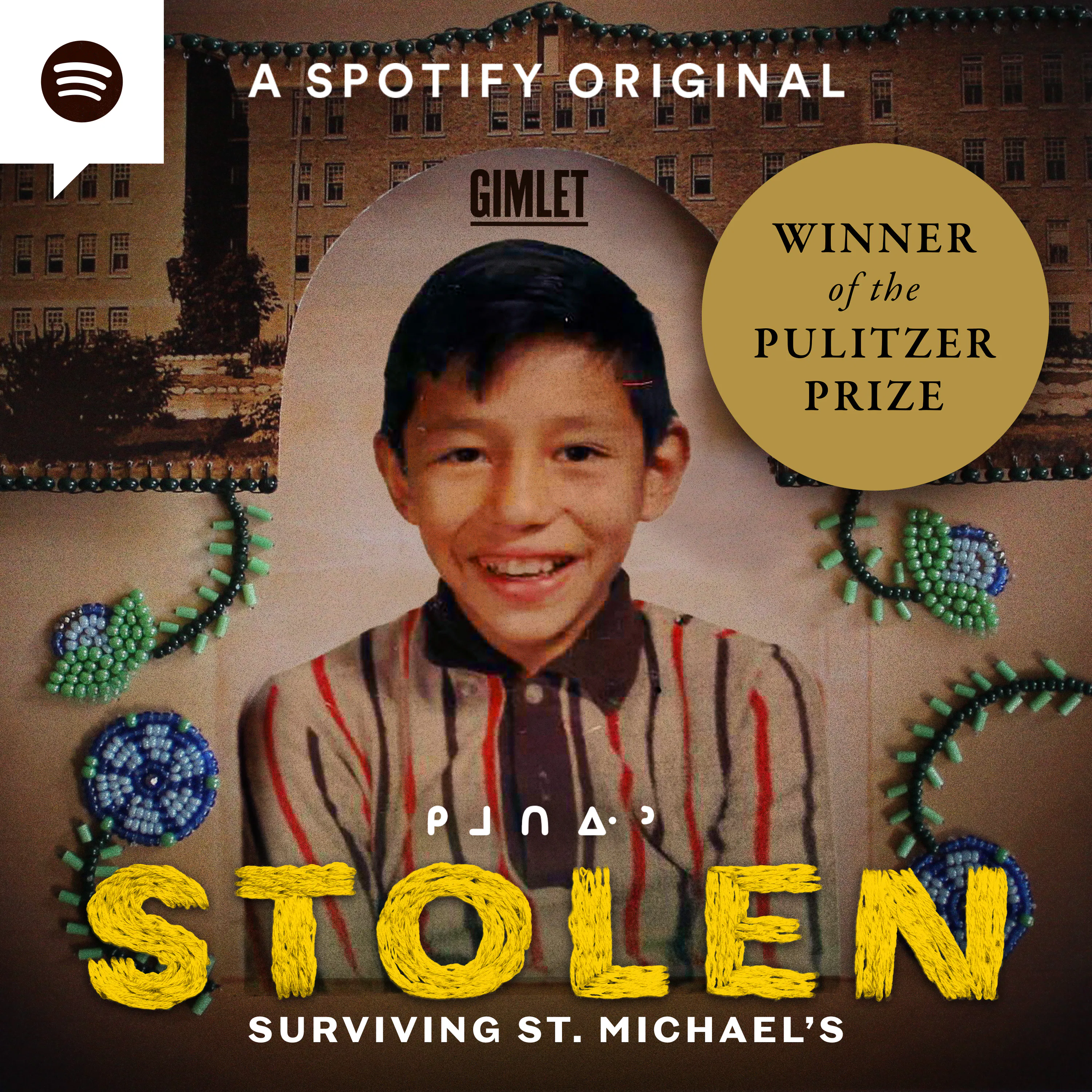
Before we begin, we want to let you know there are descriptions of violence and sexual abuse against children in this episode. Please take care while listening. Previously, on stolen, surviving St. Michaels. Uncle, I want a sexual abuse by a priest. Oh no. Did he say which priest? - What's a coach? - Coach. He's a married uncle. He was a good priest. Like the guys in the penitentiary, I said to them, "Oh my God, maybe I should be in here also, but I never got caught." Oh my God. Actually, just what killed Father Gwitchie, the national event in Edmonton, I come so close to throwing him over that balcony. - You wanted to charge the priest? - Yeah. - But there's nothing ever to do with it. - Who is it? - Father Gwitchie. - Father Gwitchie. So we are at this nursing home and a small town just as Edmonton. I feel like I'm going to just want to go in because I'm like, I spent so much time imagining this moment. - Can you feel ready? - No. I don't feel ready. No. God. I don't know if you could feel ready. I do not feel ready. I'm Ann Alberta, sitting in a rental car with my producer, Anya Schultz. We're outside of Father Gwitchie's nursing home, and I'm about to go in to try to talk to him. This whole thing started because my brother Halle shared that post about my dad and about my dad beating up a priest that had abused him at my residential school. And so we've talked to so many people and heard about so many priests. But he was the first someone that we heard about who was abusive to kids. And we think he could have been back in Saskatchewan around the time my dad was in the RCMP. So he could have been the guy that my dad pulled over. I don't know. I want to go and ask him and I want to ask him about the allegations that he abused my dad's brothers Ivan and Harris. I have a feeling that he's heard of these allegations before because they went through the IAP process. So all we can do is go and ask. After that conversation in the car, I did talk to Father Gwitchie. We spoke for a long time. But before we go any further, I need to tell you we've been cautioned against airing this interview. Here's what happened. After speaking with Father Gwitchie, we reached out to the oblates of Mary Immaculate, the Catholic Order that ran St. Michaels. I told them about our investigation into the school and Father Gwitchie and I began emailing with the head of the Order in Western Canada, a priest named Father Ken Thorsen. As the provincial superior, he acts as a spokesperson for the oblates. He told me they acknowledged the "painful reality that physical and sexual abuse happened at residential schools run by the oblates." But he said my email was the first time he'd heard of any allegations against Father Gwitchie. He said they take these allegations seriously and he hopes they'll be able to respond in a way that provides a meaningful sense of justice to the alleged victims and their families. Including me. But Thorsen also told me that Father Gwitchie has dementia and that the oblates act as his legal representative. He said it would be irresponsible for us to air our interview with Gwitchie. Thorsen sent me a letter from Father Gwitchie's doctor who said that Gwitchie has Alzheimer's and that any information he gives does not reflect reality. When I interviewed Father Gwitchie, we spoke for nearly two hours about his time at St. Michael's, his thoughts on residential schools, and allegations of abuse. And now the oblates were telling us to disregard everything he said. As journalists, we're always weighing the ethics of how to responsibly report a story. And clearly, Father Gwitchie is an elderly man with some limitations. Because of the team, we talked extensively about whether to use this interview at all. Father Gwitchie is accused of abusing his power and harming vulnerable children. And now we were having to consider his vulnerabilities. He's one of the few priests and administrators from St. Michael's who was still alive. He was there for over a decade. He was promoted from supervisor to vice principal to principal and was the last remaining oblate priest to work there. Despite the oblates' acknowledgement of the abuse at residential schools, our investigation into St. Michael's is the first of its kind. We haven't found a single oblate priest who was ever convicted of a crime relating to abuse at the school. The circumstances of our interview with Father Gwitchie are complicated, but it may be the only chance for us to put questions to a man who's been accused of sexually abusing children at St. Michael's. And to hear his response. So for the sake of transparency, and because we believe the public has the right to hear from him, we have decided to publish a portion of our interview. We think it's important to hear what Father Gwitchie has to say, but the allegations made against him. I'm Connie Walker. From Gimlet Media and Spotify, this is Stolen, surviving St. Michael's. [Music] Do you mind if I move this chair closer? Can I sit there? Can I sit there? Oh yeah. Thank you. Yeah. Yeah, I'm glad to get a chance to talk to you. Okay. What was Beardie's like? What was it like to work there? Well, it was always present. Yeah. So that's why I like it. I spoke to Father Gwitchie in his room. He agreed to be recorded, and we sat across from each other. He looked just like the man I've seen in photos, except much older. He was mostly bald with wisps of short white hair around his ears. He wore gray sweatpants and a pair of plaid slippers, and there was a large gold cross hanging around his neck. I wanted to know if Gwitchie remembered my anti-margrit, the one who's wedding he officiated. You did a lot of weddings and beardies, right? Do you remember Margaret Gamble? Yes. Really? That's my anti. I see. Yeah. What do you remember about her? What's your nice CD? Yeah. Father Gwitchie was 89 when I spoke to him. He's a native French speaker and heart of hearing, so I tried to speak loudly and slowly. What was life like at St. Michael's at the residential school? Well, that was successful. That's successful there. How so? What was successful about it? Well, we succeeded. No problem. No problems? When you succeed, you're happy, but we're succeeding. So you were happy? Yes, of course. Why? Why did you like it? Because I was treated properly, and we had fun there and everything. What kind of fun did you have? We produced ball, we played hockey, and football. So we had a blip-pink pong. So you had a good life in residential schools? Oh, yes. Oh, yes. Do you think it was a good life for the children in there? I think in general it was. What was your relationship like with children? I think it was. You can ask them that they liked me very much. You still see that to people. You tell? What was the best for you we had? Why? Why did they like you so much? Because I was good. I was a good man. You were a good man? And a good man, or is it?
Can I show you a picture of my dad since he, if you remember him? Maybe I will remember him, I don't know. I brought along photos of my dad and his brothers' children to show to father Goche. We'll see. Actually, it's my dad and his brothers. What is your dad in there? My dad is not a child there. Why is he? His name is Howard Cameron. Do you remember him? No. This is my uncle Harris. Do you remember him? Harris Cameron. That's really? No. I don't want to lose faith, but it's over all. Do you remember any of those boys? Their face, yes, but not their name. They were all Cameron's. Oh. So, what on this was special? Why are they special? Well, they're my family. Oh, I see. They're my family. My dad is the reason I began this investigation. But father Goche didn't seem to remember him, at least not as a boy. But I want to know, does he ever memory of getting pulled over by a police officer in the 1970s? My father was an RCMP officer later in life. And he said that he pulled over a priest who had abused him and beat him up. Yeah. Were you ever pulled over by a police officer and assaulted? No. No. Goche was so quick to dismiss this question. But I'm not sure he even stopped to consider what I was asking him. A lot of survivors have spoken out about bad experiences in residential schools. Well, I mean, yes, I speak to have some bad moment, I guess. You know, when you get a bunch of kids, you have to expect something like that. There were sometimes punishments or discipline at school, though, right? Well, sometimes I have to expect that. You know, when you get a bunch of kids, this simply is important. Disciplines important? Oh, yes, of course. What about sexual abuse? No, just I never had. Because my Uncle Harris said that you sexually abused him. Oh, you swam? Yes. What did I do? I don't recall that. He says he was sexually abused by you. I don't remember that. And my dad's other brother, Ivan, said you sexually abused him as well. Well, this was in my style. I don't understand it. This was in my style of time, you used kids sexually. It wasn't your style? It wasn't in my way of life. Why would they accuse you if you didn't hurt them? I don't know. I never heard you were like, "You was about it." That's the first time I hear about it. I found this moment in the interview, especially frustrating. My Uncle Harris told me he named father Goche as an abuser in his hearing for the independent assessment process, the IAP. So Goche should have been notified about the allegations made against him and invited to respond. Oh. I don't recall that. Did you get notification that they were accusing you? No. Did you ever testify? Have you ever faced any kind of criminal charges? No, that's not true. Well, my Uncle and my other Uncle, two of them accused you of abusing them sexually. Well, I'm surprised about that because this was not my style to have you with anybody sexually, not even today. What was your style? Well, I was not doing that. I'm going to be interviewing other people from St. Michael's school. And I'm going to ask them about you. Sure, you can ask. What do you think they're going to say? They won't say that. I was abused them sexually. This was not my style. Because for me, that's not a bad thing to be there if you are doing that. Because you're teaching something very bad to young people. I asked father Goche multiple times about allegations of abuse and he consistently denied them by saying it wasn't his style. Did you ever witness other people abusing children? I did what? Did you see other priests? Maybe one time I saw that, but I never paid attention to that. What did you see? What that he was used is all about. What is it? Sexually mostly. You saw someone being sexually abused? Me and everyone have used. Did you see someone sexually abusing a child? Yes, of course. Who did you see? Who was it? Well, I can't get a name because I don't want to put them down. Well, why not? Because it's not my style to put people down. What about the children who were hurt? Well, then I can speak to them. Because that's not applicable for me at any time. So it happens so much to so many kids? Well, I know. That's our style today. I mean, every school I'm sure some of my men are abused. Every school got that problem. Nobody, you see, it's not happening. They are blind. How many people at the school were abusing children? Well, I suppose there were always a couple of guys. Where did it happen? In the bedroom, mostly. How did you witness it? Did you walk into the bedroom and see it happening? Oh, maybe I saw that three times. You saw an adult with a child? Well, it was a teacher. Was a child? Yeah. Yeah. Father Gochie wasn't entirely clear on this point. But he seemed to be saying that more than once, he walked in on an adult abusing a child at the school. But when I pressed him for details, he seemed deliberate about not wanting to name names. So what happened to that person? Well, if I knew them, they were told to stop with the white, I would fire them. Because that's something I couldn't stand. Because I was abusing kids, and this is not very nice. Why didn't you call the police? I don't have a never called police, I just had to swear about it. Who was the superior? No matter which name it is, I tell them that it seemed to take action because it was a swear. Because he knew he was not acceptable in the school. Which teacher was it that you saw abusing kids? No, just like I mentioned that. Why? Because he put them down. Was it another priest who was abusing? Yes. But they heard a child, why not expose them for that? If you think it's wrong. No, I'll report him, but I don't tell them. If you believe it's wrong to do that, why not expose that? Yes, to be fired. That's what I was doing. What Father Gocce seemed to be saying was that he reported abuse to his superior. And when he was principal, he fired people. Who did he fire? I can name them. How many people? Like four people, five people, one? Oh, at least three. Three. Was that ever documented anywhere? Was it ever write a letter? Or did you. How did you. I go and speak to the director. Oh, okay. Oh, no, I don't write it down. And you didn't write it down? No. How come? I just did the swear. Okay. So I was very sorry about that. I know somebody abuse kids, it's actually really. He has to be fired. We cannot keep that guy. Because he won't stop. He wouldn't stop? If he knows that we don't know him.
is doing that right now, he won't stop. Because you know when we start to do that, we don't stop. We need to stop them otherwise they will keep on. - How do you know abusers don't stop? - That's their style of life. - Yeah, how do you know that? - Because by confession. - Okay. - So people would confess to you that it happened again and again and again? - Yeah. If you know we have to take action because it will spread like peanut butter. - Why are there so many priests accused of abuse? - Oh yes. - But why does it happen? - Because they are human. Simple as that. (soft music) - I read an article where you told the journalist that you were speaking with people in prison. And you said maybe I should be in here also, but I never got caught. - Yeah, but you don't go necessary to prison because of abuse. You go for many reasons. You stole your kind of things. Do you worry about getting in trouble because of things that happened in your past? - Oh no, if I was in trouble I wouldn't like that. My parents taught me very well and they told me what to do not to do. I had good parents that can tell you that they were example to me. As far as I don't ever abuse sexually as students. That's something for me to be my style. That's not the defects I had. I do have the defects, but not that one. (laughs) - What were the defects you had? - Sometimes telling lies. - You sometimes lie? - I tell lies sometimes not too often. - Are you lying to me now? - Sometimes I do when that's very often. - No, no, no, no. I got no reason to tell you lies. - Well, you could get in trouble if you admitted to abusing students. - Yes. - Do you worry about getting into trouble? - I never, as far as I don't ever, I never have used sexually as students. - Father, do you, are you telling the truth about your own experiences? Are you telling the truth about your experiences with children? - Of course. This conversation with father Gojje left me feeling unsettled. He described a version of St. Michael's that was unrecognizable to me, where the school was successful. Everyone had fun and he was a beloved priest. He said the students would remember him as a good man, but he said other things that sounded disturbingly familiar. Gojje said that he saw sexual abuse at St. Michael's. He even seemed to recount specific instances of it, though he denied ever participating in the abuse. But even today, listening to this interview, I don't know what I can put stock in and what I should disregard as the words of a man suffering from dementia. The purpose of this interview was to ask Gojje about the accusations I've heard, to give him an opportunity to respond, and to give us a chance for accountability. This did not feel like accountability. It's frustrating that he's now 90 years old, and this was the first attempt that I know of to hold him publicly accountable. And then, just a day after my interview with Gojje, I got a call from someone else in my family. They said another family member of ours accused Gojje of sexual abuse. They had seen their IAP documents that claimed Gojje would go into the dorms at night and pick a child to abuse. Our family member would cover their head with their blanket and hope that it wasn't them. They said the abuse sometimes happened in the chapel or in Gojje's bedroom. That was the third allegation of sexual abuse against Gojje in my family. Throughout this investigation, I've been trying to find corroboration for these allegations. And then a month ago, I found something, a set of records that name Father Gojje. Court documents from a lawsuit filed in 2000 by my uncle Ivan Cameron against the obelites and the Canadian government. His statement of claim details what he says Father Gojje did to him at St. Michael's, starting at the age of seven, and a warning, what it says is difficult to hear. It reads, "The plaintiff was sexually molested by a father Gojje, who was a priest on staff of the residential school. Father Gojje would fondle the plaintiffs' genitalia and sawdemise the plaintiff on a daily basis." Ivan's claim states that Gojje was able to abuse him over a prolonged period because he used physical violence and threats. The document goes on to say that school authorities knew or should have known that Ivan was being sexually abused, but that they did nothing to stop it. When Ivan says he was abused by Gojje on a daily basis, every day for the years he was at St. Michael's, it reminds me of what Gojje told me that you have to fire abusers or they won't stop. The allegations made in the statement of claim by Ivan were never tested in court. He discontinued the lawsuit in 2004, probably to take part in the IAP. The file includes a statement of defense from the oblates. In 2000, they denied Ivan's allegations of abuse. They denied that they were entrusted with his education, care, or well-being. They denied having any responsibility in running the school, and they also denied employing Father Gojje or having any authority over him. They said that even if what Ivan claimed was found to be true, the Canadian government was at fault, not the oblates. Now, more than 20 years later, the oblates say they take responsibility for their role in the residential school system. And when it comes to sex abuse allegations against priests, Father Thorson says they now have a policy. As part of it, its Father Thorson's job is provincial superior to know about these claims. But when I first reached out to him, he said he didn't know about any allegations against Gojje. And then a few weeks later, he told me he'd asked around to oblate priests and former staff, and that they weren't aware of any claims against Gojje either. So I sent Father Thorson the court documents with Ivan's allegations. And then, he wrote back with new information. He said that a review of legal records from oblate-run residential schools revealed that Father Gojje was referenced in 23 IAP claims, and that 16 of those claims were deemed by the IAP to be credible allegations of sexual abuse against Father Gojje. That's at least 16 survivors, 16 children whose childhoods were stolen. 16 children who left residential school haunted by this abuse, who had to drag their trauma out into the light just to be deemed credible. These survivors didn't look back at residential school as a successful place where they had fun. And I'm pretty sure they don't remember Father Gojje as a good man. This investigation started out with the goal of trying to find the name of the priest who abused my dad. But after learning this about Father Gojje, that no longer feels like enough. St. Michaels was open for over 100 years. How many abusive priests walked those halls? I want to know all of their names. Next time on stolen surviving St. Michaels. They ran 70% of the Catholic residential schools. There should be prison boss loads of them. And what was your reaction when you got that email? It was shocking in that these files are public, but you need to know how to find them. And I don't know if any of us could have anticipated that's the number we would be looking at. But it stops you dead in your tracks.
[Music] Stolen surviving St. Michael's is a gimmelot media and Spotify original production. The show is hosted and reported by me, Connie Walker, additional reporting by Betty Ann Adam, reporting and producing by Chantal Belrichard, Max Green, and Anya Schultz. Our supervising producer is Ellen Frankman. Our editor is Devin Taylor. Our consulting editor is Heather Evans. Additional editorial support from Lydia Pullgrain and Ray Honhar Mansi. Fact checking by Naomi Barr. Original music by Emma Munger, Chris Dirkson, Raymond Cameron, and Catherine Anderson. Scoring Sound Design and Mixing by Emma Munger. Music supervision by Liz Fulton. Legal support from Iris Fisher, Natalie Russell, Whitney Potter, and Rachel Strong. If you have information that you'd like to share about St. Michael's Indian Residential School and Duck Lake Saskatchewan, you can write to us at
[email protected]. If you're a survivor or intergenerational survivor of Canada's Residential School system and you need help, there's a 24-hour support line you can call 1-866-925-4419. And if you or someone you know is dealing with physical or sexual violence, you can find resources in your area by going to spotify.com/stolen. Thank you for listening. Music.
 PodcastTranscript AI