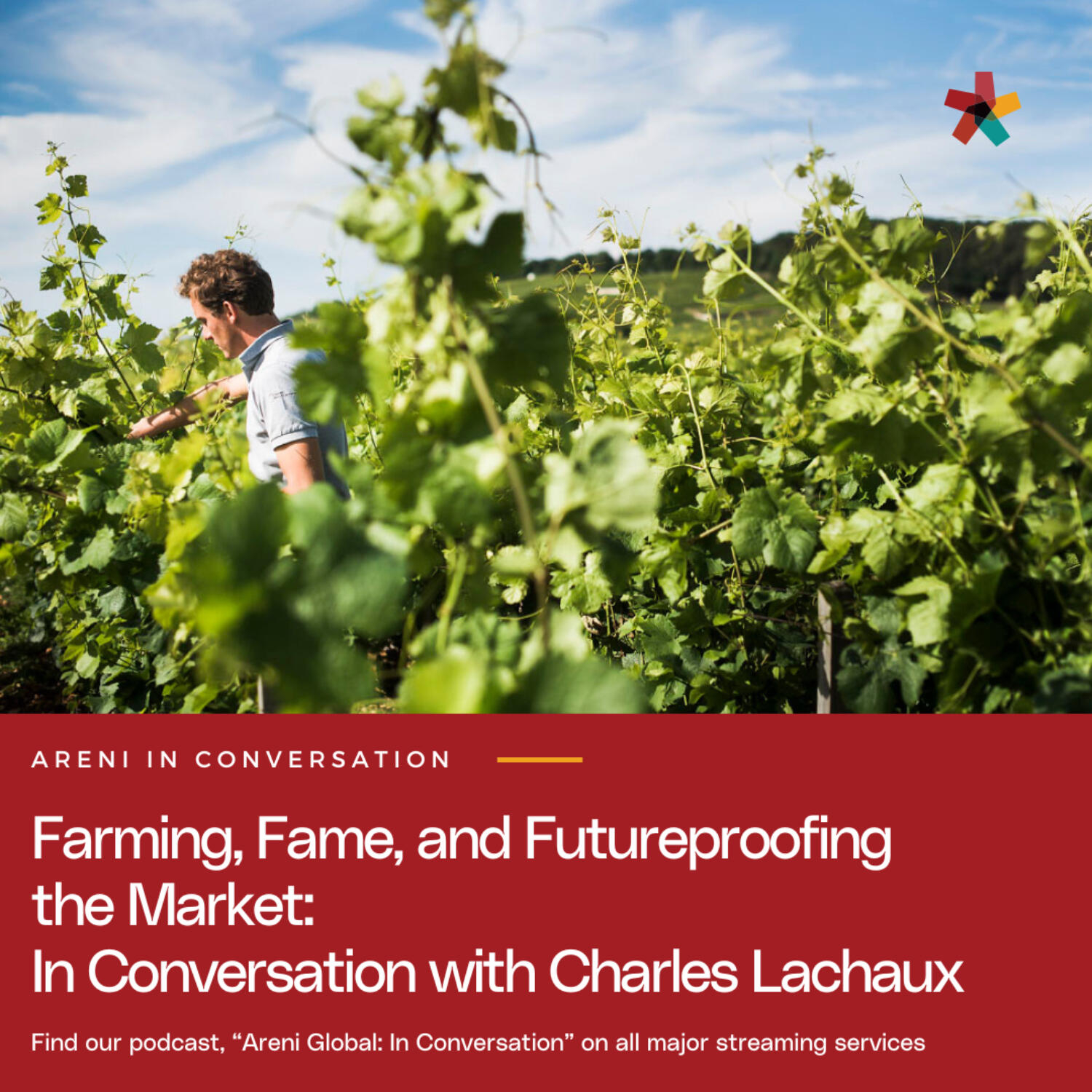
Farming, Fame, and Futureproofing the Market: In Conversation With Charles Lachaux
71m 3s
In this podcast, Paulin Vigard interviews Charles La Show, a sixth-generation Burgundy winemaker from the family estate in Vosne-Romanée. Charles joined the estate in 2011 and became co-manager with his mother in 2024. His career changed dramatically after winning the Golden Vine Awards in 2021, which increased his wine's value tenfold and brought fame. However, he had already started making bold changes before this recognition, inspired by a 2006 Savigny-lès-Beaune from Madame Loura and old pre-war vintages that showed remarkable freshness. Charles shifted to biodynamic and regenerative farming, reducing yields from a potential 100,000 bottles to a target of 30,000-35,000 bottles annually. He stopped tilling the soil and let grass grow, which lowered crops further but aimed to improve vine health. In 2024, heavy rain caused mildew, destroying 96% of his production. Despite the risks, Charles emphasizes using modern tools and hiring enough staff to make the physically demanding work comfortable for his team of seven full-time and 15 seasonal workers. His parents supported his vision, even as he changed fermentation methods and containers. Charles believes these choices, including reducing yields and embracing natural processes, are essential for crafting wines with the energy and balance he admires in older vintages. He sees his approach as a way to let the vines express themselves while maintaining quality, even if it means accepting lower production and financial risks.
[Music] Welcome to the Eurene Global in Conversation Podcast, where we talk about the future of Fine Wine. I am Paulin Vigard, Director of Eurene Global, and in the series we bring you conversation with some of the most interesting and influential figures in and around the world of Fine Wine. To talk about how the world is changing, how these changes impact the production, distribution and consumption of Fine Wine, and how that create risks to be managed, and opportunity to be seized. [Music] In 2021, 30-year-old wine maker Sharon Lassho from Burgundy was crowned best rising star of the world during the very first edition of the Golden Vine Awards, held in London at the time. Almost overnight, the value of Charles Wein's increased tenfold on the secondary market. He was soon to be invited to the Palais de l'Élysée, where he was endorsed by French President Emmanuel Macron, and identified as the successor of iconic producer, L'Éloubise-Laure. Fame and fortune followed. Charles had already started to change many things in both vineyards and cellar before his rise to fame, and with the new valuation of his wines, he continued to be bold with his choices, notably in terms of distribution, meaning that Charles is at the centre of many conversation in Burgundy and beyond. Are these bold choices the future or the doom of Burgundy's fine wine scene? Come with us as we look back on his extraordinary tragic tree and discuss his vision for the future of his estate and his region. [Music] Charles, good morning. Thank you for being here with me today. Good morning, Prima. As I just explained in the introduction, your career followed quite a unique tragic tree. And I would love to hear your side of the story. So can we start this interview by telling us who you are and how you fit in the Burgundy landscape? So I am Charles La Show. I'm a family member. I'm the sixth generation of the family Arne La Show to work on the family estate based in Vonorma Né in Burgundy. How do I fit it's a military answer question? But I think the landscape in the way I'm a family member taking over a family domain working with the family in a pure Burgundy tradition, if we can say. Can you tell us, so we're going to talk about the estate now. When did you arrive in the estate? When did you become officially the head of the estate? I joined the estate in October 11. And I started to take more and more responsibilities from 2015. And I'm co-manager with English since last year, since January 2024. With your mother, right? With my mother. Okay. So a lot of people will know what is your estate today and the reputation of your wines today. Can you tell us a bit how it was before you came on? The type of reputation, the type of wine that were produced? So we are here since a long time now. And we are lucky to have great oldings because we have vineyards in New Saint-Georges, Chambalmusini, Vonormane. And we go across all the range of the Burgundy and Pyramid with some burgundy vineyards, village ones, primary crews as well as the Grand Cruze. So it helps to build the reputation as well when you have such palations. So we always had quite a good reputation from my grandfather time. For my parents time, the reputation increased under the work of my parents. And we were quite to modern estate, I would say, because my parents have always invested in the tool to have it evolved by trying to buy new vineyards, buying new tools to work vineyards, investing in a new winery in 2003 to have something really modern to be precise in the work you do. So I think the kind of domain we were, we were more than traditional domain with a great reputation. Before you started on the estate, what did you want to do? Did you always want to be a white maker in Burgundy and come after your parents? And where did you develop your philosophy? No, I didn't know what I wanted to do until I was 16. Like, I think most of the people, and I've always loved wine, but my parents always told me, if you want to be a great wine maker, you have to be a vine grower, you have to be in the vines. And you know, the vineyard work is a work, it's physical. Yeah, it's not that romantic when you have to do it every day. Nowadays, it has become very romantic for many people, but it's tough. It's physical and you are not always in the great conditions. At the moment when June, Sunday, shining, the vineyards are pretty, but in two days will be on the heatwave, in the wintertime, when there's snow, the rain, the frosts, so that's some hot time. I remember that, and then you have to walk and you've got, you know, you boot that gets stuck because it rains so much. And yeah, it's not that easy. So I wasn't attracted by this side of the job, which is the most important side of the job. And when I was 16, I got to spend my summer in the vineyard to work. And after one week of full work during the intense growing season, with the team and the seasonal workers, I completely felt in love with the vineyard work. So I quit normal school to enroll into physical dress school and continue my studies in this way to be able to join the family domain later on. And it was always burgundy. It was always the family domain. Or did you go to other countries to learn? Or did you have, you know, crazy idea that you wanted to make Cabernet Sauvignon in Australia kind of thing? No, I've been lucky. My parents let me travel and do some some experience for myself. So I've been around the globe, but my focus was always on Pinot Noir, because I love the vitals. But I wanted to know and to learn how Pinot Noir was worked worldwide to make a mixture of it in my mind and maybe come back with fresh ideas, which happened later. So I've been to the United States. I've worked in Oregon twice. I've been to South Africa. I've been to New Zealand. I worked for over the mountains in Burgundy as well. And I did a little bit of self-training for London, Wine and Porre just before the join as well. So that gave you the other side of the story and how it is to actually sell the bottles? So I think it's important to know what it is like on the other side of the fence. Yeah. And the work doesn't finish when you've put the cork in the bottle. There's actually a huge other part of the trade after that. Who were your inspiration along the way? Like, did you have any particular personalities or wine that inspired you and actually influenced you again in your vision and the vision that you developed later in the estate? At the beginning, it was really my parents and my dad because the domain is coming from my mother's side and my dad and my mother took over when they felt in love and my dad was not at all from the wine industry. His family was not in the wine and never was in. So what we did over the time together, the domain, the reputation that was really good for somebody who was not from the wine business, they brought the domain to a normal attention to the domain with certain notoriety. So, and it changed a lot of things in the vineyards and decided to become more modern. So they were really my models. And after when I started to work with them, I had the luck in 2014 to try my first bottle of wine from Madame Loura. And because of the emotions that Baudole gave me, that just changed my mindset. And I didn't know how. Do you remember exactly what the wine was? Yes, I remember exactly. I remember where, where, with whom, almost the time it was. It was a Savini, the Narbonne 2006, which on the paper is not one of the most sexy wines, I don't know. Was there always going to say it wasn't a Romanec conti or something like that? It was a more accessible one? I had the luck because we were in the wine industry to have tasted some wines of DRC, a lot of famous estates since I was a bit younger, at tastings, dinners. But that particular bottle was the first one which really impressed me so much and gave me those special things. So it changed my mindset. And from that moment I knew I wanted to work differently.
I didn't know how, but hoping that one day what we will be able to craft at the domain would give people who will consume it such emotional and feelings. So this has become the new inference just an ideal, it's utopic. You mentioned also when we prepped together that you've tasted a couple of very old vintagees that were before the war and that influenced you as well in the style of vitic culture for example. Yes, it came a little bit after all that is a bit of of a construction. After like I have some some people I know some friends who are very deep old sellers and when you pull the cocks of those very mature bottles I'm talking about pre-walled raw wines and very often those wines when they remain they are so fresh and alive. More than nowadays wine in my opinion so I want it, I made a mixture in the main how to try to have this energy and this balance like those wines with the vitic culture, the climate we have now there, how to combine all of that to try to be the most precise we can with what we have now there to try to find back this spirit and this energy in the bottles. And so that started in the vineyard and that some of the change you started to explain. So if I summarise the changes that you've made in the vineyards all had the same purpose which was to let the wine be, let the vine be as much as possible. Do I summarize that well? Yeah, it's correct, it's really the purpose of what we do is let it be, let it go and try to have it really good but under good conditions. I mean we are not taught to step back in our jobs. So it's really good but we still need to have some food, we still need to make some wine because if we let it go too much you don't have wine because wine if the human don't print it they don't produce foods and the foods if you don't have them little with their collect fermentation they don't turn to wine, they turn to vinegar. So try to let it be compared to what we are taught and what we're used to do but it's not a 100% no no touch whereas we won't be talking to them, we wouldn't be talking. There's something that really helped me to understand that is when I became a parent because coming from Burgundy people were asking me well you guys say that you wanted to have to speak for itself like you accompany the vines but you don't control them. What does it mean? How does that translate in the vineyards and in the cellar? There's a lot of tacit understanding in Burgundy, a lot of things that people understand at the gut level but we're not really good at explaining and to me it was really becoming apparent and understanding that you have an individual in front of you that you're not going to be able to shape like the kind of company and you just need to have your values as a parent things that are important to you like being polite and being respectful and being resilient and then you can accompany them developing those values but they are going to be their own person anyway and I think to me that's that that would allow me to put words on the Burgundy way of making wine if that makes sense I don't know if that if that metaphor speaks to you at all as a parent as well. Yes and it doesn't I think that those changes even took more importance for me when I became a parent as well it made even more sense and it was it was more clear but the premise that how do you realize it it's a thing to have the ideas but after to be able to apply it is another one so it took years of of thinking of work with the people I have helped me at the moment as well to to shape this vision because what we say in Burgundy general since a few decades about not shaping just accompanying the vineyard is true and not because we do less compared to many other regions but the way we still do it from his way too much we don't just accompany when you work the traditional way nowadays you control them in a lesser way than other regions but you still control them a lot because it's what humans are used to it's really hard to let it go. So you changed the way you were pruning you changed the trimming so you let the vine develop as much as possible with its own way. You are biodynamic now as well. It's organic and very dynamic. And so there's always one thing that comes to my mind when people say well you haven't said that but often people say well we went back to how wines were made, how vines were farmed at the generation of my grandparents and there's always something in my mind that comes at that point is like well I wouldn't want to have the life of my grandmother I wouldn't want to work the vineyards the way they did it at the time because it was so hard physically. Did you also have to have like how usually by dynamic organic like doing less is usually requiring more human work. How did you manage that transition with the team in terms of managing the extra physical workload that some of those method actually required. It's a good question because I work a lot in the past way. A lot of the practices we do were used by the grandparents or even before but at the time they were forced to do so because they had no other choice because they didn't have the tools or the knowledge or the finance. Now there we have all that so we try to be precise and it's important for me to say that we work this way not to work in no school way because it's cool to work in the all the way. It's because we really believe every work we do with the team now the way we prune the way we treat this with this old school where it's done to be more precise to help the health and the balance of the vineyards but as you mentioned I don't want to have the life of my grandparents or great grandparents. They were working 90 hours a week they had no hobbies the bodies were broken when they were 40s so I use modernism to try to be precise and to make the work more easy for the team and ourselves so we hire enough people or we have the tool we need to be built or we buy the tool we need in order to be able to accomplish those tasks in a comfortable way because something about the dynamics as well is that is very important to me and people don't talk about it so much we talk about all the preparations I don't know at the end if they really have a so strong impact or not if it's just the placebo but when you work this way the people who work with us when you get to the vineyard you come with a different high with a different mindset so it changes the way you work and the quality of your task so it changes what you look for in the vineyard as well like you will be more you will see different things that you didn't see before because you were not looking for them. I changed the atmosphere between the team members all that so it's a general get together that increases the energy and the vibe the quality of the work and again I want those old school work which are sometimes very painful to be comfortable at the moment when in the vineyard we are many yesterday afternoon I was with the team during the the palisage and they told me it's comfortable we are not suffering the job is not hard because we are here enough people and we have the great tools to do what we need to be done yeah palisage for people who don't know is when you put the the vines up and you make sure this stands straight and they're not crawling on the ground. Can you forgot to ask you but like how big is the estate and how many people will you have in your physical tool team? So the estate in total is 14 hectares because the gun dig is quite puzzle it represents about 49 plots and we produce 16 different wines ready wines out of it and and out of those 14 hectares how many people do you need to work with you in the vineyard? So all your long full time we have seven people at the domain helping us and we hire more people during the seasonal works that started from beginning of May when the venue starts to grow and we hire 15 extra people until the end of July so for three months. Okay so that's that's one person for two hectares in normal time so those changes that you've made They will call.
quite bold, even if now, luckily, they're less unique. There's a lot of vignettes that have transitions, it's like we're up in Burgundy and there's more and more biodynamic and organic estates. But they've changed as well your business models because what changed with you, if I understand correctly, is your willingness to take risk and not to compromise on the quality of the grapes? Can you tell us about that? - That's the world vision. It was trying to achieve something special and not refraining ourselves on the way because of work, of economics, of risks. And it's really the core of the mindset that Arnolashore is really do whatever you have to do to accomplish what you dream of. - So the first thing is that you don't do, you're not closer to all from the maximum yield that you could produce, right? How many bottles could you produce in your estate if you were topping up the maximum that's legally allowed? - So if we would do what we legally can under the minute, we could produce slightly more than 100,000 bottles every year. My target is around 30,000, 35,000 bottles a year, but at the moment we are still a bit below the target. - Okay. - Because of our changes and because of the climate, it doesn't really help us over the previous vintageies. - And you had a very bad vintage recently, right, where you didn't produce wine almost? Last year, 2024 was terrible vintage because we had so much rain. It helped very much, mildew and oedium to develop. We lost almost all the crop, we lost 96% of the production. We have picked about 3,000 bottles under the man. There is only one wine, there are many vineyards, many plots where we've been, there were no more grapes to be picked. - Okay. So my mind is already computing numbers about the type of volume that you produce, the type of cost that I assume it can be in terms of production with the people that you have and the type of work that you do in the vineyard. We haven't talked much in the seller, but I mean, that question is, and we know from the introduction that since 2021, the value of your wine have increased and I'm going to talk about that in a second. But will you have been able to do all those changes and take all those risks if the valuation of your wines hadn't gone realistic? - We could because we started to take those risks before the value exploded because something we forgot to mention about the vineyards work, which was one of the biggest risks recently, it's from 2019. We moved to generate regenerative farming, which means we don't till the soil, we don't work the soil anymore, we let the vineyard the grass grow. So it even takes down more the crop. And we started all that, you see, we started in 2019 before everything really exploded first. We were starting to be a bit more famous to gain reputation but not as much as just after the price. So those risks could have worked without it but maybe not as much and not so fast. - Yeah, that's the speed of change that was helped by the extra cash flow, I suppose. What was the reaction of your parents? 'Cause you've mentioned you, the sixth generation, you came and you kind of changed a lot of things from what they were doing before. We didn't talk about the seller, but you've started using a whole bunch of fermentation, you've changed the container that you used to ferment as well. Like what was the reaction of your parents? Were they, why the hell is it doing? Like we've been doing this forever or why is he questioning the things that we've been doing? Like does he think we were doing it wrong or were they very supportive? - They were very supportive because when I had that special time or that first very special rule, I got the second one and I blinded my parents on this and I told them, listen, I don't know how I will be able to do it, but this is the kind of things I want our minds to be later on. So the new, what I was doing was motivated by this purpose so they did let the things happen. And you know, when you look back, they happened very fast. But the first changes about the old cluster in the seller were in 2012. From the new Tilling Air, it was 2019. It's closed, but in seven years, the mindset evolved a lot as well. And they really jumped in the train. I never really had to convince them of doing something after we started to change. - Yeah, and it's, I remember from my parents, I think, that's what led them to stop and to sell because we might neither my brother knew I wanted to take over. And I think it was the time in their life where they could have used new inspiration and new energy and they were also looking for that intellectual, not battle, but intellectual stimulation of having someone that comes with fresh eyes. How far are you from making the wines that those seven EO6s in terms of emotion? - I don't know, I will let you know when I will drink those wines when they will be like this one, when they will be 10 years old. So the transition, we have the wines at the moment in the seller because from 20, 22, we moved to 100% ceramic for the Elvage, no more oak, no more wood. So we have those wines. It's just, they are still under Elvage, they are not bald yet and they are not raised at all. So the people don't know the results yet. They are willing for it to judge if what we do is completely crazy or if there's a bit of sense in it. And I've tested them for the first time last week because I don't test the wines in the Elvage. - Okay, so you don't touch them at all? - No, we just do top-ups and we don't touch them. So and I don't taste them as well, nothing. Hey listeners, just interrupting the conversation for a few seconds. First, to let you know how grateful we are that you are listening to this episode. Thank you so much. And also to kindly ask you to subscribe to our podcast channel on whatever platform you are listening this episode on and to give us a cool rating. It's such an easy way to support us and it really makes all the difference. Thank you. Now, back to our conversation. So you start all those changes and boom in 2021, you win that amazing awards. And then it's almost overnight. I've got the data in front of me in terms of the change that it, you know, the secondary market in the terms of pricing for your wines. So for example, then those price are in English, British pounds. For the Romane Saint-Vivant 2018, in January 21, the price for one bottle was that I could find on live X was 643 pounds per bottle. And in January 23, it was 7,424, which is a progression of more than 1,000%. And if you look a bit more down in your hierarchy of Appellation, the Shambon Museum of the same year, 2018, was 58 euros back in Jan 21. And in June 22, it was 1,100,000. And 78, so that's a progression of 2,500%. What was your first reaction when you saw this movement on the secondary market and you saw the impact of some of those, you know, prices and recognition ahead on the prices of your wines? - It was completely crazy. And compared to the data you have, even in 22, it was even higher. It started to decrease a bit in 23, which is in my opinion, very good. For example, the Shambon, sometimes it's 2,000 pounds the bottle after a year. It was completely crazy and I got very scared about that. - From 58 euros again. - Yeah, from 58 euros. - I think it's important to state the starting points. - And some people were moving some wines at those price. - Okay. - So I got really scared because we produced wine to be consumed, to be drunk for the cocks to be pulled. And I've been worried for many years already before that. But big demands in burgundy, in champagne, or in bottle becoming assets and investment, more than consumables, which they are. And this was happening to us. So I was very frightened that the people were buying our bottles.
across France and the world, but for the bad reasons, just to be able to sell them, to flip them and make a huge amount of cash in the middle. And it was really worrying. It was mixed things because there's a certain satisfaction, because there is a certain recognition of your work. Yeah, proud, like a bit of pride, like my wines are. At the beginning, there's a bit of pride because I didn't realize that it's some people wonders, like, have you seen what is going on on the markets? We've been sending prices. It was insane. So you feel certain excitement and pride, but it fades quite quickly to be replaced by the scare of how we'll be able to handle this. We're not ready about it. I've never thought about it. So just after the pride, is there something that comes on like, oh gosh, some people are really making money on my back? Because you didn't earn any of those added value on the wine. You still had to sold your Shambal Musini for, you know, 58 was the price on the secondary market. You probably had sold it for 35 euros and now that we're trading for 2000s. So whether a bit of anger against the market too? So it came a two way later. It was more worries about what will those wines become? Where will their hands? It was not about the difference of margin and where was this money going? It was like, where will hand those below that those prices? Because at the time, I knew a few people on the market, for why do we're sucking the wines from markets at those prices? People were collecting wines from the US. HK, the same person was buying wines in UK, in US, in France. And the same people would have ended up with 300 bottles of harvest or even more. It happened. And how does it feel to become a bragging right, you know, the bottles that everyone want to take? Because there's also that, like, there's people buying it for investment. Because people buying it just so that they can take a picture of them with the bottle and putting it on Instagram. How that, and then, you know, I suppose, everywhere you walk now, people are asking you for selfie. People are like calling you their friends when you've met them twice. Because again, friends has a very different meaning in English that it has in French. How does that part, how did you deal or do you still deal with that part? There is good and bad in this. It depends how you want to take it. I've decided to leave the bad sides behind me and let people talk, do and say what they want and take the benefits of it. And use it to talk more about what we do. I had plans or ideas of what I wanted to try to do or give over the next 30, 40 years. In 2020, it happened over three, four years. So it went way faster. So now we try to be more precise. Not just the way we work, but in the way we live and the way we interact with people. Because as you mentioned, when the price is calculated and what has changed a lot with those price type and notoriety, it's the pressure. But before when you were affordable, if the people were not so happy, but the ones that they found it good, but not exceptional, that was fine. Now when you look up on one searcher or everywhere on Naivex and they see those prices, you have no right, no room for mistake anymore. You cannot disappoint. That's the new thing. And how do you manage this in the seller? Because I had those conversations with Pascaline Nebelte, where we were actually saying the same thing, is because those wines have so much pressure now to perform at that price level that the creativity and the innovative approach that led them to be in those position of classics and icons actually kind of decrease because people then follow the recipe because they're too afraid of disappointing people. Is that something? How do you feel about that? Is that relevant for you? Not yet. I agree. We can be disappointed, but to handle it, I surrounded myself with a team of very competent people at the domain in the vineyards and in the seller. And people who are very clever, do consume a lot of wine and are very eager about what they would want to drink or to try or to taste. So as we are like a laboratory, we're still experimenting a lot with them. I mean, like the fresh ideas you have, we talk about it. We see what could fit in the way we work to really keep pushing the quality. So you went through that phase of the wines going ballistic on the secondary market in terms of prices. And then you made some quite bold changes in terms of distribution. How are your wines distributed today? So it came with another factor as well. So the market prices exploded. And as well at the same moment, we had no production. Because when those prices exploded, and I think these products so much because the risks we took were very high as well. And at the time we were going to release our 2020 vintage, which before 2024 was the first so small vintage we ever produced at the domain. Because of the no-tilling and heat wave, we lost a lot of crop due to the drought. And we produced 12,000 bottles. So we didn't know how to end all these so tiny volumes, which the demand that six, seven months ago just completely exploded. We had, I don't know, I think it's impossible to calculate, but maybe at that time when we were about to release 2020, maybe the demand of our wine worldwide was multiplied by 50, 60. I don't know. I saw those 100,000 bottles. We could, my parents were producing in the past about 70, 80,000 bottles a year, about 80,000. We increased the demand slowly over the years. And at that moment where everything explodes, we go from 80,000 bottles to 12,000 bottles picked harvested. So we distributed about 10,000. So how do you make it up to the market? You go from 80,000 to 10,000 and you have 40, 50 times more people want to buy at least one bottle. So we have, because we were very scared about this wave of the second market and the people who would buy wines to resell it, just to make some extra cash. At that time we decided to stop to sell to wine shops in France and worldwide with our employers and distributors and as well to the private clients worldwide. We just kept some private hands direct from the demand, the ones we had already. But worldwide you wrap in the rest of the world. But any distributors of us would be able to sell to private or wine shops only to restaurants because the restaurant you can do smaller locations and you satisfy more people because except some special tables, the people don't come to a restaurant and take free for bottles of the same producer. Is it still the case today? Do you still sell you wine exclusively to restaurants and the private clients that you have at the domain? It is. It has evolved a little because the economic climate worldwide is more tense. We don't want our distributors to struggle too much. So we have allowed them to reopen a few locations to a few private customers of them. But there is still no wine shops and we keep our private customers direct from the demand. For the years we have tried to increase the list of private customers we have because we have requests every day and we have a waiting list but we want to use it. We don't want our waiting list to be a dead file. What happened with crew rated? Can you tell us about this because there is a lot of press article that has been written about your partnership with crew rated? So at this moment we decided to tell our distributors to not sell to private because they are a lot of requests. This company was just created at the time. It was more auction platform at the moment. And I have asked them because they are the connection to be able to ship worldwide the logistic platform and all the administrative process which is very complicated. We have us them.
to getting charge of distributing worldwide to the private customers. So you just subscribe to the website. And when they release our wines, you have access to them. Compared to the classic distributors or when very often, you need to be known customers or to have bought a fair amount or spend quite some money before to access their two wines. When created, started, we asked them to distribute to private. And with them, you sell to private people at a price which is a fraction of the market price. And so the customer who are buying, know the price they are buying. Most of it is getting back to her. And the company is just taking a small share. And those are set all for the vintage. So it's indexed. There's another rhythm that calculate the price of that particular wine. So let's take the Shambhal Musini 2018 that we took as an example. There will no exactly minute by minute the price of that wine on the secondary market. And anytime I as a customer log into my crew rated account and want to buy the Shambhal Musini 2018, whether I buy it on the Sunday or whether I buy it on the Wednesday, the price might be different because my price will automatically be indexed on the secondary market price, right? Not exactly. We don't do this wherever as it would be like stock exchange and it would be an nightmare. And again, I said, we don't want it to be an asset. So we look at what is the average price because when you take Shambhal 18 on one of the so-called, for example, there's always higher price and lower ones. But there's always a middle one. So with them we sell the wines at the percentage of the middle price. But it's consistent over a few months. And if the market breaks down like at the moment, we adapt ourselves as well. And then it's just a split between crew rated and you. Do they use NFT? Yes, as well. OK. Because that also helps you to know where the bottle is going. And if that bottle comes back in the market, I suppose that was one of the attraction for you, one of the things that to do is you to work with them. Yes. And if something is a result from a customer because you have the NFTs, you know who has sold it. Because if you don't use the NFT when you sell, you lose some value on your bottle because you don't keep the authenticity. And it's the way as well to ensure that some bottles are consumed because when you're a member of this platform, what you can do when you drink your bottle, you can scan your NFT. And as they say in the technical language, you can burn it. So let's say you have 12, 18 of armament in your cellar. You have a family dinner this weekend. You open two. You just pass your smartphone. You burn them. And it will show in your profile that you drank two of them. So you are more able to be able to buy again in the future if there is movement on the ones you have in your cellar. When somebody was bought for five years and hasn't touched any single bottle. And then when they do sell and if they make an added value, so if they bought the wine for 300 and sell it for 500, you make a percentage of that added value right? It's something they want to set up, but it's not working yet. It might in the future. So it's something new coming up with the NFTs, but it has never been a purpose of ours. OK. How did your distribution react? Because what happens? What are here from the trade side here in London in particular? Is that some people can get quite angry at producers also. Because when everything goes well and the wine is selling amazingly well and economics, conjocts are good, then distributors are squeezed because wineries keep wine to sell to the private client, because of course there's more margins there. But when there's more quantity or when economic difficulties arise like now, like producers are coming back to them and saying, now can you please sell my wine because I can't sell them on my own? I'm not saying that it's your case at all. I just wanted to understand if that was part of like the conversation. What was the feeling and the current feeling with your distributors about those changes? So at the time, some people got upset. Not so much about the private, more about the wine shops as well, but it was a mixed thing because they didn't knew how to end all it as well because the new no wines were going to come from the next retail for the 2020, but they were going to get almost nothing. And the people who were supplying the free channels private, retail and restaurants, they didn't know how to end all it. So in a way, it made them, it made the job more easy. They were upset, but they could tell to the customers restaurants or trade and private that it wasn't the core, it was ours. Okay. So we were in, they were doing the announcement, they were in front line, but the shots, the bullets were for house not for them because they were just passing the message. And another traditional relationship that you challenged is the relationship with journalists and wine critics. Can you tell us about that and how you work with them now? I don't know if I challenged our relation or if they did themselves. I think they did. We have always had them and needed them in the way, but when I had to give the the taste of that vintage 2020 under this financial wave on the markets, this craziness about the prices, everybody was talking about us in the wine world, in US, in Europe, everywhere. That when I was on all the lips in all the tastings, but it wasn't about, yes, stopped farming, he's moving to ceramic, you know, not farming, sorry, stopped tilling, the trimming, it was only about the market prices. And the people, even if they're professional, distributors, restaurants, they were thinking that the numbers we talked about earlier and we see on our screens were our selling prices. People were making the confusion. So when I got the journalists to try the 2020, I asked them to not talk about it, but talk about what we do in the vineyards and in the cellar and to raid the ones. Because you know, when a report goes out, you don't really read the testing commands. You need the big intro about the vintage. You read the intro about the demand, but then you just read the scores. And the intro about the demand was, most of them was, not everybody, but most of them was only about the prices. And what was happening on the markets. So I was not happy because to get through there with them, to get vineyards, to show them exactly what we do in many vineyards, to the time in the cellar before to test the ones. And I was open to any questions. And we had a very open talk and they just kept talking about the financial side of it. And there must have been conversation about that wine is not worth two thousand pounds, because it wasn't a two thousand pounds wine. It was a 58 pounds wine that overnight became two thousand right in terms of value, but the quality of it didn't jump from 58 to 2000. At the time when they were testing the trouble 2020, the journalist, it wasn't released yet, but the market was close to two thousand pounds below. And there is a, as well as something, the, it's a question I ask myself often, how objective are you when you rate something you won't be able to buy? Is there really objectivity in that when you rate a shumble that the market price is two thousand and the same before as the time was 11 or 12 thousand. How big objective can you be? And for me, who has to to speak whose voice should we listen? And I wanted to have all the journeys together on the same day, to test under the same condition. If it's today, it was testing well or not, with the syn atmosphere, the same glasses from the same bottle. And not everybody wanted to join. Some people prefer they want a little privilege to be seen apart, to have a personal talk with you and and everything. I wanted to make something more objective and more simple, but at the end, it was not so easy because we don't all have the same ideas, the same conception. So how do you deal with journalists now? You don't take critics anymore, right? You don't allow your wines to be scored. I, it's not that I allow them. I cannot, um,
of them to scroll them, but I don't greet them at the demand to taste and scroll the wine. I have some, I receive some journalists from time to time, but more normal press, not just the wine press. I want people to understand what we talk about, but I to talk about what we do in the vineyards and in the cellar and how they feel about the wines, not to rate them, give them scores and influence the market in a way. As well, it was a big risk because some people told me some overgrows to me, but you could have ruined your your market, your distribution, because if the critics don't rate your wines, the people won't want to buy them anymore. I was like, you know what? I don't care. If I want the people to buy them because they want to drink them, not because it has received 90 points or 100 points or that journalists said that, it's not what I want. So we, you mentioned it a bit, but we've, you know, when we study what to fine wine and who decide what to fine wine and what's not, we came to use what Jamie Good labeled as the community of taste. So it's not one person who decide what to fine wine, what's not. It's a group of people. It's always a community of people who's taste matter in an industry. It's not just in wine and the same in art and all those creative industry. And journalists have always been a big part of that community of stays, as you mentioned, schools have moved and still move markets despite what some people might think the score of journalists still matters in some context. So if you don't have the journalist as part of the community, of your community of taste, how did you replace them when with any other actors or you said, like, who do you listen to or who do you, who's part of building your reputation if journalists are not anymore? I listen to the people who pull the crocs who pay for the boggles because for me it was the right to speak or everybody can speak but we really get our attention that the domain and we listen very much. It's our customers in France or worldwide because the people who are paying the boggles and are pulling the crocs to bring them, we need to know if they're happy with what they have in it, with what they drink, with how they feel drinking it, consuming it, buying it. Because if they do so, they will talk about it well to their family, their friends, sometimes some of them, what's up, sometimes post on social networks, some can be bloggers or critics, but they pay for the boggles. So I think their taste is more objective. Soms as well? Because it's conditioned by the price as well, but yeah, even sons. It's important for me to know how the people who will pull the crocs and consume it, how they feel about how they're wines. So there's been conversation inside Burgundy and outside Burgundy, of course, about the state of the Burgundy price. And again, I don't think it, you know, it targets the top, top wines that everybody understands that they are expensive and iconic. But mostly the village level is really under a lot of fire and attention and criticism in terms of price. And I'm not even telling you about the Borgon, Pinot Noir and the Borgon, Yeregutti, because that's another conversation. But there's a lot of, how much, I guess my question, why I want to lead and what I want to understand, is how much impact yourself as a wine maker can have on those price. Because everybody is blaming everyone for the price of Burgundy and for the fact that they are very, very super high. Is it just something extremely neutral, very cold, off-rendy man secondary market, nobody has control over that, or can we control and should we control the price of the wines with a maximum or something? It's complicated because you cannot really control legally. When you sell a bottle, you cannot force somebody on the market that will do after you. And of course, if you are selling your wines for an expensive price tag already, of course the wine market will adapt itself and the wine will be even more expensive. So if you don't increase your price, of course you don't push to this trend of increase. And as well, there's something which is weird in Burgundy, is that since we have distribution of the men and we have increased a lot our price with the work we do and what we invest, you have some people from the same village often, they are like, "Ah, if this people can sell his Bono Manivillage for that much, my video just next to it, I don't care if I do the same thing or not, I will just put the same price because it's not normal, I earn less than him." That's where we undergo a big problem in Burgundy about the price of many wines. It's many people have increased without changing anything since 20 or 30 years in the demands. They just increase to follow the trend and to be as expensive as the most famous of the village or the more famous neighbor in the street. Some people have not invested much since the past 20 years but the price have been increased by two or three times. That doesn't make sense. It's where I want us to stand different. We are we are not cheap, we are expensive but we have increased the price to be able to work the way we do because the vintage 2020 we talked about earlier. If at the time we would have sold 100% of our production at the price we had, we would not have made it. We would have lost money on that vintage. And the price that now with the way we farm at the demand and global warming, I'm not sure vintage like 2020 won't be our new trend in the near future if those 15, 16,000 bottles won't become my regular. And I don't want to quit a virtuous way of farming because of economics. So that's why we have those prices because we need to be able to keep investing, to pay our loans, to pay our people, to still prepare the future during the transmission and everything. We can't stop all that. So how do you deal with being an individual, a unique individual with your vision and with no compromise and the Burgundy collective region? Because what we know from our research is that the collective reputation of a region is extremely important for the fine wine status. When we ask consumers all over the world, so that's the UK, the US, Hong Kong, China, France, Japan, we ask them what are the most important attributes for wine to have in order to be a fine wine. And in the top three all over the world it was, it comes from a famous region. So we know that the collective reputation is extremely important, but we also know that in Burgundy, but not just in Burgundy in many other regions, there's a lot of individualities that are successful, but are also going away from the collective approach of a region. And that's really an open question. I don't have an answer, but I'm just faced by that, like how do we reconcile both? You need Burgundy to grow in order to grow your estate, but you need your estate to be what you want and not what Burgundy wants if that makes sense. Again, what has happened to us at the men who don't have happened if we are not in the same way, if we wouldn't be in Vonorma and Burgundy with such a thing. So it's about the collective. And not today, if I'm out of it, it doesn't mean I'm not worried about it. And you see, ten years when I started to have strong changes, I was a fool, very criticized. And nowadays you see more and more demands, time to change a bit, they're forming. Time to do a slated higher palisage, work less the soil, starting to experiment with the ceramic. So I think the collective thing remains and it's very important, but it's over time you see it. In short period of time, if you consider just short time period, you have the individualities that comes out. And collective comes from the long term. And you always need people who experiment to pioneer their criticize, they become the individual, the special individuals that have become marginals, like what was doing in the rubies law a year ago or a long episode. But they are the leading demands of Burgundy. And even if a lot of people criticize, in a way, they follow and they use those reputation. And they become the new norms. Yeah. It's that cycle. If you've got a collective, then then you have a few individual breaking away, changing the norms, being criticized, but they encounter success. So the inspire and they become the norm and it's those cycles on over again. Okay. So I want to finish that podcast by talking about the next generation and the transmission and how you see, you know, maybe your kids or the next generation.
to you. Again, you're the sixth generation making wine in the Vendoromane in that estate. Does it mean that you are mortgage free now that all your land is pay for and all this setup on that side and everything is amorti? How does that work? So all the land is not paid for. You know, every generation you have to restart because of the in-eritance policy and transmission policy in France. But we have secured it at the moment for my generation. I have free brothers and with my mother, the four of us, we have secured the oldings for our generation. It means we have bought a fair amount of dividends from some of our family members and my mother and the free brothers we are in the company. We want to keep everything the way it is. But again, you pay, we have bought something that is in the family since the long time and which you already work on. So you still invest huge amount of money just to keep something you already have. So that was the story about your aunt and how you had to buy a plot from her, right? She didn't want to sell to you. So we have, it's completely the way things are handled in Bernady and changes from family to the other. But we have a part of the vines that are in the company that only owns vineyards and they were different people in it. Before it was my grandparents and my mother and my two daughter and my two aunts. So when my grandparents passed away, it was my mother, my two aunts and that's it. My mother passed part of hers to my brother's and I. So we came into the equation and one of my aunts decided to sell it. So it's now six people. If I can. One of my aunts has no kids so she gave it to my brother's and I. And yes, very nice people. And the third aunt wanted to sell but not to us. She wanted to sell to a big billionaire. So we were in trial in court for a few years. We have been able to buy it then but we had to buy it the billionaires price. So it's where the meteoric rise of our domain and the markets. And so for years ago maybe we wouldn't have been able to buy it. So you are now and I think it's important to just explain again not being too geeky or but there's two structures right. There's a structure that owns the land where you can have different owners and so shares our splits between the different owners in that structure and then holding and then you have a structure that exploits the land so that has the right to make money out of the grapes. Right. Yes, but that last structure owns some vineyards as well. The rest is on. So this the domain owns about 30% of the vineyards and they are accompanied by just about holding vineyards owns about 70% of it. And the domain is you and your mom just the two. No, we are the managers, not the owners. Another company owns the domain and this company is my mother and my brothers and I. Okay. So there's four of you, your mom and the three brothers that owns the company that owns the land. There's four of you. There's four of you that owns the domain which owns some vineyards and the capacity to exploit it and then there's two of you who receive a salary out of your work which is your mom and you, right. Yes. Exactly. Okay. And talking about your kids, I know they're very young still, but how do you envision them being the seventh generation? Are you going to let them the freedom of do whatever they want or will you be quite sad if they don't decide to be wine makers? Honestly, I don't know because I think even if you prepare yourself for that, you never act like you thought you would. Ideally, what I would love to do if one of them or the two of them would like to join to take over is to give them as much freedom as I got. But if you want to give them freedom, it means you trust them. So if you trust them, if you educate them in the way you're able to trust them nowadays. So I'm working now with my wife on let them be like the vineyards. You add all the slater that have the cap. Don't trim the top. Don't trim the top. Let them think by themselves. Feed them to feed the brain to let them develop a special conscience. And if some that they would want to take over and they have complete different ideas, so be it. And do you already have a plan if they don't want to take over? Like if they want to keep, for example, they share in the company, but they don't want to work in the estate. If there is nobody, we wouldn't want to use them. We have already talked about it in some minutes. It's not something that is in our We have been educated the generation of my mother, my generation of my brothers. We have been told our life. You will never want it. And even when you will, you won't. You borrow it from the future. So it's really our mindset. If my generation, how we kids, nobody wants to take over, we keep it, keep the shares, you build a board and you hire somebody who is very competent to work the vineyards in the wine until the moment somebody else from the family wants to take over because it almost always happens. When you hear some people have sold the demand, five years, ten years, twenty years after, twenty five years, you have somebody who's coming back and doing stuff like "Oh, my family had some old things, some vineyards on the estate, but this world, I have nothing now to start, so I need to create something new to find investors to sort of. You even see family coming back after a few years of having sold, actually, wanted to buy them. So it's really sad. I can only imagine that that battle with your aunt wasn't the most, you know, nicest part, and family history when there's money involved can be quite complicated when there's no money, everything goes well." Any final word in concern of the future of fine wine and burgundy, like that big 360 final thought on how you see the years ahead for fine wine and burgundy? I think we are at a very important moment for burgundy, the turning point. Point, if the choices may have to be right and precise because they will determine the next 20 or 30 years of consumption and drinking of our wines and with the economic situation at the moment, I think it's really the time burgundy can take the good or the bad reasons, the bad choices, and it will already change how it will go for the next 30 years. So I hope not an individualist, but for the sake of the region because as we said, the individuality is there are some domains. They will always have the customers. No matter what happens to burgundy, the same bad in Bordeaux, but it's about the collective as well. So I hope the collective will just awake. In terms of practices, in terms of what do you think is everything? Practices where we act with the customers, where we sound. There are many customers complaining when they write to know the men, to just don't get any reply. Only that just starts to don't focus just on your vineyards and your wines, but on the after-defense, when the wine proceeds to get, what is happening, what the people are expecting, what they think and to consider them. I think that's the main problem of burgundy. To invest more in the vineyard and to invest more in the commercial side as well and being more open. I wouldn't say just about to invest, but to don't be scared to evolve. That's the main thing. To not be scared to evolve in the vineyards, in the cellar and on the cell side as well. To don't stick to tradition, to don't hide themselves behind tradition. How do you scale it though? Because I understand the wine maker that doesn't really want to open it to the consumers every time. In a very old burgundy fashion, that will be him receiving the client and him taking them on tour. But because he could potentially receive 20 groups a day and it's not a tour operator. How do we make burgundy more inclusive and more open and more welcome when we can't really scale that? Everybody has to find their way. No, but I'm developing a few things on my side, but it's because I'm willing to and I want to if people don't have to force themselves, that's to be natural as well.
but there are ways to just need to be experimented, like in the minutes. Thank you so much, Charles, for your time. It's been amazing, fascinating conversation. Thank you very much, Pauline. Thank you for listening to this episode of A Reigny Global in Conversation. A Reigny Global is a think tank dedicated to the future of fine wine and when we're not podcasting, we publishing reports, white papers, articles and marketing sites. So if you are interested in the global conversation around fine wine and what the future holds in terms of production, distribution and consumption, ed over to our website www.a reigny.global. That's A-R-E-N-I and subscribe to our newsletter. All the links are in the show notes because whether you are producing or selling fine wine, you need to know what's happening in the world so you can make informed decisions. Until next time, cheers!
Podcast Summary
Key Points:
Charles La Show, a sixth-generation Burgundy winemaker, transformed his family estate after winning the Golden Vine Awards in 2021, which drastically increased his wine's value.
He shifted to biodynamic and regenerative farming, reducing yields from a potential 100,000 bottles to a target of 30,000-35,000 bottles annually, and lost 96% of his 2024 crop due to mildew.
Inspired by a tasting of an old wine from Madame Loura and pre-war vintages, he aims to create wines with freshness and energy by letting the vines develop naturally.
He manages the physical workload of these methods by hiring enough staff and using modern tools to ensure comfortable working conditions.
His bold choices, including using whole bunch fermentation and changing containers, were supported by his parents, as he began implementing them before his rise to fame.
Summary:
In this podcast, Paulin Vigard interviews Charles La Show, a sixth-generation Burgundy winemaker from the family estate in Vosne-Romanée. Charles joined the estate in 2011 and became co-manager with his mother in 2024. His career changed dramatically after winning the Golden Vine Awards in 2021, which increased his wine's value tenfold and brought fame.
However, he had already started making bold changes before this recognition, inspired by a 2006 Savigny-lès-Beaune from Madame Loura and old pre-war vintages that showed remarkable freshness. Charles shifted to biodynamic and regenerative farming, reducing yields from a potential 100,000 bottles to a target of 30,000-35,000 bottles annually. He stopped tilling the soil and let grass grow, which lowered crops further but aimed to improve vine health.
In 2024, heavy rain caused mildew, destroying 96% of his production. Despite the risks, Charles emphasizes using modern tools and hiring enough staff to make the physically demanding work comfortable for his team of seven full-time and 15 seasonal workers. His parents supported his vision, even as he changed fermentation methods and containers.
Charles believes these choices, including reducing yields and embracing natural processes, are essential for crafting wines with the energy and balance he admires in older vintages. He sees his approach as a way to let the vines express themselves while maintaining quality, even if it means accepting lower production and financial risks.
FAQs
Charles Lassho is the sixth-generation winemaker of the family estate Arnolassho in Burgundy, based in Vonorma Né. He became co-manager with his mother in January 2024.
He shifted to organic and biodynamic practices, regenerative farming (no tilling), reduced yields, and changed pruning and fermentation methods to let the vines express themselves naturally.
He was crowned best rising star, causing the value of his wines to increase tenfold on the secondary market. He gained fame and was endorsed by French President Emmanuel Macron.
He prioritizes quality over quantity, aiming for 30,000–35,000 bottles annually instead of the legal maximum of over 100,000. His practices and climate events further reduce production.
He uses modern tools and hires enough staff (7 full-time, 15 seasonal) to make old-school tasks comfortable, avoiding the grueling labor of previous generations.
They were supportive. He blind-tasted them on a special wine to explain his vision, and they encouraged his bold decisions.
Chat with AI
Loading...
Pro features
Go deeper with this episode
Unlock creator-grade tools that turn any transcript into show notes and subtitle files.
 PodcastTranscript AI