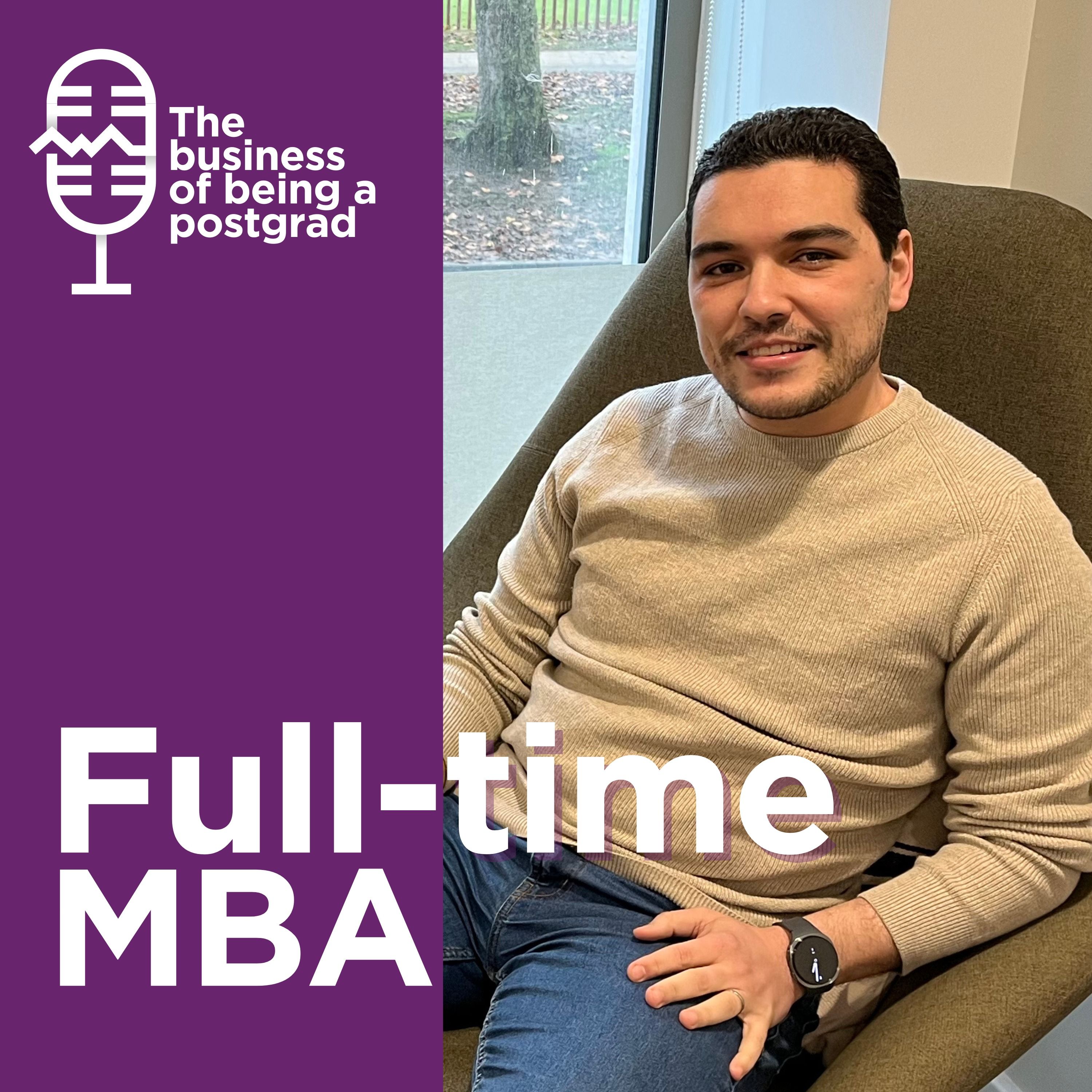
In this episode of "Business of Being a Post-Grad," host John interviews Fad, an MBA student from Morocco at Durham University Business School. Fad explains his reasons for choosing Durham, citing its strong rankings, one-year program duration, a recommendation from a successful alumnus, and the unique "boardroom exercise" that simulates CEO experience. He details his successful application for the highly competitive Chevening scholarship, for which only 1% of applicants are selected, and acknowledges the Business School's support in covering the remaining tuition fees.
Reflecting on the program, Fad highlights the value of both hard skills, like finance and economics taught by exceptional professors such as Amir Michael, and soft skills developed through working in diverse, psychologically-assigned cohort groups. He emphasizes the importance of guest speakers and extracurricular involvement, like college football, for a holistic experience. His advice for future applicants is to be authentic and specific in application essays, maximize learning from every interaction, engage in social and club activities, and leverage the mentorship program to build lasting professional relationships. Post-MBA, Fad plans to return to his company in Morocco and aims to help build a Durham alumni network in North Africa.
Welcome to the business of being a post-grad, where we share real-stories, experiences and insights from post-graduate students here at Durham University Business School. Each episode explores the highs, the challenges, and everything in between. Our conversations are split into three sections, life, learning, and lessons. So whether you're considering post-graduate study, already on your journey, or, simply curious about the people shaping the future of business, this podcast is your inside look. Hi, I'm John. In this episode of the Business of Being a Post-Grad, I sit down with MBA student, Fad, from Morocco, to hear about his experience during Micklyn's turn. As a prestigious achievement scholar, Fad shares advice on the application and interview process, and what it means to be a part of the achievement 1% community. Best up life, your journey, your experiences, and what made Durham feel right for you. Hi Fad, thank you for coming on the business of being a post-grad, which you'd like to introduce to our audience and tell them a little bit about your background. Hello John, it's good to be here with you today. Thanks for inviting me for this podcast session. So my name is Fad, I'm from Morocco, I'm a student at the MBA, co-hosted this year. In terms of background, I have a telecom engineering background, something around 11 years of work experience that ranges from technical consultancy, then I move to project program management and more recently to product management. So my experience ranges from working in, let's say, multinational companies to government companies to local firms. And what led you to Durham University Business School? Oh, a lot of reasons that pushes me to consider the Durham MBA. So I would say first of all, I was looking for a program that is prestigious. So ranking was very important to me. And looking for example at the financial times ranking, Durham MBA was consistently ranking among the top, let's say the last 15 or 20 years. That was very important to me. Second thing I would say that I was looking for a program that lasts no more than 12 months, no more than one year because you can see after 11 years of work experience, you do not want to be cut from the professional world more than one year. Yeah. I would add the fact that it was highly a recommendation from my Moroccan friend who did this MBA at Durham in 2002. Wow. He's working as a sales director. And he really pushes me to consider Durham. And maybe I can add the fourth one. You see, there's a lot of sales that pushes me to consider Durham. Let's say the unique model of Durham MBA, which is the boardroom exercise, we're pushing you to play as, let's say, to simulate as a CEO and sitting front of an administ and administration. Board of a company and play the role of a CEO. So that was very important to me, practical stuff. And being in the shows of prospective CEO, that was very important to me. So at what point was it in your career that you decided now is the time to pursue the MBA? Honestly, right after my graduation from my engineering school, I was thinking that I needed to pursue business studies. Because let's say after four or five years of work experience, I started knowing exactly how the engine is working, but not where he is headed. So I needed some, let's say, business learnings in order to tackle this. Because we'd regards your question for Durham MBA, I would say I was considered applying the year before last year, but I have a double complexity of applying at the same time to a scholarship to cover my fees. And at that time, I didn't got it. So I had a chance to reapply this year and I got an admission. And if you don't mind sharing with the audience what that scholarship was, I have applied for Chivneyed scholarship. So it was your second time applying for Chivney when you were successful? Yes, it is. And big congratulations. Thank you so much. Being successful. Yes, we received lots of applications a year across the university for lots of people to come and pursue a master's. I even think this year they had over 100,000 applications, which is the most I've ever had, I think. So yeah, great achievement. Yeah, it's a great community. Thank you so much. So, just to talk a little bit about that application process, how did you find it? How was the interview? Yeah, honestly, for the Chivneyed application, on the first place I was struck by in between practice the shocking numbers of applications. Of the applications? Yes, because daunting. Yeah. The official number says that only 1% of the whole people they are applying, they got a final admission. So this is the first place they kind of pushes me back from applying. But I think that I have a lot of great experiences to talk about, professional ones, personal ones. I think I have achieved great results and I said that I need to leverage this to craft some wonderful assets. So this is what I've done and I strongly believe that Durham University has been part of this great success. Why? Because as you may know, Chivneyed scholarship only covers a cap of 2022, how toward the tuition fees and the Durham Business School has accepted to cover the remaining fees toward the full tuition fees. So again, thanks so much to Durham Business School for covering this. Making me, let's say, ease in the financial burden so I can concentrate fully on my earnings. Yeah. Well, it's such a prestigious award, as you mentioned. So yeah, the Business School is very happy to support achieving scholars on the programme. Next, we're diving into learning. The classes, experience and the skills that have really shaped your programme so far. As you've mentioned earlier, you had quite an inspiring career and you've been involved in lots of different projects. How has these skills helped you so far on the MBA? Yeah, I think it has helped me in terms of, let's say, two main pets. The first one which is in terms of hard competencies that I could bring with me. As you said, I have worked in technical consultancies, sales of technical solutions and project product management. So I think in terms of hard skills, I could highly, let's say, lead some discussions inside the classroom, interact with the professors, but also inside the group books. Second thing I believe, after 11 years of work experience, you've started exactly know how to work with different people. Because this one of the implicit competencies that we are learning inside the MBA. So after 11 years of work experience in, let's say, no less than five different companies, it's highly helped me in terms of working with different people, even the more difficult ones. So in terms of the first term and your modules you've covered where you've been enjoying, yeah, I think the first term, the McKaylenness terms, we've been learning the basics for me models. Can I cite them? Yes, you can. So there is the leading and managing people, the marketing, accounting and finance, as well as the economics for global business. So these models they are considered the basics and they are paving the way to prospective models from the second term. So I think that I have learned a lot because having an engineering background, I had no prior knowledge with regards to models or knowledge like finance, like economics, like numbers. I'm easy with mathematics, but such kind of learnings, I have no prior knowledge. And I want to say, I want to highlight something that is very important. And I think that during my first term I have had the best professor in my entire academic life, or you've got to ask here, of course, because I'm not just throwing flowers or marketing purposes, it's the real truth. I have written this in every, let's say, how do you call it, feedback? Feedback, yes. It's professor Amir Michael, professor of accounting. He gives us not only his way of teaching stuff. It's like, he is not teaching, let's say, academic knowledge. He is telling a real story. And as I've always said, the memory of human beings, they retain only structured things. Even though you are good in terms of knowledge, if you don't know how to teach, if you don't know, if you don't have any, let's say, a strong pedagogy, students will not follow you. So professor Amir Michael, I said it again, is the best professor I have had in my entire academic life. And now I'm an aged man. After 11 years of experience, I can't hold my attention more than, let's say, 20, 30 minutes. Professor Amir Michael, I can assure you that I've taken, centred from the whole time with him. I'm sure it'll be very happy to hear that. Sure. But of course, I would like to highlight the model from economics for global business. Because it gives you, let's say, a global perspective of how business managers should react to market changes. And very specific, very special greetings to Professor Rebecca. It's a very tough model, but let's say thanks to her, it's now easier to grasp. And looking ahead in terms of next term, have you chosen your, your chosen pathway? Yes, I'll go with consultancy, consultancy. Okay, I thought you potentially might have gone with the tech coming from the background that you might have. No, because I think when I have had the look on the tech consultant, the tech, let's say pathway, I think it's something familiar to me. It's not going to add a lot of, let's say, value. So I'd say let's go with consultancy. And then you obviously have your study trip coming up in April. Yes. Just about April time. And then the, as you mentioned earlier, the boardroom exercise will kind of conclude the term. So yeah, it sounds like lots of things to look forward to. During the program as well, has there been any additional events or networking opportunities or guest speakers that you've attended or engaged with? Yeah, I think one of the, let's say, most remarkable or important things that we've learned in Durham Business School or the MBA program is that each time we're inviting guest speakers to complement the theory we're learning in class. So for example, one time we've received a senior product manager at Amazon. At a time we've received a CEO of a startup working on knowledge management. So this really complements the theory we're learning in class. And it's also a good opportunity for us to ask questions from a practical site. And how is the group working being and your cohort experience been so far? Yeah, I think it's again a very critical point you've asked Jonathan because thanks to our teaching and learning team, they have done a really great job in terms of, let's say, spotting out in terms of us in terms of groups because they have, they are relying on, let's say, experts to assign us into specific groups according to the age, to the background, to the, but also to the psychological side of people. So we've before coming in here, we've done, we've responded to, let's say, questionnaire, a very long one that has been conceived by professionals in order to structure your psychological mind. Are you the most from, are you from, from the analytical people or from the, any other, any other category yet? So thanks to them, we have been divided into, let's say, groups. And I found myself, let's say in my group or, let's say, almost all of the group, they were very complimentary in terms of geography, in terms of background. And that's very important because we've worked in a lot of projects together, marketing, economics and everything else. And I think, for example, I can give example just to make the practical side, we've had a financial expert who helped us, or let's say helped drive the discussions toward the formative and in the accounting model. I'm coming from tech background, from the perspective of product management. We had another person coming from the tech, but this time from the, let's say, from the project and the delivery perspective. Another person coming from the marketing staffs. So this complimentary pushes us not only to learn from professors, but also to learn from each other. Yeah. And the most important thing I would like to say, which is in the next term, we are going to work with new people. So we are going to be assigned with a new team to maximize the learning. Yes. Sounds like a great way to learn from each other and keep building it. Of course. Mix those up and build new relationships. Yes. And I think this is, I don't know what's happening in other business schools, but this is very unique to Durham MBA, because as I said, the leveraging experts from the field to, let's say, spot to which psychological category you're belonging to in order to divide the team groups. That leads us into lessons where we talk about the key takeaways and advice for future post-grads. So we're a few months into the MBA program now. So if we take some time here to reflect back on those first few months, what's something you've learned about yourself during your time at Durham? First of all, the most instinctive one is hard skills. So as I said, I have no prior knowledge about finance, economics and accounting. So I have learned a lot in terms of hard skills like finance, economics, and from one of the best professors, as I said, from the Michael Fistorbeca, and especially how to apply them. Because one of the assignments we're having is to select a company and then try to apply all what we've learned into it. So it's a not only theory, but also a practical one. A second dimension, I could say, which is, let's say, people's skills. This is very important because, for example, if you're going to, go with an interview, you're not even aware of the type of people or the kind of people you're going to work with. So you need such kind of, let's say, implicit competencies that you need to develop of how to work with people. The program MBA pushes us to develop such kind of competency by dividing us into smaller groups of six persons. And it's up to you to learn how to work with them, to leverage your sensors and, let's say, prepare actions on how you can work with this group. And I think it is as well at the same time, strengthening your leadership skills. But also a third dimension, which is something, let's say, beyond the academic courses. Here I'll like to be a club's societies involved in the football teams of Houston of college. I go to swimming. So I can say that here in Durham, there is a thing for everybody. Both at a professional level because we compete against a member of the University of College. Yes. And you're saying you represent the football team at Houston of college? I'm part of the team. Yes. Yes. And we compete against other colleges. But we have inside in Brazil. Is there a league table? Yes, there is a league table. Where is Houston of currently? I think we're doing good. Okay. The fourth place. That's good. It's a good place. It's a good place. It's a good place. That's right. So I will say that there is everything for everybody in here. Both at a professional level because inside of Durham University we're playing against the North League against other universities. But also, not at a professional level, but let's say at the fund level, hang out with your friends. Yeah. So what advice would you have to somebody applying to the MBA at Durham University Business School? I would say that, first of all, one year MBA program is going to fly by. You should come in here with the perspective of maximizing the learnings. So when I say maximizing learnings, so maximizing learnings in its broadest possible terms, from the professors, from the faculty members, from students in the cohort, from people living with you inside the college, from everyone you will encounter, you need, and you should learn something. Second thing, I would say, you need to maximize interactions with all of the people that I have stated. There is almost something that you can learn from everybody. And I would like to, let's say, invite those prospective students to get involved into activities and social activities. For example, you can go for a social club, you can go as well for an activity involving a team like sport activity or anything else. So this is very important. And I have learned from the professors that, so even for, let's say, the job market, the interviewers, they are asking about such kind of experiences, because it is projecting the fact that you can work easily with people, especially if you are coming from abroad. They need to know that you can work easily with British people, and this is a very good thing. And a second advice or a third one I could give is that, please learn how to develop, let's say, sustainable relationships. And there is a very good opportunity here in the Rhein-Beson School, which is, there is a program called Mentorship Program. So we are assigning alumni people from previous cohorts to everybody, to every student and here, and that is fantastic. Because we're assigning it, we're assigning this alumni to you based on, let's say, background, the professional experience, and he can help you a lot, especially from the field, from the practical perspective. So learn how to maximize or learn how to develop sustainable relationships. So do you have a mentor? Yes, I do have one. I will have he's a counter-manager for a Rhein-Beson Company in Spain. Oh, well, very interesting. And just to go back to the evening, because we're coming up to the interview round for those who are flying for next year, any quick tips just for those students who have been making such a second stage, and about to have that interview. Yeah, so for me, Chivinini is two main stages. The first one, which is the, let's say, the biggest filter, which is the right in SS. So one advice is be specific. And one practical advice I could say is that if you write something, be ready to gain. If you find that this thing could be said by any people else, anybody else, delete it, write it again. Until you say this cannot be said by anybody else, this is specific to me. So be specific as much as possible. And I think if you stick to this and you add on it, the fact that you are heading toward tackling a very specific objective, and here it's impact, I think you could have a place on the interview. And any tips for the interview? So the interview mainly is going to rely on what you've rotten the essays. So again, be specific about the objectives. And in the interview in general, the board is very, very friendly. So I think that if you pass the SS part, the interview is going to be somehow easy, but it's still in the unit to prepare for it. And yeah, look ahead. Obviously, you've still got quite a bit time to go on the MBA. But what is, at the moment, what's your career plan? What's next for you after the MBA? I mean, a very specific case because I didn't resign before coming to here. So my company, let's say, they suggested or they accepted, for me, let's say, sabbatical years. So I came in here to the MBA, then I will come back to my company. I was working as a product manager. At the same time, there was a lot of big projects that we didn't continue to continue. So I will come back to my company. And any plans when you get back there to set up any MBA communities or alumni communities? I knew one from the MBA cohorts, 2002, I believe, yeah. So I think to have MBA or the university in general is, let's say, end of the represented in rock on North African general. So one of my plans that I want to leverage on, and this is, I have written it in my essays for my admissions, my project is how we can, let's say, create a kind of association or formal gathering, of course, with the help of university. And gathering all of them rock in North African people that have studied in the Durham University in general, that's on the MBA. And the main purpose for this formal association or formal gathering is first to create a kind of close knit group between all of us. And the second one is to, let's say, reach out to prospective students wanting to continue their studies abroad and to the UK and give them a kind of taste of what it is to study in one of the best universities in the world. And to great, I think we'll leave it at that. So we're just going to finish up with a quick fire round. So we're just going to ask you a couple of questions and we're just looking for the first thing that comes to mind. So you ready? Yes, I am. Great. So we'll jump straight in. A book or a podcast that's influenced you. I would say a French one called Bliton. Your favourite British food that you've tried? Honestly, I've tried only once. The British breakfast, yeah. And how was it? So, Castle of Cathedral Cathedral, which modules challenge you the most so far? The most challenging but the most important one, economics for a global business. What would you hope you remembered for by the end of your MBA? I would say interactions with professors and people in here. And lastly, one word to describe your MBA cohort. Brilliant. Amazing. Thank you so much for joining us on the podcast. Thank you so much. Don't forget to subscribe. We've got plenty more stories coming your way.
Podcast Summary
Key Points:
The podcast "Business of Being a Post-Grad" features an interview with Fad, an MBA student from Morocco at Durham University Business School.
Fad chose Durham's MBA for its prestige, one-year duration, a strong alumni recommendation, and its unique practical "boardroom exercise" simulation.
He successfully secured a prestigious Chevening scholarship (covering partial fees) with support from the Business School, highlighting the competitive 1% acceptance rate.
Fad praises the program's curriculum, particularly Professor Amir Michael's teaching, and values the diverse, psychologically-assigned cohort for group learning.
Key advice for applicants includes being specific in essays, maximizing learning from all interactions, getting involved in activities, and building sustainable relationships through mentorship.
Summary:
In this episode of "Business of Being a Post-Grad," host John interviews Fad, an MBA student from Morocco at Durham University Business School. Fad explains his reasons for choosing Durham, citing its strong rankings, one-year program duration, a recommendation from a successful alumnus, and the unique "boardroom exercise" that simulates CEO experience. He details his successful application for the highly competitive Chevening scholarship, for which only 1% of applicants are selected, and acknowledges the Business School's support in covering the remaining tuition fees.
Reflecting on the program, Fad highlights the value of both hard skills, like finance and economics taught by exceptional professors such as Amir Michael, and soft skills developed through working in diverse, psychologically-assigned cohort groups. He emphasizes the importance of guest speakers and extracurricular involvement, like college football, for a holistic experience. His advice for future applicants is to be authentic and specific in application essays, maximize learning from every interaction, engage in social and club activities, and leverage the mentorship program to build lasting professional relationships. Post-MBA, Fad plans to return to his company in Morocco and aims to help build a Durham alumni network in North Africa.
FAQs
It shares real stories, experiences, and insights from post-graduate students at Durham University Business School, covering life, learning, and lessons.
He chose it for its prestigious ranking, the one-year program duration, a strong recommendation from a friend, and the unique boardroom exercise simulating CEO experiences.
The Chevening Scholarship is a prestigious award covering tuition fees. It is highly competitive, with only about 1% of applicants receiving it.
Be specific in your essays, ensuring your content is unique to you and not generic. Focus on your objectives and impact to stand out.
Groups are assigned by experts based on age, background, and psychological profiles to ensure diverse and complementary teams, enhancing collaborative learning.
He has gained hard skills in finance and economics, improved people and leadership skills through group work, and engaged in extracurricular activities like sports and clubs.
Chat with AI
Loading...
Pro features
Go deeper with this episode
Unlock creator-grade tools that turn any transcript into show notes and subtitle files.
 PodcastTranscript AI