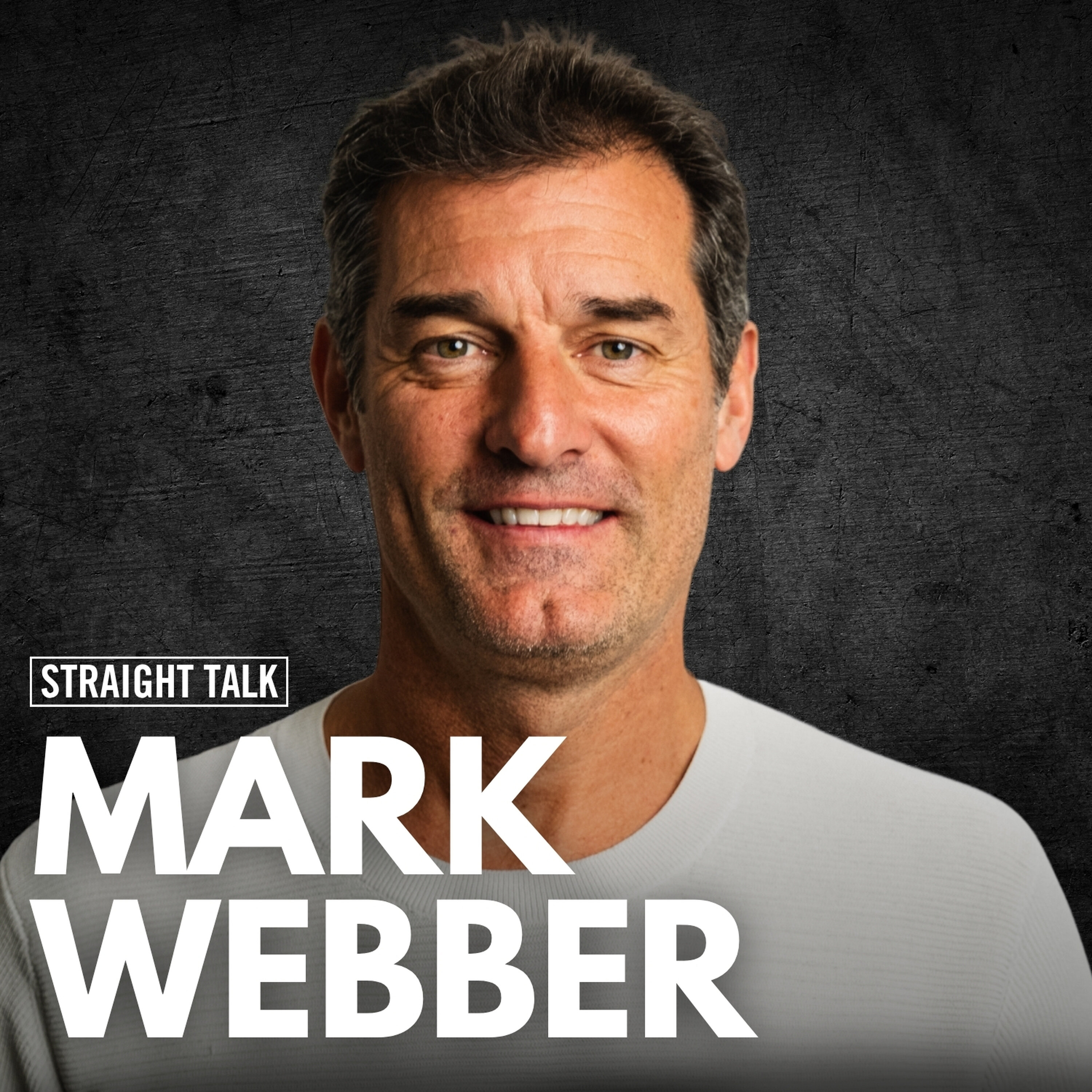
F1 Legend Mark Webber on Winning Monaco Twice, Surviving a 280km/h Crash & What All the Greats Have in Common
84m 19s
Mark Webber reflects on his journey from a Canberra Raiders ballboy to a Formula One icon, crediting his father’s strategic guidance and his own relentless work ethic. Growing up in Queanbeyan, he played multiple sports but became obsessed with racing after go-karting, eventually moving to Europe in 1995 for Formula Ford. The intense competition abroad forced him to mature quickly, though a 1997 Mercedes camp exposed his physical weaknesses, prompting him to train alone in Thredbo to catch up. A near-fatal double flip in 1999 nearly ended his career, but he risked everything to pursue F1, landing a debut with Paul Stoddart’s team in 2002, where he finished fifth unexpectedly. Webber highlights career peaks like winning Monaco twice, emphasizing the precision and mental calm required, and recounts the Multi-21 controversy with Sebastian Vettel, which he sees as part of racing rivalry. After retiring, he transitioned smoothly to Porsche, media roles, and mentoring Oscar Piastri, valuing loyalty and gratitude. He underscores that discipline, adaptability, and staying in the game define success, not just victories. Webber’s story is one of resilience, strategic risk-taking, and a deep appreciation for the people and mentors who shaped him, from his father to legends like Jackie Stewart and Dietrich Mateschitz.
Mark Weber mate, this is unbelievable from the great opportunity for me. Welcome to straight talk.
Great to be you mate. I can't believe that I'm sitting in front of you but anyway you're
sitting in front of me, how do you want to put it? Amazing, it's just amazing. Well, we just
had a little pre-talk about a whole lot of stuff and I wish we had recorded it. Don't
worry, we'll cover it, we'll cover it. He didn't say anything, he didn't go off beast
and but he will. I was just walking up here and I ran into a sporting journalist and he
said to me, I told him that I was going to do an interview with you and he said to me, "Here's
a ballboy for the Canberraiders." That's quite interesting given how famous you are today
and all the crazy stuff that you're noted for. If we go back to Mark Weber, the ballboy
for the Canberraiders can we go back to that end? Of course we can. Because I think no one
knows that stuff. Not many, no. Look, I know you're a big league I made and so am I, I watch
it all still to this side. You're still a Canberraider's world. Absolutely, yeah. Watch Ricky's
guys but I was very lucky and it was actually a bit of a fluke probably from my old man.
Like Dad knew at the time a guy called Mick Doyle who was the coach at the other 21 side
then and said, "Oh, maybe the eluce weekend for Mark to come out and do a bit of ballboying
for Mark." I was actually interesting. I was actually old for a ballboy, which was bloody
important and I'll get into that. I'm talking like 12 or 13. It's a bit like mid 80s. Yeah,
13. A bit out of 14, probably because we did the grand final with the Tigers. But I
think, under 21, to reserve 10 bucks a match, to the 30 bucks a weekend, which was bloody
wicked, so that was cool. They paid you. Yeah, bloody, it's got a little bit of money
I think, yeah. That's good, bloody. Yeah, exactly. But I think when I look back on that
when you say looking back mate, it was actually really good for me to see because when I was
seeing Mal, Laurie, Ricky, Clyde, Lazo, Arthur, Australian team, stacked side. Yeah, totally
stacked. Oh, mate. Phenomenal, you know, Sheensy coach. And, you know, to take the sand
out to Mal every weekend. Because it was sand those days. It wasn't not the tea. Yeah,
not the tea. Wow. So take the sand out to Mal. But what was funny one match, we stopped
a match once at Canberra there because what Sheensy used to like us to do was when they
kick for touch, when Ricky would kick for touch, Steve Walters would obviously take the
tap and they'd have someone on the run, get them a momentum. But our job was to put the
ball at the touch judge's feet where Ricky would have kicked out. So the ball goes out,
touch that place's flags up, stands there, bang, I'm gonna put a straight there. Yeah, bang
and then check your thugs and we'll come pick it up or someone or Mal, I was all, you
know, it's all that. But we would, I would do a monster forward pass direct to box head,
to Steve Walters. Yeah. And to get the run on, you know, and the touch, I'd just fume it.
So you were sort of, you were brief. So don't put the ball at the touch judge's feet for
a straight to him. Five seconds mate. Yeah, bang and then they're all set. And we were
all part of that was part of the strategy. Just to be honest, you don't change, like don't,
you know, if we can get it straight into onto the tap. Did you understand the point of
that at the time? Yeah. Yeah. Well, I was told, of course, I'll shit myself. Yeah. I'll
do it. Yeah, I'll do it, mate. I'll do it. So you could you reach him? Yeah. And I
was pretty, not had a little, a little pass on me mate. So you were pretty tall. I mean,
you're very tall for a race car drive. Yeah. But are you tall then? Yeah. No, I was pretty
late actually growing up, like in terms of my spirit. Yeah. But um, were you playing
footy? Yeah. Mate, I played everything. You know, I loved a bit of tennis. I loved golf.
I loved AFL. I loved by playing and rugby league. So I did, I was a jack of all trades and
legend of absolutely none. I was, you know, I loved having to go. But that's the experience
though, isn't it? Like being competitive with naturally competitive. Absolutely. Absolutely.
And I was so lucky looking back to Grapp and Queen being, you know, because it was a small
country town, you know, and sports was big. And our family was big into that. My mum and
dad, like sports and having a go was, was really important. So were they encouraging you?
Sure. Sure. You know, mum taking a swimming club and really? So those wins the night in
Queen be most fresh mate. It's very cold. Is it outdoors? Yeah. Wow. Yeah. Yeah. So, but
I think that that little athletics, like all that stuff, you know, because school for
me was, wasn't that easy. I was, I was a bit of a, bit of a rogue and I enjoyed, you
know, sport more than, you know, like the social seeing the school as well. But I really enjoyed
sport. And that was my, that was my passion really mate. So, when you, when you're growing
up, did you ever see yourself? I'm going to be a race car driver or did you ever watch
it? I mean, was that a thing? Of course. I think, well, like my dad had a huge influence
on me. No question about him. I loved Sir Jack Bram. Wow. Sir Jack Bram was dad's hero.
That's going back a while. Exactly. So, Sir Jack was, you know, racing at Warwick Farm
and some of these tracks and like in New South Wales, my dad would hitchhike from Queen
to go and watch him race against the likes of Sir Jackie Stewart and Jimmy Clark, like all
these legends from Europe, all these Formula One guns. And that, of course, was blended
into me over time as a young, as a young lad. Because I grew up, what rode in motor bikes
when I was young on the farm. And like, that was important for me to sort of have the,
a bit of the speed component early, which I just enjoyed. There was no, dad wasn't forcing
me to do it. I just enjoyed race riding the bikes at speed. Sure. Yeah, of course. And
I think that with motor bikes, you have the accountability and consequences are quite,
you learn quite quick, you know, because you've got the throttle, you've got, there's
no training wheels in it. You off you go, son, and you know, have a crack. So I think
that was, dad had the motorbike shopping queen been so really petriotly, you know, being
in, motor racing sphere, let's say, it was sort of on my doorstep and way in the go-kart
track was local. So that was, you had a go-kart track. That was so low. Not, I didn't,
but there was no track. That was so lucky. I mean, I would never, ever have been, if dad
didn't like Sir Jack, and there's no go-kart track, it was not happening. So, you know,
there's those moments where, and then once I got, I had went to, we bought a go-kart, and
I started enjoying racing the go-kart, then all the other sports dropped away. And I
think at that point, I then got an absolute addiction. It was a total. So you were racing
go-karts. Yeah. So it was a disease. At that point, it was a total disease. I was gone.
Did you just sort of ignore schoolwork and stuff like that at that point? Did you think
of stuff like that? I'd rather be out there in my go-kart. Of course. Practicing in
I was designing helmets and drawing tracks and stuff like that in class and just stuff
that I could, you know, so I just was transfixed on. As in obsessed. Totally obsessed.
Absolutely obsessed. It was all encompassing for me. So that was 16, 17, and then I went
into car racing. So that's when I started to. Carting was okay for me. I loved it, but I
was a bit big, and also dad was clever because he knew deploying. We didn't have infinite
funds. He's like, you know, you need to pull a little bit back because it's a bloody expensive sport
to give me a chance in car racing, which was more expensive. But there was, and if you're not
quick in cars, like there's no point being a freaking go-kart. If you can't go up the staircase
to go towards ultimately, which is, which is Formula One. Did you reckon the Iron Man actually
thought to himself, I'm going to take him through each of the stages, like I got him a go-kart
of his dozen license, but I'm now going to put him in a car because you can get a, do you
have to have a license to race a car? Race? Yes, a go-kart license. But yeah, so when you compete,
you need a license. You need a license for go-kart. And obviously, then when you race a car,
they're pretty much also needed a license as well. Like a license to race or a license to drive
on the road. You can race before you can drive on the road. Is that right? Yeah. So were you racing
before you could legally drive on the road? Yeah. But there's 17 or something like that. Yeah,
so yeah. So yeah, and that does happen. And even, I think it's even younger in New Zealand. So
some of the kids are racing super, like racing, like on a racing track flat. So what was your first
race car? What was the Toronto thing? Formula Ford. So single-seater. So I was always in a single-seater
car. So very rarely did I race a, what we would call a, like a touring car, like a road-relevant
street car. So I was always racing bespoke single-seater cars. That's a car with one seat.
One seat driver's seat. Own open wheels. So very, yeah, because my dad was always, he loved
single-seater racing. So I was very much on that, on that train of thought that, you know, the best
drivers are in single-seater racing. It's more accurate. You're going to be very accurate in
open-wheel racing, because the wheels are exposed and sort of the lines and everything is just a lot
more precise. So anyway, that was what. Do you have someone to teach you that stuff? I mean, how
do you become good at that? And then we're in, by the way, we're good at that. Yeah, yeah. So that's
an interesting one. I had, you get some mentors along the way. You know, early door, like hopping
into a car, you know, the first time you do that, which was actually at Aaron Park, which is now,
you know, not there anymore, it's for the houses. But that was the first time I drove a racing car,
and I just was thrown into that. And, but there was a bit of a scout there, a guy that was, and
trying to validate with my, my dad was trying to validate with him, is this, is he going okay,
or is he ready? I've read you all, because this is a big decision for my, for my family and for me,
and like where we're going to go with this. But it was actually destruction, though. Yeah, because
dad was actually thinking, like, of course, there's a process here. Yeah, it was a test drive. It was,
like, just a little test drive, like baby steps. And it was like, okay, that's some milestone.
He's done well. He's doing well there. Maybe we can go into competition, and then obviously it just
continued. So I was sort of going through these gateways of sort of dad accepting that this is
something we can do. And of course, I've, the buy-in from me's got to be big. Like, of course,
I'm hungry for it. It's not his, you know, it's, it's a bit of an extension of his love, of course.
But I have to be able to then show him how committed I am as well, because it's, I have to be
committed, you know, and that, do you think it was strategic from your dad? I mean, when you think
Back at it like oh, that's pretty happy like for a dad
or a mumble, both of them obviously mumble supporting all this, but like, for some
would have think about this in such a strategic way. And here is a humble motorbike guy fix
the stuff up, like pretty humble, living with him, he's got his son, young, where he's
sitting in the family, like in terms of kids. I was on, I got one sister, she's two years
older than me. I guess it is a young boy that's the younger kid in the family and he's
singing to himself, well I'm going to take him through each of the stage, you probably
didn't realise where he'd probably had his dream. Of course not, you know, of course at
that age you're not. And even I look back now and I said, what were you thinking taking
me to that track or doing that at that age, it was madness for the experience I had, but
of course, you know, he was big on just keep putting in deeper water, you know, you know,
and that's a little deeper, just a little bit, of course, because it, and you want, of
course, to be at that age, you want easier competition because you want the trophy and
you want to, we want to win, but it's like sometimes you've got to be putting to more
difficult situations to, to, to, to, did you see that way, I mean, always, always,
it was a, it was a late transaction, not at the time. I got to win this race. Yeah. Yeah.
Well, of course when you're younger, you're, you, you, you, you, you want to, of course,
progress naturally. You can't just sit in with the competition soft. Do you want to continue
to test yourself, but obviously he knew more than I did because it was 16 or 17. You don't
know much. Yeah. Yeah. Yeah. Yeah. Yeah. You think you're an expert, but you haven't got
much of an idea. So he was, of course, just strategizing very, very, you know, cleverly,
you know, just to sort of work and not go into hard and, and, of course, getting advice
on the way, he needs to get advice. Did he get outside advice with? Well, there's a
great touring car drive in Australia called Jimmy Richards. And once Malala was driving
a car in South Australia and Jimmy went to see Dad on the bank, he was just watching
me drive around. And, and my dad loved Jimmy Richards as, you know, we all do. He's a pretty
kind of an absolute legend of our sport. And really, you know, just a, just a great guy
and like no agenda, just like straight up. And he just went to dad and said, you're way
generous with his eye. Great. And he just said, Mark's wasting his time here in Australia.
He's really, he's got to go overseas. Well, what was the thing behind that? Just again,
go, he's, he's got to go and test himself against the best. Like we can race here in Australia,
this category, like Formula Ford and these, these formative categories, the hot bed, all
the big, big guns are in Europe. So he said, I advised, I would advise you, Alan, to
give out a go because you must have recognized that there's a potential in you and also must
recognize that your dad and you might have wanted to have, you'd have a career in this
at this stage. Yeah. Of course. Now, now it's getting serious. Yes. You know, like that's
sort of 1995, when you're racing in, like at the sharp end in, in Formula Ford racing,
which is the first step out of GoCart really, but it's still, they're pretty quick cars
and it's getting serious and it's like, but someone like that to give dad the validation
and we're sort of, one more on the right track. And two, you know, there's more to it.
Give him a chance, give him a chance to go overseas, which of course in our little world,
you're like, maybe not sure what a big step. Yeah, yeah, it was great. It was great to
be. Did you? Did you? Yeah, yeah. Yeah, went, yeah. So 96, I went, ended 95, I went to Europe
and I had that work. Have you ever come back? I had that work. Like, well, I went over there
and did a test drive for the works team, which was, which was called Van Diem at the time.
And that went brilliantly. And then they said, you can do a race like a, it's a, basically,
it's not an invitation race, but it's the biggest Formula Ford race in the world, the
Formula Ford Festival. Did they give you a car? So yellow pages in Australia sponsored
me for that race. So yellow pages sponsored me all through my, well, my junior, some
of my junior stuff here in Australia. And then they said, we're happy to support you, which
was 5,000 pounds for the week. I had to get 5,000 pounds in 1990 in October, 95. Yeah, the
UK pounds. Yes. There was 33 P to the dollar then. Yeah, yeah. It's a lot of money. I know
you're a numbers man, mate. A lot of money. Yeah. So it was, it was, yeah, it was, you
know, we, you know, it was, we had to do it. Yeah. Yellow pages are amazing. So we did
that. And then I got a really good result straight up, which was just top three in a,
like it was 120 in the field. Right. So I finished in the top three first track, first
time in that category. So that was, and then the boss said, mate, you come back next
year. This is the bike that owns a whole factory team. And he's, his name was Ralph
Thurmond. He said, you come back next year, subsidized drive. It's 85,000 quid, but we're
paying half. And you can bring the rest, which yellow pages did. Wow. So, so we get, just
to give me a bit of sense of this. So how were you, like, 20? Yeah, there. What are
we, uh, you're 20. So you're 20. You arrive in the 19, 19 year, and you arrive in Europe.
Whereabouts in Europe, we're talking about. Uh, so that was not Norwich. Uh, in the UK.
East Anglia. Yeah. Okay. So you're in the UK and you've never been on this track before.
Yeah. No. No. Do you walk the track? How do you do? How do you know where we go? It's
a great question, mate, because now there's a lot of simulators, right? So all this offline
virtual world we have now in racing that the guys use. Yeah. Of course none of that, then,
you know, so you have a, have a walk around. Have a look at it. Literally a walk. Yeah.
Have a walk, but then you just got to get in the car. And can you have a little test drive?
No. No. No. Because there's three or four, five people in your team, by the, already these
are little baby cars, nothing like F1, but obviously it's already, you've got a team.
These, these cars need to be organized and prepped up and set up and, you know, they're
pretty, they're nice little bits of kit, they're gorgeous, you know, little bits of jewelry.
And you've got to take them out there and get into them. So you can't get an old fit.
No. No. The track is, it's pretty hard to get. It's sacrosanx, yeah. Yeah. Pretty hard
to get on. So yeah. Any surprises? So when you, or can you remember that day? A lot more
intense. A lot more intense. So the racing was a lot more cutthroat, you know, it's just
a, like ruthless. The depth, exactly. The depth, ruthless, all of a sudden, I'm, you
know, on the grid with Colombians, Mexican, you know, Frenchies, German, like there's just
a, every nationality you name, they were on the grid. And it was just, and the precision,
just how close they had run you to the fence and how really? So just a lot tighter.
Putting pressure on you. Yeah, of course. And they actually put in pressure, or they just
trying to get ahead of you, and that creates pressure, or they send, let's, stuff this
broke up. Intimidation as well. Really? More in combat, more, more contacts, you know,
they're actually touching Australia. There wasn't much of that. It was right. A bit more
after you, sir. Still, still solid, but like over there was just different gravy, straight
the way. I'm going to win my facelift. But, you know, this is, yeah, these guys are
wrong. And the depth is so you could have three or four sharp guys to the front here,
over there you could 20 sharp guy, like really good operators, you know, sir. How fast
are you going? Well, that's not that quick. Oh, there's 220 K, you know, they're like,
they're, you know, that's only a 1600 engine, but it's, you know, it gets along. And
but that was, yeah, 220's pretty quick. Yeah. Yeah. I mean, I have no stories in relation
to this, because I, I, I, many, I have done a month, so we, I have to tell you what
happened there, because you're going to laugh at me, right? Many, many years ago, I was in
2004, 2005. My son, I bought an estimate and, um, do you know, because they just, they
just got released and I don't know why I did. I still got it actually, but I wish I hadn't
bought it. But anyway, don't matter. And my son, my dad, my old son, he said, let's go
out to a track somewhere in City, I remember it was. And there's a whole lot of people
going out there and he said, let's go for a drive and then I said, oh, okay, cool. And
so I did one lap and he said, that'll let me take you. And, uh, and he was driving Mr.
Bishie Evo at the time here. And he was racing in a bit. Yeah. Oh, my God. I was so scared.
And I started yelling and screaming at him. I said, mate, stop the fucking car and let
me out now. And he was just laughing and just going faster and faster. It terrified me.
I don't know where you get the, I don't know, is testosterone with adrenaline or my,
my cortisol was out of control. I don't understand, Mark, like, uh, how you control your sense
of fear or is it in your case, there's no fear. It's just adrenaline. Well, you go on
a journey of your skillset. I think you, when you get more and more experience, you get
highly skilled. Put it back then when you're 19, then yeah, you're, you're raw. You're raw.
It is definitely, um, you know, of course you have this, you know, is it nature or nurture?
You know, like, how do you just get half good at something? And it just apparently it turns
out that it, some things come more natural to you than maybe others. And you just, you
just, of course, take that for granted, I suppose, in some ways. So for me, it was more,
um, it's not, they think about racing drivers as adrenaline junkies. We're not really
not, we're not, we're not, we're not really, it's, it's, it's, I, at least for me anyway,
I don't feel like I'm an adrenaline. People would think, you know, if you do 370 K now
and a Formula One car, you, you, you, you, you, you claim for the rush. Yeah, the rush
and the orphans and things. But I'm, it's more of the accuracy and the precision and the
testing yourself and, you know, and, and applying all of your skills at the point in your
career, of course, because the most experience you have, mate, is a day or a tire. Yeah. That's
when you've got the most experience. Exactly. He's, so, you know, you're trying to, obviously,
you know, and then when you've got people helping you and guiding you along the way, because
of course you're making so many errors when you're younger. But I think that the, the experience
blended with your, just that sheer enthusiasm and passion, you know, you've got that flamboyancy,
you know, you're, you're so, um, ignorant with bliss, isn't it? You're so confident.
You're so confident. You're so confident. Yeah. You know, and you're, and you're
borderline reckless. You're making some mistakes here and there. But, but that comes and then the polished,
been polished comes getting more, you know, articulate their word, of course, consistency. You know,
you've got so many people in this podcast made it come in sport. And that is, that's, that's,
that's what they have to be able to do, right? Yeah. Got to be consistent. You know, if you
ultimately, delivering all the time, got to be able to defend your position. Yeah. Exactly. And
also be, you know, but even accurate lap time, you see someone like Raffer or Roger.
In our situation, that's repeating the same lap time all the time at a high level or a
golfer, drive it down the middle or whatever if you're like that's in our game is doing
the same lap time, very metronomically.
So it becomes mathematical.
Elite sports people can do, I think they're looking for right, they want to have the mistakes
fact.
So recklessness is out of the game, it's more about like you're just saying, it's very
mathematical and structured and it's about accuracy and repeating that accuracy.
Yes, but of course the journey, you get better of course as you get older and then when
you get to Formula One, of course that's another level again, but through the junior categories
of course there's lots of errors and rushes of blood and where you just, you know, you
make some horrendous errors because you're learning and that's natural.
But of course, if you're just, of course, if you are learning, that's the most important
thing, if you continue to do the same as like over and over and over again, then of course
people will know that and that's obviously not a good one.
Did you ever have during these periods before Formula One, but did you ever have during these
periods that you can recall a moment where you thought, "Fuck, oh, that's so dumb what
I did."
Is there anything that stands out to you that you'll never forget during this period, not
Formula One, but during this period?
Yeah, mainly linked to crashes, I suppose, in terms of just again a situation that the
percentages were so low when pulling a passing move off or something that you thought was
on and it wasn't on and you went for something that just was half-baked and half-cocked and
didn't come off.
So we talk about the decision making process, so let's see if you can recall maybe I got
to get around him, I'm going to overtake, is it like, is it a hair's breath between doing
and not doing it, or is it very strategic?
Are you looking for 20 different signatures that say, "Now I'll go."
Yeah, no, a good point, mate.
I mean, yeah, there's body language of the car in front.
How is he going?
What's he doing?
Point of explain where that is?
He's like where his car positioning is, is he driving within the car, is he on the
limit of the car in front of you sort of, you're seeing how he might be, this might be his
limit when you're saying, "Okay, well, I can squeeze him into a mistake just by following
him, you might make a small error and make it easy for myself," or in a situation where
you've got someone that's overt, like what we say, let's over-defending and see their
under pressure, they're happy to even give up a second or third or a fourth, we might
be fighting for fourth and he's happy to let them go and just, he's going to take the
battle within ourselves as now as a one-on-one, you know, between ourselves.
And that's where there's been times where I'm like, "I've got to take care of this and
fix this up and sometimes you might do it too hastily and there's contact and you've
stuffed up and, you know, so you don't look at the big chess piece, the big, you know,
the chess player, I suppose, holistically at that age too early, you're just like, okay,
when you get more experience, like, "Okay, pull yourself back out of this, let's look at
this from outside and go, okay, I need to actually strip this down a bit nicer, but when
you're in 19, I mean, good luck with that, lucky you are just right up a drain pipe, you
know, you want to be, you want to be, I'm going to do it, yeah, I'm going to do it and
I'm going to make my presence felt and I'm going to make sure he knows I'm here."
Do you sort of get into his zone?
Because like, you're driving the car, your foot here and there and everything and you're
also surveying everything around you and you're feeling what's behind you and you're
sort of feeling what's on your side, your brain, your eyes, all your senses observing
a whole heap of stuff, then at the same time you're strategizing, it's like, nearly, you
could nearly forget to drive, you think about, "I'm going to do this."
Of course, mate, of course, and that again, like at the formula one, the mind management,
you know, with the ram, if the ram is full, you know, then obviously your situation of
making the consistently the right decisions is going to struggle if it's, if your brain's
full of push, stuff going on, your ability to be able to, and the eyes are critical, of
course, and you make a good point about peripheral vision, peripheral vision is huge, in sport
and in huge, in our sport as well, because your eyes are scanned, the speed we're going,
we need to be able to, that all needs to become just, if it's coming at you super, super
slow, you know, in everything, even on a qualifying lap, which is us against the track.
The ultimate test of speed is us in qualifying, so you go out and you have to be able to drive
the car on the absolute limit and that has to be coming at you in my, in the best days
of my racing career, that is coming at you very slowly.
Really?
You can slow it down, well that's when it's, when you're performing brilliantly, it's
coming at you very, very slowly, and you're ahead, you're just so far ahead of what's
happening, and, and the same in racing, you know, so you're, that flow, we talk about
the flow or what, you know, it's very hard, you know, is that the thing you talk about?
Yes, of course, of course, so it's coming at you very, and you're, and you're so present,
you're so present, there's no baggage from what's happened, there's no baggage ahead,
it's just like you're here, you're here, you are so with the car, and you're just, you're
present, and that's when, since I guess, sort of floating in your meditative sense, that's
the big secret source, if you can get it right, obviously, if we can, yeah, of course,
I think that's, and if you can bottle out every weekend, which unfortunately went for
me when I had to come up against the Michael Schumacher's and the Lewis Hamilton and those
guys, that's a headache, because those guys, well, they're, you know, they are arguably,
you know, they have been, or they're both in the goat conversation, yeah, yeah, yeah, so,
but do you think that, do you think that they, are you saying to me now that, that was
a, not intimidating, but like a mountain have to climb, because you thought they were very
good at doing this, getting into the, that's what I thought, in that more often than probably,
you know, the guys, you know, I still had some success, but obviously the group, the absolute
greats in any sport, I think they are in that window, just a bit easier, and they seem
like they've got more time than anybody else. Of course, look at Roger, yeah, you know,
Xenodine said out, I don't know if you know anybody, yeah, I, the famous French soccer player
sure do, I'm watching the World Cup final, yeah, it's an absolute joke watching him play
football. I'm watching play, I'm watching play, I watched France win the World Cup in
Paris in years ago, and he was amazing, slow motion, yeah, it looks like slow motion, the
ball comes to it, like everything slows down, when he's on it, and people are moving round
and he's just like, so that's a beautiful example of time in sport when people, so obviously
if everything's rushed, not good, in your johns, time, yeah, time, got time mate, so they
create time, and that's the thing where, and I think it's massive on the, on the peripheral
stuff, huge, because that, that, that, that ability to be able to stall your, your gyro,
you know, even your, all your, all your balance and everything is just so in sync and it's
incredible, it's great to watch. It's, it's, it's, it's interesting, you should say that
because it's funny, I was talking to Dave Warner in the podcast, actually, and Dave said
to me that we're talking about bowlers and, and or batsmen, but they don't rely on peripheral
vision as much as they rely on them, they have unbelievable closeness of their eyes together,
and they can, they can hit a ball, because they can really zone in on the ball, that's
coming towards them, which is sort of, send, send me the opposite to you. Yeah. You've
got to have view, you got to see what's happening around you everywhere. Yeah. They're a massive
span. Well, we're covering a football field every second. Wow. Covering a football every
second. One, two, three, four, five, six football fields in six seconds, you know, so when
you're doing, you know, 220. You mean literally, there's probably been, it's a speed. Yeah,
it's a really good plus or plus or plus. It's probably studies on this. Yeah, it's about
that. We're doing three hundred and seventy K now. You know, so there's a hundred meters
every second. Yeah. Yeah. Wow. It's quick. So that's, I mean, of course, you prefer,
peripheral vision is critical because we're picking up, picking up breaking boards, and
that's if we're not driving, breaking board, like our breaking markets, you know, with that
speed, if we elect to break it one tenth of a second later or early, of course, that has
a huge effect on, on, on our, on our lap time, and where we're breaking. And also, and
that's if we're driving in beautiful conditions, think about driving in the rain, when there's
spray, and you can't really see. So then you can't see probably not as much for a limited
vision, very, very limited vision. And that's where another thing in our game, when you
are under immense stress, whether it's communication or whether it's visually you're compromised,
your hearing goes, your hearing is another credible parameter on listening to the car in
front, where, where could he be listening to things like that? It's another queuing hearing
is another massive tool for us in the car, which is, which is phenomenal because one of
the first things that go when you're under severe pressure, if the team are talking to
you in you're in a situation of pressure, the brain or that's like it just, I didn't hear
that, or you know, because that happens, does that, would you know that they said something
you don't know what they said? You could do, but you might, yeah, it has happened at times
where obviously you, you say, what the fuck do you say? It might repeat it or like just
yeah, so then when there's a lot going on, the, it'll prioritize what we've got, the
task at hand, which is of course being present with the car and operating the machine,
the best you possibly can, and then you've got to be able to take instruction. And sometimes
that can be the brain might prioritize that in a way that you might not wanted to prioritize
because you just got a task at hand. And that's again with the phenomenal guys, you know,
and even guys that form at one level, but you know, there's a lot of people that could,
I mean, mate, I didn't have the most skill. I worked really hard, but I did not have the
most skill and talent, but I worked hard. You mean natural talent? That's right. Absolutely
not. And I race against a lot of guys in the junior cars at cheese our talent, but of course
application and all these things, they're just persistent, consistent attitude. So Alex
Ferguson, what do you think?
always say, mate, he'll take, you know, the work over the
every time. That's the same thing. I mean, everything I
see in businesses is that same. So I would, you know, is a
long way home from Europe with a towel between your legs. You
know, and I never forgot that. Do you feel pressure then to
say, I don't want to come home with my towel between my legs. I've
got to make this work. And it was, and was it because I want
mum and dad to be proud, or is that just in 18 you in
mind whether a lot of a lot of accountability for, you know,
making it to go over there and, and not, not embarrassment, but
it's like, I, I, I have to make this work. I don't want to come
back to, to, to Australia. And that was like, for me, it was
nearly like a, a failure. If I came back, because I thought I
have to make this work in Europe, I want to get as far as I can
to be, and I want to get to form in the one. So it's going to
stop you there, because is that, is that more about which one is
more about, is it more about Mark Webber hated the thought of
possible failure, or is it, it could be about it, but it was at
Mark Webber is desperate to succeed. They're different things.
I don't want to fail, or I want to succeed. I want to succeed.
You know, for example, I give you, I turn pro, I got picked up on
Mercedes Benz in '90 and '97. After this period? This year,
this is, this is in '97. And, and so I was getting going, but
it's still financially like we had no real commercial firepower,
like in terms of my, the sponsorship situation wasn't great.
But Mercedes, thankfully, I was lucky to get picked up by them
through some of my results. And I went on a training camp in
Australia with all of European drivers, was about 10 of us, all
the juniors at Mercedes picked us up. And I was the worst in
fitness, worst fit. What do you mean? That altitude, like
doing the hikes and doing the snowing and all that, you know,
gym work and traditional fitness. Yeah. And I remember saying
to myself, well, back in my room that night, yeah, this will never,
ever happen again, ever. It's not happening again. What are they
to get to? I just like my height, wake up in the morning, go on
hike, you know, like with the snow shoes on at altitude,
in search, which is really nice, I stream. If you've been
full of listeners, you want to go to search, it's a nice place to
go, to go skiing in Austria. But when you're a young little
pup and you're getting belted by from Queen, yeah, yeah, from
Queen, been in the in the snow. Of course, I was so out of my
depth, literally, physically out of my depth in terms of the
snow. So, and of course, doing three or four sessions a day,
mate, I was absolutely getting smoked. And I just thought, this
is, this is I was delusional, absolutely delusional. For what
I thought I was doing was enough. And I needed a serious upper
cut, massive upper cut. And that was the upper cut. Give you
yourself an upper cut. Exactly. That was. So, what do you do?
Are you laying in bed here? I'm fucked here. I can't believe
I'm coming last and everything. What would you do? What do
you do? Like, oh, survive that week. Obviously, you know, get
myself through that. And then, you know, I know that on
their big, it's going to be feedback will be going back to the
bosses about, you know, they do a report on obviously the
driver conditioning and all the youngsters and blah, blah, blah,
and obviously you've got this Australian kid in the mountains is
obviously, you know, where? And then, but that was just what I
needed, apparently. Exactly. Bang. Because, you know, you
can have a few people blowing smoke up your ass, but when it
comes to actually physically, when you can't, when they're going
away from you, and you know, on the racetrack, I can smoke
these guys, you know, a lot of these guys. Yeah, I just
yeah, but so anyway, so that's when I took, you know, the
accountability for myself and say, I have to, no one can make me
get up and do my runs get you know, so that's self. So that's
where it's a massive team sport. But of course, the ownership
on yourself as an individual in the sport and consistently
turning like the investment in yourself to some, I have to own
all these things. I've got to own them because, you know, you
can action, as you know, I speak later on, you have to action
things, you can talk about getting fit. But then if I'm come back
here next year, I want to be top everywhere. So you got
through it and you obviously, I've got through it, did
enough to get through it with Mercedes Benz, but, but you
know, maybe I want to get invited back next year. So what, what
does Mike where we do that? What did you do? Was she going to
do any gym? What do you do? Get a trainer? I did it still a lot
myself, did a lot, I did a lot myself. Because I knew sports
wise, I was still coordinator, it wasn't like I was uncle, I
was still, I was still pretty handy at lots of different
sports, but I just thought I was just doing enough. Yeah, and
there's a great line mate from the, from the UK special forces
guys, average is easy. That's why it's popular, right? Yeah, it's
easy to be average. There's a lot of average out there. Yeah. And
we can do average. And it's popular. Yeah. And you'll be average.
Let's, let's fucking not be average. Yeah, totally, because if
you do the same as what other people, you have to be prepared to
do something that other people are not doing. Yeah, because
you do the same as them. And you'll be the same as them, be
the same as me. Yeah. So I'm like, okay. I need to be doing, you
know, so I came back here, I was in Queen being actually in
that year, I went to Threadbo, took myself there for two weeks
alone, Threadbo. That's when they had a little like Olympic
set up, I think there was some Olympic set up in in Threadboat
the time there. There's a swim pool. 2000 is out here. And it
would be ready for the Olympics. Yeah, stuff there. So I just
plug myself in up there and I just vlog myself. Like just
alone alone, running, just eat, sleep, train, eat, sleep, train,
swim, run, mountain bike, repeat, blah, blah, blah. There's
something scary about that. Then I did all that. I did all that
alone. Yeah. So and I like the element of surprise when I went
back there, it's like, okay, holy shit. He's now. Yeah, it's
good. Did you do? Okay, did you kick us up? Yeah, great. Yeah,
did well. Yeah. So that's like that was then that was that
was covered. So you now know that if I do this work, I can be
up there with the at the front of the team. Yeah. I mean, it's
not always linked to the stopwatch. But it's a it's a it's a
controllable you can control about standards about the people
are investing new, the people that believe in you, because you've
also got a showcase to them that you, you know, I'm getting
paid back then I was getting 140,000 Deutsch marks, which is,
you know, you know, better than nothing, because it was not
wasn't a huge amount of money, but like, shit, I'm getting
paid finally turned professional. This is incredible. And I'm
embarrassing myself in certain situations. So that was
something I just couldn't accept. So I had to take care of it.
So it's it, but that's a bit like I find it just a, I don't
find it, but it's a little bit scary that your mindset is
that, okay, stuff this I'm going to get back to Australia as a
school season. I'm going to go up to three though in this late
90s. I'm probably around 2000 period. And I'm going to start
training myself and be I'm going to go there by myself. And I'm
going to train the shit out of myself. It's like, I know some
like S.A.S. type thing. It'll be, do you ever think this
self was anyone observed to you about you that you're a bit
of a I've been lucky to do some of those guys, which is not
before then, you know, I met actually a really inspirational
guy and an impactful guy, my career was a guy called Bernie
Showsbury, who I met, he was part of the SPS, which is got the
S.A.S. and the UK and Heriford, and you got the SPS in
pool. Right. And, and he was influential in my career for
like from 90, from 1999 onwards, exactly on these things.
But I had thankfully before that started to find out that,
yeah, because I've got, I mean, you've got to, you've got to
own that. You know, I'd come back and mum was stressed out,
you know, I was full of Colossal, so when I'm stressed and run
down, I get Colossal. Yeah, and I came back and she saw that.
Yeah, she's like, mate, what are you doing? I said, yeah,
because of course, I was so, and it was, a lot of it was probably
reckless. There was not a lot of method in the madness actually,
you know, I know you've got another podcast on health and
things like that, which is really good. I like listen to that.
And this would not have been, if you did that sample of me going
up there and flogging myself, it wouldn't have been a, you
know, but I believed it was at the time the right things for
me to believe in my own journey and my conditioning. And it was
the way to build my confidence to actually, and then
blend into the cockpit from what performance, who had who
each of the former one had that happen? Oh, so, mate, so
after 99, I was racing for Mercedes and we had some, I had
a very nasty accident in France in June. The cars were flying.
So aerodynamic, they're very unstable. And so we had two, two
flips basically, which is just incredible. Is that because you
know so fast? Yeah. And aerodynamically, the cars were not
stable. So it's certain as a certain speed. It took off, took
off. Wow, which is not where you want to be. When that happens,
yeah, what do you feel like you're no control? Cause you
know, no wheels on the ground. Yeah. What's your head? Oh,
you think you're going to die? You're cooked. Yeah. Yeah, I
think you're going to die. I spent like this the second, there
was two within a within a day and a half. So the car was just,
it was, it was a ticking bomb. Unfortunately, and subsequently,
they pulled out of the race after the flips that we had and
things like that. So, but the car, it didn't have a lot of power.
So when you've got no power, you've got to run the car very light
on downforce. And when the cars got low down force, it's very,
you know, suspected high speed in terms of the car being
unstable, high speed. And did you know that before we came
before? Yeah, you are, you're on the, you're, you're playing
the risk game. Of course, but not to that level, there should,
the cars should never be taken off. And they were. So, but
the fascinating thing with that mark is that when you, when
you are faced with, that is a very, very, very horrible
situation to be in when you have that high up in the sky at,
you know, 280 K, and you've got trees either side of the
circuit. It's actually quite calm. There was, and I wasn't
panicked. There wasn't really panicking. I was more thinking
about, and my wife and my sister and my, all the three women,
hope they're not watching, which probably some of them were. But
you're like, you just, you think about. And maybe this is it.
Maybe this is really, yeah, maybe this is it. You know,
and you're not, you know, I wasn't panicking, but it was just,
I mean, I just want it over quick. I said, I don't want to
suffer. I don't know suffer, just turn it a lot off. When it comes down as it coming down from
way as well as it coming back on its ass. I don't have a choice in that body. So he came down
as asked. Yeah. Well, it's asked and then finished up on his roof. The second one was I was a bit
trapped in there. So he flipped. Then you worry about, you know, fuel and fire and stuff.
Oh, yeah. So anyway, so after that, I had a very difficult decision to make in my career,
which was telling the Sadies, I don't want to race sports cars anymore. Go back to no salary,
zero, zero income, go back to looking for sponsors again. And and through from 99 June, when the
accidents were through to like October, phone was dead. No one was interested in me and career was
over pretty much. I was over there and we had, and I had nothing really. And Eddie Jordan was a famous
F1 team owner at the time, based up a silver zone. And his PA, I'd ring Eddie. I was trying to
get some work with this formula, even just some testing. I can do so. Can you show me, I want to,
I want to showcase what I can do. And Eddie and his PA was just brilliant. She would never ever,
like she'd always find a way not to get, you know, I could never get through doing. I'm just this
that's for there for me. Yeah, exactly. Yeah. The gatekeeper. So that went on for a couple of weeks.
And I thought stuff is I'm going to drive to see him when he's leaving the factory. I'm going to
stalk him. Yeah, basically, yeah, stalk him. Yeah. So I'm going to drive. I had a Ford laser, a 1.1
litre sheet box, Ford laser, Ford laser. And because I had to give my company car back to Mercedes
and all that sort of stuff, so I'm like, okay, I want to get my former single-seater career back on
and Mercedes said, okay, that we want, we want, we want you to be happy to keep paying you and
going to some other categories for us and do some other things. And I want to know that's that
easy option. I still want to try and get back on my formula one dream. So that was a huge risk
that that we took there. And then I door-stopped Eddie. And Eddie Jordan said, mate, you've got to
meet this guy Paul Stoddard, who's an Australian guy. He's got a Formula One team. And let's go
on meeting. So today, after pretty much back at the same venue, Silverstone, we're all testing
happen. So I went to see Paul Stoddard and Paul Stoddard pretty much gave me a chance to inform
the one. But what committed to be Rick? I had a test drive with him in the curtain. The
category of this blow F1 called former 3000 then. So I drove for him in 2000, in that and went
well for him. And then after that, I got the chance to move into Formula One in 2002. So it was,
yeah, I mean, there was a worst team. It was the slowest team on the grid. And it was,
I had a two race contract, two races. We had a contract for two races, for basically 14 days.
Melbourne, Grand Prix, and Malaysian Grand Prix. And my first event, I managed to finish fifth.
And the first, my first Formula One race. And is that considered good, though? That was,
mate, the biggest fluke ever. Biggest fluke ever. Why? Just because there was a lot of the big guys
crashed out. Right. And our car should not have got to the finish. The Grand Prix is 300 kilometers,
flat-hours. Like, doesn't see how long, but 300 km. That's roughly flat-out. And our car,
the previous distance that had done before them was around 100 km, like in testing. So we'd never
thought. And the team boss said to me on the grid is, mate, if you can bring this car home,
just finishing. Just do 300 km. Is he such a highlight for me? And mate, I'm towards
the back of the grid. Race starts as huge crash. And we're running and there's a bit of attrition,
you know, like, it's a couple of big boys pulling out. And I'm like, looking on P11, P10,
shit, this is going to right. And like, I just want to be finishing and et cetera, et cetera.
And I'm like, this is my first Grand Prix, mate. I'm hardly fitting the car. I'm like,
it's the team's base in Italy, you know. So the cars, they used to design them around Italian
drivers. And all these little guys, a short guy, yeah, he's just told Australia in terms of,
oh, I made this thing so small. I'm finding out on my way that going this, I've never driven
in this position for that long in this car. And yeah, I was then running fifth. And there was a
driver called Mica Sala, who was a Finnish driver in a huge, very well-funded team,
Mercedes, throwing the Toyota works team was catching me. And Paul started to come on the radio
and said, mate, under no circumstances, should you let him pass? No circumstances, let him pass.
Because they can see that they're watching it. Yeah, but also because the points, so they
award points for the top six. And financially for him to get two points, because it was one point
for six, two point for five, and you work your way up to 10 points for a win. So for him,
financially as a team owner, this was huge. Oh, wow. You know, big numbers for him. So he knew,
I mean, of course, he didn't get that position because he wasn't gambling then. So he wanted
to double down. So I don't want one point or two. And I'm like, I'm in first race and I'll do what I
can. So we got fifth. And so how do you avoid it? How do you avoid this? Oh, just like, of course,
making it hard for him. You know, it's like we could have gone, okay, we're happy with the point.
We've got to get this car home. It was still, there was a lot of reliability issues.
Six would have been okay, but fifth. Yeah. But like it's like, and you know what, I was also calm.
When he arrived, I knew he was coming. He arrived and said, right, oh, I'm ready. Let's go.
Let's go. They tell you on the radio. He's on his way. I can see it on a sport. I can see it
on the pit board. Yeah. And then of course, at some point, you got him in the mirrors. But I had,
I had, you know, he was much quicker than me when he arrived, but I thought, I've just got to
make it a bit. Do you have a faster car? A better car. Yeah. Yeah. But I've just, you know,
but I decided to get around me. Yeah. And I just tried to make it. Are you glad to do that? Like,
block him off. Yeah. Yeah. Sure. Yeah. As legal. So within limits, you can't obviously just,
cream someone off the circuit, but you got to make it. He's got to make him work for it.
So anyway, we, it was always extraordinary. And um,
the story said, you've got a drive for the rest of the year. Oh, wow. So you had a concert. So
you're going from two weeks? Yeah. Two weeks to the whole year. Yeah. And then I was driving,
and then I got an offer middle of the season. I was in, um, sort of testing or there's a beauty
parade for me to drive some other teams in the middle of that year. So then year after I went to
drive for Jaguar for a few years. And that was when it really started for me financially and also
with, with proper, like a big team, a big team of people. Do they pay good money? I mean,
there's a good money. It is. Once you get to get yourself. Yeah. Yeah. Yeah. It's the driver's
a well looked after retirement level. Yeah. Yeah. Like if you say that long enough. Yeah. Of course.
Yeah. That's right. If you have a long career, yeah. You're looked after pretty well. And then,
yeah. And then I went through the feeling like I was so lucky to race for Red Bull. You know,
Red Bull was Mr. Mudder Shits was, you know, he was the probably the most inspirational guy I've
ever met in my life. Really? That just, yeah. He just, you know, had great vision. And yeah. So,
what was that interaction like? Oh my god, mate. You would have seen people make, you know, I know
you've spent time with Kerry Packer and people. People are just in the, it's like they've been here
before. Yeah. He just, his conversion factor just getting decisions right was just ridiculous.
Love spending time with him. And, you know, he was the one that, you know, adrenaline sports, extreme
sports. You know, with Red Bull, he was a big visionary on all that. And what do you learn that
personally? Well, he was a very straight guy, very, very straight in terms of just so uncomplicated.
You know, he just made everything that should be, could be complicated or people can make
complicated, uncomplicated. In other words, he's, um, he's delivered to a simple, you knew exactly
what he was expecting or what he was thinking. Yeah, just, just, you know, this is my expectations
of you, you know, do this, you know, do that. But very, very clear messages. It's an honor to
have you with a team, et cetera. And just the way he was so. Didn't put any pressure on you.
He just was, he just had this great way. And, but you also, you're honored to represent him and
drive for him. You know, and you wanted to do it. Oh, my God. You want to do so well for him.
Even though I mean, of course, he's an incredibly, incredibly successful man. But you were a small,
small cog in the chain of his huge empire, but the way that he, he believed in us guys. And,
obviously, myself and David Kultart were sort of there when the team was stock going. So it was,
it was a formative years of rebel racing and getting in now that formed one team. It's one of
the best teams there is. So, um, isn't it funny, though, back on the great memories with that?
Isn't it funny how athletes perform best when they want to play well for the, let's call it the
coach? You know, and you, you, we just, if we just go back to 40 now, you're some of the great
coaches, the team want to play for that individual and they want to win for that coach. Sure. Sure.
And it's, it's, it's same in business too. Like there are some people who just want to do it for
them. Yeah. You're, you're just saying that was that, but that was a sort of sense that you got
for yourself. I want to do well for this dude. Yeah. No, you're right, Mark. I think it's the
pride as well. It's you want him to be proud of what you're bringing to the table. Yeah. You know,
in that, that substance and being dependent on you working for him, because even though he's
names above the door. Yeah. And the day he's names above the door and he's paying you to do a job.
And of course, I want to be, you know, him to be proud of what you're doing. You're doing everything
you can to deliver for him. Of course, he's got lots of, you know, he's got a, it's a huge business,
but the racing arm of it was, was one of the biggest business, one of the biggest parts of his,
his empire. Massive part of it still is. And still is. To this day, I mean, Dietrich,
you know, unfortunately, is not with us anymore, but, um, but you're right. I think when you're,
when someone's with the name of the door, um, you know, I've been lucky enough to drive the Porsche,
too, Porsche, a phenomenal brand. I drove, I drove for the mouth, I finished with Red Bull and,
and Dietrich was kind enough to say, me, I support that move. It's great. They're a great brand.
And so that was, again, just the quality of our Dietrich hand of that transition was just
incredible between the pair of us. But anyway, Porsche, Mr. Porsche, Wolfgang Porsche in the garage.
Seriously? I hope you enjoy driving that car. Seriously? Wow. And you like that slide. If that
doesn't give you goosebumps, yeah, in terms of like, you know, I hear I am, you know, racing,
these gorgeous racing cars and Mr. Porsche is there and he's proud of you. I hope you enjoy
racing our cars and doing it. It's like, awesome. Absolutely awesome. Do you still see,
would you say that like, because I mean, I consider myself sometimes when I was younger, but
do you see that as,
That's a young, that's still a young kid, Mark, whether the boy, who wanted to do the
right thing by Schenzee, and instead of putting the ball next to the touch judges' feet,
he's taken Schenzee's instructions to help the team get keep momentum on the field.
Like, you know, the box head makes sure the box head goes the whole ball and maybe I'm
serious, it's the same kid.
But now you're, you know, you're 30 or whatever age you are, it's the same kid being the
same person and wants to do the right thing with the best thing for the team.
Yeah, I think, I think, yeah, it's not to say you didn't grow up, you just said.
No, of course, but I think that's always, it's indebted in your brain.
Of course, but it comes from the house to grow up and as well.
Yeah, and for your dad, no, of course, that's the thing, you know, like, it's just, you
know, dad was like, he was, he still is to this day, a big practical joke of people who know
my arm and like, he's a lunatic, but, you know, when it comes to, you know, just the basics of,
you know, to end up on time, please, and thank yous and like all those things in terms of
actually being respected and those things, which I think, and also for me, mate, I was also
representing, I think Australia as well, you know, like, it was a big gap, it was 25 years,
I think, between Alan Jones, winning at that level.
Yeah, I remember that.
There's only five Australians that are one mate in Formula One.
Like, it's actually, it's not easy, yes, but you are, of course, I look at, okay, there's
a blend of being patriotic because you want to get that, mate, when I hear, when I hear that
national anthem on the middle step, wow, it just blows me away.
Loose bumps, yeah, you know, I just, to this day, like, I just like, you know, to be able to do that,
you know, at that level was for me, was especially on the podium.
Of course, mate.
The incredible, like, and also the people watching in Australia course and my family and the commitment
to my mechanics down there, like, everyone, you're like, shit, this is the, this is the,
the execution of actually all that work, and you're right, like, it's not just about, you know,
it's about everyone else, but it's, it's, you are the arrowhead, you're the one that's actually
got the accountability and the standards, which you've got to consistently try and bring to the table
and keep improving yourself.
I think the adaption, we can touch on that, you have to be able to adapt all the time, right?
If you're not adapting, mate, because you're not the same.
It changes.
For different regulations, you know, look at tennis, look at clay.
Look, if you want to win four slams in a year, you know, that's not easy.
Clay, clay, grass, you know, here in Rod Labor, and then you've got Flushie Metta,
bang, golfers, different call, like whatever, so again, the greats can feel, I could
jog, adapt, a couple of surfaces, mate, I could feel a couple of surfaces, but I couldn't win
on all four.
Yeah.
Like, you know, so that's, so I've got to, jagged a few win-win or whatever the equivalent
of in our sport, but in terms of like the, but so I think that adaption thing is a real
key thing, and using your resources, the people around you, how you can get better with that.
Yeah.
I love that sense of nationalism or patriotism that you have, like, like, you want to do it
for the country.
Yeah.
Well, because also there was, like I said, that gap was big, and I was responsible for
the like, in a way like it was, you know, we've had, obviously Sir Jack was a three-ton-world
champion in his own car, I will never be done again, never be done again, AJ, you know,
one who will championship 80 and 90 and then he won races, and then it was myself, and
then it was Daniel, and then there was, now there's Oscar.
So to win at that level, I think it knows, because commercially from Australia, we don't
move the needle much in this sport.
We're not, you know, we're small country, yeah, you know, very small country.
Not just geographical, not, we're big, in landmass, but geographically, we're obviously,
you know, all the big, you know, all the big stuff in America and Europe and, and, and
all the hemisphere, you know, the commercial firepower, we don't bring much the table on
that sense, you know, we bring our speed and our, our, you know, our, our, I suppose the,
the standards in the, what we can bring to the team is, but when you say it's only, only
five is actually, you're right, it's only five, you just named them, but it's 75 years.
That's a pretty crazy, but do we, do we, are we well represented relative to our size
though, because Australia's tend to always bat beyond their weight, yeah, I think something,
pretty well.
Yeah, pretty well statistically, the guys that have, yeah, the ones that have, I mean,
pretty sugar, you know, so many wall champions, because like all the rate, eight of the Formula
One teams or seven of the Formula One teams are based in the UK.
Oh, really?
You know, wow, they're all based there.
You've got Ferrari obviously in Maranello, and another, you know, Audi are based in
Switzerland, but the rest are based in the UK, so it's in, it's a, it's a very UK-centric
sport, but so for us to leave it and to go over there, whatever ages, and to break in,
break in, you know, culture, all the rest of it, you know, and that's part of the test.
The Monday to Friday is I think the hardest part of the test, what do you mean by that?
No family around.
Yep.
You know, the devil finds, you know, time for idle hands.
Yeah, my mother used to say that.
Exactly.
You know, so when you're, you're looking for short cuts and this and that, like, oh,
the excuses, I can't, oh, maybe, you know, so when you haven't got your helmet on or
when you're not competing, there's opportunities to find some knock rate habits.
Right.
And that's, and you will, and there has been situations where you know that, mate, there's
people that have derailed their careers through exactly bad choices, Monday to Friday.
They had all the other things.
The ingredients were there, but they screwed up on the talent, but they didn't have the
mentors.
They didn't have the people to all they didn't convert into their heads, that advice at
that right time, whatever sport you know, that was right, you know, business, same, same
business.
I mean, I know some brilliant guys.
Yeah.
Absolutely geniuses.
Yeah.
Who has stuffed it up?
It's funny.
I, because I keep going back to the, the, how you brought up by it and the influence your
dad had on you and no doubt your mother too, but your dad in relation to structure and
process and steps and let's call it discipline, a discipline approach.
Those things stuck with you and, but, but well for you, I think, it seems like you're right,
mate.
But I think, you know, he wasn't a discipline area, though.
I mean, yeah, we never really had a crossword, but I think again, it was just the proud, like,
you know, in essence, you're just, I mean, I was so lucky to spend time with, you know,
with Nikki Louder.
Nikki Louder, wow.
Nikki Louder, wow.
Sir Jackie Stewart.
You know, some of these people that I, you know, of course, they're all of them, maybe
you're saying, what can I learn, how, how they roll?
What can I do?
Did you do that consciously?
Yeah, sure.
Yeah.
And, and those relationships are ones that I've treasured and I think they, they're the people
that actually, and you are, I did search for that because of course you want to try and,
you know, be the best example of yourself, fall on the way and of course dad doesn't have
all the answers, but you're like, you know, and you're intimate, you're, you're circle
because of course there is a natural point and sometimes where people that are super close
to you, sometimes they won't give you the medicine you need.
Yeah.
You know, they don't, they will, you know, you know, just, you know, sugar coat things and
blow a bit of smoke up your arson and they said, but at that level, you can't, you can't
be, you know, it's such a fine line, right, to, to, to, to be able, you know, hang in there
and also, you know, having the chance to, to execute week in, week out.
So I think that I was lucky enough to also have some nice relationships with those guys,
which was really good for me because, yeah, they, they've, they've been there and seen
them, you know, so Jackie Stewart, I think it's, it went to 25 or 30 funerals, you know,
in the, you know, in the 70s, you know, they were losing so many men racing them.
So this is a guy that's dealt with, you know, so a nicolata went through so much in his
life as well.
So icons, absolute icons of our sport and I just sit down and make, you know, so I like
Fergus some of the great Manchester United, you know, you got one mouth and two ears using
him in that order, you know, I like it.
So what, what, what, what into F one, in form of what would be your, what, what do you
think was the greatest highlight of your, of your career?
The only co winning in Monaco twice was, was certainly very, very special.
That's probably our Wimbledon.
If you like, like it's a very hard weekend to put together.
It's a tough track.
It's a, it's a street circuit.
Yep.
It's really not designed for the cars.
So it's you against the track because it's such a, it's a ribbon of Asheville with, with
arm co pinned up on either side of the track.
And you've got to be, the weekend is about, you know, the risk you're prepared to take
and when you're prepared to put it all on the line, which is the last part of qualifying
because that's when they set the grid for the race.
So you cannot overstep that market any point on the Friday Saturday and practically got
two practice sessions on Friday, he got one practice session Saturday morning and then
Saturday afternoon is the moment of you've got like, it's a 70 second lap plus and one
of two seconds depending on the grip of the track, 70 seconds where you have to be.
70 seconds.
70 seconds.
And that is the foundation of the weekend, baby, 70 seconds or 68 seconds and you've got
to execute because I've been to, I've been to a two-ground preset and, and for those
people don't know it, it's sort of a, there's a tunnel there that, and it sort of looks to
me as a street, it's sort of quite narrow and you can, it's tight, it's very tight, it's
not really for the cars here.
And keep in mind our eye line mark, like the eye line where like, it's sort of knee height
when you're in eye standing, your eye line's very low.
So the sensational speed is quite high.
So your the top rail of arm coat is well above your eye line, you're not looking over the
bloody fence, mate.
Yeah, you're like, you know, you've got the arm go both sides.
So they were big, they were huge highlights for me mate to win there and the British Grand
Prix, which is another, that's been on the calendar for, it's, it's always been on the
calendar.
That's a very, very, very famous Grand Prix, so I managed to win that twice, which was
nice.
Yeah.
So how do you control your ego when you're after you get off the podium, I mean everybody's
in a, in a champagne thing, whatever, you know, and then there must be a party on after
it.
how do you rebel party good mate? The parties are good with rebel party. Again, the podium ceremony is
quite, you know, you got the, you got the, you know, the Dignity side, you know, got people
coming up and obviously handing the trophies out and things like that and then obviously spray
champagne, which is, which is a, is a celebration. It's a convention like that. Yeah, you got to do it.
There's a story about it with the apparently there's champagne bottles and Jackie Stewart,
he thinks it was his accidentally come across it, but it was actually the champagne bottle sitting
there in a hot race all day and then he was trying to stop the champagne coming out,
being a good Scotsman, you know, he's trying to save money and save the champagne in the bottle,
but obviously there's bankers. If you're ever going to have a bank, you want them to be a tell us.
Yeah, get a Scotsman to do it, but anyway, yeah, he said the more he pressed on the bottle,
the further it went, you know, so anyway. And then, you know, it's been a tradition that the
champagne spraying is, is, is, is after a grand prix. So, and then you go back to it. You got a lot of
press. You do a lot of press every language. You know, I speak lots of languages, but I'm used,
but you've got to go around, you know, you've got to, there's a process, which is pretty repetitive,
because you pretty much want to get back to your team. Yeah, of course, it's important.
You got to talk about your race and everything, but it does get, you know, when you've done 30 or
35 of the same interview, then you're back to your team and then, yeah, and then the pride,
the pride is there. You think about your mechanics, mate. Think about the guy, the meticulous
preparation. Yeah. They, you know, I mean, some of these mechanics that we call them, like your,
your main, your front end mechanic or your number one mechanic, you know, I'd, I'd have them
beside my mommy hospital. That's the trust I have. Wow. Two or three of these guys. And if you
rang them and said, mate, I need whatever. Boom. So the trust, when he looks at you and says
the car's ready to go, he's responsible for that whole car going out, because keep in mind,
mate, in five or six seconds, I've got the car on the limit. So we don't, there's not much, there's
a bit of a warm up, but there's not much. We're generally straight up it, like we, we are into it.
So it's like a little mini airplane in many ways. So the preparation that he's got to do on it.
So you want to see him, you want to see, of course, team bosses, you want to see the whole team,
because without the team, without all of them, mate, catering staff, who's done all my meals all
the way, all the shifts, who's the physio, you know, all the people that done your travel, everyone,
you know, they had to get there, I don't get home, mate, it's a big team. My name is Eddie,
where I'm staying. Yeah, all that. Well, where's your family, then your wife said, so you,
where does that fit in the next door? She'd go to a few races. So she went to, yeah, she'd probably go
to every, you know, third or fourth race, because she was also pivotal in my career in terms of,
you know, logistics and managing staff. Yeah. So that was, that was important. So she was,
you know, good, also there for the bad days too, mate. We can talk about the cracking days,
but also the sheep ones too, which, which, which are rough. But, and that comes through the territory.
So, yeah, she's there, you know, but she was tucked away a lot. Yeah, she wasn't really,
you know, she wasn't, you know, big on the line, back then, there was no social media,
mate, lots of stuff. So, thank God. Yeah. It's a beautiful thing, isn't it? Yeah, exactly,
you can imagine. Like, it's good for the podcast. So, mate, it's good for the pod. Now, we love,
we do love social media. Our, our, our audience love social media. Well, let's just talk about
that all. And I, I didn't, I mean, I sort of realized, but when I, when I started to really think
about it, you're getting told by your team to do something and your, and, and what's the word?
What do they call it? Multi-21. Multi-21. Yeah. What the hell does multi-21 mean?
And explain that moment. I was, yeah, I was in Malaysian Grand Prix. Yeah. 2012, I believe.
No, 13. Yeah. My last year with Red Bull. And, um, basically, if the team rings up and says,
this is the order we wanted to finish the racing, then, then that's what they were. I understand
that. Yeah. Well, because, because sometimes you, you know, you're, you're, you're, like,
up into a lay point, not from the start, but like the last part of the race. Yeah. Like,
if you've done, like, 85% of the Grand Prix, they could ring up and say that this, we're very rare,
super rare circumstance, and particularly in Red Bull, it was very, very rare that that happened.
Where were you situated? I was reading the race. Yep. Yeah. And, and Sebastian was running second
at the time. Um, and he was strikingly a little bit in the first part of the Grand Prix. So he
was under pressure for some, what basically around the pit stops where he was trying to, he could have
got out positioned by some people behind him. So you can, you can, you can, you can sort of help
in a way by taking a suboptimal pit, pits, pits for myself. So you just have to help, to help, to help,
to help him clear those guys. And then we reset things at the last pit stop, which was the case.
Because all the, the chats before that, like, we were not competitive. We, we would blown away
that we were leading. We were one, two in that race. So it was, it was quite a surprise. And we
had some reliability things in the background as well. So the cars were on the limit. We were taking
some risks with certain things. And, and yeah, the, the, the cool come that it was, it was the car
two, multi two, one, car two, which was me and car one. That's how we want to finish in that order.
In that order. You first. So yeah, yeah. So turn everything down, look after the cars, engines,
and let's just get the cars on because everything's, you know, we've cleared little with seven things
enough. And, and said, said, um, obviously went, went against that. I'm, I'm saying, yeah, um,
can, can be. It was, it was just, there was a, I mean, that was just one occur where there was so
much, we'd been too much for a long time. So there was many, many things that went into that. Um,
and look, seven, I get on well today. Like we, we, we get on, what about then? No, no, not then,
you know, and he, he apologized off course after, right? Like it was a bit of, it was a bit of a,
bit of a shit show to say the least, but, um, the media would love that. Of course they would have
done that. Yeah. But like I was already, I was already a given Porsche a handshake at the end of
12 to lead. So, so he respect, obviously, you know, I was, I was going, and I did in 14, I went
to Porsche, all that was good. Um, so I think that it was a bigger deal than, than it was probably made
out. Um, yeah, it was, but also for the team, again, the challenging for them because, you know,
you got the two drivers, um, you know, going rogue on each other. Well, you, but you didn't,
you, you, you, you adhere to the, to the instruction. Yeah. Yeah. I mean, I left my engine. That's
probably one of my regrets. I should have turned my engine back up. Um, and, and I really had a bit,
bit, bit, bit, bit, bit of a, I, so I should have, I should have done that, but I didn't, but, um,
yeah. But do you regret anything about it? Um, I probably should, only that I should have, I should have
done that was, uh, turn my engine back up and, um, gave it everything, but, um, I just, yeah,
I just didn't run away. I didn't, but I didn't, but, uh, but what happened? Because, because I know
your Instagram, uh, uh, handles Aussie grip. Yeah. Yeah. Yeah. Yeah. Well, what happened at that
point? Yeah. Yeah. And what does that mean? Um, I mean, did you feel like you let yourself down on
the Aussie grip bit? Um, well, I fought as hard as I could on the day like I fought as, as hard
as I could in that last part of the Grand Prix. And, um, yeah. So it was sort of like, and of
course, you knew your mind is like, well, what's, you'll get, you're getting constantly
communication and the, the race is off. Yeah. And the race is on. So you sort of like, it's a,
there's a bizarre set of circumstances kicking off. And, um, you feel a hit in your own
engine? Aussie style. Um, just for a moment. Yeah. Um, yeah, it was an interesting,
it's an interesting few weeks after that. But, um, yeah. But that, like, there's always, you know,
but I think that the, the fans want to see that too. Yeah. It's great for racing. The fans want
to see that. Like it also, it's, it's, it's the two, you know, and also by the way, Seb,
and I think we've both said this to each other and Seb had my measure most of the time, but also we,
we pushed each other. Yeah. To really good, good levels. You know, that was, you know, that was
important for us as a team. You know, you got to push each other. You have to have the internal,
you got to have the internal rivalry for the whole team. Yeah, rivalry. It's a competition.
Yeah. It's a competition. The end of the day, it is a competition. It's not like after you,
sir, you know, so you're still going to have that, that fight. But on that particular day,
which was very rare, but on that particular date, the team thought it was right just to cool our
jets, but, um, didn't end up like that. Yeah. But was that your last formula one? That was my
last year and F one year. So my last race was in Brazil. Um, yeah, finished, uh, on my terms,
which was really made also, you know, that's where the sport's been tremendous to me. I'd finished
on my terms, um, and yeah, finished, uh, on the podium in Brazil. And with Fernando Sebastian,
two great rivals of mine, um, two phenomenal operators and, yeah, it was a good finish.
So what does, what does someone like, I mean, you know, you're any young man and, uh, obviously,
you know, obviously, but perhaps you're in a situation where you, you know, your money situation
is pretty good. Like you're, you're, you're, you're, you're comfortable, um, and family's comfortable.
Um, but you're young, you're plenty of energy. What are you doing after this? Yeah, it's good,
mate. Um, good question because I think that that next phase, again, I lent on the experience
guys, you know, what does that next phase look like? Because at 38, 39 when I stopped racing,
I still, I mean, I had a great, I squeezed a lemon, did what I could. And at that point, I was
starting to see more risks than ever, which is not a good place to be. Yeah. Yeah. You, you,
you're starting to see like that concrete wall has always been there. Yeah. My whole career at this
track, a random track. It's always been there. But then, if I could just notice that, like,
I'm starting to see stuff that I don't want to be seen. So that's the first thing it's like,
should I need to be probably thinking about pulling, pulling up stumps here? And then it's like the,
I never, the great bit of advice I got was that I've, because of course, you're tired,
India career. You think you want to have a break and raro and, and, and, and, and people, again,
or, so Jackie said,
If you have two or three or four years off, you're going to be invisible.
You need to go and work with, which I did with Porsche and sports cars, which at the
time I'm a little bit tight or maybe gap and go back into competition, but he was right.
You've got to go into straightaway, and then negotiating that contract as a form and
on driver compared to negotiating when you're two or three years off and coming back in.
You're going to get a different number.
That's important. So you feel you need the break, but keep going.
Keep going. I did some media. I'm so lucky with Rolex. I'm with Porsche globally, both
those brands are incredible. Great relationship with Red Bull. Those things for me, and I've
been with them a long, long, long time. I like that loyalty component, which I, again,
I, of course, you get a little offers here and there, but I want to be true to the brands
that have believed in me as well and my backstory and the rest of it.
So I think that's, but it happens fast, mate. I've been retired 13 years. So you're coming
up to 50 next week. Yeah, come on to 50 next week. May you're flying for 70, son, you're
cruising, you know, so I get incredible. So what are you going to do 50? Oh, 50th. It'll
involve some red, good steak, close friends and pretty simple motorbikes, probably, yeah,
mate, mate. Right now, I think of, you know, it's experientially. I think of every, like
I'm sports. I mean, so good to me. I've met so many incredible people. And I've, you
know, I've had some dodge and bullets along the way. And so of 50th, like, it's a milestone,
but I'm looking at every, not every day. That's, you know, it's a bit, you know, a bit
tacky. So every day's a freaking birthday. But I, I genuinely, you know, I'm stoked with,
you know, that I can have these great opportunities to, you know, look back and it's gratitude. Like
I mean, how important is gratitude in your life? Very important. I mean, yeah, because
I think that, you know, I, I see again, um, without being more, but of course, I've lost
a few mates that are raised against. So, you know, you think about, yeah, you, you, you
have to accept that, you know, you've been incredibly fortunate along the way and enjoyed
good health. And, you know, I've had a couple of injuries here in the air, but in terms
of like, and learning off other people on the way, watching other sports, watching people's
transition into, like, say, post career, all these things. It's fascinating. The dynamics
of how all that rolls and, and I've, again, just, again, been so lucky to take counsel
off some great people around the world. And I think that gratitude always comes back to
it. You know, it's that, you know, that, I think it's a great ceremony and Williams lonely.
Discipline, you get choices, no discipline, choices of force on you, you know, wow, that's
a good thing. Yeah. So, it'll catch up with you. No discipline will catch up with you.
We know that. You know that, mate. Yeah. So, I have to stay. I, otherwise I go, Captain
Ratz, I mean, I've got to stay on the, yeah, is that right now? So, you've got your
methods in madness. And I think that, that, that discipline in all people that have had
some, L on them of success, you know, it's, it's, it's, it's the discipline that can
see, and turn it up, mate. You've got to turn up. Yeah. You know, if you're not turning
up, you're toast. Because someone's asked me what, how I would describe success, how do
you subscribe success for life's longevity? You know, in your career and chosen field,
I think if you're in there for a long time, I think that's, that's success. Not just
winning for me, but staying in the game. Of course, mate. Yeah. Yeah. You know, like you,
the first two or three years in your career, that at the hardest, I think in most, because
that's the, that's the, if you can get through those first two or three years, at that elite
level, then, you know, you sort of like, it's not getting easy, but you've sort of broken
your way through and you're, and then you have these, you know, I always look at people
that have a long career in anything, you know, that speaks volumes to their, to their standards
and their, and their discipline and the success of, you know, of course, but yeah, you'd
need to share that, you know, give back a bit. Yeah, pay forward. Of course, you know,
the Tasmania challenge, I had an adventure race down there back into, you know, so that
was, I was, I enjoyed doing that for kids with leukemia. So there's, there's things where,
if you're in a position to give back a bit, of course, that, that makes you feel, makes
you feel good, to have much interaction with the pastry. Ah, yeah, sure. Yeah, of course.
I mean, he's the, the latest and the greatest. Yeah, right now. And he's been so enjoyable
to have him, you know, to help guide him because people guided you early, it, of course,
early in his career. Yeah. And I think that, you know, it's hard to get that, that's,
that strategy piece right to, you know, to, to get it. So to help Oscar, you know, in
that, in that, in that early part of his career and he's an immense talent, we know that.
So it's been enjoyable to do that. But that's obviously my, it's also because, you know,
whether it's, again, that happened about whether it's Alex Ferguson, Maria, all these great
football managers or whatever, some of the best guys, weren't guns in their career enough.
Yeah. You know, and I'm not saying that to me, but Oscar, I'm just saying, like, you
know, I, some of my biggest lessons, of course, was getting done by this, you know, that
you're seeing how, you know, Seb Operato, seeing how Lewis operated all, you know, I've
done cycling with Lance Armstrong. I've done, you know, Maria Sharapova for normal woman.
She's what she's done. She's had her own controversies, but incredible. Yeah. She goes about
things in turn. But so you, this snapshot of all this and it's a melting pot of information
is sort of a main point, you know, these are the things which we can contribute towards
and help you and, you know, sort of blend it all in because that's, that's some, some
that you, you hope you can be positive on someone's career.
I think paying forward your luck to meet people and maybe it's not luck. It's probably
meant to happen, but what they told you and then being able to pay it forward to someone
like Oscar is pretty important, especially at the young part, early parts of their career
because that's, oh, that's when they need it because you can say, well, here's a few
guardrails for you, mate. But also, there's going to be a few bumps. You've got to get
over, of course. And they probably don't need your pattern on the back that much. Yeah.
And of course, like the last part of your career, I think you, you know, you've got your
way right, but obviously it's just so that the, the, the, the forks, the forks in the road,
as just, I mean, business or sport or whatever or people turning up and the back slappers
or people turning up and you've got to be as plenty of them. This is, you know, you've
seen, or you've seen that, you know, you know, where that better be, be, be, be, be magnified
by a hundred times for you. Like, I mean, like, you know, you're on a global stage. You're
on a, you're in a global sport, like truly a global sport. You're one of the most, you're
in one of the most glamorous sports there are. I mean, the money that gets thrown around
and the whole thing is very extraordinary. Glum is of, you know, the tool man, money
go for a star, you know, money go grumpy. And everybody wants to backslap you. I mean,
how do you work out who's cool and who's not cool? Like who's genuine? I mean, what's
that process like? Yeah. Yeah. Um, get to sort of hang on, relax. Yeah, it takes, you
know, judge your character. Obviously, there's a skill that's required right to work out who,
who's with you on the journey, who's not with you on the journey. Um, I think that I've
had the same PA for 25 years, mate. I've had the same people, pretty much the same people
from day on with my first sponsor, the Ella Bages Boys, and I'm catching up with them.
So that, and I haven't answered your question, but in some, that, that part of actually,
just sort of, you stick to the people that, you know, you just, weeding out, I suppose
the ones that, you know, come and go. Yeah. Um, and we all have the selection process,
which is, we're all different on that, on that, I think on that phase, but I think that
the consistency of actually finding the, the people are genuinely have your back and
are keen for you to do, to do well all the time. Um, they're the, they're the gold nuggets.
They're the ones that, 'cause you can easily waste your time. Of course. Of course.
Of course. Of course. It's the first time I kick us, yeah. Of course. On people are,
you know, or, you know, the wanting stuff or, you know, how, you know, where's the strategy
piece or, you know, like all that? And so I think that that's, um, yeah, it's, and
you've got to be, could pretty good to say no. Yeah. That's an important piece. Yeah.
Say no. Yeah. Like, no. Yeah. Not, not, not for us or not for me or not. It's like,
you know, um, and that's a really important thing, Mark. Say no. Say no. Yeah. And
apply away. Yep. 'Cause that's hard. Yeah. Yeah. 'Cause a lot of times we want to say yes
to everyone. Roll over. Roll over. Roll over. You know, like, you know, especially like
the Merck, this Merck decision, I mean, the Mercedes, you know, at that point, like it was
out and I, my wife and I say, like, you know, we can stay on the comfortable street. Or,
you know, being a salad with, but this is some, well, everyone's over. It's over. It's
gone. Kenny Rogers song mate, right? And no one hold them and hold them. Yeah. I love
it. Yeah. Great song. Yeah. Great song. But I'm like, you know, let's, let's, no, we're
going to go all in. Let's just, you know, and down in the right way with, I'm like, we're
still done, but I want to, I want to get back off this comfortable ship. We're going
to get back swimming again and go. So I think that, um, yeah, those, those tough decisions
are along the way as well with the right people, you know, and then, yeah, they, they've
got to be caught. How important is it to have that in your corner all this time? Incredible.
Yeah. Very special woman. Um, yeah, she, uh, what's Kroike's, we're nearly 30 years
now. That's amazing. Yeah. Yeah. So yeah. And I think that, um, what makes it work for
that? Um, what, what's the, I think that, um, I mean, obviously the loyalty is through
the roof, obviously, we're there for each other. Um, I think that she, um, it's down to
chemistry. It's just chemistry. Best friends. It's just, yeah. Of course, just chemistry.
And I think that, you know, and dad like growing up is like, I mean, drugs, I have an issue
with this.
sun, you know, lying to me, and also if you're macaroni with your women, you know,
you're dealing with me, you've got problems. So that stuff was, you know, in,
also gambling, it wasn't. But they're sacrosanct things. Yeah. You know, fun, mate,
totally shit. We're going to have some fun. We're going to have some fun all the way.
But there's some non-negotiables. Yeah. There is some non-negotiables. And that is
important to me, you know, with Annie. So I think that, you know, and of course, you
know, we've been through, like any rink of shit, you go through some, you know, like some
testy borders, but obviously the spine and the rigour that comes with, you know, being
a partnership is solid as a rock. So yeah, it's been great. And we've been through a lot
of course hard decisions. And also blending that professional, I think it's very good that
the professional boundaries to the personal boundaries. That'd be tough. Of course, in our hobbies,
and I think that we'd like, and you know, I love nature, I love the outdoors, I love all
the stuff which she does as well, and you find those things which, but she's driven. You
know, she's driven. She's a driven woman. I'm really? Yeah, she's driven. That's important.
Yeah, of course. Yeah, she has drive and all those things, which, you know, of course,
rubs off on me as well. So both of us in terms of, you know, sort of trying to have that
good teamwork of, you know, because often you're, are there, and you close the door, and
it is the pair of you're going, okay, what are we doing now? Like, we've got some decisions
to make, or how are we going? And what are we doing here? Or, you know, and you said, you
pull the rain and off you go, and here we are 30 years later, because you know, when I left
to go over there, a lot of people said, I'll be back in six months, you know, so, and I'm
still not back now, you know, which is not, not saying that I won't be back, but in terms
of like, it's worked out okay. It's not like, you come back here much, about two and a half
months years, right? I mean, I'm a dad, you know, I'll see you're an age now where I want
to spend a bit more time with them, which I'm doing to enjoy. I mean, again, I'm watching
in a real manner, watching, you know, like, whenever overseas, of course, I'm taking an
interest in Australia, I'm still going to be, of course, you're a great result this
year, mate. I'm a great result. How good are the Queenslanders? Where are the Queenslanders?
They're, of course, they've disappeared all of the sudden. I know, mate. Yeah, yeah. So,
you're disappointed, you're, you know, the rate isn't going to, they're not, I don't think
you're done. You're cooked for the year. Yeah. I know, mate. I think the first part of
the year, I mean, obviously we'll just let a lot of points there. Yeah. A lot of the
young. Hudson Young recently, I think there was tough losing, losing him the last few
rounds. Yeah. And I, Ricky was pretty disappointed after last match. Did you go to the matches
if you're here? Would you go to a match? I'm very, really here, mate. I've never been
a state of origin. Oh, really? Which is pisses me off. Yeah, we should give you some
bit. Next year, mate. Yeah, I'd love to. Because I know Kingie quite well as a new coach.
Yeah, he's our sister. Right. Yeah. Um, and if you want, like, tell me, and I'll, I'll sort
a bit to, uh, mate, Banner might want to go to, no, he's not a leaky. Now, but he told
me that he might become a rooster support. I, I, I see. Well, because the state, he's
at the same color as freaking St. Kiel. That's why I asked him, he said, uh, yeah, maybe
I could come up with a rooster's band. Any rooster, Eric Banner's going to become a rooster
support of Ed. I mean, they got rusted crowds to ask, but we will have Eric Banner.
Yeah. He's a my good mate. He was in it. Oh, mate. Well, this is the reason I'm on
here with you today. Yeah. Because, you know, I said, because mate, I don't, you know,
Sydney talking about yourself. It's a bit, it's a bit of the top in it. So, uh, well,
people want to hear about you. Yeah, I know. Even, you know, trying to, it's, it is, it
is that, but, um, you've got something, you know, and bone smoke my life. It's just
the style of an Eric. I said, did you enjoy it? I guess you are really enjoyed it. And,
you know, Eric and I are really good mates. And, um, yeah, but look, mate, I'll, yeah.
Well, if you ever want to go to, if you ever want to go to our, our age, mate, just
reach out, mate, I'm happy. I'll get, I'll get some tickets for you and bring Ben
along. We're going to actually teach him about rugby league. Yeah. Cause his, I feel touch
footy and the only thing is touch footy or not? I feel touch footy. I can't watch it.
Like, no, I'm actually calling with support. I hate to say, but I'm a calling with
everyone. It's normal athletes. I look both, both codes of, yeah. I feel the distance
I run here. 20 Ks in a game. Big engine. The fields, such a big field isn't to run
and just, so yeah, but now it, yep. Well, I watch the road mates. So I'm, um, of
course, I'm so patriotic still love Australia. And, um, whenever I can get back here,
uh, with a small wind ride, I get, I love coming back here and checking it out, mate.
Mark, we're Australians. Love you, mate. You've been fantastic. Thanks very much.
Everything is great. I love you, mate. See you, mate.
Podcast Summary
Key Points:
Mark Webber began as a ballboy for the Canberra Raiders in the mid-1980s, earning small fees and learning teamwork from legends like Mal Meninga and coach Tim Sheens.
His father, Alan, strategically guided his racing career, starting with motorbikes and go-karts, leading to Formula Ford and a move to Europe in 1995.
Early European racing was intense, with deeper competition and more cutthroat tactics, pushing Webber to adapt quickly.
A 1997 Mercedes training camp exposed his poor fitness, prompting self-driven training in Thredbo to improve and prove his commitment.
In 1999, Webber survived two terrifying car flips in France, leading him to leave sports cars and risk everything to pursue Formula One.
His F1 breakthrough came in 2002 with Paul Stoddart’s team, finishing fifth in his debut race despite a two-race contract, which extended to a full season.
Highlights include winning the Monaco Grand Prix twice, which he compares to Wimbledon, and the British Grand Prix, with pride in representing Australia.
The infamous "Multi-21" incident in 2013 saw teammate Sebastian Vettel ignore team orders, causing tension but no lasting damage to their relationship.
Post-retirement, Webber transitioned to Porsche, media, and mentorship, including guiding Oscar Piastri, emphasizing discipline, gratitude, and longevity.
He values loyalty to brands like Red Bull and Rolex, and believes success is staying in the game long-term, not just winning.
Summary:
Mark Webber reflects on his journey from a Canberra Raiders ballboy to a Formula One icon, crediting his father’s strategic guidance and his own relentless work ethic. Growing up in Queanbeyan, he played multiple sports but became obsessed with racing after go-karting, eventually moving to Europe in 1995 for Formula Ford. The intense competition abroad forced him to mature quickly, though a 1997 Mercedes camp exposed his physical weaknesses, prompting him to train alone in Thredbo to catch up.
A near-fatal double flip in 1999 nearly ended his career, but he risked everything to pursue F1, landing a debut with Paul Stoddart’s team in 2002, where he finished fifth unexpectedly. Webber highlights career peaks like winning Monaco twice, emphasizing the precision and mental calm required, and recounts the Multi-21 controversy with Sebastian Vettel, which he sees as part of racing rivalry. After retiring, he transitioned smoothly to Porsche, media roles, and mentoring Oscar Piastri, valuing loyalty and gratitude.
He underscores that discipline, adaptability, and staying in the game define success, not just victories. Webber’s story is one of resilience, strategic risk-taking, and a deep appreciation for the people and mentors who shaped him, from his father to legends like Jackie Stewart and Dietrich Mateschitz.
FAQs
Mark Webber became a ballboy for the Canberra Raiders as a teenager, around 12 or 13, in the mid-1980s. His dad knew the coach Mick Doyle, and he earned $10 to $30 per match, which was a good deal at the time.
Mark Webber started with motorbikes on the farm and then moved to go-karts at a local track, which he became totally obsessed with. He later transitioned to car racing, starting with Formula Ford single-seater cars.
A famous Australian touring car driver, Jimmy Richards, told Mark's dad that Mark was wasting his time in Australia and should go overseas. This led to Mark going to Europe in 1996, where he tested for the Van Diemen works team and finished in the top three at the Formula Ford Festival.
Mark Webber's first Formula One race was the 2002 Australian Grand Prix with the Minardi team. Despite having a two-race contract and a car that had never completed a full race distance, he finished fifth, which was a huge achievement for the team.
'Multi-21' was a team order from Red Bull telling drivers to maintain positions, with car 2 (Mark Webber) finishing ahead of car 1 (Sebastian Vettel). In the 2013 Malaysian Grand Prix, Vettel ignored the order and overtook Webber, causing controversy and tension between the two.
Mark Webber retired from Formula One in 2013 and followed advice from Sir Jackie Stewart to keep working, not take a long break. He moved to Porsche sports cars and then into media roles with brands like Rolex and Red Bull, maintaining a long and successful post-racing career.
Chat with AI
Loading...
Pro features
Go deeper with this episode
Unlock creator-grade tools that turn any transcript into show notes and subtitle files.
 PodcastTranscript AI