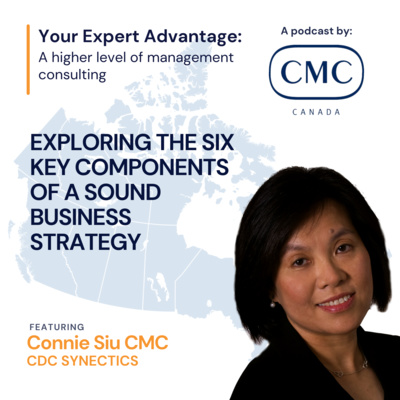
Exploring the 6 Key Components of a Sound Business Strategy
37m 52s
The podcast "Your Expert Advantage" by CMC Canada provides valuable insights for management consultants, emphasizing the significance of the CMC designation. Connie Sue, a consultant specializing in strategy development, operational excellence, and KPIs, shares her journey into consulting and the importance of a sound strategy. She defines strategy as the direction for a business, highlighting the need for clear vision, well-defined goals, prioritization, key capabilities, action plans, and alignment. Connie stresses the importance of preparation and a structured process for strategy formulation. She also discusses common areas that companies overlook in strategy formulation, such as vague goals, using actions as goals, lack of customer input, inadequate risk assessment, and alignment. Connie emphasizes the value of external consultants in providing an impartial perspective and fresh ideas to navigate strategy effectively, especially for small to medium-sized businesses.
Transcription
5607 Words, 32494 Characters
Thank you for joining us at our inaugural CMC podcast, Your Expert Advantage, a higher
level of management consulting. This podcast is produced by the Canadian Association of
Management Consultants, CMC Canada. My name is James Grieve and I'm a Certified Management
Consultant out of British Columbia and a member of CMC Canada. Our hope over the coming weeks
and months with this podcast is to provide management consultants with great thought
leadership, case studies and actionable info in a conversational format that you'll be able to
take back to your office and implement. Part of what we'll be doing is telling some great stories
from those who've earned their Certified Management Consultant designation to show you the value of
CMC, the profession's only international certification recognized in over 40 countries.
Today, to kick things off, we're going to focus on the topic of strategy.
And today we have with us Connie Sue. Connie is a consultant, author of Get Results That Count,
a practical guide on business results measurement and a speaker. She helps businesses develop
focused growth strategies, build on operational excellence and implement meaningful KPIs for
guiding execution. Connie has worked with business owners and executives of companies
in diverse industries. They include financial services, food, healthcare, professional services,
utility, transportation, telecommunication, manufacturing, packaging, higher education,
and government organizations. Connie joins us now. Welcome Connie.
Thank you, Jane. Happy to be here. Thanks for having me. So as we get going,
Connie, just like to have you introduce yourself and tell us why you got into consulting
and what you do for your clients, your area of specialty and who your typical clients are.
It is an interesting journey on how I got into consulting, Jane.
My background is in structural engineering. Upon graduation, I did a short thing in engineering
and got my professional destination. As an engineer, you know, you can avoid site work.
I love the design part, but not too crazy about working in the rain, climbing up and down,
half finished structures, or working on muddy slopes. So I decided to swap my still-toed boots
for more fashionable shoes, went back to business school, and that opened many doors for me.
I got into consulting and founded my own consulting practice, got my certification, CMC,
and never looked back. Today, I help clients in three areas, strategy development, operational
excellence, and designing for KPIs to monitor performance. My company, CDC Synetics, is based
out of Richmond, which is Columbia. And in terms of consulting, it is a good fit for me because
I am an inquisitive individual, and every project is different and is rewarding for me to be able
to help companies excel while learning at the same time. Fantastic. Well, you might have found
really interesting there, Connie. As you mentioned, you know, you have the talk about your shoes and
the key thing is the boots on the ground. So what I found, you know, interesting and relevant here
for consultants and consultants serving their clients is people who have actually been in the
trenches, right? So they understand how projects are conducted and have actually been either on the
shop floor or in the field. So that's fantastic that you made that transition from being an engineer
into the consulting world and understanding how not only designing strategy, but implementing
strategy is so important for your clients. Yeah, I definitely enjoyed it. And the pod I really
enjoy as a consultant is being able to go into the business, doing site research and working
side by side with people at all levels so actually can see how they work and be able to identify areas
for improvement, for instance. Fantastic. And, you know, you mentioned strategy and that's a key
component of your practice. Now, the word strategy, you know, it's assumed so many different meetings
in the course of business such as pricing strategy, long range strategic plans.
There are several different definitions of strategy. How would you define strategy for a
business and how do you apply that for your clients? I couldn't agree more, James. The word
strategy has been used loosely, often for operational decisions. By the example you gave,
pricing strategy for marketing, the VP of people has a talent development strategy,
and director of technology has a data mining strategy. So you might notice that the word
strategy is used in the context of how the business tackles different operational challenges.
I define strategy to be the direction for a business, which markets it will serve,
what products and services it will offer, and what capabilities are critical for success.
And hence, that's very important for a strategy to set a clear specific direction for the business
because strategy drives focus, focus drives investment and investment drives retail.
No, that's fantastic. That's a very clear definition of it. And it explains why it's
essential to every business. True. So, you know, based on that, you know, strategy is obviously
a core function of this and essential to every business. Would you agree with that statement
that every business should have a strategic plan and how that's rolled out?
You bet. Without that, you have no aim in this dangerous proposition because
different departments will be working on what's best in their own interpretation for the business.
Now, we hear the word strategy so often used, and companies or individuals or leaders feel
that they have a strategy, and they like to think they have one, and many of them
hopefully have great strategies. But there is a difference between sound strategies and mediocre
ones. And that could be really critical to the vitality and the sustainability of a business.
How would you distinguish between a sound strategy and a mediocre one based on your experience?
Excellent question, James. In my mind, there are six characteristics to a sound strategy.
Number one, it has a clear vision that not a star on what the business wants to become,
what the future looks like. And if I may quote Apple's position is to make
the best product on earth and to leave the world better than we found it.
It is inspiring, and we can attest to that revolutionary product Apple has introduced us to.
The iPod, the iPhone, the iPad. The second characteristic is the, it needs to have specific
well-defined goals. And I want to emphasize the word specific here.
We tend to use broad, warm and fuzzy words to describe goals. If you look at the goal to be
innovative, it means different things to different departments. Engineering would associate the word
innovative with new product design. Marketing would explore new ways to run social media campaigns.
And operations would associate the word innovative with lower cost options to support customers.
When you're not clear with your goals, people do their own interpretation.
And unfortunately, despite good intentions, you may end up with departments working in silo
and leading in different directions. So it is very important to be very clear and specific
what you want to achieve from being innovative. It is all about changing product design, new product
design, say so. You can do safe marketing and operations, a lot of time and effort.
So the more specific you are with your goals, the better, because there's no guessing.
The third characteristic is the strategy. Strategy needs to have clear prioritization
of all the different growth opportunities. There's only so much resources, namely money,
people and time. So it's important to focus. Based on my experience, an organization might have
less than five strategic pillars. And those pillars might be profits, operational efficiency,
safety, for instance. And each pillar could comprise three or more goals. And each goal to
turn into multiple projects. You can do the math. Easily from a strategic plan, you might end up
with 10, 20, maybe even more projects of different sizes. Keep in mind that you are going to be
drawing on the same people who are running the day-to-day operations. So that's a lot of traditional
work. More is really less. So you've got to be realistic on what you can take on. Overloaded
and fragile workers and happy employees. The fourth characteristic is the strategy
needs to identify the key capabilities required. Strategy without execution is hallucination.
So it's crucial to identify the capabilities you need to execute.
If this capability is available in health, perfect. If there's any need to develop the skills,
hire experts, or partner with another company, it will be good to know where the gaps are.
So you can plan accordingly. It does take time to get people and processes in place to do the work.
And let me give you an example. For a company that has an ambitious growth plan,
but it faces a major hurdle, it needs to replace all the legacy systems with an integrated operational
platform. So that capability becomes critical and they need to put number one priority on it
before they can sequence all the other initiatives. Characteristic number five,
it needs to have an action plan. And this high-level action plan on who is accountable for what
helps to drive focus for the business units and the department. So the action plan will align
the key initiative, the timelines, and the people to be involved. All the key elements for execution
of that strategy. And when you are very clear on the action, it makes it very easy to communicate
as well. And people can grasp what you're trying to get to. And the last characteristic is that
alignment. You want to see alignment because there will be, and I promise you, there will be
unforeseen events and roadblocks. And when you have alignment, you are voicing the
finger pointing. The aligned teams will collaborate to tackle issues together instead of pitting
against each other. So the six characteristics for a sound strategy are pre-vision, well-defined goals,
priority, capabilities required, action plans, and alignment.
That's fantastic that there's a six-step process. I think it makes it easier for people to understand
that there is a process to this and there are complexities to this. And every stage is
interdependent. Is that correct? Yes. If you look at your strategy, I would urge you to
do a check to see if you see all these elements. And that leads us to the topic,
maybe later on, that we can talk about the preparation and the process that you use for
strategy development. Right. And with one, if any of these elements are not considered and
explored fully, then it just leads for the other ones, for the implementation, the execution of
this to fail. Is that correct? Yes. I think ideally you want the strategy to be ready
specifically enough that it's ready for execution when you hand it off to the next level of the
organization. And your system lays it out so nicely and clearly. I've never seen it or heard
it laid out like this before, which I think is wonderful. And for business owners, this is a
great process to follow as well. And we'll talk more about that. And there are many approaches
to strategy formulation. And what would you suggest to business owners and executives to
build on this, to take those next steps to formulate a strategy? Indeed. There are many
approaches and tools available. There are the SWAT analysis, looking at the strengths,
weaknesses, opportunity, and threats. There are the five forces analysis that you can look at
your competitive landscape. There is the balance scorecard, which was originally created for
performance measurements, but now has been widely adopted for strategic planning.
There is the Blue Ocean strategy, which focuses on value creation, exploring opportunities in
uncontested market space. So creating that Blue Ocean rather than competing head on with your
competition in a crowded space. There are many, many more. And what I do normally is I will use a
combination of different approaches tailored to the business. But it really boils down to two
elements that are critical to work through the process. The first one is preparation. And the
second one is a process you will use for strategy formulation. The more organized you are, the better.
And for preparation, it includes understanding where the business is today, what the industry
trend is, what gets your customers excited or frustrated, and what are the main challenges
that you have to overcome and the growth opportunity that you can put forward to your team.
The more information you have at your fingertips, the easier it is to filter noise and make informed
decisions in the fashion. And that minimizes the need to put decisions on hold. With respect to
the process, you want to follow a structured approach, because a logical flow of discussion
will help to put all the puzzle pieces together. And for me, I generally start with
revisiting the mission and mission for the business before getting into the core competencies
that have helped the business excel. And we'll look at those to see how much leverage they could
use to build future growth. Then we look at the competitive landscape before identifying
growth opportunities and evaluate them. And depending on the level of preparation and
process that you use, you can have different outcomes. So I'd like to maybe take a couple
minutes to look at some of the potential outcomes when there's a lack of preparation
and/or using a disorganized approach for that work for you, Jane.
Absolutely. And one of the things that came to mind for me is the depth and complexity of
developing a strategy here. And in my practice, and seeing a lot of business owners, I work with
small to medium-sized business owners, quite often they're so busy working in their business,
they don't have the time to step back and work on their business. And if they try to do it
themselves, it's very hard to keep up with trends in the industry and that type of thing. And
it really speaks to the value that an external consultant would bring to this and someone who
has a methodology and a process to de-risk or mitigate risk in the business and uncover some
blind spots yet, at the same time, find opportunities. Just like before we go on to the KPIs here,
just to discuss that for a moment on the value of having an external person outside the firm
coming in as a consultant to just really review and take a different lens on a business based
on your experience here. And obviously, you have a lot of experience. You've got great models here
because business owners can go into, regardless of the size of their business, they can go to a
bookstore and see all these books on the shelf or read it in different publications and journals.
And how do you pick the right strategy that aligns with their particular business? And
strategy is one of these things, like many things in a business, if you don't get it right,
it could have some pretty severe consequences. So back to my questions, just the value of having
a certified management consultant come in to the business and see things and the results and
the impact they provide. Yes, definitely. I think for my clients, I always hear that the number one
benefit is having an impartial individual to help them to work through the process because then you
bring that objective lens and also fresh ideas as well because I don't live in the organization,
so I tend to have a fresh perspective and also bring new ideas.
Great. And when you're working in businesses, there's got to be areas that companies tend to
overlook. Now, you may see these because strategy is your distinct advantage here and you live it
and breathe it. What are some of the things and areas that companies tend to overlook when they
formulate their strategy? Is there any common things you're seeing, regardless of industry
or the clients you work with, that they overlook that they really should be looking into deeper?
Yeah, I'd like to share five areas that I would like to highlight. The first one is look out for
goals that are broad and vague. When you have vague goals, they tend to leave too much room for
improvisation. Let's look at an example. Company with a goal to embrace technology.
Imagine the executive sitting in the room trying to figure out what outcomes they want to achieve
for this particular goal. The VP of technology is keen to work on this day of the art technology.
The operations director wants to replace the ERP and the customer experience VP has the
integration of the contact center application with the CRM top of mind.
You can see that each person focuses on his own needs. So it is important that you can turn,
you got to turn those vague goals into specifics.
And the earlier you know that, the better because you're going to save a lot of time
from unnecessary debates down the road. When you don't do that, you're leaving that decision on
what are the most important projects to focus on to your next level of the management team
and directionless improvisation to steer the business off on a tangent.
Number two thing, second thing to look for is the use of action goal.
There's a tendency to use action, what will be done as goal, for example to open an office in the
UK. That is just one of the many tasks needed to penetrate the UK market. The real goal there is
to grow revenue in UK. The danger with using action as a goal is a shift to focus to task
and potentially narrow your thinking. And action is a mean turn in, not all actions are equal.
So instead of saying open an office in UK as a goal, reward it to grow revenue in UK.
You get people to think about what is the fastest way to build traction
and make the first sale in UK. And that's more effective than just opening an office there.
The third area is the presumption on customer needs. Many companies don't have a persistent
way to gather customer input on a regular basis. And if you happen to be in that situation,
at a minimum, I will urge you to reach out to a few key customers before your strategy session
and get a sense of what they are thinking. Talking to your customers directly is the best
source of growth intelligence. And the information you gather will help to identify changes
necessary to continue to serve their market or grow that market. And that also helps to build
an informed growth projection. When you look at the growth projection and it's insufficient
to realize your target, it also sheds light on additional opportunities of business we need to
explore. Customer intelligence is critical because developing a strategy interact with them is
wishful thinking. The fourth area is risk assessment. This is an area that many companies
tend to be a bit light with. As you evaluate your growth options, it is beneficial to identify the
potential risk. Look at the likelihood of occurrence and the severity of the impact.
And of course, having a mitigation plan in your back pocket will be helpful.
And you can easily incorporate all this into your prioritization effort. And an example with a toy
distributor, it was planning to expand east to eastern Canada. And they were aware that
commercial real estate is difficult to find. But this company, they want to keep all operational
activities in health and may need to have a better control over service quality.
It did not have a backup plan. But a nine month search turned out to be full tau.
If it had had done a better job with assessing the risk and have a mitigation plan,
they would have talked to third party logistics providers. And that delay was very costly to
the company. The fifth area is the alignment. It is important, I mentioned earlier already,
as a key characteristic of a sound strategy is alignment. You want to make sure that the
high level initiatives at the corporate level is supported by your departmental initiatives.
An example with a software company that works with, they have a corporate objective to broaden
the market adoption of the ERP. And the idea there is to develop better plugins and mobile features.
But the VP of product development had also a list of new features that he wanted his team to work on.
So as a result, the developers were poor in the direction and that led to departure of
several key personnel. So I'd like to emphasize that as you work through your strategy, you want to
have explicit and I want to emphasize explicit discussions on what the priorities are and get
alignment on them. And that's the best way to get a coherent roadmap that everyone across the
organization will work together, aim for the same outcome. And that also helped to optimize collaboration.
This is great stuff. And when I look at this and the model that's provided here,
you can see how that you could affect change in organization. And people command it with business
plans and they have strategic planning. And when they don't take the proper steps, they may overlook
things, as I said, it's been critical to a business. When you were looking at this also,
how do you ensure that it's sustained over time? So there's the plan, there's business plan, and
then there's the strategic planning. And then how do you sustain that people will have this going
forward? So when you're consulting, do you go in once and then provide them with the tools to do
that? Or typically people, you know, work with this and then have a consultant back into the mix
to work on continuously with them as they grow and develop and reevaluate the strategic planning
and that type of thing. Great question. Normally, how I work is I will go in, if it's a new client,
work to the strategy with them. We have an action plan for the next year or 18 months that will
help them to lay out the focus for the different areas. And normally then I'll go back every six
months to check on how they're doing and then revisit the strategy at least every year to see
whether it needs to update. And that helps them to reinforce whether the strategy that was developed
a year ago is the relage, or if they need to pivot or modify any certain elements of the strategy
to make sure that they are still serving the market that they are aiming for. As business
alignment changes so quickly and the technology advances very quickly, it is important to keep
on top of that. So this, you bring a very good point there. So the role of a consultant, particularly
a certified management consultant, is you actually become an extension of a very important part of
their business. So you don't just come in and write a report and then exit. You're actually seen as,
you know, a trusted advisor in their business going forward because you've taken the time to
understand their business, what the external environment is, what their capabilities are
internally, how well they're aligned to actually apply this, and then continue to work with the
client as you go forward. Now, of course, there's different types of consulting assignments,
but it sounds like for strategy, it is really quite impactful to understand the business and carry
forward with them and always tweak this as it goes along so they're maximizing the utility of their
people and time and financial resources. Is that a correct assessment? Definitely, definitely,
because I think having that continuity always helps. And as you can appreciate with COVID over
the past year, 18 months now, things are constantly changing. And for companies that have successfully
pivoted, that's great. But for those who are still struggling, I think it might be a good time to
take a look at the strategy and see where they should be headed.
Before I get into the topic of your book, which I want to address as well, because there's some
really great things that come with it. Is there any, you know, cases where you've had any resistance to
companies? Of course, they're set in their ways. You know, they've had a strategy for
a certain number of years. They realize they have to change. But are people typically embracing
this? Or when you use this framework, do they seem to understand it more effectively and then
understand it, you know, how it can impact their business? Or, you know, when you're coming in to
provide a new strategy for them, what are some of the hurdles you find with businesses where they
think, oh, we've got this. Why do we have to change our strategy?
Yes, I think a lot of time is the approach that they take. Many might think that developing a
strategy is just pulling all the key management team members together and put a plan together
quickly. When you don't prepare or don't have a structure process for that, you tend to end up
with a disjointed bottom-up projection. So everyone will bring a plan, what they think is
best for their function, rather than for the corporate overall. So we need to look out for that.
But when you follow a structured approach, you will have a orderly discussion of the topic.
And you also will be consistently using the same model or mechanism to weigh and compare your
options. So it's more rigorous and it's a more transparent way to work to what the business
would focus on and you get alignment on that. A key success that I will mention and I would like to
share is helping clients overcome that fear of missing out. A lot of times they throw so much
into the strategy thinking that they can handle it all. But if you have a rigorous process to
work through all the options and understand what each option involves, for instance potential for
revenue and also the associated costs involved, that also will be information that you can use
to build your financial projection. And that really gives you the big picture, putting all
the pieces together, understanding, okay, this is where we're headed in the next three to five years.
Do the numbers work for us? Do we want better or are we happy with that? Then that will also be
a way to gauge whether they should do more or less. That's really good insight there. And
prior to becoming a consultant, I've experienced this firsthand where in companies I work for,
you have a strategic planning retreat or it's an annual meeting of the leaders, the company,
the managers, whatever the case may be. And everybody comes prepared to make their presentation
and it just reverts to doing the same things after everybody gets back from the retreat.
Quite often because it was never facilitated by someone with a process and a system.
And in hindsight now, I could see how these planning retreats could have been so much more
effective if we would have had a system like yours there that could actually have accelerated the
business that much more. And I think I'm sure our listeners can relate to that as well,
how it could be just a waste of time if everybody just comes up with a plan. It's just the thing
you check off the box and say, "Well, this is what we're going to do this year without a process
to make it work effectively." So I think that's really important. It actually bridges to my next
topic here in your book, Get Results That Count. You talk about the use of relevant key
performance indicators, KPIs, to monitor strategic results. It's one thing to have the idea
and to say, "So first of all, why are we doing this? What are we going to do? Who's doing it?
When? Where?" That type of thing. But it's really important to measure what matters.
Now about monitoring strategic results and tell me more about this, about the importance of KPIs
and what type of KPIs are involved in a strategy and why they're so effective.
Yes. Get Results That Count was written based on my experience working with clients
on results reporting over the years. As a consultant, I get to talk with people at different
levels of an organization about the subject. Many companies focus heavily on financial results,
which is natural. But when it comes to non-financial metrics, they are at a loss
on what is meaningful to monitor. I have two goals for the book. One is to offer some insight
on how to figure out what is meaningful to measure. The second goal is to use KPIs
as an early warning tool for proactive business management. And when you look at your strategy
and your goals, you do need KPIs to track how you're doing, what is going well and what is not.
So that means that you need to make sure your goals are specific and measurable.
Hence my emphasis about clear and specific outcomes earlier. And KPIs also steer people
to focus. We hear often what gets measured, gets managed. And this reinforces that we
ought to measure the right things. And in addition, KPIs are a great tool to drive accountability.
So when we lay out the action plan that I mentioned earlier, we outlined the initiatives,
the timeline, and the people, we make sure that the outcomes and associated goals are identified
as well. And that's when the KPI comes in. And when people are clear on what they are accountable
for, they will align their decisions and actions in the day-to-day work. So that makes everything
easier and helps them to link all the pieces together. Now that makes great sense. And
you can see how it provides the opportunity for everybody to have a dashboard or insight
into what success looks like. And success looks like different things, different organizations.
I'm sure the KPIs differ. So the indicators differ from organization to organization, which is
another important aspect here of involving a consultant with experience and models like you
have as well is that it's not a one-size-fits-all approach. So just to conclude our podcast here,
just to talk about the difference between all these different approaches and why it's important
not just to have a one-size-fits-all and to have someone who has experience coming in as a consultant
who can provide that perspective so that you could actually guide companies in the proper direction
so that they can actually achieve their results. I definitely agree with that, James, because
not one-size-fits-all, whether it's looking at the strategic approach, whether you want to use
different models because it has been so popular, you want to make sure that you bring in specific
emphasis that your business needs. If you are in a situation where you're trying to be ahead
of your competition, maybe a more thorough competitive analysis is called for. If you're
in a space where you want to create something new, maybe using the strategy canvas from the
Blue Ocean strategy will work. So you want to bring in the tools that are relevant for that
business. Exactly. And one of the things that I'm finding is a common theme here, and I'll end
it with this, is that by bringing in a strategic consultant or consultant that works
with strategy, you have the opportunity to deliver the result of leaving it better than
you found it. And certainly, that's what you did here today in our podcast. So I really appreciate
your time, Connie. One thing I just wanted to, before we close up here, is how can our listeners
get in touch with you? I know you have a white paper on strategy that's fantastic. How do we get a
copy of that? Yes. Please go to my website, getresults.count.com/essential, and you can download
it. Fantastic. Well, thank you again so much for your time. And this has been wonderful. This has
been our inaugural CMC podcast. So I appreciate you being the first to join us here. Brought to
you by CMC Canada. CMC Canada administers and its provincial institutes confer the Certified
Management Consultant designation in Canada. And the Certified Management Consultant designation
is the profession's only international certification recognized in over 40 countries.
You can learn more about what it takes to earn a CMC and all the benefits that come along with
joining CMC Canada on our website, cmc-canada.ca. If you've been a fan of the show, tell someone
about us or leave us a rating in the Apple podcast store. We appreciate your time. Connie,
thank you so much. And I'm pleased to have you as a colleague and a fellow CMC. And I'm
anxious to hear about all the great value you're going to provide with our clients
and your clients going forward. Thank you so much. Thank you for having me, Jane.
Podcast Summary
Key Points:
The podcast "Your Expert Advantage" aims to provide thought leadership, case studies, and actionable information for management consultants.
The Certified Management Consultant (CMC) designation is highlighted as the only international certification recognized in over 40 countries.
Connie Sue, a consultant specializing in strategy development, operational excellence, and KPIs, shares insights on strategy formulation.
Summary:
The podcast "Your Expert Advantage" by CMC Canada provides valuable insights for management consultants, emphasizing the significance of the CMC designation. Connie Sue, a consultant specializing in strategy development, operational excellence, and KPIs, shares her journey into consulting and the importance of a sound strategy. She defines strategy as the direction for a business, highlighting the need for clear vision, well-defined goals, prioritization, key capabilities, action plans, and alignment.
Connie stresses the importance of preparation and a structured process for strategy formulation. She also discusses common areas that companies overlook in strategy formulation, such as vague goals, using actions as goals, lack of customer input, inadequate risk assessment, and alignment. Connie emphasizes the value of external consultants in providing an impartial perspective and fresh ideas to navigate strategy effectively, especially for small to medium-sized businesses.
FAQs
A strategic plan provides a clear direction for the business, helping to focus investments and drive results.
A sound strategy has a clear vision, specific goals, clear prioritization, identified key capabilities, an action plan, and alignment.
Companies often overlook setting specific goals, using actions as goals, gathering customer input, assessing risks, and ensuring alignment.
External consultants provide an impartial perspective, fresh ideas, and methodology to de-risk business decisions and uncover blind spots.
Consider elements like mission and vision, core competencies, competitive landscape, growth opportunities, and a structured process for strategy formulation.
Chat with AI
Loading...
Pro features
Go deeper with this episode
Unlock creator-grade tools that turn any transcript into show notes and subtitle files.
 PodcastTranscript AI