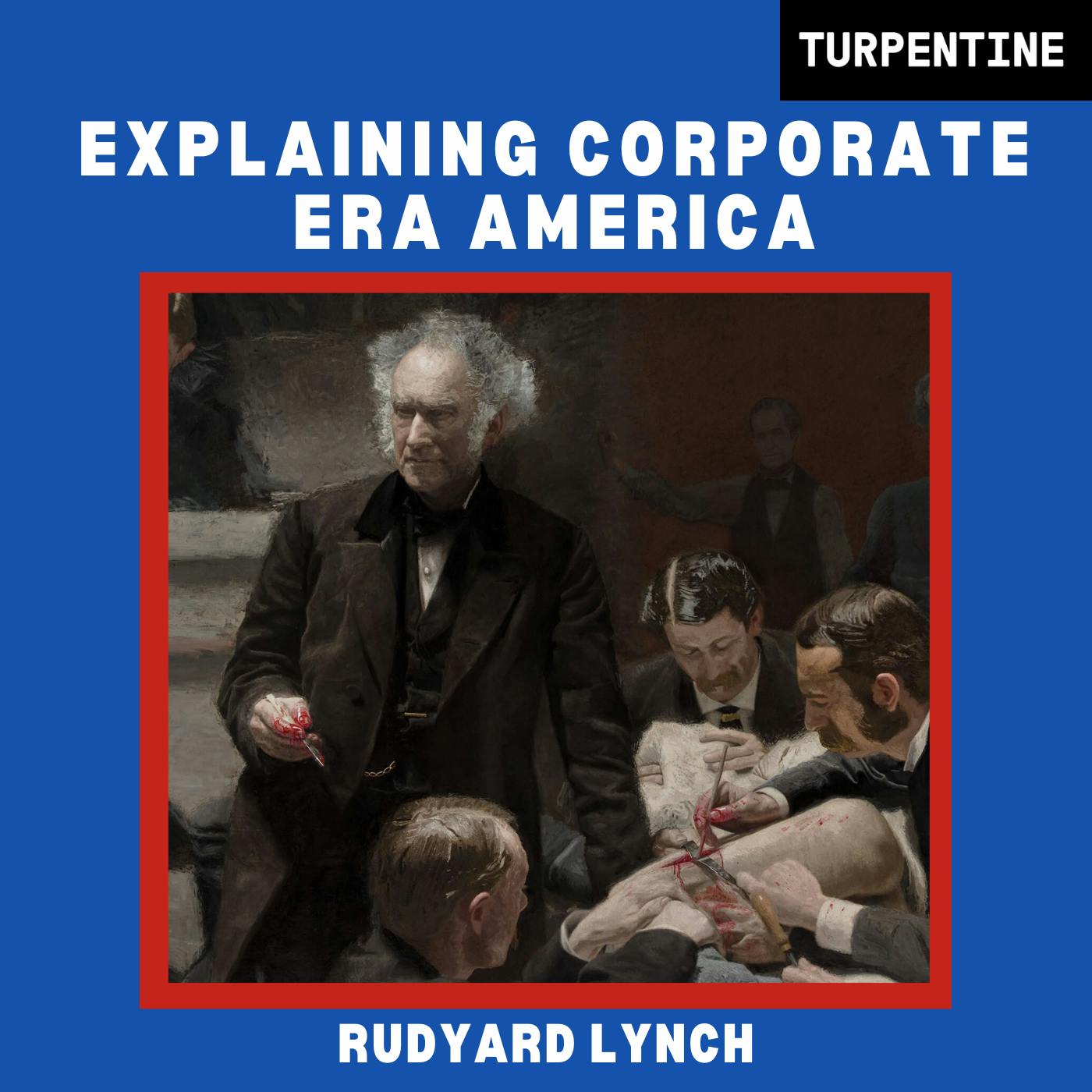
In this episode of History 102, hosts Rudyard Lynch and Austin Pageant explore "corporate era America," a term for the period from the late 19th century onward. They challenge the notion of linear historical progress, proposing instead a cyclical model where fundamental patterns recur even as societies grow in scale and complexity, akin to a double helix or spiral. A central theme is the dramatic shift from a 19th-century America, where 80% worked for small, local businesses and communities had greater social cohesion, to a 20th-century America dominated by large national corporations and a managerial bureaucratic elite. Citing authors like Houston Smith, they argue that while material wealth increased, significant intangible social and moral values were lost. The discussion frames this transformation within broader historical cycles, comparing modern American "decadence" to periods like the late Roman Republic, and suggests that recognizing these recurring patterns is key to understanding the present and potentially forging a better future.
(upbeat music) Welcome to History 102, where YouTube creator What If Fault Hist, Reddyred Lynch, and Austin Pageant, dive into critical moments in history and tease out patterns to help us predict the future. Let's jump right in. - Hi everybody, welcome to another episode of History 102, with me, Rudyard Lynch, and my co-host, Austin Pageant. And today's episode is on corporate era America, which is a term I've developed from America at the end of the 19th century, until the present. And today we're recording in my main room where I don't have the microphone, rather than in my office, because the construction sounds are too annoying. - Yes, it should be an interesting one. It's kind of, it's got a little bit of overlap with the last episode, 'cause it covers 'til the present, but you call it corporate, the corporate era, which seems like it'll get me, maybe into like Boomer economy, Blue Pilled kind of themes. - So I'm interested to see where it goes. - I have to develop the categories for recent history, because recent history is a time period that people only have the courage to divide up once everyone involved is dead. And so I've had to subdivide up with different threads in recent history. And so we did the age of neoliberalism, which I categorize as a specific global era of history, where an ironic thing is that the projector screen that America and Europe indirectly made for the age of neoliberalism, the Americans only half believed it. A lot of the rest of the world believed in neoliberalism and the ideas implicit in it more than the Americans, where the blue state Americans had to wage their own war of internal colonization on America. Well, these ideas were often accepted much more abroad. So the age of neoliberalism, it's a specific moment in history that span the world. Next video is on the Pax Americana, or the effects of the American empire that emerged with the world wars. And this is the video on the era of the American empire as it manifested in America itself. - Yeah, and that kind of fits with the consistent theme of, it was a big thing in politics, especially back in the day, a big talking point with John Kerry or Obama was that like, hey, look how much higher he pulls in Europe, which is kind of a strange thing 'cause why would we want to follow Europe? But it was seen as sort of a standard, or the perception of whether the globe liked your leader was a big talking point in terms of who we should elect, but it's a strange metric 'cause maybe the world likes your leader because he's giving them everything they want. - Yeah. - Or it makes life easy for them in some way. - One of the questions he will often ask me is they say why does blank person who is different from me perceive the world differently? And people would be really shocked if they had to live in someone else's head for even short periods of time. They've been like holy crap. How do we maintain a functioning first world society if people are this psychologically different? And-- - Right, I'm often shocked just from having a conversation with someone let alone seeing what's inside their head. - I am shocked just to talk to people who were in my good friend group, let alone people who live in different parts of the country, different sexes, different nationalities, and people don't seem to get that. For example, there are people with criminal psychology who like committing crimes. They would still do it even if they derive no financial benefit from doing so. And this is in proofing in all of the psychological literature about criminals. Or-- - It's the love of the game. Same with Michael Jordan. - Yeah, and I saw this this, people don't seem to realize that a certain type of person does risky high adrenaline things because they sort of like it. They like the thrill. There are people who go into war and they make up like two to five percent of the population who like wage and war. And one of the points that the military historian, John Keegan made is he said there's a certain type of cruelty for universal conscription that in a normal society, the people who genetically like to wage war breed together, produce children who also like to wage war. And then they do that when the rest of the public gets to sort of do their occupation. And as we-- Apology for the background noises, by the way. But as we get into this topic, there's a few different books which got me to make this framing for this time period. The first one is the book "Forgotten Truth" by Houston Smith. And this is a really important book because Houston Smith is one of the top-- or he was one of the top scholars of comparative religions. And this book is like less than a hundred pages or something. And he goes through what are the underlying philosophic principles that each religion share. And this book was written in the '90s. And it's interesting to read it that a lot of the things he's writing about, he has to completely clarify and say, you know, this may up to your crazy to you, but this would be normal to someone over history. But then you read this today. And it's-- you realize that we have done a certain degree of evolution outside of the modernist worldview since the 20th century that we're not really thinking about. And I see this also with Ken Wilber, who's in a similar field of consciousness development, where he'll write ideas in the 20th century that we're clearly controversial then, but I'll read this. And I'm just like, OK, this is obvious. For example, he has a segment saying that there are higher forms and lower forms, and higher forms will beat out lower forms and move up in evolution. And that's an idea that makes sense to the Darwinist worldview. It makes sense to most of history, makes as people on the right today. But 20th century America was a significantly more socially liberal society than red-state America is now. And one of the points he makes is he said, I don't believe in progress. And he clarifies, I know all of you believe in progress. And he said, me explaining my disbelief in progress is it will come across to you, as if I said there was an alien species in the dark side of the moon that has these lengthy Trojan wars. And I thought, I never believed in progress. No. But the time I was growing up, people didn't really talk about it. And I think that must have been a demographic selection thing. There are definitely people today who still believe in progress. Like I read Heart of Darkness by Joseph Conrad, where it's a human nature being bad. And I thought, what's special here? I thought we knew that. But he goes through it and he says, I don't believe in progress. Because America in 1990 is markedly wealthier than it is in 1900. But he said, we have lost a lot of intangibles where he said, rather than progress, you have to see history as a double helix that slides back and forth with these recurring patterns. And it's like a spiral where patterns repeat, but it just genuinely get bigger and there's innovation. And that's the theory I have. But he said that when we got this wealth, we traded it for other things. And one of the-- there's a second book I want to get to after frames how I make this video. But he brought up a statistic that stuck with me that in 1920, 80% of Americans work for small businesses. And in 1990, only about 10% of Americans were self-employed. And those are two different statistics. But there's a real underlying trend there. Because in 1920, the average employer was a family business or local town's factory. And you had the national corporations starting in the late 19th century. But they had it steeped into becoming the dominant factor in everyone's daily life. By the end of the 20th century, they had where the average person's life was controlled by these large corporations that span the entire country and the entire world. And these had become the dominant way of life that rippled through almost every single variable of the average person's existence. I saw a clip of a celebrity recently where just to show you how common this frame of progress is, where he said, I can't believe what's going on now. I don't feel that comfortable. It seems like things might be getting worse instead of better. And he struggled to even say it. It was so outside of his frame of reference. And one of the easiest ways to conceptualize that-- or de-confuse that progress concept is the CS Lewis quote, where he said, the most progressive man, if you're on a journey, and you take a wrong road, the most progressive man is the one who is first to go back to the point where you took the wrong turn and then take the right turn. That kind of adds a linear dimension to the helix, double helix, which may be a little bit static. And the linear dimension might be also wrong. It could be like the double helix itself is what's changing, because there's some dimension of change complexity beyond.
just like a static helix, but maybe Rode isn't the best way to describe it. Give me a moment. I will grab something to illustrate this. Rode may be too linear. These are two dragon snakes. This is Yin and Yang, Eastern West masculine and feminine. You thread them together where this is constant, this is change. You have constant variables over history or the universal recurrence of underlying variables that pop up again and again over history. And then you have variables that change over time. It's the biology which does change and then the culturally imprinted variables. And these two operate over again each other. And yes, you do improve, you do get better, but then you also see the recurrence of older cycles that pop up again. And it's an undulating pattern where Bronze Age collapse, civilization falls. But in the process of the earlier civilization cycle, civilization also developed. Then you go through the classical era of the Persians and the Greeks and the Indians and the Chinese. That cycle ends with the fall of Rome, which is another dark age, but you have learned so much in the time since. So you have the recurring patterns, but then the game also gets bigger and it gets more complicated where I once had a conversation with Tom Bilio where he said, how do you sort of have hope when you know these cycles keep coming back around and I told him we are currently in Los Angeles. This entire city, the size of Connecticut was built entirely since the last cycle of the American revolution. And with these sort of political cycles, they're 250 years where right this year America's 250 years old. And that's the amount of time dynasties or governments and monogamous societies last. And right. So I said in just the last 250 years, look at how much we've grown. And it's ironic that after the end of the cycle where the most stuff was developed, we are the most cynical and angry about cycles. It's not actually about the growth of the wealth. It's about your attitude to it. And this is the point that Houston Smith was trying to make that when you compare America over the 20th century. 19th century America had many issues compared to 20th century America. But 19th century America was also a vastly superior society than 20th century America by a litany of metrics, whether intelligence, social cohesion, moral character, the. Just health of the society. And so when you see 20th century America, you're seeing first the rise to global dominance and with it decadence. And the time period in history I would compare it the most to was the Roman Republic seizure of the Mediterranean. And the social structure shifts that went with that. But I don't want to get into that now because I want to go through the other books and for my analysis of this topic. Yeah, and that's a bit earlier in Rome, which is fits with my conception, because what I've always said about why I'm optimistic or at least see a path to make things better is you have that hard times lead to strong strong men, you know, cycle graph. And people always pointed to the fact that we're in the good times. And the next whole next cycle is going to be the hard times, but I try to explain that no, we're like you said, we're deep into this progressive bureaucracy. And the good times maybe we're like the 80s are the 50s, like right now conditions are not at all easy for family formation or culturally or. Whatever metric you want to use right or the percent of time spent on basic necessities like that metric you track. So I think there's actually a week and you can always go deeper into the bad times, but I think we've had enough bad times to go to the next cycle if we want that's what we're waking up to we're just we're realizing we're in a ghost story. The point of that is that you are already in a worst condition than you thought. I mean the purpose of the term the universal recurrence is that things recur and I have a concept that truth is determined by universal recurrence universal recurrence is when a plant comes out of the earth and it sparkles outwards when a child is born. It's when you develop a new idea that you go with and you build something with that new idea it's when something new comes out of the something new comes out into the world that has potential and every time the universal recurrence occurs is a new opportunity to change. People who integrate the universal recurrence into their lives they're integrating the concept that this moment could be a moment that I decide to grow something new so that's that's the content I'm saying and so something is true to the degree through which it recurs over human history so. The idea that democracy works as a social structure that has recurred in the Roman Republic America Britain Athens Venice etc and the concept that democracy has failed has recurred in Latin America in Mediterranean Europe in the Middle East in Africa so you can say that democracy has worked in democracy has failed and you can weigh that against the amount of times that is recurred in history. Does that make sense? Yeah it's it's the permanent part is basically natural law and then talking about democracy is kind of you're talking about a reflection of things that possibly violate natural law and have consequences and then the changing part is basically life. Yes and so the reason I bring this up is that we can choose to have agency and free will now we are agent of players and so we could choose to make this situation better than it currently is and I do fundamentally have hope the second book that informs my analysis of this time period this is really a brilliant book Leviathan and its enemy is by Sam Francis and this is a book written about the rise of the managerial class to a dominance in America and Francis was all. And Francis was also writing in the 90s which was the peak of the blue pill where if you're like Houston Smith or Sam Francis and you're writing the stuff in the 90s that means you called it at the peak of the of the blue pill narrative so that that's impressive but he calls the rise of the bureaucracy as an event comparable to the foundation of a new civilization or a religion and he said that it totally changed all of America's social structure and he goes through the day. So the different the ideology of the managerial elite how they train their people how they maintain dominance what their origin point was and also who their natural enemies are and this is this book is equivalent to if you explain feudalism to someone in the middle ages because in in in the medieval period we would look at that and say oh there are feudal surf society but if you lived back then you would not conceive it in those terms because it was just a little bit more. Because it was just the world you didn't think of any other social structure you just think oh there's the good king and there's the Lord but you would have to read you through the Lord uses these different systems to control the the nobility the nobility have these rights and so studying your own society often teaches you that it's very different from what you sort of first had a knee jerk reaction to about it and there's two different points in this I want I'll use to get started. One is that Frances looks at a huge shift in America was from a social structure where in the industrialized parts of the country which in the beginning were just the rest felt in New England and then the industrial revolution gradually spread to the rest of the country over the 20th century you had a town and in the town was a factory and that factory owner was sort of de facto lord of the town. And he would pay the local politician and America was one of the societies on earth where the rich had the least power so we'll hear that now but that was fairly moderate for that that was incredibly moderate for that era of history as class oppression went and it's like indirect control versus direct control and you also had the democracy was not owned by the democracy was not totally owned by business interests or the wealthy where the democracy was often in the hands of sort of cesarian cesarian handlers who were often Catholic immigrants like the Irish and the cesarian handlers were to work with the public and the mob against business interests. And so the Democrats were consistently the anti business party so in America there was an anti business interest it wasn't like a lot of European countries where the government would literally shut down unions or people protesting or force people to work. an Irish uncle, the Wearing of the Green, about the Irish
were battening against the English and fleeing to America. And there's a song says, "Where rich and poor stand equal under freedom's light." Because in Ireland, the rich had total power over the local Irish. And so the idea that in America there was legal equality, where in Ireland, if you were an native Irish, you could not vote, you could not obtain an education, you could not buy property, that was seen as remarkable. And it sad that the concessions to the lower classes immediately or within decades evolved into Marxism, which was basically killed the rich and installed an autocratic state. And so in this 19th century social structure, you had the town, and there was the factory owner and the population, and this was a coherent local social structure. And the American old industrial ruling class, they've got a bad wrap, but by basically any conceivable metric, they were better than the current managerial elite. They had a greater degree of noblesse oblige the public. They would very frequently fund charitable stuff, or art, or these things. They were better educated, they were more cultivated, they were more moral. There's a book by this author from Philadelphia, where he has Quaker, Philadelphia, and Pureton Boston, as well as, I think, is the Protestant establishment, and he wrote it in the '60s to compare the new managerial elite to the old wasp elite. And the conclusion he came to was that the wasps were superior by every single metric, and then losing power was like a cultural failing. And to be clear, I am not a wasp. I have asked a legitimate wasp if I am, and he said, "No, you're functionally Scott's Irish." - That was. - Yeah. [laughs] I wonder if we're supposed to mention these people's names. I don't think he cares. And when I grew up in Philly, we didn't associate with the wasps. In Philly, you have four different subpopulations. You have the Southern blacks, the Northeastern Catholics, the Northeastern wasps, and then the Midwestern Appalachian Protestants in the countryside, and I was in the fourth bracket. And so, you had this industrial wasp elite that was concentrated in the rust belt, which maintained a sort of colonial dominion over the rest of the country. Where before the Civil War, most of the wealthiest people in America were in the deep south, growing cotton or sugar or rice. And that was crushed by the US Civil War. The US enacted a cost on the Northeastern, a cost on the South after the war due to the abolition of slavery. That was proportionately significantly worse than what the Prussians did to the first. Prussians did to the French in the Franco-Prussian Wars, which was considered to be one of the brutal, the most brutal sort of treaties of the 19th century. The French resented the Franco-Prussian Wars for decades. And I do think it was fundamentally worthwhile to free the slaves, because that's how the economy was totally dependent on slavery. But it did set the South in a position of basically feudatory dependency on the North for a century between the US Civil War and the 1960s, the end of Jim Crow. And Northern interests bought up the South. A lot of southerners, both white and black, degraded into sort of serfs or sharecroppers. And then the rust belt interests, because New England had declined ever since the 19th century. And so the three great cities were Chicago, New York, Philadelphia. They had these interests that spanned the entire country. And but inside the industrial core were these originally small, these small towns with these singular elites. And Adam Smith said, "The most dangerous place for capitalist exploitation, because Adam Smith was hyper pro-free market. But he was also aware of the free markets' failures. And something people forget is that Adam Smith was in many ways more of a behavioral psychologist than an economist. He wrote a book called The Theory of Moral Sentiments. And so his economic principles are grounded in an understanding of human nature that people prefer things that help them and their local network. And so he said the he's worried for capitalism was, you would see a splitting of class interests that was so great that the upper and the lower classes would basically dehumanize one another. And so in the old industrial rust belt system where you had one sort of factory town, yes, the people at the bottom lived in poverty, oftentimes immigrants, replaces like Ireland or Germany or Scotland. And there was still the local connection of the coherent town culture. And I'm aware of this because Pennsylvania never moved past this. We industrialized earlier than the rest of America. And so we have all these 19th century facilities like Bethlehem or Norris town. And in other places their predominant industrial revolution was later. And Frederick Jackson Turner, who was a huge author of the early 20th century, where he's best known for his frontier school of thought that the American character is dependent on us being a frontier nation. And I think that is in a large part true, but not totally true. And he was writing in Wisconsin at the end of the 19th century. And he talks about how the American character was formed by this hyper individualist frontier mindset of you have to go out into the forest and clear this land by yourself. And that bred a self-reliance and sort of Nietzschean wheel to wheel to the Americans that exist very rarely in the rest of the world. But he talked to the interesting paradox that due to the frontier character of America, there weren't these entrenched interests like Europe. So you saw the crystallization of these huge industrial interests predominantly in the Midwest. Where the Midwest and the Great Lakes and the Mississippi and the Ohio, it creates this natural trade system that you can span the entire continent with. And so you have these huge manufacturing centers that were in places like Cleveland or Duluth or Chicago or Detroit. And Chicago as an example is not an important city by the time of the US Civil War. But by the early 20th century in the 1890s, Chicago was one of the biggest cities in the world where Chicago was the city in the world. I think with the most Norwegian's, the most sweet and maybe the second or the third city in the world with the most Germans, including in Germany. And so Chicago developed very rapidly and it was part of this huge agro industrial business centers that span the Midwest where the Midwest became the center of America. And that's why we the state with the second most presidents besides Virginia is Ohio. And our Ohio presidents were concentrated between the US practically all of our Ohio presidents were US Civil War time. Until World Wars. And from the period of the US Civil War until World War One, the Republicans practically ran America as a one party state. And the Democrats got I think one or two presidents in that time made one in the 1880s. I believe Grover Cleveland. And then they had Woodrow Wilson, a third of World War One. And Woodrow Wilson was the end of this gilded age and we're not going to talk that much about the gilded age itself, which was the era of this industrial growth after the US Civil War. But the end point of the gilded age was the formation of these huge industrial businesses that existed in opposition to this frontier individualist mindset. And what Frederick Jackson Turner said is you'll frontier individualism, huge industrial conglomerates. And then you have the rise of progressivism and socialism as a reaction against it. Because these huge industrial firms, they would often exploit the rest of the country with because they had monopolies on stuff like railroads, the railroads could horribly exploit the West because there's one or two running through. And this created these sort of populist movements and the populists and the progressives were not the same thing, although they would like to act like it. And they were out of very different demographics, but they eventually fused where the Republicans were a party that emerged in the around the time of the US Civil War. And they were dominant because they were the party of sort of northern Protestants. My mom's out of the families from Nebraska and they were all Republican voters for generations until my grandparents became hippies and became my grandmother became left wing. My grandfather was a libertarian. So the northern industrialists and northern Protestants had enough of a dominance over America that they could maintain power. And I will say that that period was the period of America's most staggering growth ever when the Republicans ran the country as a pseudo one party state. Although the Democrats did push back against the Republicans or Republicans consistently won, but the Democrats provided enough of an opposition that they weren't able to actually have a one party state. I'm just saying that is sort of simple. So the populists, they emerged in the Midwest and the northern sort of too.
here. And they were often sort of Scandinavian or Germanic peoples where they came from a village society with a lot more social sort of duties and conformity than the Anglo-Saxons or the Celts. And they pushed for regulations against the corporations exploiting them, but it was also highly evangelical and socially conservative where it was this populism mixed with hardcore American nationalism and Christian fundamentalism. And this was a huge upswelling of Christian fundamentalism. So one of the big populists was William Jennings Bryan, who made the whole cross of gold, saying that moneyed interest for controlling America. And William Jennings Bryan was the biggest advocate against evolution. And that was something that torched his reputation because he was saying I believe God made the world like in Genesis if we're teaching evolution in schools that promotes degeneracy. And so the populists were heartland. The progressives were northeastern intellectual who sort of upper class interests like Woodrow Wilson or the guy who wrote that book, The Passing of the White Race. And they were basing their content of progressivism on something that was popular in Scandinavia, in North Europe or this ideal. We will centralize the government. We will have eugenics programs to produce the perfect Anglo-Saxon race. We will kick out all the immigrants and develop these signative stick autocratic systems. And this was a popular school around World War 1 that became controversial and they moved their platforms. And the Democrats were in this weird position where they were everyone that wasn't the northeastern Protestants. So my Irish family, they were hardcore Democrats for generations before they became Republicans due to the Democrats moving left. This South were hardcore Democrats. And so the Democrats were in this position where they were against what the Republicans were for. And that meant having like a very broad coalition. And over time the Democrats moved from this hardcore anti-government. The South does not want the government to look at us to being very pro-government. And that was due to interventions by first Woodrow Wilson who was both sort of a southern segregationist as well as a northeastern progressive. Because he was from Virginia. He was a historian and a hardcore Confederate sympathizer. He was also a hardcore Anglo-nationalist. Moved to New Jersey became the ruler of Princeton University. And so he was part of that sort of centralized government racial purity sort of American autocratic progressive agenda. And by the time he got to FDR, he was from New York. He was one of the old school Patricia and wasps. And he kept the South in his coalition and he bribed them with a tremendous amount of military and government program with the Tennessee Valley Association or building the World War Two military or manufacturing facilities in the South. And then he moved to the socialistic left wing policies that appealed more so to the urban Catholics and socialists in the coalition. And he also got northern blacks to vote for him where southern blacks didn't really vote. Because the northern blacks were also enemies of the northern industrialists that the Republicans were. And the issue with the Democrats as a coalition was they'd become too sort of overweaning with all of these demographics. So, being socially conservative urban Catholic immigrants, southern conservative libertarians, socialists, Jews, northern blacks, that by the time you get to LBJ who was a Texan from San Marcos, he made this huge welfare program that predominantly helped southerners versus other groups. The South is more poor. But he nuke the South by pushing against segregation. So there are Republicans of the Southern strategy. And that's he got the party shift. I had to jump ahead there past our normal threshold. But I didn't want to lose that sort of conversational thread. Right. You mentioned Grover Cleveland and Woodrow Wilson before it's kind of a perfect example of the shift. Because when the Republican wasp were in control, that was the gilded age. That was kind of a very free market period. And Grover Cleveland was a dem who had winning messaging within that environment. It was a very free market and kind of anti-war. And then you get into Woodrow Wilson, which is that shift. And very interestingly, it's kind of a great example of the Yankee Deep South Alliance or fusion. Which seems like such a weird thing. When you described it, when I talked about the midlands and the Appalachians working together. North and South. Sorry. It's north and south English. Yeah, because the very top and bottom, I thought they could never work together. So if we get the middle two together, Appalachians in Midlands, then the win. But you said the north and south can actually have a political uniting coalition. And it would the way it would happen would be exactly how you described the fusion of Woodrow Wilson's politics. Yeah, that's a good point. And I think about that too, because I'm from Pennsylvania. I've moved to Texas. And the cultural gap between Pennsylvania, at least sort of rural Pennsylvania, to Texas, has been significantly smaller than me living in New York or Massachusetts or even Washington, DC. And that word of mail is I'm thinking these places are super geographically far, but I feel less of a cultural gap. And the conclusion I came to is that Pennsylvania, because Pennsylvania and Texas were both so people from the north of England. Well, the deep south and the Cavaliers, as well as the New England Yankees, they were both so people from the south of England. And the dividing line is that the south of England lived in villages with these concentrated social structures we built to follow the rules of the village. And the north English lived on homesteads, which breeds different attitudes towards life. Where if you live out in a homestead, you have to prioritize your own personal freedom, because you own the land and you go into town periodically. If you have a village life, you have to interact with your neighbors. So you have to use all of these social rituals to sort of manage your interactions. And I had a conversation with my best friends from New England. And I said, I think it's a reasonable policy that you should have decorum in public. And then you can do whatever you want on your own land, as long as you're not bothering anyone. He said, Rudyard, implicit in that idea is the idea that you have your own land. And he said, if you live in a city or a town, you have to develop these social norms, even in your private life. Because it's interesting that in Pennsylvania, judging someone for what they do in their private life is socially taboo. And then in New England, it's just totally normal where the town gossip about you and what you do in private in New England. And if you don't follow the social norms, that's sort of a breach of their code. Right. It's, and it's the same thing kind of as like the principal of banking of your own castle. Maybe not translating perfectly to an apartment complex. Of course, like ownership is more than just, you know, residential property. As we discussed frequently with the guild like stuff. And you mentioned the Midwesterners, the Germans, Irish, they had different impacts on those progressive systems. They kind of encouraged it. But it's also almost feels like there's a combination of factors where it's almost like farming where you move from one patch of soil to the next. And with the industrial zone starting in like Pennsylvania until the political situation kind of ruined it. So it moves to the Midwest where the political situation kind of ruins it. So it's kind of like frontiers within frontiers. Yeah. And that's how it worked with with soil with the expansion west. Soiled quality declined consistently until we basically hit California ran out of room. And then from the 1950s on, we kind of have had had marginal improvements. But you don't have the ability to just jump to the frontier anymore. A few threads about this. The first of all is my mom was obsessed with the depletion of soil quality. It was one of her her real interests for her entire life. So I would constantly hear about it. And it's strange that it's become much more of a big issue since then because no one else talked about it back then. I have several relatives who work in agriculture. I think that's part of it. So first thing. Second thing is something I've noticed. Actually, I'll say the third thing. First third thing is that America's had one of the most staggered industrializations of any country on earth where the first places that industrialized in America. Philadelphia and Boston and Valley Forge were George Washington kept his army during the revolution. That was an industrial facility that made these huge iron works before the American revolution. So Britain industrialized on the 18th century. In parts of America, we're industrializing. It roughly the same time as Britain. And so by the time we get to the US Civil War, the entire Rust Belt region or the
Great Lakes and the Mid-Atlantic in New England were industrialized. New England experienced their own. degrid, their own decline before the rest of the North. Where by the time HP Love Craft was writing in the 1920s, New England was already in decline as their farmers moved to the Midwest and their manufacturing moved to the Mid-Atlantic or the Great Lakes. And so New England used to all be farms and now it's almost all forest because the farmers moved to better land. And California and the West Coast industrialized during World War 2 where we had to industrialize them to fight the Japanese and the South industrialized world war 2 onwards where parts of the deep South only industrialized in the 1970s or the 80s. And FDR had to go to active effort to introduce electricity to a lot of the South because it didn't have it. That fits with your mention of Lyndon B. Johnson targeting the South for benefits. I thought of the FDR pattern too. I think he was making the same connection. Yes, the Democrats knew how like overwielding their coalition was. And so they tried to target the South with welfare because they're thinking was the South's poor. They're going to like it when they give stuff. They didn't realize that this fundamentally butted heads with the South's individualistic honor based ethic. Where when you interview Apple actions and this is a culture I do understand where outsiders would be like why don't these Apple actions take welfare even though they live in poverty? Why don't they move to the city? And the answer they always give is because it's an insult to my honor because if we've always lived here, if we sort of enter into dependency to you, we're going to lose our culture. And people in the cities will look at that and view it with contempt. But they fail to understand that this is a deeply ingrained cultural idea that goes back thousands of years that if you remove it, these societies will lose their central sort of sense of self and their sense of pride or the value of pride. Yes, pride or honor. Just think of the negative elements. They characterize it as toxic or something. Exactly. City people are incredibly psychologically feminine. It's what I've found because there's no sense of ownership because you've you own something in a city as you know, it's like, oh my god, everyone around you, you're taking away their right to own it, which is why you get mass utopia and the behavioral sink. Speaking of cities and dependencies, as you mentioned, the electrical project in Tennessee, one thing people don't kind of talk about is the impact, the cultural impact of these massive industrial projects because you have that and then you have things like the interstate highways, right, in the 50s and 60s, which just totally cut through the landscape and a completely new way. It used to be you had small roads connecting town to town and then you had a ton of rail. US had an absolutely ridiculous amount of rail is growing until it was like subsidized in the 20s and 30s and increasingly regulated and then interstate highways were kind of the last rail nail. But you had small towns very connected and then these trains would go through and the interstate highways completely destroyed a lot of those towns and the businesses in those towns and their connection to the flow. Two things. First of all, there's a lot of country music about that where there's a tremendous country music, the effect of these large corporations on Appalachia because it was a process of internal colonization, sort of like what the Russian leased into the Russian population. There's a, what have my favorite songs ever is you'll never leave Harlan alive and it's by Darrell, Darrell Hall. I think it's Darrell Hall, yeah. And it's about this town in East Kentucky called Harlan, which was this coal mining center and the song is a multi-generational ballad about this family. And there's a beautiful sort of Celtic instrumental segment in the middle about this family that tries to leave Harlan and then every generation they get pushed back into poverty working in the coal mines. They buy out land, then there's a recession and they move back. It's what, it's rust belt coated. Then there's like 16 tons by Ernie Ford, which is about this, I call 16 tons of coal over his life only to die in poverty. There's country music, sort of around Bristol, Tennessee, which was part of that whole area. There's, um, nose and the grindstone by Tyler Childers about this guy's father is broken by doing years of the coal mining and his father said, "You know, son, my life sucked and I did all of this, but at least I was a man so I can have self-respect and so I can pass this on to you." But the second thing is I will stand by this four-volume monster being the best history of America. I found this at my college library when I briefly went to college and I bought it out where this is a structural geographic history of America. And what that means is it looks at the geography of America and how America has related to its geography, sort of a demographic cultural basis where the first book is how America stands from Europe, so the process for how Europe populated America. The second book is how continental America or how we populated the continent in the period from the Revolution to the Civil War. The third book is Trans-Consonant of America, how we made a country that spans the entire continent as a coherent system. And the fourth book is Global America, which is how America became integrated into a globalized world. And I think this is actually the best, one of the best frames to assess American history to throw, where this episode spans the continental, the Trans-Consonantal period and the Global period. And I would highly recommend reading these books. It's difficult, but you can probably handle it. And so in the Trans-Consonantal period, you saw this unification of the entire continent into a system where when they built the railroad that connected California to the east, it was politically controversial because the Californians knew this would suppress their wages and cause income inequality. And there was more of an awareness of these dynamics than 19th century than there is today because they were more educated and practical where when the North abolished slavery, there were these huge Irish riots in the Northeast because the Irish knew that the blacks would move north, north, degrade their communities and suppress their wages. And they made Gavin Newsom governor. Gavin Newsom's West Coast. This is the Northeastern Irish. And so in California, their concern was Chinese labor, so we had a significant migration from China. And both the blacks and the Chinese were treated terribly at this time. And there was this lot of racial discrimination as the Chinese and the West Coast were ultimately stopping any migration from Asia in 1888. And to be fair though, it did cause income inequality in the suppression of wages where over this time period, the average American was shorter. In shorter and less healthy, at the time of the US Civil War, the American Revolution, the high point of American quality of life was around Andrew Jackson or the years, it's like the era of good feelings. The US Civil War, it was worse. And the industrial revolution exacerbated income inequality. So it was highest around World War One in quality of life was worse. However, our income inequality and social mobility is worse today. And it's hard to assess quality of life because in the 20s, you could save up and support a family, but you were living in, you could save up support a family. You could afford meat. You didn't have TVs, you didn't have smartphones. You didn't have air conditioning. So in the economy of a century ago, when they had in high income inequality in these issues, it was easier to have a good, a functioning life, but you had less creature comforts. And then the American elite around World War One and Peter Turchin speaks of this, they made a calculated decision to help out the working classes due to fear of a Marxist revolution. Because the Soviets had their revolution and there was Marxian sentiment in America, which was almost entirely spurred by immigrants from Germany or Italy or Eastern Europe, Eastern Europe or Jews. And there was an anarchist shot Garfield, or no, I forget Garfield or Cleveland, one of those. Sorry, might have been McKinley. I forget I am not as good at American history as other time periods. I am fableable. And so there was an anarchist assassination presence and you had riots where there were a lot of riots that they had to even bring in the government to shut them down, especially in Appalachia because the the Scots Irish did not take well to the corporate control. But the American elite made the correct decision. And so when you're looking at the prosperity of the mid 20th century, that occurred because the American elite who went to the Ivy Leagues together, they were wasps, they had a coherent moral code that was based on
in Christianity and liberalism. And it got progressively more socialist over time. With the world's worth, they increased taxes to a level that was pretty exorbitant, 90%. They created the regulatory structure. And it's important to see the American Empire as a fundamentally liberal or progressive empire, not a conservative. Everyone who founded it would be classified as a liberal or a progressive. The conservatives were consistently against the American Empire, but they totally cut off migration or cut off mostly in 1921 after we had had a huge wave of immigrants where America normally cuts off its immigration when immigrants reached 20%. And it's odd that we've pushed past that recently. And because they explicitly lowered income inequality, they put in the new deal, they cut off immigration. It meant that in the period between 1920 and 1970, quality of life in America in every single metric, whether economic, political, social, economic, health, it was the most rapid increase ever in human history. And then we reopened our position to immigration in the 60s through 80s. And we deregulated the economy where at least we deregulated some industries. We just see this as sort of a double-sided coin or the two snakes where one of these snakes is the progressive era where the government intervened, supposedly on behalf of the working classes. And this allowed financial prosperity in the short term with a radical shrinking of income inequality to a degree that would be unprecedented in human history and was unnatural without government intervention. And secondly, in the short term, this hobbled America's development as a society holistically. I'm keeping the dragons because they're silly. You can handle it. You can handle something like this. And so it's this two-sided thing where the American elite of the early 20th century in some ways made a good decision by surrendering their authority. But at the same time, they set up the issues for the next century, which is always how these things work. And when you look at the social planners of the early 20th century, you came out of this progressive, sort of liberal worldview. You, when you look at the good things they did and there were good things, if you especially, when you look at how brutal everyone else was in the world wars, it's clear that the American elite were sort of the nicest guys in the global order. We had positions of incredible magnanimity, like not crushing Germany, being very climate with Japan, feeding Europe and doing the Marshall Plan. So there is that very positive side, but a lot of these people were making corrupt decisions for power. And it's sort of Caesarian handliness, which is the thing you keep seeing in the 20th century. And when you look at these sort of government-produced, Stalinist sort of projects, and these, the ghetto, the Stalinist style block architecture, at least a significant part of that motivation was to dehumanize the inhabitants. And there is that undercurrent that these people, they were addicted and obsessed to power, about power in a highly indirect way. When you look at Edward Bernays, who will probably, I don't wanna get into now, but we could, when you look at FDR himself was sort of like a naive, he was a naive, nice guy, but he had all of these sort of very power hungry socialists and cynical players around him who were manipulating him. And so reality is complicated. And these are people who, I knew my grandfather who fought in World War II. That's how recent this is. And when you're doing something that recent, you have to see people for their full humanity, because you're still living through the consequences. And if there's some layer of the complexity of their humanity you're missing, you're going to misdiagnose the issues that are currently happening to you. - Right, and another way to show you how crazy it is and how fast things change, or how slowly they change, right? Because by the, by FDR's presidency, we're 30 years past the pivot away from like a free market democratic party into the Wilson managerial thing. But a lot of that rhetoric is still there, and FDR ran on a hardcore free market constitutional platform and then ended up trying to pack the Supreme Court and confiscating gold. So it was like, that's part of that shift and fits with like the people you said he had around him. And a good way to conceptualize the '80s and '70s financial deregulation you mentioned is to look at Ireland. Because Ireland is probably actually one of the wealthiest countries in the entire world per capita. But all they did was deregulate finance. Like the citizens still can't do anything but collect welfare that they now have to share with immigrants. - Yeah. - So it's the, yeah, not a complete solution. And then just real quick, on the 90% tax rate, that was, there used to be way more loopholes and higher tax rates. So if you look at the actual paid level, it's hovering somewhere in the 30s, 33%, but you're right and that represented like this increase into this permanent expansion of the public sector as a percent of the economy, which we have not gotten rid of. - Yeah. So I wanna talk about the division between sort of the failed managing red in Blue State America, which goes back to this time period. But beforehand I wanna say, America's staggered industrial revolution is in many ways a blessing because societies that industrialized very rapidly with Russia, Japan, Germany as easy examples. These are the sides of the lowest birth rates on earth, because they paid a highly significant social cost for that. And they devolved all three of those devolved in the totalitarianism. Because the industrial revolution involves the erasure of a lot of important social technologies. I call it the great forgetting, the great. The first great forgetting was end of the 19th century. When we lost our concepts of culture, tradition, our knowledge of the Bible and the ancient Greeks, our heritage going to the Middle Ages as European countries, honor, your old mating norms, the entire sort of canon of Western civilization and its vapors iron cage. And so the iron cage was installed in the generation of World War I. And then World War I was the process where it kicked in. The second great I'll wait, the second great forgetting, or I tell you the lesser great forgetting, there's probably ones in between I haven't categorized, is the early 21st century. And that's the loss of culture, where as late as the 1990s, the North and the South Irish fought vicious multi-generational conflicts. And these are two white British populations that end of the 1990s were funding this intractable conflict, like the Balkans or Israel. And we paper that over, but when my Protestant and my Catholic parents married, that was drawmonsied the family because mixing Protestants and Catholics, that was the first time that it ever happened. And so this was the 1990s, this was that recent. And we forget how much our culture has changed since then, or like Italians were seen as a distinct ethnic group and they were doing their own thing. And now all white or Southern, Northerners and Southerners had antipathy until very recently. And it's easy to forget that I've heard stories of people in Pennsylvania saying the '60s, if we vote JFK in, he is our first Catholic president and the Catholics will teach values of slavishness and conformity and submission to the Pope, which is why we can't have the Catholic president. - Well, they call it. That was not an uncommon sentiment. I choose to blame the Catholics like one fifth as much as the socialists, but point taken. And-- - They're just less relevant. They do both things, but they're, yeah. - And so in America, we have more of our organic society left than practically. America's more of a functioning, pre-modern society than basically any other industrialized country. And that's something we forget as Americans, but it's the reason why we were the dominant power of the 20th century, because we had more of a free market, we had more of values. And between red and blue America, you saw sort of failed marriage. And if you compare it to a society like Japan, where in Japan, you had this forced industrialization in the late 19th century. And then you had multiple traumatic events like the World Wars, nuclear war, the bubble of the 1990s. They've become much more sort of autistic and culturally controlled because it was a forced process. And in America, because it was more gradual and spread out, we have not lost as much of our freedom or cultural attributes. But if you don't-- One of the things my father would say is the great thing about America is you can fail in your hometown.
move somewhere else in the country, no one in that area knows about you and you can just restart. And he said that doesn't happen in most places on earth. And so, for example, in Pennsylvania, declined, I moved to Texas. When California was terrible, I left. And this gives America a fluidity missing in practically any other industrialized society, which is why we had all of these great industries. Hollywood was established in California because I'm going to think Epstein and I was going to say Einstein Edison. Edison, E names, but Epstein, sorry, Edison. Edison, he would have bands of thugs beat up his opponents. And he was trying to use the patent system. So it just went to California to escape the New York New Jersey-based patent thugs. The reason that manufacturing moved from the rust belt to the south was that the south didn't have labor unions or regulations, which were what killed the rust belt. And so when you look at these dis, or the reason that the finance industry is based in New York was that during World War I, the British sort of wiped out their own financial sector. And so when you're looking at America with our federal system, the reason that we were the dominant power of the 20th century, in fact, the number one reason by far was that due to our free culture and our decentralized political system that allowed these interests to predominate without predation from either above or pre-established interests or below through Cisarean mobs. Right. We have anti-fragility or hermetic pressure within our own national system, let alone the broader glow, which shows the importance of federalism, right? And you have increases in states differentiating themselves just in time, because red states have much higher birth rates than blue states, right? That's why our average isn't as low as Japan or Korea. So it's great to have that double layer of hermetic pressure. And it's why federalism is so important, even though the constitution failed, it's a good appeal. So- -Well, man, you've got to have the double layers of hermetic pressures. -Whoa, it always goes back to the dragons. -Yeah, male and female, young and young, Eastern West. -Classic, they will be united. -I have a triangle of East West and then collective and conscious Third World. So the East and the Western established civilisations that go back, established sort of archetypal civilisations that go back thousands of years. And so you have the Anglos I scale, Korea, Japan, Indonesia, the other, you have like Turkey in the middle, and then you have sort of Third World, Third World unformed as the third part of the triangle or the collective unconscious. So you have the East and the West as these preformed archetypes. Then you have Mexico is the site that scores the most anthropologically average on basically everything. It's split between Western culture like the Spanish or the American influence. Eastern because the native peoples are culturally score closer to being an Asian people in the old world than anywhere else. And then you have the sort of Third World's tribal cultures or the undercurrents. And so I say that there's the pre-established East West and the third part of the triangle is they can pull either from the Third World or from the chaos of mankind's history and our unconscious to make new forms. And the third part of the triangle is the potential for new civilisations to emerge that could unseat the East and the West's dominance. -No, you're totally wrong. You have West England, Ireland, Scotland, and then you have Oriental despotism. That's it. That's just the average. It's all Oriental despotism to me. It's everyday, bro, with the. Sorry, I gave it unseurious answer because that was the. You gave me an unseurious answer so I will give you an unseurious answer to negate it. And. -I think you said it pretty tightly. You categorize the civilisations, the dynamic. Well, man, the French are an Oriental despotism. Same thing as the Jackmans. They're basically Persians. Because the East and the West are a symbol of underlying archetypal principles and humanity. So the Mongols are more anthropologically Western-like people in Asia. And then you have empires with the Byzantines or the German conformity under Prussia that have more Eastern-like traits. Another point that San Francis makes me think is very apt is he says the predominant part of the managerial classes identity is that they were hired by these corporations made by founders in the 19th century. And these sort of founders in the 19th century, they had psychology much like modern tech founders. They were highly energetic. They were more libertarians, psychologically. They were strong and masculine and they were eccentric. And they made these corporations. And oftentimes their children were sort of degenerates where wasps are not good at intergenerational transmission. Where the wasps did very good when they controlled America's mainstream institutions like Harvard or Yale or the New York Times zone by Jews. But other institutions like that. When the Marxists took over these institutions, the wasps lost their enculturation because they do not have the sort of Celtic middle America lineage system of your family name. This is your code of honor. So they required the institutions to pass on their cultural technologies so that when the institutions betrayed them, the wasps could not get their children to maintain the wasp ways. My grandfather grew up in one of the wealthiest families in Nebraska and he gave it away to be a hippie which made my mother deeply resentful is my mom grew up in poverty where that symbolic of the sort of trend. So you've seen sort of America's the Marxist took over leadership and we're going to have to pull from a combination of the tech right and middle America to make a new leadership class. Those are the two demographics that have the cultural power because that sort of the middle America got Irish types. They've maintained their culture through this because back in the old country, they were oppressed by centralized governments. So they have an immunological response against centralized governments trying to culturally manipulate them. And then the tech right has had to form in opposition to these managerial structures. And so the wasps went through this process of cultural degeneration and the way these corporations solved this was they hired the managers where the sons of these families they would sort of hang out in Greece. They would play croquet. They would have affairs. They'd hang out of country clubs. And the managers became profoundly resentful of these families if they ran these companies for. But they lacked agency and authority because power was distributed. And what Sam Francis says is the last century of American life. He's been the managers taking revenge against these founder families who own the companies they manage. And that goes through everything. So the reason we don't eat French food anymore, even though French food is wonderful and it was widely acknowledged the best was Ian is that that older founder elite liked French food. The reason we don't build old-style mice houses was at the 19th century elite, liked living in houses like that. It's why we've gotten rid of their narrative of history. It's why we built the entire society to attack them. We're the managerial culture with people with the fact of power. They lacked agency or control. They took out their power on the demographic who ran the companies that who founded the companies that they currently lived in. I find this thing with sort of blue state Americans of they reflexively like to shit on sort of blank wasp corporation that made the thing they work at. It will be like this is Walker and Johnson shoe company made by two buddies Walker and Johnson who were these Anglo guys in Pittsburgh in the 1870s. I made the company up. And the entire identity of the managerial structure will be so that Walker and Johnson never arise again. So they they they flood the bureaucracy with the old decadent. The archetypes of what you see in old decadent societies like the scheming herring girls, the unix, the bureaucrats, the foreigners, which were all the demographics that Aristotle said a dying society per pounds. And so there's been this in the failed marriage of blue states and red states. And this is the Francis speaks at great length about the managerial class seized social authority but they were not in positions of responsibility and they always felt the need to deflect the governance of the society to someone else. So in the 20th century we had a very powerful elite. James Burnham writing in 1961 when he wrote the suicide of the west because these trends go back that far. He said that liberals were the de facto elite were the only area in America that was not liberal dominated at the elite level was the deep south which is why they were trying to go against the south partly. I mean segregation was also bad.
He said that the liberal elite were not willing to say that they were the leaders of the West. They did all these weird policies where no one was actually looking at America or the West's direction and it was the attack on the central culture. And what that did was it was one of the most rapid erasures of social authority and social importance ever in human history, because no one was willing to stand up and say, "I will be the person who does this." Was it kind of like wasps fighting wasps or wasps versus wasps and friends? We're talking about the northeast power struggle here a little. I am surprised I know this. The managerial elite is a combination of distinct demographics. It's not ethnically concentrated. And so there is a Yankee wasp element. They rarely pull from Red State Americans. Red State Americans face unenormous discrimination in the institutions. And I'm from I'm from Greater Philly. I've been called a redneck. I've been called them from flyover country. I thought, "You people must be so insane to say this stuff." Philly is a, it's the fifth largest city in the country on the coast. If you process that as flyover country, you must be so, you must be so so sort of sheltered. At least bad at geography. Yeah, it's just they have the most contemptible classism and imperialism. But they couch it. I find this as something Yankee's do. When you're talking Yankees, they will expressively be self-glothing. And then they'll say that because I am self-loathing, I am superior to you. And you should do what I say. And from my perspective, I'm like, it looks like you're having a mental breakdown. Why should I listen to you? It kind of blends with the bigotry of low expectations. Yeah. And so in their world view, this is how they get social authority sending from pureness. But in Red State America, where the idea is sovereignty and personal honor. And I like, this is my state. I'm proud of my state. It just looks like they are trying to use a mental breakdown to take control of you. It's like what a Gen Z girl does. And so it's a combination. There's some pure at Yankees. A lot of it is Catholic and Jewish immigrants from the Northeast, who were very significantly overrepresented in both the right and the left. But they're not sort of the dominant group. That was a conspiracy theory that people would say growing up, that like the Jews, the banks, and the Catholics control America. And I don't think America is a Catholic Jewish oligarchy. I once hired Dan to do an assessment of senators and leave some of the speakers. It's plurality still English ancestry. It's like when you have the smaller power that jumps from side to side as a lever point, they can be characterized as the full story. But their relevance is they're latching on to either of the main rivers or veins. So it's kind of like, it's almost like Yankee culture has killed itself or been taken over a little bit by their own imperial culture, which is like an imperial culture with a hint of postmodern puritanism, like a trace of that as a guiding force and the bureaucracy. So the bureaucracy, right, the middle managers, they take out the corporations. They take the power back. They control them through HR or the regulatory environments or eventually the DC bureaucracy. But what's very interesting, and that's through the Ivy League channel, which has some ideological connections. And that's more about social status, networking, signaling ideology. But the corporations themselves are run mostly by people who graduated from universities in the Midwest. Because ironically, while they were resentful and they took over the bureaucracy, you still need a merit-based pathway for the people actually running these organizations, where the Northeast schools are more about staffing of bureaucracy. Northeast Yankees also have a certain trait where they have these obsessive egalitarian social norms, where you're not allowed even indirectly state superiority. You're supposed to dress poorly. When I went to college, I would buy IPAs because I was making YouTube money and I just thought, "I want a better beer." And I went to college and made people would be like, "Rudyard, you should drink Bud Light." Because that's sort of like the beer everyone else drinks. That Bud Light is like shit. And apparently that was like a controversial decision for them because everyone drinks the same beer. I thought, "Why the hell would I drink Bud Light?" It's friggin' I'm drinking super garbage. I broke senior year. I'm like, "I can't do anymore. I'm not drinking the light, more light beer." I started bringing wine bottles to parties, which when I was a senior, I could look cool doing it. But if that was a freshman doing it, I would look like a poser. Yeah, I did that too. I drink wine out of a mug. And so they have norms like this and you can't state superiority. And so the way you get around that is I bringing an outsider into heavy and charge. Yeah, exactly. And then you get resentful of the outsider, but you don't understand the reason he's there is not because the outsider's in charge. It's because he's the Harry Truman. Yes. And sorry, I'm just thinking my mom had a, my parents had a had a fight over this where my dad was pro Harry Truman. He was a great president. And my mom was annoyed that Harry Truman wasn't a Nietzsche and aristocrat. But he's just like, "I don't want to have a small town clerk run my country. I want to have like a Nietzsche and aristocrat." He's just the guy who wasn't a threat. And so I remember. And my father thought they looked at deeply classist attitude to hold. But that's funny. Have hey, that's mean. Yeah. Has a respect for small town clerk, you know, instead of these variant figures, you psycho. Just thinking of what figures in the 20th century would have filled that Nietzsche and aristocrat mold. So when you look at, when you look at these managerial structures, they were merit based in the 20th century. And it was a system based around IQ because we forget that Harvard had a 12% admissions rate in the 1970s and 80s. A lot, but Harvard's like three or four percent now. So the Ivy League were genuinely attainable if you scored well on tests. And it was a meritocratic system that was northeast focused. But after World War II, there were plenty of stuff developing in the West Coast. And the South also developed where America is special. We don't have a singular elite. We have a variety of sub-elites. We're one of the best things we do. And it's one of the top reasons for America's success. It's when one sub-elite gets corrupt. Another one takes power. The issue, though, is that the core the core philosophy of this new liberal, northeastern elite was postmodern nihilism. So after one or two generations of social mobility, it devolved into utter moral corruption and powerholding interests. And this was again one of my mom's rants. My mom would say that the elites used leftism as a tool to create an ideology which they could use to control the public. And if people question it, they would say there are following the moral principles, but because there was no underlying actual guidelines to leftism, they could use this to push their own buddies and special interests. Which is exactly what happened with COVID, right? When they enacted their whole technocracy and people justified it in connection to the morality of the system. Yes. And so when you're looking at wokeness, you have this egalitarian sentiment and you can't self-promote in that system. It's very socially taboo. It's funny. Modern society is everyone is playing these retarded status games, like people mocking or like saying like, oh, black person is like hotter than someone else or richer or whatever. But if you actually are hotter and richer, it's completely taboo to say it unless you're a minority. And so it's these weird status games where we accept that everyone will engage in these low trust behaviors. And then their entire lives are consumed with these low trust behaviors. And this is something Dave Ryzen writes in his book The Lonely Crowd. It's a brilliant book of 20th century America. I have a video in the channel analyzing it where he said, the court emotional driver of the 20th century America are anxiety and desire for group approval among city people. And he said among rural people, it was still the old Christians, sort of West European values. And writing in 1949, he predicted the rise of corporate culture, PC culture, wokeness, and a vibrant rural and urban America that would form a culture war where urban America would have the advantage in the chattering classes and media and academia and these things. And rural America, which would have had periodic uproars in a system controlled by the anxiety-based city people. But in that system, you have all of these social rules and status games. And the system penalizes people who don't play these status games because the attacks on masculinity are really attacks on independence. Because masculinity is masculinity at its core is effectiveness in independence through agency. And femininity at its core is receptivity and openness and ability to go with the flow.
So what these bureaucratic structures did was radically incentivize going with the flow in a system obsessed with highly pedaced, petty, envious status games. And so it's weird when I've been in the Northeast, they'll just be like, "Hi, I'm going to sit in the corner and read, it'll go on a walk." You're like, "Why are you doing these independent things?" I'm like, "Why not?" Like, "I don't know, you shit." And in their culture, it's like, you have to do these group rituals. So when I've talked to Yankees, they'll do these weird things. They'll have a group of people and they pick something to agree on. And they'll just agree on it together. And honestly, this is like super gay. Why are we doing this? But it's like how they do cultural organization. It goes beyond bragging. If you try and score a game accurately, then you become the bad guy. You can't even, bragging is one thing, but you can't even say what you did accurately. Talking about yourself at all is bad. And then you get this culture of virtue signaling stemming out of that. And I wonder, do you think this is what Clav Vicular is doing? No. We're not talking about Clavicular. No, no, no, trust me. Trust me, it's good. I knew you were going to react that way, by the way, too. Because he's violating this egalitarian ethos, but in a sloppy, low-class way similar to how the only representation of masculinity and the culture throughout the late-night 90s or 2000s was black culture and rap. That was the only avenue where masculinity was allowed, but it's kind of like a sloppy person. Yes. So that's very true. And that's a deep point where we only glorify failure now. The archetype that the 20th century loved the best was the rock star. And the rock star is someone who is profoundly successful. And then they totally wasted it. Rock stars are miserable. They overdose stage 27. They engage in hedonistic sex. And of course, everyone wants the rock star lifestyle to a certain degree, unless you're like a completely Zen monk who lives in the forest. Oh, it's hints. The human desires. But one should pair the rock star lifestyle with responsibility as a reward. Which is what Chris did. Gene Simmons. Yeah, go ahead. And where in a healthy society, the higher your degree of status and responsibility, the more your expressive power is. And that's a reasonable, healthy, incentive structure where if someone's like super successful and done a lot for society, if they sleep around a lot, if they say arrogant, bribed, adacious things, that's a social reward. And also you want to hear those people talk because they have actual useful advice for others. We directly inverted that where as an example, the healthy thing to do to black people, black culture, where black culture went in a huge arc over the 20th century, where they started out as sort of like serfs in the south. They moved north into these industrial cities. And that was at the time when the rust belt was decaying outwards, of factories moving outwards. And so their commission in these northern cities was often worse than the south. And then the left picked them as a democrat in the Marigian Red and Blue State America. They were the children which the left used to sort of manipulate the system to give them more stuff. And the healthy thing to have done would have been to look at black history and say, you have been deeply traumatized by centuries of slavery. But in a free capitalist society, you have to genuinely learn skills. So we will establish incentive structures where that's easier. What we did instead was enable their worst traits where there was a leadership class in the black community before Jim Crow. And for the end of Jim Crow, and these were people like local business owners, church leaders. And so black America in the 60s had higher, less significantly less drug usage than today. Higher family formation than whites were blacks currently have an 80% fatherlessness rate. High employment, high community formation. But then what happened due to a combination of welfare and the black elite leaving the black neighborhoods would you saw a stratification of the black community with if you pushed against these people who were advocating legitimately degenerate things for the black community, that anyone over history would look at doing. Because when I went to school, black kids would literally mock each other for getting good grades. That was an established thing. Or rappers talk about committing crimes and just if you actually listen to a rap song and take off the social programming, it is deeply horrifying. It is more horrifying than Viking warlords singing about sort of crushing towns and villages. Because at least the Viking warlord has some sort of like, I am building a country, I am doing something. What a lot of rap in 20th century culture is is just sort of the depths of hedonism and degeneracy where I was reading this Russian thinker from a century ago who said one of the core issues of our society is that we associate the devil with being sexy where he said you should associate the devil and evil with rotting flesh and rotting flesh in the collapse of your society and degrading poverty. He said his thesis was we had to develop a concept sort of positive evolution of this like a positive archetype for sex rather than associating sex purely with negative archetypes. When I look at the 20th century, it is the attempt to turn evil and degradation into degeneracy into something innately sexy and cool which it isn't if you actually follow that logic to its culmination as derelict. It's sterile, it's gross, it's weird and all of that stuff. And it's the inversion like Jordan Peterson talked about the elevation of the lower elements of society into the top is a sign of social destabilization. Yes. And it's worth saying that like these black communities were destabilized and that the black population in America did much better under intense actual racism than they did under expanded progressive government. Yes. And that's not to justify this or that but black income relative to white increased about 5% every decade from the Civil War all the way until 1970. So that's like a clear cutoff and relative progress. So that's literally the fact that they over they manage redlining and segregation like all that stuff was less of a barrier than progressiveism. Yes. That's and that's because black America was attached to the economic issues of lower class Americans. Most black Americans are in the lower class income bracket and lower class Americans saw a radical increase in quality of life from the 20s through the 70s. Even in the great depression for the people who did have jobs their quality of life was getting better because of technological advances and no immigration. And so. And that's why it's so sick that the progressives try and focus on this legacy of resentment with not only slavery but the Jim Crow era because it's a total reversal. It's like you know, it's just feels very manipulative. Do you have any things you want to say before I get to firstly how the economic incentives colored the society and also the shift from the north south being the dominant decision to the coasts in the interior. I'll think of something a minute progressivism is bad. All right, you go. So from the time of the revolution until the 1960s the predominant division in America was between the north and the south in this blood shifts to went back to England. And it also was reflective of the north having a mercantile industrial economy. And even until the period of Jim Crow the south had an agrarian feudal economy. This mug by the way, history one or two, history one or two, merch store. It exists. Check the description of the YouTube channel. Yes. So. North and south and the south still had a sort of agrarian aristocratic society until pretty recently in Texas you have families who are sort of like local lands barrens who have huge areas of oil or cattle or whatever even today. There's sort of an American cool act or like a rural nobility across America even now. And so the north south division got turned into east through west because the cities went through a cultural shift that was unprecedented in American history. One of the arguments I have is that globalization is actually increased divisions inside America rather than decreased it. And at the end of it, Baldwin, who's a great author from the 40s, he splits America into the north or the industrial core, the south and then the west. Where the west when he was writing the 40s was the coherent region where my dad went around the American west, he would say Seattle was like a beautiful cowboy town. He said that San Francisco, there were a lot of people in California might as well have been in Wyoming in the 1980s. And so when you look at California, they had this Western
Americanized cowboy culture that existed until living memory. And what you saw with the cultural changes from the mid-20th century onwards is that urban America took in that anxiety leftist progressive morality that David Reisman talks about. And that moral code is effectively turning mouse utopia into a religion. Right, an original Hollywood was based, right? It was like the cowboy epics. It was when you still had more of the, the combination as Colin Woodward described in 11 American nations is the abilation culture and a mix of that in New England, right? But it wasn't New England progressive imperial culture dominated. And I think we can get a new Hollywood kind of based on that same pattern, right? Because the original Hollywood was western epics, like a lot of westerns. We could do a revival of medieval epics, you know, starring veterans or something that pops out out of an alternate hub. And that could be enough of a basis of entertainment taking all these amazing stories from YouTube of history and turning them into movies. That could be a base to create a new industry. You know that this is one of my sort of hot button issues of making new media projects. And so Hollywood's interesting microcosm where there, oh, I just want to finish this up, the North and the South fused together post 1960s with the Republican Southern strategy, where Nixon picked up a lot of the former segregationist South. And this fusion of the North and the South is important and no one notices it. He's created a sort of coherent red state culture. So growing up in Pennsylvania, people would often talk in vaguely Southern accents. People have Confederate flags in upstate New York or Indiana or Pennsylvania. People list country music was one of the most. The two genres people listened to are, I remember, as a child, we're classic rock in country. And I really don't like it when Northerners lark this Southerners. I'm a Northerner. I live in the South, but I will not call myself a Southerner until other Southerners tell me that I am because I don't want to invalidate their unique culture and origin and that stuff. I felt that way because I was appellation growing up in New York relative to some person I knew from Tennessee. And then I realized that they were from the Midwest. I'm like, wait a minute, I'm more culturally historically appellation than you are. You just moved there like 10 years ago. I am also, I am not appellation, but people keep shoving me into that category because I'm like enough things that are close enough to it where the collective unconscious just just decided I'm Scottish. I mean, I am Scottish, but I'm significantly more Irish and English because it just averages to be like sort of Scottish. People, my friends call me Scottish, rock calls me Scottish. The inter- Yeah, 35% is Scottish. It's like enough cost. I'm not 35% percent. I am half English. I am half Irish. Most of a majority of the rest is English. But most Scots are mixed, right? So you're more Scottish than most people. Therefore you're Scottish. You could say that. I choose not to have a fight about this now. No, I'm not saying I'm just proposing a logic. So because given my Irish family, they're in a multi-century blood feud against the Scots Irish. And I'm Scots Irish. Yes. Marion Irish woman. So it's complicated. Whoa, man. White Americans are forming a new distinct ethnic group. And so coasts. So the North and the South used it's sort of like a new red state culture. And the new red state culture. It's a mix in a lot of cases of the appellation in the Quaker Midwest culture. Those two work together well because the Appellation Scots Irish coding is like the war programming and the Quaker Midwestern programming is like the peace programming. I'm going to stop there because we're after the Pax Americana video. We're going to make a cultural history of America video. Because I know we're going to have the war programming and the peace programming go to well, what gather so well. Because there's like similar ideas between Quakers and Appellations. And I because they're both North and English. And I've seen myself alternate between them. People used to say I was much more Quaker coded enough. We'll say I'm much more Scots Irish coded. And the difference is the world fell apart. And so time to go to battle. Yeah. And you look at the American West, which had a huge cultural shift, which was very the American West was cowboy coded. And then it became like tech bro, eco eco coded. We're even Denver or Santa Fe or parts of Salt Lake City are part of that sort of Western sort of artificial non historic culture. And American Progressives tried to establish a non historic culture, which was a form of power game of like we are outside of the laws of history. So we can enforce this on you. And so that's the first thing we talked about the formation of the coasts versus the interior. And I think David Reisman has a good narrative there where the because there was a control of the means of communication. You can't talk back to the TV. You saw a Hollywoodification in a northeasternification of the entire world. And ironically, America was often less affected by these than other societies because we had an immunological system against these different subgroups. It's like how the Europeans conquered the entire world. But they couldn't unify Europe. And so when I was in France, the French youth said they hated America, but they listened to rap. They would eat burgers, they would wear blue jeans, stuff like that. Pozoes. Yes. And it's sad because France is just a better culture. And in the next video, Pax Americana, we're going to talk about how America was putting a weird position where we had to take on Europe's global dominance without evolving the traits the Europeans had developed to do that, which created weird disjoints. So that's the first thing. Second thing is the economic incentives where this time period where we started the video with moving from a society where most people were part of small corporations. And I'm counting small corporation as the factory town where there's a family that owns that factory. People work there. Like that's how Bethlehem and Pennsylvania worked. And Bethlehem later grew to be this huge industrial conglomerate. And with these industrial conglomerates, they stopped being centers for, there's not being really capitalist and they became managerial because these became institutions that survived over long periods of time and were dependent on stakeholders. So they lost leadership. And the origin of sort of PC woke culture is in these large corporations, which worked with the federal government to destroy competitors. It's a huge element where 20th century America is a very edipole society. And edipole was a Greek king who killed his father and slept with his mother. So an edipole relationship is like a mother controlling her own child trying to destroy it. And that was 20th century America because you gave the managerial class this huge power, but they had no responsibility. And the managerial class was also not allowed to flex their muscles or their power. Because let's say if you have a feudal lord, he has authority. He has the responsibility of this society. And so yes, the feudal lord may do bad things, but at least there's a structured reasonable incentive structure. With the managerial class, you have no centralization of responsibility and authority. And systems are always more predatory than individuals. And also the managerial class, they're not allowed to say they desire power. And they're only supposed to do good things. What this does is it sort of short circuits the feminine archetype into something very toxic. Because first of all, it's not, it's highly psychologically feminine, which is what the nanny state is. I mean, it's not allowed to wield power in a masculine way. But there's also no boundaries to it. And there's no, and they're asking for deeply unreasonable goals. So if you're stuck in a relationship where someone is deeply unreasonable goals, no boundaries, and you're not allowed to wield authority, but they expect self from you, is you get these highly toxic manipulative relationships. And that's what the relationship between the American people and the American elite was, where the American people had unreasonable goals for the American elite. Into the American elite psychologically, manipulative the American people. And the American people were willing to go along with it because it was easy. And, and final thing is one of the points that Amory Dorealcore and other authors say is that 19th century America was one of those masculine societies in history. And 20th century America was one of the most feminine. And this is a switch that occurred with Rome as well, where early Rome was hyper masculine. And then the Rome of the late republic was hyper feminine. As you can see 20th century America as that cultural shift where red state America kept the masculine culture. And then
And Blue State America moved to the feminine culture. And in the 40s and the 50s, political polarization was super low, where there was this assessment that America actually had to have more polarization because the Democrats and the Republicans did not offer meaningful platforms for voters. They were directly in the same country clubs, same opinions, just sort of, they were ethnic and religious identity, ethnic and regional and religious identities, not political identities. But over time, by the point you get to the 60s and 70s, there is this leftist elite in the Northeast, which is using psychological manipulation against the conservatives where Barry Goldwater was pretty moderate, all things considered. Like I look at his position, they don't think this is moderate. And then people Reagan, Reagan was beyond moderate. He got no phone or he opened up to immigration. And then the leftist elite tried to make Barry Goldwater and Reagan look like they were these horrible fascist monsters. And that's just an utterly ridiculous thing where it's crazy that the left said like, Bush the Younger was this horrible conservative monster. And so you saw the trends that ultimately culminated in wokeness, go back as far as the 60s and the 70s. And you can see earlier iterations of this under FDR and his sort of party where they gave Stalin all of these concessions, hoping Stalin would return them, not understanding Stalin as a monster. They would give the socialist and the Marxists far too much power and credit. And do you have any points before I get onto using Hollywood as an example for this? Yeah. So that's why our episode on neoliberalism was so important because it underwrites the propaganda of trying to turn Reagan into the super right figure. Yes. I'm sure you have some financial deregulation, but this is still in the mold of the Fed. We don't have really a financial free market more than France or something. And then the rest of the bureaucracy just continued to grow regulations as well as spending. So that's important. The hard numbers will pull you away from the propaganda narratives. They kind of reveal it. And so then if you have, and then back to the mother and bureaucracy point, is it like, is like the people get dependent on the topic toxic mother or on the elites? And then they are mad at the elites for not delivering and then start depending on them to deliver something they're inherently incapable of delivering. So you get like this toxic cycle unless you break away. Yeah. From that relationship, this narrative of like talking about the bureaucracy, it's a little bit corporate apologist because it takes away the blame from the corporations to the bureaucracy because they are making the uncompetitive environment. But if anybody had the most responsibility to stop this wave of bureaucracy, it would have been those business owners who took advantage of it to get like technocratic power because they were like the peak of society in terms of what you might consider an unnatural elite in terms of how much they knew and how responsible they were and everything. And they kind of betrayed everybody below them for their power. No one was able to wield authority or standards. And so things sort of just crystallized at low trust equilibrium. Yeah, that's true. That's true. Nothing to do with that. And if you win the game, not the player. And if you want to end, and it's also, I mean, this is with the era of the most staggering wealth in growth ever in human history. And so it's not surprising to think that there's all these negative extiniencies because we haven't talked about how much quality of life in proof. And it's just remarkable that people in the 20th century, even poor people would own houses, they, poor middle class people would go on vacation every year. You had universal literacy. You had no major diseases. You had universal car ownership. And America was vastly wealthier than practically any other societies, boring other ankle de aspiras. You're right. And that's exactly what helps you paper over the secret capture of your institutions. If you want to look at sort of the double helix, one of these snakes is the age of the last men and the other one is the age of neoliberalism where when we're talking about neoliberal
ism, it's the corporate alliance with the government that exists because there's a reciprocal relationship with large corporations in the government because the large corporations can deal with the costs of increasing regulations and small corporations can't. If you go to the third world, you'll find there's always family businesses at every corner. If you want to service, you can just say, oh, well, this guy's an accountant and I'll check the Yelp review. In America, you have to have the certification to be an accountant or a barber, where to start your own business or to start a banking industry in America is more regulated than our nuclear industry. And so that's one of our least regulated industries. Yeah. And it's hard to overstate how much regulation hurts business competition. Where as an example, as an employer, our laws about employers paying healthcare have done so much damage to the free market. Because if you're an employer, you don't know how much the government's going to charge you for your employees' healthcare. It's often higher than the actual wages or the whole thing if you want to build a house even in Texas, one of the better states. There's all of these ridiculous regulations to stop you from building houses. So neoliberalism's one side of this and that's sort of the corporate capitalist element. And the other side of this is the age of the last men. And the age of the last men it's a side Nietzsche talks about, which glorifies mediocrity and comfort and sterility and suicide. And these two snakes mix together over the corporate period once you get the current nightmare that we're in. But keep in mind, this nightmare we're in is this bad because it's an inverse reaction to how good it was 50 to 60 years ago. And for the other people, I don't think you actually understand how good the old America was because we have a sort of stroding or a society of, oh, things were always this bad, but things also aren't bad either. We're in a sort of state of denial. And you can't treat denial as an actual rational state. You're talking to a drug addict on the street. So the 20th century, when you look back on this time period, it was staggeringly good for practically everyone involved. And the reason no one took things seriously was because they didn't have to. There even, even poor people live very good lives in this time period. They would work five days a week with established hours. There was enough for everyone. And so the reason that the boomers look at the dating of the mating crisis and they can't comprehend it is that you would date three people in high school, let alone not being able to have kids at all. And so that I think that you end up with these staggering drop-offs, which can only be explained by mouse utopia. Well, it's like they wonder why people don't have kids, right? But from the perspective of our generation, it's like anybody you meet in high school or college, you get in these like start and stop relationships. But there's an implicit, like, cultural advice from the boomers or just from the circumstances that say, don't get married. You're not going to be able to do a long distance relationship. You're going to go to different places. Don't bother, meet someone when you're 27 or 30 or whatever. And so there's like an impossible barrier between the college and then the relocation that prevents any sort of continuity through what would look like a natural historical way to find someone. Both neoliberalism and the age of the last men are mate suppression. The age of the last man is obviously mate suppression through envy and conformity. Liberalism is mate suppression through the corporations allied with the government. Yeah. And yeah. And then they bring in the immigrants to try and make up the numbers from the lower birth rates. And then you get into a situation with AI and automation where the countries that will have the biggest advantage are the ones that don't have an immigrant population because of the shifting labor demands and like the pressure on the marketer. That's just one theory. AI will do different things to the labor market. That's a separate topic. You have 19th century America, which is sort of the red state core that was the region populated in the 19th century by anglos, capitalist, Christian, etc. That's the region that generated America's society. And then Blue State America is the 20th century American empire where the divide became college degrees. And keep in mind the red states in the blue states had equal economic size, which is something to lose people forget. If you look at it like Ohio, Ohio was a very big economy. Ohio might have a bigger economy than Thailand's Peru and Finland combined. And when you look at America, a lot of coastal people think that they are the sole American elites, but that's not true. Phil Adelphia is a declining city one of the top 10 poorest cities in the world.
America, but Philly has its own pre-established entrenched elite. That is wealthy, and it's also highly insular. And so it doesn't associate outside of it, but Texas has its elite that's very powerful. It's a combination of oil and manufacturing and tech and agriculture. California has the Silicon Valley elite, and the Hollywood elite. You have the managerial class, which is dominant in Boston or Washington, DC. You have a Miami-based elite. You have a, you have the New York financial elite and places like Chicago or Minneapolis. These have their own distinct elites. There are plenty of rich people in Minneapolis who work at the agro business there. And this is the people forget about America, but it's one of our core advantages, that if you were to nuke an entire sub-region of America, the other sub-regions still have co-hearant elites that could do stuff. And so part of the reason America has been successful over the 20th century is we could alternate between them where the Rust Belt was the dominant region at the start of this time period. And they went into decline from the 60s onwards, partly due to crime issues, partly due to the government opening up free trade to the rest of the world, causing degrowth, partly through unions and regulations. So the Rust Belt went into a very stark decline. A lot of that moved to the south, which the new south is a culture distinct from the old south. The old south is a plantation owner. The new south is a real estate mogul who becomes incredibly wealthy by building out a hundred houses in a former forest. That's kind of funny transition. They're both land-based. One of the things my father would say, he said, "The old south was raised based and the new south is class-based." Right. They took the Marxist description of a landlord literally and really, if we can't be slave masters, we'll be lords of the land. Yeah. And so, all went to the south, all went to the west, which was Hollywood or tech-based. And the northeast had a sort of, they had been in decline. The areas of the northeast attached to the managerial class did well. And I was resentful about that growing up in Philly because there's little opportunity in Philly. It's not that good, if I'm honest. But in retrospect, if you go to DC, New York, Boston, the social tax that the managerial class put on those areas was not worthwhile for the wealth they had. Because if you go to Boston, the local youth, they have no social mobility and their own upper class betrayed them. The managerial ruling class, based out of the universities, they have made life for the local Yankees very difficult. They have raised their cost of living, imported immigrants to do the work, done demographic replacement, destroyed their culture. So, they had to be taking pride in being a Yankee. It's insane now, but southerners can take pride in being southerners. In DC, it's been this DC is just, DC is one of the, DC is more northern culturally than Pennsylvania is, even though DC is further south than Pennsylvania. And DC was a small southern town in World War II that did DC went from being an adjust the capital with not much else, being this huge center due to the rise of the American Empire. And New York City firstly had a sort of Dutch and Anglo culture. And then the Catholics took predominance in the Catholics in New York. They had developed sort of authenticity where you're like, oh, this is an Italian pizza place. I wish you're in the police. The Jews are like lawyers and they do various, like white collar jobs. And so New York in 1980 or 1960 or 50, which is a huge difference New York. And the 50s was like a beautiful, wonderful place. And by the 70s and 80s, it was really scuzzy and gross. And then it had a regentrification in the era of neoliberalism is you go to New York. In New York has none of that hard authenticity that it would associate with a place like Philly where it used to be. If you went to a bar in New York and you fucked someone up, there'd be a, it would like, New York was a hard place. You'd probably get beaten up. And now New York has become super bougie managerial class where the managerial and it's also been, I mean, demographic replacement wasn't a big variable on this time period till the 80s, the 90s. We projected earlier, but until the 80s and the 90s America did not have a large scale immigration. But most of these northeastern cities, Barring Philly had foreign demographic inversions. And that really kicked in the 21st century. We forget how recent a lot of this is. And we'll probably head into the postmodern, subjectiveist instincts of the culture that we're already there because it made it work. Yes. Or whatever. And so in New York, it's just the new culture's horrifying because when I was there, I was trying to figure out, can I actually get an authentic reaction out of someone? And the answer is basically no. The culture is very inauthentic, very managerial, very sterile. It's all about like, it's all about making enough money so you can still live in a horse stall. Right. The horse poor. Yeah, watching Yankees try to have cultural pride is like watching a leftist try to have national pride. Like Cape Cod can do it a little bit sometimes with some montages of sailboats and crab cakes. But Cape Cod are even like really Yankees. Like if you talk to a new Englander, they'll be like, oh, that's where the like the managerial class bougie people go. Right. I guess it's kind of closer to a cavalier territory. No, it's so imperial America is an actual cultural category. It's a category I'm from my cultural America. Imperial America is the modern managerial class. And I'm going to finish this episode with talking about a few cultural representations where he get into the Pax Americana where next video is Pax Americana video after that's going to be a cultural history of America. So we can get into sort of the more regional differences we talk about a lot. And I have an anthropological term called places where SNL is funny. And this is like five subregions of the Northeast. And it includes Alexandria, Virginia, Washington, DC, parts of Manhattan, Brown University, not the rest of Providence, and parts of the greater Boston area. And this is sort of the Northeastern Imperial Corps where California is another part of the American sort of Imperial apparatus, but they do their own thing. California's are quite culturally different from Northeast learners, even though they're both progressives. And in this Northeastern Corps, they have all of these implicit social rules that don't explain that dictate all of their lives. And they're part of a suicide pact together. And it's interesting where I went as a teenager, I was trying to figure out how culture worked, how America worked. So I'd watch these TV channels that showed the progressive narrative. And it was really weird where they all of their art is sort of like a mutual degradation. And they're trying to like degrade each other to like see who's better. And you can see the trajectory where it was originally trying to represent this ideal of like late, so you know the movie when Harry met Sally. No. It's one of those popular romcoms and it's set in late 20th century New York City. And it's about this Jewish guy from I believe New York and this white girl from the Midwest and they fall in love. And so that was this ideal of like late 20th century, Blue State America of we're still Americans, but we're still heterosexual. We believe in like helping black people and not being overtly religious. Where there was this idea of like post-modern nihilism that was functional. And Gen X is the generation I know of with the most diversity inside it. They're hardest to categorize. But there's this sort of archetype of this cynical Gen X guy of like man, when I was young I breathed the systems out of joke. Nothing means anything. So you should just get rich and get laid. And that was the agricultural civ still had the capacity to admire the nobleness of the nomad at the time. And yes. And so there was this sort of balance of we are being postmodern to the level of practicality. And what I saw in 2010s was they were trying to maintain that order of like who is that TV presenter in the 20th century who. Yeah. Walter Krunkite's idea of like the liberal American social norms. And those people just went utterly crazy. And they purposely got rid they purposely self-destructed with through wokeness. Getting rid of their own positions in these jobs. Their own I don't understand how they see it as moral as screwing over their own children. Because it's their duty to provide their children sort of grounding in the future. But for some reason they see it as moral for them to screw over their own children. It's like lemming one of the things that I heard growing up is the response to the line my friends want to do it is what if your friends jump off a cliff. Right. It's like they didn't hear the line. My friends are doing it. But what if your friends are jumping off a cliff. Right. That's why that line was so popular in the last 20 years because that's how everyone was acting. Yeah. So you can point it out but it's being pointed out because it's the common cultural behavior. And it's like they were subjective enough to have tolerance of the red states or the Midwest or the flyover. Right. Like oh wow. That's so they leave their door unlocked. That's so nice. You know. Oh, like at the
There's other shows where people move into New York City from the Midwest and they're like, oh, that's so cute and nice. And then it got like, at the time that they could treat them like a modern leftist might treat a Muslim, right? Where they ignore some aspects of their culture that blend with or contradict leftism because it's like this international kind of religious tolerance. Like the way liberals apply that to Middle Easterners now is how these people applied it to Midwesterners in the 90s or whatever. - They think they said that too. I think they would openly compare red state Americans to like Islamists. They'd say that Republicans like the Taliban and it's just astonishing that these people don't seem to realize red state people, they're educated, they have nice restaurants too and they live in nicer houses than blue state people. - Right, it went from, oh, that's Quaint talking about the flyover states too. Oh, you're just like radical Muslims too. Oh, you're worse than radical Muslims or the Middle East. - I mean, David Letterman, he was one of those late night hosts. He built this entire career, shitting on middle America. And he did that for years. That was going back the 20th century. But you're right where there was also an attempt to frame themselves as part of the American project and it's part of James Burnham's because they used to say that modern progressivism was the ultimate realization of the ideals the founding fathers had of sort of freedom and democracy and all of these things. And what was going on there? And this is John thing James Burnham talks about where I want to emphasize again, writing in 1961, he said the West was going to commit suicide and the reasoning he had was that every single time the West lost, the liberals cheered it on. He had the liberals going to have a consistent moral code. They just cheer on the West's loss. He said, if this is our ruling class for decades, the structural endpoint of this will be us committing suicide as a civilization. And he was totally different. - And it was within the left committing suicide and that took out like our arm and our leg and messed up our spine. - Yes. And what happened that Burnham also talks about is he said the liberals take power from the conservatives and liberals are mostly well-meaning people who are silly and naive. What happens is that the liberals have no defenses against the Marxists where liberals do this, Marxists institutionalize it. And you know how reasonable women will often placate insane women? - Yes. - It's the same dynamic. Where girl groups do not criticize each other. Where you're giving the concession to a reasonable person where leftists liberals in the 20th century, they were the most pro free speech people. I'll often talk to older people and they'll be shocked I'm a conservative because I've been, there's a joke that is ruddy in his like step, is what you're gonna say a hippie thing or a step world-born thing. Where I have bigly hippie traits. And people like look at scant status as for the older generation of conservatives. They is the older generation were, the older generation of liberals were pro free speech. They were pro subjectivity. They were pro sort of mysticism. And those people were the ones that the society gave concessions to. But then the Marxist institutionalized power and the liberals didn't say no to the Marxists. So you move from the American progressive left being the endpoint of freedom and the founding fathers to screw them. We're going to install a new Marxist civilization and it was a gradual takeover and it occurred because nihilism was the unifying ruling ideology. And so when you have nihilism, which was a tool to unify a diverse democratic population because it was just easier to say, okay, our ruling ideologies we believe in, nothing, so you can't hold me accountable. So I'm just going to sort of do material betterment. But the nihilism was a cost that ate at us. And so the Marxists gradually took power over the institutions covertly. And I remember when I was a child, the idea was Marxism is a dead ideology because the Cold War proved that it was sort of dysfunctional. And that was an idea we had for decades that sort of the Reagan, Fatcher revolution, disproved Marxism. So we all agreed that capitalism was superior and there were lots of authors who said that this 20th century tyranny ended in the 1990s. What they did it protect was the Marxists mutating taking over the institutions and because the entire world had grown so nihilistic in a world of nihilism, the Marxists were the only people capable of social organizing on a large scale. - Right, and like you said, this change was kind of gradual, but it already had kind of happened because this whole progression we're talking about with the Democrats shifting from like constitutionality, free speech, even free markets to communist progressivism is exemplified perfectly in FDR's arc from his campaign to his presidency. But it took some more time for those contradictions to shake themselves out. But that was like as those values disappeared, they gave way to nihilism. Like nihilisms eating the values or filling in the gap or both however you want to conceptualize it. But like the loss of those values from that FDR contradiction into the rise of nihilism. - Nihilism is also a dancer when you give an inch you lose a mile. Because nihilism is sort of like the bottom of your psychological theater and things in this settle around the bottom. And. - But it's the losing position now for the first time. I remember having these discussions with my friends where like there'd be the Marxist and then there'd be me and then there'd be guys in the middle always saying, well, you know, it's ultimately like you can't prove free will. But this guy's version makes you happy and your version makes me feel sad. So. - Nihilism. - Nihilism is not a real philosophic position. It is an intellectual cry for help. If someone says nothing means anything or lives their point less than like, are you good? Like is everything fine? Because if a person says that we're not automatons, we're individual humans, they're on motivations. - Right. - That is a terrifying cry for help. And you can casually say that, but the implications are huge. - It is, yeah. And whenever things are getting worse now and no one does anything, the reason is always nihilism. - Yeah. - Yeah. - And. - You have to the last minute. - You must transcend nihilism to overcome. - Which means there's such a big opportunity for arbitrage because everybody's way more nihilistic. We grew up thinking everything's like saturated with hypercompetitiveness. The reality is there's tons of stuff that can be fixed and there's almost unlimited less opportunity to cut through if you actually wanna do something. - Yes. - No one else's. - Yes, I'm aware. The creator is at the age of the last man. - It's just an irony if everybody's thinking the same thing so nobody does anything. - Yeah. Not everyone's thinking the same thing. The people in our intellectual ghetto were thinking the same thing. Our intellectual ghetto is quite small. - No, I mean, the broad culture, the broad nihilistic culture is everybody's thinks because everyone thinks there's no opportunity, they don't move. But in reality, that makes the opportunity bigger because no one's moving. - So. - Yeah, arbitrage. - People who are blocked from opportunity through crabs in the bucket and that's a complex process where, for example, if you want to make money, you are blocked from hiring for racial or sexual reasons, your block from making your own business by regulations, you're blocked by a variety of things. If you want to mate or have children, you have a society which refuses to give you social norms, you have a society which will actively degrade the quality, will actively push for your union to break apart, we'll not educate your children to the school system. So the age of the last man in society with the least human agency ever. And that's what Nietzsche says, the society breaks human agency. But if you break through the age of the last man, you totally win the game. And that's what you do. - I'm not sure the two sides, because if you're operating in a different paradigm, like maybe YouTube or something, right? Which isn't as constrained although they're censoring us right now. - Yeah. - Shadow banning or whatever. But so I mentioned the opportunity, but the other half is like you say, it is like a Soviet novel, where the Soviet novel is this guy trying to like, get motivation crushed, motivation crushed, until you become like completely dead inside. - Which is why Nietzsche said, if you break the age of the last man, you win everything. Because the cage makes everyone so weak that when you break outside of it, you can gain total domination of the cage. - Right, and you're bouncing up and down to break outside of it. And that bouncing can be like demoralizing, but eventually someone's gonna bounce out of it. - Whoa man, you just have to blast, you just have to forget using a dynamite. And I'm gonna finish with Hollywood and American Beauty, where Hollywood is interesting where it was founded in around World War One where Warner Brothers Studio is was founded when the Ottoman Empire was still there. And it went through the an arc comparable to Ibn Koldun's Polygamist societies where Hollywood lasted 120 years in Ibn Koldun's And that's how long it takes a barbarian.
to grow decadent. So another barbaric would conquer them in the medieval magreb. And Hollywood is polygamist because the CEOs often are. And in the beginning Hollywood was founded by a lot of people fleeing the northeast where they had this passive resentment where it was often Catholics or Jews or homosexuals or nerds. There were this oppositional relationship. I mean Hollywood in the rest of the society where early Hollywood had a lot of porn or nudity or degeneracy or morally ambiguous plots. And there was this effort to push the haze code to force Hollywood to conform to sort of middle America. America's ideals and this was part of an era when Los Angeles had a huge migration from the Midwest where the Midwest in the early 20th century or the Great Plains had more people than it did today because it was a wet period where the Midwest was the center of the world. And then with with the dust bowl that made the Midwest the Great Plains very dry there was a huge migration up to the West Coast. And so Los Angeles went through a period of being this Presbyterian highly conservative, stole Midwestern place. And that coined with the haze code where you ban sex or moral degeneracy and plots or whatever. And I think the haze code it was too constructive because it let it did not allow the extremities of the human condition. And you have to show people the acromonies of the human condition to give them a framework on their daily boring lives. And so this yeah go finish this point first. And so like the haze code was more extreme than a lot of Victorian art or like 18th century art. But in that American Puritanism has always been Karen coded where you had prohibition America illegalized alcohol and they constitutional thing for over a decade that was very historically rare. And it was sort of Midwestern Republican women who presented the Catholic men drank a lot. And so you had the haze code that opened up. Hollywood went through a renaissance in the 70s with a lot of great movies that were gritty and dark with the godfather as the most famous one. And then Hollywood became commercialized in the 80s through the 90s where they were making movies that were still fun but they were worse and worse quality more corporate more controlled. So by the time it gets to the early 2000s you have all of these movies of like shlubby not admirable guys being dumb and then getting the hot girl. And so this is sort of the end point of the process of the age of the last men. And that was the last moment Hollywood did not see its audience with contempt. We're after where Hollywood turned on its own audience, destroying its own structure, destroying all of this stuff because the duality of sort of neoliberal capitalism in the age of the last men was so nihilistic the people who ran the projector screen turned on their own populations and their own structures because they couldn't bear it anymore. And I think it's really shocking this society at the end of this 120 year cycle where Hollywood is now Hollywood is now the decadent Oriental Court that has the barbarians conquer it with the Unix Haram girls bureaucrats and slaves. And there's been zero investigation in our society. Why did our narrator class go so staggeringly insane that it turned on its own people? Because that's a very historically important thing that no one seems to have a handle on and the reason I don't think people do is that people do not have a genuine grounding in human nature. The only way I piece this together is you're studying like Jungian psychology or Poing on very old theories where the modernist frame simply does not have space for this. Interesting. Well, it kind of fits with the conception earlier of like how actually there's more to be optimistic about because we're later in this cycle of progressivism than you realize. We're already deep into the ghost story, etc. And now with Hollywood, this attitude of contempt towards the audience is so brazenly in your face and almost an unexpected way. I'm even shocked every time they do it. Like with the Snow White where the actresses like we don't like the original Snow White because it's patriarchal or something and we're changing this or that. Like purposefully explicitly saying I don't care what you want. This is what you're getting. And there was another recent example with they're making a I don't know a tomb raider movie right where the girl was like this and one's not about her being beauty. This is about a woman who is unapologetic about her strengths. And you're like and she literally said I don't care. It's not about what people love about the character. This one is about this thing. Like she literally said we're not making it about what people love about the character. Like so it's like anything that brazenly in your face has to be a sign that it's the end of a dynamic because you can't sustain that level of like extremity. Nietzsche said the age of the last man would be so pathetic that a hundred men of fiber could end it. And that's where we're at now. And the thing with those dynamics where the creators are shooting on the audience is because they've so decentered authority and responsibility no one in these structures keeping track of if the thing works. What they care about is the signaling games inside their own bureaucratic structure which advanced them. And the signaling games became highly toxic. And when that happens without the authority or the responsibility there's no mechanism to reset these bureaucracies which gets stuck on the highly toxic signaling games. Right. It's like when an empire is competing on games beyond the nation. So eventually the interest of the nations give as long as they can stay in control. Yeah. And it becomes more about that internal operating system. That's really interesting. And like one way that conservatives could get better at entertainment because you see we talked about alternatives to Hollywood. There's the daily wire show called pen dragon. It's like an Arthurian tale right. I really liked it. I was like excited about it. But there are some elements that are still missing because they'll have great dialogue on politics and history. They'll talk about like Jesus in context of the show and like the impact of the religion on like tied into the plot line. But they don't quite make you feel the same way about the characters as the leftists can. Like all this stuff is important. But it's like the reason you care about civilization is because you have a stake in humanity and actual person and their motivations and and then like transcending something or achieving something or being happy. Like something with a lot of meaning to them. So unless you focus on the character and if you just have this autistic layer, then you lose all the benefit of the autism. But if you can have the character, then you can color the autism. You know that I'm deeply invested in conservative media in its future. It's one of the things I think a lot about. And a huge issue that they have is the the sort of daily wire the mainstream right. They're two sort of Americana focused. And I hate the Americana aesthetic because Americana is like 1950s or 60s Americana. And I've seen it everywhere. And the reason people use it is it's still a period in the 20th century that's progressive. You can use it and not reject the modern world. If you're using H. Greek or medieval aesthetics, you are because it's going to be self obvious. It's going to be obviously better. And the American and I noticed this with the sort of most of the mainstream right is they still operate within the left's friend. They'll say the Democrats are the real racists or like the woe-collect mob. And I'm just thinking if you guys pulled on pre-modern philosophy, you can just intellectually shoot the left in the foot everything they care about. Shoot a call. They can't get beyond aggressive. And because they should be reading Aristotle and 19th century thinkers, they should not be looking at sort of like I mean, I bought San Francisco's book Beautiful Losers where his thesis that 20th century conservatism had agreed to lose against the left but do so in a more elastic looking way. And that was their dominant thing. Which is the perfect example of why it's not enough to go back to the 80s or glorify the 50s. We need to get beyond this video which starts in 1895. Right? And yeah. To the classics. Yes. And I'm going to end this video if one of my favorite movies American Beauty. These I think I think American Beauty is a great film because it speaks to a certain era of American history that's very recent. But it's still an era that's over. I can look at American Beauty and say that none of the stuff in this movie reflects my lived experience. But I know if I was 10 years older at Wood and American Beauty is it's about a suburban suburban family. They are an unhappy sexless marriage. The wife is a shrew. She works in real estate. She cheats on her husband with the local real estate guy who's going through a divorce. The husband has a middle-life crisis where he snaps starts fantasizing about his teenage daughter's friend who is a she's not a good person. She's constantly scheming and she leads him on. Their daughter has an identity crisis. She dates this like drugs.
Drunk dealer, Shaman guy who's the one good character. And so it's a great movie because it talks about all of the threads that lead to our current society. But before they had seeped through, where one of the weird elements of the era we are currently living through is all of the issues we did not think about took over everything, stuff like psychology, nihilism, family, national identity. In American beauty, you see a society that is very wealthy on paper, but everyone involved is miserable and falling apart. And I think that's what's been going on for decades. And we've hit a threshold where all of these variables are bad enough that we have to solve them to survive. But we didn't think those cultural variables would drag us down, but they in fact did. And when I look, watch American beauty, there's so much stuff where Lester, the main character, he is like a proto-red pill guy. You can see a lot of the dynamics of feminism or a misandry hating men in American beauty. You can see the potential of a spiritual awakening. You can see how the older generation did not prepare the younger generation for what's going on, the obsessive popularity contests, the use of these sort of useless fillers, where there's a line where, and there's a scene where Lester and his wife are going to see their daughters dance recital, and Lester is like, she doesn't actually want us here. And the mother, Carolyn says, oh, she's just willful. And Lester said she hates us. And I love this scene because it's like a fourth level simulation you lack from. This girl isn't actually like doing this dance thing. The mother doesn't actually care. The father knows that this is a sham, but he goes along with the wife because he's cucked to her. And so everyone involved is performing an illusion. And that's what the end of this year of history was. And then to kept going and then no one said anything, things got worse and no one said anything. - Yeah, that's a perfect kind of description of the nihilism that also leaked into the feelings about marriage and general, which is impacting the current situation. And it's based on these real dynamics where things went wrong. But like, the only thing you see is the, as a reactionist is like the sentent to nihilism, which is separate demand from recovery. - Yeah. - And it's funny how you said that all these themes were foreshadowed in the movie because it was very subtle. It was like either through narrator dialogue or like outburst of frustration in a particular context. But yeah, that was really, yeah, that was really well. - Thank you. - Someed up. - So that's it for today. This was a good episode. I will see you guys next week for the Paxima Rokona. - And I'll just mention on the daily wire show, what you said about them like getting right back to the 50s or 80s or like being stuck within this same American paradigm is one of the first independent movies they did was a Western. And their bad guys were a bunch of like Confederate soldiers who were like cartoonishly evil. I was like, guys, come on. Like that's the most different you can get from progressive culture. But the current show with Arthur is awesome because a big theme, political theme of it is Vortigan and the Celts who sold out their country to work to bring in Saxons to increase their own power, which is a perfect modern political corollary with the grace replacement and getting votes. So like, yeah, get those emotions in there and so that autism can max out its value. - Yeah. - Well, okay. - All right, good times. - Bye bye. - Talk to Americana.
Podcast Summary
Key Points:
The podcast introduces the concept of "corporate era America," a period from the late 19th century to the present, characterized by the dominance of large corporations over daily life.
The hosts discuss historical cycles, arguing against a simple linear view of progress and instead proposing a model of recurring patterns combined with increasing complexity and scale over time.
They analyze a major societal shift from a 19th-century structure of local, family-owned businesses and community cohesion to a 20th-century system dominated by a managerial elite and large bureaucracies.
The conversation references thinkers like Houston Smith and Sam Francis to critique modern society's loss of intangible values (like social cohesion and moral character) despite material wealth, drawing parallels to historical cycles of rise and decadence.
Summary:
In this episode of History 102, hosts Rudyard Lynch and Austin Pageant explore "corporate era America," a term for the period from the late 19th century onward. They challenge the notion of linear historical progress, proposing instead a cyclical model where fundamental patterns recur even as societies grow in scale and complexity, akin to a double helix or spiral. A central theme is the dramatic shift from a 19th-century America, where 80% worked for small, local businesses and communities had greater social cohesion, to a 20th-century America dominated by large national corporations and a managerial bureaucratic elite.
Citing authors like Houston Smith, they argue that while material wealth increased, significant intangible social and moral values were lost. The discussion frames this transformation within broader historical cycles, comparing modern American "decadence" to periods like the late Roman Republic, and suggests that recognizing these recurring patterns is key to understanding the present and potentially forging a better future.
FAQs
History 102 is a series where hosts explore critical moments in history to identify patterns that can help predict the future, focusing on themes like corporate America and historical cycles.
The 'corporate era' refers to the period from the late 19th century to the present, characterized by the rise of large corporations that became dominant in shaping daily life and social structures in America.
Historical progress is described not as linear but as a double helix or spiral, where recurring patterns and cycles exist alongside genuine innovation and change, with societies sometimes gaining wealth but losing intangible qualities.
In 1920, about 80% of Americans worked for small businesses, but by 1990, only around 10% were self-employed, reflecting a shift toward large corporations controlling economic and social life.
The 'managerial class' refers to a bureaucratic elite that rose to dominance in America, fundamentally changing social structures, comparable to the foundation of a new civilization or religion, as analyzed in Sam Francis's book.
While 20th century America achieved greater wealth and global dominance, 19th century America is noted for superior social cohesion, moral character, and intelligence, despite its issues, highlighting a trade-off between material progress and societal health.
Chat with AI
Loading...
Pro features
Go deeper with this episode
Unlock creator-grade tools that turn any transcript into show notes and subtitle files.
 PodcastTranscript AI