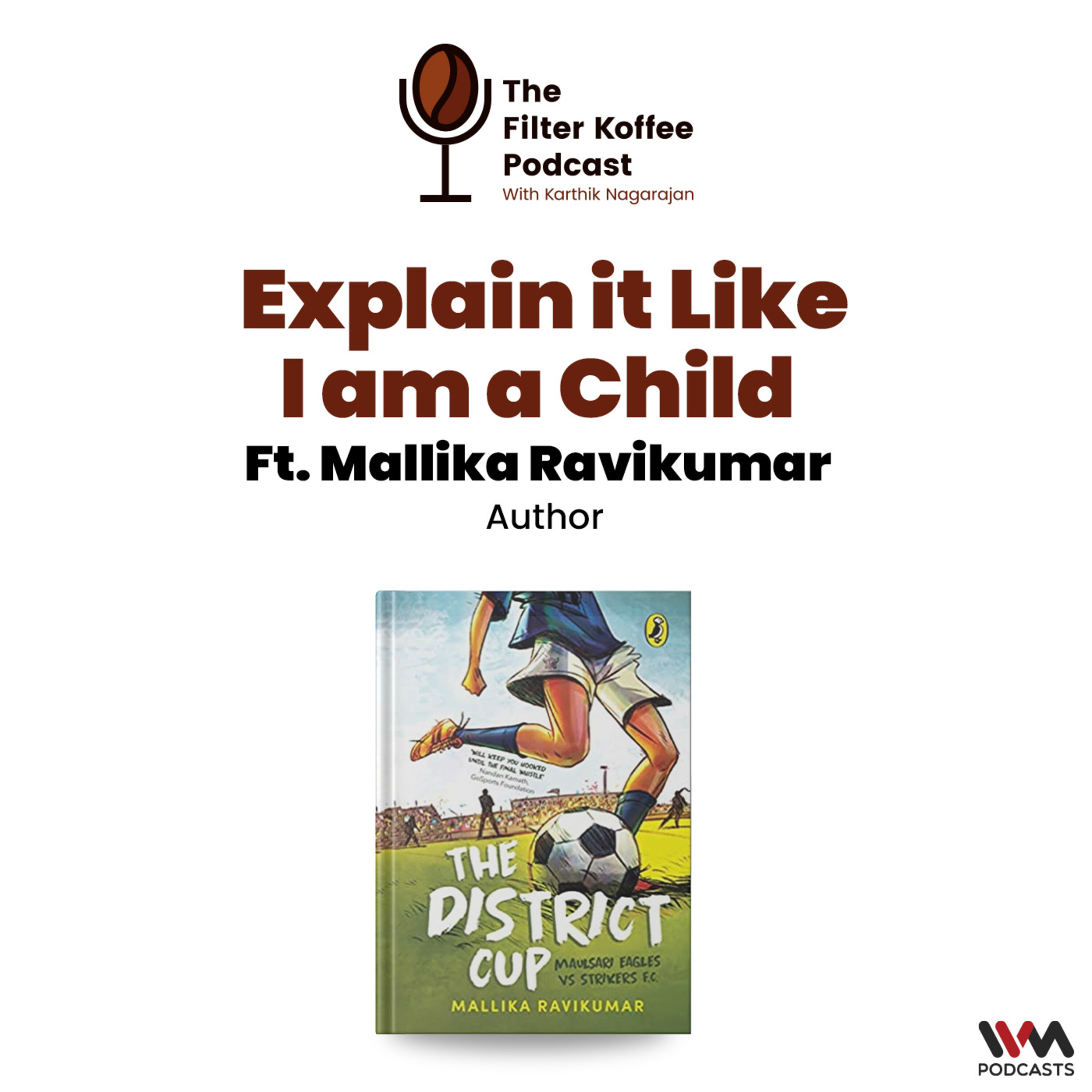
Explain it Like I am a Child ft. Mallika Ravikumar, Author
45m 4s
The transcription features multiple podcast promotions and an interview. Sanya Mirza introduces a new podcast blending pickleball with in-depth discussions. The Filter Coffee Podcast returns after a hiatus, featuring an interview with Malikar Avikamar, author of "The District Cup," a children's book addressing age fraud in Indian football. Malikar explains her transition from law to writing, driven by a passion for making history accessible to children through engaging topics like sports and culture. Her research involved extensive conversations with football insiders, revealing deep-rooted issues of age manipulation in youth sports. The discussion also touches on challenges like inconsistent birth registration in rural areas. Other segments promote podcasts on personal finance (Pesa Vesa) and unfiltered conversations (Cyral Sales), highlighting varied content across streaming platforms. Overall, the text showcases podcasting's role in exploring niche topics, from sports ethics to historical education.
It feels like everyone's talking about two things right now. Pickleball and podcasts. So what happens when someone who's lived her whole life on the court decides to bring those two worlds together? I'm Sanya Mirza and I'm bringing you a brand new podcast, serving it up with Sanya. I've had some incredible conversations with friends, fellow athletes, artists and entrepreneurs. Each episode starts with the game of Pickleball and once the rallies are done, the real talk begins. Serving it up with Sanya, watch and listen on YouTube and wherever you get your favorite podcast. Record keeping is a fairly new thing in terms of having a registration, a registration of death and so on. But in big cities, where you and me, I are, but in smaller towns, in villages, in people born in tribal areas, records are not kept as well as they are in cities. So at the time of birth, it is possible that someone genuinely doesn't have a birth certificate. I mean, it's highly likely that if you're born in a place which is very remote, you may that parent may not have registered the birth. So the record is not kept at birth and therefore you have to enter the system at a later date if you're playing to get obtain a birth certificate. So there are provisions to get birth certificates later on. Hello and welcome to the filter coffee podcast. Firstly, apologies for the very long break in the show, which was largely because of personal reasons. But I'm glad we're back and I'm eternally grateful for your patience. Thanks for listening. It means everything. The episode you're about to hear was recorded in Jan 2023, just before we went on the break. My guest, Malikar Avikamar is many things, a mother, an author, a lawyer, a culture, an archaeology enthusiast, and also an ethno-bottonist. If like me, you're hearing that last term for the very first time, it basically means someone who studies the confluence of plants and culture. When my conversation with Malikar traversed all of these subjects, we originally started talking about her new book, The District Cup. It is a book about football and that it's very core. It deals with one of the biggest challenges faced by Indian sport, age fraud, something that even Rahul Dravid called as an erosion of culture, something that is hugely detrimental to the sport of cricket. In fact, Malikar's book begins with the Rahul's quote on the subject. But while the book is extraordinarily well-researched, it is actually written as a children's book, replete with illustrations and a very, very easy language. I found this approach to the topic very unique, but then I quickly realized during the conversation that this is a larger literary endeavour for Malikar. She wants to tell stories to children that will help them understand the world they live in better and not just teach them history as a useless chronicling of wars. Malikar's personal website, which is malikaravikumar.com, is a treasure trove of content for both kids and also parents. In this episode, I spoke to her about how the book happened, which she told me involved among other things, her desire to write something on football so her kids will actually read her book. I also spoke to her about where her research on age fraud in football took her and how deeply rooted that rot is in the sport in India. I also spoke to her about how she plans to retail history to children, especially our botanical history in a way that children will actually get about. Stay with us. We'll be right back on the Filter Coffee Podcast. Are you looking for finance, products and services that can enhance your personal finance experience? Are you looking for a space to talk about your financial product or service? And are you looking for a crisp talk show where the conversation is all about money? Well, your search ends here. Hi. My name is Anupam Gupta and I'm host of the Pesa Vesa Podcast and I invite you for the conversation about your personal finance on each Monday, on the IVM Podcast app or the website or on any podcast streaming platforms. See you folks. Namaste. Sajir Kahaal. Good morning. Evening afternoon. My podcast is 'Cyral Sales'. Where no gas, no topic and no filter is safe from further brooch. That's me. Monday to Friday. Saturday Sunday. I'm with our kids. We chat with celebs. You'll never meet traffic jams on streets and people from all professions. Every Monday I go live with the show, ask me anything. AMA. You throw the questions. I dodge them better than a Mumbai rich ad driver. I even host a panel discussion called 'Cocken Bull' where we dive into current affairs and wonder why anyone even cares at all. And Friday releases are always surprise episodes for you all. So tune in to 'Cyral Sales' on YouTube and all audio streaming platforms. Welcome to the filter coffee podcast Malikya. How are you doing? I'm good. I'm very happy to be here. I've been a listener of several IVM podcasts so I'm very happy to finally be on one of your shows. Never thought it'll happen. Thank you so much. Pleasure is entirely asked. I know that you're talking to us from Bombay, but you actually live in Portugal, don't you? Yeah, I am from Bombay, but for the last one year I've been in your APS. There is an indirect connection to the book and where you are, etc, which we'll get to in a bit. But I wanted to start off with, I know you are a trained lawyer or a practicing lawyer. How did writing happen to you? Tell us a little bit more about that phase of it. Yeah, so writing has always been a hobby, even before my writing, as a profession sort of happened. It was always a hobby and I was practicing law and then once I had kids, I took a break from law. I went back to studying. I did my master's in history and so on and I continued to write as a hobby and then I wrote stories for my kids and then their friends and everybody seemed to appreciate and like it and read it. So I thought maybe there is a little more to this that I can take the next step and as I was in a break from maternity break from work, I had some time where I was not working where I thought I'll do something else and I took to writing a little more seriously then I pitched it to some publishers and they seemed to like it and then you know it went off from there. So it was a hobby that turned into a profession really. What is writing as a hobby actually mean? How does it manifest? You mean like you do blog or write for yourself? So blog is of course, you know, I'm a child of the 80s and 90s so at that time it was little writing in your diaries and I used to have pen pals, I used to have friends. You had this cochlems, there was a Chennai based magazine, my grandfather used to subscribe for me. So there'd be a list of, you know, addresses, people who want to have pen pals would give it their address and you could write letters to them. So that was something I used to do then write a poetry, I used to like writing about various things. And you know generally if you're like photography, you see a bird, you want to click a picture, you see some, you know, have an experience a party, you want to click pictures and keep them. But if you write, you like writing, your first instinct is to record it in words. So if I had some holiday or a travel experience and I'd always find that I wanted to write it down, to remember it for a long time. So that was a very natural response in me. So writing as a hobby would really manifest in these sort of ways, diary writing, pen pals, you know, recording every experience in a written form, that sort of thing. Do you have a Chennai connection where to grow up? I know, I grew up in Mumbai but I am, you know, Tamilian so I have relatives back there and so we had regular visits to Chennai for weddings and family occasions but otherwise I am Mumbai based, I've been always been in Mumbai. Yeah, two questions. I don't think it's around. I don't even think most of the books are around except probably a few hundred somewhere in my house. Okay. Yeah. We were talking, you know, before the recording that I was reading the book and then I was also reading your website which I found equally fascinating and there is a lot going on there. You know, you're writing about history, why are you beautifully curated? It's very easy to navigate this and experience different aspects of your writing. But when your writing is in many different levels, there is even a section on guides for barons and guides for writers, you write about history a lot but I think the common thread to all of this and also your first book was around history. What is that fascination? Where does it come from? The manifest of your life. So history like I said, you know, I studied history also at the formerly I did a master's in ancient Indian history. But again, in my childhood days and earlier when I was not had studied history formally in college, I had done commerce and then law, a history was always my, you know, preferred area of reading when I was reading fiction, it would be historical fiction. When I'm reading something serious, it will be, you know, historical nonfiction. History was the central sort of theme through everything that I read. I used to like learning a lot about, you know, history of various places. And one of the things that I used to have is that I found history was taught very, not very nicely in schools because the focus was always, especially in the exams was always on dates, on wars, on all the things that I think, you know, we need not focus on. And even the perspective given of, you know, if there is a war going on, you know, the Alexander the great, for example, the idea of anybody who's out there to conquer the world is seen as a great value. So these are things that I didn't sit well with me. I thought there was an alternative perspective to history and with children enjoy more, for example, sport. What sport did kids play, you know, 500 years ago? What did they eat? What did they wear? There's so much more to history than kings and dates and wars. And that is my perspective, what, you know, some of the professors I had sort of passed that on to me. And I thought it was a very nice thing to share with kids. And I did find that children found that more interesting, rather than, you know, who ruled at which era and who ruled after him and what was the political structure they had. And kids can't relate to that as much as, you know, things that material culture around them or how did the potato get into Indian cuisine, you know, it wasn't there a thousand years ago. Things like that which they can immediately relate to. And it is something that they get interested and curious in, curious about kids are inherently curious. But I think by focusing on things that are so distant, so remote, you sort of kill their curiosity in history. And then they find it. Most kids will tell you history is boring. When I think there is so much more to it that we can share with them to make it more interesting. So that was my reason for writing history for kids. And in the book, I've tried to look at various angles where, you know, they can relate to history in a different way and not through kings and wars and dates. Right. And we're talking about your first book in this case. That was a second book, yeah. When you come into Italy, in fact, you know, now that I look back with your lens, not understanding the fact that I loved history, it was my, easily my most favorite glass. It is all about who won what war, it was, we looked at history from a war lens. Yes. Absolutely. Yeah. But that to me change, like you, I also read a lot of nonfiction history, especially about English. And recently, I was, I spent a lot of time, I took a fascination to orangus and I wanted to understand, you know, what this person or this phenomenon was, why is he hated so much. Right. In the process, I discovered, he's also a fantastic administrator. For example, he focused less on monuments and more on humbing and roads and sanitation in the cities and stuff. Which is an aspect of all of this. I don't know about at all. Coming to this book, you know, you talk about, I saw a video of this story behind this story and you talk about how, you know, you, you, you, you pretty much wrote this book because your voice, your children, they were not necessarily reading your, your other works. So you want to write something for them. Is it? Talked to us a little bit about the origins of your book. Yeah. So as I, as you know, as you rightly said, I put up on my site, my children, like most kids of this generation are big Harry Potter buffs. So they were mostly reading Harry Potter and once they finished reading all the books, they did it all over again. So I, you know, I kept saying, you know, there are other things to read. I'm glad you're reading, but read other things as well, especially I have written some books and other kids. Tell me that, you know, auntie, I like reading your book. I learned this from your book. But you guys don't seem to read, you know, like in Hindi, they say, Gharki Murki, Dalwara were sort of thing. You don't really respect or regard things that are closer home. So they said, yeah, of course, we don't mind reading what you write, but you don't write what we want to read. And I said, what does it that you want to read? And they said, football, you know, that is their favorite subject, they're playing football quite seriously. So, and I thought it was a way of telling me that, you know, you are not going to be able to write what we want to read. So I sort of took it up as a challenge and it initially it was, because sport is totally not my thing. It's like you said, you know, it's history and trees is another subject I write about. So initially, I thought, you know, obviously it's not going to happen, but the thought kept, you know, playing in my mind and a character formed, a plot suddenly formed and slowly, and because I am a writer, not consciously thinking of it, but somewhere or the other, some ideas came in and I thought, okay, let me take a chance, I wrote a few chapters. I showed it to them. They seemed to like it. Then I said, okay, the world cup is coming up in a couple of years. Let me pitch it to a publisher and see what they say and, yeah, and then Puffin picked it up and said, yes, we'd like to have a book during the world cup and this seems great. So that's the story behind the story. When did you start just searching for the book, when you start the process? Over two years ago, actually, so yeah, more than two years ago, I've been, so the thing is, eight cheating was not the main theme of the book at that time. The book was centered around kids playing football and the other obstacles they face, a little bit of the corruption in the system, but also parental opposition was the main thing that I knew about, but I slowly went into eight cheating as after I, you know, sort of work started working on the book because I found that that was the central theme that I would like to focus on because it is actually a very, very big issue in Indian sport, in youth sport in India. In fact, your book pretty much starts with a quote from Rahul Dravid on how age-related cheating is actually stifling careers and stopping us from getting better as the country as a sporting nation. Before we get into that, in a big way, you started writing this book a couple of years before, you know, with probably a timeline of the world cup as your goalpost. Right. So to say, but this also must have required a lot of researchers and like you said yourself, you're not a football person. Yeah. And by the way, I totally relate to Kirtan, football, I'm a, like to call myself a soccer dad myself, my six year old to test, but what was, what was your, your, your research process? Did you, I'm assuming you set out to probably write a book for children, which is around football, which is what it is. But what was the research process like, did you watch a lot of games, did you start reading about it? Growing up in Mumbai, you know, a football, at least 20, 30 years ago was not so big. Unlike in maybe Kolkata or Kerala and some other Pagoa and so on. So cricket was something we all saw as a family. But I personally never played any spot, only watched cricket. So football was at, I had absolute zero knowledge. I only took to football because my children, both my sons play football quite seriously and they dream of continuing to play seriously at some point, play at a good level. And they're still very young. But they watch a lot of football and they have a lot of football friends. So they're always talking about football. So it was only the entry point was only as a parent. And even my perspective today and whatever little I know today is only as a parent of children who are very keen football followers and interested in playing football. Not as a player, not as somebody in the system, not even as a spectator as much, but only as a parent. So it started with spending a lot of time on the field because I was taking them to training, I was taking them for matches on weekends, every weekend, Saturday, Sunday, baking in the sun in tournaments, you know, sit around talking to referees, other coaches, other teams. You see the kids, you listen to a lot of things that's going on, somebody went for some selection, what happened there. So although my kids were small, I heard a lot of stories as writers, you know, you're always open to listening to what other people are saying and then that sort of builds up slowly in your mind. So I was listening to a lot of things. And then when I started working on this book, I reached out to a lot of people in the system in AIFF youth development, you know, people who are heading the youth development in all India football federation, I spoke to a lot of coaches, I spoke to players, I spoke to people who are running football academies. I also spoke to people who had quit the system because of age fraud. I spoke to somebody who was playing quite seriously and he found that one of the states trials he went for. It was something shocking. He told me he said, my coach came for the same trials. The somebody who was about seven or eight years older than him or maybe a decade older than him came for the same trials as him and he just was so disgusted that, you know, this was being rampantly allowed that he decided that he's not, he didn't want to cheat. So he decided to quit and now he's taken to something else. So I spoke to a lot of people and that gave me a rich source of information. So many of the instances I've mentioned in the book are not just statements of imagination, but based on what actually happens, again, based on what other people have told me, although I have not played or experienced it myself. So a research process, a lot of it was reading and speaking to people who are involved in the system. You know, what if I'm fascinating about this is this kind of a research and this kind of core of a problem usually would make up for a great nonfiction book written for adults, but I found it fascinating that you've taken that as a core and written fundamentally while the book is works as much for adults as for children, it's very breezy, so I'm assuming it was intended. I'm glad to hear that. Yeah. But going back into the problem itself, you know, I think you sort of bring out a lot of the research through the voice of Siraj, who's the coach. I remembered one of the things he's asking a kid who's playing really well. What is your age and that the boy saying do you want to know my actual age or my official age? Correct. Which really, I thought it was like the core of the whole thing. I can. Yeah. Where is this coming from? Like, because it seems to be a very unique subcontinent problem. What is the core of this issue? So there are multiple factors involved. One is that record keeping is a fairly new thing in terms of having age registration, registration of death and so on. You of course have it in big cities where you and me, I are. But in smaller towns, in villages, in people born in tribal areas, records are not kept as well as they are in cities. And it's highly likely that if you're born in a place which is very remote, you may and a parent may not have registered the birth. So the record is not kept at birth and therefore you have to enter the system at a later date if you're playing to get to obtain a birth certificate. Now that gives us entry point of those who wish to manipulate the birth certificate also, not those who are genuinely interested in getting a certificate because they don't have one. The system is made for them, but it also provides a window for those who want to get a manipulated birth certificate to say that I don't have a birth certificate or I've lost my birth certificate. And I just have to give an affidavit that is a statement on oath that says, where I say that, you know, my child is born in a certain year and this is his birth date and I will get a birth certificate based on that. And that happens so often that it's become very, very common in the sporting system for people to use. And this is not just a phenomenon in football. Like you said, you know, Rahul Dravid's opening quote is about cricket largely, but you find it across. Google age fraud, Indian sport, you'll find every sport in India has is being plagued by that problem. And the reason is, I think of course, one is that it is easier to manipulate a system because the records are not, you know, 100% full proof and there is a window to do it. And also, I think even those in the system who know it is happening are finding it very difficult to tackle the problem as the people who I spoke to mentioned, you know, because it's so rampant and it is happening across the board that it's difficult. In some cases, you know, there were 50% of a team is, you know, eight cheats or age fraud. What do you do? You can't disqualify, you know, the entire team because of that because half the players are that they've got manipulative documents. So it's such a rampant problem. Is that the kind of proposal? Yes, that's what some people who I spoke to told me that and even these articles that, you know, Akhar Sharma is a journalist who's looked into this very seriously and there are articles I've linked it up on my website as well. He said after researching his article called Indian Football's Age of Deceit, that's the title of his article. And it's all focused on age fraud and he's deep-dived into this. And he said after writing this, after working on this for a few months, he said he was so depressed, he couldn't write anything else. He's an avid football buff and he found it so depressing that this is the state of things. And all these facts and figures come from his article and then I also spoke to him and he was very helpful in giving me a lot of information. And he said it was so bad that he was really depressed after writing this, so it is quite a serious thing. I'm sorry, I'm bringing down the quality of the discourse by asking a very dumb question, which is, is it because, for example, if I'm a 17-year-old and if in the under-19 league I'm not able to perform really well, I sign myself up for an under-13 league because I can then, you know, bulldoze my way into excellence. Is that the core human motivation of this? Right, it totally is. So if I am a 15-year-old and I may be a very good player, but I am not standing out compared to other 15-year-olds, but because I am larger and more muscular and stronger and faster than 13-year-olds or 12-year-olds in the under-12 or under-13 league, I will stand out and hence get selected for state-level, district-level, external, national, whatever. So I will then be the outstanding player in that group. Whereas in my own age group, I may not be good, I may be very good, but I may not be outstanding. So that is definitely the motivation that people, which is pushing people towards age fraud. And as I just mentioned, cricket, you know, I don't know if you come across this, but the captain or the man of the match in the under-17 cricket world cup that India won few years ago. We beat Australia in a final. The player of the match was found to be, I don't remember his player of the match or captain, but he was found to be later on found that he was indulging in age fraud and he was suspended. So this is cricket world cup, you know, and this was happening at the highest level in cricket, which is like a sport that everybody is talking about. In ISL also, you know, a few years ago, the AIFX said somebody who had scored, I don't want to take any names, but these articles are all available online. Somebody who had been the youngest ISL goal scorer as a teenager. They mentioned it in glowing words and later on it was found that he was also age cheating and then he was suspended for six months. So this is happening at the top level. So obviously it will percolate down and you know, people like in the book say, you know, if it's happening in the top level, why should we not do it? So it builds into the culture and one person is doing it. So then the other person gets forced to do it. So it's a very rampant issue. And like you said, the motivation is that I want to be chosen for the next level and I can, you know, stand out only in a younger age group because I am not that good to stand out in my own age group. So that is the key motivation, yeah. So one of them which I mentioned, you know, where this boy goes for state trials and he finds his coach is also there in the same trials. That was something that, you know, anecdotal thing that just stuck out. And I have mentioned in passing, the other is something that you mentioned where, you know, he's asking him, boy, what is how old are you? And he says, actually age or official age. This is something I heard on a podcast. I think it was seen in the unseen IVM podcast was something related to sports and the organizing of the youth, the 17 football world cup. That was the theme of the podcast. And one of the speakers there, I think Nandan Kamata somebody mentions this anecdote. So that was another shocking one. The cheating aspect is not related to age fraud alone in the book. It is other, you know, thing petty things that people do to get ahead. This incident happened in front of me in one of the tournaments my children were participating in, we were waiting by the sidelines for, you know, the next game, which was their age group. And we were waiting for an older match to fit a match of an older age category to finish. And one of the coaches accused, you know, the boy in the opposing team of age fraud and he said, this boy cannot be 13, you know, he has facial hair and he's the look at his calves and look at his muscles. He has to be about 15 and he's cheating. And the coach who was being accused actually turned around and said, you know, you are body shaming my child and you are body shaming my, you know, student. This cannot be done and the parents came into the field and so the tables actually turned right in front of us. The coach was demanding an explanation and saying, show me your documents was then apologizing saying, no, no, no, no, I am not body shaming anybody and, you know, he had to go on the back foot. And so this happened right in front of me again, another anecdotal thing, which I have. There is a, you know, seen in the book based on this. So these are some of the, you know, anecdotes that people shared with me or that I experienced and these are real incidents. So it's not, not imaginary. Well, well, this is the backdrop of the book. You're also creating a universe, right? And I don't know how much of this is, is this fictional part of my Geographic lignit, but I must say, is Malsri a fictional town or does it exist? Yes. No, no, no. It is a fictional town. I didn't want to base it on any existing town because then the Football Association of that town will, you know, I didn't want any legal issues saying that some city's Football Association is indulging in this. And growing up, you know, Malgoody Days was one of my favorite books, Arke Narayans. And I always wanted to create a fictional town like Malgoody. So Malsri is my fictional town and it is based on the name of a tree. Malsri is actually the name of a tree. So yeah, it's a fictional town. Yeah, in fact, I had by my notes too to talk to what is that, is there a Malgoody sort of inspiration? But I love the name. You know, there's an avenue or very far from where I'm calling called Malsri Avenue. Oh, I see. Okay. So you are, you know, creating this universe of different characters, you know, that is the Caves, Brithvi, or Ghatambini, they all are assuming, in a way, characters you would have met or spoken about in your research. Yeah. And one of the other things you also talk about is, is this how gender plays a role in sports. And you want to slightly touch on that aspect of what you heard and how you brought it out in the book. Sure. So in football, youth football, generally, you know, you see, you go to any tournament and you will see boys playing. And in the boys, in a team of say, you know, if it's a 7B7 tournament, so there'll be seven players on the field and three or four reserves. So in a total of 10 or 11 players, you will have one or two girls in the team, but the rest of them are boys. And then you inquire why, you know, the girls don't have a team of their own. And then you get told that, you know, they aren't enough girls playing. And I also spoke to two girls who played football at a serious level. And one of them is playing in Spain currently. And she told me that we always had to play with the boys because they were not enough girls playing. We didn't have a team to have a girls team. So in a way, you're playing with boys who, and then you get told, you know, it's a very rough game. You'll get pushed around. Don't play. So people who are trying to be kind to you are saying, you know, beta, you know, you'll get her. Don't play. And then there is a reverse also where you, you know, get the bullied and told that girls can't play football, you know, that that also is something I've touched upon in the book. Girls do face, you know, by people who are being nice to them, to say that you, it's a harraf sport. I don't want you to get hurt and by people who are being nasty. So you get get it from both sides and they have to battle both these sort of odds against them to go, go further. And later on, of course, you know, other biases that I've mentioned, some of them in the book, you'll get tanned, you'll get dark, you know, these kind of things that girls also have to deal with because they're out in the sun playing. They girls have to deal with it far more than boys. I think so, these are issues that girls face and genuinely not having teams to play with, to compete with in order to go ahead is a big hurdle that girls face apart from other societal issues that all, you know, across the board, not just in sport, but across the board. Women are, you know, there's a greater chance of them facing that. But from that, these are specific sport related barriers that girls face. I just love it that the, you know, in essentially, I'm repeating myself, but in a case, go be able to bring in shapes of these in a very subtle, but, but a powerful, which I think it's very important for children, you know, as well, these are not just that adults deal with in life. Talking about that, the other thing that I also fell in love with was the way you have illustrated it. The illustrations, I'm assuming are hand-wrong. And they also, kind of, for some reason, it sounds a very, very 90-ish to me in terms of the, that's in, that's in feel of that. What was the thinking from what from an illustration perspective? You always wanted to do an illustrative book. So the illustrations. There is an illustrator who worked on the illustration's name is Gobindasau. He's a very good, he's a student, but finally you're, you know, in design. But he's the one who's illustrator, the book and Puffin got, you know, got the illustrator and got the, him to work on the illustrations. And I had to, my inputs were early just to, you know, say that these are the features of the characters. These are the descriptions. This is what the scene should bring out. So it was very peripheral that way. But the illustrations, the credit should all go to Gobindas because his work and he's done a fantastic job. But he did mention it to me that, you know, comic strip and translation, two of the ideas that have been planted into my mind by other people who read the book that, you know, this, so yeah, I should, I, I, I'll speak to the publisher. So it's early in their hands. No, no, I love the way it is. But more importantly, what do the boys, every voice think of it, they find it on a reading copy? Correct. No, no, yeah, they were part of the process of, they've read the manuscript itself, you know, as I was writing chapters, they were actually part of correcting some of my errors because like I said, I'm not a football person. So, you know, things like if the left back is taking a shot from here, then the goalie cat cannot dive to the right, he has to dive to the right, you know, these sort of tiny things that wouldn't occur to somebody who's not on the field and playing or watching regularly. These mistakes, many of them, you know, they corrected and rectified and so they, they totally were part of the writing process itself, so writing and definitely reading after the book is out. Yes, they did. They were quite involved. Right. Wonderful. Wonderful. They're from the book itself and talked to you because, you know, they just, after I've gone through your website, I have like so many questions in my head about the other things, you know, that you do. Right. But, you know, like you were speaking before the recording, it seems to me that one of your biggest convictions is that kids should learn history in its actual form and understand that very well. And that's as much a part of learning and growing up as it is, as anything else is. Why do you feel that way? So, few reasons. So, one, I think kids are innately curious about their past. So, for example, you sit down with a young child with a photo album, you know, they'll want to know who's the person in the album, who do I look like, where's my father or my mother like this when they were small did they do the things that I'm doing now. So, kids are innately curious to know about where they came from, about their past and that natural curiosity then extends from family to, you know, your larger geographical setting and then historical setting and so on. But by focusing on the large, you know, macro, you sort of kill their interest in the micro immediate micro, glowing more about my family or knowing more about where I came from. Why I eat the food I eat, for example, the example that I mentioned earlier. Those are things that are innately, you know, what they question and want to know about. But then you're suddenly telling them, you know, the Chola is ruled at this time, the Palavas ruled at this time and, you know, the Mughals ruled at this total, you know, no correlation at all. And then you kill that curiosity which they want to build on to know more about themselves as a family, then as a group, as a tribe, as a nation. So you have to grow from the immediate to the larger setting, but we sort of do it in the reverse. You know, we show the world map first and then find out about your geographical area when it should actually be in my opinion, the other way around, you know, learn about, learn to draw a map of your own setting first and then think of world map. You know, so that's, that's my approach to start with your immediate and then broaden which I think kids do relate to. So that is one aspect of, you know, my understanding of history which I would like to pass on through my books and so on. And the other is I think the meaning of several things we do, especially, you know, today when you have so much information on social media, news and so on, and a lot of misinformation as well, I think to be able to make sense of the world and to form an opinion on how you want to live your life, how you want to conduct yourself, how you want to treat the people around you or behave with people, communities around you. It is important to be well informed. You can take whatever side, you know, be right left or whatever, ultimately, but read enough from both sides and then make up your own mind instead of just being conditioned by the immediate world you see around you because there is a lot of misinformation that you need to wade through to sort of then finally form your opinion based on your own convictions and beliefs. So I think it's important to crystallize ideas in a way that show both sides and not just bulldoze children with one side which can often get done. So these are the two, I think, you know, focal points that drive my history writing and my idea of wanting to write for history for children. Yeah, to your first point, I can see why that's important, not with the kind of a motivation that you have, but generally I thought, you know, a few weeks back, I thought it'll be a nice idea, you know, to ask my daughter to draw the map of where she lives. So we took out this really big sheet of paper and every time we go for a walk, we go for like 10, 15 minutes and she has this small hand note and she'll take notes on what all she saw and then she'll come back and then add that to the map, right? So we have nowhere near finishing it, but I hope in a few months she should have a map of the place where she lives. I thought it was important because she gets to know what all make up, you know, a neighborhood of the diversity and things and people and trees and roads as well, and all of that. So I totally relate to your first point. That's fantastic. I think that's the right way to learn geography also, you know, learn about your own immediate draw map of your house, draw map of your street, your immediate surroundings and how is the child going to Envision Universe and world and then you bring it down later on and think you to end up knowing, you know, the capitals of countries far away and you don't end up knowing, you know what's in your own backyard sometimes. So I think the approach should be more, which is natural, which is a natural way of child wants to learn also, learn about, you know, what is immediately around them and then sort of expand. So yeah, that's wonderful that you're doing the snap. Thank you. Even I feel that's probably important for others as well because I find it really, really funny that everyone who's reading news will know what Rahul Gandhi said about the soldiers fighting in the border and what Jai Shankar's response to that was, but they will not know what is the sewage situation where they live or what is the electricity situation where they live or, you know, what are some of the other challenges faced by, you know, which is very here and present, right? Totally. Yeah. And I think the news has come to a stage where it is so non-localized. Yeah. And that local news almost seems unimportant anymore, right, in the value of the rally cycle of years. Correct. On the topic of, you know, nature and local, et cetera, I also read in your website about a phrase which, honestly, up until now, I've not heard of, which is ethno botany. I mean, say this one. Yes. And ethno botany. Yeah. So botany, as we all know, is the study of plants. Ethno botany comes is, you know, studying plants from not from the perspective of the morphology of the leaf and the bark and the trunk and the roots and the, you know, system of how the plant creates, you know, the chlorophyll and how photosynthesis happens. That is the, you know, the biological part of it. But ethno botany deals with how people relate to plants. So why certain plants are worshipped, many plants are worshipped in India at various times, especially at festivals. And plants like now we are around Christmas, you have the Christmas tree. In fact, the latest video on my YouTube channel, which is about trees is about the history of why we decorate Christmas trees. What does a tree got to do with Christmas and how this connection happened? So ethno botany. Sorry. But why do we? It's a very, very long story. So initially, so one of the, you know, things is about evergreen trees, especially in winter countries, where it's very cold. That is not winter countries, but in winter, where in countries where it's very cold and deciduous trees drop all their leaves, evergreen trees stand out as, you know, symbols of life and hope because it's so dreary and dark and these trees are still green and you feel okay, these trees are green and you bring them home. The tradition of bringing some part of the tree home to continue because earlier, pre-Christian societies in Europe believe that trees were imbued with spirits as, you know, societies in India still do that. We believe trees, you know, animism is a part of our religion here as well. But that was a situation in pre-Christian Europe and they used to bring into their house these trees, evergreen trees to think that these trees spirits would also protect them through the dreary days of winter. And that's how this tradition of bringing in plants began. But when Christianity came in, they frowned upon, you know, animism and worshipping trees and there's a slightly violent history, which I've also mentioned in the video. And the trees, the oak trees that they worshipped at those, in those times, were hacked down. And the evergreen tree, the coniferous trees, that is a pine trees and the fir trees. These trees took the place of the earlier oak trees, which were symbolic and holy. But the idea is that evergreen trees stand out as symbols of life and hope during dreary winters and that is the basis of why these trees are brought in and celebrated during these winter months. So that's the, you know, cutting a long story short, there's a lot more to it. But that's the central idea behind it. So ethno-bottony is understanding how people have related to trees and people have related to, you know, through worshipping them, literature, poetry, celebrating festivals around them, how different, you know, cultures use various parts of trees to make their food, to make their clothes, to make various materials they use. So it's a correlation of people with botany, so that is ethno-bottony, which is my specific area of interest. And this interest has also sort of been sought after in your case by many people including the government of India, isn't it? I read on your website that with a cheap content writer for the government of India, portal on Sagar Patel and the National Virtual Library of India, how did that happen and what is it that you did there? Yeah, so this was a project to the Department of Science where they putting out beautiful curated, you know, virtual museums on various personalities. One of them was Sagar Patel and that is the project that I worked on because my background in history and I was helping them curate. There's a lot of content on these people. For example, Sagar Patel, they were do version files, they were all in the radio files, national archive files, and you can't just put all the raw data there. You have to sort of make it a virtual museum experience for a visitor. So you curate it and you write it out in a way that is interesting for viewers who come to the website. So that is what the virtual library site was all about. And from that, in fact, I learned so much about Sagar Patel and the process of accession is. So my next book, 565, which is going to be published with hatchet is about the accession of princely states and Sagar Patel's story, not just focusing on him, but the whole story of various states and how they acceded to India. But this virtual library site was specifically about Sagar Patel and his contribution. So this was a government project that I worked on based on my background in history and my writing put together. Would that be intended for a younger audience, or is that intended as a different? No, no, no. The government website is intended for general readers who want to read more and find out more and get the next book, 565. 565. Oh, yeah, 565 is for not for very young readers because it's a very dramatic and politically charged story. So it is for what you know, what you call middle grade or young adult category. Wonderful. And 565 assuming is the number of princely states. Yes, yes. Fascinating. Can't wait. You know, we will end the episode. Malika, we are asking, I guess what he or she is watching, reading or listening. What are some of your, your records? What are you watching these days? What am I watching? I just, I haven't finished watching it, but I was watching Kantara till a few days ago on Netflix. I was unfortunately not here to catch it on the big screen. I'm told it's a big screen movie, but I wasn't here where it was out. So I was watching it. I haven't finished watching. That's the movie I've been watching. What I'm reading, I'm reading a very interesting book called Nature's Government. It's about how, you know, colonial societies, you know, if you find these botanical gardens in various cities, right? So what is the idea? It was not just for people to have pleasure gardens to walk around, but how the colonial, various colonial governments used botany as a way to plunder and exploit the, you know, the colonized societies. So Nature's Government is about how the British especially used, you know, plants to further their colonial project. So that's a very, very interesting book that I'm currently reading. It's called Nature's Government. So that's what I'm watching and reading. Oh, that's fascinating. Yeah. And sorry, it's botany as a way to plunder the natural loses degree. You're right. Yes. Yes, absolutely. Another video you'll find on my YouTube channel, TreeTalk with Malikaravikumar is how teak, the Indian teak tree, you know, Tekkamaram is where teak comes from, the Tamil word Tekkamaram. Teak, actually, I find, you know, it is the British Navy which conquered the large parts of the world. What was the basis of the British Navy? It was Indian teak because all their ships were made of Indian teak. So they have, you know, the teak plantations you find in India, even today, a large part of them. They went into the forest, cleared up forest, grew teak, had these teak plantations because they wanted it for their Navy because they already hacked all the oak forests in England. So teak was really the bedrock of what changed. And this was, this period was called a teak rush between France and England because during Napoleon's rise, the British really needed something to bolster their naval strength. And the Indian teak really saved them in their fight against Napoleon. So these are aspects of history I find very fascinating. Like I said, not about kings and wars, but about other things that really changed the tide of history. And a large hand is actually plants and, you know, trees like Indian pepper, you know, the colonial guys came here for our pepper and that changed Indian history completely. So that's my interest of trees and history coming together. I think that should be a separate episode by itself. Yes, absolutely. Absolutely. You do have a fascination for trees and their histories, etc. Some of these finer stuff, like what you said about what Napoleon said, what does your source work? Can you get that information from? So there is a lot of information I read. Like I said, this nature's government is a book that is giving me a lot of information about, you know, how the colonial project was furthered with botany. So there are many, many books available when you look, when you look out for, you know, this sort of information and find people who've done a lot of research and research papers are there, books are there. So I'm not doing primary research in that sense. You know, I'm reading what people have already found and written about. But because I'm interested in this, I sort of end up getting those book recommendations and read a lot in this space. So that's how I learn many of these interesting snippets. And we're very thankful that you curate that knowledge so beautifully in your videos. Thank you. Thank you. Thank you. Link in show notes, all of the videos that we spoke about on your website. Sure. Sure. Yeah. But you were also speaking about early, you're being on podcasts. What are some of the things you're listening to these days? Yes. In fact, I'm hoping to have, you know, a detox podcast as a side note, I'm hoping to have it out also, I'm meeting somebody from IVM, Hosun. And the same material that I discussed, you know, like I said, teak, tree, Christmas tree. So many interesting things about trees, proverbs, we have so many rich proverbs in Indian languages, about trees. I'm hoping to bring all that in a curated form because a lot of this, like I said, is in books and, you know, in things that I've been collecting over several years. And I think there'll be an audience which is interested in this sort of thing. So the same material that I have in my video, I hope to also bring out in a podcast. Let's see how that goes. At the podcast, I listened to, I've listened to some of your podcasts on sports, which I found very interesting. I listened regularly to Amit Varma, Srinan, Unseen, I find some of them, there's a long format, some of them go on for hours, so I can't finish all the episodes. But I find many of his chats very interesting and I learned so much about, you know, a rich diverse group of people. I listened to the Charwaka podcast, I listened to some crime podcasts. I listened to Cyrus's podcast sometimes and I just want to laugh and have a good time. So you're very, very random mix of things. Wonderful. Thank you so much. You know, I totally enjoyed a district cup and I can't wait to recommend it to every child who can read. And so on. Thank you so much, Karthik. Thank you so much. We'll, of course, link the book as well to the show notes. Malika, thank you. Thank you. Thank you. A good luck with all the things you're pursuing. You obviously have multiple of them, which are a good luck to each of them. Thank you. Thank you so much. It's a paradox to be on a filter coffee podcast because I'm a total chai person. But yes, it's been great talking to you, great talking to you, Karthik. Wonderful. Thank you so much. Thank you. Bye. If you like this podcast, don't forget to check out other interesting podcasts on the IBM network. You can listen to us on the IVM podcast app or IVMpodcast.com. You can also follow us on our social media. We are at IVMpodcasts on Twitter on Instagram. And if you want to reach out to me, I am the underscore Karthik. That's Karthik with an H on Twitter and filter underscore coffee with a K on Instagram. The latest show brings you candidate no filter conversations with the biggest names in spot and entertainment. Check out this moment from her episode with the one and only Karan Johar. You had both of us actually have been raised by two parents and there was usually one bad cop and good cop. And in my case as well, my father was the good cop is the good cop and my mom was the bad cop and she was the one who was disciplining. And we both are at a stage in our lives where we are single parenting. Me to a large extent and you almost fully right and you do have your mom who helps you but tell us a little bit about that because yours was actually by choice. I think it was something I've always wanted. I feel like I am inherently a parent even when I wasn't. I've always had you know feelings of paternal instincts towards the kids I worked with in the movies or the kids I've mentored as a director. Like Alia Varun. Alia and Varun and all of them. Like I just felt I always wanted but I somehow knew that it was a decision I had to take along with my mom. And when I said it to her when I felt I was fully emotionally equipped to be a parent. I asked her and to my sure and utter joy she was like I can't wait. And I feel like it's daunting for me because I'm an only child and a single parent and it's a double whammy because my mom's not been keeping really good health in the last year. She had a stroke last December and from then on she's not been able to do what she was doing as a co-parent. She's also 83 years old. So it is not easy you know that you know and I have twins so I have double the issues. I'm the only dad on two WhatsApp mom's group. I'm the one who has to schedule their lives give the time and balance it by running a company and be there for my mom. It's all it's overall overwhelming. But that joy of just having that love being the proud recipient of the love when they come and give you that hug and it doesn't matter to them and it's sad to say this but it's I never want them to be on well I always have to be happy but the moment they hug you when they have a tear in their eye and you feel like you that because now kids have stopped hugging the way they used to and they were three and four now you have to beg for that love because I want an eye and there's nothing doing because I am like my dad. My dad was tactile, wanted the hugs and kisses and I desired it okay I want to be hugged and they meet me but when they need you and they are feeling wonderful and they give you that hug that's to be heaven. That moment of that child in your arms and you hold them tight and and just hug them with your core. I feel like I don't know what heaven feels like but that to me is my heaven. Yeah you know same and for me as well I think the whole single parenting yes it is hard but also because we're working and we do so many different things right. But you know I've just seen the flip sides on you it's actually liberating because you're not at crossroads with anybody else like everybody else has when you're not yeah yeah yeah I know well well I know that's why I don't have that flip side. You're well cross border is well so I mean you have a situation which is even more daunting and overwhelming but at my end I feel actually I'm blessed because I feel you know when my twins were being born and when they were born I had a hundred people give me pieces of advice on parenting twins or reading books, hearing podcasts, I did nothing. I was like we are blessed with what we call a superpower it's called instinct. Your instinct is a parent kicks in and your instinct is different from every other situation and parents. Exactly and there is no right or wrong way it is your way and over parent there's something called over parenting. Yeah I am not an over parenting but I do find it challenging to leave him like now when I'm here you know because I live in Dubai and you know and I feel the same way when I have to travel. That's the biggest challenge for me like to stay away right like for a period of one week then I have to like obviously just like your mom comes in my mom and what a blessing like right now she's with him because I'm you know working for this one week and I'm here and I won't see him and and that for me is the hardest part anything else I'm fine with. Sometimes that will also make him more independent. I always see the plus in everything instead of worrying about the minuses I feel there are big pluses in every extreme such situation like the big plus here is that your son and my twins will be very very independent and they'll be strong and they'll be resilient yeah and that's something that I would wish for all of them like we say inshallah we really really hope for that to happen last couple of questions both of us have been in the public eye or spotlight if you say for many years now and I was very young I was like 15 16 you were as well and it's hard I mean single parenting all of this stuff but also having romantic relationships is hard. How do you feel do you feel that how have you made peace with the fact that you are today your single you know or to your single or we think your single is your status is single okay your official status public status is single no my real status single so have you made a peace with that that you know you're okay with it you're there is a line in another song which I'll let her to see her not to meet the bears in the game push the sea where you go him you may be out of the game I'm okay now there was a point of time I really wanted the love I wanted yeah I remember talking about this I want a relationship and I went through all kinds of dynamics a broken heart one sided love I even made a film on it that was cathartic but beautiful for me I would help me heal I waited I realized that is somebody going to love me for who I am or what I bring to the table then you come on with doubt then everyone says oh put yourself out there I'm still looking for that there I don't know where that there is a brother they say like you know abroad but I think you know you know I'm going to live here I have a mom and two kids I have to live here so I've gone through those beats and I don't get lonely it's not it's a reality when you know when you get the loneliness is in your highs yeah not in your lows actually because in your lows you have your mom you have your family yeah I have two cousin sisters I'm very close to my best friends I have my my family my friends my kids just to hug in your highs what do you do you celebrate a victory like I remember I got a call saying you won the national award and I put the phone down and for one I kept thinking what should I do tonight who's house do I go to who do I sit with and who's hand do I hold yeah who do I feel that I feel a little bit I should pat my back today and feel a little happy it's those moments you know when I went to receive the national award they asked me who's your plus one and I had no one I had no one like Apoor was winning it who's my partner at work and my best friend and he was bringing his wife everybody was discussing with their partner women you know or whoever my mom is not physically capable of coming and my kids are too young and I was like how it just felt that reality with and many a night you sit at home when you're eating alone eating alone is the other thing that makes you feel a bit lonely and you're I'm saying yeah because I'm relating to a lot of what you're saying and any time I don't even go to the dining table Sanya because that makes me feel worse so I eat in my room like I know they say you shouldn't lie down and eat and you should sit and eat but I sit up like this they have a table they put my food on it and I eat and I always bought something so I can actually dilute the emptiness of the moment or the loneliness of that being because I've come to realize that I'm okay today I'm I've dealt with it but yes the love of a partner the sharing the nothings of your day or the highs of your life with is very different from what you get from a parent a sibling or a child that love and it's not the intimacy or the sex it's just the partnership that you form it's almost a friendship and the the companionship right that's what you're talking about I meant actually to be a unit of two yeah you know real true love comes from a partner that you have you know whether it was the beginning in origin of man and woman or man and man or woman and woman and whatever the dynamic today is but we are meant to a unit of two and then we go and create a family yeah but this real unit is of two we were never meant to fly solo no matter what we were created in pairs yes yes we are and we are yeah but now we're up in a jejodi mirilini manahi but maybe maybe not yet and this he never said never and this that happens my arms are wide open like Shah Rukhans you know I'm willing to welcome you know I've told the best love stories I so loved but unfortunately I didn't buy it myself love what you just heard that's only the beginning catch the full episode of serving it up with sanja now streaming on youtube all major audio platforms and on menthra glam stream don't forget to follow the show and hit subscribe so you never miss an episode
Podcast Summary
Key Points:
Sanya Mirza launches a podcast combining pickleball with conversations featuring athletes, artists, and entrepreneurs.
The Filter Coffee Podcast discusses age fraud in Indian sports, focusing on Malikar Avikamar's children's book "The District Cup," which addresses this issue in football.
Malikar shares her journey from law to writing, emphasizing making history engaging for children by focusing on relatable topics rather than wars and dates.
Research for the book involved interviews with coaches, players, and officials, highlighting systemic age fraud and its impact on youth sports in India.
Other podcast promotions include personal finance (Pesa Vesa Podcast) and a casual talk show (Cyral Sales), emphasizing diverse content across platforms.
Summary:
The transcription features multiple podcast promotions and an interview. Sanya Mirza introduces a new podcast blending pickleball with in-depth discussions. The Filter Coffee Podcast returns after a hiatus, featuring an interview with Malikar Avikamar, author of "The District Cup," a children's book addressing age fraud in Indian football.
Malikar explains her transition from law to writing, driven by a passion for making history accessible to children through engaging topics like sports and culture. Her research involved extensive conversations with football insiders, revealing deep-rooted issues of age manipulation in youth sports. The discussion also touches on challenges like inconsistent birth registration in rural areas.
Other segments promote podcasts on personal finance (Pesa Vesa) and unfiltered conversations (Cyral Sales), highlighting varied content across streaming platforms. Overall, the text showcases podcasting's role in exploring niche topics, from sports ethics to historical education.
FAQs
It's a podcast hosted by Sanya Mirza that combines pickleball and conversations with athletes, artists, and entrepreneurs, starting each episode with a game and then moving into deeper discussions.
There are provisions to get birth certificates later on, especially in remote areas where records may not have been kept initially, allowing entry into the system at a later date.
It's a children's book that addresses age fraud in Indian football, using an engaging story and illustrations to explore this serious issue in sports.
She wanted to make history interesting for kids by focusing on relatable topics like sports, food, and culture, rather than just dates and wars, to spark their curiosity.
She wrote it as a challenge after her children, who are football fans, said they'd read her work if she wrote about football, leading her to research and address age fraud in the sport.
She spoke to coaches, players, officials, and those affected by age fraud, and spent time on football fields observing and listening to stories from the youth sports community.
Chat with AI
Loading...
Pro features
Go deeper with this episode
Unlock creator-grade tools that turn any transcript into show notes and subtitle files.
 PodcastTranscript AI