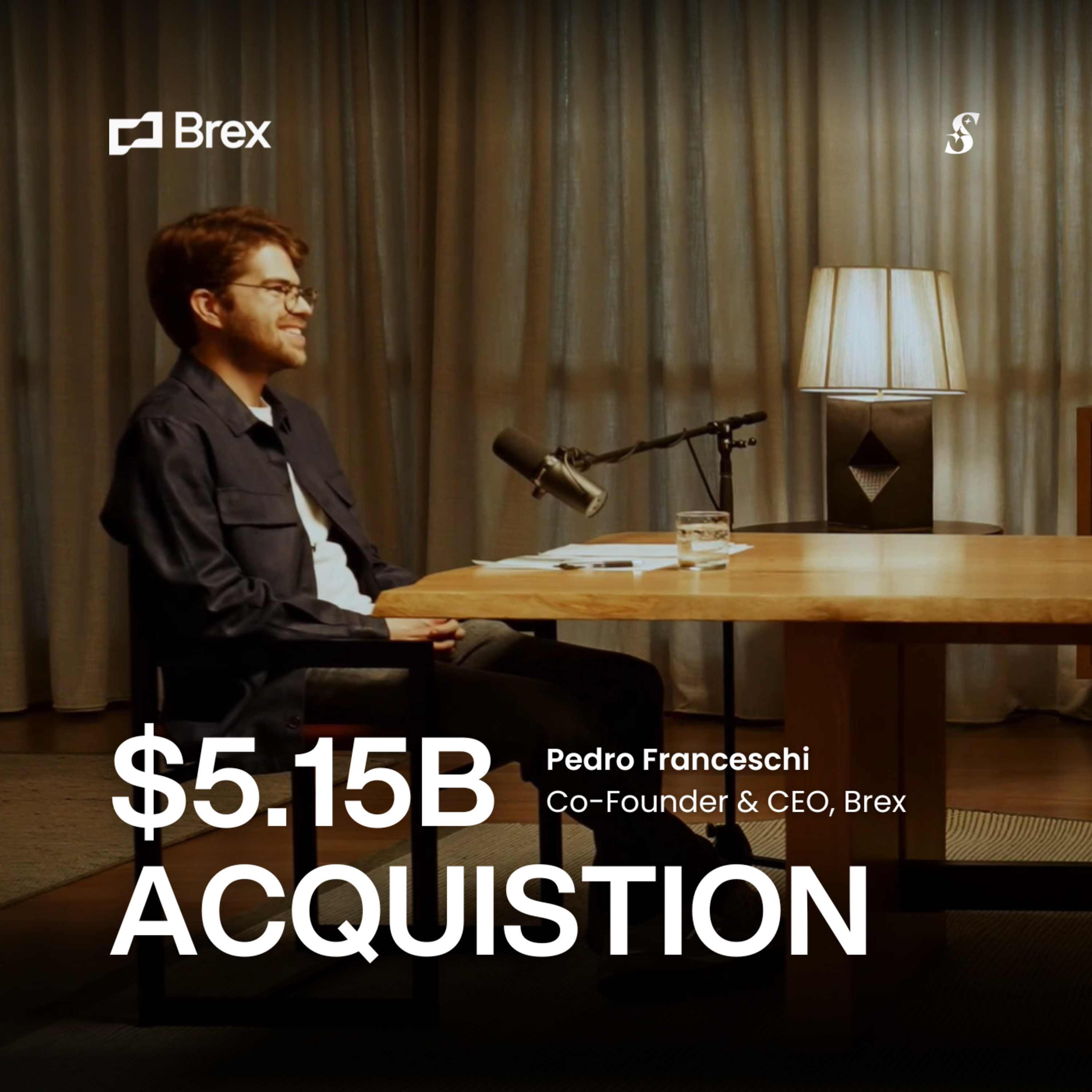
Exclusive: Brex’s $5.15B Capital One Acquisition | CEO Pedro Franceschi
68m 25s
The transcription details the rapid merger between Brex and Capital One, completed in just over 40 days. Capital One, recognized as an early fintech innovator, was drawn to Brex's unique integration of financial services and software, which transforms how companies manage finances. For Brex, the partnership provides immense scale through Capital One's resources, including millions of businesses, large R&D budgets, and distribution channels, accelerating growth and AI development by years. The $5.15 billion valuation aligns with top public fintech multiples, reflecting Brex's strong trajectory and future potential. Importantly, this is not an exit; Brex's founder remains CEO, emphasizing continuity and autonomy to build a leading financial platform. The deal has received positive feedback from customers, who see enhanced legitimacy and innovation speed. Overall, it represents a strategic union to dominate the corporate financial services market.
Before we start, I just want you to assign something really quick. All right. [LAUGHS] Now that you've signed the official document, you are now legally required to share everything about this M&A transaction. It happened incredibly fast. The whole thing from first serious meeting to sign definitive agreements was a little bit over 40 days. Rich started the company 30 years ago with that thesis. Time after time after time, Capital One has been very aggressive in investing technology ahead of a lot of their peers. And you know, only banking, if you look at an massive scale, that doesn't run the mainframe, it's actually on cloud. They've spent a lot of time sort of positioning themselves in that direction. We had always sort of assumed that it would be going public, because that is what a lot of companies do. And I started to go deep into what could this actually look like? It was so unique that it was impossible to unsee it, which is like, look, we can accelerate 5, 7, 10 years of growth. And in three is we sort of jumpstart this entire industry by saying, you know, not only we're going to do this across card banking since managed to build a accounting AI, but at the same time, we're going to do this as a bank at a country level scale. Nothing's happening to startups. We're just doubling down accelerating growth by 50% next year on the team. A lot more dollars going to product development. And we're accelerating our AI roadmap by two to three years compared to what we do as a standalone company. Sponsored by Brex, it doesn't feel like an exit. I think that's a thing that is so different for me. So you're doubling down on war mode? 100% doubling down. We never thought of selling the company. And we did it because we thought it was fundamentally different than any other combination. I'm not gonna lie, the last two and a half years were really hard. This allows me to go back and say, all of this really hard work was worth it. This is the most difficult question I'm going to ask you today. Are you happy? Hey, Joe. Welcome to Sorcery. Thanks for having me. This is very dramatic, but I love the long table. Okay, so before we get in, I just want to, before we start, I just want you to sign something really quick. What is that? Don't worry about it. All right. (laughs) There you go. Okay. It is signed. Now that you've signed the official document, you are now legally required to share everything about this M&A transaction. How did this happen? Oh, God. Okay, so maybe that sort of recap. So it happened very fast. That's the first thing. And then maybe sort of to recap, I think it's good to start on why capital and what they did, then why we did what we did, and then what we think this means for customers in the industry more broadly. So maybe starting with capital one. I mean, they, a lot of folks that understand a lot about financial services have a lot of respect and admiration for them. But the reason is because they're really the first fintech. They sort of invented this idea of fintech. And what they did in the '90s, they realized that, you know, consumer card underwriting was like dramatically inefficient. And when you brought in data and technology into the process, you could dramatically expand the number of customers that served and the customer experience and the amount of credit you have to them. And Rich started the company, you know, 30 years ago with that thesis. And, you know, over time after time after time, capital one has been very aggressive on investing technology ahead of like a lot of their peers. And, you know, see, only bank, if you look at a massive scale that doesn't run a mainframe is actually on cloud. So they've spent a lot of time sort of positioning themselves in that direction. And when they looked into this market, what they realized is that customers' expectations have completely changed. And, you know, in the past, used to have financial services on one side, software companies on the other side. And these two worlds were totally separate. And what we created at Brex is a new category of company where you bring these two worlds into one. And they realized how much this changes the way a company manages their money. Because you can just move so much faster, you can make better decisions. And a company becomes what you spend on. So there's a very important role that a tool like Brex plays into a company. And when they saw that and they realized the technology that we build. And, you know, the fact that we were leaders in the market, we created the market. And especially in segments that are the hardest and most complex like the enterprise. And then they looked into how we build it, which was from the model of the stack up all of our financial infrastructure from scratch. They realized that there was one plus one equals five scenario, right? And then when you combine as if the scale, the balance sheet, the brand distribution of Capital One, there'll be a pretty special combination for them. Then when you look into our side, like really the reason we did it was very similar. Was, you know, at Brex, we always had a very large ambition to build something at, you know, country level and sort of global scale. You know, I moved to the US from Brazil to build something really big. And then once, you know, spending time with Rich and the team, and I realized that the magnitude of what could be built, it was impossible to see it. So, you know, Capital One has millions of businesses today that they serve. They have, you know, a six billion dollar marketing budget, a six billion dollar R&D budget. And those are, you know, 50, 150 times bigger than our today. And that was extremely compelling from just scale what we get to build together. And then I think on our side, you know, I thought a lot about, you know, what does this mean for the company and for me and for the team? And really the clear thing that was, as we spend time together is, I don't think we would ever do this if a company that wasn't found or led as well. Because the reason it was such a good fit with me and with the company and the team was because there was a very sort of clear founder of session and actually, you know, becoming the winners in the space in this industry. And then when you look into sort of the last point, which is customers and all that, I think the really interesting thing is, you know, I spent time over the past, you know, five or six days talking to, you know, a lot of our CFOs, a lot of our customers in the enterprise and, you know, startups and sort of all over the range. And the reaction was sort of overwhelmingly positive. Because, you know, customers are saying, well, you know, before, you know, I was, you know, CEO of Fortune 50 or Fortune 500, a Fortune 100 company, making his decision to bet on a company like Brex. There was like much smaller than Amix or much smaller than JP Morgan. And now, not only, you know, they, you know, are sort of, you know, made into the winners of the space, but now they get to operate if 100 times bigger budget on R&D and build a product much faster. But, you know, second, this bank understands why they are going to be the winners and why I made that decision. So, legitimizes them in many ways. And then I think the third thing is, I'm not going anywhere. So, I'm going to continue being the CEO and founder. And I think to me, something that was very important was actually doing in a way that I continue to have a lot of autonomy to build things in a way I believe. And that was a very important point for me and Rich, as I started to discuss it. Like, how do we continue, you know, the insane momentum that Brex has now and accelerate that versus, you know, bogging, bogging yourselves down with, you know, a lot of integration costs and things that wouldn't necessarily add value for customers. But going back to timeline, I mean, as I said, it happened incredibly fast. So, the whole thing from first sort of serious meeting to sign definitive agreements was a little bit over 40 days. 40 days, which was wild. When did you first meet? Some of our board knew the corporate dev team for a while. And we met, you know, probably right after Thanksgiving. That was the first time we actually started seriously spending time. And they had a strong admiration for the business over the years. And I think we had a lot of mutual respect. But we started, you know, we shared very basic materials. And in momentum, just picked up. We got a term sheet on December 22nd, right before the holidays. So I was in Miami with my wife's family and my in-laws for Christmas. And, you know, suffice to say, I spent a lot of my Christmas negotiating terms and discussing things of lawyers and, you know, bankers and all that. But, you know, we did a board meeting. Folks were excited about where things could land. And then we signed a term sheet, first week of January, January 2nd or 3rd. And then, you know, we had a very sort of fast timeline. I spent nine hours of rich the CEO on, I think, was January 2nd or 3rd. We're supposed to be a lunch. We're supposed to be a one hour lunch. And we ended up having lunch. And then, you know, we continued chatting. Then we had like tea. Then we had dinner. Then we had like maybe, you know, like another water or something. And the conversation just kept going. And I think it really clicked the potential of what we could build together. And then, you know, a lot of diligence, a lot of work from the teams. And I think two things to me that really stood out in the process. One is you got to respect the conviction and the speed in which $150 billion dollar company moves to make a bet of the size in like 30 days. Effectively from maybe three weeks from a term sheet to actual docs, that was really remarkable. And the second thing was just the level of rigor that they went in. Like, they understood everything about the business. Everything about the way we run risk. That we build product, that way we think about go to market, that way we think about our unit economics, that we think about credit, like everything. Like, they went into an insane level of detail. And that was really, really cool to just see the thousands of decisions you make in the course of building a company, at the end of the day, being sort of appreciated by someone that deeply understands the industry and deeply understands many decisions that we made that were misunderstood for honestly, last eight, nine years, like building on financial infrastructure, going up market, you know, having this obsession over building from the bottom of the stack up on everything we've done. So a lot of that was really exciting. And we were super impressed with their team as we spent a lot of time together. Sorcery is brought to you by Brex. The financial stack trusted by more than 30,000 companies, including one in three venture back startups in the US. Nearly 40% of startups fail because they run out of cash. Brex is literally built to help founders avoid that. Unlike traditional banks that let your money sit idle, shipping away out it with fees, Brex is designed to help you spend smarter and move faster. They're all in one solution, combines checking, treasury, and FDIC protection into one powerful account. You can send and receive money globally at lightning speeds, get 20 times the standard FDIC coverage through their partner banks and even high yield from day one. With same day and even same hour liquidity, access your funds anytime. Companies like Scale AI, DoorDash, Service Titan, Hymns, Anthropic, Flexport, Robinhood, and Plaid Trust in Use Brex. Start today at Brex.com/sorcery. That's B-R-E-X.com/sorcery. So this is the largest, one of the largest bank fintech deals of all time in history. A lot of uproar and I guess energy on the internet is all around valuation. I'd love to understand how you got to the $5.15 billion valuation and how valuation for Brex has evolved over time. - So a couple of things. The first one is there was a very good post from Jason from Saster on, you know, Brex valuations and you know, fundraising implications when you raise a really high prices and all that. And I think the thing that most started founders in my opinion, miss when they think about fundraising and private companies is that at the end of the day everything converges to public markets. And the problem is that is a very hard thing to realize when you are kind of where we were in 2021, where you know, the company was growing like hockey stick, every single investor wants to invest. There's a tremendous amount of appetite to just pour in more money in the business. And at the end of the day, you know, sure there are the fundamentals of the business but a lot of like private raising is a supply and demand thing. And if you're the hottest thing in town, your valuation goes really high. And that creates a set of circumstances that locks in the company in a set of expectations and trajectory and growth that if you deviate from that to the smallest degree, that creates, you know, sort of unintended consequences in the near term. And I think what happened at Brexit is, you know, like the company was dramatically smaller in 21 compared to today, right? And which I think sort of signals how much the $12 billion was a stretch back then. So then what we realized at the end of the day in '23 is we said, look, there's a lot of like Zerp era companies that had this unrealistic expectations about where the valuation is. And evaluations dictate a lot of things including employee sentiment, employee morale. And one of the things that I believed in when we did this big reset of Brexit, Brexit 3.0 is we said, look, employees need to fundamentally believe in the value of the equity. And so we did this very painful thing of saying, look, the teams will see reality the best wins. So let's reprise employee equity back to $4 billion. And we did this early 24. It was extremely dilutive. I think it took, it wasn't very popular with our board and investors. But at the end of the day, it was a matter of where is reality if this was a public company today? And it was very hard to price the company exactly given where the company was and the growth rates and all that. But that was a really critical thing to say, look, at the end of the day, employees will have upside and a chance to build wealth from this point onwards. And we spent a lot of time locking that in when we did the whole reset. What was one of the biggest points for me was reset in the valuation. We reset a lot of things about how we operate and how we build the product and how we do go to market and the leadership team. But the valuation was a really critical thing. And then, and then when you fast forward to today, back then, the company was burning $100 million dollars. We was growing the single digit, high single digit percent. And you look at where the company is today. The company is growing 40% to 50%. Borderline casual positive is a very different story. And the last 24 months, I think, were really transformational and just like understanding what are the things that made the business successful and tripling down on them and sort of reestablishing what matters and what doesn't matter. And then when you look into the capital one acquisition and the price that we've got to it, I think the first thing is, at the end of the day, everything converges to public markets. So let's look at who are the benchmarks in public market, FinTech, that exist for us to compare ourselves with. And when you look into the market, the reality is you have the average multiple is a seven times forward gross profit multiple. So when you look into companies like Chine, companies like Navine, that's between five to seven times. And then when you look into the top quartile companies, or the top desial maybe, then you have the companies that I think everybody has a lot of respect and skill and appreciation, companies like Toast, companies like Affirm, companies like Block. And then when you look into, and those trade it, some are between 10 to 12 times gross profit, Affirm trades at 12, Toast trades at close to 11. And then when you look into who is the best public FinTech company in the world, and it's Adyen. And Adyen trades at just below 14 times gross profit. This deal is at 13.4. So when you just compare to where all the multiples exist in the range of outcomes of being a public company, this is the very, very top of the range. And then the thing that made me really happy about it is, look, let's ground ourselves into the range of outcomes that exist for a company like Brex, where this thing could trade in public markets, given the growth rates, given the constraints, given everything, right? And then most importantly, when you add in, what could this thing become inside a platform like Capital One? I think we said first, the price here has enough value for everybody to be really excited about the outcome. But then I think the thing for me is like, I really care about Brex outliving and becoming much bigger than me or anyone that exists in the business today. And we thought a lot about, should we just like, how big can this thing get independently? And when I look into my life, and I'm like, what are the things that I'm the most proud of? One of the things that I'm the most proud is my first company in Brazil grew 10X since we left. And it's, you know, now it's, you know, over $500 million in revenue is like hundreds of millions of maybe the eye year. And that just happened because the business continued going much beyond myself. And when I looked at Brex, I was like, how can we make Brex a platform that I can continue to scale because I love the job and I love like being the weeds, but with a potential that's much bigger than any independent path could potentially get us to. And then you look on this on day one after closing, Brex would be the third largest corporate car in the country, you know, which is really exciting. And with a very clear bath, you know, over the next few years to be in a position to really rival MXJP Morgan. And I think that's a really exciting thing to be a part of and build. And really, to me, the part that folks don't appreciate about it is like, yes, it's a great financial outcome. It's a massive fintech exit, you know, biggest bank acquisition history, all that is true. But at the same time, the degree to which everybody in the company and everybody at Capital One is doubling down on this is very underappreciated. So you look at, you know, the filings together of the acquisition, the public filings from Capital One, you know, there's $950 million of integration costs and retention and all that. And really what that means is they're adding, you know, a lot of water to display that is Brex because the trajectory is that exciting. And when you pay this high of a price, the only way the math work adds up is if you have this very visceral belief that this thing can be much bigger than what it could ever be as a standalone basis. So, you know, this is maybe a long way of saying, we fund the mentally think that Distroge actually puts Brex and the path to being the most important financial platform for companies in the US. And it will be really exciting to build this thing at a dismissive scale. - I don't think I've heard any interview where someone has really broken down an M&A process in detail. So I'd love to hear from you what it was like getting that term sheet, what was on the term sheet and then the filing itself. Also, why you decided on a 50/50 split cash equity. - So the way the way it started was, you know, we, they tend to be very rigorous on understanding the deal model and where the value ultimately lies and how big can this thing get, right? And I think one of the learnings for us was, you know, at the end of the day, if you look at every single large scale player that does like M&A, you say, well, like all banks are doing M&A all the time. But the first thing is not all M&A is created equal, right? So the first thing is if you look into, for example, the top five banks in the US and you see, who does a growth M&A versus distressed asset M&A? There's a massive difference. So for example, you look at, you can say, well, JP Morgan does M&A. But if you look over the past 10 years, you know, 95% of the JP Morgan deals have been distressed assets or like a very high number, right? Like, for example, first republic. First republic wasn't a growth deal. It was like, this is a distressed asset that could be, you know, you could buy it for cheap and integrate it into JP Morgan and make it into a thing. And then when you look into the thing that I think has been really special, all capital one, is the fact that they've done time after time, deals that were very aggressive to growth, right? So the discovered deal, I&G directs, like you have Bernier, there's been a lot of deals that were pretty big for the scale that they were. And then when you look into any other sort of large scale bank, the appetite for where the kinds of M&A that they will go in is just different. So this is maybe the first thing which is understanding why this specific party was very excited about this deal. And I think it has a lot to do with Rich. And the way he sees the world and, you know, being a founder, right? Like having very strong ambitions and very high levels of energy and sort of appetite for investing. But then I think the second thing is understanding what are the ways in which you can make this into a growth platform? So a degree that I think is very hard as an independent company, right? So we spend a lot of time understanding, look, here's the leverage that the business has to grow materially faster. So for example, one, which is just math, right? Is you say, look, you know, companies constrain how much they invest in growth based on unit economics. So, and then one of the conversations we had with Capital One that was really interesting is, we said, well, we run our business on CAC paybacks. We look at LTV, so CACs, but the reality is like, given, you know, not only the cost of capital, but given just historically the way the business performed, we think this is a good enough model for the way we invest in growth in the near term. And they said, well, you know, for us, our cost of capital is so much lower than Brex, that we actually look at NPV. So we discount these cohorts to present value. And we look at whether, you know, what's the LTV to CAC on each cohort? And Capital One spent a lot of time doing this with a very high level rigor in a very large scale. And when you look at these two different ways of running the business, this way that they do warrants a dramatically higher investment on the exact same business, just because the cost of capital is different and the way you constrain and look at the horizons of growth are different, right? So this is just one example of something that we're looking at saying, oh, wow, we can invest, you know, a lot more here, just by changing a little bit the framing of where and how this decision gets made. And then I think maybe the last thing that was really interesting as you end through, you know, the steps and I can give you some more context there, is there was this very strong interest in understanding the way we segmented our customer base. And especially what we did on the startup side. And one of the things that was really interesting to us is we said, well, you know, Capital One has millions of businesses. Like, why would they care about startup customers? And Breast Today serves one in three startups in the US. It's a very strong source of investment and pride and honestly, just like from a strategy perspective, we always believe that startups will always be the bleeding edge. So what we do for those customers eventually will be what we do for the rest of the market. And I think the thing that was the most striking to me is how much they understood the value of that. Because, you know, most big companies would say, well, you know, startup customers like an SMB and Capital One had this foresight that I think was really interesting of saying, this will be the tip of your spear because that's the way you build the product. That's the way you build your brand. That's the way you get the, you know, we went from zero to 300 public companies on Brex and you know, all the major AI labs run on Brex Today. You know, because there's been so much momentum and sort of inertia in the startup side. So that was super interesting to see a big bank operating of a startup mindset and thinking about these different segments in their different ways. And then from a time perspective, I think the thing that was really interesting to me is just how quickly they moved. So, you know, they were really focused on getting it done very fast and, you know, announcing on their earnings, which was January 22nd. And, you know, we just came in, spent two weeks in person with their team. You know, first week was, you know, going in every single area of the business, every function, every department and going super deep. And, and, you know, of course, it's spent a lot of time with Rich understanding how would we operate? What would be the things that would be, you know, priorities on day one? It would be the things that would be priorities later. And one of the things that was really interesting is, you know, when we thought about what are ways in which this can go right and things can go wrong. A very big thing is this idea of how do we make sure that this become an accelerant for the company and accelerant for what we're doing? And, you know, capital on this and crush the butterfly, which is Brex. And one of the things that we spend a lot of time is creating this idea, which is, you know, ultimately, of course, there's going to be some things that we have to integrate, like financial reporting, right? But ultimately, it's more exciting for it to integrate things into Brex than Brex into things. And when you see this mindset of saying, look, yeah, traditional M&A and integrations are done in this very specific way. But we're willing to do something different in service of growth, in service of this being a creative to the trajectory of the company. That was really inspiring. And in something you notice on every conversation, right? We met like, you know, I don't know, 30, 40, 50 people on their side over the course of the month we spent together. And it was remarkable just to see the degree to which that culture permeated all the way down to every level of your organization. Turing is training the next generation of AI with tasks that require real expertise and real world judgment. That's why companies like Nvidia and Thropic, Salesforce, and Gemini partner with Turing. Turing builds realistic reinforcement learning environments and data systems based on real operational traces. The kind of infrastructure frontier labs need to train superintelligence. Visit Turing.com/SOURCRY. What was the diligence process on your side? Did you use your existing team? Who was the team involved in this? So we had very few people. We had probably 15, 20 people in total at the end. But the majority of it was just leadership team. And one of the things that's interesting is, you know, and Capital One had, you know, for your size, they had a sort of a small number of people, more than us, probably like four or five times more than us. But at the same time, what was interesting is, you know, there were a lot of meetings that you went into, into meeting. And, you know, the level of detail that our team could go in still, right, is still remarkable to me. So, you know, I remember, you know, going into meeting and then someone asked me a question about, you know, the way our, our financial infrastructure worked, or our banking core did something. And then James or CTO being like, well, you know, I'm talking about the pro-strategy building and the sort of direction and vision. But then, you know, this is the way we actually do, you know, serialization and the database to make sure money is consistent. And one of the things that we really believe in is, we have this principle that we call operated all levels, which is like leaders need to be exceptional individual contributors in whatever they do, and never lose connection with the craft. And, and going through diligence was super interesting, just to see in every function, right? I mean, like, you know, Garrett or CRO was, was, was amazing as well. Just like, explaining, yeah, this is a strategy. We build our sales org, this is a build our teams. But also, here's what exceptional due execution looks like, right? Here's like the way we actually handle an individual customer relationship and contract and negotiation and pricing. And to a level of detail that was really exciting for me to see. So, so it was very few people going super deep. And, you know, we, we had a, you know, sort of before diligence, it was basically, you know, me and Ben, our president, who runs a company with me, and, you know, and a lot of it, honestly, was just getting, getting all the, all the, the, the people to, you know, of course, understand the importance of, you know, of explaining everything to a great level of detail. But also, at the same time, I would say, the fact that people just really knew the business well. So they could go to a level of detail. They didn't need to involve that many more people. But, you know, very intense, I would say. A lot of people were doing 18-hour days, 20-hour days. So it was definitely, it was definitely very energy consuming. But, you know, we got so great off them. So you were aggressively courted. And sometimes when, someone's, you know, a little bit more on the offense for you, it's hard to see the reality of deals, right? Or the reality of how things are operating. So being aggressively courted by Capital One, how did you and your team then have the discipline to look objectively at that business and see if it was the right partner? - Yeah, so, so first is, you know, we didn't have to do this deal, right? And I think that's the thing that is an important reminder, which is, look, we could have raised more private capital, we could have IPO of the company. And, and, and, and, and looking at the set of options that existed, we still decided to pursue this. So, so, and in second is, the company was never for sale, right? So they approached us and said, we want to take a look right now, because we're really excited about what you're doing on, on, on the sort of broad U.S. economy, on the sort of, the way you're scaling outside of tech, the way you're going to have to do enterprise. So, so I would say it was, it was, it was one, not, not, not the only path. And second, it was something that, because it wasn't the only path, the alternatives are very credible. It's not doing the deal. And that puts you in a position to approach it, much more rationally and objectively, where we said, look, at the end of the day, you know, when we look into who are the range of partners that we would do this with, capital one has always been, you know, a bank we admire tremendously, largely because they invented Vintac, and because of Rich and being founder led. And then, and then I would say the second thing is, we never thought of selling the company. And this may sound weird, given we did it. But, but at the end of the day, you know, we always saw Brexit as an independent company. And, and I would say the reason is because, when you talk to anyone in the company today, there is a very high degree of obsession about winning and becoming really big, and just like achieving really large scale. And that has always been like the North, like the, for us, it was always about like, how do we maximize the potential of this product and this idea and this way of running your finances as a company? And, and, and it's almost like, if you subordinate everything else to your mission, what does that mean about the way you actually choose the right outcome for the company, right? And, and, and we had always sort of assumed that it would be going public, because that is what a lot of companies do. But, when we started to go deep and when I spent time with Rich and I started to go deep into, what could this actually look like? We can invest at a level of R&D, especially on AI, that would take us a long time to get to from a standalone basis. And in three is we sort of jumpstart this entire industry by saying, you know, not only we're gonna do this, you know, across card banking, since we managed to build a accounting AI, but at the same time we're gonna do this as a bank, at a country level scale, and globally on the enterprise side, when we think about everything we do, you know, with companies that operate across multiple countries. And, and that was really, that was really compelling. And, and then maybe the last thing, which is, you know, particularly interesting is, like, I wasn't interested in leaving or stopping to work at Brex. So, to me, it was really important that like, this wasn't, and I always thought of like, an acquisition as a good buy. You're saying, oh, the company's going and I'm staying. And, and the thing is that never felt that way, because it was actually about the mission. It was about like, how do we accelerate and fuel this belief that if we subordinate everything to maximizing the scale of what this company can be, we should subordinate that decision as well. And, and the more we thought about it, and the more we went deep and the more we thought about, okay, what are all the things that this thing can become with a partner like Capital One, remaining independent with me as a founder and CEO, with all the things that I think we got to from a structure standpoint, that was pretty special. So, it doesn't feel like an exit. - So you're doubling down on war mode. - 100%, 100% doubling now. - I think it's so funny because there is clearly a very severe competition between Brex and Ram. And, I have to admit, it's entirely entertaining on X and it might only exist on X, by the way. I don't know if anybody else knows about this, but it seems to take the tech world by storm. So, how is that going to play into this next chapter and this new story for Brex? - Yeah, so first, we have a huge respect for them. They've been an incredible company. And the thing that is remarkable is, you know, yes, both of us are the new players. And Brex and Ram combined probably have 3% of the U.S. markets. So, at the end of the day, you know, we don't spend a lot of time thinking about them. They probably don't spend a lot of time thinking about us because that is not who we're really competing with. If you go into the deals and you go on the streets of the sales scenes and you see who we're seeing, it's not Ram, it's not Brex, it's MX, it's JP Morgan. It's like big national banks, it's Wells Fargo, it's cities, Bank of America, those are the players that are actually out there. And I would say look, I think the way we think about it is, you know, just because of the scale of this thing, Brex will be the third largest corporate card in the country after closing. So, really the question is like, how do we put this on a trajectory to be, you know, more meaningful for customers than MX and JP Morgan, right? And that's really who we're ultimately competing with now. So, for us, it's, you know, sort of graduating a little bit, you know, how we think of the competitive set and the set of outcomes that we can build. Because also the set of tools available for us to go build are different, right? From having, you know, a $6 billion marketing budget, a $6 billion R&D budget, just a very different level of scale, brand, presence across a variety of products, not just card. And, you know, we think there's gonna be space for many winners. But, you know, for us, this was a way of just, like, jump starting the competition for the next five, seven years and still be really, really proud of what we build that, you know, and Brex being the biggest platform in the country. - On the day of this announcement, there was an onslaught of activity on X. And it was a lot of ramp supporters or investors, that sort of thing, that were calling a victory lap. And then we're also kind of saying a lot of deceasedful things. I've never seen anything like that before. What was that like for you as a CEO who had just made the biggest Fintech bank acquisition of all time and seeing lots of passive-aggressive note? - Yeah, I think, I think at the end of the day, it was a little bit the way we started this conversation, which is you have to remember that everything converges to public markets eventually. And, you know, like, you know, the numbers are private, but, you know, Silicon Valley is a small world. People understand where, where relative value is and where people trade. And, you know, we've seen that movie before. So, I think for us so much at the past two and a half, three years was about tuning out of everyone and everything that we hear about, you know, Twitter and, you know, and like, and people talking about things and, you know, what about Brexit? Brexit status, Brexit life. And just saying every ounce of energy we spent on that versus actually fixing the company, improving the quality of the product, improving the way we could go to market, increasing the rigour and hiring, making the culture stronger. This bucket was so much more meaningful than, by a factor of like 10,000, right? Versus like paying attention to like, you know, where were the vibes on X, right? And I think to me this was similar, which was like, you know, it was actually really exciting to see that because, you know, of course, you know, a lot of the reactions were, you know, I think, I think, probably not the most constructive. And then our team seeing people's reactions to those reactions was like, oh my God, we actually built something tremendous, right? It's a degree that, you know, I think if it wasn't that polarizing, you know, maybe the team would have less validation from the outside. So in some ways, it was very validating because people were like, this is a big fucking yield, like $5 billion of liquidity. In 100% of the stock, right, was really compelling because the other thing that people forget, even though it's relatively obvious is, you know, when someone front raises the private company, you're selling one 2% of the company, right? When you're selling, when you're doing a transaction like this one, you're selling 100% of the company. So there's a very big difference between putting in 100 million, you know, at a very high price and being, you know, $5.15 billion of like cash and liquid stock into an actual asset that grows and compounds. But, you know, like, I think there's gonna be many winners and, you know, what have you to respect for them? But, you know, I would say, I would say, you know, over the phone is of time, we're gonna see how these things play out. But, you know, I think we get to build if, you know, a much, much bigger war chest and pockets now, which would be really fun. - Very fun. It's gonna be a lot of fun. To be direct is possible with this next question, are you ready? - Go for it. - Well, there were clear marketing attacks against Brex in this acquisition, whether it was email marketing or online of what do you do if your service provider, if your corporate card, if your finance stack, if it gets acquired. And so what does this actually mean for your customers? What does this mean for startups? - So here's the thing, Brex is only gonna get better for two reasons, because I remain the founder and CEO and I will continue running the company for as many years as I can inside Capital One. And the second thing is, we now get to invest so much more aggressively than we ever did in AI, in accelerating the roadmap across so many fronts that we weren't able to invest in the standalone company because we had to make resource and decisions. And then the third thing is, when you go especially after customers that are outside of the tech bubble, like a traditional mainstream business in the US economy, they know what Capital One is. There's like a trust associated with that. And when you go after the enterprise, they say, well, I can make a bet on a random private company or I can make a bet on a 150 billion dollar public company that I can go in and understand their business and their financials and what they're about. And that is very compelling on the enterprise. And we've seen already in five days, very different tone from prospects on the enterprise on like Fortune 100, Fortune 50 companies that wouldn't take us as seriously as they did after this. That was really compelling. And I would say the last thing is, for startup customers is, you know, next year for example, we're increasing our startup team by 50%. Sorry, this year. And you don't do these moves, you don't invest much more aggressively in R&D. If you don't fundamentally believe that startups really matter. And it is where we started the company. It is our ethos, it is our DNA. And for us, it's always been about like, setting the stage for what happens in the rest of the market. Everything we build started with startups because they, you know, if you just look at every single technology, adoption starts in early adopters and innovators, and then they grow into early majority then late majority, right? And we're now, you know, at this moment where, you know, I think Brex is going into early majority, finally. But at the same time, you know, the innovation and all the things we're building, they follow the exact same cycle, right? So when we think, for example, the agents are building now on AI, and we see the reaction of like a customer when they see something that took like hundreds of hours being done in like 10 seconds. Again, the starts on companies that are more tech forward, typically smaller startups, and then eventually permeates into the entire range of customers all the way into, you know, a fortune of 50. So that is the DNA of how we build product. And changing that is the same as changing the ethos of who the people at Brex are. So literally nothing happens to startups. Nothing happens to startups. Well, actually, more investment, more aggressively, 50% grow from the team, a lot more, more sort of marketing growth dollars. But the biggest thing is the product investments in AI are accelerating at a clip that we think would take as probably two to three years, and it's going to happen now. So that'll be really exciting. OK, just say that one more time in the camera, please. OK, nothing's happening to startups. We're just doubling down, accelerating growth by 50% next year on the team. And we're accelerating our AI roadmap by two to three years compared to what we would do as a standalone company. Sponsored by Brex. Some of you may not have heard this yet, but our sponsor public just launched something called Generated Assets. And it brings AI into investing in a way I've honestly never seen before. Here's how it works. You type in an idea like AI-powered supply chain companies with positive free cash flow or defense tech companies growing revenue over 25% year over year. Publix AI then dispatches a swarm of agents that scan every single US stock, evaluates them, and instantly builds a custom index around your thesis. What really stands out is how clearly it explains why each stock is included. And before you invest, you can even back test your idea against the S&P 500. So you're making decisions with real context, not just guessing. And beyond generated assets, public lets you invest in stocks, bonds, options, crypto, all in one place. They'll even give you an uncapped 1% match when you transfer your investments over from another platform. If you want to build a portfolio that actually reflects your thesis, visit public.com/sourcery, paid for by public investing, full disclosures in the description. Since startups are just going to be thriving and accelerating, what else is going to happen? So I want to go a little bit deeper into AI. Because Brexit has been on a tear with AI. You had released six agents. And you had a really big fall release. So for people who don't know, can you lay out how Brexit's taking on AI? Yeah. So phase one of Brexit was building where financial services like card, bank accounts, et cetera. Phase two was saying, let's go and build software that makes those financial services much smarter and more automated, right? So we're good expense management, we build accounts payable, good accounting with a lot of these automation and sort of software to help customers manage what's happening in their card and bank accounts. And then really the phase three of Brexit is when you think about the labor, right? When you think about the actual work, the finance seems are doing on top of Brexit. And the way we characterize this last phase is what we call the inversion of control. You know, before you were doing the work as a human and sort of recording it on Brexit and sort of entering the data on Brexit and Brexit was a system of record. And really what we see in this phase three is actually the opposite. As Brexit is doing the majority of the work and then you are managing by exception. And what we fundamentally see happening is every single area of a financing will have a very high degree of automation done by agents. And then the question becomes who's gonna do that, right? Because you have effectively three possibilities. You have existing incumbents in the finance space like the ERP companies. For example, I don't think they're gonna go through that. Then you have like new startups sort of folks out of YC that could be building something new in the space. And that is a possibility. But at the end of the day, we think there's a very unique property in building the money movement, software and the automation in one company. So you think there's a structural advantage of doing these things together, especially when you think about doing it at a global scale and doing it at a very large scale. And then I would say when you sort of zoom out and you look into the third possibility, it's companies like Brexit that touch like every single expense in a company, every single dollar of money that goes out of a company passes through us in some way. And really the interesting thing is like, for example, one of the things that we build is how does audit agents. And really what it does is it goes through every single expense in the company against your expense policy and what we call like an audit policy and annotates violations. And it does it in a way that is much more complex than saying, well, is there a memo here or is there a receipt here? What it does is interpreting an understanding context that is much broader than one transaction. So it says, well, this person on the sales team is traveling for a customer trip and they're going on this dinner with X number of people. Is this expense appropriate or not? And think about the number of variables that you have to compute to determine that, right? It's like, okay, who is this client? Who is the sales rep? Which level are they hitting quota or not? Are they with their teams or not? Because that changes how much dollars you're paying per person on that meal. What is the relevance of that customer? And when you start to add in all that context into the Brexit platform, you start to get to a really powerful place, which is Brexit starts to have much more agency over the entire arc of a financial decision, right? Because back in the day, Brexit should be just the moment you go spend and swipe the card is where Brexit was involved. And now we know so much more about so much more data that exists about an employee, a transaction, an expense. And the benefit of that is you can fundamentally change the way a company makes decisions in a very material way. Because the thing about finance teams is they're responsible for 100% of the spend in the company, right? If you're overspend, you go fire your CFO. But then at the same time, they only make 5% of the decisions. So the question becomes 95% of the decisions are made all over the company. It's people just going on trips, signing contracts, paying for vendors, going to marketing events and hosting customers and all that. So then the question becomes, how do you bring in effectively a mini-CFO and the decision making that a great finance person would have, and that level of judgment and agency into every financial decision? And that is the opportunity we've got. And you see this happening in every facet of finance, right? You see this happening on, of course, all the expense management side. You also see the happening on procurement. You see the happening on accounting. You see the happening on travel, right? So really the strategy for us is, what happens when you change Brex into agentic mode and every surface of the product starts to be in Asians and starts to collaborate in ways to get more complex tasks done across entire surface of Brex. And we're now at a phase that, we launched this big fall release three or four months ago. And I'll set a point that I was talking to CFO a very big AI lab that is becoming a Brex customer now. And this person was telling me that the thing that we build, the degree of automation and the quality of the automation is not only light years away of competitors, but also to a point that they can actually now start to change the way they allocate head down internally because it's better than what a human was doing. And I think once you cross that threshold of saying, the quality is higher enough that you're displacing labor in a company, that is the bar for us and that is what we're trying to do. And not just for a SMB customer like some of our competitors do, but for a very large, very complex enterprise use case. And we think there's gonna accelerate tremendously of AI. So we think it's a generation opportunity, very critical to being the position that we're in, with a level of scale, having access to the entire financial infrastructure to actually control the money movement and change where money is going. And doing this not just for a startup and a small customer, but making sure that that same solution works for a very large enterprise customer. Because that's the only way of actually displacing labor and automating it to a point that you say, you actually don't need to hire that person in the first place. And that's actually how the entire strategy of Brexfitz together because we say, look, yes, we're serving the enterprise customers. You understand where ultimately your company will become and get to. But when you start from where you are today, you can point to and say, I can run a business a size of DoorDash or Coinbase or Palantir or Zoom or ARM or Anthropic or Intel because these companies run on Brex. And when you start the right way and we graduate into all the levels of automation you need, we can get to this vision that we have, which is like, how do you make a financing of one person? And we think that's a really compelling thing for the future of business. - It's getting fire today. - Exactly. (laughs) You have a stake? - I think we have one coming. - Great. - Do you know that Fogo De Chau means fire of the ground? - 100%, I'm Brazilian. - I know, I'm just checking your Brazilian Portuguese. - Exactly, (laughs) - Exactly, that's how they do stakes there in the south of Brazil at least. - In the south of Brazil, in the ground. - Yeah, they put like these, they do these like, based these fire pits and then you just put the stake on the ground and you rotate it and it cooks beautifully. - Well, we have a surprise for you. We made a pit outside. - Love it. - And we have stakes. - We have stakes. - Great. - Cooking in the pit. (laughs) - I'll help, I'll eat so. - Okay. - So one of my favorite questions in every single interview is my Brex question. Did you believe that? So I always frame this because Brex is all about performance, spending is part of moving faster, the intelligent as fuck, I'm sorry, intelligent, agentic finance platform. So, core component that I believe with performance is all about who you surround yourself with or who you admire, who you look up to. So who is that for you? Is there anybody, especially as you go through a huge life milestone like this? - Yeah, I would say, I think there's sort of two buckets, right? There's the, you know, the sort of aspirational folks that, you know, the more you learn about the way they see the world, the more you can build a little bit of a mental model of who they are. I think for me, the people that I think are, are pretty tremendous at this. Steve Jobs for me is a very clear one of transcending, you know, where technology ends and where art, human connection starts. I think that's a very special combo. I would say the second one is, I'm a big fan of Charlie Munger. I think he has this very visceral way of understanding and sort of exploiting reality. And it was very useful. A lot of the mental models that he has that were the past such and a half years of Brex. And, you know, I think there's a lot of companies that I admire. I mean, I think, you know, Brian from Airbnb is fantastic. Tony from DoorDash, I learned a lot from a lot of these folks. But, you know, when I think it's sort of, who are the people that actually is kind of a lot of time with day-to-day, they were incredibly inspiring. I would say Victor Ozarti, who was a benchmark and now is running and crushing his own fund. He's been in my board since day one. He was one of our first early investors. He's Brazilian, lives here in Silicon Valley and he's phenomenal and incredibly helpful thinking through every single outcome, every single situation, new matter, greenoaks, fantastic. Sarab from DST, also fantastic. You know, both incredible at articulating. You know, where the company is, where the world is, where we want to go. And, you know, Mickey from Rivet, of course, has been, you know, on our board since day one, also tremendous. So, I would say I think there's a sort of a range of folks that have just seen the movie a lot and can help you understand with clarity where you're going. And I think the, you know, for example, there's a lot of folks that you spend time, especially folks that maybe a little bit ahead of you in your journey that are incredibly inspiring. So, you know, Neil invited me to be on the board of Groupang in Korea, which is, you know, basically the Amazon of South Korea. And bomb, the founder is insanely smart. One of the best operators I've ever met. And when you spend time with someone like that, you realize what does it mean to be an excellent operator? Because, you know, one thing you sort of hear about and read about it. And the other thing is you see it in front of you, right? And some things you have to feel it to understand what they mean. And spending time with bomb and the Groupang team was a very similar experience for me of just understanding what true greatness looks like. - Hey, Drew, you're 29. You just had a $5 billion exit. What are you most looking forward to in the next five years? - I think to me, it's just, I think to me, I would say three things. Number one is getting Brexit to be, honestly, just the biggest plot for me can ever be. And sort of living up to the full potential of this idea, which, you know, we created this category nine years ago. And I think we're just barely scratching the surface with, you know, maybe one and a half percent of the US market. So that's number one. Number two is, I got married, you know, last year, you know, excited about starting a family, you know, which is, you know, coming over the next few years for sure. That's a big goal. And number three is, is, you know, I would say really think about, you know, beyond where Brexit's today, what can we actually do inside someone like Capital One? Because I think it's very unique to have this level of access and resources and honestly, just trust from such a massive institution. And I'm really excited to learn a lot there. You know, I'm spending a lot of time with Rich and the team. And, you know, every, every minute I can get with them, I just learn more. And, you know, I think it's a pretty fascinating experience to be inside a Fortune 50 company, you know, six largest bank in the US and learn as much as you can and use that to compound, compound Brexit. And, you know, build more things together. So I think it'll be really exciting. - Is it true that Rich Fairbank is a fair, rich banker? - That is technically true, I think. So yeah. - Glad we cleared the record on that. Okay, so as we wrap up, I have a couple of quick questions from X. Founders ship faster on deal. Set up payroll for any country in minutes, hire anyone anywhere, get visas handled fast and get back to building. Visit D-E-E-L dot com slash sorcery. That's D-E-E-L dot com slash S-O-U-R-C-E-R-Y. - Go for it. - These questions are from Nicole Wishoff. She asks, how long were you building relationship with Cap1? - We folks in our board, some of their board knew them for probably two or three years directly. I would say indirectly, I would say there was mutual appreciation and sort of respect for probably four or five years and for sure, when we understood how we both built things from the bottom of this stack up, there was a huge bonding thing for all of us because it's very different in any other fintech company in the world and they've done it a lot. But after spending a lot of time with them, probably last a couple of months, I would say. - Another question from Nicole Wishoff. What are the trade-offs of M&A now versus IPO later? - God, hot question. I think the biggest trade-off is to understand things over the fullness of time and not as a point in time. So a lot of folks say, well, let's IPO, right? But the reality is like, public markets require a story that continues to compound over a very long arc. And you know, our business is compounding at 40%, 50%. So on one hand, that's a really exciting thing. On the other hand is, I think the way to think of public markets is there is volatility. Like that is just beta. It's just the market's moving. And there's things that affect the perception of your business and where you trade that are completely outside of your control. So I think for us, it was a question of like, one, first it was an incredible outcome. So it was hard to compare it to an IPO in many ways. And the second one was when it looked into an IPO, how do you factor in the cost of beta, the cost of just volatility in the stock and the market that is independent from your execution, right? And what does that do to your team? And you know, we had a lot of friends that, you know, they did incredible IPOs over the past few years, but you know, the stock trading is 70% down. And I think that is psychologically very different and very hard for the team. So that's how we thought about it. And ultimately, you know, we didn't have to make the decision because it was such a good outcome, but that's how we probably think about it. - This is a good follow up question to that. This is from Trace Cohen. He wants to know how did you do the recap and RSUs to $4 billion years ago? And how did that really help all employees? - Yeah, so before we were issuing RSUs to $12 billion in 2021. And then in 2023, we actually said, let's reprise the equity of four. And we did something that's pretty unusual. We switched from RSUs into options. And the strike price was low on those options. So that was beneficial for employees because, you know, not only did they could exercise it, but it was something that actually made it worth re-striking a lot of RSUs into options as part of that. And I would say the big thing for us was, again, how do we create the conditions where folks believe in the value of the equity and can have upside from here? And I think a lot of the times CEOs and founders forget that the price of your equity means a lot. There's a lot of psychology. There's a lot of expectations. There's a lot of things that come with it. And we wanted to set it at a price that we felt comfortable there would be upside from it, which, you know, of course, nothing serialized. But I would say it was a hard thing to get, you know, everybody comfortable because it was very dilutive. But ultimately, the right thing, because God, all of our teams to be excited about staying and come out even better. - This question is from Stuart Blitz. Did anyone say what's in your wallet during negotiation? - 100%. A very funny story is we, when we're doing, going through diligence very early, I went online and signed up for a capital on card. And then I got a spark card. And I had all my notes of like everything that I would do differently in the flow and all my feedback and all that. And of course, they had it on ours. But it was funny. There was like one of their, I think their board decks has like a photo of me of a capital on card holding it and being like, you know, I signed up here's the card. And, you know, there's a funny thing on sort of reverse due diligence. But I absolutely, you know, I have brex. I use brex for everything today. But I'll use soon brex and capital on for my personal stuff. - Love that. This one's from Alex Cohen. Did you have any other offers? - No, company wasn't for sale. I mean, we're just, it was, it was, it was very unique. You know, being a founder of that company and giving us a latitude and autonomy to continue to execute the trajectory that we're in. It's pretty unique and not how most eminent happens. So, I would say it was, it was a, we never thought of selling the company and we did it because we thought it was fundamentally different than any other combination. And also fundamentally different from me and independent from a scale perspective. So, that was pretty exciting. - Close out. This question is from NICorp. Are you happy? - Very happy. Very happy. Look, I think, I think, at the end of the day, like I'm not gonna lie, the last two and a half years were really hard. There was a lot of uncertainty, really high attrition. Like, we excited and growth is really hard. Most companies can't do it. It's just really hard to reignite the thing that made you great because you're much bigger, you're as much more scale, there's car tissue everywhere. So, it took a lot from me and the team on a very personal level. Like a lot of stress and anxiety and keeping my mental health, the team's mental health in a good place took a lot. So, I think the outcome is of course really exciting for everyone and we're really excited to build this part of Capital One. But I think to me, the most exciting thing is, this allows me to go back and say, all of this really fucking hard work was worth it. And there's a thing which is saying, well, the numbers are better, the metrics are better and the customers are happier. And PS is high and the retention is high. All these things, of course they matter, right? But there's a very big difference between that and saying, here's a crystallized outcome, which is the biggest deal of the size that ever happened in history and the scale of a bank and a Fintech company. And by the way, here's what we're gonna go build down with this new thing. And that was really gratifying to be able to say, all this energy, all this intensity was worth it. And I think it just proves that doing hard things is, there's a lot of meaning behind it. And I think the outcome could have been different. But at the end of the day, it's like 50% of the battle is in your own head. It's just that you keep going, you keep compounding. And I just had a fundamental belief that Brex could be a lot better than when it was two and a half years ago. And when you look back and you say, gosh, we're a very different company versus two and a half years ago, that isn't quite of the rewarding. - And you're not even 30. - 29, so. - Exactly, that's great. Any last thoughts, anything you wanna say to the world? - The world's very complicated. And people try to fit things into mental models that previously exist. Because that gives you a sense of predictability over how things will unfold. And the more time I spend with Rich, the Capital One team and our team at Brex, the more I see that the mental model of an exit is wrong for this deal. So time will prove the things that we're building and the scale that this thing's gonna get to in the quality of the product, the amount of R&D investment we're gonna be doing and go to market of course. But the mental model of an exit is wrong. The right mental model is like, this is a growth, this is a growth deal and this is a growth like to some degree combination. This feels much more like a merger than an acquisition. Even though the skills are very different. So, you know, world watchouts, we're coming and we're just getting started. - Remind me again, how much is that marketing budget? - $6 billion. - Perfect, amazing. Thank you so much Pedro. This was so much fun and congratulations. - Thanks for having me, I appreciate it. - Hey, it's Molly. If you enjoy our interviews, check out our newsletter sorcery.bc where we deliver a once a week top deals and tech headlines email and also go deeper on our podcast interviews. Subscribe to sorcery today. And don't forget to subscribe to the podcast on YouTube, Spotify, Apple or wherever you listen. Link in description to sign up.
Podcast Summary
Key Points:
Capital One acquired Brex in a rapid 40-day process, driven by shared vision and strategic fit.
The deal accelerates Brex's growth, AI roadmap, and product development by years, leveraging Capital One's scale, balance sheet, and distribution.
Brex's valuation of $5.15 billion reflects a premium multiple, grounded in public market benchmarks and future potential within Capital One's platform.
The acquisition is framed as a partnership, not an exit, with Brex's founder remaining as CEO to drive innovation and autonomy.
The transaction validates Brex's model of integrating financial services and software, enhancing credibility for enterprise customers.
Summary:
The transcription details the rapid merger between Brex and Capital One, completed in just over 40 days. Capital One, recognized as an early fintech innovator, was drawn to Brex's unique integration of financial services and software, which transforms how companies manage finances. For Brex, the partnership provides immense scale through Capital One's resources, including millions of businesses, large R&D budgets, and distribution channels, accelerating growth and AI development by years.
15 billion valuation aligns with top public fintech multiples, reflecting Brex's strong trajectory and future potential. Importantly, this is not an exit; Brex's founder remains CEO, emphasizing continuity and autonomy to build a leading financial platform. The deal has received positive feedback from customers, who see enhanced legitimacy and innovation speed.
Overall, it represents a strategic union to dominate the corporate financial services market.
FAQs
The entire process from the first serious meeting to signing definitive agreements took just over 40 days, which was remarkably fast.
Capital One saw Brex as a leader that combined financial services and software into a new category, enabling companies to manage money more efficiently. They believed merging their scale, balance sheet, and distribution with Brex's technology created a powerful synergy.
Brex will accelerate its growth, with plans to increase the team by 50% next year and speed up its AI roadmap by 2-3 years. The founder remains CEO, maintaining autonomy to build the company's vision within Capital One's platform.
The valuation is based on a 13.4x forward gross profit multiple, aligning with top public fintech companies like Adyen. It reflects Brex's strong growth and the potential to scale significantly within Capital One.
Brex reset its employee equity valuation to $4 billion in early 2024 to align with market reality and ensure employees had meaningful upside, despite it being a dilutive and challenging decision.
Customers benefit from Brex gaining access to Capital One's vast resources, including a much larger R&D budget, which will accelerate product development and innovation while validating their choice of Brex as a strategic partner.
Chat with AI
Loading...
Pro features
Go deeper with this episode
Unlock creator-grade tools that turn any transcript into show notes and subtitle files.
 PodcastTranscript AI