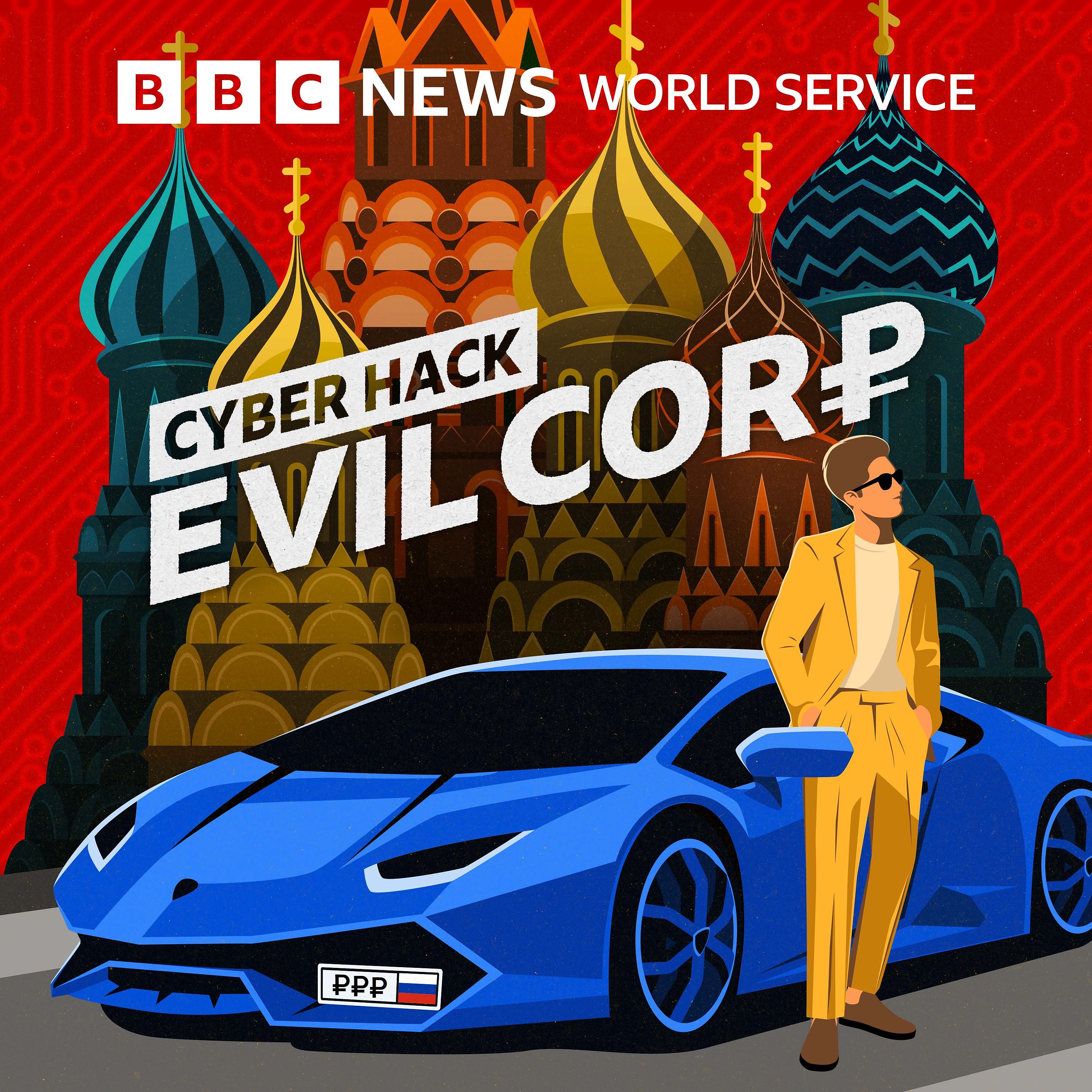
Maxine Yakovets johtaa Evil Corps -nimistä kyberrikollisverkostoa, joka varasti satoja miljoonia dollareita ja toimi Moskovassa suojattuna. Hänen 600 000 dollarin häänsä, joissa esiintyi kalliita autoja ja julkkiksia, paljastivat varastettua vaurautta. FBI tarjoaa 5 miljoonaa dollaria hänen pidättämisestään, ja hänen isänsä, veljensä ja muut sukulaiset on myös asetettu syytteeseen. Kyberrikokset alkoivat Zeus-haittaohjelmalla, joka tyhjensi pienten yritysten tilejä, kuten Leibor's Luggage -liikkeen, joka menetti 12 000 dollaria. Kyberturvallisuusasiantuntija Lawrence Baldwin seurasi rikollisten viestejä ja yritti varoittaa uhreja, mutta viranomaiset eivät pystyneet puuttumaan, koska tapaukset olivat liian pieniä. Tämä mahdollisti rikollisverkoston kasvun, ja Yakovets elää yhä suojattuna, vaikka häntä etsitään kansainvälisesti. BBC:n toimittajat Joe Tidy ja Sarah Rainsford tutkivat Evil Corpsin toimintaa ja paljastavat, miten kyberrikollisuus ja valtion suoja kietoutuvat yhteen nyky-Venäjällä.
Pipsyä on suurin katsotaan, että jokin on suurin. Saleististi grillasivat ja niirhän sillä kävi, että saleististi onnistui. Välkeen sijalli. Episodes on jo tästä jatkoa. Mutta jos jatkoin katsotaan, että jatkoin on jo tästä seuraavaa. Täällä on jo tästä jatkoa. Täällä on jatkoa, jota on jatkoa. Tämä oli jatkoa katsotaan, että jatkoa katsotaan katsotaan, että jatkoa katsotaan 20-jatkoa. Tämä on jatkoa, että jatkoa on jatkoa katsotaan, että jatkoa katsotaan. This was Moscow's underground street racing scene以前, - a wild mix of people buzzing around in beat-up, - but beloved ladders and other souped up old cars. - By day they blended in. By night, they'd gather in secret locations, - tear down hundreds of meters of tarmac, - before melting back into the city before sunrise. But they're emerged another - more brazen kind of streetracer in Moscow. The kind that doesn't wait until night. Once who's speed through the city, under the sun, - right under the nose of the police. Their Moscow's super rich, and they know no one will stop them. Not because they're fast, but because some say they're protected. One of them was thin with quiffed blond hair. Maxine Yakovlietse. But Maxine wasn't riding ladders. His ride of choice was a Lamborghini - wrapped in day-glow yellow and grey camouflage. Racing through Moscow, not for the thrills, - but a show who owed the road, like nothing could touch him. Maxine wasn't afraid of being seen. In fact, he was easy to find. He and his crew regularly posted on social media. Videos of them racing through Moscow in an array of flashy cars, - posing with stacks of cash, - even playing with a pet lion cub. In 2017, Maxine had just turned 30, - and he was about to get married again. But this wasn't some quiet second chance. It was held at an exclusive golf course, North of Moscow. I walked it myself some years later with the manager, - who told me the price of renting the course for a day - was a call quarter of a million dollars. For this wedding, there was no expense spared. Staff directed VIP guests to walk over the perfectly manicured turf - to a giant pavilion decked out like an imperial palace. Its white facade was brilliant against a dark green forest backdrop. They climbed a wide set of steps to a veranda overlooking the course. Servers in black ties circulated under chandeliers. Inside, a spectacular ballroom. Matching purely bouquets, the size of trees. But that was only half of the story. After dinner, the lights dropped. Dancers emerged, lasers flared, and Russian pop icons took to the stage. This shrine to tradition, transforming into a modern dazzling dance floor. We called the wedding planner to find out more about this extravagant affair. They didn't want to talk. We tracked down others who worked at the wedding. We were told they'd signed NDAs, non-disclosure agreements. They couldn't talk either. But the wedding planner left dozens of images online. And if you flick through them, straight away you can spot. there's something off. Look closely. There's the bride in her white strapless gown, looking thoughtfully into the sunlit distance. Here's one in black and white, classy. She seated at a vanity table, the long train of her dress billowing behind her. Now she's gazing up at her groom on the darkened dance floor. Curiously, Maxine Space is harder to make out. A dramatic drone shot films directly above them, shows the couple walking hand in hand through tall trees. A wide shot catches the groom in the distance, as the lens focuses on the father of the bride. One from the side has Maxine's face in shadow, as he and the bride sink a knife into a cake, that's as tall as they are. Why so shy, Maxine? Perhaps there's a hint in the vanity license plates on his neon Lamborghini. War. That's Russian for thief. A joke, perhaps, or a blatant admission. Maxine Yakovets of Moscow, Russia, has been indicted in Pittsburgh, Pennsylvania, for his alleged role as the leader of a cyber criminal gang. So perhaps that outlandish wedding is more than a celebration of love. Maybe it's a brazen display of stolen wealth. Maxine Yakovets is a true 21st century criminal, who with the stroke of a key in the click of a mouse committed cyber crimes across the globe. He's earned his place on the FBI's list of the world's most wanted cyber criminals. So that might explain his newfound bashfulness. We're pleased to announce a reward of up to $5 million for information, leading to the arrest and/or conviction of Russian cyber criminal, Maxine Yakovets. That's the kind of money they put up for war criminals and terrorists, even some of North Korea's hackers. And if you've listened to the Lazarus heist, you know what they're capable of. Yakovets and the members of his criminal network devised and implemented the kinds of criminal schemes so audacious and sophisticated that they would be difficult to imagine if they were not real. For years now, Maxine Yakovets has evaded arrest, but he isn't just hard to catch. He's not meant to be caught. He's said to be living under the kind of protection that most criminals can only dream of. Protection, some say, that comes with strings attached. Though others tell a different story. Are looking for Maxine Yakovets? I'm from the BBC. There is no Maxine Yakovets here. He hasn't been here for 15 years. I have to say my heart was thumping. As the BBC's cyber correspondent, I've been trying to track down Maxine Yakovets for years. And in 2021, I travelled to Moscow in search of him, winding up at his dad's front door. Maxine, where is this? Look, Maxine is not here. I'm his father. Victor Yakovets, in the flesh. Yep, green t-shirt, blue jeans, gold chain, gold ring, gold watch, bald head. How do you think your son has become so rich? Who said he was rich? How did he afford the $600,000 wedding? How much? Firstly, this is slightly exaggerated. Only slightly. It would take the average Russian a lifetime, maybe more, to make anything like that kind of money. You seem very upset by the US and the UK's accusations. Of course I'm upset. They created a problem for the family. For many people who know us. What was the purpose? But back then, you were only on the trail of Maxine. That's right. And meeting his father was the closest I got. But three years later, in October of 2024, there was a twist. The British government accused some of Maxine's own family. Artem of Yakovets, Edward. Including his father. Victor Yakovets. I was amazed. Victor, a powerlopart of the criminal empire too. And not just the father. Maxine's brother, cousins, and his father-in-law were all implicated. Many of them were standing alongside Maxine at that Moscow wedding in Tuxedo's. Big brother, Artem, bald as his dad. To his left, cousin Kyril, short, with a beard and wavy hair. Cousin Dmitri, taller, with a little less facial hair. Those wedding photos now look less like a family album. More like a police line-up. They ran their operations out of the back of an Italian restaurant in Moscow, in the back room, just like you would see Tony Sopranoju. They really viewed themselves as the new Mofioso. These are the blood ties said to bind an alleged global hacking empire. With thousands of victims around the world, emptying bank accounts and upending lives. Crimes that live up to this criminal cruise shows a name. Evil Corps. When you look at the Evil Corps group, they were really one of the beginning godfather, so to speak. I'm Joe Tidy, the BBC's cyber correspondent. I spend my time in the city.
time chasing the world's most dangerous hackers. And I'm Sarah Rainsford. I was Moscow correspondent for the BBC until I was expelled. They claimed I was a security threat. We've teamed up because if you want to understand cybercrime and you want to understand modern Russia, you need to understand evil core. They're not just part of cybercrime history. They are that history, accused of stealing hundreds of millions of dollars and working for the Russian state. Cybercrime, state power, and life lived beyond the law. This is CyberHack, season three, evil core from the BBC World Service. Episode one, Zeus. 30 years ago, this screeching handshake was how you got online, slow and clunky, but it still felt like the future. Lawrence Baldwin was a network engineer, working for a big American telecoms company. With this cumbersome connection process, the security risks he's tasked with managing at the time seemed minimal. His motto, "What could possibly go wrong?" But Lawrence begins to see the landscape shift as the new century rolls in, and the broadvand era begins. The world's becoming more connected, and we all start spending more about lives online. You'd install a firewall on your ADSL connection, and it would light up like a Christmas tree in two seconds after connecting. And it's like, what the heck are these guys trying to do? Each light on his firewall, that Christmas tree, is a silent alarm. They're alert, so attackers are testing the digital locks trying to break in. But why? It really upset me that I would see this activity and have 10 years of network analysis experience, and I was like, I have no idea what the goal is even here. And that's what spawned the pressure on me to basically ultimately try to answer that question. Lawrence is seeing more than mischief. He's seeing the first signs of an emerging underworld, criminals crawling beneath the surface of the internet, looking for opportunities to stay as much money as possible. And it hits a nerve. This is not just technical, it's personal. I get very triggered by injustice. Something in him needs to act. I set out with my primary mission, driving what I do, to disrupt cybercriminals. So Lawrence quits his job and he starts a cybersecurity firm, My Net Watchman. There's not a lot of people that would just like put all their life's focus on something without having any concept on, like, how am I going to pay the bills? Three decades on, Lawrence has morphed from network engineer to cybersecurity legend. He's been called a dark hero of the internet. He doesn't just prevent problems, he infiltrates criminal organizations. I actually, in a way, began thinking like a criminal. He almost never gives interviews. And he's never spoken publicly about his part in the hunt for Maxine Jakubjerts. Until now. Summer, 2009. Lawrence is already the guy bank's call when hackers strike. He's got the FBI on speed dial. And he's about to find out what happens when you mess with a god. He's on the trail of a group of cyber criminals using a bit of malware code named after the Greek god of thunder. Zeus. Malware is malicious software that hackers use to gain control of a computer. It's hidden behind those dodgy links we're always told to be suspicious of. And Lawrence has discovered they're using it to steal money from a string of victims across the US, stretching from coast to coast. An auto body shop in Georgia. A plastics company in Pennsylvania. A Native American tribe in Washington state. Even an order of Franciscan nuns in Chicago. Nuns? Nuns. Lawrence's intro to this investigation starts with a tip. A colleague's got hold of a sample of the Zeus code and he spots something. It looks like a reference to a server or central computer which the criminals use to chat to each other. Within minutes, I start taking a look at what's going on. Sure enough, there is a server where messages are pinging back and forth. Life. To get a closer look, Lawrence applies a packet sniffer, a tool that network engineers use to monitor online traffic. You're the cyber correspondent. I'll let you explain packet sniffer. Well, if you think of a packet sniffer like a nosy postal worker, they read every letter that passes through the mail sorting facility. Whereas normal postal workers just see envelopes and addresses, a packet sniffer will be able to read everything. Unless the letters are protected, written in some indecipherable code, for example. And to Lawrence's surprise, these hackers are pretty complacent. None of the messages he sees online are encrypted. So, not only could I see this server within minutes, I could actually see the full transcript of all of the chat communications. That's when my Zeus nightmarried began. [thunder] As the criminals are talking, Lawrence is watching. It's as if he stepped invisible into the backroom office of a cybercrime syndicate. Most of the messages he sees are in Russian. Lawrence doesn't speak Russian, but there are a few words and phrases he recognizes. And he begins to make some sense of what's going on. Much of what he sees appears to be people talking back and forth. But they're also sharing lots of names and numbers, and then he sees reams of bank details. Lawrence builds his pulse rise. And then it was like, almost like a panic, because I'm going to have to build something that ingest this data and puts it into a format that I can triage it myself. [music] Lawrence begins his triage operation, processing all this data that's flowing by in real time. Not to mention some basic translation from Russian, so that he can better understand it all. Soon the conversations he's tapped into start to make a lot more sense. Hey, I just did the fraudulent transaction. I've moved $200,000 out of the victim's bank account. And here's the victim's name. And then here is where I sent the money to. And there would be a laundry list of individuals' names and bank account numbers and dollar amounts, essentially documenting the details of the fraudulent transaction. Behind all the detail about victims, names, addresses, bank account numbers, there are real people losing real money. But the criminals are ghosts. Lawrence gets to know them only by their online handles. Two of the more prominent members of the group go by Aqua and Tank. Lawrence circles those two in bread. You'd think with all that info he already has, first-hand testimony of hacker stealing money, the likes of the FBI would love to know more. Think again. Initially, I didn't say anything because I knew it was pointless until I could much more understand the breadth and scope of this pointless, well, here's why. At this point in time, I had already spent many years trying to be helpful with cybercrime cases. And I have to say it was incredibly frustrating experience. I would see a bad actor doing something and I'd throw something over the wall to law enforcement and say, hey, I'm seeing this, you might want to check it out. You know what would happen? 99 times out of 100? Nothing. [LAUGHS] You hear the laugh, but it's rufal. Lawrence is the kind of person who needs to know what's going on. So he talks to his sources in law enforcement. What is going on here? Help me understand. And he learns a cold truth. Prosecuting cybercrime is really hard. It's massively labor intensive. It is extremely expensive. And the reality is, step one, to be able to really even get a case going is that you have to know the extent of the fraud. And the aggregated loss has to be a staggering obscene amount. Like, I'm not even talking millions, potentially tens of millions. Officially, he says, American authorities will take on cases where the losses are $50,000 or above. But 50,000 gets a piece of paper written on that then goes into a file somewhere, probably never to be seen again. The reality is, only cases of tens of millions or even hundreds of millions are really ever going to get worked. It's not like the cops don't care. They're just massively out of the way.
overwhelmed. And maybe those hackers' lorant is watching over, aqua and tank are all too aware of that. Perhaps they know that as long as they keep their crimes on the more modest side, they'll be left well alone. In turn, making easy money. But that still leaves a deluge of victims. That gap between what the hackers can do and what law enforcement can handle is what provides the building blocks for an emerging criminal empire. because it can be completed, creating, retaining moisture products together with createейlful saw, which is very much promising fish at the top. The answer to our questions is if we can wait to see if the beard can be removed from the shell Manager's words or outcomes. Your work can be disregarded in any way possible, as the beard can be removed from the shell Manager. Please visit the shop shop shop at the Komzi bus stop. And every day he knows no one is coming to stop it, at least any time soon. It was very stressful. The victims are piling up. A Lawrence starts looking them up. He finds them mostly made up of small businesses which can't afford to lose a dime. He feels a duty to help them. I'm a small business myself and I didn't want to see them get hurt. It put me in a situation where I felt a huge sense of obligation to do anything and everything I could as quickly as I could to try to mitigate the fraud. So he makes a decision. If the cavalry isn't coming, he's going to have to ride solo. I was going to melt this intel for everything it had to disrupt what they were doing and then in a complete parallel to that use everything that I knew about the constraints that law enforcement had and do everything I could to make them successful. Step one, warn people. The obvious shortcut is to warn the banks directly that their clients are being robbed. The banks, in some cases, can put a stop on transfers. There's a dozen or more large banks in the US, 18,000 small banks. There's no way he has time to put in that many calls. So I had no choice but to try to contact the victims directly. I would just always be very calm. I would start the conversation with. Look, I'm going to apologize in advance. This is going to be a very odd conversation. I am not going to be asking you any questions at all. I'm only going to be giving you information. Please don't hang up on me. This is what I believe has happened. Obviously don't trust over what I'm saying. But you really need to get on the horn with your bank, ASAP. Try as he might. Lawrence just couldn't keep up with all of Zeus' victims. Though some of them would hear the bad news directly from their banks. We got a call from the bank and said, "Are you aware that there's no funds in this account?" Leslie Richards ran a family business, Leibor's Luggage, in Albuquerque, New Mexico, with her husband Frank. At Leibor's Luggage, we have thousands of business cases, great gift ideas, and it's a very good business. The shop represented a lifetime of work. Who started in? Was it your side of the family? Leslie? No, Frank's side of the family. I think his family in Cleveland started the business in the 1930s. I started the business in 1978. There was a base on a business that a family member in Cleveland on the hire was running that led me to believe I could be successful doing the same in Albuquerque. Then in 2009, after more than three decades in business, Leslie and Frank were told everything they'd worked for had gone. What was the cost? Excuse me. How did that happen? You know, just disbelief and horror. Because we had no idea what had happened. And the bank clearly didn't have any idea what had happened. Leslie and Frank lost more than $12,000. It might sound a modest sum, but for her small family business, it was devastating. One transaction that wiped out our checking account. And that money then, what was that for? That was for paying rent and buying merchandise and paying our staff members and paying insurance and taxes and health insurance. All of the things that on a day-to-day basis you need to run a business. We didn't have money and savings that we could fall back on. This is a stuff of nightmares. You're earning a business and suddenly you've got nothing. Broke with lots of people depending on you. For Leslie, she had eight staff to pay, families to feed. Then there was Leslie's mother. She'd been doing the company's books. She was mortified that this was somehow her fault. Well, I mean, she was well into her 70s at that point. Doing us a favor. But I think she thought she was responsible in some way for some period of time. So all of those feelings, the anger, the frustration, the fear. Well, I think we knew cybercrime is a growing threat. You know, I think it's the realities of the world. There are people there who don't have an ethical center. And it's very sad that that exists in the world. But I think for the history of mankind, there have been good players and bad players. And those are the bad players over time. And it takes a lot of work to protect against them. But that's precisely what Lawrence Baldwin is trying to do. As he hears stories like Leslie and Franks again and again. Accounts emptied. Businesses blindsided. Family is shaken. And every call drives home a simple truth. He can't fight Zeus alone. Enter Brian Krebs. I'm an independent investigative reporter. And I write the website KrebsonSecurity.com. Did you know that to Krebs is now a verb? Did you know this? I have heard that, yes. When you get Krebs, it means that Brian Krebs has found out everything about you and you're a cyber criminal. And suddenly the world knows your name and your face and where you're from. In 2009, Brian was writing for the Washington Post. And he was intrigued by the sheer volume of cybercrime activity coming out of Russia. So much so that he'd started learning the language. Then an anonymous source reached out with a tip. We started talking a lot and yeah, I was very interested because he'd figured out a way to eavesdropping their instant message conversations. The source, of course, Lawrence Baldwin. The dark hero of the internet is now teaming up with someone who operates very much in the spotlight. Lawrence shares his secret link to the hacker's chat. I wanted to be really careful with this access because it wasn't the whole point of what I was doing. It was just a right sensational story. I wanted to make it very clear to everybody running a small business. That this is a very real threat and it was pervasive. These guys were just going to town on small businesses across America. Brian starts to live his own Zeus nightmare. He too can't immediately figure out who is running it behind the scenes. Is it Aqua or Tank or one of the other handles he keeps seeing? I really wanted to talk to these guys at that point. I really wanted to interview them and do all that but I was just a fly on the wall. But the victims on the other hand were in plain sight. It was part of my morning routine. I would get up and make some coffee and just shuffle over to the computer and say, "Okay, let's see what kind of victims we have today." Brian also calls to warn the company's he sees in the chat. His message, like Lawrence's, contact your bank quickly to stop the money going out the door. Meanwhile, he learns two key things. Most small business owners had no clue how exposed they were. Also, a lot of banks had never encountered this before. You know, Zeus was a game changer. A game changer, fitting for a piece of malware linked for the King of Gods. In the old myths, Zeus rarely showed mortals his true form. He'd appear as a swan, a bull or even a shower of golden rain, slipping past defences.
that's taking what he wanted. The malware worked the same way. It disguised itself as something harmless, an email attachment, a link you thought you could trust. One click and Zeus takes his throne. Suddenly your computer belongs to him. The malicious software will open up a connection on their computer, a back door and connect to the bad guys at which point they'll lose their passwords. From there Zeus puts the hackers in control. They can use your machine as if it were their own. And you won't even know what's happening until it's too late. It really did make it almost a pointy clicky exercise for the fraudsters to very quickly impersonate the victim's bank. But even gods have limits. And at times Zeus was too successful. Zeus infected tens, possibly hundreds of thousands of computers at once. It created a flood of stolen data. If the FBI was overwhelmed by the volume of cybercrime, hackers like Aqua and Tank were equally snowed under with the sheer volume of data they were gathering. It's basically a hugely overwhelming problem for the miscreant. Because trying to find the good stuff inside of this massive stream of firehose of compromised information is not as easy as you would think. Joe, help us out. Well, think about it. Not everything a victim is doing on their hacked laptop is useful or worth anything to criminals. Hackers don't care about online shopping habits or Facebook chats. They're hunting for one thing. Money. Specifically bank details. But if you say they're infecting tens of thousands of computers, maybe hundreds of thousands, then how do they find that needle in the digital haystack? Well, the solution to this problem of too much information would give Tank, Aqua and their partners in crime their name, the Jabba Zeus Crew. Where did they get that from? Jabba is the messaging service that hackers were using and through which Lawrence was eavesdropping on them. And the Jabba Zeus Crews code was programmed to watch for any infected computer logging into a bank. When it did, the God spoke to the criminals through Jabba. He would send them an instant message and say, "Ding! Got a live one here." But the Jabba Zeus Crew didn't work alone. They recruited accomplices. Something Brian Krebs came to understand. The first story was about these guys getting into the payroll accounts of a town in Kentucky called Bullet. Bullet is actually a county, a local government district, with a population at the time of about 75,000. And it's right by Fort Knox, the home of America's gold reserve. But the Jabba Zeus Crew probably had no idea about that. And even if they did, trying to rob Fort Knox is certainly something which will get the FBI's attention, something they absolutely want to avoid. They were after a different price. Zeus said infected the computer of Bullet's treasure up. That's the person who controls the county's cash. Money coming in from taxes and going out to pay county employees. In other words, they're the person with the key to the vault. And the Jabba Zeus Crew is now working to get that key. They hacked the treasure as computer to log into the county's bank account. But they don't immediately empty it. There's just too much money. And robbing a local government would certainly trigger an investigation. So first, they get into the account and redirect any one-time pass codes, those extra security checks, to an email address they control. This was crucial. Now they can get in any time. And they've gone from controlling the treasure as computer to controlling the county's bank account. Next, they add a bunch of fake employees to the county payroll. Though, these people really exist in other parts of the United States. These are people they've likely recruited online enticed by the promise of a payday, otherwise known as moneymills, who would provide a key tool for the Jabba Zeus Crew. They would add these moneymills, these people, to the payroll of the companies that they'd hacked. And then they would send them a batch of payroll payments to all the new fake employees, i.e. the moneymills. And those people would be asked to withdraw the money in cash from their bank and then wire an overseas to one or more people. The Jabba Zeus Crew began paying the fake bullet employees, sums just under $10,000. It's a sum that shows the hackers sophistication. Because they understood that over $10,000, the transaction gets more scrutiny, more fraud controls. And by the way, there are limits to how much money you can wire overseas in one go to one person, so they're kind of chunking it down, death by a thousand cuts really. Over the next week, the fraud rolled on, quiet, invisible. Finally, someone in the bullet county office noticed a number that just didn't add up. They called the bank. And by the time the bank puts a stop to it, more than $400,000 is gone. Bullet is bewildered. One county official tells the local paper, "It's not like the old days when the bank got robbed and the sheriff generated up a posse and took off after the bad guys." No, it really isn't. This is 21st century crime. Today, even if they were a posse, they'd have no idea where to look for the criminals. It looks like the bad guys have vanished into the digital void. But Lawrence and Brian are still on the trail. Brian tracks down a couple of the fake employees and finds not hardened criminals, but victims themselves. It was really heartbreaking to tell these people, "Look, you're part of a scam. You know, they're going to cut you loose at the end of the month and if you participate in this, you're breaking the law, blah, blah, blah." The fake employees, both women under the age of 35, thought they were working for a company that just needed help moving money abroad. Each of them received almost $10,000 of Bullets money into their own bank accounts and were told to wire almost all of it minus a commission to Ukraine. One woman began to wire the money and then thought it was suspicious and stopped. The other went ahead. Then she found herself on the hook for the money when Bullets' bank came calling. Brian writes it all up in his blog and the Washington Post hits publish. Soon the ripples reach all the way to Russia and to Jabezou's hacker, Aqua. They described the entire scheme, the vusters. Literally within an hour of when he put the Bullet County story out, we saw them chatting about it in the chat server. They exposed the text. They laid out the entire scheme. I'm really pissed off. How did he know? Tanks in on the chat too. They were writing about us. Yes. Shit. Tank later writes, "Now the entire USA knows about Zeus." And then it was cool because then I relayed that to him within minutes of when it happened that it was like, "Oh my God, it's like we are so up in their business right now, it's hilarious." Now Lawrence and Brian know, these handles, Aqua and Tank are definitely the ones pulling the strings in these real world heists. They dig more. And amid the hacking talk, they find chatter about lunch, cars and holidays. And buried in this seemingly mundane gossip, there's an important detail. They're friends, sharing some of life's most intimate moments. "So what's going on over there? She's giving birth. I will write later. Oh, can you dad?" During this time, Aqua and Tank both become dads and the pair of beaming about their newborns. But Lawrence and Brian aren't as alone as they think. Someone else has been eavesdropping on the celebrations in the Jabba Zeus chat. And this revelation has gifted them a massive clue. Because remember, every time a baby is born, their name is registered. And so are the names of the parents. The baby talk is a lead. It's a date and a time to chase. So while Aqua and Tank celebrate new lives, halfway around the world, a much bigger cavalry than Lawrence's Baldwin and Brian Krebs is saddling up. Next time on CyberHack, evil core. The FBI enters the scene. And the user, riding out to meet Thunder. Now we know exactly who he is. This has been Episode 1 of 6 of Season 3 of CyberHack Evil Core from the BBC World Service. It's presented by me, Joe Tidy. And me, Sarah Reinsard. We'd like as many people as possible to hear our stories.
Just so that serious, and who cares about Cyberhack, it really helps. If you haven't already, don't forget to check out the previous seasons of Cyberhack, The Story of the Lazarus Heist. To ensure you never miss an episode, follow or subscribe to Cyberhack on BBC Sounds, or if you're outside the UK, on BBC.com. Thanks for listening. Mielestäni parasta Shopify saan se, että voimme harjoittaa liiketoimintaa ilman teknistä osaamista. Voimme hallinnoida yrityksen taustajaristelmiä ja front-endia sekä myydä verkossa, vaivatta. Jos Shopify olisi pyöräilyvaruste, sollisimielestäni itse polkupyörä. Sillä asiat hoidetaan ja meidän liiketoiminta me hoituu Shopify'sssä. Aloita ilmainen kokeilu, Shopify piste.com sivustolla. Olen Shannon Maldonado, käsintehtyjä artesaanitua teita myyvän jaujiin lahjakaupan perusta. Valitsin Shopify, koska alustoja testa testani totesin sen ehdottomasti yhdeksi helpokäyttöisimmistä alustoista. Minulla oli tärkeää pohtia kehittymistämme tulevaisuudessa. Kaikki myyntiin tarvittavat työkalut, kuten varaston suunnittelu ovat kätivästi dashboardissä. [Muuttu]
Podcast Summary
Key Points:
Maxine Yakovets on rikollisverkosto Evil Corpsin johtaja, joka on syytetty kyberrikoksista ja varastanut satoja miljoonia dollareita.
Hänen hulppeat juhlansa, kuten 600 000 dollarin häät Moskovassa, olivat varastetun omaisuuden esittelyä.
FBI on luvannut 5 miljoonan dollarin palkkion hänen pidättämisestään, ja hänen isänsä ja muut perheenjäsenet on myös asetettu syytteeseen.
Kyberturvallisuusasiantuntija Lawrence Baldwin seurasi ryhmän toimintaa Zeus-haittaohjelman avulla, joka varasti rahaa pienyrityksiltä ympäri Yhdysvaltoja.
Viranomaiset eivät pystyneet puuttumaan rikoksiin, koska niiden laajuus oli liian pieni, mikä mahdollisti rikollisverkoston kasvun.
Summary:
Maxine Yakovets johtaa Evil Corps -nimistä kyberrikollisverkostoa, joka varasti satoja miljoonia dollareita ja toimi Moskovassa suojattuna. Hänen 600 000 dollarin häänsä, joissa esiintyi kalliita autoja ja julkkiksia, paljastivat varastettua vaurautta. FBI tarjoaa 5 miljoonaa dollaria hänen pidättämisestään, ja hänen isänsä, veljensä ja muut sukulaiset on myös asetettu syytteeseen.
Kyberrikokset alkoivat Zeus-haittaohjelmalla, joka tyhjensi pienten yritysten tilejä, kuten Leibor's Luggage -liikkeen, joka menetti 12 000 dollaria. Kyberturvallisuusasiantuntija Lawrence Baldwin seurasi rikollisten viestejä ja yritti varoittaa uhreja, mutta viranomaiset eivät pystyneet puuttumaan, koska tapaukset olivat liian pieniä. Tämä mahdollisti rikollisverkoston kasvun, ja Yakovets elää yhä suojattuna, vaikka häntä etsitään kansainvälisesti.
BBC:n toimittajat Joe Tidy ja Sarah Rainsford tutkivat Evil Corpsin toimintaa ja paljastavat, miten kyberrikollisuus ja valtion suoja kietoutuvat yhteen nyky-Venäjällä.
FAQs
Maksim Jakovlev on venäläinen kyberrikollinen, jota syytetään Evil Corp -nimisen rikollisryhmän johtamisesta ja satojen miljoonien dollarien varastamisesta tietoverkkorikoksilla. Hänet on asetettu syytteeseen Yhdysvalloissa.
Evil Corp on väitetty maailmanlaajuinen hakkeriverkosto, joka on varastanut rahaa pankkitileiltä ja aiheuttanut tuhoa uhreilleen. Ryhmää on kuvattu uudeksi mafiaksi.
Baldwin käytti pakettisnifferiä, joka tarkkaili rikollisten salaamatonta chat-viestintää Zeus-haittaohjelman hallintapalvelimella. Tämä antoi hänelle reaaliaikaisen pääsyn heidän keskusteluihinsa.
Kyberrikosten tutkinta on erittäin työlästä ja kallista, ja tapauksia käsitellään vain, jos tappiot ovat kymmeniä miljoonia dollareita. Pienemmät rikokset jäävät usein huomiotta, koska resursseja on rajallisesti.
Leslie Richardsin matkalaukkuliike menetti yli 12 000 dollaria Zeus-haittaohjelman avulla tehdyssä petoksessa, mikä tuhosi yrityksen käyttötilin ja vaikeutti liiketoimintaa.
Häiden kuvissa Jakovlev on usein varjossa tai epäselvä, mikä saattaa johtua hänen halustaan pysyä piilossa FBI:n etsintäkuulutuksen vuoksi. Hänen autonsa rekisterikilvessä luki 'VOR' (varas).
Chat with AI
Loading...
Pro features
Go deeper with this episode
Unlock creator-grade tools that turn any transcript into show notes and subtitle files.
 PodcastTranscript AI