Speaker 1Actually, we are, you know, settling the equivalent of the world GDP every month. So if Euroclear stops for one day, I mean, the financial markets will face some trouble, unfortunately.
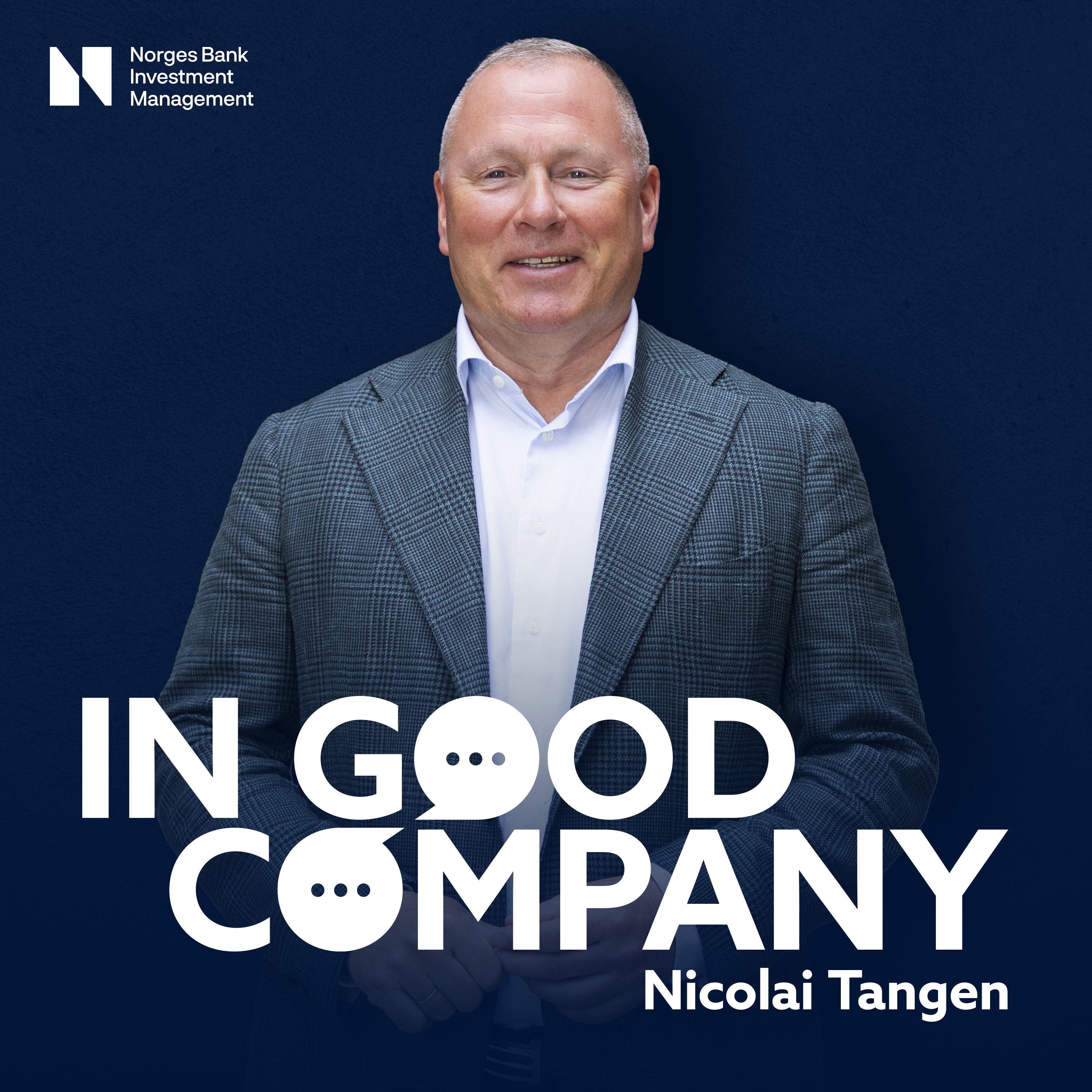
Speaker 2Hi, everybody. I'm Nicolai Tangen, the CEO of the Norwegian Southern Wealth Fund. And today I'm talking to Valérie Urbain, the CEO of Euroclear. Every time you buy a share or a bond, someone has to make sure the share actually moves and the money actually arrives. Most of us never think about it, but one company in Brussels does exactly that. And they do it for more than 1,000 trillion euros. That's also called a quadrillion. Now, the company is Euroclear, the plumbing of global finance. And my guest has spent more than 30 years at Euroclear, holding several positions, before becoming the CEO. Valérie, welcome. Thank you very much. First of all, so in your words, what does Euroclear actually do?
Speaker 1I think you explain it very well, actually. We are a financial market infrastructure, making sure that the funds, you know, move from where they are in the hands of investors to the hands of people who need funds in order to finance their project, to finance their activity. And so we are very much, you know, we have created this network between the issuer community and the investor community. And we are doing that across different markets as well as different instruments. So who are your clients? So the clients are basically all the financial institutions in the world. You know, we have about 3,500 clients and they are based in more than 80 markets.
Speaker 2How do you make money?
Speaker 1We make money through, first of all, you know, the volatility of the market. So we have a fee on the transaction, but then we also have safekeeping fees for all the assets under custody. And today we are holding 45 trillion of euros of assets under custody. And therefore this is, you know, we have safekeeping fees on those instruments. And the third source of revenues is net interest earnings. So basically, whenever cash is left on our accounts, we invest the cash and we earn net interest earnings. Who own you? We have a very interesting business. We have a very interesting shareholdership in the sense that it has changed. And in the last five years, it's stabilized. And we have foreign sovereign funds, sorry, like the Sovereign Fund of Belgium, Sovereign Fund of Singapore. We also have very long-term investors such as the pension fund in New Zealand, pension fund in Australia. We have foundations and, of course, some of the banks as well. So it's a very diverse. It's a very diverse shareholding, which is reflecting a little bit the global footprint of Euroclear.
Speaker 2So what would happen if you close for a day?
Speaker 1I think the news will not be good. Because, you know, given the role that we have for, I mean, across the market, you were mentioning that actually we are, you know, settling the equivalent of the world GDP every month. So if Euroclear stops for one day, I mean, the financial markets will face some trouble.
Speaker 2Unfortunately, yeah, yeah. Now, settling trades is one of the things you do, but you also handle dividends, votes, corporate actions, what we in our fund call asset servicing. So why does that matter?
Speaker 1Well, it doesn't it does matter because when our clients are buying securities, they need to lodge them somewhere and then they need to make sure that throughout the life of the asset that they hold in the portfolio, you know, payment of dividends happen, corporate action happen. So the tax treatment. Also take place. So it's very important that we service the assets while they are in their wallets, which is also very important. And I would say it's one of the key services that we have developed more recently. It is also the collateral management, because, you know, all these securities are sitting in the portfolio, but they can be used to finance transactions, you know. So collateral management is a service, which is now really the glue. You mentioned that
Speaker 2if you close for a day, it would be a disaster. So what is it that worries you most? Is it, you know, fraud, cyber war?
Speaker 1Well, unfortunately, for the time being, the world is not going that well. So there are quite a number of concerns. But you're right. The ones that you have mentioned are important element, especially I would say on the cyber operational incident, of course, always exist as well. At the same time, you know, we have a lot of. Recovery capabilities we have, you know, I mean, business continuity for us is really key in our agenda is also a key topic for the board. So hopefully we have, you know, we are equipped for this type of incident, but you never know, of course.
Speaker 2What are the kind of things you can do to protect?
Speaker 1So, you know, we are already in multiple locations, both from an IT perspective. We have a number of data centers, but you also have, you know, people who are located. In different locations and on a monthly basis, we check or we test, if you wish, the move of the production from one place to the other to make sure that, again, we are able to really recover as quickly as possible. Otherwise, you know, we have also arrangement with our service providers to also, you know, smooth a number of things. So, I mean, yeah, as I said, business continuity is one of the top topic of the board of the management.
Speaker 2In February 2021. In February 2022, when Russia invaded Ukraine, Russia's central bank had almost 200 billion euros in securities sitting at Euroclear. So what happened just after the invasion?
Speaker 1So, I mean, at that time, you know, the international community decided to impose sanctions. So we had, of course, sanctions for the European authorities as well as from the US and other G7 countries. And therefore, of course, I mean, we implemented all the sanctions. So it meant that all the assets belonging. To the central bank of Russia had been immobilized. Now, the thing which happened as well is that those securities and usually when clients hold securities with us, they are never part of the balance sheet of Euroclear. But over the time, the securities redeemed and therefore were transformed into cash. Now, Euroclear has a banking status and therefore, you know, the cash started to fall on the balance sheet of Euroclear. And so now we have, you know, a balance sheet of almost 200 billion. Which is very much the result of this transformation from securities to cash.
Speaker 2What's going to happen with the cash?
Speaker 1So the cash for the time being is invested by Euroclear. But at the same time, contractually, we never pay interest on the cash which is left with us. This is very much a demand from our regulators because given the systemic risk that we already have in terms of the securities business, our regulators wanted to make sure that we don't incentivize clients. To also leave cash with us. So that's why for every client who is depositing cash with us, there is no remuneration. And of course, we apply the same rule for the sanctioned entities. And so the cash which is sitting on our books is invested. And all the revenues related to this investment of cash, which is revenues belonging to Euroclear, all these revenues is paid back to the European authorities. That's what we call the windfall contribution. And I must say there, the board of Euroclear, the shareholders of Euroclear have found that it was not opportune for Euroclear to benefit from the war. And that's why, you know, even though these are really purely benefits to Euroclear, this is being given to the European Commission, which is then, you know, using this money to support Ukraine.
Speaker 2There's been a lot of discussion about this, right?
Speaker 1There's been a lot of discussions
Speaker 2because, and I do understand. Yeah. Billion, and give that as well to Ukraine.
Speaker 1And I really understand the emotions and the emotional aspect, if you wish, of this, of that topic. I fully understand that. And as a citizen, I have my own beliefs. As a CEO of Euroclear, I need also to make sure that the decision makers understand the unintended consequences of such a decision. Because there is a legal regime which is very specific to the assets belonging to a state. And so far, you know, according to. There is a special legal regime. There is no opportunity, there is no legal, you know, reasons to seize those assets. Second thing, which is also very important, is not only about seizing the assets, but it is also about continuing to provide confidence in the European markets. You know, the European markets for 60 years benefit from a very strong credibility because of the legal certainty, the respect of the rule of law. I mean, this is also, you know, allowing so many foreign investors to continue to invest in Europe. But clearly, if we start completely eroding the trust of those investors into the markets by changing the rules and by not respecting the rule of law, that could suddenly deter some of those investors from the European markets. And so that's also a consequence that we have to pay attention to.
Speaker 2When you look at Europe relative to the U.S., uh, In the U.S., you have one big settlement system. In Europe, you have many. How does that impact Europe, you think?
Speaker 1Well, you know, it depends a little bit what you are looking. And in Europe, we always tend to look at what does not work and we forget what works well, right? So there is a history in Europe and we are not the United States of Europe. We continue to be a number of countries with all its market practices. But still, when you look at, you know, the volumes in Europe, there has already been an integration or consolidation of the markets. You know, when you take Euroclear and Clearstream, we already represent more than 90% of the volumes, you know, managed, settled in European assets. Euroclear alone will represent 50% of all the European assets. So we already had seen some consolidation. Also, because both Euroclear, Clearstream and now Euronext have also started to acquire a number of CSD. So there has already been a form of integration. Now, it is true that when you really zoom into the instrument, you know, Eurobonds very integrated only between Euroclear and Clearstream. You look at the fixed income in Europe, pretty integrated, thanks as well to the collateral management, because collateral management is a service which allows for, you know, pooling. So it's a very good example of assets. Now, ETFs, for example, very also integrated, but fair to say that the equities remain a market which is fragmented. And it is fragmented also because every country has its own corporate law, its own laws in terms of bankruptcy, in terms of taxes, etc. And so you're right that unfortunately, despite the fact that few groups own a number of CSDs, still, the equity market is fragmented.
Speaker 2Do you think it will stay the same? Do you see a capital markets union in Europe?
Speaker 1I'm an optimistic person, so I really hope that we will see some progress.
Speaker 2But if you have to put on your realistic hat.
Speaker 1I doubt that it will be done very fast. And also, when you look at what is happening in Europe is also, I mean, there is a very heavy election agenda in the coming 18 months. And these are always moments where, you know, there is more focus on domestic interests rather than on European ones. So I must say that. I fear that it will take maybe longer than what we are all expecting.
Speaker 2How do you see Euroclear as a bridge between Asia and Europe?
Speaker 1Well, it's very important for me. It's really part of the of the strategic priorities of Euroclear. I mean, Euroclear always had, you know, a strong commercial footprint in Asia. So we are we have a long standing relationship with Asian investors, but we want to continue to increase it. And we want to continue to increase it for different reasons. So, first of all, it's it's a continent where the growth is higher than in Europe. So I think it's important to be part of it. But we also saw some changes in the behaviors of the investors. You know, initially, the investors were primarily invested in the US and then eventually, you know, investing in other parts of the world. And while doing when they were investing outside their country and the US, usually they were using a Western counterparty. You know, an agent or custodian. Now we see that there are more and more investment flows within Asia. So, you know, I don't know, Japan investing in Singapore, Singaporean investing in Australia, you know. So we see that there are more and more investment flows within the APAC region. And Euroclear, we have really built this knowledge of bridging different pools of assets, you know, bringing interoperability. Between the different markets. And therefore, we believe that we can also play a role within the Asian region by continuing to share, you know, our expertise for the Asian markets. And so, yes, definitely Asia and continuing to build links with Asia. Also between Asia and Middle East is something that is part of the delivery on which we are working.
Speaker 2You mentioned changing tax a bit here. How do you think AI will change your business?
Speaker 1Well, AI is already changing the business, you know. I mean, AI certainly internally is already changing the business in the sense that we are using AI more and more to improve efficiency. And I believe and I continue really to insist that AI should be seen by many of us like an opportunity. You know, it's a way to reduce the manual tasks. To have better information and therefore to eventually increase the value that we can bring to our clients. So clearly, AI is being used a lot in operations, but also in IT to improve or to modernize our IT stack. And we are also starting now to use AI to develop more services for our clients.
Speaker 2Another technology which is impacting you is tokenization. Yeah. So you're working with Banque de France to tokenize the part of the short-term debt market. Just explain, please, tokenization.
Speaker 1What is it? Yeah. Well, tokenization is basically representing in fractions, you know, an asset. And I am a strong believer in this program that we are working on with Banque de France because, you know, so far, DLT works. But in the capital markets, there has not been really winning. You know, a winning initiative in the sense that the market adoption remains very slow and very low. And so we have seen in, you know, some of our experimentation that issuers can come, but there are not enough benefits for really investor to join the initiative.
Speaker 2Can blockchain actually replace your business, you think?
Speaker 1No, I don't think so. And I think that's something that we were talking a lot about five years ago. You know, there was a comment that everybody will be disintermediated. I think there is, again, our recognition that having a trusted party and also a neutral party will be important to avoid fragmentation. You know, typically, Euroclear, we can work with everybody. Now, if it is a platform which is developed by HSBC or by Citibank or by BNP Paribas, their competitors will not join the platform, you know. So that's why having somebody like Euroclear, which has this platform. So that's why having somebody like Euroclear, which has this neutrality, but also this knowledge, you know, and the trust, I think it's something that is being still valued by the players in the capital market. And so Pythagore, because that's the name of the initiative, is really working with a full ecosystem to migrate it, you know, in one go on the blockchain. And so Banque de France is providing the cash leg with the use case of the first use case. The first use case of digital euro. So that's, you know, that probably you have heard about the project Pontes in ECB. And so that is one of the first use case of ECB, of Pontes. And we are providing the securities leg. And we are really working with the issuer, the traders, the primary dealers, the investors to, you know, adopt the new technology.
Speaker 2In the US, they've had stablecoins for a long time. Is digital euro a bit late?
Speaker 1It depends on the need, you know. I think that for the type of business that we have, it is not too late. And it makes a lot of sense. I think for the retail market, on which I'm not really part of, probably that stablecoins is something which is also attractive for the retail. And there are some opportunities which are emerging in Europe, you know. So we'll have to see how it evolves.
Speaker 2You mentioned the expression T plus one. And it basically, the amount of days it takes. The amount of days it takes to settle a trade, right? So in the US, they changed to one day settlement in 2024. In Europe, it will happen from October next year. Yeah. Why does it still take two days in Europe when it can go much faster?
Speaker 1Well, you know, when we talk about T plus one or T plus zero, I mean, you have to realize that it's not just, you know, on the platform of Euroclear that this is happening. Because actually today, we can already do T plus zero. And we have a number of sophisticated clients who are using this functionality. But what you have to realize is that when we talk about, you know, an investor, a retail investor buying securities on the stock exchange, usually has to go to give an instruction to its bank, the bank, first probably to its broker, then the broker to the bank, then the bank to us, then the bank, you know. So there is a long chain of intervening parties. And so the more you reduce the time between the two. The time between the trading and the settlement, the more this chain needs to be very effective and very quick, you know, in giving instruction for the information to flow from one side to the other.
Speaker 2Do you think it will be instant at some stage?
Speaker 1I don't think, well, I have to nuance. I think that could already, as it is the case today, for very, very sophisticated operations. Or for, you know. Maybe snap retail. You may have, you know, some of that. But I don't think that in the institutional business this will happen. And the reason I'm saying that as well is that, again, I was referring to the Asian markets. When the Asian investors invest in Europe. They usually do that from their head office, you know, from Japan, from China, from, you know, older countries. While when they invest in the U.S., usually they do that from their U.S. location, from their U.S. office. And so they are in the same time zone. Europe, you know, T plus one in Europe means T plus zero for the Asian investors because of the time zone difference. So I think that if you want, again, to continue to attract, you know, investors from all around the world, you need also to take into consideration this reality. And that's why I believe that from a wholesale business, I don't see T plus zero happening across the board. It will happen for some specific operations, for sure, but not for the usual transactions.
Speaker 2I'd love to talk a bit about leadership. You joined Euroclair in 1992. What would you say is the biggest change in the company since you joined? Apart from, of course, you becoming the CEO.
Speaker 1Well, many things have changed because when I started, I remember that we had no BlackBerry. We had no emails. I remember that I was still, you know, typing my letters to the clients. So the speed, the speed of interaction has changed dramatically. The sophistication of the markets, therefore. It's changed dramatically. The usage of new technology. So lots of things have changed, actually.
Speaker 2Who's been the most important person in your life as a leader?
Speaker 1Well, I have had very generous bosses, you know, bosses who have really pushed me outside my comfort zone. And I have in mind somebody who, when I was meeting him, you knew when you were entering in his office, but you never knew when you would get out. Because, you know, he will always use. Any interaction as a learning opportunity, you know, and really forcing you to find yourself the answer to your question. And I found that having this kind of boss is extremely educative, but also it builds your self-confidence, you know. So, yeah, and I have one in mind, but I also have others who have had this generosity to each time, you know, continues to push me and support me as well. In the progression, so.
Speaker 2How do you work in supporting the people who are coming after you?
Speaker 1Well, it's very much by listening, also by challenging them. And then when I'm trusting them, you know, it's really to expose them and to give them the opportunity to do things by their own. So, yeah, I think it's an art. It's not a science. And you need. Also to adapt your style to the people that you have in front of you, because not everybody requires the same support. And so that's why really listening and trying to understand where the person is, is extremely important. For some people, you will need to be positively encouraging them. For others, you will need to challenge them. So, yeah, as I said, it's an art, but it is certainly one of the things that, you know, nourished me the most.
Speaker 2You led in a period with a, you know, war, a lot of uncertainty, technology change. What do you think is the key to being a good leader in a period of so much change?
Speaker 1I think to remain authentic and to share the good news and the bad news. You know, I've seen that last year when we were in the middle of the discussion on the Russian assets. You know, I've been extremely open with my, I mean, with my staff, you know, explaining when it was starting to become sensitive, not sensitive. You know, and I think that that has created a lot of trust also between me and the staff. So, remain authentic because we are not supermen, superwomen. We have our own vulnerabilities. And that's a way also to recognize that the value of the team, you know, it's not a one man or one woman show. It is about engaging all your colleagues to really thrive and accept changes. I think this is the most difficult. The most difficult thing for me is making people accept changes, because unfortunately, the change is becoming constant.
Speaker 2And do you like, do you like change?
Speaker 1I do, because otherwise I don't think I will be where I am. So, yes, I do like the change, even though sometimes it's tiring. But yeah, I think that's also what keeps you energetic. And it's a way also to constantly learn, actually.
Speaker 2Absolutely. I love, I love change. Now, when you look at the people around you, how would you, how would you characterize the corporate culture at Joglair?
Speaker 1Well, you know, I always say that I stayed for more than 30 years because of the people. And we have, on one side, we are very much experts in our domain and we like to, you know, to show our expertise. But it remains, I mean, a human company. We are only 6000 people. And so there is still a human touch, which for me is extremely important. So, yes, we are demanding, but at the same time, we are caring also about people. Sometimes, you know, I would like that we are even more performing and that's the thing that I'm also bringing because the market is not easier. The competition is not quieter. So it's important that we remain on top of. But I still like very much this ability to care about people and to talk about people.
Speaker 2What failure has changed you the most in life? What have you, what's been your biggest failure?
Speaker 1Well, I think failure. Well, first of all, you know, I love Mandela. Mandela has always said there is no failure. Either you win or you learn. And that's something that I've tried to apply throughout my life. You know, failure is probably when I lost an RFP, you know, lost a business to my competition. And so this is the type of things where you start re-questioning yourself and re-questioning the way of positioning the company. At the end of the day, what matters is what you learn about you and about our capability. What matters is your ability to overcome this difficult period.
Speaker 2You were born and raised in Senegal. Do you think that helped create this resilience in some way, shape, or form? In what ways?
Speaker 1Definitely. Because first of all, I think that it taught me the value of the differences. You know, I was different. I was not from Senegal. And so I was different since I was very, very young. And so I think. You nurture, therefore, the value of having diversity in people with different backgrounds, people with different perspectives. So certainly that has, I mean, my youth, because I traveled a lot in different African countries, and that has really taught me that. I think also because at a certain point of time, I had to come back to Belgium, you know, when I was 16 years old and to live on my own because my parents continue their expat life. I mean, when you are alone. At 16 years old, there are moments which are great, but there are moments which are very lonely. And again, I mean, you need to overcome these kinds of shortcomings.
Speaker 2Is there anything from your African upbringing that you have brought with you?
Speaker 1Yeah, I think, well, first of all, this diversity and inclusion, for sure, but also this capability of taking the moment in a joyful way. You know, I think African lives in the moment, and I think I try to always be very present at the moment we are in.
Speaker 2Do you meditate? No, I don't. No, you just talk about being in the moment, right?
Speaker 1No, exactly. No, I don't meditate.
Speaker 2Are you a spiritual person?
Speaker 1I am somehow, yes. I have my own beliefs, and yeah. But I think this is also probably something that I took a little bit from Africa. So yeah, definitely.
Speaker 2What's something about you that most people don't know?
Speaker 1Well, now it's not a secret anymore in Euroclear, but it is a secret outside. You know, I'm collecting the Smurfs. The Smurfs, you know, that's a little Belgian character, you know, so yeah. So I continue to do that. So that's something which I had to reveal when I became CEO of Euroclear. And it's very nice because I have now people, you know, offering me some Smurfs.
Speaker 2How many do you have?
Speaker 1I don't know.
Speaker 2300. Okay. When do you get up in the morning? 6 o'clock. How do you relax? Reading. What do you read?
Speaker 1Certainly not professional books. I have to switch off. And usually I read in French because, you know, the French literature, I mean, listening to French because English is my professional language. And so I really like to, I really enjoy reading French romans. Also history, historical books. I like that.
Speaker 2What's the. What's the book that has given you the most?
Speaker 1Well, there are so many. There is one book which I always go back to is Libertango. So it's about, you know, a conductor of music. So, I mean, and you could, I mean, the writer has written the book while listening to music. And when you read it, it's almost as if you listen to the music.
Speaker 2And what kind of music do you listen to?
Speaker 1I love blues. I love jazz. And otherwise, you know, I'm pretty eclectic in music.
Speaker 2Lastly, what is your advice to young people?
Speaker 1for young people do what what um i mean um you know work with your passion i mean we spend so much time at work you need to really enjoy it and the second point is believe in yourself because plenty of people will tell you shouldn't do this shouldn't do that believe in yourself because often i feel in the new generation that there is not always sufficient self-confidence and i think they are also there to manage the future of our companies and so we also need to listen to them we also need to learn from them and to see how we can prepare them for becoming the future leaders and so i mean we need to trust them they need to trust themselves and to believe in them in
Speaker 2themselves great place to end and thank you for all your hard work we for sure trust you a lot because you settle millions and millions of dollars in the future and i think it's a great place to end and i think it's a millions of our trades every year and so for that a big thank you to you and the team and we look forward to staying in touch
Speaker 1thank you very much and thank you for your trust thank you
 PodcastTranscript AI