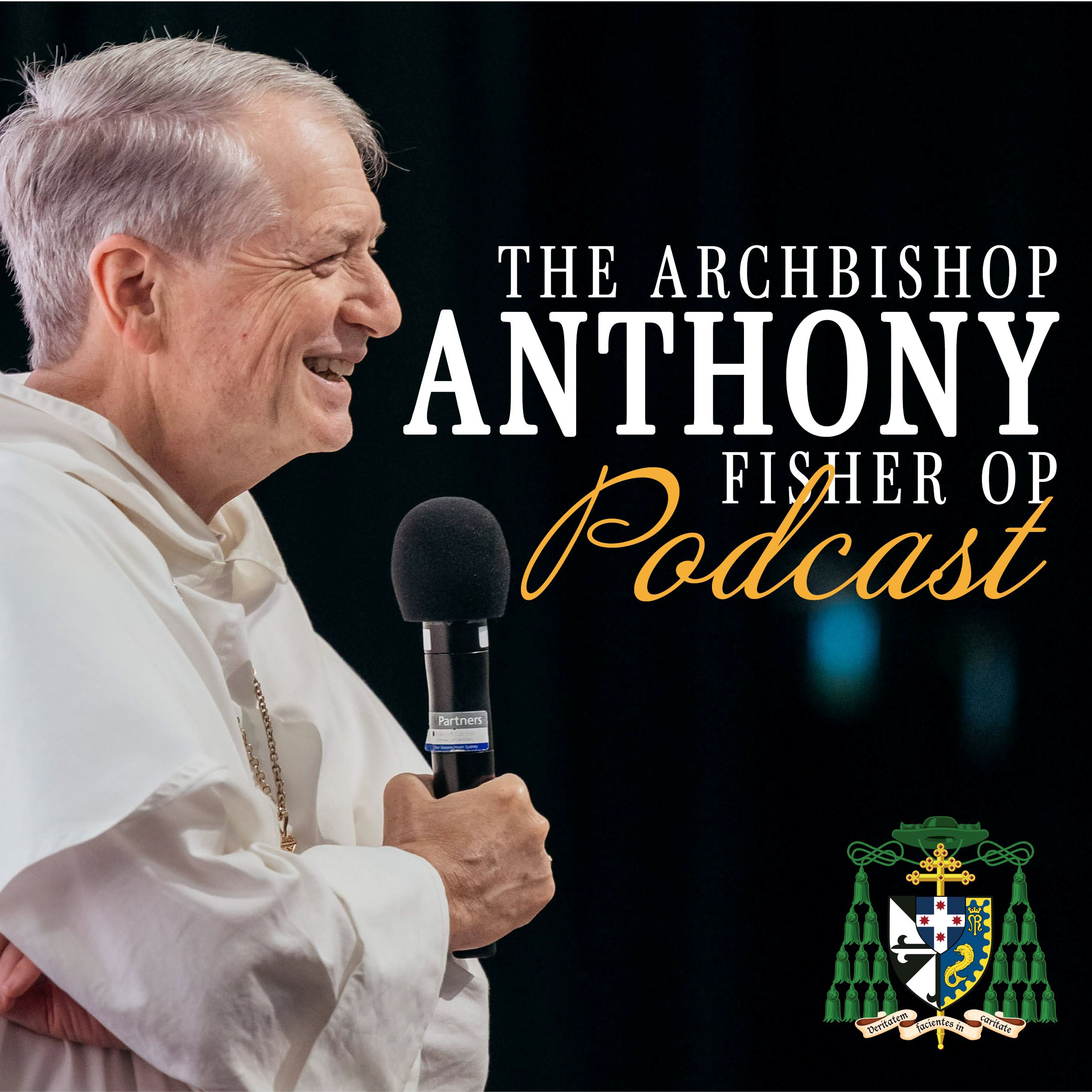
Eucharistic Miracles - Didasko Faith Formation 2026 at CIS
from Archbishop Anthony Fisher OP
35m 4s
In this address, Archbishop Anthony Fisher reflects on the Eucharist as the central miracle of Christian faith. He begins by honoring saints Carlo Acutis and Pier Giorgio Frassati, both devoted to the Eucharist, and notes Carlo’s cataloging of Eucharistic miracles, such as bleeding hosts or preserved cardiac tissue. However, Fisher emphasizes that faith in the Eucharist rests on Christ’s words and apostolic tradition, not on extraordinary phenomena. Drawing on St. Thomas Aquinas, he explains that transubstantiation—where the substance of bread and wine becomes Christ’s body and blood while appearances remain—is the true miracle. The Eucharist also involves anamnesis, making Christ’s sacrifice present across time, as described in the Catechism and liturgical poetry. Fisher connects this to Jesus’ Bread of Life discourse, where eating His flesh and drinking His blood grants eternal life, a teaching defended by Church Fathers like Cyril of Jerusalem and Ambrose against heretics. The Eucharist is described as “medicine of immortality” and a pledge of future glory, a foretaste of heaven’s wedding feast. Fisher concludes that while extraordinary miracles can support faith, the greatest miracle is the Eucharist itself, which sustains believers on their journey to God. He encourages deeper appreciation of this sacrament, urging listeners to see it as the center of existence, as Flannery O’Connor famously asserted.
[Music] An address by Archbishop Anthony Fisher. [Music] Thank you Angus and welcome all. Welcome to my place, the Catholic Institute of Sydney. And if you're not enrolled for a degree here yet, you will want to be by the end of this evening, I'm sure. We'll start with a prayer. This is St Thomas Aquinas' prayer to the blessed sacrament, named the Father, the Son, or the Spirit. Will you help me, sisters? I was sacred banquet in which Christ has received the memory of His passion is renewed, the mind is filled with grace, and we are given the pledge of future glory. You are given them bread from heaven. [Music] Let us pray. A God who has left us in this wonderful sacrament and abiding the memorial of your passion, Gras as we pray, so to reveal the sacred mysteries of your body and blood, that we may always experience within us the fruits of our redemption through Christ our Lord. Amen. Father, Son and Holy Spirit, amen. Sisters have a different translation. With an American accent. Last September Pope Leo canonized the young Dominican layman, Pierre George Frissati, along with the even younger First Millennial Saint Carlo Acutus. Aiden Ramsey told me that he had advertised this talk tonight, promising people that I would do a Eucharistic miracle while I was here. I can't promise you that, but what I've brought you instead is a relic of St Carlo Acutus. Which St Mary's Cathedral was just given only two weeks ago. And he is a miracle. So you've got a Eucharistic miracle when you've got him. The Dominican from Turin was a daily communicant, Pierre George, and he used to make deals with his fellow students, that if he beat them playing billions or some other sport, they would have to come to mass with him on Sunday. With all my strength, I urge you young people to approach the Eucharistic table as often as you can, he said. Feed on this bread of angels to draw the strength you need to fight the battles with your inner passions and your outer adversaries. For Jesus Christ has promised all the graces needed to those who feed on this most excellent sacrament. The Eucharistic thought was our ammunition for the battles of this life, until we attain the armistice of heaven, which came early for Pierre George at the age of only 24. Pierre George's twin incanunizations and Carlo, known as the Saint in Sneakers, was only 15 when he succumbed to leukemia. Last year we offered a Carlo cutest virtual reality experience at the purpose conference here in Sydney. Teenagers, adults, even an archbishop, donned the VR headsets to explore his world, including kicking a football with him and praying the rosary with him. Carlo earned the title of God's Influencer thanks to his remarkable evangelization project, fusing his passions for faith and technology. Last year we offered at the purpose conference that VR experience, but then this year we had showing when his relics came to us here in Sydney the miraculously Eucharisticchi which he himself had prepared. And that, I believe, is now available for any parish that wants it through the Legion of Mary. So it's 26 panels, each one two meters high, and back in front, it's not, you'll need space, but it's very interesting. And only last week Carlo drew us nearer still, when we welcomed some major relics of Saint Carlo to Saint Mary's Cathedral. The boys, Perricardium, the membrane around his heart, and those relics are now making their way around Australia for the next few months. Carlo had a great gift for engaging his peers. He knew what it took to get clicks and go viral. But he wasn't just a Catholic cult figure. He saw how something awesome could draw in his generation. And he thought the drama of Eucharistic miracles might be just the hook they needed. And dramas there have been. Acutus recorded instances of hosts bleeding, turning to flesh, glowing, levitating, or surviving destruction. Cases of the baby Jesus or the blessing Christ appearing on the host or in place of it. And instances of chalices turned to blood, and blood drops on the pattern or corporal. Examples also of animals kneeling before the sacrament. Of people cured on receiving Holy Communion. Of populations preserved from danger by the sacrament. Restories also of people living for extended periods on nothing but the Blessed Eucharist, or receiving it mystically from the hand of Christ himself. Many of these miracles cataloged by Saint Carlo, took place on liturgical solemnities, as if to spotlight something about the feast. Also fascinating is how many of the samples have tested AB. The rare blood type found also on the shroud of Turin, or as living but stressed human heart tissue. Some of these miracles were attested by great saints, such as Gregory the Great, Claire of Assisi, Alfonso's Laguri, and the rather skeptical Thomas Aquinas. He was so taken by the miracle at Balsena that he became an advocate for a universal feast of corpus Christi, and got the gig to compose the texts. Yet interestingly, Thomas thought most such miracles dubious, and of little importance for Eucharistic faith. On his account, we would not need such spectacles if we really believed what the church teaches. It brings me to two, the real miracle. So what should we say about Eucharistic miracles? A few thoughts. On the Miraculous Eucharistich website, Bishop Raphael O'Mattinelli, points out that our faith in the Eucharist is not founded on Eucharistic miracles. But on the words of Jesus, transmitted to us in the Apostolic tradition, and received with faith. Believing, as St Thomas Aquinas taught, is an act of the intellect graced to receive divine truth, and of the will graced to consent to it. And the principal source of that truth, Christ Himself, who instituted the Eucharist on the first Holy Thursday, he commanded us to do this in memory of me. A Christian, Martinelli, points out, is obliged to believe in the Eucharist as it is part of public revelation. But they are not required to believe in Eucharistic miracles, which are private revelation only, even if some have the Nehill Obstet of the church. We must be wary of Eucharistic miracles, distracting or devaluing the every day miracle of the Eucharist. We can also be too credulous, to readily believing every reported, weird and wonderful story. Still, Eucharistic miracles can help us see beyond the visible, to recognise the wonders of God, despite the limits of our own perception and reasoning. To deepen our appreciation of those mysteries,
and to have Christ at the centre of our existence. The Bolinese Dominican Theologian Roberto Codgy points out that Eucharistic miracles are extraordinary interventions of God Himself intended to confirm our faith in the sacrament. They highlight the Catholic faith that with the words of consecration, this is my body, this is my blood. The entire substance of bread becomes the body of Christ and the entire substance of wine is precious blood. That change cannot be detected by the senses, but only assured by faith. As Eucharistic Dr. Pa Exelves, a quinas thought many Eucharistic miracles reported in his day were suspect. So not all, as we saw regarding the miracle of Balseno. But he was the church's greatest advocate for the miracle of transubstantiation, whereby we receive the Lord's body and soul, flesh and blood, humanity and divinity, under the species, the appearances of bread and wine. And that is surely miracle enough. On a quinas' account, when the Eucharistic species appear like flesh and blood, or like the baby Jesus, these are secondary miracles, apparitions like those of our Lady. Were the substance and accidents of Christ's flesh and blood present together, we would bite the risen Lord in Holy Communion, and he would be deprived of part of himself at every mass. But when God grants a miracle like a bleeding host, Christ is neither more present nor less so than he is under the species of bread and wine. The great miracle is not that Christ's living flesh and blood sometimes appear at the Eucharist, but that his flesh and blood do not normally appear. And that's how Christ intended to be adored and received by us. In the time left to me tonight, I want to reflect on a few more dimensions of this primary Eucharistic miracle. So three, the miracle of Anomnesus. In Christopher Nolan's sci-fi epic interstellar, Matthew McGonicky plays Cooper, a father who travels through a black hole and shows that time is not just a relentless march from past to future. Speculative physics, especially general relativity, theorizes that time, as experienced, might be able to be traversed, touched or revisited in some way. Interstellar is sci-fi, of course. But sometimes reality is stranger than Hollywood. Consider what is happening each time the church celebrates the Eucharist. The past is not simply memorialized as when we read a history book or flick through old photos. No past and present miraculously merge. In St Luke's report of the Last Sapper, Jesus says, "Do this in Anomnesus, remembrance of me." It translates the Hebrew word "Zikaron," as at the institution of the Passover. This day shall be a Zikaron for you to keep as a feast to the Lord. More than just a memorial, the Jews believed that the Passover Zikaron made them as present to the liberation from Egypt as were their ancestors. When your children ask what this service is about, God says, "You shall say, 'It is the sacrifice of the Lord's Passover,' for he passed over the houses of the people of Israel." Zikaron or Anomnesus is not just celebrating the past, even imaginatively. No, what God accomplished for the old Israel and for the new is ongoing. As the Catechism puts it, "In the sacred scripture, the memorial is not merely the recollection of past events." But through liturgical celebration, these events become in a certain way present and real here and now. In this way, Saint John Paul II taught, we experience the mystery of oneness in time, whereby each mass makes present the past called Trudeon. The coalescence of time is, of course, conceptually challenging. Experience and theology have their limits. But that has not stopped our greatest minds from doing their best. In his antiphon, which we recited, a sacraman convivium, a quietness captured the intersection of past, present, and future at the heart of the Eucharist, not through scholastic clarification, but by liturgical poetry, beloved across the centuries. A sacred banquet in which Christ is received, the memory of his past, passion is revered, the soul is presently filled with grace, and we are given the pledge of future glory. This is a great miracle. At the sacred banquet of the last supper and cavalry, is not 2,000 years distant from us, but present in the hands of the priest and upon the tongues of the faithful at every mass. 4. Living bread for the living dead. Christ had just performed his most reported miracle, the feeding of the 5,000. It's so stunned people that they chased him across land and sea. But then he started to unpack what it meant, what the miracle bread was all about. His words were shocking. Many were so scandalized they grumbled, then they quarreled, then they loudly objected, and finally they abandoned the Jesus project altogether. Each time they pressed him to qualify his teaching, he doubled down and got blunter. I am the bread of life come down from heaven. Then the bread is my flesh given for the life of the world. Then my flesh is real food and my blood real drink. And finally, very truly I tell you, unless you eat the flesh of the Son of man and drink his blood, you will have no life in you. You will be like zombies, the living dead. The verb used here is trogon, meaning not nibble, but nor as if devouring a stake. Jesus was not talking in mere metaphors, and they knew it. Peter of course shone that day when Jesus asked the apostles if they would abandon him also for his hard teaching, he responded, "Lord, to whom else could we go? You, only you, have the words of eternal life, for you are the holy one of God." Three centuries after that,
that initial protest against Jesus teaching on the Eucharist, on the North Coast of Lake Galilee, renewed challenges to Christ's words emerged from Aryans, Manakis and Nostics. When catacizing the newly baptized, Sincerell of Jerusalem urged the Neophytes to trust Christ's words over their own experience or over the views of the troublemakers. And to be assured that what seems bread is not bread but only taste like it, it is the body of Christ, a short that what seems wine is not wine, though it tastes so, but the very blood of Christ. Sincerell's contemporary in the West, St. Ambrose and Milan, urged those under his care not to doubt God's ability to work a miracle like the Eucharist. If by his word God could create the universe from nothing, he could also change that which exists into what it was not before. Be convinced, he told his catacumans that this is not what nature has formed, but what the blessing has consecrated. For by the blessing, nature itself is changed. Nine centuries later it was the Cathars in southern France's turn to deny Christ teaching about the Holy Eucharist. The Dominican friar, Peter of Verona, contemplated and preached on God incarnate in the Eucharist. He famously died with a Cathar dagger in his head, writing Crado in Unum Dayum in his own blood on the ground. But there are more stories to be told of him. He attended a Cathar rally after hearing that an eminent Christian had been converted to the heresy by an apparition of the Madonna at the previous Conventical. When the Virgin appeared again, Peter held up a consecrated host to her and said, "If you are the mother of God, worship your son." Rather than kneel, the supposed Virgin immediately grew horns and exposed as the devil she vanished. Three centuries later, Christ's words were again being contested, this time by the Protestant reformers. Luther and the Anglicans, while still holding to a lower case version of Christ's real presence in the sacrament and its centrality for Sunday worship, rejected the philosophical underpinnings of transubstantiation, spiritualised the sacrifice as that of the participants in the service and denied any continuing presence afterwards. Svingly and Calvin went further, characterising the Eucharist as a commemoration only, the sacrament as only a symbol, insisting that it is no more present there than everywhere else. In response, the Council of Trent affirmed the Church's ancient faith that on the night he was betrayed, Jesus took bread and wine, consecrated them and said they were now his flesh and blood, that he commanded the Church to keep doing this in an amnesus of him, and that the consecration affects a change of the bread and wine's whole substance, if not its appearances. In any particle or drop of the sacrament, we receive the whole Christ. Had a distinguished literary dinner in Manhattan, the Feisty Southern writer Flannery O'Connor was confronted regarding the Eucharist by the political activist and lapsed Catholic Mary McCarthy. McCarthy proposed that the Eucharist was just a symbol, if a pretty good one. O'Connor famously shot back, well if it's just a symbol to hell with it, reflecting on her reaction years later, O'Connor wrote, "That was all the defence I was then capable of, but I realise now that this is all I will ever be able to say about it, except to add that it is the centre of existence for me, or the rest of life is expendable." Accepting Eucharistic realism, even when unfashionable, or apparently illogical, or something O'Connor shared with the counter-afformers like St. Pius V and his Tridentine brothers, with the counter-Cathars like St. Peter of Verona, with the Church Fathers like Ambrose and Cyril, and with Peter and the Apostles. She was not alone. Five, the Miracle of Heaven on Earth. In the bread of life discourse in the Gospel of John, Jesus explicitly connects eating his flesh and drinking his blood with the gift of eternal life. So too, in the book of Revelation, we read one of the clearest subscriptions of heaven, an otherworldly wedding banquet of unimaginable joy, a feast where God and humanity are together and united as bride and bridegroom on their wedding night for all eternity. Offering one last addition to Christ's catalog of Beatitudes, the beloved disciple writes, "Blessed are those who are invited to the marriage feast of the Lamb." Only a few years after the death of the author of John's Gospel and his Apocalypse, his two disciples, Pollock Up and Ignatius, were also promoting his high eucharistic theology. St. Ignatius of Antioch referred to the Eucharist as the Medicine of immortality and antidote to death. He took literally Jesus teaching that he who eats my flesh and drinks my blood has eternal life, and I will raise him up on the last day. What Ignatius called Medicine, a quietest referred to as Chibos Vietorum, food for the journey. In his great sequence for Corpus Christi, loud as C. Ones Alvatorum, he sings, "Echepanus, Angeloorum, Factus, Chibos, Vietorum." It's striking imagery. Angel bread is now given to earthly travellers to nourish them for their journey home. Every communion is a kind of viaticum, and so much more than the host-shaped coin the ancients put in the mouths of the dead. It is a pinus, a down payment or pledge of future glory, a veritable admit one to the wedding feast of the Lamb. Earlier I referred to St. Carlo Cutus' tagging the Eucharist his highway to heaven, and nod to the fact that communion redies us for union with God. His saintly twin, Pierre Giorgio, was riotously funny with his friends, but intensely focused in chapel. He attended Eucharistic Congresses, prayed all night before the sacrament, and humbled the clergy as they saw this bread of angels bringing him ever closer to God. In the speech to young people from which I quoted earlier, he reflected on the otherworldly aspect of the sacrament. Jesus Christ has promised to those who feed on the most holy Eucharist, eternal life, And the necessary
graces to obtain it. Totally consumed by this eucharistic fire, you will be able to thank him. You will enjoy a tranquility the world has never tasted. You will have that peace of mind reserved to the pure, requiem in eternal. I said that St Carlo came to visit us here in Sydney last week, the form of his relics, but his twin in canonisation, St Pio Giorgio Frasati, his whole body came to Sydney at the time of World Youth Day and was first at the University of Notre Dame in the chapel there at St Benedict's and then in St Mary's Cathedral so the youth of the world could be close to him. Close to the one who said there is no sure a pledge or dear assign of this great hope in the new heavens and the new earth than the Eucharist. Six ending the end of the beginning. We could reflect on many more dimensions of the miracle of the Eucharist. The way it extends the incarnation to each of us. How it offers us at once Christ sacrificed and Christ risen and living. How it makes Christ present in many places at once. The way something divine happens through mortal priests and human words. How the Eucharist makes the church that makes the Eucharist. Or how the Eucharist makes saints. There is much more to explore about this miraculous sacrament. Some of that will doubtless be covered in the future to Dasco talks. And we all have Eucharist 28 to look forward to. But I promised later in the evening, but while it's still in my head, to remind you about the future to Dasco talks. It's a great program there and no doubt that other aspects of the miracle that is the Eucharist will be explored over many months and talks by us. The bleeding host of Balsena, the cardiac tissue at Lajjana, and all the other Eucharistic dramas recognized by the church and collated for us by Saint Carlo, have their place in awakening faith, silencing doubt, deepening devotion. But the greatest Eucharistic miracle is the every day one, the every tabernacle one, the everywhere every altar one, the every tongue one, the grace of the mass. Every mass makes Calvary present to us and us present to Calvary. At every mass Christ is offered whole and entire body and blood, soul and divinity. At every synaxis, heaven and earth are joined and we are summoned into the communion of saints. These great miracles require no papal commission, no glass reliqui, no scientific verification. They are promised by Christ, handed on in the Apostolic tradition and experienced by the faithful for two millennia so far. So the most extraordinary thing in the universe turns out to be available every day, a miracle to which we are all invited. God bless you. [BLANK_AUDIO]
Podcast Summary
Key Points:
Archbishop Anthony Fisher discusses Eucharistic miracles, focusing on recently canonized saints Carlo Acutis and Pier Giorgio Frassati, who promoted devotion to the Eucharist.
The primary miracle of the Eucharist is transubstantiation—the change of bread and wine into Christ’s body and blood—not extraordinary physical phenomena.
The Eucharist serves as an anamnesis, making Christ’s past sacrifice present; as living bread for eternal life; and as a foretaste of heaven, uniting believers with God.
Summary:
In this address, Archbishop Anthony Fisher reflects on the Eucharist as the central miracle of Christian faith. He begins by honoring saints Carlo Acutis and Pier Giorgio Frassati, both devoted to the Eucharist, and notes Carlo’s cataloging of Eucharistic miracles, such as bleeding hosts or preserved cardiac tissue. However, Fisher emphasizes that faith in the Eucharist rests on Christ’s words and apostolic tradition, not on extraordinary phenomena.
Drawing on St. Thomas Aquinas, he explains that transubstantiation—where the substance of bread and wine becomes Christ’s body and blood while appearances remain—is the true miracle. The Eucharist also involves anamnesis, making Christ’s sacrifice present across time, as described in the Catechism and liturgical poetry.
Fisher connects this to Jesus’ Bread of Life discourse, where eating His flesh and drinking His blood grants eternal life, a teaching defended by Church Fathers like Cyril of Jerusalem and Ambrose against heretics. The Eucharist is described as “medicine of immortality” and a pledge of future glory, a foretaste of heaven’s wedding feast. Fisher concludes that while extraordinary miracles can support faith, the greatest miracle is the Eucharist itself, which sustains believers on their journey to God.
He encourages deeper appreciation of this sacrament, urging listeners to see it as the center of existence, as Flannery O’Connor famously asserted.
FAQs
Saint Carlo Acutis, known as 'God's Influencer,' was a 15-year-old who catalogued Eucharistic miracles online. Saint Pier Giorgio Frassati, a 24-year-old Dominican layman, was a daily communicant who urged young people to receive the Eucharist frequently.
The primary Eucharistic miracle is transubstantiation, where the bread and wine become the body and blood of Christ, though their appearances remain. This is considered the greatest miracle, as it happens at every Mass.
Anamnesis means more than a memorial; it makes past events present and real. In the Eucharist, the Last Supper and Calvary become present here and now, uniting past, present, and future.
The rare blood type AB, found on the Shroud of Turin and in some Eucharistic miracles, suggests a connection to living human heart tissue, highlighting the miraculous nature of these events.
The talk warns that faith in the Eucharist should be based on Jesus' words and public revelation, not on private revelations like miracles. Overemphasis on miracles can distract from the everyday miracle of transubstantiation.
The Eucharist is described as a foretaste of the heavenly wedding banquet, a pledge of future glory. It is called the 'medicine of immortality' and 'food for the journey' to eternal life.
Chat with AI
Loading...
Pro features
Go deeper with this episode
Unlock creator-grade tools that turn any transcript into show notes and subtitle files.
 PodcastTranscript AI