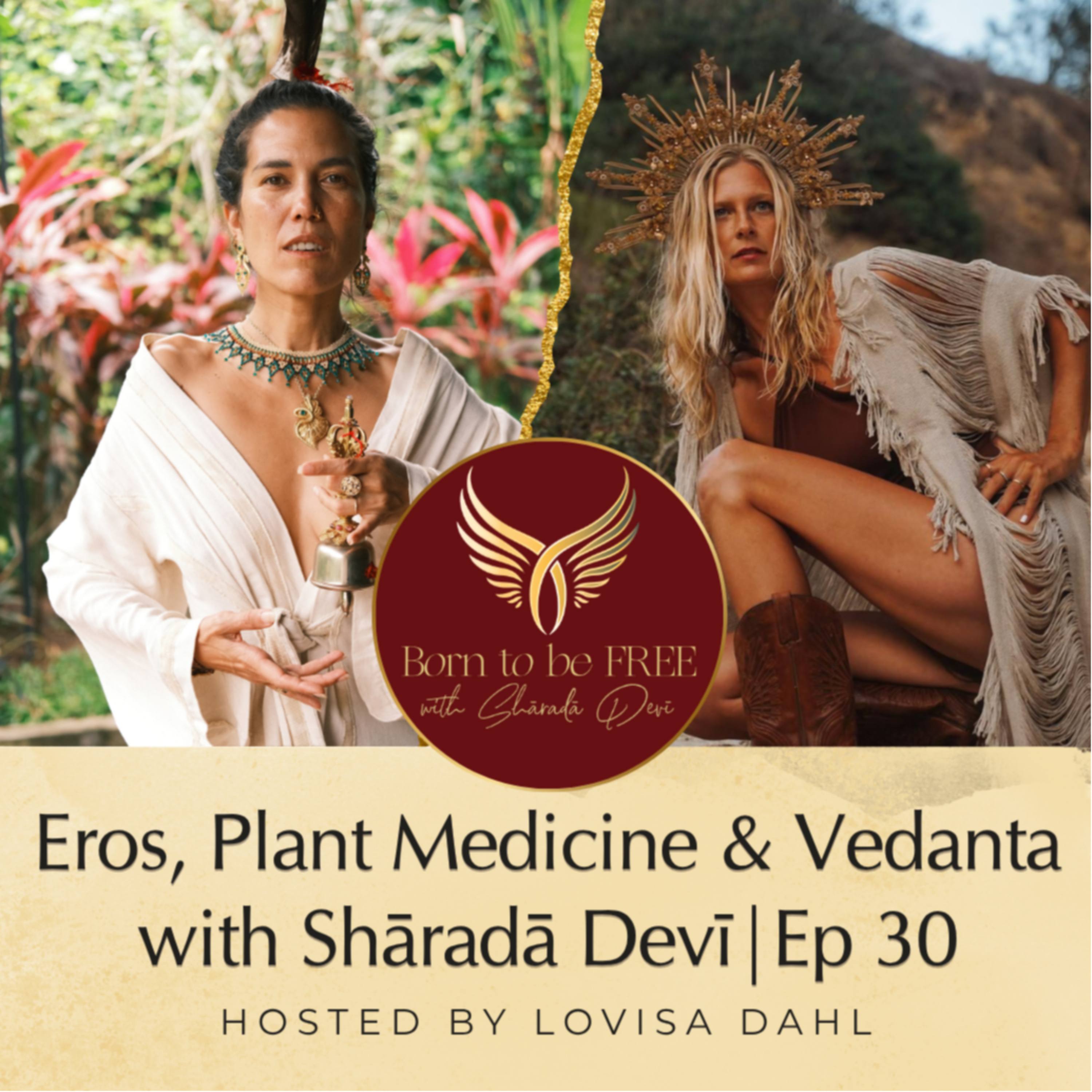
Eros, Plant Medicine & Vedanta with Shāradā Devī | Ep 30
from Born to be FREE with Sharada Devi
80m 18s
In this episode of the Born to Be Free Podcast, host Shada da Devi is interviewed by her longtime friend Larisa Dal. They reflect on their decade-long friendship, which began with a sacred bridal shower and deepened through shared studies in Advaita Vedanta. The conversation focuses on the origins of the B-woman project, a community that grew from a prayer given by Swami Bhagishananda: "No woman, B-woman, all women nature nurture me." This prayer encourages women to know themselves as the source of love and security, and to simply be themselves. Shada da explains that women's circles emerged as a healing modality where women share their deepest secrets without trying to fix or judge each other, using listening and prayer to heal the "sisterhood wound" of competition and jealousy. She teaches that jealousy arises from ignorance of the non-dual self, using the metaphor of "one gold, many ornaments" to illustrate that all women are one being despite apparent differences. By admiring rather than competing, women can contribute to each other's growth. Shada da also discusses "being the permission" for women to rise and live authentically, a permission she received from her teacher. She shares a personal story of removing her nose ring after a tantric initiation, symbolizing release of identity and relaxation in her nervous system. The episode emphasizes returning to the truth of our shared being, celebrating duality without fear, and using admiration to heal collective wounds.
I'm your host, Shada da Devi, the Born to Be Free Podcast that serves as a bridge between the ancient and the new era, a confluence of opposites where all is seen as sacred and every experience is meant to cut the paltry into a supreme destiny. Oh, welcome to the Born to Be Free Podcast. My name is Larisa Dal and I have the great, great, honor to be here today to interview our beloved host, Shada da. I feel a little bit nervous and very excited. I love these episodes where we get to hear your story and we get to and I'm still so honored that I get to ask you the questions and can take us on this journey. And Shada da, I'll just give a little brief Shada da and I, we have known each other for many years, now 10 years and we have studied Advaita Vedanta together. I have been in the Diamond, your mentorship mastermind program which was amazing and and we have and you have also lived in our house for a while so we have really we really know each other from so many different parts of life. I feel like you are probably the person in my life that play the most roles for me. I remember how I met you the first time, I accept it. Yeah. Naked in the sauna, celebrating you before you got married. Yeah, that's how I met you. Yeah, we were in the sauna and it was the the sacred bridal shower which was much more than a bridal shower. It was an offering to the goddess, to the wife, to you and we based you and massaged you and offered flowers before the wedding. It was just so beautiful and it was for me it was I don't think I knew any of you. Like I had just met you and all of a sudden in the early morning you came to our tent and you kidnapped me, took me to the lake in the sauna and it was just this such a beautiful almost unreal experience that I wish for all women because that is it was it was really an initiation I feel. And you are so open I remember you just were able to fully receive which is very unusual for many people it's very difficult to receive attention, touch, adoration, offering and you were just so in your feminine, yeah, deputive mood already. I loved it so much it was so so beautiful and I really like it really it was also came out of the blue like I really didn't expect anything. And I I also remember from those days that I went to one of your women circles and you were speaking about admiration, admiration instead of jealousy and that hit me so deep and it really it really changed something in me and I know that I am not alone of that. I know that the B-woman project that you that you started founded and grew to thousands of women I don't even know how many women who have passed through that and are still in that community and changing so many women's lives and really healing the deep sisterhood wound I feel is such a big part of the B-woman project. How did you how did you come to do that to create that? So the B-woman project and thank you so much Lisa for for hosting me and interviewing I asked to be such she would do this episode to interview me and so thank you so much for doing that. Yeah. Thank you. I wanted to yeah have the opportunity to share a little bit about where I am at in my life right now and and I was thinking who could hold that space for me and so it was you and also because of our extensive past and journeys and walks of life and shared interest I felt that I could ask you and so thank you again for being here and the B-woman project yeah it's not really like I don't it's not it's still alive but more like it's alive in the heart of heart and in the prayers because now it's Davy school everything is under the umbrella of Davy's school, Persew wisdom, B-woman project, Vaitika Dharma I had so many names. No and different programs and systems and and then it all kind of came under the umbrella of Davy's school but yes B-woman project started a long time ago and it really started with that prayer no woman B-woman all women nature nurture me that prayer that was given to me to us by my rivier teachers Wami Bhagishananda he has given me many prayers he's given us so many prayers and helped to restore the value of prayers and not only Sanskrit prayers but also English prayers and one of them was no woman not no woman no cry like the Bob Marley song no woman like no no myself know what you are know that you are the source of love of happiness and security and everything you want to be like get on the journey and get to know yourself like that's the intended meaning of no woman B-woman B-woman like no when you know what you are all just be yourself there's nothing for you that you need to do to accomplish to achieve to prove to impress anyone be yourself like B-woman and when you are yourself you discovered that you are all women being yourself you are all women nature nurture me and so then I added this melody because he shared it with us in the form of just no woman B-woman all women nature nurture me and then I was saying that again and again and again and then at that time this melody came no woman B-woman all women nature nurture me and so then I started to sing and chant that and I started to share it with other women and I introduced it into the Davy circles this women circles that are also inspired by Swamiji I started my goddess classes Davy classes with him he has been he is a worshipper of the goddess introduced Davy to me and to so many of us and and inspired me to do Davy circles which are circles for women to share our deepest intimate secrets all those stories that we wouldn't share with anyone he would always say you've got to share your secrets and share your heart Davy share your heart and through sharing your heart you heal your heart and you heal the heart of every woman because you're not alone in what you're feeling and no woman can understand or like yeah no woman can understand you better than how do you say that well basically a woman can understand what you're going through or like no man actually I mean not fully true but it's harder I would say for a man to really understand what it means to be a woman I mean they can like I have certain exceptions I have quite a few friends I have very feminine qualities but still like it's the woman's body we go through the period the blood and the change of the breasts and and and just being a woman has very strong implications in these times and it's harder hard for a man to understand what that means and with women we just know like we we've gone through this crazy initiation of what it means to be a woman and that's how I started this circle like just the topic of what does it mean to be a woman and then actually one friend to you then she said you gave us all the
these circle topics when I started the women's circle, facilitate the training, and you gave us all these topics. And then the top, it was, what does it mean to be a woman? And she's like, you don't need any other topics. That's the rest of your life to talk about. She just told me recently in a retreat. That's beautiful, I love. It's true, actually, right? Yeah. And so it was there for us to just come together as women to remember how we sat in circles, how we were in the retent, how we sat around the fire, how we shared our stories, and how we didn't try to fix each other, or pity each other, or advise each other, or criticize, then just be there, listen, listen with our full heart, and pray together. Feel each other, cry together, laugh, celebrate, and breathe, whatever is there in the field, and then we pray. Then we would always pray. We would sing or dance, or dance. And that was so healing. And still is, still this day, I think it's one of the most important and strongest modalities, like from all the different tools, so many tools we have, but still to come together in a women's circle, in a sharing circle with a strong foundation of honoring each other, and be really present, and then bringing in prayers. So simple, yet so profound, and to get out of this competition and jealousy, I mean, I grew up in Switzerland. Competition is everywhere. The ambition, like they need to prove, to perform. And then we as women, we compete against each other, we compete against the man. And so it was also there so strong in my body and imprinted, and to get out of this, it's been taking years to purge this tendency. And the way that it says, put in the opposite. So if you compete, you contribute. You're jealous. First of all, you can only be jealous of something that is there already in you. You just don't see and recognize it in yourself, but you cannot be jealous of something that is not there in you. And then admire, like praise, praise, admire, adore, say the qualities. Your jealous of her hair, say how beautiful, how beautiful hair you have. Right? [LAUGHTER] Take it till you make it. And so yeah. Isn't it also interesting? I'm just thinking so often we can-- we can praise the qualities of the sun or a beautiful flower. Like all of these objects in the outer world, we can praise them. And we can say, oh, wow, that fragrance is amazing. This flower is so beautiful. But then when it comes to other people and us think also, other women, instead of that praising, we come to the jealousy. Why is she like, no, why does she have that? And it's just so sad. And it's really something, I think, on a collective level that we get to heal. And that the bewomen project that later also became the Davis school. And all of that, it's really what it's doing. It's really healing that deep wound because it's actually not normal. Like it's common, but it's not normal not to be able to admire what we see and love in another human being. The natural thing really is to admire and praise that. But this we have to come back to that truth. And we are afraid, right? We somehow believe that if I would praise that in you, then the fear is that you would maybe get arrogant or then you would be better than me. So we are afraid to mere in that way or express, share admire because somehow we have this belief that if I now praise you, then you're better than me or in the pedestal. That means that I am submissive or yeah, yeah, or than you, which is not at all true in any way. No, I can praise and admire it like, wow, that shows great maturity. Do you think that this comes from the dualism? Okay, do I have it on me? Yes, no duality. Yeah, well, this separation that if I, like if I praise and honor and admire, then, yeah, that somehow creates that duality. I don't know that it would come from that somehow that then I don't know. Yeah, I think I know what you mean. I mean, it is true. Like, I mean, we are in this belief that you and I are different. And that's what we see. I mean, look at us. You're blonde. I'm brown. You're blue. And the appearance, the appearance, everything we see is dual, separate. And so that's, believe that's the real of Maya, Devi, of the sacred illusion in that sense. But it's not the illusion that we are not existing, which often Maya is translated as such. Maya refers to the illusion that you and I are different. And then this idea of separation has created all this tension. And then the comparison, and then in that comparison, we start to compete. And then in that competition, we end up alone, basically. We are maybe so successful and have so many riches, but we're alone. And there's nobody to enjoy it with me. Yeah. We're alone, and there's nobody to enjoy it with me. The big house, and you have the big money, and you have all these things, but you're alone, and you die alone in misery. And so underneath all of that, we say, like, there is self ignorance. Like there's ignorance of the non-dual self ignorance that you and I are in reality, one and the same being. And in that knowledge, instead of then competing, we can contribute. And so whatever you have to healthy degree, you share it with those that don't have that, but they have something that you don't have. Like we all have interrelative, and then we can share our wealth, our skills, our knowledge, and we grow, and we benefit from all that is given. And enjoy this apparent duality, instead of fear it, we celebrate the duality, like the difference, the apparent duality, but we know that it's not really different, that we're not really different. And so like the example that we always give or have given and still give, because it's timeless ancient example, which was carried through in the Bimum project, and in all of the trainings and programs, is the one goal and many ornaments. So there's one goal, but many ornaments. So you have the nose ring and the ear ring and the necklace and the bangles, like many names, different form. I'm pointing out to the nose because I used to have a nose ring for 15 years. I don't know the nose ring. Yeah, no, I took it out, actually. I had, it was a very beautiful moment. I received a very special initiation from Daniel Odie, actually, an elder, a tantricah, and it touched me so deeply. I was so moved and so touched, and I just, and because the initiation was the yoga of touch, it was a beautiful, incredible offering. And then I took out the nose ring to just fully immerse in that experience. And then it was that nose ring was out, and I just offered it. I didn't want to put it back again. And somebody was listening, maybe they could think, "Well, that's not a big deal." But somehow that nose ring was so beautiful. And it was a big deal because I got it 15 years ago and I went to the Ashramin India and I found it in this gold shop. And it had so much meaning, like one object can have so much meaning, even though it's just a little object. But it represented a lot from me. But in that moment also, when I received this initiation, I was like, "I'm ready to let that go, like this identity." And I talked to you about that at the beginning, there was a certain identity and ready to let go of this jewelry, which is so beautiful. And I got so many compliments for it. And I just offered it. And I noticed there was, like I could feel, and I'm still feeling it, there's still a relaxation that is taking care of.
place in my whole system because it's been there for so long and even though it's part, it was part of me but I could also feel a certain release because I never knew if I suddenly could get stuck with the clothes or it could be pulled off and I could feel very subtle tension and now from a cranial level perspective or the feel I could just feel my nervous system like this very subtle relaxation, deep subtle relaxation and I'm still feeling it like it's still yeah yeah it's beautiful. It's like interesting which piercing also for navels for those that have a piercing in the navel or so to like tune into it's yeah still right to have it because it does influence our bodies and those points but yeah basically going back how did I come to the nose ring and back it the one called the many ornaments right so I was pointing to the nose ring because often I wear a lot of jewelry and and so then I have a nose ring and I have a ring and an abangle and we have many different names different forms the nose ring looks different from the ring the fingering and the fingering looks different from the bangle and so it looks different and it has a different function but from its standpoint from its own standpoint of gold there's only gold there is no nose ring there is no bangle there is no necklace there is just gold there's absolutely no difference no separation in any way between the nose ring and the fingering and the bangle it's one and the same right and that's you and I like we are one and the same being there are no two beings and yet there you are gorgeous stunning beautiful Lisa blonde blue radiant me brown hair brown eyes and we look different but we are one and the same and that's that's what we call itself knowledge like the removal of self ignorance the removal of ignorance the destruction of the wheel of separation and so that's the gift of Advaita Vedanta and and so absolutely like that is the reason why yeah we are caught in the separation and the competition and the difficulty to admire each other because somehow we believe that then the separation will become even bigger if I admire because then you would identify with that you would your ego would get bloated like by that admiration and then I would be under you and and we have experienced that like that's what some of us have experienced if we are praising someone it doesn't come from I'm praising you because I admire you I praise you so that you like me like that's maybe what we remember from being in school or when we have all these children play and going on and like who is the best who is the coolest and so then we we praise each other out of that fear and out of that desire wanting to be liked and to belong and so then we may be associated to that old memory and that's not where we come from when we are in a women's circle or practicing admiration it's not to to be liked or to belong I mean yes somewhere also we do it to belong but it's with the awareness I admire you so that I can bring out that quality me and then actually you who receives that admiration that you can really receive that admiration also that you can acknowledge that quality in you which often is very difficult to receive yeah admiration yeah yeah and you know I think Shadada you are you're like on your journey you've been like so many times like over and over again you are really embodying the permission you are being the permission for women to you know to rise to take up space to dress however they want to express themselves to you know all of these things you to to build successful businesses to to charge for their work like all of these things you really embody it and you really really am modeling the permission you're being the permission and I think it's so beautiful and I what how do you see on like how do you what's your view on that yourself is that something that you've actively been thinking about or beautiful question yeah thank you for mirroring that being the being the permission yeah remember I did this mistress masterclass called the permission it was yeah it was it was very it's there if anyone wants to watch it it's there in the daily school platform you can sign up for it like two classes that I did on on the permission yeah like I I have received that permission from my teacher basically again it's like it was really that mirror my teacher who was just there to empower me all the way through like it was that mirror like yes you can do this yes you can shine yes you can it's it's so simple but it's so profound again like that what gave me the permission and not that we really need a permission like it's it's kind of funny to think that we need the permission but we do need the permission not that we really need the permission like who would give us the permission like there's no being out there like really giving you or us the permission in one way yes it has given us the permission just by the simple fact of our existence like that we exist means that's the permission for us to be us yeah and yet we don't feel we have the permission to be all of us we are programmed we are trained we have we grow up in in this certain belief and structure and myth that we need to follow what is the norm at this time what are the values and values of being successful having a successful career getting mad having children and all of that I need so that I am loved accepted belong to the society instead of like I do these things because they are really true to my values and what I want to live and then this becomes my contribution so and then the permission here is meant that I can inquire into is this really what I want to live by is this what I really want do I want to follow the Western myth do I want to go down the road of a traditional career do I really want to get married do I really want to have children like to ask ourselves these questions we need almost the permission for it not that we do again but we feel like we do we don't feel we're allowed to question when we don't feel we are allowed to question the system the the myth yeah who are you to question that this system and the system includes like our parents and the school because if I question it means that it may be wrong or that it has a fault and what are people most afraid of to be wrong like why most couples end up in divorce because everyone needs to be right and everyone is afraid to be wrong and so then everyone is trying to bring over their point make a point and then I am wrong you are right and so we're so afraid of being wrong because if I'm wrong it means I failed and if I failed I don't deserve love and without love I cannot exist and so then we're in this hamster wheel of trying to prove trying to be wrong needing to be wrong and following this myth basically this unhealthy myth and and at one point we all discover that it's not working like more and more people are waking up that the system and the myth that we grew up in is really not working and
more burnout stress, cancer, cheating, you name it. Now all the kids have ADHD as soon as they're a little bit too hyperactive. And so the system is failing and the myth is being discovered that the happily ever after is not true. And so yes, nowadays people are more questioning and asking, but still I still, and now I'm in Switzerland a little bit more than I used to be. And I still see like people are in that, in that loophole. And so like the permission to question. And then when we start questioning, well, we will find answers. And I question from a very young age. And I think that's because yes, my life didn't go as usual. Because usually your parents are longer alive than you are as a child. My father died when I was very young. And so like that brought in this question, like, what is God? What is death? Who am I? Those questions were there in my life from a very young age. And so this question led me on this path that I have been. And so I've always had a lot of question. And I always questioned. And thanks God as I found a teacher who also questioned everything. All the found answers. And so then it gave me the permission to not go down the road that everyone else or many people went down the road, basically. And I have a successful career and then get married and then have children and build a house. And did certain things also. And then I didn't work out in that way. I definitely also did certain things. But yeah, to question, to find answers and then to be radical. And to be radical is not only to dress with a red hat or things like that. But at that time, 15 years ago, it was radical to pray. And it still is radical to pray, like to daring to start praying. It's huge. It's huge. It's like so many people are afraid of prayers. And so then to chant a mantra, learning sounds great. At one point it was weird for people to do a downward facing dog. Now that is much more common people doing downward facing dogs. But it wasn't always like that. And so yeah, I just, yeah, I don't know if that answers the question. But it was because someone basically that I crossed it gave me the permission, the question and to be. And then that gave me the courage or the ability to give other people, especially women, the permission to have desires and to express themselves and to be loud and to be wild and to be naked. Yeah. Oh, I know. I love that answer. And I'm also thinking like when you, because what I, I, well, I don't know where to start. Like when, what I think that you are doing, like because you come from a traditional Advaita Vedanta background, like you have studied with traditional teachers and so, so, so many years. And then sacred sexuality came more and more into your world. And there was a point right when you started to feel like this. I'm here also to share this work. And any, on a, on a surface level, we can say that those two would go against each other. We don't usually think about spirituality, especially now, like a traditional, like a traditional Advaita Vedanta and put that together with sacred sexuality and arrows. And like we don't. But like I know that when you went to, to see Rada, our teacher, I, I, by the way, the Vedanta teacher in California, was it last summer? I think last. We do have yet. And you've also brought in the embodiment rituals, the, the pleasure rituals to that space. And I, I was here. I was not there, but I was feeling it so deeply. Like I really feel like you are doing exactly what Swami Dayananda, the, the teachers of our teachers who you have also studied with before he passed away. Like what he did when he brought in first of all women to teach, like a female teachers, female Advaita teachers and the psychology. So he opened up for psychology to be part of the San Pradaya, the teaching methodology that, that, that, that could be part of it. And that was groundbreaking back then. And now you are groundbreaking to, to merge these two worlds. Vedanta with sacred sexuality. What do you, what do you feel when I say that? And, and also about the permission, like how, how, how does it permission to do that come through from, from our teachers? Yeah, yeah, there is still, there is still a little, when I tune into my felt sense, tuning in what's happening in my body. I can feel there is still a little bit of, like, some nerve, like, not nervous, but it's still a little bit of frozenness there around merging, Advaita Vedanta with sacred sexuality and the medicine of arrows and, and it's been now many years of consolidating, is that what we say, to bring that together to find trust and confidence and, yeah, trust and confidence in that merging and giving myself the permission to do it, to do it. To do that, the reassurance, the validation and, because yes, like you say, somehow I also have felt that, and that, that was so, I don't have a word for it, but, like, it's virtuality is this, and sexuality is that, and I remember when I was studying in the ashram and, like, really diving so deeply into the tradition, which I love with all my heart, but I identified so much with the dressing, the, yeah, like wearing salwars and, and the specific traditional outfit and, and braiding my hair and putting on the sari and putting on bindi, and like, again, also the, the nose piercing and, and I love it, it's so, so beautiful, but it was also very proper. And I, I, I, I found a certain safety in it also, like, I'm, I'm pure, I'm, I'm doing the right thing, I'm, now doing the yoga and the meditation and the chanting and it's all very proper and structured and it gave me a certain, yeah, confidence, the ability, identity also, and it served its purpose for a very long time. It really gave that structure so that I felt I could melt into this teaching and remove self ignorance and then, and then also, eventually, I started to discover well, there is, there are parts of me that are still afraid and acting out and not feeling fully safe and juicy in my body, basically. I, I am felt a certain dryness and a certain pain in my lower back and, and I discovered I was also a resistance towards embracing, like really the womanhood and the pleasure of being a woman and pleasure itself and, or gassams and, and, and I didn't really know that I had an issue with it. Until. Actually, I went to women's circle. It was when I was invited to a women's circle where I had so much resistance towards going to the women's circle. I was like, "No, I don't need women's circle. I don't need this woman stuff. I just need this teaching and the proper way, like the very structured, masculine, beautiful, proper way and know this woman thing. That's like too fluff, basically. Then I went to this women's circle. The first hours, I just cried. I just sobbed. I didn't know. I just cried and cried and cried and cried. And it was just these tears coming. I was like, "What is this?" "Yeah." And then the sharing and then meeting my first tantra teacher more than like a long time ago and then she introduced at that time like many do. Eye gazing. And it was like, "Oh my God, it was so scary to look someone into the eye." And then again, I just cried and cried and cried. And so I discovered, understood that the knowledge, the teaching, the structure is all there, but something in me hadn't integrated or allowed and still needed healing. And that kind of healing that was needed was the feminine, soft approach, the earth-based. Yeah. Yeah, embracing the body. And then understanding that I had sexual trauma, yeah. And like many of us have. I am when I was a teenager, a certain things have happened. And I'm not going into the full story also because I haven't really told my parents. And it's also like, desiring to protect them and not making them worry or anything like that because I really feel like with all the years of healing and growth, I feel really together and whole in that way, but also out of love and protection. But I do share the details in my programs very much of those experiences because that really helps for people to also heal and grow. But I understood, "Okay, there is a lot of unresolved issues." And so then I understood, "I need to now just really go into those experiences, meet them and recreate new events that are loving and honoring and empowering to heal what has happened." And I also understood that I actually am a very powerful priestess and witch and there are certain powers there that we have as women and that Shakti that is there in all of us that we can use and wield that for healing for ourselves and for others. So it opened up a whole lot of world when I came into the world of sacred sexuality. And there was so much relative freedom in my body, so much healing, so many tears, so much joy, so much. Wow! I'm all of this. And then it was like the side of me that awakened up, this witch, sex priestess and feeling alive and juicy. And then there was this other part, kind of, that was the proper yogi, Vedantic, chanting, listening to the teachings. And then for some time it was like my outside, the me that I portrayed to the outside world was this Vedantic, very structured, very traditional. Through that I get a lot of respect, which I did, like so many people respect me for having studied so properly for so many years. And I found safety in that, but then there was this other part that was messy and wild and bloody and all of that. And then I'm like, "Ah, but I'm this also, I'm not only this." Like I suddenly this part that I identified and loved so much, like so so much was like, "Ah, feeling like being in a prison, in a cage." Like, "But I'm not only this, yes, I am that also, but I'm not only this, I'm this, this orgasmic, wild, crazy, unpredictable, bloody, juicy, messed up part as well." And so then it was a huge journey for me to really embrace that and then bring it into this world of structure and proper and yeah. And then it was many years actually. And when I told my teachers, like yes, like so much validation and championing and like, yes, you need to embrace this and celebrate it and share this with the world. And yes, I got the permission. I did get it. But still, even though I had it, it still took quite some time for me to like really integrate it and start talking about it and sharing and teaching. So that's been a pilgrimage to bring like the Shiva Shakti, like it feels like Shakti of the feminine, of the bloody, the non-linear, non-predictable with the Shiva that is linear, not that it's linear either, not at all, like but the structure and that which is more calm or words and yeah, in that way and to bring. And now it for me it's like of course they go together, like they were never ever meant to be separate. It's yeah, they're perfect for each other. Yes. It's not the any better. It's like you have the knowledge and you have the structure and the words and the tradition and wonderful to abide and find safety in that. And then you have the Shakti, the embrace, the nature, the earth's practices and the wild and it's perfectly complementing each other. And then not only that, then I also started to embrace the whole medicine world. I mean, like a delic medicine and I dove into that area of really embracing the gift of Mother Nature and that was also quite a journey for me to bring that in and find resolution and how that fits into the Advaita Vedanta part where words is the main teaching and then suddenly you bring in plant medicine where it's all about experience. Yeah. And to just process the experience and in Advaita Vedanta it's all about the nature of our experience and not emphasizing the experience but still honoring the experiences. But now also like my whole plant medicine journey also it finally I feel like I understand how they all fit together. They're not separate, they're not against each other. It's the same. Like I can I have seen how spiritual traditions are also in competition with each other. But even within the spiritual world like how certain groups and schools even see each other as competitors. Yeah. That like really working together and helping us to integrate this human life and with plant medicine like there's so much to say but the one thing I say for today is that what I so deeply understood is that like for certain people they have been so traumatized by human beings that the moment they sit in front of a human being or a teacher or figure everything just shuts down. Like there's no trust in the human form anymore because we human have really messed up in so many ways. And the plant medicine gives you this incredible gift and opportunity to find trust again. To find trust again in yourself, in humanity. And so the plant medicine can take you on this journey to process a certain experiences that you've had as a human and find that strength with him and with nature and also open up open again for humans because not all humans are like there are incredible human beings. There are incredible teachers and we need teachers like this idea that you are your own guru and just throw away this whole guru thing. It's so sad and it's yes I get what people are saying and why they are saying it but you do need a teacher like you do need a teacher. You need to say good-meer that gives you the permission to be all of you that sees the jewel of jewel that you are, the wholeness, the limitlessness, the gold.
It's like you need that mirroring. Like it's like a child that never gets that mirroring from their parents. Something I want to say die, but it doesn't fully die because it, yes, it goes into exile. Yeah. And it just takes a long time, maybe, for it to go back. But it will come back if in the right circumstances, with, in the right situation, with the right people. And we need that, and because it's the truth also, we are love. And there are beings that have discovered that truth. And you need somebody who looks you into the eyes and can make you see that. Just, and I don't make you see it through their eyes, but they make you see it through their eyes. By looking into their eyes, and they have discovered that they are love, that they are loved. And that's passed on in the field also, in that unseen world. So that's the transmission that's, that gift from human to human, once a human has seen the truth. And, yeah, and that's the magic where a book cannot, cannot do the job. No. No. No, I will ever, very touched. Yeah. Especially what you said that, when there is so much trauma from, from other human beings, that for some people, the possibility to heal will come from, from the earth herself, from plant medicine. I get chills all over. Wow. It's, because like, something that I felt so deeply the last few years is that I'm like being called by the earth. Like that I feel like I'm called by her to share, to do. And I don't, I don't, I don't work with plant medicines yet. I don't have to say, but, but I, I feel it so deeply that like, her intelligence is infinite. Like what do we know? Like really what do we know? When I say that I'm feeling like I'm called by the earth, and plant medicine makes people be able to heal and open and grow. Our perspective of, of this reality is so small, in comparison to her full intelligence, limitless intelligence. Oh, yeah, that really, that's very deep. And we need both, like that's what I, that's what I really understood now, is that like the teachings of Vedanta, there are words. And I know so many people aren't afraid of words because the words come from a human. And then they remember their father, their mother, their teacher, and how they have abused and misused their authority. And people think that it's a human that talks and they're feeding their own ego. And I get it. I get you guys not totally. And the spiritual bypass is also used in the whole new age world. It's like, so there are reasons for it. And hopefully I feel you 100,000 percent. And I, and you, and we can say, with complete, with completeness, that, that vital Vedanta, the teachings, when it comes from a tradition of San Pradaya, the traditional one, is a means, is a mirror in the form of words, that when they are handled appropriately, not for to blow one's ego in any way, but in the deepest reverence of Saraswati, of the goddess of knowledge and words, they are a means to help us understand our reality, our experience, and eventually the nature of every experience. And why that's so important, because every experience is limited. That's ultimately real. Like, no matter how incredible the experience is, we can never hold onto it. It will change. And you will continue to experience painful and pleasurable experiences. And so most people, we are running after the only pleasurable experiences, and we don't want to deal with the painful ones. But the true freedom is the ability to know yourself as a free being, while experiencing painful experiences, which doesn't mean you're not going to experience the pain. Which means you can recognize yourself, know yourself, I am free in spite of this painful experiences, experiences that I'm going through right now. Like myself right now, there's some sacred family karma that we're experiencing, and it's painful. One of my family members in deep depression, and of course I'm experiencing this depression. And I'm purging it also, but I also know myself that I'm free from the experience. And so that is that refuge in and through the experience that is being exhausted right now. And so the words, like, and the sampradaya, the pramānam, the teaching methodology, has that capacity to help us understand, assimilate our human experience. And yes, it is given by a human, but when it's properly taught, properly passed on, that human doesn't abuse or misuse these words, or the power that is given. The power that is given is used to mirror back the listeners, wholeness, and power, and fullness, and wells, like it's that's mirrored back again. And so I know that one needs to experience it in order to understand that it really exists. And it's the same, like with ayahuasca, like you kind of, or plant medicine, you kind of need to do it to understand the power of Mother Nature, and the gift that she can give you. And so to have this together, like to have the plant medicine that, yes, no words can ever describe certain experiences that we've experienced as human beings, and to release that. Wow, thanks God, as we have the plant medicine for that. But then we do have still the words to be able to describe and help our minds to understand and to assimilate this life. And then with sexuality, like for me, it's like the sacred triangle. I really feel like I found my sacred trinity of my offerings. It is the plant medicine and the Dwighta Vedanta and the aero's medicine, because then, through sexuality, you're coming into the felt sense, and the honoring, and you're taking your power literally back into your own hands. By using your very own hands to hold yourself, to touch yourself, to pleasure yourself, and to receive the greatest gift, this human incarnation. And then using this great gift of this human incarnation to gain more freedom, to discover our freedom, and through the body, yes, through the mind, not by bypassing it. And so, sexuality and embracing this body and the gift of this body and the pleasure, capacity, and potential, at any time I can have an orgasm. And to give myself an orgasm, when I'm in deep depression, hallelujah. I mean, you can do that. Everything in you tells you to know, I'm just going to be suffering and suffering and suffering. But to just use your hands or your breath to touch yourself, when you're in deep pain, that's the revolution. Like that's where, then the system, and the religion, and the unhealthy misweek grew up with, and the pharma industry, they cannot get at you, because you're taking your health, your well-being, into your pleasure, into your own hands, you use your hands to make yourself come. And there you go. It's really amazing. And then you orgasm, and then you let the healing take place. It's not just like this. Yeah, yeah, very annoying.
know, like sometimes we feel pressure and then we just make ourselves come quickly and there is this quick release and then we continue. Great, it would add. But I'm referring to also like take a moment to breathe, have an intention or just really say okay now I'm feeling bad and I'm going to use this sacred pleasure tool and I'm going to come and then after you're going to rest that's very important, the after that used to lay down for five minutes, ten minutes and then let the medicine work because it's not just the moment, right? It's the after where it's like when you take the medicine and then it takes half an hour or an hour or whatever for it to work and so it's the same here with our yeah, eros medicine to take it to give yourself that. And then those and then let the healing take place. And it's so profound and it comes like from a totally other way, like from a way where we usually don't think about sexual pleasure, we don't think about sexual pleasure like when we don't feel like it, like when you're depressed or you're having pain or experiencing like some kind of not feeling good and then you meet that, you meet that with your pleasure, it's the most powerful thing. For me it was like wow, a new world opening because like you're saying you take your reality into your own hands, like how can I, how can I, how can I be with this? How can I hold this pain? And for me also that understanding also came actually from giving birth. And now that you were speaking, I thought a lot about about pleasure in birth which is part of what I work with, what I do. Because we have been taught this idea that childbirth has to be painful and it's painful and that's the only thing it is. And then in the same time we're giving birth through our sexual organs and we have the possibility to to pleasure ourselves to decrease that intensity because that's what it does and we bring oxytocin to our bodies so that it actually makes the birth progress more smoothly. But there is so much stigma around that, we feel like we cannot do that because birth is medical and we're in this medical setting and we're not allowed to bring in our pleasure there. But why not? Like it's a system failure and that goes for the whole world. We have this system failure where we're not, we think that we are not allowed to bring in our pleasure. You're like each month already when we have our moon, our cycle, right? And we have pain, if you have pain, many women do or beings that have a womb and bleed every month they have menstrual cramps and you can touch yourself. You can massage the thickened mountain and massage yourself, have an orgasm or I know there's also many beings that cannot have orgasms which is due to the stress and the psychological and emotional reasons but really we're all capable of having an orgasm unless there are some nerve damages but otherwise we actually all can have orgasms and many don't just because of not feeling safe or ashamed but actually like your orgasms. And I also still, you know, like I just had my moon and then the first day I was like, "Oh, like a part is just like, oh I don't want to do anything but then there's some pain and I'm like, oh yeah but I'm going to pleasure myself now and I'm going to make myself come and the moment I do that the pain is almost gone. It's so simple. Imagine we would have been told that when we got our period instead of, yes, now you take them, the pain killer or the pill to not experience any cramps and instead of just like, yes, now you can touch yourself and make yourself have pleasure and an orgasm and that's the best antidote or support for the pain that is there. Yeah, yeah, so simple again, you get actually so simple, so deep, but we think we need all this very expensive and complicated methods. Yeah. Yeah. Okay. What a conversation. I feel like I want to, I'm so curious to ask, like where, with all of the knowledge, all of the wisdom that you have and all of the tools and this triangle that you're speaking about, the sacred triangle that has now like really rivulied itself to you, right? Where do you see? What is your vision for going into the future? What do you see? What do you feel? Hmm. Yeah, I'm feeling. Yeah, what this most present is to offer containers where the sacred triangle is supporting us and those that are in my field and offering programs and containers, spaces, support. And that's where people can really be held and go through their spiritual awakening, spiritual growth, spiritual reclamation of their whole or gothmic and free self. And yes, that's been there for a long time for me, but I do feel like also now over the years I've settled, like there's a lot that's settled in me and integrated and worth the ability in myself and confidence and also relaxation. Like for some time there was also some, like still some old pushing and some old, like I need to go and do and now these last few months I've been really like in this purging of that I need to push something forward. No, I know that this is the reality and the truth and is what needed and those that are wanting this which are many that will find each other. Like the goddess, the sacred will help us to find each other. So to really settle into this and also calling in the support, like from the universe and from the masculine, like this masculine support structure that can help us women that have now, yeah, spend so much time for healing and to be supported. Like the universe wants to support us and how can I be supported so that I can really support a woman and being that want to go through that. And so it's been a lot of me just leaning back and going through my own purging and resting in that and then, yeah. So the new program, it's not the new, it's the new, it's the golden womb that is coming now, it's going to be the third time and many of the other programs I've been, I've put it on pause for now and see if and when they are going to happen again or not. But right now I'm really like, like really giving my energetic space to the golden womb. Yeah, the golden womb which is this trauma informed sacred sexuality, daily coaching, certification which you will be part and other incredible women and to offer this, yeah, this structure womb for other beings to heal and grow and expand and go through this journey. It's still like, I'm still in the in the creation process actually, like the curriculum is still being refined and also I would like to offer like plant medicine journeys with people that I know that are shamans for us women.
like also to, like because if we are together for a long period of time and we create this safety and we have the teachings of Vedanta and the sacred sexuality practices and then do the plant medicine journeys. It's just such an incredible container because many people that I know they go into this plant medicine journeys but they don't have the womb, the structure then to bring back what they have seen or learned and don't maybe always feel the support that is needed in order to integrate what they have seen in the plant medicine journey. And so yeah, my vision is to offer this and for now it's like online and then in the future in one way I do see like a place where people can come but not just like for a week retreat. I kind of want to get out of this like just week retreat which is very nice also but more like a place to live because it just takes time. The healing is not a quick fix and you need to have like community around people that have been in there that already are embodied to a certain extent. There's a certain relaxation there, there's a trust in there and then you have healthy food, you have these practices, you have the teachings, you have the possibility of doing plant medicine in a safe space and then the rituals and but again like I see a place but I don't really want to organize it and manage it at all. So it's more like I see that like the masculine taking care of all of that. I can be there or us women and we're like held also. So that we can pass on this knowledge with them and help the next generation. So in one way it's almost like a mental hospital but it's not a mental hospital. It's like a wellness home. And we can come and it's affordable and we can stay and just be in nature and in community and we have teachings of plant medicine, aerosmetician and something like that. Let's see. What makes the muse the online programs? But he will all be in the subtle field. That whole vision will be held in the subtle field. And I was thinking when you were describing like the parts of the muse program which is I mean it's so extensive and it's going to be totally epic and amazing. But then there is this other part which is the subtle field that I felt so deeply in the diamond. Like right when I signed on for the diamond I felt like I elevated into a field that was particular for those of us who were in it. And together it's like this field that we create. So that is also there that is also so much part of when we decide to go into a program or something especially when it's a little bit longer. We are part of a field and it's something that's untouchable. Like we can't see it but it's the whole where we're held. It's like a wound, the golden wound. I love this vision. I love this vision. And also in some ways you don't know this but in some ways it actually ties together with something that held in me. My husband and me are envisioning. Who knows? Yeah. We will see. Yeah, I love to hear more. Yeah. Yeah. It's all there. It's all there. It's all there. It's all there. Yeah. I've seen that so much. You know, like living in Bali for so long and then like here also now being in Europe for a little bit longer. What I see is that there are so many retreat places there. It's amazing. And you can do all these week long or two week retreats and amazing. But I feel like that. Where one can stay for a while for a few months and be immersed in a way of living where it's not just a retreat the one week and then you go home and then you need to go back to your regular life and then try to somehow integrate it. But a place where you can come for a few months actually and really immerse yourself in a lifestyle that I had the blessing to be immersed in that. And so that's what really automatically I feel helped to really make the shift and adapt and be and pray to go to the bottom of the iceberg like into the bones and every cell. And it's that core living, it's that community like in the Vedic tradition also the student would go to the Guru Kulam. You're not going to just the school. You're going to the Kulam to the family of your teacher. You live with your teacher. You live with his wife or her husband or their spouse and the children you're living together. And there's so much learning like in the moment when you cook together when you're doing the laundry. Like that's where really I learned the most. Yes, in the teachings and at the time of classes and all but then to bring it into the day to day life and that attitude and that's a life and the reverence and so that's what is happening in core living together. And I haven't seen so much that that is so widely available. Yes. Yes. Yes. Wow. I love this vision. It's a task to. A task to. If it's so, ultimately good. Yeah, exactly. Because it always comes with a lot of other responsibilities of course and. Yeah. Yeah. Yeah. I have no great soul for having had this conversation with you. I was so touched by so many pieces and I. Yeah. You bring so much beauty and wisdom and to the world. Shara da. I feel so blessed to have you in my world and I know that all of the listeners feel that as well the blessing of you and it's been so beautiful that you get to talk more this episode and share all of that. And you have so many. Also if you are listening now and Shara da has so many beautiful programs, you can go into the Davis School for example. I've been in Davis School for quite a while and it's so beautiful. It's just this vast library of so much wisdom, so much and the muse is there for those that are called. So many other offerings. Is there something else you want to say? No it feels very calm and yes I'm grateful for you Luis. Thank you so much for taking the time and for having this conversation with me. It felt really good to share and be mirrored by you and very inspiring. And yeah those that are listening and watching, you feel the calm for the golden womb, reach out otherwise there's a David Temple that's like a more gentler immersion and just keep your eye out for things that are coming. More will come and if you feel like supporting and part of this vision and you're like having the capacity, inspiration, the finances or so and want to build or something like a wellness holistic living situation. Yeah let's dream together. And yeah, no that's it. Thank you so much. Thank you so much for my help.
Do you receive this gratitude for your presence? May you follow your wildest dreams, live your highest purpose, and expand into the infinite, because that's what you are.
Podcast Summary
Key Points:
The podcast episode features host Shada da Devi being interviewed by Larisa Dal, who shares their long history of friendship and shared spiritual studies in Advaita Vedanta.
The B-woman project began with a prayer ("No woman, B-woman, all women nature nurture me") given by Swami Bhagishananda, aimed at helping women know themselves as the source of love and happiness.
Women's circles were created as safe spaces for sharing intimate stories, healing through listening without judgment, and using prayer, song, and dance to overcome competition and jealousy.
The core teaching uses the metaphor of "one gold, many ornaments" from Advaita Vedanta to explain that despite apparent differences, all women are one being, which dissolves separation and encourages admiration over jealousy.
Shada da emphasizes "being the permission" for women to rise, take up space, and live authentically, inspired by her teacher's mirroring of empowerment.
Summary:
In this episode of the Born to Be Free Podcast, host Shada da Devi is interviewed by her longtime friend Larisa Dal. They reflect on their decade-long friendship, which began with a sacred bridal shower and deepened through shared studies in Advaita Vedanta. " This prayer encourages women to know themselves as the source of love and security, and to simply be themselves.
Shada da explains that women's circles emerged as a healing modality where women share their deepest secrets without trying to fix or judge each other, using listening and prayer to heal the "sisterhood wound" of competition and jealousy. She teaches that jealousy arises from ignorance of the non-dual self, using the metaphor of "one gold, many ornaments" to illustrate that all women are one being despite apparent differences. By admiring rather than competing, women can contribute to each other's growth.
Shada da also discusses "being the permission" for women to rise and live authentically, a permission she received from her teacher. She shares a personal story of removing her nose ring after a tantric initiation, symbolizing release of identity and relaxation in her nervous system. The episode emphasizes returning to the truth of our shared being, celebrating duality without fear, and using admiration to heal collective wounds.
FAQs
It is a podcast that serves as a bridge between the ancient and the new era, a confluence of opposites where all is seen as sacred and every experience is meant to cut the paltry into a supreme destiny.
It started with a prayer 'No woman B-woman all women nature nurture me' given by Swami Bhagishananda. Shada da added a melody and began sharing it in women's circles, which grew into a community for healing sisterhood wounds.
Admiration is practiced to bring out qualities in oneself and others, rather than competing. Shada da explains you can only be jealous of something already in you, so praising those qualities helps heal the deep wound of separation.
It illustrates that while we appear different (like a nose ring, ring, and bangle), from the standpoint of gold, there is only one substance. Similarly, we are one and the same being despite apparent differences.
She removed it after a tantric initiation from Daniel Odier to let go of an identity and experience a deep relaxation in her system, as the piercing had created subtle tension over time.
It means embodying the freedom to be oneself without needing external approval, inspired by her teacher's mirroring. She teaches that existence itself is permission, but we often need help to unlearn societal conditioning.
Chat with AI
Loading...
Pro features
Go deeper with this episode
Unlock creator-grade tools that turn any transcript into show notes and subtitle files.
 PodcastTranscript AI