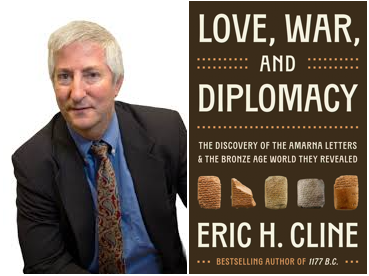
Eric Cline: Love, War and Diplomacy, international relations in the Bronze Age
20m 0s
The podcast delves into the discovery of the Amarna letters, found in 1887 in Egypt, written on clay tablets in cuneiform. These letters, dating back to the late Bronze Age, contain diplomatic correspondences between rulers and provide insights into ancient civilizations. The circumstances of their discovery were dubious, involving looting and questionable origins. The Amarna letters were written in Akkadian, a diplomatic language of the time, and reflected the prestige of scribes who were few in number. Cuneiform writing, a syllabic system, required specialized training to read and write. The podcast highlights the significance of these letters in understanding ancient societies and sheds light on the challenges and intricacies of deciphering ancient languages and scripts like cuneiform.
Transcription
2998 Words, 15712 Characters
This podcast is brought to you by the Albany Public Library remained branching the generosity of listeners like you Like a God daddy these people talk as much as you do Received cons unsupervised learning Everybody this is received con and I am here with returning guest Eric client professor Eric client of George Washington archaeologist that you probably know for his 1177 series of books most probably 1177 the your civilization collapsed There's now a graphic book of that and also after 1177 the survival of civilizations But today we are here primarily not exclusively but primarily to talk about love war and diplomacy the discovery of the armak our Marna letters and the Bronze Age world they revealed so the fact that I tripped over a Marna Probably is indicative this is not This is something that a lot of people know about but it's kind of nerd famous As opposed to just like you know Man or woman on the street person on the street, right? So can you tell us before we go into like the book and stuff like that What a Marna means like, you know, it's a place is you know, you isn't a person, you know, just a person who wouldn't know, you know Yes, absolutely and and First of all, thank you for having me back on again. It's always a pleasure to be here, but yes You and everyone else trips over the pronunciation of that name including Word and all of that because whenever I'm typing a Marna It auto corrects to Armana, which I think you know Armana radar ranges used to be a thing Right, and so every time somebody writes to me They're like I want to hear about the Armana time like no the Marna, right? So all right, so a Marna comes from it. It's a modern-day Archaeological site. It's called tell El Amarna It's in Egypt and it's approximately half way between Cairo and Luxor so it's right, you know almost in the middle of the country there But it was the capital city of the famous heretic pharaoh Akanatan and its ancient name was Aka Tatum Atum is the the disc of the Sun. It's not the actual Sun. That's raw But Atum is the Cincircle around the edge of the Sun and Akanatan who is ruling at about 1350 BC or BCE if you prefer Middle of the 14th century 3400 years ago He was the one that outlawed all other gods and goddesses in Egypt. You could only worship Atum and so he had a revolution not just in religion, but also in art and everything else And along with that he built a new capital city and that is tell El Amarna He was only there for 1015 years something like that and when he died the city was abandoned and King Tut moved the court back to Luxor. So it's what archaeologists love. It's a one-period site You go and excavate you know you were based on the Akanatan's reign exactly But among the other things that they left at the site when they moved it back Down south to to Luxor they left Park or almost all of the royal archives that Akanatan and his father, Oman Hoechep III, it's full of letters and Includes one as they exchange with royal kings the other great kings but also with vassal rulers that owed them allegiance in Canaan. So the Amarna letters have become very famous Within archaeology, but they are not well-known Outside of that small community of scholars. So I wanted to do a deep dive on them and bring them to the attention of the public Yeah, I mean and obviously it's a engaging book title the book is engaging I will say so you know, I want to start out a little bit Perhaps in a surprising way for the listener. Instead of talking about the late Bronze Age talk about the 19th century The book kind of is structured in a way where you you know are hitting two epochs I would say like the early Assyriologists Antiquare late antiquarian Kind of like the the emergence of modern archaeology in the late 19th century, which was you know, I think many of us Know about Heinrich Schleeman You know it is like explosions here. You know what I'm saying the things he did and it's in that context of that world and so Talk about a little bit I guess word me skullduggery may be involved in the discovery and The assembly of the Amarna letters like in 19th century Europe Yeah, sure so you're evoking kind of Schleeman is dead on in fact Schleeman was Digging a Troy in the 1870s and then the 1880s Dropped dead in 1890. So the Amarna letters were found right at that time. They're found in 1887 So precisely the same time Schleeman's working up at Troy in Turkey, but The circumstances of their discovery are a bit cloudy, shall we say? The usual story that people tell is that a local woman who lived near Amarna was in the ruins looking for either Firewood or Fertilizer and it is true that ancient sites do provide pretty good fertilizer because of all the human activity back in antiquity But while she was looking for that fertilizer She happened upon a wooden box full of clay tablets That's how the story goes and that not knowing how much they were worth she brought them all back to the village Turns out there are almost 400 of them and she sold them to a neighbor for literally pennies on the dollar That neighbor recognized that they were worth a lot more He in turn sold them for about 60 times that price to antiquities dealers and they then Flooded the market basically with them such that by By November or December of 1887 and into early 1888 there were Representatives and agents from all the major museums in Cairo and Luxor Attempting to buy these tablets and ship them home to their museums Now one of the problems with that story is that the woman the woman who supposedly found them could never be located again They never they could never find her and I think and I'm basing this on the work of some of my scholarly colleagues I think she was made up and It was actually one of the antiquities dealers who was doing an illicit Exclamation at the site who found them and then concocted the story It's very much like we have other stories where somebody was chasing an an errant goat or sheep and Happened to see they had fallen into it tomb when in actuality they were tomb robbers looking for tombs So I think it was actually an illegal excavation rather than this woman But regardless we then get all of these agents all these museum purchasers Coming to Egypt and trying to buy these these tablets so in the end They were dispersed. I mean as I said there's about 400 tablets in all and They are now pretty much all over the place. I think you could say they're in 14 different museums They're in eight different countries. They're in ten different cities. They're on four different continents I mean it is a prime example of egregious looting that would only be comparable to Like the Dead Sea Scrolls or some of the more recent looting in Iraq after the first and second Gulf Wars So you know if these have been found by archaeologists First of all we would know exactly where they came from at the site We think we know where it is, but we're not sure and they would have all been still together Presumably in Egypt at the Kyra Museum But also we're told by a number of different sources that in lugging these tablets up and down Down to you know down to Luxor and up to Cairo they were in donkey bags and they broke and so one Scholar at the time says he thinks of between A third and a half of all of the original tablets were destroyed and are now a lot of us. Yeah So we've still got 400, but there might have been at least 600 if not more. So this is a huge loss Even though what we've got is amazing. We would have had even more So we put it into the context of the day when all of these people were being you know colonialists and grabbing the stuff Making taking it out of Egypt and taking it back to the Louvre in Paris and the British Museum in London and the Museums in Berlin. There's even a couple at the Met in New York But out of all 400 there's only 52 that are still in Cairo all the rest are dispersed around the world Yeah, I mean I I would say I would say that In terms of You know archaeology, you know, we see the end product a lot of time but There's there's a lot of detail and just like human Activity in a not so high-falutin scholarly way that also goes on and I think we know a little bit of the Elgin Marbles controversies And I think with archaeology isn't you know, it's it overlaps with the art dealer market as well And so there's a lot of money involved right potentially potentially. Yeah, so You know, I think it's interesting that you you know highlight that I will I can you you actually tell you said tablets You know, I know what that means so you know when we're talking letters here We're not talking like folios or like you know piece of paper obviously. We're not even talking carcassment or You know anything like that or papyrus that tells what we're talking about. Yeah, we're talking about clay tablets There are some mistakes you'll see out there on the internet saying that they're stone tablets No, they're made of clay In part because you're inscribing you're writing directly on the clay while it's still wet and then you can fire it as if it's pottery And it becomes permanent. So these are clay tablets most of them are about the size of your hand like You can hold it in your hand with one hand and write on it with the other So they're like palm sized, but some of them are even larger There's one that was that's like almost a half a foot tall So they can get pretty big and they've got lines of Cuneiform which is the wedge shaped writing system that was used in the ancient Near East to write languages like Akkadian, Babylonian, Hittai, Sumerian, and so on Cuneiform literally means wedge shaped in Latin and it's interesting that these tablets are written using Akkadian and Cuneiform even though they're in Egypt You would have thought they would have been written using Egyptian hieroglyphics But at that time and we're in the late Bronze Age here the 14th century Akkadian is the lingua franca. It's the diplomatic language over the day So just like French was used in Benjamin Franklin's time as the diplomatic language so back then Akkadian was used So if you had a king in Egypt who was writing to some other king His scribes would know Egyptian, but they would also know Akkadian Up in Anatolia modern day Turkey where the Hittites were the scribes there would know Hittite and Akkadian If you're living in Mesopotamia if you're in Assyria and Babylonia then you're lucky because you're doing Akkadian anyway and using Cuneiform So when I say that these are the Amarna letters or the Amarna tablets as their alternate names Yes, we're seeing things written on clay Now that doesn't mean there weren't other things that might have been written on Papyrus But that hasn't survived the clay however has survived and Almost all of them I actually just heard a paper last week almost all of them were in fact Fired in a kiln before they were sent because that would not only Protect them from damage But would also stop anybody from altering what was written on it because now it was permanently baked into it so We have Similar archives elsewhere written also on clay tablets, but they're few and far between We have an archive up at the Hittite capital of Hattusa We have some merchants archives Which are also royal at Ugarit on the north coast of what is now Syria And we've got other ones from the site of Mari a little bit earlier in Mesopotamia But this is the only one this is the only such archive we have from Egypt There must be more every thing you would have had them right double the third would have had it Ramsey's would have had it But this is the only one we've got from Egypt Okay So Obviously this is This is quite a not a labor intensive or maybe capital intensive. It's an intensive way to do writing. I think it uh You know, I mean, you know back in in our day, you know, we used to write with pen and paper and you know send it off to mail And now we have this flood of information On screens that we see, you know, it's so cheap You know, this is this is not something that's like entirely accessible to the average person correctly There would not be that much maybe taxes. My understanding is taxes are probably Uh, one of the reasons that writing emerged Um, and maybe you know, if you're a peasant Uh That your taxes might be a ledger somewhere, but you're not like like normal people are not normal quote-unquote people You know average people in the ancient world are not writing like this to each other. Are they? No, no, no, no not at all not at all and I mean a lot of what we have you're correct a lot of what we have is um economic Tablets economic text right, but no, I would say the the usual figure you hear bandied about is 1% Would have known how to read and write back then in that area of Egypt and the Mediterranean It was uh, even the kings and queens probably didn't know how to read or write so the position of scry Was a very prestigious one and in Egypt especially you can always tell a scribe He is the person sitting cross-legged with something on their lap and that's pretty much the universal sign of a scribe So yeah very few people would have known how to do it. It is labor intensive, but on the other hand Once you know how to do it, it can be quite fast. In fact, there's a couple of um of videos on youtube where you can see somebody Uh, actually writing in cuneiform a tablet today and they can get pretty fast It's mostly what you do is you take a read from you know the the Nile River a piece of papyrus The actual stock and it's when you cut it. It's got a triangular end and that's what you jab into the wet clay You jab it and drag it jab it and drag it and a number of those eventually You'll get these wedge-shaped signs. There's about oh 600 of them or so each with multiple meanings depending on the context So you really did need to be trained on how to do this But once you get to hang about it's pretty fast one thing to keep in mind. This is not an alphabet Um, the alphabet will come along soon enough, but not quite yet The signs that they're making are syllabic So it's like a vowel and a consonant or a consonant and a vowel and the way that you write it is you usually use one sign that ends with say like an a and the next sign begins with the a sign. So one example The word for if is schum and ma so you have the schum sign, you know, sh um and then the next sign is ma ma So and then the schum and ma runs together. So you've got schuma, which means if so you write it like that So it's syllabic not an alphabet Well, yeah, and I think I said north indian language or the indian languages are syllabic as well So, you know, this is a one little thing and um, so so obviously um, you know, you know how to read cuneiform, right? Yes, uh, I know. Yes. Exactly. You can infer but remember cuneiforms are writing system So I can yes, I can identify the signs what I can read is a cadian. So the language exactly Which is you know, very similar Babylonian a cadian so I can read homorabi's law code or you know the original i for nigh Tooth for a tooth but um, you know and those are going to be specialists But then you have hitchitologists who are specialists in hitchite where which they're using up in an otolia Right, so my two languages and graduate school were ancient Greek and ancient accadian I see and then like in Greece you have linear B Uh, which is similar, but it's it's for Greek um actually just this is a I don't know what the answer to this is I could ask Uh in AI, but let me ask you because I think you would know better about how many people do you think of the world can read cuneiform today of whatever language How many people today can read cuneiform? Oh
Podcast Summary
Key Points:
The podcast discusses the discovery of the Amarna letters in the late Bronze Age.
The Amarna letters were found in 1887 in Egypt and are written on clay tablets in cuneiform.
The discovery of the Amarna letters involved dubious circumstances, including looting and questionable origins.
The Amarna letters were written in Akkadian, a diplomatic language of the time, and contained correspondence between various rulers.
Cuneiform writing is syllabic, not alphabetic, and required specialized training to read and write.
Summary:
The podcast delves into the discovery of the Amarna letters, found in 1887 in Egypt, written on clay tablets in cuneiform. These letters, dating back to the late Bronze Age, contain diplomatic correspondences between rulers and provide insights into ancient civilizations. The circumstances of their discovery were dubious, involving looting and questionable origins.
The Amarna letters were written in Akkadian, a diplomatic language of the time, and reflected the prestige of scribes who were few in number. Cuneiform writing, a syllabic system, required specialized training to read and write. The podcast highlights the significance of these letters in understanding ancient societies and sheds light on the challenges and intricacies of deciphering ancient languages and scripts like cuneiform.
FAQs
Tell El Amarna is a modern-day archaeological site in Egypt, located approximately halfway between Cairo and Luxor. It was the capital city of the pharaoh Akhenaten.
The Amarna letters are a collection of clay tablets containing diplomatic correspondences from the ancient Near East. They are significant for shedding light on international relations during the Bronze Age.
The Amarna letters were discovered in 1887 in mysterious circumstances, often associated with a local woman finding a wooden box full of clay tablets near Tell El Amarna, Egypt.
The Amarna letters are made of clay and inscribed with cuneiform writing, a wedge-shaped script used in the ancient Near East. Most of the tablets are palm-sized, but some are larger.
Only about 1% of the population, mostly elite scribes, knew how to read and write in ancient Egypt and the Mediterranean region. Even kings and queens likely did not possess literacy skills.
The Amarna letters are written in cuneiform, a syllabic script used for languages like Akkadian, Babylonian, Hittite, and Sumerian. Cuneiform was the diplomatic language of the time.
Chat with AI
Loading...
Pro features
Go deeper with this episode
Unlock creator-grade tools that turn any transcript into show notes and subtitle files.
 PodcastTranscript AI