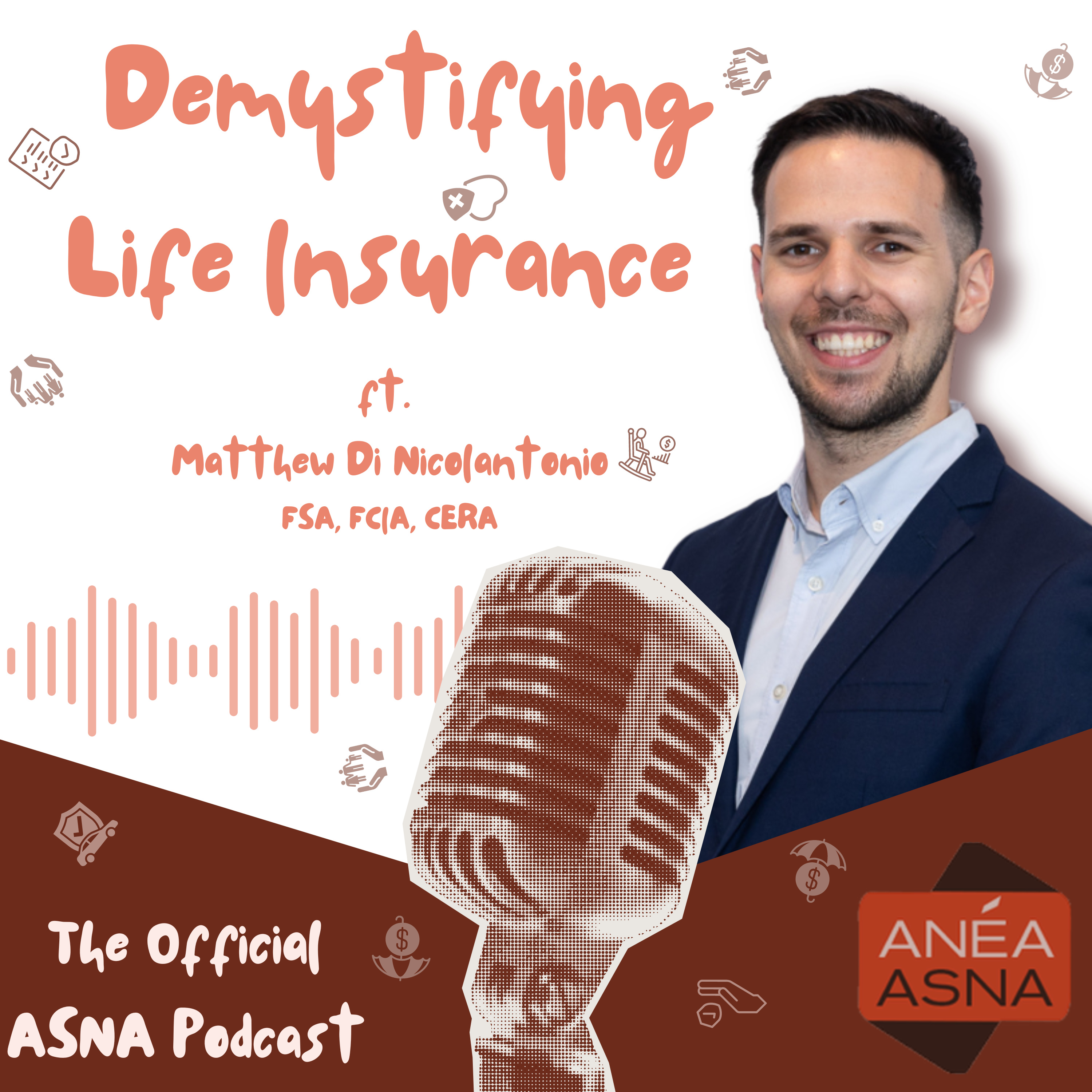
In the podcast, Matthew Dini-Kolantonio discusses his career journey at ManuLife, focusing on his recent promotion to a global role in product and insurance risk management. He reflects on how his previous roles in oversight and group benefits valuation prepared him for this new position. Matthew emphasizes the diversity and complexity of roles within the life insurance industry, challenging misconceptions about its perceived monotony. He also shares insights on hiring criteria and advises candidates to demonstrate curiosity and research in their applications. Regarding the Canadian life insurance market, Matthew highlights key players and the maturity of the industry, suggesting that interns explore opportunities in this field. Looking ahead, he anticipates technological advancements and trends like climate change to shape the future of the actuarial role in life insurance.
Transcription
5384 Words, 29516 Characters
Hello everybody, welcome to the official ASNAP podcast. My name is Darsh Ward here, I serve as the VP Communications of ASNAP and the host of this podcast, where we try to bring actual knowledge right to your doorsteps. Today we're joined by Matthew Dini-Kolantonio, an associate actually at ManuLife with over five years of experience in life insurance. Matthew's journey is mocked by a strong commitment to both his profession and his community. His earned, his degree in actual mathematics from Concordia University where he also completed a summer exchange in Spain. Beyond his work, Matthew is deeply involved in public service. He's held various leadership roles in the Pachlimol Genestika Beck, reflecting his passion for politics and making a positive societal impact. He's also been a peer mentor with ASNAP, helping guide actual aerial students across the country. So let's dive right into it, Matthew, the world of life insurance. Thank you for being here today, I truly appreciate your time. How are you feeling today? I'm feeling great, and I'm honored to be here, and I'm really happy to be able to speak to my experience and hopefully give your listeners some more insights into the life insurance industry. For sure. Matthew, you recently told me that you're about to get into a new position at ManuLife. You got promoted to associate actually working in product and insurance risk management. I was hoping you could talk a little bit about this new role, and if you're excited for it, and what the role entails. Yeah, absolutely. So I just started in the role fairly recently, and it's a really interesting role. It's a global role, so I get exposure to our Asia products, our US and our Canada products, and really I get to work closely with underwriters to understand the impacts of some new key initiatives on our business. Yeah, looking at those new initiatives and what the impacts might be, whether those align with our risk appetite as a company. And I get to look at the lines of business from a really different perspective. So some of the reports I get to work on, one of them is the geographic concentration of risk. So that one I get to look at for our group benefits businesses across the globe. Do we have a large concentration of risk in either one building or one particular postal code, if there were to be, say, an earthquake or a terrorist attack on for bed, like do we have enough free insurance, or are we overexposed in a particular area? So that one's interesting. I look at our retention as well, so trying to see, you know, for some wealthy individuals that may come to our Canada business, get a life insurance policy there, go to our Japan business, try to get another policy, you know, do we have too much risk on one particular person, or are we getting enough free insurance as well to spread out the risk? And one of the other really interesting things that I've found so far in the role is I look at our sales bands as well. So, you know, politics is very interesting to me. You mentioned that while we did the parliament simulation earlier. So with this role, I get to look at what's going on around the globe, different conflicts and whether we need to put some temporary sales bands in place, say, you know, Israel, Russia, countries where there might be some civil unrest, do we need to rethink our practices. So far, really enjoying the role very much. It's really different than my previous roles at Manilaev, which I'm happy to talk about if you're interested in. Yeah. No, for sure. That was actually really interesting. I loved how you talked about the sales band. I think that really peaked my interest. That was super cool. I never thought that you would have to work in a role directly involved in something like that so far away. So that's cool to know. And you mentioned your previous roles as well. So do you have to be an expert because I know that you said this is a global role, but you have to be an expert in like understanding the Canadian insurance market before you move onto a role like this. Is this why you had the two previous roles? I think you worked in oversight work for IFRS 17 implementation and group benefit valuation. So these roles sort of serve as a building block for you to get to this global role. Yeah. Well, I wouldn't say it's a necessity, but they definitely help. So I could talk a little bit about the roles. My first one, as you mentioned, on the oversight team, that was a valuation role. It was Projects Beast. So I got to work on one project that was more modeling focused and another that was more on the project management side of things. And it was a great first role at the company. I got a good oversight on different products that we sell in Canada. And so that's definitely beneficial to my role. I understand the Canadian market a little bit better. And my second role was, as you mentioned, in group benefits. So that was another valuation role, but this was a modeling focused role. I did become the model expert after a couple of years on the team. So I was in charge of our five models that we have in group benefits. So that would be your long-term disability. We have some life insurance as well. If you think about your dental coverage, vision coverage, things that are typically offered to employers. So that was a really interesting modeling focused role. And I think it helped as well. Like I mentioned earlier, the geographic concentration of risk that's purely related to our group benefits business. But now in this new role, I get to see it from a totally different perspective. Whereas before I was focused more on valuation, calculating reserves, what are the assumptions that go into our models, the appropriate, are they up to date and everything? Whereas now, getting to see things from a global perspective as well, like our business and the Philippines and Hong Kong, other countries as well, instead of just Canada, it's been helpful. It sounds like you're moving from a so-called more traditional role to a more like evolved and new sort of role in the actual scene. Would you say it's more non-traditional? I would say so, yes. And that's kind of what I was looking for. I think it was great. I have some pricing experience for my internships and I got to work quite a bit in the valuation since I started with the company. So I wanted to try something a little bit different. And this is more related to the exam path that I took as well. I got my fellowship in corporate finance and ERM, track of the SOA, so getting to see things from a more high level risk perspective is really interesting to me. Wow. It's cool to see how you can pivot and move around because once you get your ASA, you could pick which FSA path you want to take and that would sort of transition into the responsibilities and roles you want to pursue later in life. Exactly. So that is cool to see. How heavily are technical skills involved in the work that you do on a day-to-day basis in terms of the valuation you did before and this new role? What sort of software do you use on the daily? Yeah, good question. It definitely depends on the role. So my first role in oversight, that was not a very technical role, but I did express an interest in working on a modeling project. So I got to work on one, which was great. My second role in group benefits valuation, it was the opposite. That was primarily a modeling role. So here I got to learn a lot about Axis, which is still the main modeling program that's used in life insurance, across various companies in Canada, and throughout the world. And now my current role in product and insurance risk management, it's not a technical role. Similar to my first one, I'm working mainly in Excel and Word, but that said whether you're in a technical role or not, you still need to be able to analyze results. Modeling something is great, but explaining the impacts of your changes or the drivers of the corridor of a corridor movement, that's really where actuaries can play with people. I don't know if that was very insightful, thank you for sharing that Matthew. Something else I wanted to ask you was, you also have experience working as an intern in PNC, and you had some time about the year you spent in pension administration. How was your time there, if you could speak a little bit on what you felt while you were working in those roles? Yeah, absolutely. So yeah, I did get to do three internships during my degree, and my first one was in pension administration. I worked up on Bardy. And that was a great place to start, I got to put into practice some core actuarial concepts that I had just learned in my classes that year, like present value and annuities. It was a great work environment, and I did go back part time afterwards, which is why yeah, I ended up working there for about a year in total. And yeah, my second internship was in PNC, I worked on the pricing side, personal lines, and that was a great role too. It was my first time working with programming, I had never really done any programming prior to that, and it was a good challenge. It wasn't the right fit for me, and that's okay. That's kind of the point of the internships. I really highly encourage everyone to try as many different things as you can during your degrees. It's really the time to do it. It's basically a four-month test for you, for the employer, and there's no commitment after to come back if you really don't like it, then at least you know, and you won't waste a couple of years after you graduate to try and find what it is that you like. So I got to try a little bit of the different things during my internship, which was great. I'm building off that. So what initially drew you to life insurance and what has retained you there for so long? Yeah, a great question. So the life insurance internship at Manulife, that was my third one, and my last one, and I would say the fit with the company was what initially drew me. The company culture was great. One of our values at Manulife is share your humanity, so we're really encouraged to bring our true and authentic selves to work, and I think that that's amazing. You want to be comfortable where you're working, and that's it. It helped that I got along with a lot of people, and so it was a great fit from the start. But beyond that, I would say there's just so much to learn. Had a big company, a big life insurance company in particular, because that's been my new experience. I mentioned I've had a couple of roles already. I mean, my third role with the company, we get to change roles every two, three years, to see something completely different, and being a big company, there's just so many different things to try. You have your traditional actuarial roles, like pricing and valuation, where you're calculating reserves. But life insurance actuaries can also work in experience analytics, where you're conducting studies. So looking at our different assumptions every two, three years, seeing whether there's still up to date with the latest trends, and whether any updates need to be made there. They can work in asset liability management, working group functions, where you'd be aggregating data for reporting across geographies. You can work in capital reporting, where you're aggregating capital across geographies, or analyzing the different asset classes that we hold with real estate. Actuaries can work in audit, and there's so much more. That's just the difficulty iceberg. So I guess that's what drew me and what has kept me in the life insurance industry so far is the fit with the company personally for me, and then just this year amount of opportunities to lay. So what I've gathered from all of this is life insurance is very diverse, and there's a mix of traditional and non-traditional roles in all these companies, and it's really up to you to reach your arm and extend and figure out where you want to be, because for me, like when I was still in university, but I've been trying to understand where my place is and all this, a lot of like myths and misconceptions come my way about like what life insurance is, and people say it's a boring, repetitive desk job, but clearly it's not the case. It's really up to you. It is what you make it to be. What about you? Are there any myths or misconceptions that came your way, which you found to be completely untrue? Yeah, I think that's the main one. Life really has this trope of being boring, people think, "Oh, it's long term. We sell a policy. We just make sure people pay their premiums, and then we don't talk to the policy holder for another 40 years." But there's really much more to it than that. Life insurance company will offer many more products than just a whole life insurance product. For example, universal life or participating life insurance products, these have really interesting and complex riders and features, group benefits, which I worked in previously. It's usually annually repricable, so it's a short-term product where we're constantly repricing to make sure we have the best possible retention, so that's very engaging. We also have our investment in banking products, like ETFs, GICs, mortgages, credit cards. That makes it that we're competing with the big banks in Canada as well. We sell travel insurance through our affinity business as well. It's very varied. The products are really different from each other, and you get to see so many different things. For people who might think that life insurance is boring, I would argue that the opposite. I would say it's as interesting or even more interesting than PNC, with just this year amount of products. Thank you for sharing that Matthew. Some of you might not know this, but Matthew, you're also the co-lead for accruements at Manual Life in Montreal, so I was hoping to get into that. I'm pretty sure our listeners would love to hear some tea on what exactly you look for when you're hiring, some green flags, maybe even some red flags. Yes, okay. I could talk all day about this, but what I'm really looking for in terms of candidates is someone that's curious and that isn't afraid to ask questions. Critical thinking is such an important part of the job, so if you're able to understand the bigger picture of your work, you'll be able to deliver a much better analysis than someone that's simply updating the links. I'd also say you stand out if you can truly be yourself. I mentioned it earlier, our company value of sharing your humanity. I think it's so important, because if you think about it, we're going to be spending a huge amount of time together when you're working with us, so we're also assessing whether you could do some of this easy to work with and get along with some red flags you asked for. Yes, know what the company you're applying for, what they do, try to craft a unique cover letter for each application. I'd say it doesn't have to be long, but I want to see that you've actually done some research on the company and that you know what we do. I've seen some cover letters with other companies' names on it, so please don't do that. On that note, if we're a life insurance company, don't say in your cover letter that you're excited to try PNC. Also, if an application asks for three documents, then put all three documents. If you're just sending your CV without your cover letter and your transcript, you clearly didn't care enough to read the requirements and things like that show your intentions. Honestly, you got me there, because I feel like a lot of the seniors, what they told me when I was applying for internships was, cover letters don't really matter. Don't worry about that too much. They don't really read it, but thank you for opening my eyes on that. I'm definitely going to be more careful with that. Yeah. It depends on the company. Maybe some companies they don't care so much, but when you're looking through so many CVs that look exactly the same, I think anything you can do to differentiate yourself, that's say like if you put even an interesting hobby or some volunteer experience, that helps set you apart, that'll catch our attention. So I do take a look at the cover letter, speaking for, yeah, my own personal experience. And the last thing I would say for an interview, you know, come prepared with a couple questions that show why you want to work for us. And again, that you've done your research and your golden. Fair enough. Yeah. Thank you for sharing that. I'm definitely going to write that down and apply that to the best of my abilities. Something else I wanted to ask you, I wanted to dive into the Canadian Life Insurance Market just in general for students who are trying to navigate their early careers about trying to understand what the key players, the key companies in the Life Insurance Market are and what sort of experience they should be looking for when they're applying to these different companies if you could speak a little bit about that. Sure. So the Life Insurance Market in Canada, it's fairly mature, it's been around for about 200 years. And so most of our growth now, it's coming from our group benefits business, which as I mentioned earlier, it's annually reprisable and from Asia, where the Life Insurance Market is much newer. But we also have growth from new product launches, like Vitality is an example of something that we offer which allows people to get rewards, like gift cards for just engaging in healthy activities, so getting a certain number of steps in in a day or going to the dentist once or twice a year. So products like that, I think those are pretty interesting new things that are being launched in Canada. And if we compare with the US, the US has a lot more Life Insurance companies and they tend to specialize in specific product lines. Whereas in Canada, there's just a few big players and they generally offer the whole suite of products. So you have ManuLife, Sunlife, Canada Life, and Quebec, Desjardins, Industrial Alliance. These are the big companies, they're fairly similar in terms of their product offerings. And I would say for the benefits that they offer new hires and students as well, like salary increases for when you pass an exam, study days off, things like that. So I would definitely recommend to try at least one of your internships in Life Insurance and see how you like it. Fair enough. Yeah, that was very insightful. I liked how you gave us a good summary of the Canadian Life Insurance market and when comparing it to the USA, I think that was very insightful. Something else I wanted to talk about is the future with the actual role in Life Insurance. Obviously, things are evolving at an incredible rate. What an actually does now is different from what we did then. I don't think vitality would be a thing in the past. It is something new that's been added on to the role of an actually. So could you speak a little bit about what you expect in the future of how this role would change? Yeah, great question. So the industry has definitely changed a lot over the past few decades. I've heard stories of 40 years ago, calculations being done by hand and with these big calculators and I've heard, you know, 20 years ago, some actuaries when you need to come in on the weekend to see how their runs were going during quarter-end because they'd be running just on one computer and the run crashed and they'd have to pick it off again and I can't even imagine. So I would continue to expect changes in technology, definitely some other emerging trends. Climate change is huge, so we're needing to decide which geographies we want to operate in and climate change is negatively impacting people's health. So vitality, that's one of those products we're able to offer to improve people's health. And I recently worked on our company's climate change disclosure and there's some really great work being done in this space. So we definitely need to understand how climate change is impacting and how it'll continue to impact our claims. And another big one would be cyber risk. So insurance companies have a huge amount of data and our risk management teams are assessing these risks regularly and trying to see what we can do to mitigate them. And because of that, share amount of data insurance companies are heavily targeted on cyber risks. So we need to have the best possible protection to avoid any sort of data breach because that would have a huge impact on our reputational risk. So those are some of the things I would continue to look for in the next few years. So the three things you spoke about was technology, climate change and cyber risk. So how should young actuaries develop like certain skills? What skills should they develop to like stay ahead in these three areas? Yeah, I think technology is crucial to our work as actuaries. Our business decisions, they're largely driven by our analysis of large amounts of data. So the more insights we're able to draw up on this data, the better our decisions and results are going to be. So it'll be crucial for actuaries to stay up to date with changes in technology. And I would say the more programming languages, you know, the better. And on that same subject of technology, another big change right now is with respect to AI. So we need to be able to understand, you know, how to leverage the risks associated with AI, how to mitigate those risks. If we talk about gen AI, chat GBT, for example, it'll retain anything that you put into it, so we can't put confidential information into it, but I manually, if we've developed our own internal generative AI tools, so that's that's been great and it's going to continue to evolve and continue to be improved and that's going to help us with our work for sure. So that's something I think we as as actuaries need to stay up to speed with because it's just going to continue to evolve and if we don't leverage those those tools, then we're going to be left behind. Wow. That was very insightful. I loved how you spoke about chat GBT because I find myself using it all the time, not for client work, just for personal work. I don't want any confidential information out there. Something else I wanted to ask you is, you've always wanted to give back to the community, be it as an educational assistant, a peer mental, or even your goal at the path, the more genus, the Quebec. Where does this inspiration come from to sort of give back? Sure. So I mean, those are pretty different experiences, the ones that you listed. So educational assistant, that was my first part-time job as a student. So there I was just looking for my first summer job experience for the peer mentor. So I had a mentor in my first year at Concordia and this was really helpful for me to get an understanding of the actuarial field and how to best prepare myself for exams and to be able to secure my first internship. I really do see the value in mentorship programs. So I decided to become a mentor later on in my degree for younger students, because when you're first starting out, you don't really know what's going on. So being able to get advice from someone that's familiar with the field, that can be very helpful. And we actually have a mentorship program at ManuLife as well for our interns and for our new hires so that they have another resource for questions about the company and the industry. And yeah, you mentioned the parliament simulation. So that initially just came from an interest in politics, like I mentioned earlier, I love politics. So I decided to sign up for that and I ended up learning a lot about some new and evolving subjects that impact us all, like AI, sustainable transportation, the functioning of our political institutions, and I got to meet some really dedicated and interesting people from different backgrounds. I did that for five, six years, so yeah, that's a little bit about the, I guess, where those experiences come from. Um, question building off that, did you ever find like your actual skills being put into practice in these different roles you held at the youth parliament? Yeah, I would say so. I was always or almost always the only actuary at these things. It tended to be a lot of law students that were very interested in participating. But yeah, I guess having a bit of a more technical background helped. Like there was one bill that we were studying that was about, you know, should we replace judges with an AI, uh, funny enough, and this was back in 2019 that we had this debate. So, uh, yeah, it was a matter of talking about like, are we ready? Is is AI there yet? And, you know, what sort of confidence level will we need to, to have to be able to fully trust that? So, uh, I guess I was able to leverage some of my technical experience and make a couple of tweaks to that bill that we were studying. So yeah, I think it helps bring a different perspective. You don't need to necessarily have this passion for politics. A lot of people don't that they sign up for the simulation. They just, that are interested in debate or just want to, you know, need people that, uh, you know, have similar interests to them. So yeah, I did help them. Thank you for sharing that as well, Matthew. Um, the last question I have for you, Matthew, is if you have any advice at all for young actually is considering a career in life insurance. Like, for instance, a student who is, who just entered university, I, I think I want to do actual science. I think I want to do life insurance. What should I do to explore these avenues and see if I'm a fit? So I have a few different pieces of advice. The first I would say is to pursue your exams at a study piece. So whether you're doing the, the S O A or the CIA path, I think the more you can do earlier on the better and it'll give you an idea to even if you're, you're not sure yet, if that's the path you want to pursue, it'll give you an idea of whether you're interested in, in that and, uh, and want to do more exams like that, uh, they're so much fun. But, uh, no, I mean, I, I think that that differentiates us in Canada as well. If you compare with the US, uh, they tend to only start their exams after their degree, or they'll do maybe one exam during their degree, whereas in Canada, we're pretty good at doing at least, at least like, for your four exams during our degree. That's more for the S O A path, and I was a bit different with the, the CIA path. But I, I mean, it, it remains the same I would say the more you can do earlier, the better. There's, uh, you know, for time management, maintain a schedule and, and do what best, what works best for you, everybody has, if the schedule, some people work better at night, some people work better in the morning, um, so just maintain a schedule, uh, that helps you stay on track for everything and, uh, make time for the things that are important, you know, we often say there's not enough time, but we can always make time for the things that are important to us. That said, we do have to be disciplined, so we've got to say no to things sometimes. Uh, I don't know how many parties I had to say no to when I was studying for my exams, but, uh, it's, it's worth it in the end, because then you can say yes to everything when you're done. So, uh, yeah, that's on, on the time management side of things, um, for courses, I would say, help each other out. Uh, I firmly believe in, uh, together we stand, divided, we fall. So really, uh, I think everyone will get further along if you help each other out instead of it being a more competitive environment. I think that that's just going to be detrimental, uh, ultimately, and at the end of the day when you're working, you're not working against other people, you're working with other people. So, uh, do that with, during your degrees as well, it's my recommendation. Uh, I mentioned it earlier, try as many different internships as you can, uh, that'll help give you an idea of what you want to focus on, what you might be interested in, um, be curious, ask lots of questions in your internships, you're there to learn, and, uh, that's what, that's what we're there for, uh, as, as managers, as employees to, to answer those questions and to, to help support you. And on a personal note, I would say try to do an exchange, if you can, I, I got to do an exchange in Spain near the end of my degree, and that was one of the best experiences in my life. That's a lot of different people from different backgrounds, uh, and yeah, it was just so much fun. So, uh, highly recommend doing it today. Did you finally get to say yes in your trip to Spain? I finally got to say yes, I think I, I wasn't writing anything that, that summer, so, so yeah, so that was great. I'm actually really interested in doing an exchange. I will definitely look into that, um, and that brings us to the end of this podcast. I wanted to thank you, Matthew, for your time and your incredible insights today. And I will be sharing your LinkedIn profile in the description below. So feel free to connect with Matthew if you have any questions. If you want to learn more about what he does, and if any of his insights really resonated with you, feel free to reach out. Um, I also want to thank you all for tuning in today. Hope you all learned something today. Please check out our website and socials that will be linked in the description for more actual resources. Thank you all, and have a great week ahead. [BLANK_AUDIO]
Podcast Summary
Key Points:
Matthew Dini-Kolantonio, an associate at ManuLife, discusses his journey and new role in product and insurance risk management.
Matthew's career progression from oversight work to group benefits valuation prepared him for his current global role.
Matthew highlights the diversity and complexity of roles within the life insurance industry, dispelling myths about the field.
Matthew shares insights on hiring criteria and advice for candidates applying to life insurance companies in Canada.
The Canadian life insurance market is mature, with key players like ManuLife, Sunlife, and Canada Life offering a variety of products and benefits.
The future of the actuarial role in life insurance is expected to evolve with technological advancements and emerging trends like climate change.
Summary:
In the podcast, Matthew Dini-Kolantonio discusses his career journey at ManuLife, focusing on his recent promotion to a global role in product and insurance risk management. He reflects on how his previous roles in oversight and group benefits valuation prepared him for this new position. Matthew emphasizes the diversity and complexity of roles within the life insurance industry, challenging misconceptions about its perceived monotony.
He also shares insights on hiring criteria and advises candidates to demonstrate curiosity and research in their applications. Regarding the Canadian life insurance market, Matthew highlights key players and the maturity of the industry, suggesting that interns explore opportunities in this field. Looking ahead, he anticipates technological advancements and trends like climate change to shape the future of the actuarial role in life insurance.
FAQs
In his new role, Matthew works closely with underwriters to understand the impacts of new key initiatives on the business. He also analyzes geographic concentration of risk, client retention, and sales bans globally.
Matthew's previous roles in oversight work for IFRS 17 implementation and group benefit valuation provided valuable experience for his current role. These roles served as building blocks for his transition to a global position.
Matthew describes his transition as moving from a more traditional role to a more non-traditional role focused on high-level risk perspectives. He appreciates the opportunity to explore different roles within the industry.
Matthew looks for candidates who are curious, ask questions, and demonstrate critical thinking skills. He advises candidates to research the company, craft unique cover letters, and come prepared with thoughtful questions during interviews.
Matthew mentions key players in the Canadian Life Insurance Market such as ManuLife, Sunlife, Canada Life, Desjardins, and Industrial Alliance. These companies offer a range of products and benefits for new hires and students.
Matthew anticipates continued changes in technology and emerging trends like climate change impacting the role of actuaries. He mentions the importance of understanding and adapting to these changes in the industry.
Chat with AI
Loading...
Pro features
Go deeper with this episode
Unlock creator-grade tools that turn any transcript into show notes and subtitle files.
 PodcastTranscript AI