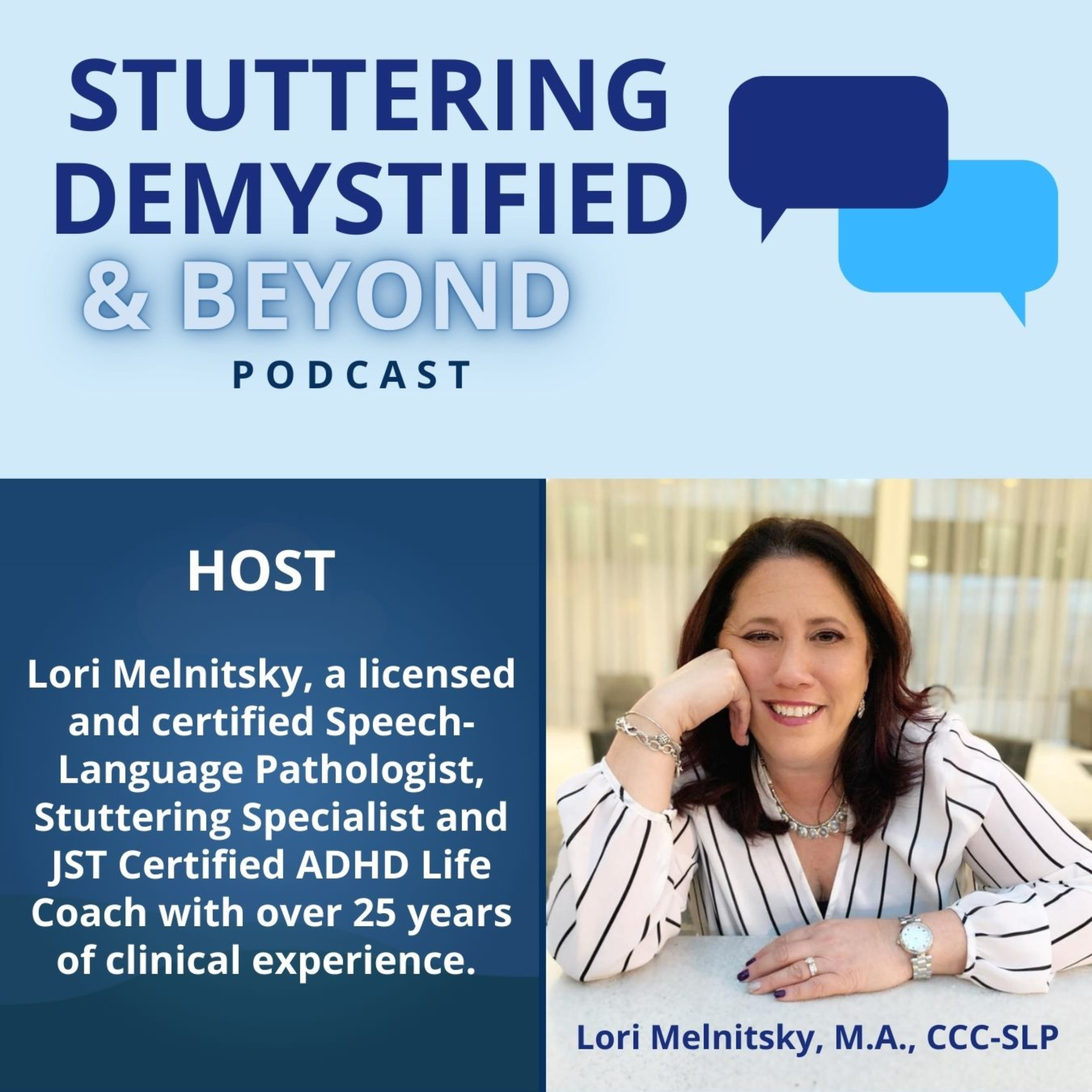
Episode 97: College Is Hard Enough—Stuttering Shouldn’t Make It Harder
10m 4s
In this episode of "Stuttering Demystified and Beyond," the host Laurie Melnitz recounts her experience in college, feeling isolated and challenged by her stuttering. She reflects on the importance of communication, fluency, and self-esteem in academic and social settings. Laurie stresses the significance of seeking help and support for stuttering, especially for young adults in high school or college. She encourages parents to recognize signs of struggle in their children and provide information and support. Laurie's journey led her to become a speech pathologist, developing a program based on her experience and the MPI approach. She offers coaching and emotional support online to help individuals improve fluency and feel better about themselves. The message resonates with the idea that everyone's voice matters, and seeking help can lead to significant progress and confidence.
Transcription
1315 Words, 7166 Characters
Hi and welcome to another episode of Stuttering Demystified and Beyond. I am your host, Laurie Melnitz, a Stuttering Specialist, speech pathologist, Mom, and a person who stutters. And today I wanted to talk to you, I want to tell you a story actually, about college, and I went to Hofstreet University on Long Island, I lived home for the first year, and many years ago we had to go to college orientation. And I didn't know anybody, most people were assigned a roommate because it was overnight, but for some reason I was not. I was in a single, and the electricity wasn't working all that well. So I was in a single with very little light. And one night we had to do an icebreaker, which they said, "We're not going to tell you what we're doing, everyone's going to go around in a circle, like, oh my god, I'm going to have to say my name, it's not going to be good." I was panicking, and they gave us a roll of toilet paper, and they said, "Tare off any number of sheets from one to eight." They didn't tell us why, they just said, "Tare it off." So I only tear it off one, because I really didn't know what was happening, honestly. Some people did tear off eight, they were more daring, and it turns out we had to go around the room and say one fact that ourselves, thinking back, I'm thinking maybe we had name tags, but I'm not positive, because I remember thinking I might have to see my name. So I can't remember the fact that I said, "I just heard my thinking like, thank God," I should say. Luckily, I only tore off one sheet, because that meant I didn't have to speak a lot. I realized at that time that, even though I finally had found, my parents had finally found someone who specialized in stuttering the year before, it really wasn't prepared enough for the amount of talking and socializing that I really needed in college, looking back, I'm a very social person, and my stuttering and my confidence and my self-esteem, and I always kind of suspected that I had ADG kind of held me back. I somehow made it through that night, I remember like staying in a world with no light, thinking this is very strange and really feeling like very isolated, and the first year of college, living home, finding it very hard to meet others and speak. Looking back on that, when I realized how important communication is, how important more fluency was to me, how important my confidence and self-esteem mattered. I always work, though, and I think that always gave me a sense of belonging and purpose, even before school, even though I didn't feel that comfortable in school. The next year, my parents told me that they wanted me to move on to campus. I think they realized how isolated I was at home, and they also helped me get into more intensive fluency speech therapy. I worked with coaches on confidence, and I met a few other people who stutter, who really made me feel like I wasn't alone. I realized, looking back, that communication is even sometimes more important than academics for me, especially, and for many of the people I work with. I thought I was a quiet, shy, introverted person, and I'm actually the exact opposite. I'm an extroverted, love being your own people, love speaking, love hearing other people, love helping others, and when I went back to my masters eventually in speech, and I still was struggling a bit, realizing the importance of communication. If you're a parent of a high school student, especially a college student, and you see your college student kind of answering in short sentences, hiding in their rooms, not making many friends, it might be time to get them help. As a parent of a high school student, I have older daughters now who are at a college, but I remember communicating with them in college about other things was never easy. They went away to school and sort of always had a worry, had to say the right thing, and I do have a younger daughter who has ADD and attentive, so I realize that there can be conflict at times. I just think we don't want to go through college thinking like if we get the greatest GPA ever, we're going to, you know, automatically have a job. We're in a world where internships matter, where people are getting at a school with like four internships behind them, and they're going on for a master's, and they're going on for an advanced degree, and inside I didn't want to talk about studying, I was embarrassed by a lot of shame, and my father studied also, so it wasn't that it was unheard of, it's just that I didn't want to admit to my parents that I was really struggling, I didn't want them feeling bad. I didn't really know how to approach it, even though they were, and I guess it was just easier saying everything's okay. Sometimes time is of the essence. Sometimes it is important to just really, you can sometimes even just say, you know, I was just wondering if you ever needed help, please feel free to come to me. Sometimes as young adults, we don't realize that other people are struggling, and so we don't know there are support groups out there. We don't know. We think we're the only ones. You know, I remember thinking at one point, I'm the only one who's going through this really hard time. I feel isolated. I really can't speak all that well. At that point, I needed to lose weight. I was overweight. I was the only one. And just getting help sometimes makes you feel so much better, and I just want to stress if you are a parent. Sometimes we want to help them, and we want to fix our children, and it's got to come from them. So it's okay to provide that with information. I, for a young age, for some reason knew that when I went to the library, I could look up information from the Stuttering Foundation of America. I'm incredibly thankful for them, for Malcolm Praser, for his daughter Jane, and that's www.stutteringhelp.org, because they really taught me a lot about stuttering at a young age. I think it's the reason why I went back. Eventually, I became a speech pathologist. So I eventually learned that there were other speech pathologists who studied, and I really wasn't alone, but I developed my stuttering program based on years and years of experience continuing at my own experience and working with hundreds who stutter also. And I developed a program based on the MPI program, which is off the market. So I developed a program based on it that I actually find very effective, and it does, and it requires commitment, but also a way to balance it in life. So if you're looking to improve fluency, and again, fluency doesn't have to be like 100%, it could be doing much better than we are now, and feeling better about ourselves. And I included a coaching and emotional part that can all be done online. If you're in college, if you're in high school, most of the time, if you can find two times a week for two to three months, you're going to make tremendous gains. So I hope this episode helps you. Again, if you stutter, your voice matters, your voice matters, and it's worth taking your chance and trying to get help. So if you get, you can visit my website at www.all.all.all.alensbeach.com. Thank you for listening and believe in you.
Podcast Summary
Key Points:
The speaker shares a personal story about feeling isolated and struggling with communication in college due to stuttering.
Emphasizes the importance of communication, fluency, confidence, and self-esteem, especially in academic settings.
Advocates for seeking help and support for stuttering, highlighting the role of parents in recognizing signs of struggle and offering assistance.
Summary:
In this episode of "Stuttering Demystified and Beyond," the host Laurie Melnitz recounts her experience in college, feeling isolated and challenged by her stuttering. She reflects on the importance of communication, fluency, and self-esteem in academic and social settings. Laurie stresses the significance of seeking help and support for stuttering, especially for young adults in high school or college.
She encourages parents to recognize signs of struggle in their children and provide information and support. Laurie's journey led her to become a speech pathologist, developing a program based on her experience and the MPI approach. She offers coaching and emotional support online to help individuals improve fluency and feel better about themselves.
The message resonates with the idea that everyone's voice matters, and seeking help can lead to significant progress and confidence.
FAQs
Communication is crucial in college, especially for those who stutter, as it impacts socializing, confidence, and self-esteem.
Parents can provide support by encouraging their children to seek help, offering resources like support groups, and creating an open dialogue about communication challenges.
Individuals can find valuable information and resources about stuttering at www.stutteringhelp.org, provided by organizations like the Stuttering Foundation of America.
A program based on the MPI method, emphasizing commitment, balance in life, coaching, and emotional support, can be effective in improving fluency.
By dedicating two times a week for two to three months, individuals can make significant gains in fluency and feel better about themselves.
It is encouraged to believe in yourself, take the opportunity to seek help, and visit the website www.allensbeach.com for further resources and support.
Chat with AI
Loading...
Pro features
Go deeper with this episode
Unlock creator-grade tools that turn any transcript into show notes and subtitle files.
 PodcastTranscript AI