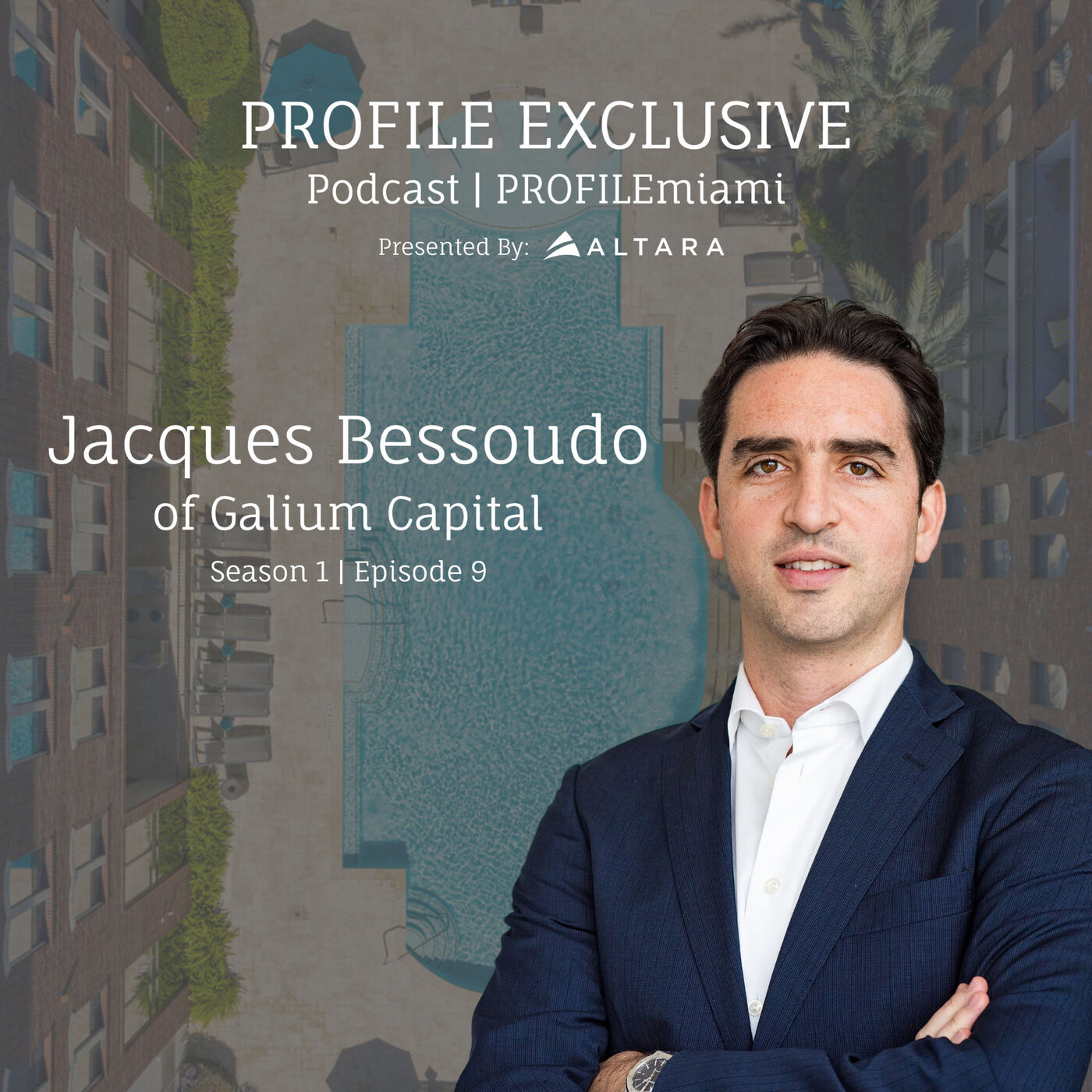
Episode 9: PROFILE Exclusive Podcast Featuring Jacques Bessoudo of Galium Capital
36m 25s
This podcast episode features Jack Bizzuto, founder and managing partner of Gallium Capital. He discusses his background, from growing up in Mexico and working at Boston Consulting Group to founding his Miami-based private equity real estate firm in 2018. Gallium Capital now manages a portfolio exceeding $600 million, concentrated in multifamily, office, and retail assets across key U.S. markets. Bizzuto outlines his investment strategy, which prioritizes selecting cities with strong fundamentals like job and population growth before evaluating individual properties. He emphasizes a conservative, non-speculative approach, learning from early mistakes in deals with temporary incentives. The conversation contrasts the management and financing difficulties of single-family home investments with the relative efficiency of multifamily assets. Bizzuto also details the firm's acquisition process, underscoring the critical importance of broker relationships and ethical conduct. His philosophy centers on securing stable cash flow and achieving target returns through proven asset classes rather than chasing high-risk, opportunistic deals.
Welcome to Season 1, Episode 9 of the Profile Exclusive Podcast featuring Jack Bizzuto of Gallium Capital. Before we dive in, please go to www.ProfileMiamiR-E.com and click subscribe to stay up to date with all things commercial and residential real estate in South Florida. You can also follow us on Instagram @ProfileMiami. Profile Miami is the leader in South Florida residential and commercial real estate news, events and content. Actively read by over 3 million of South Florida's top developers, brokers, investors, architects, designers, and other real estate professionals annually. This podcast is bought to you by our sponsors, Gallium Capital, a Miami-based real estate private equity group, and Altara properties, South Florida's first street smart and market-wise full-service real estate brokerage. Our guest today is Jack Bizzuto, who serves as managing partner of Gallium Capital, a Miami-based private equity group which he founded in 2018. Gallium Capital invests in and manages over 600 million of commercial property in major markets across the United States. Gallium Capital's portfolio comprises of multi-family, office and retail assets across various major national markets including Houston, Palm Beach, Washington, DC, amongst others. Previous to founding Gallium Capital, Jack's oversaw the management of over 200 single-family homes across South Florida and spent eight years with the Boston Consulting Group, one of the top global strategy consulting firms. Jack holds an MBA from Harvard Business School and a BA in Finance from ITESM. Gallium Capital is based in Miami, where we met Jack's at his office, overlooking ball harbor and sunny Isles guidelines. Thank you for listening and enjoy. Welcome to the Profile Exclusive Podcast, where we profile and get to know the movers and shakers in South Florida's residential and commercial real estate industry. My name is Demetri Dimascas, co-founder of Profile Miami and managing broker at Altara Properties. Welcome to season one, episode nine of the Profile Exclusive Podcast. We're here with Jack Pizzuto of Gallium Capital. Jack, welcome. Hey Demetri, thank you. Thank you for having me. Thanks for coming on. So give us your background story. Where did you grow up? I grew up in Guadalajara, Mexico. There's as many of you know, it's the second largest city in Mexico, but in many ways it felt like growing up in a small town. I grew up there until after college. And there, I looking for jobs, I've moved to Mexico City and started working. My first formal job wasn't consulting for the Boston and the Tottenham Group, which is the largest consulting companies in the world. And where did you go to school? I went to school for undergrad and it's called the Monterey Technology School. When I finished, I was sure that I was never going to go back to school again. But then after working in BCG for a couple of years, it opened my eyes and opened many doors. So I applied for business schools and business school in Harvard. And that's how I got into the US. So when did you first get interested in real estate? And can you tell us about the first deal that you ever closed? I've always been exposed to real estate since I was young. The family did some real estate on the side. And it always was fascinating to me. So as soon as I finished business school and moved to Miami, I was still working in consulting. But I started doing independent, very entrepreneurial real estate deals. I think that the first one that I can remember, I found a condo building that a developer had just rescued because it was bankrupt for a couple of years. And then this developer was offering very high incentives for buyers. So I bought a few condos there and it was crazy cash on cash for the next, for the first couple of years. But it's also good learning experience. Because right after those initial years expired, then the real property tax is an H.O.A. if he's in everything started to kick in. And you looked at it in the immediate term that didn't think through the entire life of the project. And I think that's one of the key learnings that we now apply in every investment that we do, which is you have to have high certainty of a deal throughout the life of the deal. So every time I look at deals now with tax abatements or land leases or similar credits, or extra skeptical and really look at the deal twice before investing. So when you did you leave Boston consulting and then immediately acquire these properties or were you still working while you were managing them? Yeah, I know. I bought them and did it as a hobby and it really didn't require a lot of management. But I did the first few deals were pretty successful. I had a lot of work to do with the deal. So I had already accumulated a group of family and friends that were happy buying real estate in the U.S. It was already the height of the market. So they were all excited and kept telling me, "Listen, whenever you find a deal or have something to invest in, please let me know." So I already had accumulated a group of people willing to invest. After about two and a half years of working and consulting after business school, I decided to leave Boston consulting group and start a fund raised some capital and started looking for deals more formally. And how old were you when you started this fund? I was about 30, 31 years old. So what were some of the other early deals that you worked on? Sure. So some of the exciting deals that I remember as early on we started buying property from large home builders, national home builders. So we were buying portfolios of single-family residential homes in bulk from them. It was pretty cool because they are large builders. Some of them were publicly traded. And we were buying portfolios of houses directly from them. And quarters were really the only thing that they wanted is move inventory and accelerate sales. So imagine we would buy 40 or 50 houses at a time at 20 to 25 percent below the prices that the houses were already being sold to retail buyers. And the only thing that we need to do is buy the portfolio, lever it up. And imagine we would do 70, 70, 30 financing structure. So if we were able to sell the houses at the prices that we're selling at that time, we would basically almost double our equity just by holding, renting out and selling when the developer would leave the community. So those were pretty successful. I think from there is that I started to accumulate a pool of investors. And the learning there though is sometimes you have to be patient. Because since we bought, we objective west to dispose the homes as quickly as possible. Had we waited until the community is matured and especially today in this market where single family homes are so hot, we would have made a lot of money. We're going to get into the multifamily later. But can you let our listeners into the difference between investing and managing in a short or single family home investment portfolio as opposed to just owning a multifamily building with the same amount of units? The quick answer is it's much, much easier to go to the multifamily route. And I think it's two reasons. The first one is that management in single family residential is much more intensive and also more expensive. There's a big buzz of institutional buyers wanting to go to the single family route. But still is a very, very small market. So what that does is that there's very few companies that can manage it for you in a professional and efficient way. As opposed to a multifamily where you can hire a national manager for like two and a half or three percent of rents and they would take care of everything. So management is a challenge there. Initially when we were assembling the portfolio, the only solution was to manage ourselves. And as you know, there's very little money to be made out of management if you don't have the volume. And it's very intensive. And the second reason is financing. Even when risk is very similar and it may be even lower in the single family residential because you're diversified across different assets. You can sell some of them while you keep others. And when risk is similar, debt is much cheaper on the multifamily site. The agencies do not lend or single family residential portfolios in the way they do for multifamily. And you're talking about probably a hundred to a hundred and fifty basis point difference between the two of them. So between the higher management costs.
and higher cost of debt, the impacting cash on cash is significantly higher in multi-femme. Where did you learn about all of the intricacies and the financing and debt side of real estate? Was that from consulting or did you pick up on that as you got into real estate? No, consulting had learned a lot from consulting and we can go into that, but I think business school helped a little bit in terms of like setting up a fund and GPLP structures, seeing examples of people that have been successful doing it. But in reality, the biggest part of the learning was on the job. A lot of it was trial and error, but I can tell you is that we were very conservative in the beginning and in terms of structures, we always aired on being on the more conservative side when we were facing LP. So the objective from the beginning was we were never going to lose a deal with an LP because we had an overly favorable structure for the GP. So when you have that room to maneuver, it makes it easier to learn on the job. So what were some of the keys that you've learned along the way to being a successful real estate investor? Don't speculate. We don't like to speculate with our money and less so with our investor's money. In the deals that we structured today, we have to have every assumption very well thought of, like we're never going to assume growth that is not already, like we're never going to assume growth, we're never going to assume prices that are not already there. And Miami right now is a good example. Miami is super hot right now and everyone is expecting a very high growth in rents because of the massive population immigration that we're seeing, but that's not something we would put in our models. So that's the first one. And I think the second one is, it's a little bit obvious the fact that if something is too good to be true, then it probably is too good to be true. But based on this, we are investing in our investment strategy. We rather take a more macro strategic view. And instead of like finding a one-off inefficiency in the market on a city. And what I mean by that is I rather select a city that has a very good macroeconomic or strategic indicators. And go there and try to buy properties there because we know that the market is going to do a lot of the work for us, rather than be opportunistic and try to find the only property that no one else has looked at. The private equity business model can be pretty complicated. Where did you learn how to structure deals and the GPLP and waterfall models and just basic underwriting on larger properties, larger commercial properties? Business school helped a little bit. There we learned the basics and how do we review it every structure that is out there. And more than that at Harvard, one of the cool things is the case method where we really looked at a lot of people and investors that did it in the past and different ways in which they were successful. But in reality, the bulk of the learning was on the job. Literally, the first deals that we did when we were doing more institutional public deals already, every deal that we did, we tried a different structure. And we started doing waterfalls and we swapped for more like 80, 20 structures with a pref. And until we found what our investors liked, what we thought was fair for everyone. But one thing that we did from the beginning is we always had the philosophy of if we're going to make mistakes, we want to do it on the side of investors. So we always benefited investors from the beginning. And that gave us some additional room to an over. So tell us about Galiam Capital. When did you launch the company and what were some of the first deals that you guys did? Of course. So we started Galiam in 2017. After having done several deals on my own, I partnered up with my current partner. He also did deals on his own before Galiam. We figured out there were a lot of synergies of doing it together. We did our first deal in 2018. It was a tiny deal from there we started growing the first multi-family deal we did towards the end of 2018. And as a big threshold for us in 2020 and the middle of the pandemic we did our first deal larger than $100 million. And that was the turning point for us. Today we manage a little bit north of $600 million ourselves as it's on our management. So ear portfolio includes a bit of multi-family, retail, single-family and office buildings across the United States. Can you give us a brief overview of the Galiam portfolio? The biggest concentration is in multi-family. We have around 2000 units that are class A multi-family in primary markets. We especially now in the most pandemic or middle of a pandemic world, we think it's the best asset to invest in because of of the risk. It's proven to be resilient once again in another crisis and the cost of capital. Literally didn't suffer a class A multi-family, good markets didn't suffer throughout COVID. In spite of government mandated moratoriums in some cities and states. So that's why it's had the biggest growth there. Then the second largest asset class that we have is office. We still think, we're still like the office asset class. There's some people that think that it's dying. We think that the only thing that happened there is a lot of additional supply was generated suddenly because of COVID. There was a lot of vacancies and sub-lease activity. But we think that as soon as that is absorbed, the asset class is going to go back to normal. One thing that we do think is that we are much more cautious when underwriting office deals estates. It has to have a very, very good retro. But if that's the case, you could still find good deals and you can still finance them at costs that are lower than before the pandemic. So we still like the asset class. Then the rest of the portfolio is opportunistic, mostly good local deals that we get because of the local advantage. So what is your investment strategy and philosophy? In terms of asset classes and types of assets, it's not very sexy. We like big asset classes that are proven. We don't like to, and a lot of people are excited about new asset classes that just came out into the market in the last few years, such as industrial flex or co-working or co-living. We like to stick with a big asset class categories. We think those are demand for those when we're trying to sell properties are always going to be there. We like big markets. We think that in recent years, because there's no yield in the financial markets there's been a lot of players that have come into real estate looking for yield. And what that has done is they've gone into, if you look at multi-family, they've gone into the B or C asset class because that has a little bit higher yields. But what that has done is that the gap incorporates between the within an A class multi-family deal versus a C class multi-family deal is now much narrower than what it usually is. So we think that tertiary markets or C class assets are overpriced to what they have always been relative to the better assets. So what are the key elements that you look for in a property when assessing an investment? So an important part is we select markets first and properties later. The first thing that we do is that we focus on three or four cities only and we continuously review our strategy in terms of the markets that we like. So we would sit, identify markets, and in the Southeast mainly of the US that we think have good macroeconomic indicators, population growth, job growth, supply, and after we select that a market we would start looking at individual properties. That way, the market and the market cycle would do a big part of the job in terms of rent increases. And after we have selected markets, then we start looking at individual properties and return thresholds, which typically by we're buying properties that have IRR, expected IRRs, no lower than 14, 15%, our investors is still predominantly private family offices, high-end, worth individuals, so they also like cash and cash. So it's typically properties that have
cash flow from the beginning, cash from cash above 6%, and potential for value add. The amount of the value add varies from deal to deal, but overall, it will give us a 13 to 15% IRR, two X or above equity multiples. Can you walk us through the acquisition and closing process from identifying the property where you're sourcing them through the equity raise, assessing the different options and then do diligence and finally closing? Sure. So in any given month, we probably get 50 to 800 deals into our acquisition pipeline. Obviously, that's too much or too many analyzed. So very early on, we screen the properties that fit into our criteria and examples our vintage. Right now, we're only on the right deals that were built between 2005 and 2015. So very early on, we screened the ones that don't fit, we screened them out. Then we have a very good team of analysts that would start on the writing formally, the deals that we do like. We have weekly acquisition meetings where our analysts would present five or six deals and our investment committee would decide whether to continue focusing in some of them or to just discard them. And we have last year, we bought four deals. So that's how competitive the market is. One thing that is characteristic of this market, we really, really value the relationships that we have with brokers. People say cash is king, but these days, brokers are kings. And you have to be nice with them. You have to be ethical. We have never submitted an L.O.I. for a deal that we wouldn't think that we would buy at that price. We have never withdrawn an L.O.I. We have never gone at deal awarded and not execute on it. And I think that's very important. So can you let us into the difference between the different commercial sectors and investing in office versus retail versus multifamily? Yeah, we like all of the asset classes that you mentioned. Obviously, there's prices and times for each of them. If you look historically, copyrights obviously have to be higher in offices than than multi and have to be higher in retail as well. And that's because of the risk associated to those asset classes. Multifamily is, as we know, the least risky asset class within real estate. And that has been, you can look at the historic charts of historic copyrights per asset class. And consistently, multi-family has to be flat as the lowest copyright asset because it's the more the most stable in the past. You can look at the past three or four financial prices and multi-family has not suffered. So to start there, you have to, you're going to invest in an asset class like office or retail. You have to be getting a premium in returns because it's more risky. And why it is more risky? It's because you have higher capital expenses once a tenant leaves. It's harder to replace tenants while in multi-family, you have a very diversified into a lot of tenants. And those are contracts that you can very quickly replace without a lot of capital investment. So, Jock, can you tell us about the difference between a real estate investment fund and a rate or a syndicated private equity style deal? Yeah, those are two models that we see a lot and we constantly question whether we should be one of the other. Since we started, we have decided to be a, we follow this indication model, not a fund. The difference is that an fund you typically decide the amount of your fund, go out and raise it and then, while you raise it or after you finish raising it, you start investing. And as opposed to our model in which we have a good investor base, we identify a deal, we lock it up and then we offer it to investors. And both have benefits. The main reason of why we have decided to not be a fund is that given the state of the investment cycle in which we are in, where properties are at all-time highs, we don't want to have the pressure to invest money that we've raised. We'd rather find good deals and we find them then we'll get the capital. Give us some insight into the property management and asset side of the real estate private equity business. A lot of institutional players will care about acquisitions and dispositions because that's where the money or the bulk of the money is made. And that is probably true. However, we are a more entrepreneurial group. We think of ourselves as an institutional owner and not only an institutional investor. And what do I mean by that? When we are managing the properties, we are much more active than the average institutional investor. So on the, so you have two sides of management. One is asset management and the second one is property management. On the property management side, we rely on national professional managers. We always third party higher third party managers to manage their properties because they're very good at it. You have to have the local scale that would manage better and more efficiently and cheaper than what we could do it. But on the asset management side, we're one of the most active players that you're going to experience. We are very impatient for doing things quick. We're very involved. We're very hands on. And in the end, you're the owner. So if you're not on top of the property manager at all times, your property is not going to perform as you expect. So we're always going to be chasing for the last dollar on the current operations and not only on the acquisition and disposition price. So what are some of the ways that gallium capital adds value to properties after acquisition? It can vary a lot. The one and it's probably the most common is capital improvements. We would take a multi-family building that was built in 2005. And even when it's a relatively new property compared to what a lifetime of property could be in real estate, you can see it ages quickly. So we would come in with $5,000 to $10,000 per unit and replace kitchens, replace flooring. And that usually has a premium in rent that has a very good return investment. Like imagine if we replace sometimes there's carpet and common areas of a multi-family unit and replace it with hardwood floor, who would re-face the kitchens. And that will give you $100 and $120 per unit of rent premiums per month. So if you make the calculation and calculate the return investment, that's very, very high. And in the end of the investment, if you do this over and over over 400 units and apply a cap rate at the end, that's very accrued. Other types of value add strategies relate to operational excellence. So we love properties that are owned and managed by family groups. There we would come in, we would institute professional management. And there you can very quickly see efficiencies in the expense site. We implement revenue management software, we manage more efficiently. And again, that has a direct impact in your NUI. And when you multiply it, use a cap rate multiplier that has a lot of money that you can make in the exit. So Gellium Capital has been one of the most active investment firms acquiring multi-family properties in Houston, Texas over the past year. What was your attraction to Houston? And how did you find that first deal of the Fairmont on San Felipe? Houston is among the top 10 cities in the US. Houston is the one where you can see the lowest prices per unit, significantly below replacement costs. And the reason for that is that Houston experienced massive over supply in the years of 2013 to 2018. And that cost rents to be stagnant. So that was an expansionary part of the cycle for most of the large markets in the US. And in Houston, rents didn't grow. So now that supply has stabilized, we think that rents are going to start growing just as other comparable cities have seen growth. And we think that in five years we're going to look back and look at the basis at which we're acquiring. We're going to be very happy with that basis. And you ask about the Fairmont on San Felipe. Fairmont is the first deal that we acquired in Houston. It was an interesting story. We acquired this right in the middle of COVID. We participated. It was a marketed process. We participated. We lost it. It was awarded to a different group in March of 2020. But then it was right when COVID kicked in. So the group that got it decided not to continue with the acquisition.
'cause they couldn't even, there were institutional, and institutional groups, so they couldn't even fly to the property to perform the due diligence. After we saw this, we had already understood the performance of multi-family in difficult times and times of prices based on looking at previous downturns in the US. And we realized that really, multi-family was still good position. It had no reason to believe that it was gonna suffer so we took the aggressive position of investing into a large deal right in the middle of COVID. It was not necessarily the highest price that was offered for the property, but we were aggressive and really executed pretty quickly. And it paid off right now the basis that we acquired that property for, it has already significantly appreciated from the beginning of 2022 now. Since the acquisition of Fairmont on San Felipe, we've also acquired two additional properties in Houston. We acquired Tade Tanglewood and then Millennium High Street, which are two magnificent properties in the Galeria area, which has continued to build the momentum that we've had in Houston. - Excellent. So you mentioned before, but South Florida has seen very sharp real estate price increases. How do you see the market continuing to play out? - Yeah, so what we've seen in South Florida in the last few months is crazy. On the single-family side of our portfolio, prices grew for about 40 to 50% from the beginning of COVID and now. And that's why I said had we waited to sell more houses now would have made a lot of money. But regardless, single families is a different asset class because your buyer is the end user. So in the end, they don't care about what the cap rate is. But because of this, we have not seen the same growth in other asset prices. Right now, everyone's talking about the growth in South Florida and how rents are gonna be, are gonna have explosive growth. This is something that we don't underwrite in our models, 'cause I think it's still speculative. We definitely wanna be in the mix and participate in acquire properties in South Florida, but they have to be properties that are good on their own right now and that generate enough cashflow for us to make sense to acquire. And we wouldn't just buy just to be in the mix in a market that is definitely hot right now. - What does the typical work that in your life look like? - So I wake up about 6.30, I meditate daily, 15 or 20 minutes, take the kids to school, get to the office by eight. And usually I like to spend the first two hours of the day doing high level, high impact to do in my to-do list before even looking at email. 'Cause otherwise, you just start responding emails and that can take the entire day. At about 10 a.m, I start getting to the day. I respond to emails for about half an hour and do that two or three times during the day. And the rest is usually meetings in the office, a lunch with a broker or an investor. And I'm typically home back for dinner at seven. And I do a little more email before going to sleep. - Long day. So how about your days off? - With the kids as much as I can. I don't have enough time with them during the week. So I try to disconnect during the weekends and dedicate a time to them as much as I can. - And how about your favorite places to hang out in Miami? - Every Friday, before finishing the work week, I usually spend time with friends and Corsair at the JW and Aventura. I'm also at the four seasons in Sarvside a lot. And I like to spend two or three times a week just go to a restaurant on my own, often one of these two and sometimes thinking, making phone calls, catching up with people, friends, colleagues. - And last question, what's next for you on Gallian Capital in the short and long term? - So we have a portfolio right now about $600 million of assets on their management. We've raised about 200 millions in equity and we wanna double that in the next 12 to 18 months. So we have the goal of deploying 150 to 200 million before the end of 2022. Obviously, we always have, we're prudent and the benefit of being a deal by deal company and not a fund is that we never have the pressure to invest. So if we do it, we're gonna do it responsibly. Hopefully we'll find a lot of good deals that would justify deploying that capital. - Excellent, Jack, thank you for coming on. - Thanks to Mitri, this was great. Congratulations for the podcast series I've listened to a few of them and they're great, continue doing what you're doing. - Thank you very much. We'll see you soon. - Thank you for joining us for season one, episode six of the Profile Exclusive Podcast presented by Profile Miami. We would like to thank our sponsors, Gallium Capital, a Miami-based real estate private equity group and Altara Properties, South Florida's first street smart and market-wise full service real estate brokerage. Please join us monthly as we profile and get to know the movers and shakers in South Florida's commercial and residential real estate industry. Keep up to date with the latest news and content at www.profilemiammyre.com and follow us on Instagram, LinkedIn, Twitter, and Facebook at ProfileMami. We look forward to continuing to bring you the best real estate news, events, and content in South Florida. Thank you for joining and see you soon.
Podcast Summary
Key Points:
Jack Bizzuto founded Gallium Capital in 2018 after a career at Boston Consulting Group and Harvard Business School, starting with small, personal real estate deals.
The firm now manages over $600 million in U.S. commercial real estate, primarily in multifamily, office, and retail assets, focusing on major markets with strong macroeconomic indicators.
Key investment philosophy emphasizes avoiding speculation, requiring high certainty throughout a deal's life, and preferring stable, proven asset classes over trendy or opportunistic ones.
Early lessons included the operational and financial challenges of single-family home portfolios versus the efficiency of multifamily investments.
Success is attributed to conservative, investor-friendly deal structures, rigorous market-first property selection, and maintaining strong, ethical relationships with brokers.
Summary:
This podcast episode features Jack Bizzuto, founder and managing partner of Gallium Capital. He discusses his background, from growing up in Mexico and working at Boston Consulting Group to founding his Miami-based private equity real estate firm in 2018. S.
markets. Bizzuto outlines his investment strategy, which prioritizes selecting cities with strong fundamentals like job and population growth before evaluating individual properties. He emphasizes a conservative, non-speculative approach, learning from early mistakes in deals with temporary incentives.
The conversation contrasts the management and financing difficulties of single-family home investments with the relative efficiency of multifamily assets. Bizzuto also details the firm's acquisition process, underscoring the critical importance of broker relationships and ethical conduct. His philosophy centers on securing stable cash flow and achieving target returns through proven asset classes rather than chasing high-risk, opportunistic deals.
FAQs
Gallium Capital is a Miami-based private equity group founded in 2018 that invests in and manages over $600 million of commercial property, including multi-family, office, and retail assets across major U.S. markets.
Before founding Gallium Capital, Jack Bizzuto managed over 200 single-family homes in South Florida and spent eight years at the Boston Consulting Group. He holds an MBA from Harvard Business School and a BA in Finance from ITESM.
Gallium Capital focuses on proven, large asset classes like multi-family and office in primary markets with strong macroeconomic indicators. They avoid speculation, prioritize high certainty in deals, and target IRRs of 14-15% with cash-on-cash returns above 6%.
Multi-family investing is generally easier and more efficient due to lower, more professional management costs (around 2.5-3% of rents) and cheaper debt financing, often by 100-150 basis points, compared to the more intensive and expensive management of single-family portfolios.
They first select 3-4 cities in the Southeast U.S. with strong population growth, job growth, and favorable supply dynamics. Then, they evaluate individual properties within those markets that meet their return thresholds and value-add potential.
His first deal involved buying condos with high initial incentives, teaching him to evaluate the entire lifecycle of an investment, not just the short term. He now approaches deals with tax abatements or similar credits with extra skepticism.
Chat with AI
Loading...
Pro features
Go deeper with this episode
Unlock creator-grade tools that turn any transcript into show notes and subtitle files.
 PodcastTranscript AI