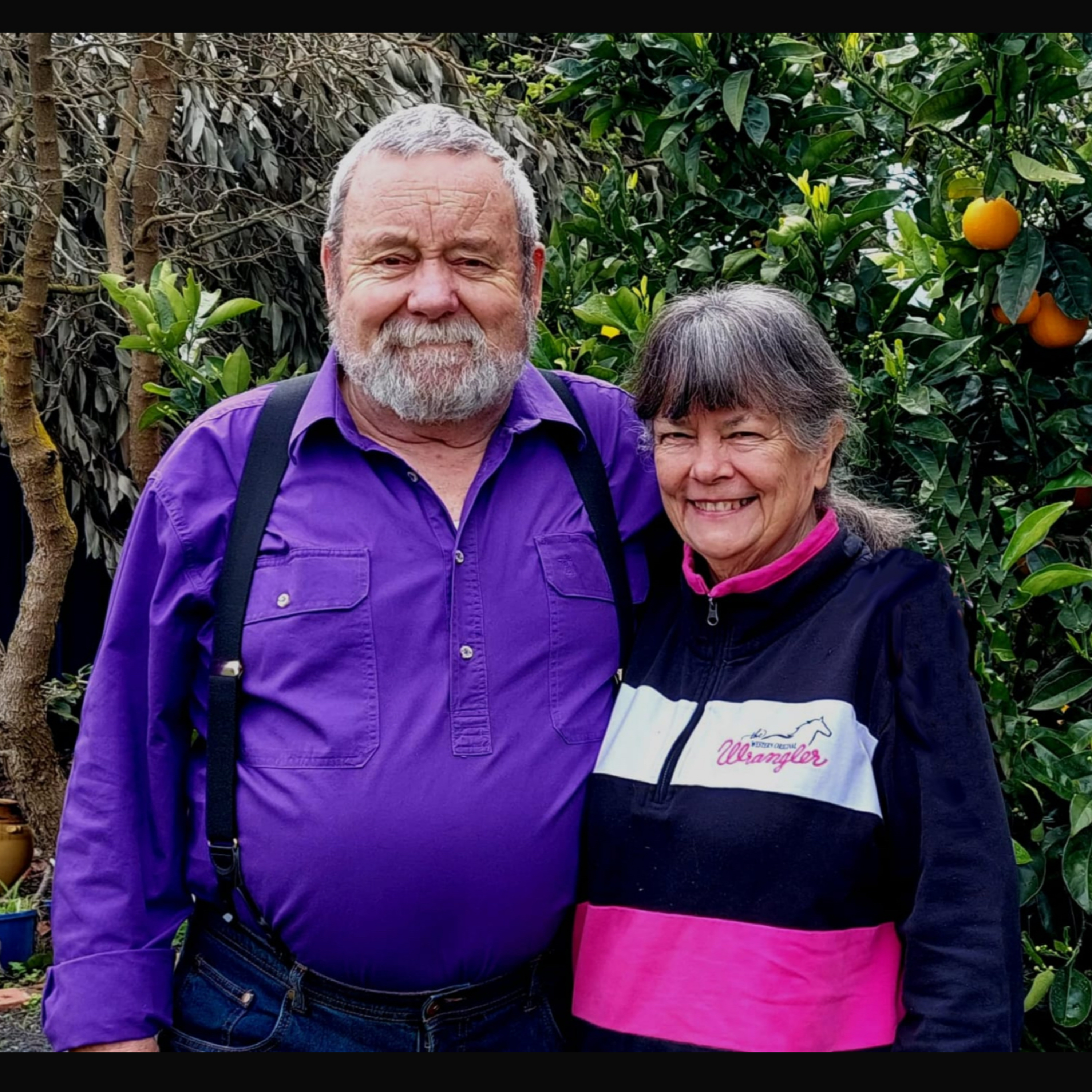
Gary Williams left Casted and at age 15 to join the Army, training as a carpenter in Melbourne. There, he met Trish, a teacher, and they married in 1968. Trish taught primary school and kindergarten, later earning degrees in early childhood education and working in library children’s services, where she ran creative programs like camel rides and pirate events. Gary spent 15 years in the Army, gaining diverse experience in management and logistics, before transitioning to vinyl welding—a niche trade repairing damaged vinyl invisibly. The couple moved to Queensland, where Gary returned to building, constructing ranger huts on Morton Island while living on a boat. Throughout his life, Gary retained his love for the outdoors, learned from Scout mentors like the McCallum brothers, and enjoyed bike racing as a youth, including the Casted and 50 event. Back in Casted and, he revived his passion for entertaining, performing in reviews and stage shows. Trish also wrote a children’s book, *Joshua and the Bugle of the World*. The couple’s journey reflects a blend of military discipline, creative pursuits, and hands-on trades, all rooted in their early experiences in Casted and.
[Music] Hello and welcome to Casted and Connections. An initiative of Hands Up Casted and where a group of enthusiastic locals have come together to capture, preserve and share stories of people who have a connection to Casted and. He left Casted and as a 15-year-old and returned 40 years later with his wife Trish calling himself a born-again Casted Donion. Gary and Trish Williams have had an interesting journey. Trish providing the brains and Gary the Braun in this beautiful partnership. Welcome to you both. Gary let's go back to your early memories of growing up in Casted and what it was like. My earliest memories are probably of Sanford and probably when we went back through them once from the parents they just covered a lot of memories back and from when I was about nine ten months old. So remember the heap of that Sanford but we came to Casted and in 1949 when I was three years old and I will remember the trip and the changing appliances. Went to Casted and primary school, Casted and High School and at age 15 after doing form four left the High School and joined the Army. Okay. During our school years, joined the Cubs at age eight. I was never a really great student. During the Cubs at age eight and hung into the Scout movement until I left Casted and at age 15. So heaps and heaps of my growing up and memories of things that we did with that. With the Scouts. Yeah. So at that time with the Scouts, what sort of things did you do? Pretty much anything we wanted. Peter and Ian McCallum, or Ian Peter whichever way the McCallum brothers were migratists in France and the Scouts. There were others, there was less twig and Alan Marshall and others. The McCallum's, we all looked up to them like heroes as they were. The local footy heroes and Casted and his greatest poaches. Poaches? Yes. Yes. I know that Ian went on to be a park ranger and chase poaches and he did a pretty good job of that because he knew how they operated. Oh dear. So what sort of things did they poach? Anything and everything. Anything it moved. I would have like to say once if it flies it dies. When we were in that duck shooting, we ran to river somewhere we'd run into where McCallum. He'd always have a dozen ducks hanging off he's built. We want everyone out to. He used to get up in the morning and go out catching himself a couple of fish for breakfast. That's probably due to the younger. You'd be heading to Merck Gambier and be fogging whatever. You know, there's a kid with my parents. We'd see him McCallum coming back on his motorbike with shorts on. That's how they were. They were rough tough and they were our heroes. And they taught us so much. Really about the bush. I always felt comfortable in the bush next to me because of the McCallum brothers because they taught us how to do that. When we went on scout camps we'd take a couple of traps and catch rabbits. We'd take fish and lines and catch fish. So pretty well looked off the line. One of my favourite stories, Gary, is when you went, you'd go after school and get on the back of the truck because that's something that kids today that would have no idea that you could even do such a thing. Tony Murray was in my patrol and then a couple of others, half a dozen others and whatever it was. And we'd get out of school at four o'clock. Straight down here Tony's dad had a butcher shop just a couple of doors up. And we'd bowl in there and he was a great big packer of meat. Never knew what it was until we got out there. We had our rucksacks with and we'd go round to the scout hall through the tents on the back of a flatbed truck and was on board George Philos. Through the tents on, we'd all pile on. There could be 15 or so on the back of a flatbed truck. Nothing else, no warden, no side. And every go and we'd go out to the 9 mile creek or my ring or wherever we were going to be camping at that particular top. He'd say, "Right by then we'd throw all the gear off and he'd drive away." And there we'd be a bunch of 12 to 15 year old kids on our own. In the bus. The Elmer Marshall, Peter McKellum or whatever would probably come out after work. So we'd do a traffic shop at about a past five and he'd come out. But sometimes they didn't come out until after the movies. And at the time they'd have the camp set up, we'd probably caught a couple of fish while that's those. And we'd never any congratulations. They'd kick you bumble whores and you'd ride. That was all good. That was a great play. It's a good memory isn't it? Yeah, great grounding too I think. Yeah. Okay, so the other sort of things did you do? Didn't like school so much or weren't a great school? I never had any trouble passing exams but the teachers knew that. I got the kicks in and the beyond, but not going extra bit and getting good marks. So I did as much as I needed to do the pass and then got out doing things that I enjoyed doing. I was very involved. Bike running? That's right. And this back in the year of Doug Isle and David Young, they were the two stand out bike riders. Richard Boyd and myself Stuart Bigham. Bigham's had the shop down there. So we spent a lot of Saturdays out racing bikes. That was a little good. Tell, were you used to go out to Red? I wanted to go out to that and I went out to that and Robin. That's it. Out to the Leather Robin School. It started swimming pool. Prung out to the Leather Robin School. That was the first one. That was usually that was a handicap race and then we get off puff for a couple of minutes and then jump back on the box and have a scratch race back. And Richard Boyd always wondered, "Honey, captain, I always want to scratch race." And it's still part of the cast in 50 years. Yeah, today. Yeah. Yeah. Yeah. The cast in 50, what a huge event for a young bike riders. Yeah. We had the likes of Russell Mockridge and Sid Patterson, Peter Peah and all these world champions. Yeah. It's come for the cast in 50. Yeah. Amazing. Amazing. I hope all you had the, yeah, I could have quite a little bit of what I was rickered about somewhere around Australia day. We just have a sports car on the way down here at the Able. And they have running, jumping, bike riding was a big part of it. That was in the track station. Yep. That was a grand event. We all looked forward to it. It's all gone now. Well, you had a track around the Able. Yeah, like a track, I think. In my time it was a clay track. That's it. Yeah. And then later on, they fell to it. And you were to compete it in the high jump no doubt. Don't laugh. It's been no. No, I didn't. I didn't. But later on, I was in the army. I became a pole vault and didn't really want that. I caught that. There you go. For those of you who don't know, Gary's not a tall in stature. But got back to his ears. Got back to his feet. The streets. I used to be seven foot six and then I started smoking. Oh, dear, dear. So that's a good morning for you. All you're at smokers out there. Just they're moving on. You decided to join the army. As a 15-year-old, you headed off to Melbourne to do an apprenticeship as a carpenter. Yeah. The army apprentice the school at Belcom, which is just next to Mount Martha. On the bay. Yeah, we've been involved down there and spent three years at Belcom. I think it was second year. Yeah, in the second year, we had compulsory dancing classes so that we didn't make fools of our social graduation. So we had like three months of that. I think it was second dancing classes. Young tricky came in and I said, "No, better not. Merry that girl." And I did. And you did that. There you go. It was 15, I was 16. Wow. Wow. And so it was just love first sight or? Absolutely. Obviously, don't really miss the selling. Don't really miss the selling. Being reciprocal. Not the same time. Not the same time. You grew up. But I didn't see any needed. Check. I just saw it all kind of marry and that was that. Oh, is that okay? I told a mother that. Oh, really? So what were you doing at this time, Trish? When we met, I was still in high school. Yeah. So long ago. And after that, I went to teachers college and I was a primary school teacher for quite a few years. Then we had children, two children, a boy in the world, Tim and Sarah. And I later went on to working kindergarten and libraries. Yep. And you've also written a children's book I heard. I have. Yes. Yeah. Very talented lady. That was called Joshua and the Bugle of the World. That's right. Oh, there you go. There you go. So you married in what year? 68. 68, yeah. And lived in the eastern suburbs of Melbourne. No, no. Got that wrong. That's the challenge. What'd been
I went out of Belk and went to Broad Millers for 18 months into Portsea and did a course down there and when I finished that course I went up training National Service in a Cape Urkha. I did it only the six months and that's how I got that shit and came back and married my girl and we then moved on to Aubrey. What on that? So that was your first married month together? My first post the afternoon married was at Raymeer Training Centre, Fort von Schurley and Tricia was teaching across the road at the Primes Hill. Oh okay, so those early years would have been probably a bit hard, was it away from home and the first 40 years of the hardest? Yeah, I think so I don't think we thought like that in those days you just did what you did, you know, you were prepared, you had your training and you were going her off to have your life together and. I don't remember who was ever sitting there saying I wish I were somewhere else, I just did it. Yeah, okay, I was 19, I was early 19. Then we got married, you were 21. Yeah, okay, yep, which was quite normal back in those days. Yes, yesterday it sort of people tend to get married a little bit later. Yeah, whatever it was done, I finished full-time school and it was longer, we got posted down to the area workshop at the Pucka Pundit, the quartermaster. While we were down there, I fell off to a level of water skiing, so we did a heap of water skiing at Lake Nagami. In fact, one year we water skiing every weekend of the year. Yeah, pretty cool. So who had the boat? Oh, we had to buy one. Couldn't use someone else's boat, you had to have your own boat. So we bought about, funny enough, I was interested in fishing and went and bought some. While we were talking about the size of the motor, I said no, no, it's 30-40 horse per-older, I said she introduced it, I might want to go water skiing. But all right, so we got one of the bigger motor skaters, I went water skiing, she didn't. So she just came with it, but didn't agree that. So you just sand yourself on the shore, did you? Yes, yes. And we managed to round between postings down at Pukapangala, three postings while we were there, yeah, there forever. Another one is agent of the same workshop and then down to the headquarters of the staff officer down there. So what was your actual job in the Army? Well, that's the point of making. Military officers all get the same training until they've done the officers course. And you go out to a core, and you do core training. But once you're in your core, there are just a series of things that you have to do. And you have to do quarter master work, you have to do admin work, you have to do staff postings, you have to do field force postings and courses and things to get your promoters to the next level. So when you get these Army officers come out and they think they know everything they're probably buddy. Yes. Now, I don't, lots of us don't, but you do get experienced in a very wide range, different fields, which stands for good step when you come out, because you can turn your head and just about it. And also the management of men, people? Yeah, yeah, man management. Yeah, you know, like that, it's a good skill. The girls are a bit harder to manage. Never. That's what we had female officers to say to sort them in. Never. So during all this time, Trisha is still teaching. Yeah, oh, well you had the kids as well. So teaching and it's a long time ago, I have to think back, what are we always doing? Yeah. And by bringing up, you should, or jumping again, by bringing up Pucka Ponyl, I had intended then to throw a tuition because that Pucka Ponyl, Trisha went to, she was a teacher, very highly regarded teacher at the primary school. In fact, when the two I see got himself his own school in Seymour, there's a little bit of a big ring session going on between the two principals over who was going to get switched. Oh, that was pretty cool. Yeah. But then Pony and I, and I'm putting Poyl again, sorry, Pony and I've Trisha then just told I, well it's time to start a family and I'm promptly resigned. I can. Well things don't always go according to plan, so after six months, she's got a job running the kindergarten and did that for a year or so. I really enjoyed the kindergarten too. And I, that became my preference. And I went back, actually when we moved back to Melbourne, I went back to study and ended up with a degree, a couple of degrees in early childhood education, which I really love. Yeah. Was that where you, was that combined with the library? Yeah. No, that was another. Exactly. Yeah. I went into working the library in children's services. And I used to run programs for literature programs and activities for children, which in a big library service down there. And I really enjoyed that. And also I worked in displays. So whatever, you know, was the flavour of the month, I got to put up big displays around the libraries and things like that, which I have a bit of, enjoy a flair for that sort of thing. Because you've got quite a creative mindset, I think, having new, yeah. So because you're a dress maker and you like making costumes. Why wouldn't you call it a dress maker? You're like making costumes. Yeah, I enjoy making costumes. Not for particular. No, I wouldn't make clothing for people, but I like making costumes and inventing those sort of things. So what were some of the sort of programs that you ran at the library? Oh, well, things like we'd have children's office, for instance. Uh-huh. Well-known authors down there that we could have to come in and speak to the children. All sorts of things. It depend on, I think I was laughing the other day about how we had camels one year. We were doing a big program about Egypt and we had a camel person come in and we got to ride camels around the library. All around the library is so much fun. Yes. In those days there was a reasonable amount of money spent because it was a big library service. And so the camels would have gone on to one of our other libraries in that area. In that area. So, but always something fun to do. Oh, pirates and, you know, we employ, yes, pirate beat. Clowns, all sorts of things. We dress up, we'd have big Alice in Wonderland, lunches and really good times. And I imagine they are. They're still going. I still follow my library service down there and they still have all these wonderful things. And they create fantastic memories for kids too, doesn't it? Yeah, which is awesome. We've had the military years and then we packed up and we had enough. Had enough up to 15 years and decided to move on. Packed up on April 4th, yeah. We had. Oh. I thought it was appropriate to resume the fact for April 4th. That gives me a month notice. Anyway, that was that. Yeah, but we discovered a thing called vinyl welding, which was a magic thing where we were chased it up, found the guy that was doing it. And he could actually do invisible welding on vinyl. Invisible men. It would never know they'd been damaged there. So I put it to him and he taught me how to do it. And he started doing it was fantastic. So that was sort of, you know, because a lot of the cars they used to just had vinyl seats. That's right. Yeah. A pole street, you know, lounge suites, all that sort of stuff. That's right. We'd see it and people would have them fix their lounge suites and their vinyl floors. Yeah. So how does that work? Magic, or magic. Oh, it's magic. Oh, it's not going to give away trade seats. That's natural. Definitely. It's melted. Basically, you're melted. We use the compound and actually in the hole. And then colour it. Spray colour on. Columatch. Columatch. Columatch, and you can colour match the right to the colour so you can't see. That was all good. So other techniques and products that now that are not in the little world, that's right. That's what it was then. Yeah. And then it took that, started in Melbourne and then moved to Queensland, went to partnership with the brother and the Lord of India, same thing. So we did most of Brisbane, which was really good. Okay. And while you're in Brisbane too, you had another little stint out on Morton Island. We did. Yeah. I was never really in love with the Vona Wilding, breathing in all sorts of fumes and I was smoking enough without that. Oh, she made it. So I went back to building. Back to the trade. And always tell people now are in trades that when I dash off and do something silly like being in a tainers, they'd do that, but finish your trade first. And the number of times over the years I went back to building. Yeah. Incredible. Yeah. So yeah, one of the things we did was built Morton Island Ranger Bates. Wow. We lived on a boat over there and we stayed over there for two weeks and then come home for a weekend and back over for another two weeks. And yeah, it was like doing in paradise. Yeah. Not saying the job was, but the life on the boat. Yeah. So you just, we'd drop over the back and spear breakfast. Yeah. All that sort of stuff. We always had rods out, so you know, you'd be shooting and watching a bit of
to be something about, you need to rod go off, so grab it real efficiently. - And fresh oysters? - Paradox. - Absolutely, yeah. We camped on the rex. The rex for a bunch of river barges and teams that have been scuttled. And we camped on the rex. And the rex were encrusted with oysters. So we just, when we felt like it, we never watched it. - Yep. - Awesome. And at this time, Tish, we still teaching then? - Yes. - Yep. - We built our own house there at the time when he's talking about there. So we bought a block of land and cleared it. - In a bush, yeah. - Built our own house there. - So you were teaching and Gary went back to school at some side, you told him, no, this was our way out. - That bottle's all down. - Oh, sorry. - That's all done now. (laughing) - Okay. So busy life, 'cause you would have the tickets then, yeah, and Gary was probably away a lot. - Yes. - Yeah. - Tell us a whole other story. - There it is, too. - There's two. - We'll have to put that in part, too. - Another day. - Another day. - Oh, look up there. - The first opportunity I really got the start, giving stuff back. So it was where I got back involved with the scout, and running a venture scout unit. - Mm-hmm. - So we, actually, together we ran a church, a US group for a couple of years, and then a scout leader approached me and said, "Hey, come on, do a venture unit, "what's that we do?" So we had a great time there, teaching kids, all the bushcraft, all that sort of stuff. - All the stuff you learn from them are Kalen boys. - Mm-hmm. - Not the poaching, though. - Absolutely the poaching. (laughing) - So a lot of Keston knows you as great entertainers, you've revived the entertainments, seen in the town since you moved back. Where did you get your love of entertaining, do you think? - That really, no. Started in primary school. - Yeah. - It's been a show off. - Let me do anything on the stage, until probably also a Puck of Pagno, so that was an early 20 point of the stage, about at school, you know, the teacher wanted somebody to get up and sing a song, I had no problem at all, yeah, and they wilded it. So, did that, let's come from there, it was always there. - But then you went on and did reviews and stuff at Puck of Pagno, and. - Yeah, at at school, my if it's an entertaining, I really appreciate it by the teachers. (laughing) - Yeah, I reckon at Puck of Pagno, we're first started actually getting up on stage and doing stuff. - Yeah. - And at Puck of Pagno, I'm 22 or 23 or whatever the heck I was, and I got a guitar. I thought I was gonna do any of this singing, I need a guitar, I just got a play and sing. So, I've got the guitar and stuff around with it for a couple of weeks, playing tunes on one string, and eventually, it's a little frustration, for you to say, "Give me the guitar." Like, "Ave the guitar." And she went, "Pum, that's an A chord, "that's a D chord and that's a G chord." You can play any tune you like on those three chords. Now practice that and stop what you're doing. - That's the first one you should actually play guitar. - Oh, there you go. - So there we were, fantastic. - But Gary has the ability to play by ear, whereas I'd been learning as a subject, when I was at college, learning notes and chords in the theory of music. But that's all I could do, but he actually just plays by anything, just picks up an instrument and you'll practice a lot. Not saying it's easy for anybody who we're heking here. So, away he went with my guitar. (laughing) And the love of music, I mean, music creates so many different emotions in people, too, doesn't it? And it's also creates great friendships, of course. - Exactly. - So, what about some of those friendships over the years? - It's for a music, perhaps. - Oh, for a music. - Endless. - And so many, - Endless, countless, endless. Probably the first, what do we call them? The first known entertainer that actually became friends was, where this was a chapter in the Northern States in Black American. His name was Giddle Asky. You can Google Giddle Asky, there's plenty on it. Another friend brought me to our house for a music night, 'cause by that stage, we were having a monthly music night. - Like a night club in your house. - Oh, we did it once, that's it. - Yeah, we did. - And my friends, and we had, was always a big age, like a spread of ages, wasn't there? - From teen ages, right through. - 70s through the 70s. - 17 to 70s, yeah. - Yeah, some like that. - They were like, that was great. It was really good. So our daughter Sarah, had probably 15 at the time, was learning tips from a world class music, that was 70 something. - Yeah. - You could come here and share her, and show her what it is and how it is. Which was great. So Gill Eski, from the US, you said. So what's his claim to fame, if you like? - Probably. - Gill did wonderful things. And in the entertainment industry, among the entertainers of that era, he's a legend. He had his own big band, I mean, a big band, not just half a dozen patients. - Yeah. - Very gaudy at the time, owned Motown. - The owner of Motown. - Yeah, he wasn't the CEO, he was the owner. - Wow. - He owned it and ran it. He ran Gill. I've got these three young girls here, the really great singers, but they need to be kicked into shape and become an actor. And I want you to come and do it for me. So he did. He dropped the big band and went to Motown, and he shaped the super-heems. - Wow. - So that's probably Gill's main client of fame. - Yeah, but other things. When B.B. King visited me fairly frequently, I went along with Gill, and I met B.B. King, and we said, "Oh, mate, so not just, "no, I know him from somewhere, "they were really old mates." So in that case, we sat down with B.B. King, who didn't drink, by the way, but we sat down and drank his whiskey, whilst all the other peasants were I should in. (laughing) - Excuse me. - And Gill was a really good friend. Well, just a bloke we knew. - Yeah. - They'd come around to our house and we'd go around to his house and have a grand time. - It was very loud, wasn't it? - Oh, it was from Texas. - He was a big man and very loud, but he was also very humble and just ordinary, wasn't he? - Yeah. - Lovely man. - When did you first meet me? - A mutual friend brought him around to one of our music lights. - So I got this friend of mine, you from America, I'd like to bring him. - Yeah, bring him in, he brought Gill in. - You're coming in. He was loud. He walked up and he picked up my smokes and gave himself a smoke. He said, "Oh, whiskey important stuff for whiskey." And all the time I was making a big noise and I was on the point of throwing him out. - Really well. - No, no, it's not gonna happen. But no, no, no. I'm glad I did because we developed a great friendship. - Really well. - He was as old as you did. - Yeah. - Okay. - Okay. - Okay. So you then, like you've been in the entertainment industry now for a while, I suppose we're jumping all over the place a little bit here. But in the last, I think since 2017, you started the Sanford Music Festival, which brings thousands of people to cast it and Sanford in the immediate area. How on earth did you come up with this idea? - Well, yeah. We had been, you want to tell us to? - We'd been over to Francis to their folk gathering. We'd been a couple of years. Anyway, this particular day we were driving home and we were talking about how it all went and things we enjoyed about. And I said, "You know what? I reckon you could run a festival, Gary." And that's where it all began. - Famous last year. - How we got drove in the driveway at Castanon, we had it all worked out, where we'd have it. We ended up, we went down to the oval at Sanford and we thought, "Oh, right, well this will be a good place and we could do this, that and the other." And it's just all kind of blossomed from there. - And it has great following. - Yes. - Even though it's held the same weekend as the Port Ferry folk festival, I suppose the genre of music is quite broad. - Similar to when they began, but not so much now. - Yeah. - A lot of the old, a lot of the old original Port Ferry goers have discovered our festival now, they come and see ours. We just find that we got on quite well now with the Port Ferry. Never talked to them, but the message is going back and forth and we get on quite well with the Port Ferry organizers. And sometimes I'll even recommend to somebody. How about you go to that one? That's good for you. - Yeah. - For that's good. And in fact, a couple of years ago, when Cabin was on, we had a festival happening, like just after the Cabin closed down. And our headline act was going to be the Royal Hodgents. And I think on the Tuesday before the Friday, the festival, Sarah Rancid. - Yeah, we've got Cabin. - That was the end of that.
And she said, "Now I've got to re-appendabed because she was also going to be flying at Port Ferry Road with Dave Newton and the Bushwackers." I can't. So, "Now I've got to re-app Roger and tell him that we can't be there as well." I said, "Well, why do they're telling me I need a band?" And she did. And half an hour ago I got a phone call from the Bushwackers. This is where the good results should come in. Roger rang up and said, "Guess, I believe you're short of a band." I said, "We are." I said, "Well, what about we come up and do a set of they for you?" Wow. How terrific is that? Absolutely. Thanks for that. Then, I left a checkup first because Port Ferry had an occlusion zone and we were within their occlusion zone. You checked with the organisers of Port Ferry and they said, "Of course, we're all in this together." You know, they don't look after them. So, that was good. And that was where we were on a scum and we didn't have a bad relationship with Port Ferry. And it's only got better sense. But those friendships are magic. Because the Hank, we talked about Hank yesterday, Hank Gritt, who quite a celebrity around the focus. Honestly, if we had something on Sunday, this Sunday coming, and I was suddenly thought, "We need Hank here." I could ring him up and if he wasn't doing another gig somewhere, he'd come over from Adelaide. It was like that. Yeah. And. Same with Leonard's band. Leonard Cullen. Yeah. Yeah, there's another. Yeah, the. The Cullen could ride Leonard Cullen. They're the same. They'll just get out of their way to do good stuff for where. Fantastic. And Donutton, for those that you don't know, is part of the Bushwacker band. But he also wrote our favourite. I wrote. "Cullen" wrote what I think should be our national anthem. We are Australian. We are Australian. So, yeah. Which he will tell you about regularly, no doubt. Oh, yeah. He's also our patron. Oh, he's a patron. He's a patron. Yeah. That's right. He's too. We talked about the Sanford Festival. And then every year, when we put that, putting our heavy advertising out, we remind people that Sanford is not the end of the earth, but on a clear day, you can see it. Well, now we've got people coming from Queensland. International? International, yeah. New South Wales. Lots of people from Adelaide. Yeah. On their travels, they call them. Yeah. No, it's fantastic. Prior to Sanford, of course, within the area, you started up the theatre. Old Cockenball. Old Cockenball. We did. We did. I do love this quote from Gary the other day when I was talking to him. Yes, it was full of innuendos and he said to me, you know what an innuendo is. And I said, oh, yes. And he said, no, you don't. Is it a Spanish supository? So that gives you a bit of an idea of what the Cockenball was about. There was a lot of innuendo in the names. We called it comfortably rude. Yeah. Yeah. So those days? That was fantastic. Sorry, I loved it. I really loved it. In fact, the players, or the cast, always thought that if people didn't pay us to entertain them, we would pay them to come and be an audience. Because we loved it so much. Yeah. And that, things are enough. It's probably one of the casted and the best kept secrets. We ran it for eight years. And over that period of time, some people would say, huh? What ever happened to that thing you used to do down there at the opening? I said, it's still going. Oh, yeah. And for eight years, that's supported Trisha and I. And kept the public life. Unfortunately, which you said, I could hit some noise. And we just had to stop. Which you couldn't do anymore. But we used to have groups coming from as far away as Mount Martha, Mornington, Ballarat, Lorsham. Bordertown. Narrowcore. Bus tours. Like bus tours. Yeah. First, we're over Kingston. So over the years, Gary, like, and Trisha, you know, since you've been back in Castan and involved within the entertainment industry, I suppose. Have you seen much local talent developed? Yeah. Heaps of it. There's heaps of local talent. And they really started getting more of an outlet now. And I noticed that one of the Parsons boys now, that's been seeing around town. I tried to booking for next year's Australia day, but he's already booked for. Well, the Gigle boys. That's it? The Gigle. Sorry, I'm telling lies. Just one of the Gigles. So, yeah. One of the Gigle boys. Yeah. It's already booked for next year. But the Parsons boys also sing and they're starting to do a little bit around town. Yeah. But the ones that. So is there anyone who stands out in your mind over the past 15 years or so that perhaps. Tom. Tom Muburn. Yeah, Tom Muburn. Oh, I'm a garage baggage. Yeah. We're a. Can't remember what we're doing, but it was end of time that was anyway. And Tony Muburn approached me. Tom's going to hate me for saying this for years. And Tony Muburn approached me and said, "Look, my son's out there and he's a really good guitar player." But he never plays in front of a noise. Always plays at home and he's running. And I've heard that many times then. Maybe some time then. When you're seeing that. Not that much. So, I saw, yeah, all right. Well, eventually I got out there and met Tom. And we went out to eat music room and I saw about 15 guitars and I thought, "Oh, he's fairly serious." And he picked it up and started playing what a brilliant little music. Yeah. I've still been one of playing public. So, in the end, we introduced Tom to our daughter, Sarah. And Sarah, her husband, Leon, and Ben, playing music together. So, for New Year's Eve at the Geller, I think it was the first time we did it. Tom came in and practiced with them. They played together. Yeah. Now when they come up, Tom comes and plays it. It's all good. But then Tom got to, he got to playing and singing. Yeah. So, he'd play and singing and then he picked up a trumpet. He's pretty good on that too. And he's sitting down behind drums and he's good on that. He breathed. And all that time, it was a secret. Yeah. So, much muskied view along the joy to see those sort of, that sort of thing happening. You know, someone blossoming and coming out. Oh, the bed. With Kate Parsons, you know. And Kate came along to a couple of karaoke nights and she wasn't too bad. But we needed someone to fill in the spot on one of our shows. I've got Kate to do it. And didn't expect very much. And that was fine. She filled the slot. Then, the next show, that was Heratio Zidler's All-Time Music Hall. In fact, I think to be able to, I would like to rest. Another time, you got Kathy Brody to fill in on Heratio Zidler's All-Time Music Hall. And one of the lines in that was she comes in and interrupts, something of her flowers. And we talk about, you know, being quiet and interrupting the performers. She said, "What performer?" I said, "You think you can do better and she said, "Why don't I?" So she has to go and she does. Yep. And then we got Kathy to come and do it. The same gig. And Kathy came in. We said our lines at London script. And I said to Kathy, "Do you think you can do any better? She said, "What couldn't do any worse?" Which got alive. It was all good. Yeah. So she just said anything. But the people, I think, texted and knew about Kathy Brody. Yeah. They didn't say much now about the fasteners, but what was it at the time? Yeah. Brilliant. But brilliant harmonies. You know, you put them up there with eagle stuff. Absolutely fantastic. Kevin Winch. You know, I'm a gen. Yeah. Kevin's got a golden voice. Yeah. And still performing tonight. Yeah. Yeah. Catriola. Catriola hill. Brilliant. Yeah. A bit high maintenance, Kat. But there's a. There's a lot. There's a lot. There's a lot. And loved each other. But we fired over the script. But we always turned it on agreement and did it. Yeah. Well, that's. That's temperamental artists, isn't it? Is that what you call it? Yeah, I wouldn't mind it, in my course. No, you wouldn't be one of them. No, no. I mean, we're going around in circles a little bit, but that's okay. You've made a lot of friends through music. But there was a little story that you told me about. That I've just remembered about when you. Got the bus to Sydney when you were a scout. And you went to Sydney because you went looking for something. You want the shawry? I don't know. You want more stories. 1961 was the world jamboree in Lanzdown. And two of us went from Castedden and Robert Miller and myself. I mean, got on the bus here. I had a hamlet and a train to Hamilton down in Melbourne. But the time we got there, the whole bunch of other people from this area with us, or with them. Down at the station, Spencer Street in Melbourne, Randabilly Walters and Old Castedden Boy. Special trains landed down. It was like one of the things out of the Old Westerns in Australia. The old carriages were the doors that opened outwards and the veranda on the back, sort of stuff. And I guess we just acted like a bunch of your mates about having many hours to get there. So how about the station? How about we do a little bit of work?
- You were being 14. - 14, yep. - It's from there up to the station in Sydney or wherever there was buses out the lounge, that was all good. But then it didn't amaze me, it's not amaze me now that we could just go out, book out, so we're going into Sydney to see this, I'll just see that. And like, yeah, why you got, no, why we got, it's like half of us, and all of us, that's why we're going into Sydney. And all the way into Sydney, one of the other kids was with us, you know, having a Sydney guy, yeah. A poor, yeah, but they got other places, you know. The one with the red lights, with the girls, ah, I think. (laughs) Right, I'm a country boy, I said, what place, what a red light. Anyway, mind you the author, and that's all we got to see one of those. (laughs) We wouldn't get talked to anybody, 'cause we got to see one. So we're walking around the suburbs of Sydney, we got off time, we're walking around the suburbs with houses, looking for red lights. (laughs) Didn't find any. So we went to a lunar park. That's what you tell us. (laughs) You also doubled in fireworks at one stage, too. Yeah, yeah. And then you're involved in fireworks, yeah. We had a furniture factory, which as part of a giant furniture factory war, went belly up. We actually paid our bills more, but you know, we had to close it down. Which we did. And I sort of said, well, I spent all my life being very serious, very important and very, whatever. I think it was time we did something we enjoyed. Let's open a fancy dress shop, which we did. And I reckon at the time we had about 15 costumes. So I just grabbed stuff out of my wardrobe, and took some wardrobe and filled up shards. (laughs) But it's not that we walked around clown seats. (laughs) No, I'm just not mad at clothes. That's something that make it look like a lot of stuff. Who was that? Never there we were. We opened a fancy dress shop. And kicking along, I started needed to do balloons. So I went and did a balloon course, I learned how to do fancy stuff with balloons. And other types of things to do with party. And at the side of the one way, we should colossal the one stop party shop. Whatever you want to do with party, we'll do it. So we got karaoke gear and started doing karaoke. And then started doing smaller type performances. To be great with these performance of what you're making, you go flash and bang. So looked up a guy that did that sort of thing. They named it Keith Lewis. Went and saw Keith. Talked about it, you know what I'm right. We talked about what it flows. If stuff I'd done it some days rather than the army. You know what I'd say? You can blow things up. My job was to get you to make all those effects without blowing anybody up. Which is basically it. So I did a fireworks course. And we went on from there before we came back to casting. We had dozens and dozens. De-bessling. Remember we did that on the dress? De-bessling. Doesn't the fireworks display? But also we did special effects. So there was two major wrestling venues in Melbourne around the area. And we went to one out in the Northern suburbs. And we used to do special effects for them. So when something brilliant would happen, some star would deck some other star. We had flames going up in the air. We had one bloke who was to come out. He was Bradman was the biker. And he used to come out on his Harley Davidson. Well no, he came to the passenger on the Harley Davidson. And we'd have colored smoke coming out of the back of that. And another kid was chucky the street kid. So he got to come out because he got to fight Bradman. He comes down to the scooter. Bradman, you come out on the Harley Davidson. Chuckie came out in the scooter. And we had a thing underneath it that made it very loud bang. It had the new penny bang. That was under the scooter, perfectly safe. And also we had Charles the Spark coming out of the handle to the scooter. It was so good. You had to come out and go around and go to bang. And the Spark came out. And that was all very good and somebody took scooter away. But when it went bang, Chuckie, he just threw the scooter. The scooter went out into the audience. And suddenly in amongst the audience, we got sparks and flames. That was pretty exciting. How was your premiums? Pretty high. I ended up doing it away because of that. But the other time we sit, kept fire to the pads on the top of the corners of the ring. That was Keith. Got on your case. The other effect there that it actually ended up being a little bit hot. So after the flames were pretty strong, yeah, there were little containers. We just go, "Will they work?" Stop being because the ring was burning. That was caught on fire. Also, look, exciting. Burning ring has fired. The right arm has. There were many, many incidents. Sit fire to a wedding. Sit fire to a wedding once. Yes, hot chicken. I don't know that I'm high. You're good. It was so funny. What happened there, Trish? Oh, well, I used to go along. And I'd be like the helper. So I'd be left in charge of watching so that no one touched any of the buttons and set them off while they were moving about setting up other things. Anyway, this particular time we were in this giant venue, huge. And we had all beautiful pedestals with flower arrangements and things. And there were showers of sparks and things hidden in the, on top of them. So that as the bride would come in down the staircase, the beat. What do you call it? Fountains. Fountains. But anyway, the beat. We float a bit on. They'd float. They'd float. They'd come out on fog. They'd be pushing the butt from the stow and the stiffer. And all right. The really huge venues down there, anyway, in this particular time, had the columns where there were all the beautiful flowers. We had all arranged on it. Gary was set them off and they went off. And one of them caught fire. And I'm trying to let him know that it's here. I'm sort of going like this on top. Anyway, it ended up okay. No, I don't think they actually realised what had happened. But we sure did. What had happened was that we normally had only arranged it. We used their vines. And the vines were hanging down on these pedestals. And this particular time we couldn't get the vines. So we went to the flowers and got plastic stuff. And the effect was hot and the set was fine. I felt pretty sorry. So that was like your vinyl welding coming to the play? I'll pat that with my hands. I've got a bit of a bit of a s-- But they didn't know. The audience had no idea. So it was all right. Yeah. OK, so also with fire, you were telling me about when days you'd passed away, which was December? That wasn't a set. No, no, sorry. It's September. It's September. I left September when we planted the armhand. And we had a wake in the backyard. And I just happened to have a two-inch mortar gel. And a launcher. So I thought, well, more appropriate times. We're in the backyard right next to the castle school with a firework that required around about 100 metre radius safety. I just said, hey, everybody, just get back there a bit and bang and up and went, shh. Fan-touching. Days of heaven was up. Yeah, they did, they did. When he wasn't doing fan-touching, big bang. And I'm on fire and you're tensioned like the pollution coming like that. But I then went back inside. And as I was walking past the TV, I saw a new airplane flying into a building. I looked at that. Good God. And it was a real flying flying into the valley world, right, Senator. I didn't mean it, sorry. No, no. Another, which I haven't got over this, there was at school when you were at school, you had a teacher called Miss Lade. Miss Lade? We did too. Oh, that goes right back now. Yes. We're all terrified of Miss Lade. I'm talking about from prep grade one to Miss Lade every Monday morning we'd have an assembly and we all had to stand with the hat on your heart saying, oh, I've got my country not like that. And then we'd seen the national anthem. And Miss Lade used to have things with the turning fork and sing a few little notes and get us into the right tune and away we would go. And that was her client of Famous Faraday, I was concerned. Apart from that, I knew that she was in that room and we were all terrified of her. Oh, she really had a reputation. Miss Lade. Well, I finally got into grade three. She was a lovely teacher. She was fantastic. Look back now, I've told many people over here possibly the best teacher I've ever had because she really cared about the kids. It was her calling. Yeah, that's really good. Now, I was in having a yarn. Sorry. I didn't have any yarn with Bill Pieden a couple of years ago. Now I still have the shot. And we're talking about that and something came up, I've hosted something about Mrs. Oliver. He said, "Oh, yeah." And he told me, he said, "Miss Lade, oh Mrs. Oliver had. " "Well, there was an afterschool. My Monday morning we came along and the headmaster said, "Morning girls, Mrs. Lade, if now Mrs. Oliver, I'm sure she'll be married." "That's okay, she'd name Mrs. Oliver." my down below that story. But years lighter miss.
Mrs. Oliver works into pedants. Well, this is part of it, right here. Right here, right here. That Miss Bill Pedin standing at this. I mean, Mrs. Oliver and somebody else walking, he goes, "Ahhh." Miss Lai, because she was not married when he was there. Miss Lai had had a guy named she said, Mrs. Oliver, thank you very much. And William Pedin, as I remember, you're the most foul mouth boy that ever graced our school. (laughing) So, for our Bill, he said, he's done it. Sorry, he said, "I just started to go read from the chest up. "I'm going to ride up to the airport." So, I just sat in barracks, I couldn't think of anything. So, I was speechless. That was the Miss Oliver. Lost words. But just unfortunate name, I just think that in the sleigh. Yeah. Yeah, yeah. We're not going into that, though. Well, Gary, it's been great to talk to you and Trish today. Thanks so much for what you do for the area. You're certainly giving back in spades, if that's what they're saying is. For stuff and we're so lucky to have you back here. I just one more thing I'd like to ask both of you is what does cast it and mean to you? For me, a time. Mm-hmm, time. And I told you yesterday, well, we were always coming back to cast it. But one of our motivations in that was so we could come back and give back to our community what our community gave to us. That was very important. But Trish, you're so about that. Mm-hmm. Well, it's home to me as well, even though I didn't grow up here. I grew up in Gipsland, but I've been coming here since I was about 17. And it's home to us and to our kids. You know, they regard it as home. And in fact, our daughter has a house next door to us as a holiday home now. But I do think it's just the most remarkable place. Like, I was trying to think before what, you know, I could say about cast it in. And it's the people and the characters in the town. And the pride they have in their town. But also, it's the natural beauty. You come across from, say, Hamilton or from the Mount, whichever direction, and then you're going along and it's yes, it's everything. But in all of a sudden, you get to those hills and to the month or even before it calmer, but say to the month and way back when we lived in the city, Gary was fast-paced man. I always used to laugh because we get to the bottom of the month and we start driving up. And you could hear his voice getting slower and slower. And he was like, it was just amazing. And he was just so relaxed that he was home. But when you look out at a casted and known as the walled city, that's the term. And it really is. And I always tell our grandkids and now our great-grandchild, that's what it is. And you come up over those hills and you just, it's just beautiful. All the rolling hills, the plateaus, the big clouds, a big sky. You know, on the top there, I'm not talking about. - Me too, no. - When we go across. - Quite a line. - No, no, we're that big skies. And we always say, oh, it's like in the Weston. - You can imagine. - Oh, I'm not talking about plateaus. - Yes, oh, plateaus are beautiful. - And the sky there is just fantastic. - But, you know, and the red gums and the ribbers, the whole thing. I mean, you travel the world to see scenery like that, but you don't forget that it's here. So that part is, you know, one of the things I love about it. And also the history that's kept in the town, the buildings, and Thorn Macallan's photos of the old days. You can see what it looked like, you know. You can see stage coaches parked out the front of the Golanelle and can show the stables and the whole bit like it's all there for you to see. And it's still here, so. And hopefully it'll, you know, it'll keep being like that. So that's another thing that I love. And also, there's everything I was going to say that you could want, but it's really everything you need here. All the facilities, the sport, every sport you can think of. - Yeah. - And all the different clubs that belong to, belong to all those sporting things, you know, I might miss the wall, but this, I wrote them all down. I thought you could look at them all. And then we've got the Kelphee Festival, the Brings All the People to town. We've got the Bush music festival, we've got the fan run, the. - All everything, like. - The Shiklub Trials, Polo Cross. - And don't forget that I have great pride in the Vice Regal Band. I think to go that long and to have that carry that name and now letting having young people coming up through it's still going. - Yeah, it's fabulous. - I think that is fantastic. And people will refer to it as their little town. - Yeah. - So yeah. That says everything, really, doesn't it? - Yeah. So it's home to both of you, isn't it? - So, and welcome home. - Okay. - Thanks a lot, guys. - Thanks a lot. - Thanks a lot. (music) - We hope you've enjoyed today's episode of one of our homegrown heroes. Jump over to one of our other episodes to continue the casted and connections journey with us. Please don't forget to follow our podcast and share it with your family and friends. Thank you for listening.
Podcast Summary
Key Points:
Gary Williams grew up in Casted and, joined the Scouts at age eight, and learned bushcraft from local heroes like the McCallum brothers, who were known for poaching.
He left Casted and at 15 to join the Army, training as a carpenter at the army apprentice school in Belconn (Melbourne), where he met his wife Trish.
Trish became a primary school teacher, then kindergarten teacher, later earning degrees in early childhood education and working in library children’s services, creating programs with camels, pirates, and other creative events.
After 15 years in the Army, Gary and Trish moved into vinyl welding (invisible repair of vinyl) in Melbourne and Brisbane, then Gary returned to building trade, including building ranger huts on Morton Island while living on a boat.
Back in Casted and, Gary revived his love for performing and entertaining, starting in primary school and continuing with reviews and stage work, and also got involved with Scouts again.
Gary recalls bike racing as a youth, including the Casted and 50 event with world champions, and later pole vaulting in the Army.
Summary:
Gary Williams left Casted and at age 15 to join the Army, training as a carpenter in Melbourne. There, he met Trish, a teacher, and they married in 1968. Trish taught primary school and kindergarten, later earning degrees in early childhood education and working in library children’s services, where she ran creative programs like camel rides and pirate events.
Gary spent 15 years in the Army, gaining diverse experience in management and logistics, before transitioning to vinyl welding—a niche trade repairing damaged vinyl invisibly. The couple moved to Queensland, where Gary returned to building, constructing ranger huts on Morton Island while living on a boat. Throughout his life, Gary retained his love for the outdoors, learned from Scout mentors like the McCallum brothers, and enjoyed bike racing as a youth, including the Casted and 50 event.
Back in Casted and, he revived his passion for entertaining, performing in reviews and stage shows. Trish also wrote a children’s book, *Joshua and the Bugle of the World*. The couple’s journey reflects a blend of military discipline, creative pursuits, and hands-on trades, all rooted in their early experiences in Casted and.
FAQs
It is an initiative of Hands Up Casted and where locals capture, preserve, and share stories of people connected to Casted and.
Gary moved to Casted and at age three in 1949 and attended primary and high school there. He joined the Cubs at age eight and was active in Scouts until he left at 15.
They went on camps where they set up on their own, caught rabbits and fish, and learned bushcraft from local heroes like the McCallum brothers.
He left school after form four and joined the Army to do a carpentry apprenticeship at the Army Apprentice School at Belconnen.
They met at a compulsory dancing class during Gary's second year at the Army Apprentice School when he was 16 and Trish was still in high school.
Trish was a primary school teacher, later worked in kindergartens and libraries, and wrote a children's book called 'Joshua and the Bugle of the World'.
Chat with AI
Loading...
Pro features
Go deeper with this episode
Unlock creator-grade tools that turn any transcript into show notes and subtitle files.
 PodcastTranscript AI