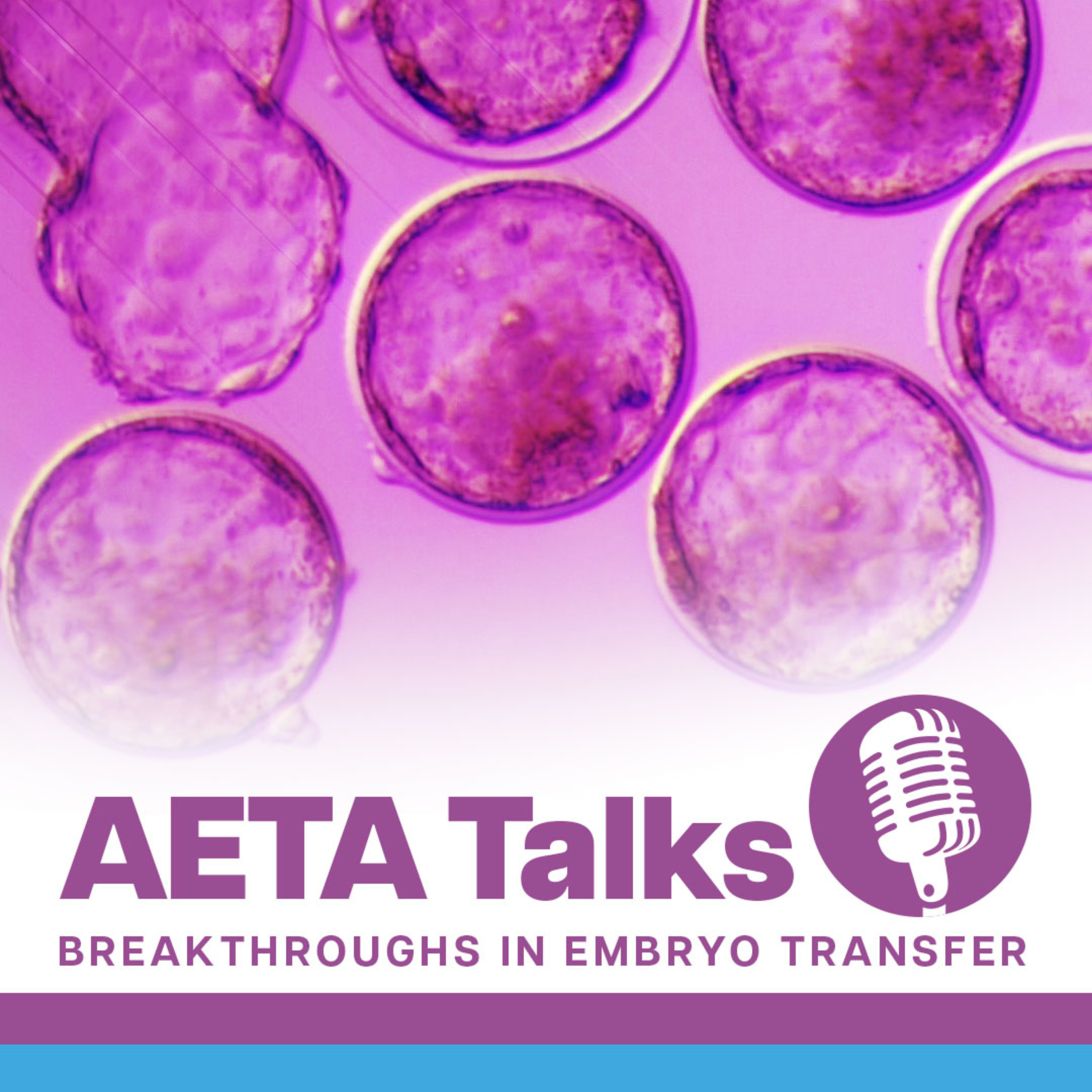
(upbeat music) - Hello, and welcome to AETA Talks, the official podcast of the American and Retreats for Association. I'm your host, Kelsey Sevelle, helping lead the Promotion Committee with Dr. Romantosta. Romant, do you want to introduce yourself? - Yes, I'm one of your co-hosts, Dr. Romantosta's Warte, AETA Promotions Committee Co-Chair. Rachel, be with you, everybody today. We've got a great show for you today, and our three of you have two very special, actually three very special guests. Joining us, two of them are from M. Genesis, Dr. Carol Wells, CEO and founder, and my career, and biologist and advisor. Our future discuss the work M. Genesis does, and provide their insights on cutting edge development in M. Retreats for. We also joined by Dr. Bradley Lindsay, a long time AETA member, who we will bring his critical perspective and challenging questions to ensure we truly investigate M. Genesis claims and methodologies. - And if you enjoy AETA talks or have any feedback for us, please feel free to let us know at
[email protected], and make sure to like, subscribe, and rate us on whatever social media platform that you're currently using, and spread the word to invite friends and colleagues. - We'd like to give a special thanks today to our sponsor, M. Genesis. M. Genesis is revolutionizing livestock reproduction with its innovative embryo health analysis platform using proven machine learning technologies. M. Genesis provides objective data driven, embryo evaluation that helps producers select the health as embryos shoot for them to transfer. Your support enables AETA to continue sharing valuable insights and conversations that are advanced are in the stream. So today we're gonna start with like talking with Kara, the first question will be towards her, and Kara, I mean, first of all, please introduce yourself, in following that what inspired you to start M. Genesis was there a specific moment or challenging your career that sparked this idea? - Thank you so much. Really appreciate you all including us on this exciting podcast today. So a little bit about myself and my background is I'm from the Houston suburbs grew up in Missouri, City, Texas, and I wasn't really familiar with this industry at all until I started college and started doing undergraduate research and reproductive physiology. And once I saw the science and embryos in Ixie, I was completely hooked. I thought it was some of the most fascinating stuff in the world and I wanted to learn more about it. This led me pursuing a PhD in reproductive physiology setting embryo selection techniques. This started about 15 years ago and at the time I was actually working on a specific gravity device to evaluate embryos. It was pretty cool studies. We found out that when you dropped embryos through a fluid filled chamber, the ones that sank like a stone were actually non-viable and did not go on to develop like the embryo counterparts that would drift slowly or even flip. So this was all really cool for academic purposes, but what was really interesting is at the time I was doing 100% of my research on mice, but I had peers in the animal science department that were like, hey, what you're working on is really interesting. My veterinarians coming over to transfer some cattle embryos or some sheep embryos would you want to come use your device on these embryos at our farm? And so I did, and we were able to create some publications out of that, but what I realized in this process was that my friends weren't just being nice to me. They weren't taking the risk on their embryos on their expense because they wanted to help me graduate, but it was because that they wanted solutions to improve live birth outcomes of IVF and embryo transfer that could be accessible by then. Long story short, I had a lot of. Some hard learning lessons along the way, especially as I learned more about the industry, practical commercial side of IVF and embryo transfer. When I realized that products didn't just need to achieve accuracy, but they needed to be practical, affordable, and fit into the workflow of the livestock and biologists or embryo transfer practitioner. And so I really dwelled on this for several years, wondering how can we create more objective, non-invasive solutions that could work in this industry? And the aha moment came one day in 2020, right at the start of COVID, which I'm sure we all remember quite well. When I realized that advancements in computer technologies and machine learning were starting to transform all aspects of our life, that why haven't we applied this to livestock embryos yet? And by not doing so, it was truly a missed opportunity. And so I took the notion that if embryos are living growing organisms, do they have activity that can be captured in short real-time videos? And can we use machine learning and artificial intelligence to evaluate that activity and outperform what the best embryologists in the world could see with the human eye and brain? So five years ago, this was a research project. We've been collecting data ever since, and then building upon these solutions and evolving the product so we can create objective analysis of embryo health and real-time. - That's great, that's great. Kelsey, if you wanna go ahead? - Yeah, I was just gonna just so we can get everybody kind of introduced. Michael, right, can you kind of comment on some of your background and introduce yourself a little bit and then also just tell us like how you're involved with Mgenesis? - Yeah, I've been around ET my whole life. My dad has a practice in Colorado, so I grew up giving donor shots, what not. Quite a bit of experience, transferring, selecting. I went on my own back in like 2019, similar to when Cara started this. I get frustrated, the pregnancy rates have been kind of stagnant for a while, I mean these IVFs have improved quite a bit in the last few years, but I do think I am a believer in technology and the next step is to leverage this technology to improve pregnancy rates and ultimately live calf outcomes and for the clients and just to push genetics forward in the beef and dairy industry. So we need to use whatever technology we can. And so I met Cara, I forget what year it was. I think it might have been 2019 in Colorado Springs at the ATA and we kind of kept in touch and she told me about this. That was when she was working on the gravity, but then she reached out to me a couple of years later and like, "Hey, I got a new project. Look in, what do you think of it?" We need some more data, so I slowly got involved and then have provided quite a bit of the data to train the models and test all the systems and everything. - That's awesome, that's awesome. Dr. Alinsky, would you like also to introduce yourself, please and then just tell us what you know about this technology or if that's the first time you're hearing about it. - Yeah, no, thank you for the opportunity. It's a welcome invitation that I accepted readily because I pretty much spent my entire career in embryo transfer. I've been in the business now for 42 years if you can believe that, but I started out with the old Granada Corporation first doing equine repro and embryo and then migrated over to the cattle division and it was a great opportunity to see all the technologies that we were using and trying to implement practically in the industry in the '80s, including being the first domestic company to commercialize IVF. And so it was very exciting to me to be part of that and then move on to the commercialization with IVF finding that there's a lot of problems obviously and just trying to work through those issues and realizing that we have so many challenges with IVF embryos, they're not the same as we all know and then trying to find solutions to that. And like I said, it's been most of my career trying to solve some of these problems and I think initially we realized that we were going down the wrong street in terms of looking at embryos and trying to figure out why IVF embryos wouldn't freeze. Well, some of the early attempts to alter that, outcome was to try different methods of freezing and I always held back from that, realizing that we probably needed to look at building a better embryo to freeze but it all comes down to evaluation, right? And we have a lot of subjectivity with technicians, we have the subjectivity now between in vivo and in vitro embryos and so it's, you know, there's been other attempts I guess at looking at how can we integrate different technologies to evaluate embryos, the human eye is amazing but microscopes can duplicate a lot of what, and then it's now analyzing the data. I think that is one of the things that, and I have worked with Cara and, you know, their team in terms of collecting some of the data, we didn't contribute a whole lot but I saw early on that they were on to something and I think, you know, obviously there's probably a lot of work to be done but I think they're definitely on the right path and I'm excited to continue to see where it leads and how we can rely on technology rather than, you know, human subjectivity and error. - Thank you, Dr. Lindsey. That was a great introduction and we are so blessed to have you on this podcast with us today and all three of you guys we've remodeled and I really appreciate your time. - Absolutely. - Cara and Michael, can you, you know, you've mentioned Cara that, you know, you've kind of shifted towards the AI and machine learning as like the foundation for M Genesis but can you kind of give us a more background on exactly what the M Genesis platform is and how your technology works? - Absolutely so I'm super thankful for everyone like Dr. Lindsey who paved the way for, you know, IVF to be such a mainstream technology today that we all get to work on and I think it's really exciting how we get to keep innovating in this space. And so really the core of our technology is evaluation of embryo health and real time. And so what does that mean? So we know that an embryo should be a living growing organism. We know that they're using energy. We know that the cells should be dividing. We know that they should be differentiating but this is not something that as embryologists we can see in real time. I think about it like if you have a weed in your yard, it might not have been there yesterday but then you went outside this morning and it's three inches tall. And you're like wow, that weed grew really fast. But if you laid in your yard and stared at it overnight you probably would have never seen it grow. I feel like that's what's happening with these embryos. The changes are quite fast but they're not fast enough to be perceived by the human I am brain. And that's where the power of artificial intelligence and computer vision comes in. So we believe that video data offers more data than a single still image analysis. Which is like, I think Michael and I talked about this in the early days. All the research on time lapse imaging was really fascinating but we didn't believe that time lapse incubation was really practical and feasible for the livestock industry. So we were like how do we shrink that down and create something that's more data than a single frame image but not as cumbersome as time lapse incubation. And that's where we landed on these 30 second videos of embryos. We also realized that the livestock industry still operates with very low margins and that whatever hardware that we utilized deliver the system to the field needed to be practical and affordable. And so the answer for that was really right in front of us. Every single one of you I can imagine owns at least one microscope and I can also assume that you own at least one cell phone. And the camera in your cell phone is probably the best camera that you've ever owned in your life. And so we're like, okay, they have microscopes, they have phones. So we started by simply capturing 30 second videos with camera equipment and microscopy equipment that people already had. And for years we actually just saddle that data. Machine learning models, they need to be taught how to learn things. You can't just give it data of an embryo and say like figure out which ones make pregnancies. And this was probably one of the most challenging parts of training these model. To teach them we had to know which embryos made pregnancies and which ones that didn't. So people like Michael took videos of thousands of embryos that they had in the routine everyday practice and then they would work with their clients to get either calving or ultrasound updates that we could use to say, hey, this model actually made a pregnancy or this model did not make a pregnancy. Michael and I think we celebrated the first 500 embryos even though that meant nothing for machine learning. I think we celebrated the 1000 embryos going to this data set and it really wasn't until we started getting 10s of thousands of embryos with labeled pregnancy outcomes into our data set. That machine learning models could really do their job. So the machine learning, it would take this labeled data. So videos of embryos that make pregnancies or videos of embryos that did not make pregnancies. And it would mind these videos for patterns associated with embryos that make pregnancies and those that don't. And then once we started getting enough data to start seeing trends and then ultimately become really specific and targeted, we can show it a video of any embryo that's bovine from any equipment and it will produce a confidence score from 0 to 100 of how likely that embryo is to make a pregnancy. And so now going forward, people can use this objective information to select which embryos they want to transfer, which ones they want to discard and just make better and more data-driven breeding management decisions. - I have a question. So for you, Cara, and for Mike, I mean, and then I'm going to let that also after you talk about this one, I'm going to let the Dr. Linzi kind of bring his counterpoint on this topic, but talking to him, James's technology be applied in the field of Invertrans for MEANY. Am I receiving, for instance, if I'm transferring like you know, IVF embryos for XLAB? And then I have a microscope. I have a basically like my iPhone. So am I getting like a 10 embryos on that four-well dish and I'm putting my phone there and holding that phone for 30 minutes and then 30 seconds, I'm sorry. And then is that like a machine going to just tell me which embryos the your tool is going to just tell me to transfer that has the higher likelihood of making a pregnancy that how he works or how do you, what are the producto implications of life? No, how am I going to use that in my towards my clients to better the conceptual rates? - Absolutely. So we created a web-based platform. So in the browser on your phone, whether it's Chrome Safari, whatever you go to imgenesis.app. Here you can upload or record the videos of the embryos. You can have multiple embryos in each video. We just ask that they be in focus not touching or overlapping and typically at about 60 to 90 X magnification. You record that 30 second video and then immediately the machine learning starts analyzing those videos and you get a report directly in that web-based platform. Ideally the embryo should still be in the dish under the microscope. When you receive these results, there will be a box around each embryo which correlates to the scores and then you get that embryo health score for each of the embryos that you just took a video of and you can use that data to decide that hey, today you wanna transfer only the top 20% of embryos or you wanna transfer all but the bottom 10% of embryos. It's really your call that we give you that score that helps you rank the embryos from most healthy to least healthy and you can decide how that fits into your practice and I think Michael can probably give a more first hand user experience on these things but it was really developed to just empower embryologists with more objective data to make better decisions. - Yeah, I'll just touch based on the practical on the field side. I've done up to 12 at a time and it's 30 seconds so I'm usually, I line up my 12, I can hit start. Meanwhile, I usually just record my stages and grades for each one as I'm looking at them and then by the time I'm done recording my grades and stages like the video's done and then you can upload it real quick and I go on to the next set because we know we wanna move fast. I go on to the next set and then in the meantime, the machine learning and the system is running them and you get scores back really fast. So it really doesn't. There's been concerns about workflow and how fast you can do it like I don't really think it's minimal for the benefit that it can provide. So. - We also believe that as technology advances, computerships are getting faster or faster. All those workflow issues that are present today are likely not going to be present in the future. - Got it. And Dr. Lee, what would it be your concerns towards like, you know, basically that process in the field? - Well, you know, just to touch on one thing real quick, you know, I think I would, on a positive note, say, you know, the one thing that is key with this technology is the aspect that it's non-invasive, right? Previously, you know, we've had to rely on, you know, terminal evaluation of embryos, such as staining embryos to total cell counts and intercell mass, the total cell ratios, and a lot of other, you know, to test that wouldn't allow us to keep, you know, the embryo alive. But, you know, one of the things that we can do, also, and is, you know, with developmental kinetics kind of correlate the data that, you know, cares team with them, Genesis is collecting, you know, because that, that, they're looking at a portion of that embryo's life as it develops. There's been, there was, I remember long time ago being very excited to see, you know, I guess one of the first time lapse videos I had ever seen much less that was applied to an embryo and it was fascinating. But I learned a long time ago, and this is to answer your question that in biometry, which is the, you know, the study of the statistical analysis of biological organisms, which is vastly different than hard physical sciences. So, the, what I learned about this, and when I did my PhD, was we need to use much, much larger data sets, right, to get sample sizes large enough so that the power of the test is statistically significant enough, we can make valid conclusions. It was maddening to me during the '80s when all these studies will come out, and I don't mean to bash. Theory of Genology is a journal, but there's a lot of, you know, journal articles with sample sizes of 20 and 30, you know, which don't mean anything. But I think cares team that they have understand, stand this and are attempting to increase that data analysis because right now we're at the beginning of this, trying to correlate, you know, among diverse, I mean, individual data sets and trying to make broader conclusions. And so I guess that would be a question I would have back to care in the team is how is that progressing? I mean, I know there's a lot of genetic variation within region, you know, and breed types and all these things, and it has to probably play into account with your data. - Great question. Honestly, this would have been a whole lot easier had we developed a little box, put a microscope, lens and camera in it, and really was able to standardize the environment that people took these videos in. But when we talk to people in the industry, they didn't want that. That's one more thing to buy. That's one more thing to haul around. They really wanted to use the microscope and the phones that they already owned. So, you know, in business, I don't really believe if you build it, they will come. It's never been that easy for me. So it's really about product market fit. We had to understand the life, stock and biology business and the types of technology that these people would actually adopt. And that's where my team has helped me, people like Michael, people like Dr. Russell Killings were who have worked in this field, and they know what they would buy and they know what their peers would buy. And so we said, okay, we're going to try to make this work off of cell phones and microscopes that they already own. And in the early days of this, those variables completely turn this project upside down. Like one camera, I might have a blue cast or a gray clapped cast, and just the computer would get really confused whenever it saw these videos of embryos. Fortunately for us, technologies and artificial intelligence, they're becoming more robust, you know? Your self-driving Tesla needs to be able to drive in the day and the night and when it's foggy outside. And so camera technologies are really getting a lot more robust to all these environmental variables, which were definitely able to leverage when using this product. So now going forward, we've realized that we need these variables in our data set. So we try to take as many videos with as many phones as possible, with as many cameras as possible, with as many microscopes as possible. And sometimes we even take videos of the same embryos with different camera types, so we can see the drift and the models as, you know, these embryos are exposed to these different variables. We have a really intelligent and amazing machine learning engineer who is accustomed to processing video data in real-world environments. And so he's been able to do things algorithmically that can help adapt for these variables. I don't know that there's ever going to be an end date where we're like, we're done. I think this product is perfect. We're never going to evolve it after that. I think it's going to continuously being an evolving process. But when new people work with us, we say hey, we want you to give us 30 to 50 embryos recorded on your system. That's going to be completely free of charge. And we want to use those videos that you recorded to help do quality control and help calibrate it. If we are confident that our system is able to get a good read on that system set up, then they can proceed and start using our analysis and their decision-making process. If not, then we'll just ask them to keep recording more videos of embryos and keep doing calibration on that technology until we can get a good read on them. That's great. Yeah, it's fascinating, too. I love the part when you say we're never just going to be done and walk away and say, yep, this is finished because it's so cool to always just have a goal to always be bettering the product, bettering the industry's knowledge base and the technology that we have at our fingertips. So have you guys tested Mgenesis against, like, experienced embryologists and see how that shakes out, like the machine learning system versus the human eye? Yeah, so we actually have a couple of different products. One is Easy Grader, which is just a machine learning base automated embryo staging grade analysis. The exciting one that we're talking about now is Envision, which is the embryo health analysis, which goes beyond morphology. And we actually published a study last month in Journal of IVF Worldwide, where we surveyed 42 embryologists at the IETS in 2024. We asked them to stage and grade these embryos and predict which embryos would make pregnancies. And then we compared those against our machine learning results, and we use those data for this publication. It was predominantly on the staging grader, because that's easier to make claims about and see. And our machine learning graded and staged embryos comparably to people with 10 years or more of experience and then outperformed those with less experience. For the Envision, how we validated this is kind of like I said, at the beginning, we didn't have anything for years. We needed the data to build this product. And so the embryologists would record these videos, transfer all of the embryos that he thought were acceptable. And then we use the actual pregnancy outcomes. So using that, we can now take the machine learning models, prediction of those embryos, and compare it against actual results so we can see how well these perform. So are those on fresh and frozen embryos both? Typically, so our first product is for fresh embryos, because most people do direct transfer. They don't want to thaw them out and look at them again. So our first products are available for fresh embryos, at day six or seven. I have a couple of-- it will be like a combination of questions here at CARA. And then I'm also going to ask Dr. Olene to jump in on this one here. But when it comes down phrases to the applications of Mgenesis towards embryos, when we were talking about fresh embryos on, of course, flush an idea. There's a little bit of a difference there. And then does the environment, for instance, are our embryos on a heated plate, on a HOD media, x, y, and z? Going to change the evaluation. And has Mgenesis also used the technology towards olocytes to predict also cleavage rates? So we recommend that people do not change their protocols with the exception of taking a video of these embryos. So if you use a heated stage, we definitely recommend that you still use a heated stage. If you're just doing conventionals and are not working with a heated stage, and that's fine. And actually, when you upload the video, it asks you to report if the embryo is conventional or IVF just so we can help distinguish those differences, if need being. But really, the only changes to your day-to-day operations that we're trying to initiate is that you add a video to this process. Oh, olocytes, so we don't have much data at all from olocytes. I think theoretically, it could be used to predict cleavage. And actually, I think there was a group in Sweden recently that published a nature paper where they were looking at machine learning and application to bovine olocytes, which was kind of exciting. I would love to move us in that right direction. It just needs data. So if there's people willing to collaborate with us, I'd love to have that conversation. What are your thoughts, Dr. Lindsay? Well, yeah, she's addressing a lot of the questions, I guess I had. But as I mentioned before, one of the first observations we realized we started making IVF embryos. And these guys are different, right? And so you clearly identified that, trying to, I guess, develop a couple of different algorithms. And I guess my question is, are you finding that the machine learning is it's easier for it to have predictability of embryo viability for an in vivo versus an in vitro? Because that's what I would expect. That's when we look at, and there are some papers that published some of these terminal evaluation techniques of embryos. And just morphologically, when you looked at them, it's like they looked the same. But when you looked internally with intersemasts, ratios, and those kind of things, that these embryos were different. And I'm just wondering how easy or difficult is your algorithms, is that able to pick up that? Great question, so today, our product is a decision support tool. It is not a diagnostic. And so what that means is it can recognize normal, and it can recognize abnormal. So for example, if I'm watching my horse walk to me, I can tell if she walking normally or if she's limping. And just staring at her walking, I can't diagnose-- if she's limping, I can't diagnose what is wrong with her. Is it a knee? Is it a hoof? Does she have an injury? But I can at least say, hey, she's limping. She's not normal. She's hurt. It would take more advanced diagnostics to really go and look in the source cause. But functionally, normal embryos make pregnancies. Confirmize embryos do not make pregnancies. So what would be awesome to know is that embryo genetically compromised, does it have heat stress? What's wrong with it? We're not at that point yet. But if we can at least help you identify the healthiest embryos with a good chance of making pregnancies, and then the embryos that really don't have a chance of making a pregnancy, we feel like we are helping move that needle. So I do think with time, we can do more studies where we can become more of a diagnostic, but today it's really a decision support tool. OK, and just to add a little bit on Dr. Lin's question, it's like if you have that has happened to me many times, I have like three or four embryos on my plate. And then like, I know there's one that's like growing on holding me to right there. And then the other two are not growing and expanding. If I separate those embryos myself, and I transfer them, and then the machine also does the same thing with-- I'm talking about your vitros here, the likelihood of a human eye being as accurate as the machine on your data. How have you guys-- do you guys have any information? On precise information on that, I know you said that the machine was better than people that had 10 plus years of experience. But have you actually gone very like Michael, for instance, sore embryos versus the machine sore embryos at the same time? Yes, so what I think you're asking is how is it do on negative controls? And I've definitely asked people to take videos of their grade for is take videos of their UFOs, take videos of these degenerates because we need to train the model on those as well. Because that's something that we will encounter in the field. And today, it is very, very accurate and predicting and determining that those embryos have no chance of making in pregnancy correctly staging and grading them correctly and getting that accuracy down. So we've done a lot of negative control studies. We've also seen a lot of embryos that look beautiful and perfect, score low through our system. Even some people that have rolled those embryos retested our system, they score low again. And then actually in practice, those embryos did not go to make pregnancies. So what's kind of fun about the system? So if we take out the machine learning, just quantifying the amount of activity and these embryos gives us a trend. So what we've seen is completely agnostic to embryo stage and grade. Embrose with high activity and low activity do not make as many pregnancies as embryos with mean moderate activity. It makes a nice bell shaped curve. And like most things in biology, the embryos fall into this. Now average is good outside of standard deviations. Either left or right is bad. I've not proven this, but this trend really mimics the quiet embryo hypothesis, looking at embryo metabolism, saying that some of the embryos that are too fast growing and too metabolically active are actually burning through their energy stores and developing at a rate that's not sustainable with life. So they're burning themselves out. And so like I said, without machine learning, we are already seeing these trends that give us some insights into what our assessment is looking at. When we give machine learning to it and we pair it with machine learning, we get to be even more targeted and specific with those outcomes and how we predict that. - That's awesome, thank you. That's great. Kelsey? - Thank you. - Yeah, so I kind of want each of you three to give me some feedback on this question. I think maybe Dr. Lindsey will start with you, but where do you see I'm Genesis and just the whole technology platform that I'm Genesis kind of stands on heading into the next five and 10 years from now? - That's a great question. It's kind of like you're asking us to look into the future and that's fine because I love those kind of questions. You know, this machine learning aspect is one that I think will continue for a while because again, we, I think everyone understands now we've got to collect a lot of data to validate the models and that obviously needs to continue. I do think there's some other maybe integrated technologies that could be run in tandem with this technology. I have to admit that I've only recently kind of reinserted myself into the, you know, looking at other technologies. I've recently got a new partnership with setting up IVF labs and that is challenging me, I guess, in my thinking to look at things. And I think one of the ways that we might be able to do that and it's similar to machine learning, but it's using actual AI technology to look at, you know, bigger statistical models and, you know, start getting out of my league whenever, you know, it's really been a struggle for me, you know, coming from my era, childhood of the '60s to now start thinking about, okay, all these futuristic applications of, you know, machine learning or AI, we, you know, not just predicting staging grade, that seems to be something that's fairly basic. We, you know, we're looking at, you know, the embryo's ability, I think we gotta stay focused on that for a while and predict embryo ability to not only, you know, we select it for its viability, but cause it actually make a pregnancy. So that is a given, but also, you know, look at maybe, because siren dam factors get diminished once we have a viral embryo. But are we missing something by not going back and re-evaluating siren dam, you know, influences on a larger scale? So it's almost like, I think we have to revisit some of our old paradigms in terms of thinking that we know what we're doing and it could go all the way back to, you know, how we set up, you know, the recipients. That's the next big factor, right? So that's one question I must still have for carers, like how is, you know, how is recipient being taken out of the model to evaluate predictability of an embryo's viability, because it may not be the embryo's fault, right? - And I, can I step in on that one? To answer the original question, like, where does this go in the next 10 years? I think a pretty simple approach is just, collect as much data as you can on everything. So like, a lot of the transfers and the data set I've done and I actually manage the ReCIPs. And I mean, I have, I'm working with a PhD at University of Wyoming to come up with a ReCIP index taking all this ReCIP, because you're right. Like, we know the ReCIP is a huge factor. We know the weather and the environment's a huge factor. So going forward, one of my big goals is to, you know, to make a ReCIP index, we're gonna start incorporating ultrasound reels basically here shortly. Like, in the next couple of weeks, we're gonna start collecting data on that, that analyzes the ovary and the uterus and then all the other ReCIP factors that we can collect, you know, days since estrus. I even have it down, like, we have iPads that we report everything on. There's like no more paperwork. Like, I have it down to like, I'm within five minutes of how long that embryo's been in the straw, you know, 'cause we do know that negatively affects it. So like, I can get within like five minutes on that. We know that affects it. And then external weather like this PhD from University of Wyoming is gonna help us with it. So like, that's it, you know, that's one thing I, if I can collect it, you know, that's one thing I can do to contribute is like, I can measure a lot of this ReCIP stuff and try to take that out of there, you know, 'cause we know we're transferring embryos into ReCIPs that aren't good. So that should help out the accuracy. We even have like genomics on the ReCIPs for, you know, how good a ReCIP they have. So like, we have a lot of data on the ReCIP side that'll be really exciting to incorporate. And then, you know, you kind of stack all this stuff together and who knows where it's at in 10 years. But I can't help but think, you know, like, we're gonna drive that cost of pregnancy down. Every little bit we can improve, we'll drive that cost of pregnancy down. And it, you know, eventually the cost of that life cap down. And I think when we get that lower and lower and lower, that, you know, people, other producers, not just elite genetic producers, we'll be able to look, we'll be able to use IVF technology to improve their genetics all over the industry. And then, what does that do to our industry? Like, it's pretty exciting, you know, like, more milk and more beef, you know, with less resources. So like, I don't know, it could be pretty cool. I'm excited about it. - That's my complete, I completely echo that 100%. And, you know, I think, imgenesis was not created to be a silver bullet. We said, hey, there's a lot of problems in the system. It can be environmental, it can be maternal, it can be embryonic. What are my skillsets capable of solving? So we focus on the embryo. So our technology is really evaluating the embryo. But I believe that it can be used as a complement to other technologies to look at recipient, environmental, genomic factors, et cetera. And then, that's how we really move that needle to exactly what Michael was talking about with that more pregnancies, higher return on investment for the beef or dairy producer. And then, ultimately, that every embryo transfer makes a pregnancy that survives the term, it drives the price down. And it makes more protein to feed more people, more sustainably. So I think it's exciting, we've learned a lot. And I also think it's really cool that because we have a video database of so many embryos, if we want to go back and look at something retrospectively, we can absolutely do that. If we want to look at, you know, the impacts of heat stress or weather or maternal environment, we're already sitting on that data to do that. And we can go back and look at whatever we want. So data is power and it's super exciting to be innovating in this space. - Well, thanks again, Cara, Michael and Dr. Inzi for taking the time to walk us through this exciting and the transfer innovation. This was a very, very exciting talk. I was, you know, thrilled about it. And, you know, once again, it was great. And that brings us to the end of another episode of A-E-T-A-Talks. If you enjoy our show, be sure to like, subscribe, and rate us and spread the word to a friend or colleague. We welcome all feedback at A-E-T-A-S-S-O-C-H-Q.org. Kelsey? - Yeah, we love the feedback. So please send it to us, guys. For previous episodes, show notes or more about A-E-T-A, just please visit our website, A-E-T-A.org. And thank you, guys, so much. Micah, excuse me, Cara and Michael at M-Genesis for supporting this episode of A-E-T-A-Talks by sponsoring, then also with your time today and all of your expertise. And thank you so much, Dr. Inzi, for being here with us today. Really excited to have you pioneers in our industry with us. - Thank you, it was very, very good. I enjoy it very much. - Thank you, guys. - Thank you. (upbeat music)
 PodcastTranscript AI