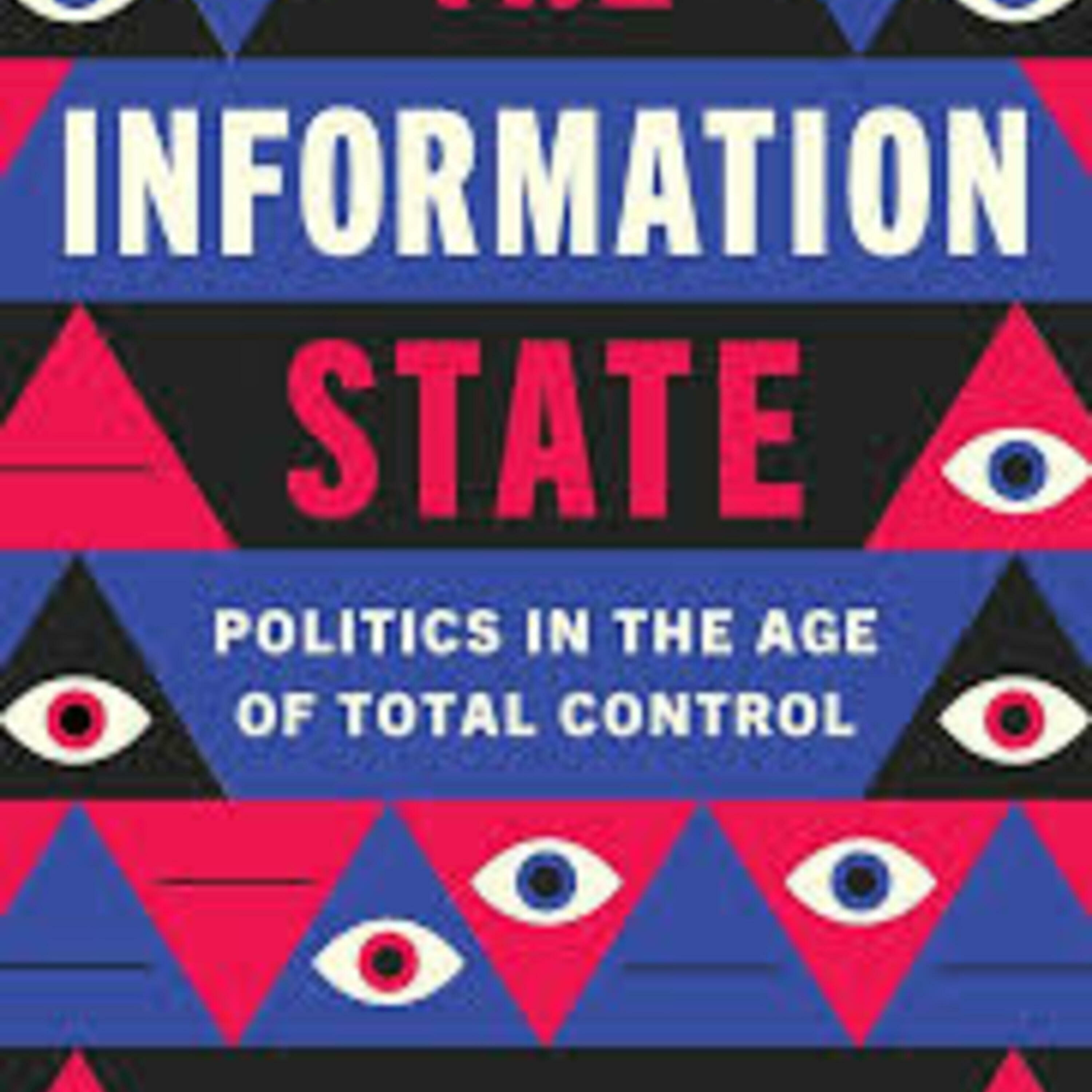
In this podcast transcript, author Jacob Seagull discusses his new book, *The Information Estate*, which examines the rise of a technocratic "information state." He argues that what began as a legitimate effort to combat foreign disinformation has morphed into a domestic system of information control, censoring American political speech under the guise of protecting democracy. The book traces this development to a long-standing philosophical and institutional trend: the dream of using information systems and algorithms to administrate society, a vision dating back to thinkers like Leibniz. Historically, this manifested in the Progressive Era's push for a professional bureaucracy, which, while aiming for efficiency, created an expert class often disconnected from public will. Seagull contends that digitalization has accelerated this, enabling tools designed for foreign influence operations to be turned inward, regulating domestic discourse. The result is a fundamental threat to political agency and sovereignty, as decisions are increasingly made by opaque technocratic instruments rather than through democratic engagement. The book urges a deeper understanding of this systemic shift as a prerequisite for any meaningful political response, moving beyond narrow anti-censorship advocacy to confront the broader erosion of human-centered governance.
Welcome to Man of Festo, out of podcast. Your regular visit to the archives of vanity or men and women who stop making myths started issuing proclamations. Your guides for this journey by co-host, the novelist Phil Clyde and me, Jacob Seagull, the knocker off of tall hats, may you continue to be a person. And our very special guest for this installment of Man of Festo, why it's me, it's the knocker off of tall hats, Jacob Seagull. Welcome to the program, Jacob. Thank you so much. Jacob, it's good to be here promoting my new book, The Information Estate, Politics in the Age of Total Control, which you can buy now by always, it'll be published on March 24th. But if this happens to come out before then, just know that you can pre-order it. And wherever you pre-order it, and if you like it, you should leave a good review. If you don't like it, feel free also to leave it a good review or to criticize it, do it every want. As always, before we get into the meat of it, we want to thank our sponsor for Man of Festo, Fairfield University, A Jesuit University, in Fairfield, Connecticut, our trustee and honored patron for this podcast. We greatly appreciate the support from Fairfield, then at some point later this year, I want to travel in the States to promote the book. I will do an event at Fairfield University, so if you're in Connecticut, I'll post those dates. And if you're local, I would love to see you there. So, okay, Phil, shall I hand it over to you, as my interlocutor? - All right, yeah, so Jake has a new book out. - You should buy it, read it, argue about it online, and yeah, leave stellar reviews for it. Regardless of how you feel about it. - Just-- - Of course. Maybe just buy it, buy multiple copies. - Buy multiple copies, hand them out. - The idea here, the idea here, and we'll get into the book in a second, but the idea I've figured out is, you write a book and fill those this better than I do, being a much more successful author than I am, but you write a book and you want it to do well enough that you can write more books, right? I mean, that's, I think it's very difficult to really fully make a living, just writing books. There are very, very few people who do that. So even you aspiring writers out there should know that simply, like solely supporting yourself or much less a family solely from income made from the sale of books and publishing houses and book advances, et cetera, is next to impossible. But if you write a book and you sell enough books that you can write more books, then you figure out ways to support that with ancillary income, and that becomes the ambitions. I've been thinking about that lately. I was asked to write something sort of advice to young authors. So that's how I'm looking at it now. This particular book, The Information State, comes out of this essay that I wrote for Tablin Magazine in March 2023, a guide to understanding the hoax of the century, 13 ways of looking at disinformation. And that essay was a fairly forceful critique of the counter-disinformation industry that had established itself in the US, sort of out of the infrastructure the counter-terrorism industry and some other related enterprises really starting in 2015, 2016. And so I made the case in that original tablet essay that the claims about disinformation had been falsified, exaggerated, and weaponized to serve partisan ends. I never disputed that there was a real threat from foreign disinformation. I don't dispute that now. I don't question legitimacy of disinformation as a category when it's applied in its original context to forms of deliberate propaganda coming from hostile foreign actors. But what I disputed was the expansion of that term and that conceptual framework into a kind of totalizing campaign to control the information that Americans could access. And I objected to the application of protocols that were developed to apply to foreign foreigners, non-Americans, specifically terrorist groups, applying those same protocols to policing the speech of Americans. That was a-- and I warned in that essay that there were even more intensive and invisible forms of this kind of information regulation coming that they represented a aspirationally totalitarian form of politics and that AI would intensify all this. Now I wrote this under the presidency of Joe Biden before Trump's reelection would change things. But then in this book, what I try to do and fill you can be-- the judge of how successful this was, or where do you think I got things wrong? But what I do in this book is not simply to continue along this path of critiquing disinformation or the politics of disinformation or attacking political censorship, per se. That's really not my interest. I didn't write this book to advance the cause of anti-censorship, let's say, because I think that focusing narrowly on censorship misses the point that the attack on free speech is not just about speech in it of itself. It's about the attack on political agency and political sovereignty. But the reason why the First Amendment is enshrined in the Constitution is because the framers understood it as being intimately connected to the exercise of political rights and of religious conscience, specifically. And what I try to do in this book is explain the development over centuries of how a rationalizing technological approach to the administration of society has relocated human decision making and human agency outside of the grasp and scope of individuals and of human-centered communities and relocated it into opaque technocratic instruments, both of the state in the sense of bureaucracies and also technologies, computers. And what I ultimately am trying to show is that we've crossed a threshold, and we've entered into this new phase that I call the information state, where this very old dream of technocratic administration and of the totalizing computerization of society, which goes all the way back to the 17th century, as I show in the book, the digital machines could solve all social problems. Is there in the writings of the German philosopher Godfried Leibniz in the 17th century? And that's not a random tangential connection I'm making. Leibniz is a primary influence on Norbert Weiner, the father of cybernetics, whose idea of man-machine symbiosis is also a major influence on the head of DARPA, ARPA, as it was then known, J.C.R. Licklider, who's one of the primary architects of the internet that I am speaking to Phil on at this moment. So you can draw a straight line, not a direct line, but a line hooks around mountains and goes along valleys, et cetera, and it winds, and it takes a long time. So it wouldn't be straight. Actually, it's not a straight line at all. You can draw a long, on the straight line, but a dashed yet continuous line from this idea of an informational code to reality and to politics that appears really flowers in the 17th century to the present. The reason why that's important is what I'm attempting to demonstrate in this book, what I'm attempting to show to people is that the system that we live inside now, if you are somebody, for instance, who read my tablet essay on disinformation and you thought, wow, this thing he's describing is quite pernicious, we need to fight the sensors. What I'm trying to say is, no, that's actually-- that's not enough. There's not a politically convenient solution to this. Because the problem of the information state is not simply the sensors. It's that the idea that you can informationalize all of our problems, that you can informationalize society in total, and then algorithmically compute answers to all social problems, is not only a flawed model, in my opinion, it is the dominant model of the society that we have been constructing for hundreds of years. And the total digitalization of the world, this epoch that we're living in now, which I think is, going to be comparable in its transformative effects to the development of the printing press, the total digitalization of society has rewritten the rules of political sovereignty, it has rewritten the underlying basis of our conceptions of human freedom of political sovereignty, of participation inside our own societies in ways that we have yet to come to terms with. And before we can meaningfully really do anything with it, we have to first understand where we are, what we're living inside of, and try to come to terms with it. And I'll stop there. OK, so that's sort of like very high, high rhetorical register and abstract. There's a kind of-- a lot of the book is sort of nuts and bolts tracing of institutions, right? And the development of institutions, particularly through the US government, right? Alongside these ideas. And that's one of the things that I really enjoyed about the book. So the tablet essay--
is details essentially like during the Global War and Terror. There are these institutions that are set up to fight ISIS, messaging, jihadi, messaging online, and then later Russian disinformation operations. And in one sense, that's nothing new in warfare information operations. It's always been a part of warfare. There are always a sort of supplemental effort. Sometimes they're overemphasized or what have you. But we developed these tools, but also because of the nature of the internet where everything is flattened, everything is accessible from everywhere. They became this kind of bleedover between normally with information operations. They're only supposed to be done against foreign publics. But there is no such thing as pure foreign public when you're putting something on the internet. It's not like a radio broadcast that can only be heard in Yemen, right? That's the claim at least. That's the claim. And that cracks open this sort of gray space where all of a sudden you have tools that are developed as a sort of supplement to warfare where the US public is one of the audiences. And then gradually comes to be assumed that the US public should be one of the audiences. Right? I shouldn't disinformation is trying to affect US elections and so on and so on. And you have this apparatus that's not simply an idea. It's like actual institutions that have partnerships with the US government or run by the US government, which are working with especially tech companies to control the flow of information online. And over the course of global war and terror and then with increasing concern about Russian disinformation and US elections and then COVID in the rise of Donald Trump, you have this increasing assumption among a kind of technocratic elite that they need to be censoring and controlling and shaping the messages. It is not simply that the US public is receiving but actually information messages that the US public might be saying or parroting or whatever. And so you have this bleedover where tools that were originally designed to sort of shape the battlefield to combat, say, the spread of jihadism are now being used to try and control what American political opinions. And that results in a whole series of censorship that goes from taking down posts about COVID, sometimes posts that later turned out to be scientifically accurate to kind of infamous Hunter Biden laptop story that gets canceled. And because it's claimed to be a kind of Russian disinformation, I'll even though it is a valid story and people inside the government knew that it was valid. And that is bad. So there's that is like a main thrust of the tablet essay. And then this book takes the kind of development of that apparatus, right, as one strand of a larger story. And so on the one hand, you have the development of new abilities to try to influence public opinion. And so this book seems to operate into registers. So when you're talking about these types of information operations as a component to war, you seem very, very skeptical of what they can do. When you talk about them in terms of what they're doing domestically, it sometimes seems like you're much more concerned with their efficacy. But there's that. But alongside that is this long running as you say attempt to create a new kind of state. And one of the sort of pivot points is the Wilson administration. So you know, the, if you look at like, okay, so the democracy in Athens is in a city state. It's relatively small. There's a small number of people who actually have the ability to vote and they can all kind of like show up and argue together and so on. And as the 19th turns into the 20th century, you have these increasingly massive states with an increasingly complicated array of things that they do. And you have a kind of reform movement of which Wilson is a part which wants to create a kind of professionalized bureaucracy. And the normal line that you, I think the sort of normal history that we can think of is when the sort of like what Francis Fugiama tells of the development of the forestry service, right? Where you have a old patronage system, right? And instead of a patronage system where somebody, you know, gets a job as the, you know, deputy rat catcher in New York City because they support your political party that you give people a test or you make people go through schooling such that you're, you know, the people in charge of everything from aviation to medicine to whatever are sort of, you know, experts, right? And have greater expertise that is less about partisan affiliations than about kind of speeding the marriage, right? Okay. And one of the things that you point out is that at the inception of this movement, right? There is a overt anti-democratic aspect to it, right? That this is not like a hidden thing that Wilson, there's some great quotes. He says, "In order to make any advance at all, we must instruct and persuade a multitudinous monarch called public opinion, which was a problem since he saw the many of the people as selfish ignorant, timid stubborn or foolish." And so the idea that Wilson had and you quote a couple of other people in this milieu who are important for the development of these ideas is not simply that you want to professionalize bureaucracy, but that the professionalized bureaucracy comes to its own opinions about what the state should do. And then arresting upon their expertise instructs the selfish ignorant many of the things that they should give a sent to, right? And that in a way, this is a co-option of popular democratic world, right? And is seen as such by the people who are instituting this, right? Is that fair enough? You don't fantastic so far. I'm going to play this back so I can use your description of this in my future media appearances that you're doing great. Yeah, keep going. So you take that and you know, one of the things that then happens is because it is a, especially at the higher levels, it's a very particular type of American meritocratic system, right? And we've had episodes about the issues with the meritocracy and manifesto in the past, which we don't need to rehash, but you point out that this creates a group of people who are sort of distinct class, right? That tends not to be broadly representative of the American public, right? The people who are making decisions about clean water supply and what the interest rates should be and so on and so on tend to be highly educated postgraduate coming from a particular cultural milieu that has its own class interests, right? And that this in turn means that, you know, sort of there's like the ideal of the apolitical technocratic expertise and that is, and I think nobody would say that that's possible. That like not only that sort of a lose-dory, but also there's a kind of class interest, right? That this group is ultimately going to come to have, which is a problem if they're making a massive amount of decisions that in our sort of original conception should be made by the American body politic. Debating issues and deciding how we're going to shape our nation, right? That the bureaucracy ends up making a lot of decisions on behalf of the American public, zested in their expertise for what is best for them, but their expertise is coming from a class that has its own class interests that may not perfectly match the American public writ large and also may get captured by partisan ends, which is something that you show later in the book when you start talking about how that class started using the tools of information shaping. Yes, all of that, but there's an additional aspect, which is that the original claim that Wilson makes and that this is endemic not only to progressivism, but actually to a whole number of different late 19th century. Set aside your feelings about Wilson. I've complicated feelings about Wilson. It's a great writer. The multitude in a monarchy called public opinion is called that. Wilson is phenomenally impressive in a whole number of ways. I'm very critical of them in the context that I'm writing about him here, and I'm critical about other in general, but I do want to ask you that. On the one hand, I think that issue that you set up is correct, that we have a massive complicated state. There's all these decisions that have a huge effect on the shape of American public life. But then there's a, I think there is a genuine question about how you then get the public will adequately express in a state as complex as ours. 100, yes, yes, it's not like the spoiled system. So one of your concerns is about the abuse of power by those who have captured the tools of the state. One of the things that the progressives are trying to do is prevent that because if you have a professionalized bureaucracy, that is to some degree buffered against the executive. It actually creates better management. The obvious example is that every president wants to be able to tinker with the interest rate right around election time.
if they could, but there's a strong reason to have like a buffer between them. That's right. And so the spoil system, not just is, look, you're gonna have partisan hacks doing the spoil system, but that if you don't have that kind of buffer, it actually creates more incentives for, it creates much more abuse of power of the sort that you're concerned with. And so, you know, like the currently, you know, like the Trump administration has these sort of like political litmus tests and loyalty tests for people even down to the level of assistant US attorney, right? And on the one hand, that's gonna sort of degrade the quality of US attorneys that you have, which is a kind of effectiveness of government problem. But it's also means that one of the reasons that they're doing that is to shape that into a tool of state coercion, right? And that's why you have these sort of like ridiculous legal cases being made. Don't get into Trump yet, because I want to address what you're saying in the context of. So that, like, is the one hand, making it totally responsive to elected leaders, creates its own kinds of abuse problems. And then on the other hand, you have this like, well, I want the people's will represented and having a buffered technocratic administrative class is actually a counter against that. And so that seems like it seems like a. It's a real problem. It's a real problem. I don't know if that's a resolvable, but it's. But it's. The thing that I'm most interested in is that that tension is what is constitutive of our politics. It's not ultimately the resolution of that tension, because as you say, maybe that tension is irresolvable. Certainly we haven't resulted yet. But let's get into a little more detail about what you're describing, because I think that this is. We're still living within the legacy of this. The critical period for understanding our current digital political environment in some way is this period in the late 19th century when ruling elites are first trying to come. And political classes across the. Developed world are first trying to come to terms with industrialization. Right? Because what industrialization does is it introduces a degree of complexity into modern societies that first of all requires new technologies of information control. And in a very direct way that's chronicled in this amazing book called The Control Revolution that I mentioned by James Beniger, it's the industrial revolution spawns the information revolution, because the information revolution is the necessary next step to manage the surplus of goods and processes created by the industrial revolution. On a political level, societies get more complex, more advanced, and they seem to grow not only more distant from the sort of ability of local policies and average non-experts to control. They also grow more corrupt, as you pointed out. So will Sonyan Progressivism develops originally, American Progressivism develops originally in response to the Guilded Age? Right? And it is not merely a will to power that arises out of the venal interests of people who want to lord over the peasants. It is a reformist movement that is arising in response to a public demand for reform during the Guilded Age in the late 19th century. What it develops into, however, based in part on the sort of willsonian notion that we can dispense with old-fashioned addivisms like the Constitution of the United States, which was a useful document to get the country up and running, but it doesn't have anything more to say for an advanced industrial society entering the 20th century. And that's a pretty direct, quite directly. That's not paraphrase, but it's not really an exaggeration. And use more insulting language towards the Constitution. And this is not an uncommon position for progressives of the era, including some right-wing progressives. Remember, had you realized that this is also a progressives? I was at eight. I was at a dinner. Hold on, let me just try to wrap up, because I want to respond to what you're saying, and then I'll come back to this. But my point in retelling this context, which I go over in the book, which I know you read there, but listeners may not have read yet, is that I am not trying to portray the development of these new informational control techniques or of progressivism and technocracy itself as merely, you know, like malevolent ideologies. And this is, I'm not trying to engage in sort of political demonology here. I'm saying that the technological, social, historical process produced this moment, which was the gilded age, which had a number of potential responses. One of them was progressivism. And then this is what progressivism developed in the Wilsonian guys, and specifically what you don't mention, but what is the sort of central episode of this opening chapter on World War II. The reason why I spent so much time on it is that Wilson had run initially as the anti-war candidate, and then in-off, so he was going to keep the US out of the First World War. And that was always actually more complicated than his campaign slogan suggests. But the long and the short of it is that when he then ran and got reelected in his second term in the White House, he ended up bringing the United States into the First World War. And that was an unpopular decision, though many people rallied behind it because they supported Wilson or because they believed that the German threat had to be contained, or because the German attacks on the United States and sabotage attempts had provoked them into feeling that there was a necessary retaliation. Whatever the reason, there was a divisive issue. And Wilson's response to the debate around his decision to reverse his policy and enter the US into the First World War involved the creation of the first full scale propaganda office of the US government, which was called the Committee on Public Information, run by a progressive journalist named George Creel. And the CPI, the Committee on Public Information was not only a propaganda office, essentially every country involved in the war had its own propaganda office because they all believed not without some justification that modern wars require organized propaganda offices because propaganda itself is now so vital to determining the outcome of wars. But in the US context, what ended up happening was that this propaganda office, the Committee on Public Information, didn't just try and mold public opinion related to the war. It developed into its own kind of governmental sociological phenomenon where all of these different people, including luminous, you know, luminary intellectuals like Walter Littman, many journalists, academics, national security experts, were all brought together under the guise of this. Single enterprise, the Committee on Public Information. And though that office was closed when the war ended, it introduced a new model for how the government, how the state would relate to American citizens and would relate to speech rights and information that never really went away. And so this was ultimately where progressivism ended up, where Wilson ended up on this crucial question of how decision-making authority should be distributed in light of, you know, this complex problem you described. And what he ended up on was a state propaganda office. The stultifying effect of that on like daily public life is captured pretty well in pale horse palewider. There's a bit where one of the characters is thinking, there must be a great many of them here who think as I do and we dare not say a word to each other of our desperation. We are speechless animals letting ourselves be destroyed and why. Does anybody here believe the things we say to each other? And there's like this perpetual kind of like knocking of the war propaganda. The war, the war, the war for democracy for humanity. A safe world forever and ever and to prove our faith in democracy into each other and to the world. Let everybody get together and by liberty bombs and do without sugar and wool socks. Was that it? Miranda asked herself. Say that over. I didn't catch the last line. Did you mention Adam? Adam is the guy that she's in love with who's going off to fight. If you didn't, I'm not interested. What about Adam? You little pig. Oh, please do let the show go on and get over with it. I must write a piece about it before I can go dancing with Adam and we have no time. Cold oil, iron, gold, international finance. Why don't you tell us about them, you little liar. Yeah, and look, these are wartime exigencies that like on an individual level provoke the iron of somebody who's caught in their gears. What I like is that quote articulates, but that you can maybe justify a national security terms related to war. But the thing I'm trying to describe is the way that they they never disappear after the war is over. They become institutionalized and in a way they become invisible. They lose the sort of stark wartime drama that made them stand out against the background of the routine state. They become just additional layers of machinery in the power of the state. And the CPI, the Committee on Public Information is so directly a precedent for the counter disinformation industry.
I have to read a quote now. From the opening of this chapter, there's a book called Words that won the war, which is a history of this World War One office created, but by Wilson called the Committee on Public Information. And it's a sympathetic history, okay? And so this is a quote from this sympathetic history of the Committee on Public Information. If they included misinformation in their complex of ideas about the war, at least it was misinformation shared with them by editors and college professors, the country's greatest intellectual and spiritual leaders, and by public figures in the shadow of the White House. And it quotes, you know, there's a longer version that appears in the book, but so you had created an official propaganda office, which was spreading its own misinformation. In the first World War, you know, and that's the term they're using this book is written in 1939, but if it was spreading its own misinformation, it was righteous misinformation. It was misinformation for a holy cause. So that's the sort of founding episode in the progressive technocratic 20th century, 21st century tradition. And it's very, very, it's really a formative period in American life. I know people are very hung up now on like the Second World War is the origin of the sort of mythos of the post-war era, but I actually think the First World War is a much more influential period in the country's history and that's why I started. - Yeah, okay, so then you move us through time, you talk about sort of shifts in warfare, the development of counterinsurgency doctrine during the Vietnam period and take us forward to the kind of modern era where you have sort of complex of tools that are established around information and control that are associated with the bureaucratic state. And you also have a growth of a public, a private sector and you are specifically concerned with nonprofits issues with your characterization there, but we can just go ahead, let's get into it. Tell me what it is. - Well, you sort of basically describe them as them filling, okay, so you say you have a nonprofit in industry employing millions of people, functioning as a job program for the educated professional middle classes who could be mobilized as a reliable voting block, financed by democratic party donors, filling up parag governmental role and then their causes are incidental to the power structure they propped up, which is why funding would dependably increase despite their lack of success, solving the trench problems, assuming solutions were even possible with not really anyone's interest. That just seems to me like really depends on the nonprofit and what they're doing. Like, there's a whole range of nonprofits, some of them are fighting fights that are not exactly fights that will always be one, right? I mean, like a sort of free speech organization like fire is just going to perpetually be fighting free speech battles if it holds true to your submission. A, you know, medical, like is, okay, no. The NGOs that do medical stuff in the third world providing like mosquito nets is it all just a front so that you can have a job's program for democratic party staffers or do mosquito nets actually have a, no, no, but I'm not like, no, but like, it's spoken at such a broad level and with, because it's addressed at a broad level. Yeah, it just seems like if you, it seems, yeah, it's at a broad level, but it falls apart when you start to think of specific examples, right? No, I don't think it falls apart. I think that the, I don't think that the broader claim falls apart. In other words, if you're looking at it at the scale of the industry, at the scale of the sector of society that is dominated by the nonprofits, which has undergone a truly extraordinary growth just in the last four decades. I am addressing myself to the motives and causes of this growth of the sector as a sector, which is now a multi trillion dollar industry. So the reason why nonprofits are a multi trillion dollar industry, I am claiming, and I stand by this claim 100% is because they provide a power governmental form of state power that can effectively regulate as the state regulates, but outside of the, outside of the accountability mechanisms of the formal government. And that simultaneously, they're a kind of, that they do another thing that the state does, which is that they employ people who are there then loyal to the state. By no means am I saying that, or I work for nonprofit, tablets are nonprofit, I'm not making a claim about whether individual nonprofits can do good things or do good work or capable of all kinds of, I think, very salutary benefits to society. Right, something larger. What I'm addressing myself to is this, the sector as a sector, and specifically it's growth. Right, so like largest nonprofits in America, right? Like feeding America is not really about setting up a large network of food banks, but it's about democratic political control. Well, I'll give you an example. I know more about-- Thank you, which is-- Which is a-- Which is a-- Which is a-- Let me, let me try to answer. I'll give you two examples that I know something about. Again, I don't know about the food banks. It's not a problem I'm as familiar with. But I spent a lot of time researching homelessness. I'm just going on a list of the largest ones in America. I understand, I understand, but I can't address something that I don't know anything about. But I think I know something about some analogous nonprofits that are engaged in work that is by its appearances totally non-controversial and beneficial, which is work for homeless people, for instance. But I spent a lot of time researching nonprofits and the problem of homelessness in the US and why it seems totally resistant to the funding levels and the activities of these nonprofits. And what I deduced from that was not that these nonprofits never do anything good, that they never help homeless people. What I deduced from that, and what I heard from people I talked to as I was researching this, including homeless people in Los Angeles, was that the power and budgets and sort of purview of the nonprofits was totally inoculated from their ability to address homelessness as a problem in anything but a kind of palliative way. So in other words, there are a lot of homeless programs in California, in Los Angeles, in San Francisco, in particular, do engage in activities that appear on their surface totally non-controversial. And some of them are good and righteous and non-controversial. What they don't do is reduce the number of homeless people at all or introduce social solutions that would put them out of business, that appears to be something that they are inclined not to get involved in. You can see this in the massively growing harm reduction industry, which has taken upon itself the philosophy that curing drug addicts of their addiction is not only impossible but immoral, and therefore we need institutions now to essentially humanize and sort of sterilize drug addiction for people. You live in a city that has these functioning at the moment they are likely to increase under the current mayor. That to me is the paradigmatic example of what I'm talking about. They don't even claim to want to solve a problem anymore. OK, so let's take the homeless example. So there's a variety of things that maybe you could do to deal with homelessness. I mean, one of them is rising housing prices. So if the rents in the city go up, certain number of people can't make it and sort of slip you on the margins. I suppose if you were a NGO who was focused on caring for the homeless, you could say, well, maybe you should be politically supportive of things that bring down housing and that's fine. But I don't think that it's contradictory or somehow evidence of their unwillingness to solve the ultimate problem that they narrowly construe their mission as trying to deal with the immediate human suffering when you deal with homelessness. And that is a far, far cry from like it's a job program and something that a matter of social control. I don't see that. I think those are totally consistent. We can sort of move past that. But that's one of the things that I see. There's this large cynical lesson that you have. And also you treat them as a unified political block in a meaningful way that I just sort of-- There's a sector there that I fundamentally reject and I don't forget it for a second. As a sector, it's a unified political block. If you look at how NGOs donate money and how their employees tend to vote, it's a fairly unified political block. And I'm only addressing it. As a sector, there are good things you could say about any number of individual NGOs. OK, so then you have the rise of social media, right? And social media and digital communications then start reshaping how we have the expression of our political opinions is and the way that we receive them is mediated. so it has whole cascade of effects.
This was another area where we're always somewhat confused, right? Because at one point you're talking about social media as the public finally being able to hear itself speak. And then at other points, you know, you're talking about how the very notion of free and spontaneous choices start to look like a farce in the context of an algorithmically controlled digital environment. But either way, digital communication has a huge kind of impact in this story on how news gathering, reporting, and the expression of critical opinions happens. And it also opens new avenues for government interference in political fun, right? Yes, but I know what section that comes from the line about the public finally being able to hear itself speak. And that's the section where I talk about how this ability leads to the formation of digital swarms, which are inherently nihilistic and capable of effectively tearing things down, but not a digital swarm is essentially the 21st century version of the 20th century masses, right? It is a seemingly mass phenomenon in which many internet users, because a digital swarm only occurs on the internet and only occurs really on large social media platforms. And it involves a sort of mass convergence of some large number of internet users onto a particular target activated by a particular grievance or demand. So like a cancellation episode where somebody says something wrong or is accused of making some sort of racist or otherwise hideous comments. I can't just happen, left truth, right? Sure. War in the Rocks guy got into a dispute with some dude called Sidious Public as a West. A cynical police, yeah. Who doesn't seem to be the-- yeah, not-- have yet to be impressed by any of his points. But so somebody on the Rocks board and article about him were they used his real name. Now he's used his real name before, unlike a podcast. So it's not like he was keeping it hidden. But according to a digital swarm, he started complaining about it and whining that they were doxing him. And then this kind of took on in right wing Twitter world, this sort of war on the rocks is doxing conservatives. And then all of a sudden they were finding the address where the mother of the War on the Rocks guy lives and giving threats to people who work for younger staffers, who work for War on the Rocks and so on. And there's this sort of like-- and it expands beyond the original guy. At one point was like saying, please stop this, right? Yeah, so that's characteristic of a digital swarm is that it doesn't have an internal headquarters capable of shutting it down or redirecting it. Right. And it's kind of-- it's highly grievance-based, not particularly rigorous about even the cause of the grievance. It seems to be that it's more about the delight in having grievance that justifies sort of a kind of degree of nastiness. I think that the main thing about it is not the psychology of it though. So like the delight aspect or the jui-sons aspect or whatever it is is less important. It's not-- it's not principally a phenomenon of the conscious mind, if anything, it's more of a sort of activation of the unconscious. And a way of the thing about the digital swarm is that the individuals who are active in it are not especially important. The importance of the digital swarm is the speed at which it amasses in public and the way in which the speed of the swarm attack-- and this is where we should mention-- the very notion of a swarm attack is a concept borrowed from warfare, drones, engage in swarm attacks. The idea of a swarm starts off, obviously, in the animal kingdom and among birds and insects, and is then repurposed for military maneuvers and is now being applied to the social sphere. But the power of it is how fast it moves, how fast it assembles. So you can't defend against it because you never know where it's going to appear. And there is no central command and control structure. You can appeal to to shut it down. And the moment it disappears, it leaves effectively no trace. So it's like a tornado hitting. And the people don't know what to do. And so even if you know consciously that it can't last, that these events are always ephemeral, the incentive to give into it is tremendous because it's applying this kind of concentrated form of pressure. Yeah, but the Covington Catholic is one of the more crazy. Like there was a period where everybody-- Which one was it? Covington Catholic, the guy who, like, there's a photo of him seeing-- Yes, yes, yes, from that. And you had like-- Right, right, right. Major big time journalists or whatever talking about how they wanted to punch the face of a child. Right. It was like-- So this is-- Yes, right. But this is another-- Two days later, if it hadn't become a-- It hadn't then become this whole debunked thing. Two days later, they would never have remembered who this person even was. Because it's-- So again, yes, exactly. Characteristic, again, I think this is a new kind of social phenomenon. You can't simply think of it as the digital version of a 20th century mob. What's that? It's something fundamentally different, even if it shares characteristics of the mob. Like in a mob, people push each other to transgress normal boundaries in the context of the collective event. So like that person who said they would punch the kid in the face is probably not somebody who throws a lot of punches in their life, I would imagine. But there is something about the frenzy of this collective event that eggs people on to these sort of extreme behaviors, and then it all dissipates. And so whatever it is that it has torn down, there's no period of reconciliation and reconstruction that comes after it. It's an almost purely, as you said, filled grievance-based and destructive phenomenon. Even if it's righteous, I should add. Like there are swarms that are activated by some impulse or trigger that is on its surface righteous. Somebody has done something terrible. And but the swarm, nevertheless, even if what activates it appears to be justifiable, it itself cannot behave in rational or ethically bounded ways. Because it's leaderless. Because it's leaderless and it's conscienceless. Like it doesn't have a, and this is the point that Biong Chul Han makes. It's a very, very good book called, I believe it's called the digital swarm. Yeah, I think the digital swarm, I think it's the one he wrote right after psychopolitics, very good short book. And the point he makes is it doesn't even have a wheat, right? Like the mob, the 20th century, industrial society had the wheat of the masses. The swarm doesn't have a wheat. It has an alien consciousness. It has a sort of disembodied aspect that is fundamentally unlike the collective rituals of the 20th century, and which is, in some fundamental sense, cybernetic, in that it is driven by feedback loops of digitally mediated feedback loops. But anyway, I can talk about swarms for a long time. Maybe there's other stuff you want to do. OK. It's the most grossing speech I've ever read. It's been worked on here and in Russia on and over eight years. I shall force someone to take the body away from him. And Johnny, what will be those microphones and those cameras with blood all over him, fighting off anyone who tries to help him, defending America, even if it means his own death, rallying a nation of television viewers into hysteria, to sweep us up into the White House with powers that will make Marshall know seem like, OK. Well, should we talk about the modern? I mean, this was where I had the most problems, right? Yeah, I can imagine. Well, I mean, it just seems like you go through this history and then in the modern era, it seems like you kind of go through a list of the things that, like, right wing conservatives got mad at us about online and without much kind of leavening and with sometimes some kind of, like, just sort of uncritical-- Things like what? Like COVID policies? So when you're discussing misinformation, as brought about-- and when there's misinformation in the public sphere, it's this thing that is sort of hoax that is not going to influence US elections. But then when Hamilton 68 is shaping mainstream news coverage of Russia's influence on America's politics, it's nearly impossible to overstate how big that impact is. Right? The Russia-- Hold on. I didn't-- I said hoax. Hold on, hold on. Hold on. Because that's not-- Hold on, fill, fill. Fill, wait a second. That's how I said. Go back to Hamilton 68. I say that it's impossible to overstate-- correct me if I'm wrong if you're looking at the passage. I believe what I say it's impossible to overstate is its impact on media coverage, not on the electorate itself. OK. But that's a-- So it's not the same thing. And you'll like, you know, talk about like how the administration will like feed bits of information to gullible reporters. But only-- you're only concerned about that if it's happening to like Rachel Maddow, right? And of course, both sides are engaged.
in this, both sides are trying to gain the digital environment. The links between the Trump campaign and Russia were obviously wildly overstated but also real. Now, when you bring up the Mueller report, you bring it as a total indication rather than something that talks about like very disturbing things. The Trump administration was doing. The Mueller report found that WikiLeaks actively sought and played a role in key Russian information campaign stuff. It likely knew it was assisting Russian intelligence influence effort that staff on the Trump campaign sought advance notice about WikiLeaks releases, created messaging strategies to promote shared materials and anticipation of it following their release and encourage further leaks. That doesn't appear in your book, which is if you're concerned about precisely the topic that this book is about, that should appear in the book. How does that not appear in the book? That's crazy, Jake. And you're so concerned with being like, it's hoax, it's disinformation, it's like, how about you just say like, this is a problem. Both sides are trying to engage in it and actually like instead of just reciting every conservative grievance, right? And like, you know, like generous six by the way, it gives like a paragraph and you're like, well, you know, they were inflamed by some real cloppy things and then some absurd ones and then a splinter group rampage. But it was really just like a continuation of the violence of the summer and it's like, anytime like the Trump administration does something that's bad, it's like, it's minimized, it's couched, it's a reference, it's a response to the dastardly liberals and it makes you seem like a partisan hack, which you're not. And it makes it very easy to dismiss and I don't think that the fundamental argument should be dismissed. But like, I can't get it. Yeah, I mean, I disagree with you. I don't think it's the end of the book. I don't think it's easy to dismiss. I think that people will find excuses to dismiss it because they desire the kind of path formulation of symmetry that you're asking for now, which is a, which is a both, a both sidesism, which is a both sidesism. Try it. I'm trying to get rid of his inauguration. We're re from the Trump declared his own inauguration to immediately stop all government censorship and bring back free speech to America. And then he quickly acted on those promises in traumatic ways. Like from the beginning, you're going to read that. That's easy. Pressure, university funding, black law, restricting press access, curriculum control, using immigration enforcement, occurred to tell speech targeting law firms, loyalty oaths for government jobs, checking social media profiles for wrong think. Like, the whole using the apparatus of the state to enforce an ideological agenda is something that they do from the beginning. And when you write a line like that, it's a joke. Like, if you, if you, you quote him, the next line should be, and he was lying through his teeth, this was nonsense. Tell me when you're done. promises in dramatic ways. And then I'm done. I respond. Now that is, that is my complaint with the latter half of the book is that you are incredibly sympathetic to the Trump administration ways that undercut your argument and also just make it, it reads part of it. It is partisan. It's not partisan toward my support of the Trump administration. It's partisan toward my opposition to the use of the, the weaponry of the national security apparatus and the federal bureaucracies to delegitimize the democratic electoral process. I think that it's very easy for somebody like you who didn't say anything at all, who didn't say anything at all, who didn't say anything at all about like, don't rush or get stuff being an obvious exaggeration at the time. To come out eight years later, it is. It's convenient. It's, it's like easy to say now that these were obvious exaggerations and to hand wave it like that. But these, what you're referring to as obvious exaggerations were the centerpiece of the national news cycle and of the, the political interests of Congress for something like five years running. And so if those were exaggerations, those were exaggerations that were unbelievably central to the life of the nation and to its politics. Now, having said that, I think that, you know, I think that there's something to what you're saying. I think that I wanted to write sort of the most pure form of this argument and that I also don't think, I'll put it like this, I don't think that the Trump administration or Republicans in general are exempt from the kinds of abuse of power and corruption that I'm describing. And in fact, right after the quote you read where I say that like Trump effectively repealed these kind of censorship acts I talk about. I also described things that, you know, the Trump administration was doing that I think are illegitimate and dangerous precedents, etc. But, but I don't buy at all the idea that there is anything like an equivalency in the balance of power between the Democrats and the period I was writing about them and the Republicans in the period I was writing about them in terms of their access to this machinery of political control and the informational control that I'm describing. The very purpose of the machine in the way it was assembled was in part to ensure that Donald Trump could not be president because he was considered illegitimate as a candidate for reasons having to do both with his alleged associations with Russia and also with a more general set of critiques of him as a candidate. So if I didn't, if I didn't address the ways in which Republicans are also guilty or Trump specifically, the Trump movement specifically is also implicated in guilty of some of these forms of state abuse, informational abuse. If I didn't write about it in the same way, it's for two reasons. For one thing, I simply deny absolutely anything like a symmetry between the two parties in their access and use of this infrastructure of power. That's the first thing. And the second thing is that I omitted some things that I given more time. Maybe I would have addressed and certainly the book would be a little different if I hadn't been writing it. Essentially before Trump was back in office, there's stuff that addresses Trump in office now with the very last parts of the book that were sort of me trying to like look ahead into the future and see what was happening. I certainly would have addressed more of the sort of corruption of the influencer class around Trump in the way that the Trump administration has this set of digital influencers around it. But it didn't happen in the first, I mean like, you know, Trump pressuring Zelensky using arms transfers to try and dig up dirt on Joe Biden that he convinced he did. Phil, you had Biden bragging about. But this is a separate issue. This is Trump using the power state to coerce a foreign actor to try and provide evidence to feed conspiracies or whatever about a political opponent. I don't see how that's relevant to the I think you wanted me to be more critical of Trump and the right and I actually think that's fair. No, I think that that's fair. I don't think that example. But I don't see how that is relevant to the thesis of my book. It's about using the power of the state. But my book is not about abuses of state power. But my it's not a book about abuses of state power in general. It's a beauty. I'm not talking about that. I'm talking specifically about it's an information operation. That's what it is. And and and and you like no one has actually been more aggressive about trying to turn the powers of the state against the American people in in attempt to shape public discourse and opinions in it and in free expression than the Trump administration, right? No, I think that's an I don't know. I think that's a totally insane claim. I think that's a farcical claim that is no, I don't think that's remotely credible that no one has been more aggressive than the Trump administration and trying to shape public opinion and and censor speech. I mean, is that that's what you're claiming? So so so give me the the the the relevant encounters to the sort of direct FCC pressure, the university funding, things, the campaign to control curriculums, the restriction of press access, the immigration enforcement used to curtail speech, the targeting of law firms, loyaltyos for government jobs, going through public employees to check their social media profiles for wrong thing. These are all things that the Trump administration has done. Yeah, and a number of those I object to. Right. I mean, look, it doesn't we don't we don't need to like dwell on this. But I think it's a question of scale, not just the sort of grievousness of the offense. It's a question of scale and effectiveness. There's simply specifically effectiveness because you have this line about how it's like the information stage is metastasized into one of the most powerful forces in the world, a sprawling Leviathan with tentacles reaching across continents and every corner of American societies, it took control of the internet and worked to achieve nothing less than the eradication of harm and human error. But like Trump got elected twice. So it can't be that powerful. Well, it can be. So this goes to like it, it's a warrant for the most powerful force in the world, entirely dominant, like trying to fight Trump. He would hold on. This is a crucial question. Yeah. But that's like saying that law fair couldn't be that powerful since Trump was facing and already been convicted of some felonies was facing seven felony counts, including a number of charges that any
honest observer knows were cooked up for the specific reason of preventing him from being reelected as president. Therefore, law fair can't be that effective. I mean, large national elections are difficult to control. Part of what this book is about is the paradox that you're describing, which is the gap between the ambitions of informational power and what it can actually achieve. So you asked an important question early on that I want to come back to because it relates to this, which is why do I, why do I, I describe misinformation as being, uh, or informational control mechanisms as being so determinative and so powerful and impactful in the domestic context, but, but I don't see them as being determinative when they're either perpetrated by foreign adversaries or when it's the US doing them overseas. Because I'm also very critical, right? I'm also critical as you point out of our uses of information warfare doctrines overseas. They're profound paradox of informational power that I'm trying to wrestle. Part of this has to do with the fact that Americans are not good at using these tactics in warfare because they, they are not a good match with American doctrine and military strategy going back two centuries. For instance, compared to Russia and China, both states that have advanced doctrines of informational and narrative warfare, the US simply won't be as good. We can be better than them at cyber warfare, which is about attacks on communications infrastructure. We're not going to compete with them when it comes to informational warfare. So there, there is an asymmetry there. The other part of it is that as a rule enunciates in his book on propaganda, propaganda is always more effective when it's directed at a domestic audience than it is when it's directed from abroad. Now propaganda can be most effective when there is a sort of convergence between a foreign and a domestic propaganda operation. And, you know, maybe I could have spent more time on that in the book. I think that's a totally legitimate criticism. I felt like that had been written about a lot. I don't dismiss, you know, I'm hardly sympathetic to Russia at any point in the book. I don't dismiss Russia's aspirations in this regard, but that's, there have been five dozen books written about that in the last year. There haven't been any books making the arguments that I'm making. So I wanted to develop an original thesis and not weigh in on things that other people had weighed in on. But I think that that, you know, maybe that's a real sort of blind spot in the narrative. The last thing, the sprawling apparatus that I described. I think that somebody who reads the book and hears me describe the construction of these hybrid threat centers in the Czech Republic, for instance, which is a country that I know you know something about can reasonably judge whether I have exaggerated or mistated what was going on there. Now my, my description of the kind of truth bureaucracy and the disinformation regulating bureaucracy that was created in Eastern Europe and became a model for the bureaucracy that was then recreated in the US. Much of that comes from a book written by Nina Jankiewicz. It was involved in working on it who was the, you know, short-lived head of the Biden administration's disinformation governance board. So this is not just me pulling this out of a hat. This is all one out of you. I quote here from Jankiewicz herself who describes this as quoting Jankiewicz the far reaching the Czech government at the end of 2016, created the center against terrorism and hybrid threat with the far reaching mandate of countering terrorism, hybrid threats and disinformation of all strikes. Then to her credit, Jankiewicz quotes a number of concerned Czech academics and this is me quoting from those Czech academics quote, "We are absolutely not disputing that Russia is conducting some influence operations, but we are really uneasy with all the framing of these things in terms of hybrid warfare. Basically, you lump up intelligence operations and disinformation and put it all together in one package." And that infrastructure that these academics are describing where counterterrorism, foreign disinformation and domestic misinformation are all wrapped up in one package is a huge sprawling industry in Eastern Europe in the period that Jankiewicz is writing about, which is 2016, she writes, "In Kiev alone, there were no fewer than three major fact-checking initiatives all funded by multiple Western governments. The number ballooned if the post-communist space was considered holistically. It goes on." Now, I'm talking about that same system spreading across Western Europe as well and becoming essentially the successor to the counterterrorism establishment in the US. That is a, unless you're disputing that the counterterrorism establishment was an extraordinarily powerful and influential establishment. I don't see how it would be really controversial to say that the successor to the counterterrorism establishment, which was the counterterrorism information establishment was the same. And again, I have basically the same criticisms as the Czech journalist intellectuals of Jankiewicz's, who Jankiewicz sites, which are twofold. First, if you are really concerned about the Russian threat, as these checks certainly are, and as I am as well, as I think is a legitimate threat. I understand there are people who critiqued the disinformation establishment who did so in a way that was meant to underscore or not underscore. Under mine, the seriousness of Russia having military aspirations. I've never made that argument. It's not what I subscribe to. I make the reverse argument that the focus on countering disinformation by policing political speech was a blank check to Russia to expand its military operations. That it was incredibly ineffective at stopping Russian advances. And the US would have been much better off investing in anti-tank and anti-aircraft assets for Ukraine, Poland, and other Eastern European allies. That secondly, hold on, let me just finish. And that secondly, by creating, in the way these checks are describing, a single category that houses both foreign disinformation, terrorism, and domestic misinformation, you have inexorably created a political weapon that it couldn't be otherwise. It's not simply a question of abusing the legitimate purposes of fighting disinformation. It's that from its very inception, it was created to be a kind of system of totalizing control over political speech. And that that is by itself, regardless of the ways in which it's abused, which obviously make it worse. But it is even in principle an offense to the principle of free speech and the constitution. Look, if you're saying that instead of disinformation centers, the CIA should restart in Devor magazine. I'm certainly. Encounter. Sorry, I mean, Councillor. And what if it's better? Which with CIA funding published an early chapter of "Hundred Years of Solitude," which is pretty funny. I think that so, I think that all the concerns that you have about the sort of lending of more traditional, there's like public diplomacy and there's information operations and censorship. And I am, as I said before, an agreement about some of your concerns about the means to which these things are placed. I don't think that we did this instead of the other things. I mean, like, we held three-armed Ukraine train the nation's surrounding Russia, expanded the presence of special operations around Russia. Now, we sanctioned Nord Stream two companies. Did a whole bunch of the conventional things that you would want to do to restrain Russia? I think that there's a way of over-emphasizing this. I do think that obviously their America should have. should be doing public diplomacy, should be trying to get its messages out and countering bad information that doesn't necessarily mean that that needs to be this kind of. I think they're very valid critiques about how we go through this. I tend to think that the more straightforward public messaging is better. And I do think that when we try to be coercive, there's a backlash. I mean, one of the questions for all this, like, kind of social control stuff is whether it is effective, right? And I think that there are probably places where it's effective and then places where it is actually counterproductive to the original goals, right? Like, I don't think. like, all the censoring and control of COVID stuff tanks, faith, and public health, right? It did not. it did not tamp down the concern that other people hadn't actually made things much, much worse. And I am in general, I think that the desire to push back against certain types of top-down socializing and engineering censorship, I think all these things are good, to push back again by more skeptical about the power of these tools to do what people actually envision. You know, I mean, you rightly say that this has been a goal of social science since Francis Bacon, right? But I remember seeing Chris Bayhead talking about that. It's like the ability to predict and control people in the way that you wouldn't a scientific experiment. And he's like, you know, hundreds of years
later, we still can't even get polling right, which is a binary choice, and you're allowed to ask people who they're going to vote for, right? And we can't even get that right. And so like the idea that you're going to be able to completely reshape society in other ways seems to me so, so far from where we currently are, which isn't a reason not to be concerned about this stuff, but I also think that it's not a reason to think that there's any kind of system of totalizing control that is even remotely close to what these practitioners think. So, here's what I read in the book, I'm going to quote myself around. By removing harmful ideas, the war on disinformation was supposed to rebuild people's trust in their political system. Without mis and mal-information polluting their minds, they would come to see the party and it's affiliated institutions as legitimate and good. Instead, it accelerated a debilitating collapse of legitimacy across American society. And I describe this as the real radicalizing turn. What ended up happening, this is the reason why I talk about Vietnam at length is not only because it's pivotal in the development of counterinsurgency and of the internet. It's also because this is the first time that we see in a way a similar dynamic playing out. And this is something I observed for myself and Afghanistan. There are these extraordinarily powerful informational tools. These extraordinarily powerful technologies of data, sensor, data, censoring, monitoring, allocation, analysis and prediction. And yet, though they can impose a kind of a form of lockdown on society, they rarely, if ever, produce long-term stabilizing outcomes of the kind they attempt to produce. What they do produce, however, is dependency. So it's not that the tools of informational control work as they claim they'll work, they don't produce the outcomes, they claim that they'll produce, but they do further entrench this dependency on the larger digital system, which then in turn concentrates power in the hands of those who control and steer that informational digital system. And that's one of the paradoxes at the heart of the book. And it's not one that yields to like a simple, I think that in the next phase of all of this in the coming epoch of artificial intelligence, there's going to be a much more stark distribution at power curve that I'm describing is going to become even more stark, but I don't think that it will answer that fundamental question. I don't think that AI is going to close this gap. It's not that the all-powerful tools of AI will perfect this aspirationally to the egalitarian system that I'm talking about, but they will make the dependency even more acute. And I think at the case of AI, intimate and dramatic. I think AI is going to reintroduce a kind of mythical, intimate element to this. Look, that's why I bring in good. Yeah, okay. I think that, yeah, there is a question of what all this will be with AI. I tend to be skeptical of the grand claims of AI, but I know that your AI girlfriend is calling you, Jake. Do you have any kind of closing thoughts? I think that there's, I think that the, you know, it's a fascinating book. I've had my disagreements with it as articulated here, but nonetheless, I think that the ambitions that you describe, which get instantiate in actual institutions that you trace, you know, throughout the past 100, 100 years or so in American governments, are absolutely something that we need to reckon with and think about and argue about. So I would strongly argue that people get the book. Any closing thoughts? No. Yeah, thank you, people should get the book. And hopefully I'll be doing some appearances in the US doing various talks and whatnot, mostly in New York City in May. So we'll post those dates online. I would encourage people to come out, you know, bring a book. I'm happy to sign it. Talk to folks. Always good to meet manifesto listeners. And yeah, I'll see you next time. Great talking to you, Jake. All right, man. And from that point of view, it's most improbable that anyone will ever know exactly who is enjoying the shadow of whom. I've given our objector his fair share of program time. 20s men talk. I never know whether it's a man of genius or an eighth of genius.
Podcast Summary
Key Points:
The guest, Jacob Seagull, is promoting his new book, *The Information Estate
The book argues that a centuries-old technocratic ideal—using information systems and algorithms to administrate society—has culminated in a "digital Leviathan" or "information state" that undermines political sovereignty and individual agency.
It traces how tools and institutions originally developed for foreign information warfare (e.g., against ISIS or Russian disinformation) have been repurposed to shape and censor domestic political discourse, especially during events like COVID-19 and elections.
A historical pivot is identified in the Progressive Era (e.g., Woodrow Wilson's professional bureaucracy), which sought rational administration but created an insulated expert class whose decisions can bypass democratic will and reflect its own interests.
The core tension explored is between effective, buffered governance and genuine democratic participation, a conflict intensified by digitalization, which rewrites the rules of political freedom without public understanding or consent.
Summary:
" He argues that what began as a legitimate effort to combat foreign disinformation has morphed into a domestic system of information control, censoring American political speech under the guise of protecting democracy. The book traces this development to a long-standing philosophical and institutional trend: the dream of using information systems and algorithms to administrate society, a vision dating back to thinkers like Leibniz. Historically, this manifested in the Progressive Era's push for a professional bureaucracy, which, while aiming for efficiency, created an expert class often disconnected from public will.
Seagull contends that digitalization has accelerated this, enabling tools designed for foreign influence operations to be turned inward, regulating domestic discourse. The result is a fundamental threat to political agency and sovereignty, as decisions are increasingly made by opaque technocratic instruments rather than through democratic engagement. The book urges a deeper understanding of this systemic shift as a prerequisite for any meaningful political response, moving beyond narrow anti-censorship advocacy to confront the broader erosion of human-centered governance.
FAQs
The book argues that society has entered an 'information state' where technocratic systems and digital technologies have relocated human agency and political sovereignty into opaque, algorithmic tools, undermining democratic participation.
It traces a line from 17th-century thinkers like Leibniz, through cybernetics and the internet's architects, to show how the long-standing dream of a computerized, technocratic administration has become today's dominant model.
The essay critiqued the U.S. counter-disinformation industry, arguing its claims were exaggerated and weaponized for partisan ends, expanding from foreign threats to control domestic information access.
It suggests focusing solely on censorship misses the point; the deeper issue is an attack on political agency and sovereignty through technocratic information control, not just speech restrictions.
It highlights Wilson's push for a professionalized bureaucracy as part of a progressive, anti-democratic shift where expert elites guide public opinion, shaping modern technocratic governance.
Tools developed for foreign audiences during the Global War on Terror, like combating jihadist messaging, gradually bled into domestic use, censoring American political speech under claims of disinformation.
Chat with AI
Loading...
Pro features
Go deeper with this episode
Unlock creator-grade tools that turn any transcript into show notes and subtitle files.
 PodcastTranscript AI