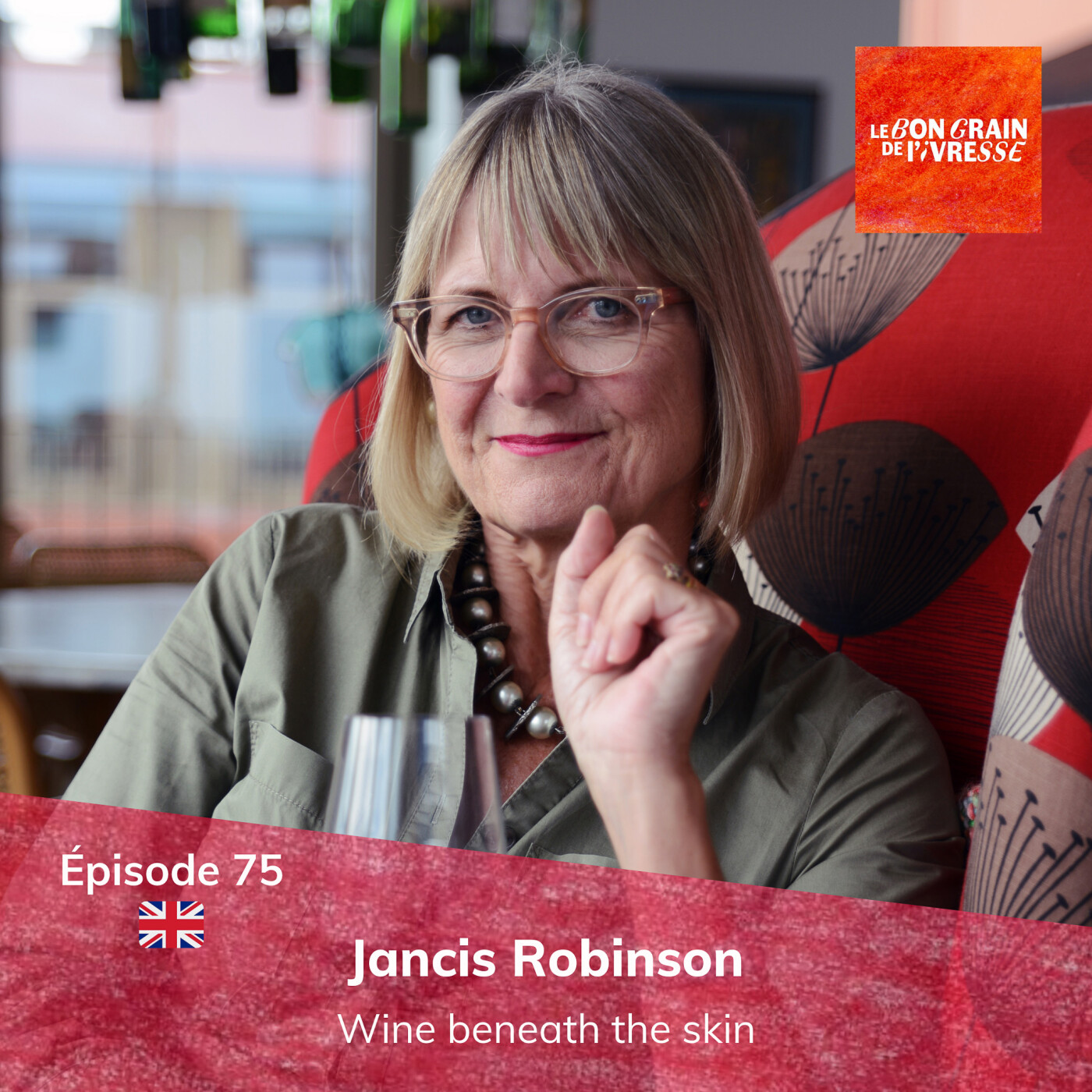
Episode 75 : Jancis Robinson, wine beneath the skin
55m 31s
Le podcast met en lumière Jancis Robinson, figure emblématique du monde du vin, qui revient sur son parcours et sa philosophie. Originaire d’un petit village du nord de l’Angleterre, elle a découvert le vin à l’université d’Oxford, notamment grâce à un Chambolle-Musigny 1959 qui a éveillé sa passion. Après des débuts comme assistante éditoriale dans un magazine spécialisé, elle a obtenu le diplôme WSET en 1978 et est devenue Master of Wine en 1984. Elle insiste sur le fait que le vin est un sujet d’apprentissage sans fin, et qu’elle a toujours cherché à le rendre accessible, rejetant l’idée que le prix soit un indicateur de qualité. Son site web, lancé en 2000, est né d’une nécessité de partager ses notes de dégustation au-delà des limites de la presse écrite. Aujourd’hui, elle observe avec scepticisme la tendance à faire des vignerons des stars, préférant l’humilité et le travail de terrain. Elle se considère avant tout comme une écrivaine, prenant des notes méticuleuses lors des dégustations pour offrir à ses abonnés des analyses précises et honnêtes, même lorsque les critiques sont négatives. Son parcours illustre une carrière guidée par la curiosité et le désir de transmettre, loin des dogmes et des modes.
Je suis positif et j'ai envie de parler. C'est mon favorite de communication. Je ne sais pas que je me sens que tout ce que je parle est brillant, mais je me sens que je me sens que je me sens quelque chose. C'est une grande terme pour décinier ce brevage que nous aimons tant, le jus de résin fermeté. Et parce que vous émoyez mon passionnément, je vous propose de découvrir les secrets d'un bon vin. Parc où on semble le vignoble à la rencontre de vignorones et vignorons valoureux et engagés, pour des discussions autant couleurs. Nous voyagerons à travers les régions, les sépages, les savoir-faire, et les belles histoires du monde dur. Je suis romain Bécquière et je vous souhaite la bienvenue dans le bon grain de livresse. J'ai dit que je suis romain Bécquière et je vous souhaite la bienvenue dans le bon grain de livresse. A few years ago, Nobel-Rod Magazine titled "The Article about Earth, a Royal Vigness" "I couldn't agree with a better formula to introduce Gencisse Robinson." - "Hello, Gencisse Robinson." - "Hello hello." - "Thank you very much." - "Congratulations on your diploma." "We won the WSET diploma that I saw you receive the other day." - "That's very nice of you. Thank you very much. I'm particularly happy to be with you today in London, which is quite original for us in this podcast. Can you start by introducing yourself, please?" "I'm Gencisse Robinson. I've been writing about wine for 50 years. I will be celebrating my 50th anniversary as a wine writer on the 1st of December 2025." - "Congratulations." - "And we celebrate on exact to the same day by coincidence, the 25th anniversary of www.gencisserobison.com." - "We're going to talk about your websites, but I would like to start with something I'd like to tell you from you. Unfortunately, I can't find the source of this sentence anymore, but the quote is "I never felt intimidated." - "That's true." - "Do you know why you told that already?" - "I suppose, because when I started, the wine world was substantially dominated by men, and I'm not a man. Because it's quite a complex subject, and I started out knowing almost nothing about it. Perhaps that's why I thought perhaps I should have felt intimidated, but I was just so interested in wine that I didn't think it would be a problem to learn about it. And I had just, well, reasonably recently graduated from Oxford with a degree in maths and philosophy, so I was used to studying. And I just felt, I'll just get on with it, you know, head down, work away. And also, I was lucky because rather than being in the wine trade, I've never been in the wine trade. I was, and Am, I described myself as a parasite on the wine trade. I'm outside it, I can comment on it, I have licensed, asked lots of questions about it, just like you. So I'm in a very fortunate position, really, to learn about it. And when I started out, I was assistant editor on a wine trade magazine. So I was often invited to travel to places, which was another great way of learning. So I was, I was, I was really lucky. And also, I think I, since 1980, I've been self employed. And so I've never had a boss that I had to be intimidated by or impress or as some young women, unfortunately, have experienced in hospitality in particular, but in sectors of the wine trade have experienced harassment, which has never happened to me. So in so many ways, I feel very lucky. Would you say that during your career as a wine writer, helping people, not feeling intimidated by wine or wine people, was wine of your objective? Very much so. I think wine is quite a complicated subject. And I've always wanted to open it up to democratize the world of wine. I've never been swayed by worshipping cult wines or, or, I've always been very aware that there's no direct correlation between price and quality. And I see it as my job to look out for real value as opposed to worshipping the most expensive wines, for instance. And I suppose I think I've written somewhere. What I really have wanted to do is, I know that there are no rights and wrongs in wine appreciation and that one's own personal likes and sensitivities are the most important thing. And so rather than telling people what to like, I've wanted to give people sufficient information that they can make up their own minds. You started to work at a time when the wine consumption, especially in Great Britain, was not as it is today. So you participated a lot to discuss wine democratization. Can I say this word in English? Yes. The democratization, the wine. How do you feel about the fact that today you talked about worshipping for bottles? And also it seems for some wine makers. Some wine makers start to be stars as chefs can be. How do you feel about that? I don't think it's an entirely healthy trend. And of course now we're living through a time when global wine consumption is actually going down for the first time in my professional life. So perhaps they're getting what in English we call their "come-up-ents". I don't think anyone should set out to make themselves a star wine maker. And in my experience, an awful lot of the ones I admire are very modest. And just a bit like me, get on with things rather than a bit too self-conscious about their image or their status. So as I said, when you started wine was not as important as it is today, especially in Great Britain. And I will come back to the wine consumption decrease slightly later. But finally, why wine? Where does your interest into wine come from? Well, I sometimes say with a tongue slightly in my cheek that perhaps it was because in my teens, do you know who I mean by Twiggy? I'm not sure. Twiggy was a very famous English model who was very, very thin. And she was the star of Vogue and everything, when I was in my teens. And we all wanted to be like her. We all wanted to lose weight. And I started being vaguely mathematical. I learned about calories and I started to learn to count my calories. And because when I do something, I sort of go at it, I started to lose weight. And actually, it developed into a mild case of anorexia. And of course, anything that you deny yourself, you become absolutely fascinated by. So in my teens, I became fascinated by food. And then when I got to Oxford, where there were some very good sellers, I mean, I wasn't brought up with wine at all. You grew up in a very small village in the North of England, right? A tiny village of 40 people in the very far northwest of England, nearly Scotland. And I mean, I occasionally be exposed to a glass of wine. The local farmers used to drink Spanish sweet sickly golden wine, which they called Spanish so turn. With steak in the local pubs. And I remember my grandmother being served at a lunch that I went to with her in South of England, more sophisticated than North of England, something that they called Lutema-risling, which was actually,
Lashky recently, not proper recently at all, came from Slovenia in bulk. It was chock full of sulphur and it really was the worst. It doesn't sound like a wine. Anyway, I remember it. Being interested in food, it was quite a short leap to becoming interested in wine. I was lucky enough to have a friend in my all-women college at Oxford who had been brought up with wine. It was very serious and cerebral about it. She would do things like buy two half bottles of two wines that were similar but different. She would give me a little taste of each one and a little lesson about why they were different. That ignited my interest. I had a boyfriend whose father gave him too much money and some of that was spent on taking me out to eat. I firmly remember one seminal bottle and I think for many people who end up devoting their professional lives to wine, there is one wine that lights the flame. For me, it was a Shambon musenilis emulur's 1959. At that stage, I didn't know that you had to look at the name of the producer. But in retrospect, knowing the restaurant and the supplier, I think it probably was Devogui. That wine was so different from student plong, so much better. I sensed that here was something that could offer great intellectual stimulation because it was so complex. There was history and geography and all sorts of things in it, as well as massive sensual pleasure. I'm a Taurus, so I like earthly delights. I became as interested in wine as I was in food. But when I graduated, it was 1971. And in Britain, at that stage, the subjects of wine and food had no social status whatsoever. If I had said to my Oxford fellow students, I was going to find a job in wine or food. They would have been horrified. They'd have said, "What a waste of a Bonox for education." So I went and worked for a travel company for three years because I like travel. And then I dropped out as everyone was doing in the mid-70s and went to live in a. What do you call it? What's the word for shepherd in France? There was a little shepherd's cottage. A bargerie. Yeah, shepherd cottage is bargerie. It was in the Lubeuron and it had no electricity and its own well. And it taught me a very good lesson, which is that even if you have no job, if you're a certain sort of person, you still worry. It's not leisure. You just swap meeting a deadline for worrying about whether you've got enough oil for the oil lamps. So not working was no solution. That was a good lesson for me to learn. But of course, in France, I was surrounded by people for whom eating and drinking were extremely important. This is everything, yes. And so I was determined when I got back to London to find a job in either wine or food. And it could have been food. But the first job I was offered was assistant editor of a wine trade magazine. You spent 20 years working before launching your website. 25. Yeah, 25. How did you build your confidence into your judgment about wine? Well, by that stage, I'd written probably ten books. I'd presented at least five, six television series about wine. I was a master of wine. I became a master of wine in 1984. And no one had said, "You know nothing. You're a fraud. What rubbish." Oh, and I was already the. I'd been the wine correspondent of the Sunday Times, which from 1980 to 1986, which is the biggest selling weekend paper here. And from 1989, I've been the wine correspondent of the Financial Times. If I look back a bit more when you were younger, I mean, when you. When you started to work into wine, before you were the correspondent for Sunday Times or at your work at the TV, how do you build your confidence at that time? When did you start to feel confident about your judgment? Well, this is a very pertinent observation to make to you who have just collected your diploma. Because I knew that I knew so little about wine when I got my first job. I immediately signed up for the WSET courses. And when I graduated with my diploma in 1978, I was the top student. I got whatever was the Bintness Cup equivalent then. Although all I got was a tiny little wooden plaque, not like. Not like a trip to Australia. So I thought, "Oh, well, you know, I must know something about wine." And I actually, the only time in my whole life that I thought, "Right, I now know everything about wine," was just after I graduated with my diploma. I thought, "Right, that's it. I don't need to learn anything more." And of course, how wrong I was. I learned, as I said, I learned something new every day. And I'm sure you know. You never stop learning about wine, which is what makes the subjects so rewarding. Exactly. This is why it's very interesting because there is always something new to learn, something new to discover, and that makes it very exciting. And you have to run to keep up with all the new developments. And there are so many interesting scientific discoveries about wine, as well as new regions, new grape varieties, new ways of making wine, new people. So new ventages, of course. Well, lucky it's not like gin, you know, where you just make the whole, the same thing all the time. Did the master of wine have a lot to improve at that time? I mean, in the '80s, it was slightly different that it is today. Oh, much easier. It is today. I was so lucky to do my master of wine exam in 1984, when Australian wines tasted Australian. They even looked Australian because they were all using, I think, the same sort of yeast, which gave Chardonnay a sort of slightly green, greenish color. California wines tasted absolutely Californian. Nowadays, to take Chardonnay as an example, it's very difficult. Okay, a good burgundy perhaps stands out. But pretty much everyone else is making a barrel-fomented Chardonnay in a very, very similar way. Chardonnay is not the most terroir expressive grape varieties. So I feel very sorry for people in the master of wine exam being given, if they're given a lineup of Chardonnay, really. No, I feel very fortunate about when I do. The only thing that master of wine candidates have today that we didn't in the '80s is good literature about wine science. Then there was practically nothing in English. So I was buying sort of a knowledgey textbooks by Emil Peno, which were far too advanced for the master of wine exam. So there weren't as many resources, but the subject was much less complex. Do you think it could be necessary for master of wine? Sorry, to refresh their exam, to recid the exam a few times during their lifetime. I think it would be a very good idea if we were forced to do continuing education. I hope that in my job, which is all about keeping up to date with developments in the wine world, I'm perhaps slightly better positioned than some masters of wine who get the qualification and perhaps work in completely different field. I thought it was fascinating that the diploma graduation ceremony that the top student was a full-time doctor. Yeah, that was really impressive. Who seemed really rather unfazed and engaged with wine. She left as soon as the ceremony was over, perhaps to go and do some operation. So in 2000, you launched your website, jenticerobison.com, which is a media about wine. What was your ambition at that time?
that time when you decided to launch it? - Well, I often say my career has been guided not by ambition or even intention. It's more like me responding to a series of external stimuli. So in the year 2000, I don't know if you remember, but everyone was going on about the internet. Everyone thought they were gonna make their fortune. - Internet bubble. - Yeah. - And I remember distinctly, I had a series of people coming to my front door because they all had the tech, but they all lacked content. By that stage, I'd edited several editions of the Oxford Companion to Wine and one of the world at the subwine and of course, I had articles coming out of my ears. So I had masses of content. So a lot of people were coming to me saying, "Let's go into business together. I'll make your fortune blah blah blah." And there was one guy that I picked from these people that I thought was the best bet. And he said, "We'll make a website called jansysroms.com," because that was the fashion then. And so with my next book, which was due out in September or October, I asked the publishers to mention jansysroms.com on the jacket of the book. Then in August, I found out this guy was not being straight with me and I didn't want to work with him. But there was a mention of this jansysroms.com, so it had to exist. So it was a very humble beginnings. It was literally me and the man who advised us on which computer to buy, who very kindly took upon himself to do the subscription side of it and the sort of basic tech of it. It was a very unsophisticated site. And it was a very unsophisticated subscription. Oh no, first of that's right. For the first year, I was motivated, as opposed to an ambition. I was motivated by the fact that I was being lucky enough to go to all these tastings. But I couldn't use my tasting notes or what I learnt fully because I just had one article a week. And as you know, print is very limited in terms of length. So I was learning so much that I couldn't share. And I had all these tasting notes that I couldn't share. So I thought a website's perfect because you can write infinitely. And I can put all this knowledge, share it on jansysrommason.com. But then after a year, I realised I was spending far too much time on it and not getting any reward. So this chap and I decided that we would launch a subscription part of it, which we still have some free and some behind the paywall. But he couldn't manage to do rolling subscriptions. So we had to sign up for a calendar year. So even now, we still have a sort of bump every January because we've got a lot of loyal members who have actually joined in January. So their subscriptions come up for renewal in January. It's changed since then. Got a lot more sophisticated. Of the record, we talked a bit about Andrew Jefford with another wine, Dronely, to live in France. And it works a lot for a decanter in Great Britain. During my interview with him, we talked a lot about the difference between wine critics and wine writer. Do you consider yourself as a wine critic or as a wine writer? I very, very much consider myself a wine writer rather than a wine critic. I've always enjoyed writing. My first article was published when I was 15. In the local paper, it was about fashion. And I actually positively enjoy writing. It's my favorite means of communication. I wouldn't say that I feel that everything I write is brilliant. But I get a real buzz when I feel I have written something good. Whereas tasting notes and going to a tasting feels more like work, even though it's this pleasure there. But ever since we've taken money from people for the website, I have a sort of strong conscience that I've got to taste as much as possible and concentrate as hard as possible. So at the many tastings that go on in London, I probably look horribly serious. Before I had the website, I used to view tastings as jolly social occasions, to say hello to people and catch up on the gossip. And so now I just stand there with my laptop looking very concentrating and serious. So it's not as much fun in a way, although it's lovely to make discovery of new producers and new wines, that kind of thing. Last November, we were at the same party celebrating the 100th anniversary of Closentune from Trimbach, which is lovely. It was lovely night. And you impressed me because of what you just said. We were in this very nice restaurant with a big bunch of porosentune hotels. Yes, fabulous. And you took notes about all the wines, and you published a big, massive article with tasting notes about every vintage we tasted. And you were the only wine, the only one, sorry, taking notes during that night. Well, I wouldn't say-- I mean, that was obviously a very special occasion. I'm not like Michael Broadbent, my old friend Michael Broadbent, who started the London Auction scene in 1966, was a master of wine, and was Christie's wine person. And he was famous for writing an out on every single wine that he tasted, even if it was just a very casual thing at some friends who weren't interested in wine. I'm not that fanatical, but when I feel the wines are too good to miss, then I will try and write a note. And as I say, it's slight guilt and feeling an obligation to the members of jansettromison.com. But I enjoyed the dinner. Yeah. Me too. Talking about wine critics, I hope I will choose my word properly in English. But there is something that you and your team do, and that is not that common in the wine world, which is criticizing wine in a kind of negative way. You know, giving negative feedback to a wine. Nobody does that almost. Really? Why is it so difficult to criticize wine in that way? Do you know? You're telling me something. I didn't know that other people didn't criticize wine. I don't, as is perhaps obvious, I am very productive. I work very hard, but I don't. I'm usually in broadcast mode rather than receiving mode. I'm usually writing myself rather than reading what other people write. And I quite, I don't feel that's a bad thing because I'm not influenced by what anybody else thinks. I don't think the rest of the team are either. We just say what we think. And I think that stands a sin good stead, actually, that if you do occasionally criticize, then what you say is more valuable and more respected. And you're not just a publicity machine. That's why I'm so adamant that I'm not in the wine trade. I'm not part of, I want people to love wine, but I'm not part of the public relations team for individual producers. There's something I want to add to that. Yes. We now have a wonderful man, Master of Wine, in Bordeaux, James Lawler, who covers the primers on Primer for us. And I don't really, I like Bordeaux and I've had some good times in Bordeaux, but I've never really enjoyed covering the primers because I feel like a performing monkey. But you're invited along and your job is to give schools preferably as high as possible. And it just don't, I've never felt as free as I do normally when I decide who I'm going to visit and what I think. I mean, I wouldn't say that writing up primers, I've in any way written anything I don't believe, but the whole business of being welcomed for the purpose of selling that particular vintage makes me uncomfortable. So you refer to, yeah, decide where you go. Exactly.
who you meet, or even maybe taste in your offices alone without the. I taste quite a lot here, usually early evening or late afternoon after I've written during the day. And then London is a great place for tastings. I do think, in the height of the season, you could go to about four tastings a day. I mean, we don't, obviously. And we try not to double up, because we all work hard and there's no point in both two of us going to the same event. But we get invited to a lot of tastings, and it's quite an art to decide which ones are going to yield something useful for readers, or an interesting article. There are some journalists that consider that you only talk about wine that you like. And if you don't like wine, if you don't think that wine is interesting, you just don't talk about it, because otherwise you may annoy the wine makers or some people. You think that the rule of journalists is more than that? I do, actually. Particularly if your criticism comes from a tasting which has been organised by a producer or an importer, they decided to show those wines. And it's up to them if they're not impressive. But I can see that for journalists who live, perhaps journalists in France, feel closer to more wine producers than those of us in England. I mean, it's true now that the English wine industry has grown up a lot, but we don't live our lives surrounded by wine producers. And I do feel sorry particularly for wine journalists who are based in Napa Valley, which is just nothing but wine producers. And if they criticise a wine, they know the odds are they're going to bump into the producer at the supermarket the next day. That must be quite challenging. Since the beginning of the conversation, you have a lot to use the word editing or editor. You don't talk only about writing, but you talk about editing. What's the role of the editor in wine magazine or in your media? I have a feeling that editor has a different meaning in French to editor. I mean, for me, I'll tell you what I think of as an editor, is somebody who reads through what someone has written and corrects it or polishes it, or makes it a little bit more relevant or more interesting. And it's something, an activity I really enjoy actually, and until I sold my website in 2021 to an American company, I used to do all the editing. Every single word on the website went through my laptop. And I did actually enjoy it, but the new owners of course wanted to analyse how the website worked. And they got the old editor of Wine Enthusiast magazine in the US to do a sort of study. And I think they were rather horrified to find just how much I was doing. Especially since I'm so old, it's quite dangerous to have me doing so much. And now, so now they've made me editor in chief. And all I have to do is write, taste and travel, which are the three things of course, which I absolutely love. Although I do actually edit a few people, not that many, but I keep my editing hand in. And sometimes I spot things on the website, which need a little correction, which I will point out. But we do have a wonderful managing editor, Tara Q. Thomas, who lives in Brooklyn. And she bless her, does all the admin and editing, HR and all that kind of thing. So for you, it's a key position in a media to enter the success of the media, right? Editing, yes. Very differently. And what are the qualities needed to be a good editor? Very keen eye. Julia, a hardening, my master of wine colleague, she was a professional copy editor before getting into wine. And she will pick up a full stop in the wrong place, or a capital letter, where it should be a lowercase letter. She's absolute hawk eyes. I get most of them, but she'll get all of them. So that's one thing you need. Consistency, you have to be aware of what the style of the public education is, how you write, do you write, do you write, do you write, do you write, do you write, do you write, do you know, that kind of little detail. I think being sympathy with both the likely readership and the ethos of the publication. I mean, we are very, I would say, we care more about writing and the literary worth than perhaps some publications. We also like to be very objective as witness the tasting notes. And we like to, I think, perhaps more than most publications, we don't just concentrate on the classic established wines. We try to keep up with the whole world of wine. So my article this Saturday for the Financial Times and on the website will be about the improvement of Belgian wines, for instance. And then Nick and I were in Japan for just a week earlier, oh well, last month. And I made sure that while I was in Japan, I tasted, I went to, I had a Japanese wine tasting organized for me, tasting of Japan wines. And I'll write about them, you know, that kind of thing or what's going on in Eastern Europe. And we were very early supporters of Greek and Portuguese wines, which I think of people now realize how good they are. But I think we've been saying how good they are for longer than most people. I would like to come back to wine consumption, we already talked about it a bit. So today we see, as I said, in many places a decrease in wine consumption, especially in Europe. How do you deal with that as a journalist that has dedicated or career and life to that drink? I'm sad about it. I feel, again, very fortunate that my career has mirrored the great flowering of interest in wine. And there are no shortage of wine students, actually. People may say that consumption is going down, but people are still fascinated to know about it and to learn about it, which is one cheering thing, one encouraging thing. But, you know, I'm 75 now. And I would, and for me, when I set off 50 years ago, it was so exciting because wine was just taking off. But I would feel less, I would feel more worried about starting off as a wine writer today because of the declining consumption. Two days ago, I was talking of my friend, Amber Lebo from a L'Evage wine coaching, and she wanted to ask you a question. And this is, what's her name? Amber Lebo. Okay. Where she based? In London. And this is directly linked to what you just said and her question was, if you were today 25 years old young woman entering the wine industry, what pass would you take? What path? Yeah. Well, I don't really understand the world of influences, but I have seen how influential they are. And I understand you can make money, you can make a living being an influencer. I don't think it would sit very well with me personally, but it's probably a more lucrative career path now than being a wine writer, which is very sad. I don't approve of people being paid to endorse products. But if they establish a reputation purely on the basis of the quality of what they say or write, and then perhaps they can pull in some sponsorship or ads, then I suppose I've got to accept that's the way things work now. Our son is a restaurateur and he, one of these restaurants,
influences came to interview the chef at one of his restaurants and we as a family watched it and you know didn't think much of it except that the 24 hours after that was shown that one little restaurant got 1100 bookings that's and that's bookings not customers so it just shows if you know if you are genuinely influential what power you have? How could we seduce now more people to drink wine? I can understand why there is so much activity in low and no alcohol drinks because partly thanks to the World Health Organization giving out inaccurate information about how or misleading information about how one drop of alcohol will be. Yeah, World Eth Organization. Say on their website that any alcohol consumption is risking your risk from the first tip. But of course that influences people, people are aware of that and the World Health Organization sounds like a very powerful, very important organization even if in the back it's got temperance campaigners pushing a message which it has. So anyone I understand why people are trying to drink less and there is no doubt alcohol can be harmful. I mean more good, too much bad no doubt about it and and probably I've yet to taste a delicious no alcohol wine but I'm sure I will I'm sure that it will arrive and it'll be a huge success. For sure. We'd like to talk a bit about Bordeaux. I was recently in Bordeaux to try to understand why the region is such a complicated situation considering entry level wine to premium wines. And I would like to have your point of view as a journalist and as a British person. What's wrong with Bordeaux wines today? I don't think there's anything wrong with the level of the Pâtichatto and Croubaige-Wa wines. I think I've long said they are the best value wines in the world because they're made many of them, you know, not that differently from a crew classy and yet the prices are ridiculously low. Much lower than a Cabanet or a Cabanet Merlot blend from California and Australia that's no better. But because they're made in such huge quantity that has a downward effect on the prices they can charge. I think part of the trouble is probably that the Bordeaux wine trade is a very, um, hermetically sealed little social group and although they do travel they listen probably more to their neighbours and and negotiating on shadow owners than to the market. And we've seen that really. It's taken such a long time for them to realise that the new vintage has to be cheaper than any vintage that currently available. And thank goodness it's happening with the 24's. But of course the 24's don't have a great pedigree and I haven't tasted them but people say that there are some pretty nice ones and that it's much more varied in quality than usual. You need it to be a very good wine maker in 2024. Yeah. Yeah. But still the market hasn't ignited the market and I think also the style of Bordeaux being wines that you need to age and that are quite concentrated and tannic in youth is kind of out of fashion, sadly for them. Yes, I agree with that but I could take another example that for me is we could describe the wine a bit like this which is the wine from Pierre Montet. You need to age a bit like Barolo and Barbarraisco. It's very high in tannins. It is high in tannins but it's more refreshing than Bordeaux. It's got a more marked acidity and it's not as, I mean people shouldn't really taste with their eyes but I think the fact that it's not as concentrated color, deep colors are out of fashion. So I think that's part of, and then people can convince themselves it's like Burgundy with the kind of little crew and all that kind of thing. And also I think the people like, they feel more reassured if the person talking to them about the wine and selling them the wine actually works in the vineyard and gets their hands dirty or at least works in the cellar. It's quite rare in Bordeaux that you know there are different strata of society. I see what you mean. Yeah. And I think people prefer to buy wine from someone in with dirty hands and jeans than in a smart suit. What's the last one region that you can I just sorry add to that thing about Bordeaux? And the people who really have bought, who've been keen on Bordeaux and there are a lot of them in the UK and I know in our members forum on the website everyone gets buried. They may not buy on Premiere but they're really interested in the prices and interested to see whether the wines they bought have gone up in price or whether they get high marks in tastings of mature examples and that kind of thing. But most of them are relatively senior people in terms of age and they've got full cellars. People have tended to buy in multiple cases at a time and of course Britain has lots of storage facilities. So the typical I would say a lot of our members have multiple cases of Bordeaux sitting in a storage facility and they need a very strong argument to make them buy some more. I recently recorded with someone that wants to ask you a question you will I will launch the the the record and you will I'm pretty sure you will recognize her. Jan Cicifist one question but I would love you to answer with all the experience that you have is what one thing do you think we could do to assure the perinity of a world of wine? Is that Fiona? She's obviously in France when she says that because perinity is not an English word but yeah I met her in pommel role this is Fiona Morrison. Yeah right and perinity what means that it will go on and on and on and every year it's like the same it the route is perennial is it? It means that yeah it will go on and on and on and on and on and on. Yes yeah I can't see wine disappearing at all it's too delicious it answers the need for people to have stories behind their products that they buy it lasts and lasts I don't know if you saw that recent research study it from the group that research into pesticide residues and they chose wine to examine but that's only because wine hangs around for so long you know they could have done potatoes except potatoes get eaten in weeks and there's something sort of earthy and elemental about wine I think it resonates with people that this is an annual crop that's different every year that you can see growing that has a wonderful smell when you walk into a winery and that just gives so much pleasure I honestly it means it may be that the Bordeaux wine trade suffers in the short term but I think the world of wine is continuing to grow in production terms it's just not continuing to grow in consumption terms but do you fear that the wine world reduces so much that it only it is only taken seriously by a few wine lovers and that's it I think that there's a huge difference now in terms of wines social status compared to when I started and it is widely seen as wine knowledge is still very respected there's the only people who would not who make who don't respect it up I suspect people who are slightly intimidated by it so make fun of a wine someone who knows about wine but I don't I mean wine snobbs I would run a mile from wine snobbs and there aren't there are very very few of them and usually if I'm not right.
I have a very rarely meet one. And then if they discover that I'm a lifelong wine writer, they'll shut up again. - So we understand discussing with you. I understand discussing with you that you are still very excited about wine. - Mm. - What would you like to achieve that you haven't done yet? - Ooh. And I still go to far too many tastings 'cause I'm too curious. Most of the things that I haven't done yet would be impossible. There are various people that I never met who are now dead. Like I'd like to met Jean-Pierre Moex. I just feel so blessed. So best. I had an audience with the Pope last September because I was part of a commission to advise him on a vineyard that he wanted to plant in the Papal summer palace. That was a high point. I've had lunch with the Queen because on the Royal Household Wine Committee, what do I want to do? What do I have? And I've traveled so much. I've been so lucky, honestly. I suppose I'd like to see my grandchildren find really nice life partners and since they're one of them's only one. And the oldest is only 14. I'm gonna have to stay alive quite a long time. - Who are the people that are changing the world of wine today? - Who are they? - Yeah, who are they? Who are the ones that count? - Well, these influences are obviously, I don't know whether they count but they're certainly influential. I think people who are aware of what's going on in the world of wine are impressive. I spent, afternoon this week with Louis Michel-Lige Belé from Bourne, Romani. And he's quite impressive in the way, I mean, he charges an arm and a leg for his wine. But he does listen, he's in reception mode, quite a lot of the time, not just broadcast mode. And he says he travels not really so much to sell the wine as to listen to potential buyers and what they think and how he can satisfy them. I think that's, and then there are, - That's the wind that we hear right now. - We're very high up. And then there are producers who keep, who are aware of what's happening to the planet and how important, say, regenerative viticulture is, how important soil health is. And don't just sit back. They're the people who are taking us in the right direction, I think. I'm really, really glad that the tyranny of scores seems to be over. It's more over in some markets than others, but an America, I think, is still to a certain extent guided by scores. But scores have never been that important in the UK. I don't know about France. But I think it was unhealthy when merchants stopped following their own taste and just followed what writers liked. - Yeah, you're going to use that in France. Yeah, the inference of scores is limited, I would say. - Have you ever think about retirement? - I thought you would say that when I heard it. You say, "I have your. " Not really, no. I definitely know it, because I just, I love the subject and I love writing. I love tasting and I love traveling. - So it direct me to my. - And I have, I don't play golf. And what else do people do? - I don't play bridge. My husband plays bridge. I don't know what I do. - So it leads me to my last traditional question. Sorry, are you happy as I was writing a journalist? - Oh yes. I feel so fortunate. I really do. I've just had and having a charmed life. - Thank you very much, then, Jensis. Thank you. Jensis, it was a great pleasure to share this hour with you and thank you very much for offering me this view of London. Dear listeners, I hope this conversation with Jensis will pick your curiosity and make you want to explore every corner of the world of wine. I am Roman Becker and you are listening to "The Bon Grande Leveresse". Our post-production has been done by Emmanuel Nabe thanks to Emmanuel Doreff for the original music and to Lena Masily for the graphic design. We'll see you again very soon for more wine adventures. Until then, have fun and drink well.
Podcast Summary
Key Points:
Le locuteur est un passionné de vin qui anime un podcast intitulé « Le bon grain de l’ivresse ».
L’invitée, Jancis Robinson, célèbre 50 ans de carrière comme critique vinicole et 25 ans de son site web.
Elle se considère davantage comme une « écrivaine du vin » que comme une critique, privilégiant la transmission de connaissances sur la dégustation.
Son parcours a débuté par un intérêt pour la nourriture, puis pour le vin, malgré un milieu modeste dans le nord de l’Angleterre.
Elle a contribué à la démocratisation du vin en soulignant qu’il n’y a pas de corrélation directe entre prix et qualité.
Elle critique la tendance à « starifier » les vignerons, préférant l’humilité et le travail de fond.
Son site web a été lancé en 2000 comme une plateforme pour partager des notes de dégustation détaillées, d’abord gratuitement, puis par abonnement.
Elle insiste sur l’importance de l’apprentissage continu et de la rigueur dans l’évaluation des vins.
Summary:
Le podcast met en lumière Jancis Robinson, figure emblématique du monde du vin, qui revient sur son parcours et sa philosophie. Originaire d’un petit village du nord de l’Angleterre, elle a découvert le vin à l’université d’Oxford, notamment grâce à un Chambolle-Musigny 1959 qui a éveillé sa passion. Après des débuts comme assistante éditoriale dans un magazine spécialisé, elle a obtenu le diplôme WSET en 1978 et est devenue Master of Wine en 1984.
Elle insiste sur le fait que le vin est un sujet d’apprentissage sans fin, et qu’elle a toujours cherché à le rendre accessible, rejetant l’idée que le prix soit un indicateur de qualité. Son site web, lancé en 2000, est né d’une nécessité de partager ses notes de dégustation au-delà des limites de la presse écrite. Aujourd’hui, elle observe avec scepticisme la tendance à faire des vignerons des stars, préférant l’humilité et le travail de terrain.
Elle se considère avant tout comme une écrivaine, prenant des notes méticuleuses lors des dégustations pour offrir à ses abonnés des analyses précises et honnêtes, même lorsque les critiques sont négatives. Son parcours illustre une carrière guidée par la curiosité et le désir de transmettre, loin des dogmes et des modes.
FAQs
Jancis Robinson est une célèbre écrivaine du vin avec 50 ans de carrière, célébrant son 50e anniversaire en tant que telle le 1er décembre 2025. Elle est également Master of Wine depuis 1984 et correspondante vin pour le Financial Times.
Son objectif est de démocratiser le monde du vin, en donnant aux gens suffisamment d'informations pour qu'ils puissent se faire leur propre opinion, plutôt que de leur dire quoi aimer.
Elle a obtenu son diplôme WSET en 1978 en étant la meilleure étudiante, puis est devenue Master of Wine en 1984. Elle a appris qu'elle ne cesse jamais d'apprendre sur le vin, ce qui rend le sujet si gratifiant.
Jancis Robinson se considère comme une écrivaine de vin plutôt qu'une critique, car elle aime écrire et partager ses connaissances, tandis que les notes de dégustation sont davantage un travail.
Elle l'a lancé pour partager ses notes de dégustation et ses connaissances de manière illimitée, car la presse écrite limitait la longueur de ses articles.
Elle ne pense pas que ce soit une tendance saine et note que la consommation mondiale de vin diminue pour la première fois de sa carrière professionnelle.
Chat with AI
Loading...
Pro features
Go deeper with this episode
Unlock creator-grade tools that turn any transcript into show notes and subtitle files.
 PodcastTranscript AI