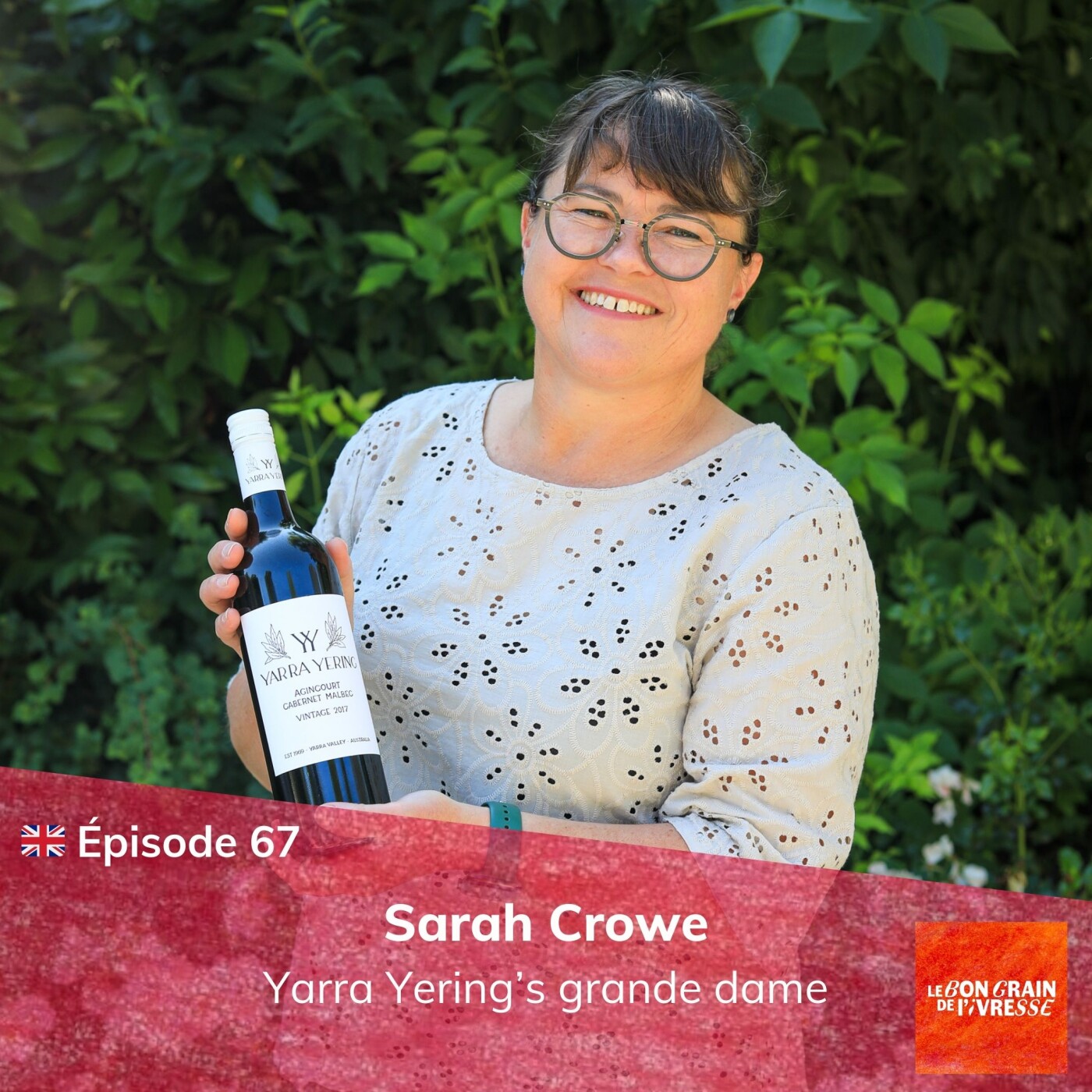
🇬🇧 Episode 67 : Sarah Crowe, Yarra Yering's grande dame
66m 36s
Sarah Crow, vigneronne et directrice générale de Yarra Yering dans la Yarra Valley australienne, raconte son parcours atypique. Après des études en horticulture, elle a débuté dans la Hunter Valley, une région au climat chaud où elle a appris auprès d’une communauté viticole solidaire. Elle a ensuite rejoint Yarra Yering en 2013, attirée par le climat frais et les vins de corps moyen qu’elle apprécie. Le domaine, fondé en 1969, est connu pour ses vins rouges emblématiques nommés "Dry Red Wine No.1, No.2 et No.3", une appellation pratique pour les distinguer des vins fortifiés. La philosophie "never rushed" guide chaque étape : vendanges manuelles, tri minutieux, fermentation en petits lots de 600 kg et élevage patient. Sarah cherche à produire des vins transparents, reflétant le millésime et le terroir, sans lourdeur ni extraction excessive. Elle expérimente différents contenants et techniques pour affiner les styles. Malgré les défis de main-d’œuvre, elle voit un regain d’intérêt des jeunes pour le travail de la vigne. Yarra Yering reste un vignoble iconique, où la précision et le respect du temps donnent des vins frais, élégants et aptes au vieillissement.
[Musique] Le vin, le jajat, le pinard, le pif. Il existe une ribembelle de terme pour désigner ce brevage que nous aimons tant, le jus de raisin fermenté. Et c'est parce que nous les mons plus que tout, que nous voulons mieux comprendre ce qui fait un bon vin. C'est pas à je, climat et terroir, il participe, mais avant tout, il y a la pâte des vignorones et des vignorones. [Musique] Je suis Romain, je suis Florion, je suis Antoine. Nous sommes trois copains et nous nous en nom à la rencontre de ces hommes et de ces femmes dans leur domaine pour les interroger sur la magie de leur métier et leur vie au milieu des raisins, des vignes et des bariques. Bienvenue à toutes et à tous dans le bon grand de livraisse. [Musique] La dernière année, Australia a pu en avoir une position de change de la vignorone de la ville. La production de la vignorone est exprime, mais leur reputation a été prusée et plusieurs vignorones ont une interne de la cléme internationale pour les qualités de la vignorone. L'arrière-yering est une de ces femmes et Sarah Crow a beaucoup de temps à faire avec elle. As-yari-yering, le vignemaker et le manager général, elle a été présenté sur la lait de la vignorone de la ville de l'Etat, réfinir les practices, en des détails, pour produire les plus riches de la vignorone de la Vignorone de l'Australia. Elle a été un peu plus faible dans Paris, avec un local important, Guy Tentorner, de l'Ottawa de la Vignorone de la Vignorone. Elle a offert une chance de récorder la conversation que je suis en train de vous dire aujourd'hui. Enjoye, d'Hierly Seniors. Je suis Sarah Crow, je suis le vignemaker et le manager général, à l'arrière-yering vignorones dans l'Ottawa de la Vignorone de l'Australia. La storie de la Vignorone est pas très obvious. Nous avons fait avec cette podcast beaucoup de personnes qui sont passionnées avec la Vignorone et leur path aux vignorones de la Vignorone est très bien, qui est pas exactement la storie de la Vignorone. Can you explain us how you started to be a wine maker please? As you said, you accidentally became a wine maker, mais vous avez été dans les deux plus faibles, peut-être plus faibles, un rejoué de la Vignorone de l'Australia, un tour de Vallée et un tour de Vallée. Can you explain us please what are the specificities de cette région et what are the styles of wines that are made in those regions please? The Hunter Valley is considered a warm climate, warm temperate climate, and the varieties most common there are semi-on and charazes. They do also grow some nice shardny as well, but most well-known is for the semi-on and the charazes. And that's a warm region, relatively high humidity. They would have dry winters and their rainfall comes in summertime, so close to harvest. It's a little bit of a challenge in region in that way. Yeah, it doesn't sound as easy. No. And then because I had worked there, it was considered, because it is the Hunter Valley can be a difficult region sometimes. That was one of the reasons why when I interviewed for the job at Yara Yearing, that was considered a good ground in, because they had not long come out of the 2011 vintage in the Yara Valley that was high rainfall and a difficult season. But typically the Yara Valley is cool climate. It's not cold, it's not as cold as satasmania, but it's cool climate. We are a warm site within that cool climate region. And I guess most of our rainfall falls in winter and spring, typically. These things seem to be changing a little bit of late, but our rainfall is mostly winter spring, and our summers are typically dry. Our challenge in times in the Yara Valley are in the growing season for things like mildew. That's the kind of difference between those two regions. And the variety is actually. So most people would know the Yara Valley for Shardin et Pino-Noir. Those plantings happened in the mid-1990s. There was a big planting boom in Australia. And Dimaine Chandon had come to the Yara Valley to make sparkling wine. That is why there's a lot of Shardin et Pino. A lot of those vineyards are now made into table wine. But at Yara Yearing, our dominant varieties are actually Shirazan Cabanay. So we grow a lot more red wine than white wine. We're going to talk about Yara Yearing, of course. But I want to talk a bit about Hunter Vare. In which kind of wineries did you work in Hunter Vare? I was at Broken Wood Wines. That's where I actually started working in the vineyard. And I spent, ended up being there for nine years. You know, as ended up as the assistant white maker there. And then I moved down the road to be the white maker at one called Bimbadjana State. And probably less well known in the Northern Hemisphere. What did you learn when you were in Hunter Vare? Why in this region was a good start to be a wine maker? I think it's largely that it's a wonderful wine community in the Hunter Valley. And those people, wine makers, viticultulas, really gather around somebody new. And they're very happy to share their experiences and their knowledge and educate and mentor young people. So, you know, I had very little wine knowledge and experience before I went there. And it was, in particular, Broken Wood Wines. It was a very good, it's like an unofficial kind of wine university, I suppose. It's considered in Australia. So it was fortunate for me that I was there where they opened so many wines and so many Australian industry icons come through and visit and share their wines and their experiences. So, yeah, I would say the number one reason would be, you know, the community there was so, is still, you know, so invested in bringing young people through in our industry. So working in hard-séculture and wine is not exactly the same? No. How did you convince people to hire you at the first winery? It was, I made a phone call and I said, I'm a horticulturalist, I'd like to work in your vineyard. And the vineyard manager there, it was just, I think, the timing was right of that phone call. He must have just been thinking, gee, another set of hands for pruning would be useful. And I happened to call. And so, you know, that did require me moving three hours away from where I was living and where my family were. But I did that and I would drive up on a Monday and I would work all week and then I would drive home on a Friday afternoon and we did that for a number of weeks before I moved there. So it was just a, you know, I'm a horticulturalist. I'd love to work in your vineyard situation. As we were leading into the next harvest, the 2002 harvest that was, another lady working in the vineyard just suggested to me that I should go and work in the winery for vintage, just because I'd get more hours and basically it was just to earn more money is why I went into the winery in the first place. But I would have to say that I think I've always been a very hard worker and I would have to be a very diligent and that's a really valuable thing in a winery who's someone who's happy to get their hands dirty and particularly in harvest work the long hours. So I think at first it was just like, oh, she works hard. We'll keep her around for a little bit longer. And why did you decide to go back to school? I think it was, I had done part of an arts degree as well and I didn't see a career future in that for me personally. So I hadn't finished the Bachelor of Arts degree. And I think I was always, I'd studied horticulture. I just always felt like, you know, eventually I'd find something that I like so much that I really wanted to get a qualification in it.
So yeah, I studied part-time. It's considered half of a full-time load, and we did this by correspondence, and we would travel to the university for residential schools, so intensive learning for a few days, depending on the course. - Previously, you just raised a point about people saying, maybe it's a good set of harms to prune in the vineyard. Nowadays, in France, for example, it seems that it's more and more difficult to find the people to work in the vineyard, is the situation the same in Australia, and especially in Yardavare. - Yes, it is a little bit harder to find young people coming through. It's, I think, it goes through phases. So I feel like, at the moment, I'm less concerned about future viticulturalists. We seem to have had a little bit of an influx of some great young people who are keen and interested. Who knows, we might go through another cycle where it seems difficult to find young people to help, but I think there's a curiosity, and there's an interest in working with the land and food products, and I think this is something that young people are actually becoming more interested in, where their food comes from, how things are grown and made, and shopping locally, et cetera, et cetera. So I think that might be helping our industry in Australia. - In 2013, you started your journey at Yardavare. Why did you decide to live in Yardavare? - It was a really difficult decision. It was difficult to leave, but it was also easy to go, because the reputation of the area in Vinyard and I was so excited for that role, but I was also quite sad to leave the Hunter Valley. But I had started to consider, you know, what my next career move within the Hunter Valley might be, and I really just didn't see a path to my next step in that region, which is why I had started to consider, if I'm not gonna stay in the Hunter Valley forever, where do I want to be? Because in a way, I had stumbled across the Hunter Valley, and lucky for me, it was such a great region. But I decided that now this time, I could be more in control of my destiny. So where do I want to be? Where do I want to live? What wine styles do I want to make? And I very much liked medium-weighted wines and the Hunter Valley makes medium-weighted wines as well. I wanted that cool climate, fragrant, medium-bodied, medium-weighted, fresh, like, you know, lovely fresh acidity in wines. These are the wines that I like to drink, and so I started looking at cool climate regions, and then the job at Yari Yaring was advertised, which is quite an unusual approach for such an iconic vineyard as well, but they really, the owners wanted to put it out there and see who put their hand up instead. You know, many people just expected that they would, you know, go and approach one or two, kind of key people, but lucky for me, they'd started to advertise. Were you confident at that time that you could enter the job? I was. I really was until I arrived. I was super excited. This is going to be great. And then, particularly in the Yari Valley, there's a lot of the community there is quite protective and loves the Yari Yaring brand. And so people started to suggest to me or it's a big job. You know, the more people talked about it, the more I started to think of, what have I. Yeah, can I do this? And can I do it? You know, and can I do it well? So, but yeah, I think just going back to that, getting stuck in and, you know, having the kind of self-drive that I do, everything turned out okay. What makes Yari Yaring a clinic for you? Well, it's a good question. I think our number one asset is our Vinyard site. And sometimes it's hard to list three things that make it such an iconic site. We, the wines that have been made, even when the vines were quite young, the wines that were made back then, have this amazing fruit power and ability to sell or an age so, so well, that, you know, we have 50 years of looking at wines now that tell us that this is a very special Vinyard as well. I mean, there are some other elements to the Vinyard. It's a dry-grown Vinyard, so no irrigation. The soil there is. It's very ancient and it's relatively kind of low in nutrients. So, we're in the foothills, so we had good drainage and we also, you know, get good sunshine. All of these things just kind of add up to what we can see when we taste the wines that it's a special place. So, the vines have been planted in 1969. First vintage is 1973. Correct. Yari Yaring. And actually, in Yari Valet, previous vintage made was 1923. That's right. Can you explain us why there is this big gap of 50 years with a wood wine producing Yari Valet? Yeah, so some people will kind of say some, tell some different stories about it, but as far as I know, the, you know, Australia in the 1920s, gone into economic downturn. At the time, they would have been making mostly fortified wine. In that region, economic downturn, the vignades were returned to pasture or sheep mostly. And then, you know, an even sad effect, some people say that, you know, after, after a war, there was less people to work in the vignades and I suppose less, less focus on making wine and people were just kind of rebuilding their lives, I guess. You just mentioned fortified wine. So this explains why your iconic wines are called dry red wine. Number one, number two, number three. Can you explain why you chose to call them dry, which can sound the, sounds weird? It does. Yeah. It's a, well, our, our founder, Dr. Bailey Caritas was, well, he was a botanist, but also an academic. And within Australia, throughout that previous to 1973, most of the wines made were fortified wine. And so really, it was a very practical reason that he called the wines dry red wine because he wanted to convey the message to the consumer that it wasn't a fortified wine, that this was actually a table wine. So it's just a very practical reasoning for the naming. And you decided, I mean, Yara Yaring decided to keep the name even if almost nobody produced a fortified wine anymore. It just, that was its name. That's what he labeled them in 1973. And then he just continued this system. And now we have a reputation. And people, people shorten the names a little bit. They will just refer to the number one or the number two. And so that, that kind of makes it not quite a mouthful. And we all know what we're talking about. So it's, it's, we're too far now. We're too far down the track. So we have a bit of noise because some people are cleaning the kitchen just behind us. I'm sorry about that, but let's keep, let's keep discussing. So when people go to your, to the website of the winery, the first big ID they see is never rushed. Yes. Can you explain what that philosophy is? I think it's an important philosophy for us that we, that we take our time. And we do everything we. have a focus on being more precise than just getting the job done. It also helps us reference the fact that we don't release our wines as early as a lot of other producers. And in particular, for the export market, we like to sell our wines a little bit longer again, so we hold the stock back because we don't want people to be, first of all, it's in production. We don't rush what we're doing. We take our time. We think things through. We consider our options. But then once the wine is in bottle, we don't want to rush the wine out to market. Because the wines are so well known as being very good, um, cellarine options, it's a little bit of a reference to, you know, the wines aren't going to fall over anytime soon. They stay youthful and fresh for a really long time. So the consumer also doesn't have to have to be rushed when it comes to enjoying their yara-yaring wines. What do you like to do with the wine of yara-yaring? I mean, what do you like in the wine? How do you like them to be? Oh, I. It's that, first of all, a beautiful expression of our site, but I also want them to reflect their growing season as well. You know, we don't want every vintage of the same wine to look identical. We want them to feel the same, but they should represent the season with which they were grown in. So a cooler season, a warmer season. But I want them to be a beautiful expression of that vineyard. I try very hard to, even though I am the wine maker and I make a lot of decisions around the wines, I feel like I'm looking for a little bit of transparency in the wine. And if the, if my hand as a wine maker is too heavy, then you don't see that detail in the wine. So I guess to sum that all up, I just want to make something that's really beautiful, but I want it to be reflective of where it's grown. What do you mean by transparency? I think it's a. You know, the wines aren't. that we're making aren't super extracted. And so you can see this lovely detail in the wine. I guess I sometimes describe it as. You know, they may be a little bit lacy. They're not heavy. They're not heavy wines. Thick and super, you're very extracted in the extreme. But there's. You can see the expression of the wine quite easily. You don't have to think too hard and work through. Look past the oak, for instance. Would you say that the division that you explain has changed since you started your your job at the art hearing? And if yes, how did it change? Yeah, definitely the wines have evolved in the 11 vintage now that I've made there. And a lot of that, we have these wonderful little small fermenters that Dr. Caratis designed and used in the 1973 vintage. So they hold roughly 600 kilos of grapes. They allow me to do a lot of experimentation and trial work to understand the blocks, the varieties, different techniques, production techniques, and how that impacts on the resulting wine. So I have this wonderful tool that I could really pull the wines apart in one way of thinking of it. Pull the wines apart, trial lots of different techniques and thoughts, and then kind of put the wines back together again, working out which direction I think we should slowly evolve into. And then that requires investment in capital equipment and machinery and to make these things easier. And maybe it's also things like trialing different vessels which we do. Just to work out what is the best way for us to make the most beautiful wines. And can you explain us what never rushed means in the vineyard, please? Yeah, everything in the vineyard. We do a lot of passes, foot passes with the vineyard team. It's a little bit of a reference as well to that we still hand pick all of our grapes, which gives me way more options when it comes to processing the fruit in the winery. So in the beginning throughout the growing season, it's foot passes, it's shoot position in, it's cropped thin in, it's making the, getting the balance in the vineyard when we're growing the grapes. And then when we harvest, hand harvest in, which is pretty slow and hot work as well. And then when we get into the winery, once we pick, we put them into a cool room overnight because it's usually pretty hot when we're during harvest. So we chill the fruit overnight and then we process across a sorting table and we can choose to bunch sort or bury sort. We can rearrange all of that equipment as we're going, as required. If it's like this isn't working, how I want it to, let's rearrange and try something different. And the little 600 kilo ferment as I was talking about every, if we process maybe a big day for us would be eight tons of grapes to process because we are sorting quite slowly. And then every 600 kilos of that eight tons, we have to stop all the equipment, get a pallet jack, remove, you know, squeak, squeak, squeak, pump it up, remove that fermenter, drop it somewhere else, take the pallet jack out, go and pop it in another one, squeak, squeak, squeak, pump it out, put that in under the equipment and then we start everything again. So every 600 kilos, there's this break while we just move in fermenters around. Every so often I think there must be a quick way for us to do that change over of fermenters. But it's just how we operate now that's eight tons is a long enough day. As much as possible we try and work around that as the season will allow us. So I think that everybody has understand what are the drawbacks of this small fermenters? What are the advantages then? What's the trial work? I think there's just been able to really do a number of different techniques on one batch of fruit. So I can start to build in layers and complexity into the wine through using different production techniques. That's one advantage as well as the trial work. That trial work as well filters through from the vineyard. So if Andrew George our vineyard manager wants to do some trial work in the vineyard it's easy for us to keep that separate with our small fermenters as well. So what else was I talking about? It's the advantages of the fermentation area. So the small fermenters, they are a lot of work. They take up a lot of floor space. We hand plunge them which gives you a close connection to them and and often I am the one who does the plunging round most days and I it's very easy to see the fermentation and what's happening and looking at the skins and the colour in them and how that fermentation is progressing. I really actually love doing that plunging round myself because it helps me plan what's happening in the next few days because I can see where the different fermentation stages are at, how the skins are looking, how they're feeling when I think it needs to be pressed off skins. It's a great way to be quite intimate I suppose with the fermentant. It's very visual. There's another element to them which is the ratio of skin to liquid and the consistency that this is how the yari-yari wines have been made for 50 years as well. I don't know if when he designed these fermenters if Dr. Caratis was considering the skin to juice ratio or not but it's been consistent for 50 years and I'm sure there's something in that as well. You mentioned a lot of hand work at your yari for should position.
positioning for our resting, for example. Are there common practices in Nyer-Avalet? - It can be because it's a high rainfall region during spring, during the growing season. It is a high import region, and a lot of that is that footwork, the many multiple passes that we do. - I'm sorry, when you say high rainfall, can you give us a figure, please? - It's close to, the long-term average is about 850 millimeters. - Which is pretty close to Vardo, for example, in France, something like this. - Yes, I believe so. The last few years actually have been, we have had some years that are over a meter. It can also be quite varied across the Yarra Valley, just because of the landscape there, and the way the prevailing weather comes and the foothills and hills tend to push the clouds around. We are considered to be in a rain shadow where the warramate hills behind us often push the clouds around us. So often in comparison, we would often have lower rainfall than some other vineyards in the Yarra Valley. But the last few four years have actually been higher than average as well. So they've been particularly challenging. If you're not doing that intimate, detailed work in the vineyard, you're likely to have some mildew issues in the Yarra Valley. It's a high-import region, yeah. - And with such a high rainfall, as you mentioned, footwork is important because I guess that the soil is pretty wet. And so it's very difficult to use the machine, I mean, tractors to go in the vineyard. - It can be a real challenge, yes. Yeah, it can be very, very slippery out there. So I often, yeah, it's not uncommon to see tractors bogged in a vineyard in the Yarra Valley, that's for sure. - So previously you mentioned that we can find a lot of Pinot Noir and Tradunet in Yarra Valley. This is not what you produce the most. - No. - Although we do produce them. Yeah, you produce a bit, yeah. So yesterday, I had the chance to attend a very nice tasting with your wines. Thank you very much again for that. - Yarra, welcome. - And I tasted Cabrernet Sauvignon, Merlot, Chardonnay, Syras, Tourigant National and other Portuguese gravities, Mataro, which is the name in Australia for Mourvédra. How can you produce such a wide range of gravities? - Yeah, I can see how that can be a little bit mind boggling, particularly when you're based in Europe and regions are very controlled in what they can grow. It's a wonderful vineyard site. We have this, so it's cool climate. We're warm sight within that region. It just seems to work. And I think it could be fascinating, say in France, to consider, because in Australia, we have no real regulation around what we can grow in our tons. - Yeah, there is no appellation or protected designation of a region. So in France, we know a lot that appellation with the set of requirements that are linked to the appellation. And for example, in Brugandis, you grow Pinot Noir, Chardonnay, Aligote, and a bit of César in Chabri region, and that's it. - Yes. - Okay. In Bordeaux, we grow Cabernet Sauvignon, Merlot, Cabernet Flan, blah, blah, blah, blah, blah. Which is not the case. In Australia, you can plant anything anywhere. - We are free to do as we please. (laughing) And so I know there's some changes happening for instance in Bordeaux, where considering climate change, they're looking at some other varieties that have been approved as well. - From Portugal, for example. - Yes, that's right. So I think that it's possible for the regions that you know to grow one or two varieties that they could also grow 20 varieties like we do. But there's been a lot of trial and trial and error, I guess, over the years. And there's been varieties that have come and gone. And when they don't work, those varieties come out and something else gets planted. So in the very beginning in 1973, Dr. Caritas did say he didn't really know what was going to work. So he was just trying a lot of different things and that he'd work it out eventually. So yeah. - But I mean, when you hear about Turiga Nacional, for example, Shiraz and Pinot Noir, I mean, if you look at where they are planted in Europe, they are planted in very different climates. So it seems a bit fascinating that you can make all those great varieties in the same region. Does it mean that each of these great varieties are planted in very different sites that have very specific climates? - There's not that much variation across Havignard. The Portuguese varieties are planted on the highest, rockiest part of Havignard. But there's not a great distance from, in say, elevation from the bottom of the Vignard to the top of the Vignard. There's a little bit, we have these gravel bands, which we, so we tried to focus on, say, the Cabanet, where there's a little bit more rock in the soil. But it's, you know, there's maybe a fraction more, it feels a bit more cooler or shaded where we've planted the Chardonnay. But it's not extreme differences across the Vignard. There are, I think, when we consider climate change, for instance, the Portuguese varieties may become even more important to us than they already are. But there are some other things we can do. I think also Chardonnay and Shiraz are very versatile varieties. And so if you look across Australia, they are grown in most regions, all across Australia. And Australia is a really big country with lots of diverse climates. But we can grow particularly those varieties and just make different styles of wine. And I think that helps a lot. I think our, for the more, tannic varieties, I think our site is very important that we can achieve tannin ripeness, so the Cabanay, the Tarega, for instance. And that's where that cool site, but with warmth is really important to achieve the tannin ripeness. So it means that you harvest the different varieties at very different times. How long does the harvest last? It will depend on the season. In some more than years, our shortest harvest time has been about four and a half weeks. And I think the longest has been 10 weeks, so it can vary quite a lot. Four, 90 acres, that's it? Yes. Which is for French people, 35, 36 hectares. That's right. And that's two vineyards side by side as well. How many people do you need for the harvest? Oh, for harvest, we get bring people in to help with the picking of the grapes. Yeah, so we depending on the weather, and if we're in a big hurry, then we just, we get more pickers to come and help. But yeah, our vineyard team is five people throughout the year. Which is not that much for 90 acres? No, no. We do get other labor in throughout the year as well if we need help, but we will do the very important things like pruning ourselves with our team, and then we use contractors to come in and pull the canes out and tie them down. You blend a lot. I mean, for example, you have the range of wines that are called, as we say, dry red wine, number one, number two, number three. Number one is the kind of a bordeau blend, with Cabernet and Merlot. Number two is a rone blend, with Shiraz, mainly Mataro, but also white grape varieties like Vionier and Marsan. And the number three is the Portuguese blend. I'm very interested in your process of blending. How do you start to blend? Do you ferment separately the grape varieties? How do you work? If we start with the dry red wine, number one, all of those varieties are fermented separately and matured separately, and that is probably the most stressful blending week in my calendar year. And that, because some of the varieties are quite limited, they can be quite easily put together, so we might only have two or three barrels of petite vero, for instance, so as long as I'm happy with that, that goes into the blend.
The malback is also a smallish component, usually maybe 10% in that blend. And I will usually typically use all of the malback so that can go in. The cabanet, as long as I'm happy with all of the parcels, I will put then those, the cabanet altogether. And so the one that's left, the one where I very much hone the blend is usually with the Merlot and how much of that Merlot and where it fits in and we have the most seamless pallet from from front to back. That's, it's very stressful that week. You said that you mature the grapes separately. I mean the different gravities separately. So it means that you mature the gravities and then after the blend you mature also the wine. Why do you choose to mature separately? What's the purpose of that? Well a lot of it is I don't want to make those blending decisions when I'm busy and distracted, for instance, during harvest. It starts off as a practical decision as well because of the different timing of the rightening of those. And we only have so many tanks and fermenters. So as we go through and press those grapes off then we send them to barrel. So it starts off practically. This is the best way for the production flow in the winery. But then it also means that I'm not distracted and I have time. I have, you know, I have about 10 months of watching and tasting the blends to cement in my mind if I think they're good enough to go into the blend. And then we sit down and really take our time when we put that blend together. And then it will go back to barrel blended. So does it mean that you try to make blend several times a year to be sure of what will be your final choice? I do a little bit of that bench blending. So periodically we'll go through the different varieties and sample all the batches and get the feel for them and I make some notes and start thinking about right where I think they will end up at the end when we finish blending. And when you mature separately, do you mature in oak already? Yes. Yes. Okay. You mentioned Merlot. How do you like your Merlot? What is a good Merlot to be in the blend? Well we do say that we have rubbish Merlot clones in Australia. I'm on a little bit of a quest to find some Merlot clone that I love. Our original Merlot that we have, we don't know where the cuttings came from. Maybe those records aren't in the office so to speak. And we have trialled some other ones and trialled to give it kind of six years, take it out, got another one in the ground at the moment. Yeah. Merlot in Australia has been a bit of a difficult one. Occasionally though, I will bottle a straight Merlot when I really love it. It's not today. Well 2019 was the last time I did that. Okay. Do you work the same way for the Odor blend? The dry red one number two is a little bit more dynamic in that it will throughout the year when we rack the barrels. I am more likely to rack some batches together. And it might be that I have in my career I've had more experience with Shiraz than Cabinay or Bordeaux blends. So it might be that I just feel more comfortable and confident that those batches are going to end up together. So the Shiraz, the dry red one number two happens a little bit more organically whereas I really do kind of put my serious face on when it comes to the dry red one number one. The number three is a little bit different again because some of those Portuguese varieties are such a small amount that we co-ferment. It's like a field blend co-ferment. I can generally keep the Teryganas now and the Tintakau separate and the others tend to be kind of fermented and pressed off together just because of the volume of them. I would like to mention the specific blend that you have at your year-end which is Pinon or Shiraz. Yes. How did you start to make this one? It goes back to my roots in the Hunter Valley where there was a famous one maker there through the 40s and 50s who it's commonly known and spoken about that he would always put a little bit of Pinon in the Shiraz and a little bit of Shiraz into the Pinot and that was Marie Soche at Mount Pleasant and I was lucky enough to have one of these wines one night that had come out of James Halliday's cellar and I was invited to this dinner and it was my wine of the night and it was a Mount Pleasant I think from memory now it was a 1952 ermitage. Stevens, Stephen ermitage. We used to love to steal French terms in Australia. It was just so silky and you know lacy and pretty and beautiful and the conversation was how much Pinot do you think is in this Shiraz? And in the end it was like it doesn't matter because it's just such a delicious wine. So that was on a Friday night on the Monday I went into work and I started playing around with blending some Pinot and Shiraz just to see how it looked but I wasn't trying to make a wine that looked like a wine from the Hunter Valley I really wanted to take that inspiration for that blend very much for it to have a Yara Valley feel and so our blend is 50/50 that was the first the first blend that I tried on the blend on the bench was 50/50 and then I started to go you know and look at the other percentages and I always just came back to 50/50 and so that would have been very unusual for Marie Soche to blend a 50/50 wine. How do you select the Pinot Noir and Shiraz that will be in that blend? It happened I was trying to you know I was talking about pulling apart and doing some trial work in our small fermenters and the Yara Valley is quite famous for its use of or it is now for its use of whole clusters of bunches and so I had a block of Shiraz that hadn't ever made it into or in my time wasn't making it into the dry red wine number two blend so to try and understand this block a little bit better I thought let's do some 100% whole cluster fermentation and see and see how that looks. So I had this very bunchy fragrant juicy, fleshy Shiraz component that after doing my trial work it was so different that it still wasn't going to make it into the dry red wine number two blend so I had already been thinking I'm not really sure where this bunchy Shiraz is going to fit and so in that you know making the blend but being very Yara inspired I decided to use that bunchy Shiraz and then I just looked at the different Pinot batches that we had and to decide which one fit fit with that wine best but it started with some experimental work on whole cluster ferment insurers. And what Pinot noir fits with the fleshy and juicy Shiraz? Well we had it was probably the in the first year it was the I guess the skinniest, the leanest Peno that we had so it still had the fragrance but it didn't have the volume. And with good acidity I guess yeah yeah and it brought a real freshness kind of calmed the bunchy Shiraz a little bit. So yesterday during the tasting we started to have debate or discussion about cork and screw cap screw cap you only use screw cap at your earring. Why did you make this choice? Well my experience working in the Hunter Valley around particularly semi-on.
and its ability to oxidise so-so quickly that we were, we had embraced the screw cap there. So I had a lot of experience with screw cap. And so for me, it's the best technical closure that we have to ensure that the wine is going to look correct. - But some people say that's with coric. You have oxygens that helps the wine to age, but it seems that you don't want to have the contact with oxygens, am I right? - Yeah, I think it's very in degrees of oxidation, not maturation for me. And you know, our Yarra Valley wines, there's a certain weight to those wines. And I think in bigger, richer areas, you can hide a little bit of that oxygen ingress because the wine is so fruity to begin with. But in particular with our wines from the Yarra Valley, I think it's much easier to see the influence of cork and how variable that can be. - Yesterday I was pretty amazed about the texture of the tenons. I found them very soft. Even for the, I would say the big wines, even with carbonary, even with shiras, even with portugues, gravities. How do you manage to get the tenons so soft? - I think, you know, when we choose harvest dates for red wine, it's for me, of course, it's flavor and chemistry balance as well. But the most important thing is tenon ripeness. And then when we're processing, we're sorting out anything that's undesirable, under set, over set berries. So we never have small green berries in the fermenters and we never have the raisened berries either because these are discarded in our sorting process. So there's nothing particularly abrasive that makes it into the fermenter in the first place. And then our gentle extraction through handplunging, our presses gentle, I think, oak selection. - Yeah, I don't know what they do in the kitchen, but we have some, we are noise sometimes, I'm really sorry about that. - No problem. I think oak selection and the tenon impact that is very important as well. So we've transitioned from, you know, heavier toasting in oak barrels to a lighter, longer toast and I think that has helped as well. - How do you choose your barrels? - Well, in Australia, we have to place our barrel orders in October. So we're choosing oak before we've even, you know, finished flowering sometimes. Very different to here in France where they just wait till they've pressed off and they're tasting their wine and then they go and order the oak barrels. So it's a really different situation that we're in in Australia. It's a, I use a lot of different coopers and it's part of that is, it's like hedging your bets a little bit because in some years, in a warmer year, a handful of coopers might work the best. If it's a cooler season, some of the other coopers that we use might really shine in that year. So part of using a lot of coopers is about, it's a little bit of insurance in a way to make sure that we have a good balance in the resulting wine because it is so far out from harvest. And where are the coopers that you work with? There are all French and from it across because, you know, we make Shardin et Pino, Shraas, Cabanet and associated varieties, buying oak from keepers all across France. Nobody's in Australia to produce oak barrels. There is, there is some people in South Australia and to be honest, one one cooper did offer this, this year, or not this year, one year offered to, like we'll build the barrels but we'll wait until you call us and tell us when you've got your fruit and then we will fire the barrel, we will toast it and send it to you. So maybe the comparison is, you know, coffee beans are roasted and toasted and they are better fresh, although some people will say there's a time there to where it's like two weeks after roasting, coffee beans will be at their best, maybe not one or two days. But it was this idea of us having this try of comparison of what it might be like when if you're so close to your cooper. And so we got this freshly toasted barrel filled it probably 12 days after it had been fired and it was the worst one I've ever made. So I think that we just understand barrels that are kind of six months old and it's just what we're used to and it's a whole different concept for us that I personally don't think I understand. What's the rate of a new oak that you use every year? It changes with the wines. The dry red wine number one sits at about 40% these days. The dry red wine number two, 30% is quite common for us. So it's only over 25 and 40%. And you mentioned the toast of the barrels. How did that evolve since you have been about Yara Yaring? When I arrived in 2013, I just tasted through all the oak that have been used and historically there was a heavier toast and also toasted heads. And I already wasn't really a big fan of toasted heads. So that was the first change that I made when I had to, I arrived about a week later, I had to order barrels for the next season. So it was a very, that was a very quick decision, but then it was this kind of slow evolution of just trialing different things and seeing where I thought it sat better. As we upgraded equipment and invested in new ways of processing, that also requires a bit of a change in oak selection. So Chardonnay and Pino, I bottle within kind of 12 months before the next season. Historically, Yara Yaring had left those in oak for more like 18 to 20 months. So if you're short in your maturation time, you have to change your oak grain as well. So it's just a very slow evolution across the 10 years. So Clay Machines is everywhere. Does it, I mean, is it a big challenge for you with the style of wine you want to produce? - Yes, it's something that I think about quite a bit. If we are reworking a block in the vineyard, for instance, most of our blocks originally run north south, they wanted to capture as much sunshine as we could. So if we're reworking a block, then if we can, based on the slope of the site, we will change that more east-west or even on an angle to protect the fruit zone from the hot afternoon sun. You know, we try to make sure we get good canopy, growth and coverage. And then there's also a selection of rootstock, which can help us get a grow a bigger canopy and help protect that sunburn or sun that early writing. And there's lots of things that we're trying to think about in the vineyard and then clone also election as well. So for instance, there's some Shardonnay clones that we've been working with that are much more mineral and citrus focused and I think that will be the future. But yeah, rootstock can have a really big impact on the size of your bunches and berries and that can help us keep the wines tighter and finer. How would you like to make the style of your wine evolve in the future? That's, yeah, that's a good question. I guess it's been evolving for 10 years. And I feel like we've got to a pretty good place. There's a few,
I think there's some other varieties that we can try with that. You know, we're 50 years old now. What does the brand look like in another 50 years time? So that's the way that Andrew in the Vinyard and myself in the Winery are thinking about, you know, what's it going to be like? What are the wine styles going to be? How do we mitigate this earlier? Earlier harvest, warmer perhaps years. So, you know, we're working a lot with, say, cover crops and undivided cover crops and trying to keep the moisture in the soil some years. Not lately, we've had a lot of rainfall the last few years. You know, so we're very much working from the ground up to try and make sure that we can still be making these cool, climate, elegant wine styles. And in the cellar, what are the topics you want to focus on? I'm looking at, you know, different kind of vessels and what we need to be thinking about. And I can't, I feel like I can't have a comment on things like ceramic eggs and amphora unless I trial them and have a go. So we're very much looking at what vessels we need to be using. I think we've got to a very good place with the sorting. I think my next in the cellar, the next thing that I really need to think about or want to think about is there's not a lot of refrigeration capacity in our cellar. We don't have a fridge plant. We don't go through a chiller. For instance, we don't have a must pump and reflecting on an earlier question, the must pump. Not having a must pump is probably also one of the reasons why we have such beautiful fine tenons as well. But focusing on refrigeration, particularly in our barrel cellar, to keep the wines bright and fresh if they're not getting too warm. Because it's underground, but it's not as cool as it was when it was first constructed. Regarding ceramic egg and amphora, did you taste wines that convince you that you should try those vessels? Definitely the ceramic egg. I have a friend who was making reasling in Tasmania and when I visited her and tasted that, I thought it was really fascinating. So that's when I started. I got a couple of eggs. What did you like in that wrestling specifically? There's a real chalkiness and a texture. I've used it on Shardinay. I don't use them every year, but it's a seasonal dependent kind of decision. I love, because we are a warm aside, it was very nice for giving us this limestone chalky palette extension. So the same wine in barrels had this lovely fullness and richness, and then to blend it with a little bit of wine from the egg, it gave a real palette extension and a freshness to the wine. So that's what I liked about the ceramic egg. We've recently, we've only won season in with a couple of amphoras. My plan didn't go according to plan with the varieties that went in there. I wanted to put Tarega into that amphora, but the season didn't present. So we ended up with a trial work again. Cabanae won, Shardinay and the other. And there's this beautiful aromatics in those that have come from the amphora and a different texture on the palette. So I've surprised myself and I have actually bottled an M401. Sounds delicious. Thank you. I want to try it. Yesterday we tasted wine, which is called Agencourt. Can you explain us the name of that wine please? Well, the original vineyard planted in 1969, the naming of the blocks was very simple. Block 1, Block 2. And that flows through to the dry red wine number 1 comes from Block 1. And the dry red wine number 2 was sourced from Block 2. So and then in 1990, Dr. Carrida sport the neighboring property. So doubled the size of the vineyard. And all of those blocks he named, well, he's a bit of a war buff as well. So just for some background, he would read a lot. And so each of those blocks are named after battles that the French lost to the British. We can understand why Australian people have this link with the British. This is true. So Sarah, I think it's time for the last traditional question here. Where is the le Bon grand du Vresse? How are you happy at the hour hearing? Oh, I love it. So I'm here visiting France. I've been on leave because I've been there for 10 years. So that's a long time. This is the longest job I've had. But I mean, no way board with my work. And we have lots of things to do still. So it's an amazing vineyard. I feel very privileged to be there and be making wine from it. Thank you very much, Sarah. Thank you. Thank you very much, Sarah, for your warm welcome and for this fascinating insight into Yara Yeering. I am Roma Vaker and you are listening to the Bon grand du Vresse. Post-production has been done by Emmanuel Napa, thanks to Emmanuel Doreff for the original music and to Lena Mazilu for the graphic design. Dear listeners, I hope you like this episode. Cheers!
Podcast Summary
Key Points:
Sarah Crow, vigneronne et directrice générale de Yarra Yering, a débuté accidentellement dans le vin après une formation en horticulture.
Elle a travaillé dans la Hunter Valley (climat chaud) avant de rejoindre Yarra Yering dans la Yarra Valley (climat frais), où elle produit des vins rouges emblématiques comme le "Dry Red Wine No.1".
La philosophie de Yarra Yering est "never rushed" (jamais pressé), privilégiant la précision, les fermentations en petits lots (600 kg) et la vinification sans irrigation.
Les vins de Yarra Yering sont réputés pour leur transparence, leur fraîcheur et leur capacité de garde, reflétant le terroir unique du domaine planté en 1969.
Summary:
Sarah Crow, vigneronne et directrice générale de Yarra Yering dans la Yarra Valley australienne, raconte son parcours atypique. Après des études en horticulture, elle a débuté dans la Hunter Valley, une région au climat chaud où elle a appris auprès d’une communauté viticole solidaire. Elle a ensuite rejoint Yarra Yering en 2013, attirée par le climat frais et les vins de corps moyen qu’elle apprécie.
3", une appellation pratique pour les distinguer des vins fortifiés. La philosophie "never rushed" guide chaque étape : vendanges manuelles, tri minutieux, fermentation en petits lots de 600 kg et élevage patient. Sarah cherche à produire des vins transparents, reflétant le millésime et le terroir, sans lourdeur ni extraction excessive.
Elle expérimente différents contenants et techniques pour affiner les styles. Malgré les défis de main-d’œuvre, elle voit un regain d’intérêt des jeunes pour le travail de la vigne. Yarra Yering reste un vignoble iconique, où la précision et le respect du temps donnent des vins frais, élégants et aptes au vieillissement.
FAQs
Le vignoble Yarra Yering est sec, non irrigué, avec des sols anciens et peu nutritifs, un bon drainage et un ensoleillement optimal. Les vins qui en sont issus ont un potentiel de vieillissement exceptionnel, comme le montrent 50 ans de dégustations.
Le fondateur, le Dr Bailey Carrodus, a choisi ce nom simple pour indiquer aux consommateurs qu'il s'agissait d'un vin de table et non d'un vin fortifié, ce qui était rare en Australie à l'époque. Le nom est resté et est devenu une marque de fabrique.
Cette philosophie signifie que l'on prend le temps nécessaire pour tout faire avec précision, de la vigne à la bouteille. Les vins sont gardés plus longtemps en cave avant d'être commercialisés, car ils sont réputés pour bien vieillir.
Elle a commencé comme horticultrice en travaillant dans un vignoble de la Hunter Valley. Pour gagner plus d'argent, elle est passée à la cave pendant les vendanges, et son travail acharné l'a fait rester.
La Hunter Valley est un climat chaud et humide, connu pour le sémillon et le shiraz. La Yarra Valley est un climat frais, avec des précipitations hivernales et printanières, réputé pour le chardonnay et le pinot noir.
Ces petits fermenteurs, conçus par le fondateur, permettent de réaliser de nombreux essais et expérimentations sur différentes techniques de vinification. Ils aident à comprendre comment chaque parcelle et chaque méthode influencent le vin final.
Chat with AI
Loading...
Pro features
Go deeper with this episode
Unlock creator-grade tools that turn any transcript into show notes and subtitle files.
 PodcastTranscript AI