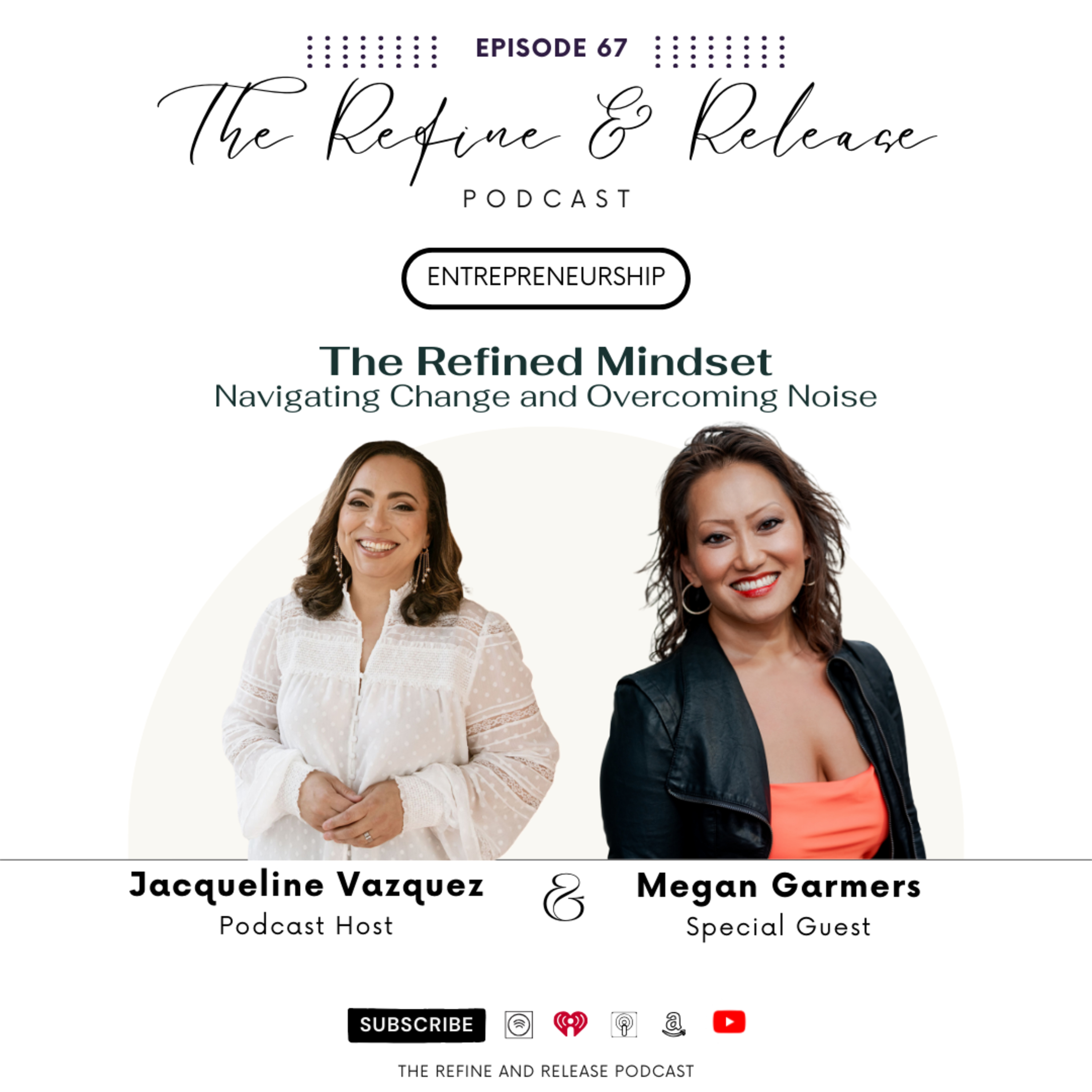
Episode 67: Entrepreneurship-The Refined Mindset: Navigating Change and Overcoming Noise
68m 9s
In this episode of the Refine and Release Podcast, host Jacqueline Basquez interviews Megan Garmers, a seasoned business and marketing consultant. Megan highlights the importance of entrepreneurs embracing their multifaceted identities, arguing that unique personal blends create irreplaceable value. She shares insights from her 27-year career, which spans weddings, tech, beauty, and fashion, noting that entrepreneurship often stems from a desire to solve problems creatively. Megan recounts founding the first national on-site hair and makeup agency for weddings by recognizing a shift toward personalization in the late 1990s, despite initial industry resistance. She stresses the necessity of adaptability in business, especially in dynamic fields like weddings, where client expectations constantly evolve. The conversation also touches on practical aspects of entrepreneurship, such as managing morning routines and addressing health challenges like perimenopause brain fog with supplements. Megan discusses the obstacles female entrepreneurs face, including sexism and societal expectations, advocating for resilience and self-compassion. She concludes by encouraging listeners to define success on their own terms, celebrating individual strengths rather than comparing themselves to others.
Welcome to the Refine and Release Podcast. With your host Jacqueline Basquez, this is a refreshing space for women navigating the challenges of entrepreneurship, faith, or infertility. Stay tuned for today's episode. Hey everyone, welcome again to another episode of the Refine and Release Podcast. I have to say that very slowly because I was in the need recently changed. I'm really excited about it. So I wanted to make sure that what's sinking in and it is, and I love it and I love today's special guests. And I think about her, I think about refinement and how she carries out all of her platforms and the things that she does, but also just how genuine she is. I'm going to welcome Miss Megan Garmers as a business and marketing consultant. She has experienced spanning 27 years in multiple industries, internationally. Her experience and network in the wedding and events industry, tech, beauty, and fashion industries, provide a unique understanding of what strategies to litify the best ROI for your target audience. The wedding masterclass produces events around the world dedicated to empowering wedding professionals like myself and I can definitely testify to that by providing them with the connections, opportunities, and insights needed to thrive. These events include passport, pro date of the wedding industry, masterminds, oh my gosh, the mastermind dinners, you just have to tune into that and attend and fan trips for wedding professionals, both traditional fan trips as well as ones focusing on creative editorial photoshoot, which I'm missing one, but that's okay. I'll see you back in a 10 another one. Megan also coaches a select group of professionals to expand and optimize their businesses to scale, create online courses, speak at conferences, and identify new streams of revenue for long term entrepreneurial success and passive income for years to come. Let me welcome Megan. Hello, Miss Megan. Hello. I'm good to see you. Likewise, is there anything else you want to add to your introduction? No, you did beautifully. I know it's a lot, oftentimes a mouthful, but it has been a kind of unique blend of all sorts of things and it's one of the parts about being an entrepreneur is that as an entrepreneur, you just naturally like to solve problems. You see a problem and you think, how can this be solved? How can things be better for everyone who's experiencing this? And then you just do it. And sometimes you end up in places and spaces that you had no idea you were going to be in and you just keep going and rack up a lot of experience doing that. You know exactly what I'm talking about. I think it's interesting because oftentimes we want to think of ourselves and other people as either two-dimensional creatures or just singular people, singular objects, singular thoughts, ideas. When in fact you are made up of complex, multiple parts, when you're really looking deep, you have hobbies and interests that span a range and oftentimes experiences that span a range and there are ways that all those things mix together to make you unique, certainly providing a value that no one else can. So instead of shying away from those things, I think it's important to celebrate them. I so love how you summarized that because it definitely makes sense. It makes sense that we have so many complex pieces to us that intertwine and make us who we are, identify us who we are. I have something in one of my first book that I wrote, The UQI, The Unique Quality Identifier. So when you were saying that, that's what came up and I was at an event speaking last week and I mentioned it because I was speaking to entrepreneurs or future entrepreneurs. And once you tune into what that is, who you are, your value, you can produce so much more. Your success level is at a different level because you're now curating it based on your potential, your unique value. So thank you for starting us off with that because that truly is the essence of being an entrepreneur and understanding your worth pretty much. Yeah. So how do you start your mornings? Usually it starts by rolling over and grabbing my phone, which is not what I would ever suggest to anyone. But it's a habit that it's hard to break. I did a good job of breaking it during the pandemic mainly because there weren't important urgent things going on every day that I had to keep tabs on. But as an entrepreneur and multi-hiphonet or whatever you want to call it, there's a lot of things that a lot of moving parts. And we do a lot of international work as well. So when I wake up, that's not necessarily the start of somebody else's day when they're in Italy or Singapore or wherever, they've been awake for a while. So sometimes you have fires to put out that these things are going to take time right away in the morning. So I like to just have a general idea of what's in store for me the first hour. If nothing is urgent, I make my coffee. I get settled in with my computer and wake myself up as I'm doing various tasks that need to be done. But usually my mornings are most productive in terms of a lot of that work. I've recently started taking creatine in my coffee, which has been so helpful. Anyone going through in this date, certainly explains my age. But anyone going through parry menopause and the brain fog that goes with it, you can't have brain fog when you have a lot to do. And so that little bit, just half a teaspoon of my coffee, has made all the difference just so I can start my day off and have a good understanding of what's ahead, what I need to tackle, and be able to get a mental wrap around of what that day is going to be. Sometimes I'll have a second half teaspoon later on, but I have to say that it's been such a life saver and really allowed me to stay focused for certainly for the morning, but even throughout the rest of the day. And what is that you add? So it's creatine monohydrate. Normally you'd think of creatine as like some bodybuilder thing like adding their protein and creatine shake for pre-workout. And it does help build muscle, but one of the things that it also helps with is your brain health. Wow. And it is amazing. Like I said, total game changer for that brain fog. Sometimes it's easy, I think, especially as for women to blame yourself, like your inability to overcome any biology or physical issue. And sometimes you just can't. It is the important part about understanding that we are biological, physical features. And sometimes we need help no matter what that looks like. And there are things that sometimes were deficient. It could be something as simple as vitamin D or something else. And when we're in tune with that, we can optimize our physical health, which optimizes our output. I wish I had that when I was going through a parrymanopause. And I'm telling my age because I'm already postmanopause. You're talking about telling your age. I just feel mine. But I started early. I was at the earlier stages of it. But yeah, no, I'm not missing that. So I'll keep you in my prayer. Oh, thank you. Yeah. I know what to go into in some way or another. But thank you for sharing that. Thank you. Because that's the reality of the world, right? Especially for women. If we're speaking to women directly, we have our role as an entrepreneur. But not forgetting who we are personally as a human, as a woman, and the things that we're challenged with, physically, that we feel like we can control. But then like you said, there are certain things that can help us along the way. And recognizing that sooner than later, to see how we can help our flow and our process professional. Thank you for sharing that. So speaking of entrepreneurship, we got a lot of tidbits just in the earlier part of this. But how did you start in the role and journey of entrepreneurship and why? It's funny because growing up, I always thought entrepreneurs were people who owned gas station and little bodega and or they happen to be in a family business that
It's been a really long time and I didn't I had no context of what that looked like of of creating a business from nothing. I thought that was really what that was. It was like either a franchise owner or some type of service professional for a blue color job of sorts. And so I pursued a professional career path thinking that's really what I wanted to do. But my entire life, if I've seen something that needed to be fixed, I always wanted to fix it. I wanted to learn it. I wanted to do it. I wanted to make it better constantly. And I think those are the kind of the cues that sometimes again based on our environment growing up and the kind of the ideas or stories that were told about who we are, who we could be. It's important to remember that those things really, they shape our ideas of whatever ceiling we think we have. And when I first moved to New York after college, my world totally opened up and I realized that, jeez, there's so many options and entrepreneurship is not just gestation owners or bodega owners or owning a franchise or whatever that is. It really is about creating a solution. And those are the things like that was around the kind of the.com boom that everybody was there was tech entrepreneurs. There's a lot of different kind of nuanced ideas around what it means to be an entrepreneur. So those are influences that really shaped my ideas and how I was able to utilize my natural skills to be able to create a business. Now you have obviously the internet and you have social media, you have a million different articles and books at your fingertips. You don't have to go to the library or look it up in encyclopedias where you can actually go and from your bed at home and learn about these things. And that's why for me, creating spaces and places for people to parse through all that information because I didn't have the information readily available. And I knew that other people who were in similar spots to me didn't necessarily have the background that I had to be able to absorb and digest and then reapply or kind of edit to make it fit what it was that I was doing. That's a really crucial part. You can absorb information, you can understand it mentally. But if you don't understand how that can be impactful and applied to whatever it is you're doing, it's useless. And so what was your first role as an entrepreneur? So my degree was in psychology and I had been approached by a friend who I was working in health and fitness management. And she had said, I do this thing on the side and I work with a celebrity hair and makeup artist and I need an assistant for the weekend. I like the way that you do your hair makeup, would you be interested in assisting me? And I was like, sure, not a problem. Just by nature, I always knew all of the different things before they came out. I was really big on all of the different makeup products and trying things out, spent countless amounts of money. But I was something that I naturally enjoyed and my minor was art and design, my father's artist. And so I went with her and really enjoyed it. And was surprised that the type of money you could make doing that. And so the celebrity, would you want to be trained and come do this on the weekend? But I said, sure, why not? Not a big deal. I was getting ready to go to my PhD program. I was like, this is just extra cash. And we would do bridesmaids, obviously. And they would say, I love the way that you do my makeup or my hair. Do you have anyone in Chicago or Dallas or Miami or California? Anywhere. Because at that time, and again, these are things that date us at that time weddings were not personalized. They were very cookie cutter. They were very traditional. I always say that you had three options, pink, peach and mauve. That was it. And for hair and makeup, everybody looks the same. You wore your hair in a very specific updo. Your makeup looked very specific and everybody looked the same. Late 90s, early 2000s, there was a huge shift towards personalization. And people were saying, I don't want to look like that for my wedding. But nobody was offering those services. And so I thought, here's a problem. Let me create a solution. And so I started the first national hair makeup agency doing on-site services for hair and makeup specifically for weddings. Worked alongside the knot. We hired and trained artists all over the country to do things that were personalized, not cookie cutter. To be able to go into someone's home, the very beginning of this people, no one did that. You only went to a salon. And so starting, starting of an entire aspect of the industry really requires a certain level of not just grit, but almost blindness to what everyone else is telling you. Why would I want you in my home? That's the most ridiculous thing. Why would I not go to a salon? How do you even do that in my house? I don't have. Do you have everything you need? Yeah. There was so much pushback. And a big part of starting that was creating that environment and helping people understand what the value was to that service. As well as really training staff to be able to provide something that they had never even thought of before. Like, why would they do that? How would they do that? And so that's where I started from there. It was doing a lot of education. It worked with the knot a lot and helping just different entrepreneurs that I met within the wedding industry understand. So what is the psychology of a bride soon after that? The show, Bridezilla, came out and so this whole idea of crazy. Oh, we're definitely dating ourselves. Yeah. Because I remember who's wedding is it? Anyway, yeah. I worked with David Satera on his show. We did stuff with TLC for say, yes, to the dress and Randy to the rescue. We did all sorts of things all over New York, Rital Fashion. We've done that since 2007. And so we worked a lot with a lot of different entrepreneurs. And again, just a passion project of mine, I just saw that people needed education. And they needed more than just these are couples you should advertise here. This is the hot trend now. So do this thing. They really needed understanding of how to create a business that was going to last. And such a very, I don't want to say and stable like it was unstable for people necessarily, but it was unstable in the sense that the idea of what a wedding looked like and what couples were wanting was so nuanced that there were a lot of people who had been in the industry that were very quickly shut out because they didn't adapt soon enough. And that was it was heartbreaking to me because it wasn't because they weren't good at what they did. It wasn't that they didn't provide a good service or product. It was because they didn't understand the nuances of how to serve a client, a couple in a way that was different than what they were used to. How do you have a dynamic business? How do you constantly reinvent yourself? Because that's it's unique to the wedding industry. Most things it's like you can look at a demographic and be able to pinpoint exactly where to advertise what to say what to provide. And it stays pretty similar. That's not the case. That's changing. And for me, I believe in flexibility. I'm always curious. Having that curiosity is key. And I feel that's why I've been able to adapt in the many changes that this industry of events brings. And if you don't adapt to change, then you're going to say where you're at. Yeah, I'm glad it is. It's one of my favorite books. I know I mentioned this that's the mastermind dinner, but it's who moved my cheese by Spencer Johnson. And there's a quote in there. If you do not change, you will become extinct. And it's true for any business, but it's especially true for wedding businesses, just because the individuals you're clients, the people that you're serving are constantly changing. And so being able to have a business that's more than a couple years long requires change. Yes. And if you look at a company like Starbucks, how they market to the different generations, every company does it. So when it comes down to our industry, knowing that the client that you're serving now may not be your forever client. So how you adapt to those changes. So that is with your journey and your extensive experience in the entrepreneur world and education as a woman, what challenges have you come across or you seen or experienced? How long do we have? Yes, we have as long as we can, but let's keep it to a
just a few and we can keep chatting afterwards. Oh my goodness. It's very interesting and I think that one of the things as a female entrepreneur, no matter what, like when I started or even if you start now, there are challenges. There are some of challenges that you just, they are what they are. And then there's challenges that are specific to a timeframe. So when I started, when you started, the ideas around women working, women having businesses, women as bosses, all of these ideas. And I will say a lot has changed and I'm very grateful for that. The idea is that women can be strong and powerful and still be kind. And that being purposeful doesn't mean that you're being aggressive. Whereas if a male were doing the same thing, it would be normal and that's boss behavior, but a woman does it and it's called many other things. I think a big part of my journey really had to do with my personality and for better or worse, sometimes better and sometimes worse. There is a bit of unapologetic behavior when it comes to certain ideals. And you can be on board or you don't have to be, but I am not going to change to try to make you happy. I'm going to try to make you happy, of course. But if it comes down to who I am or it comes down to a value or a moral that I believe in, just not, I'm not going to bend to that. And you can have your ideas and I'm going to prove you wrong and time after time, I would work really hard. Five times is hard to be able to do that. And I think having adversity when you are younger can either make or break you. And I was fortunate enough to have a lot of the personality traits that allowed me to experience a variety of things from sexism to racism to eagism to all of the things and be able to come out on the other side because I was able to put my head down and I had resources and I had support from friends and family to be able to do that. I fully understand that not everybody has that. And I think it's unfair for us sometimes people who either they're listening or they can see someone and say they can do it, I should be able to do it. And it's wonderful that there is the hope and belief that's possible. However, it's really important to make sure that we're honest with ourselves and our abilities to know, okay, their circumstances, their skillset so vastly different from me that I should not hold myself to that ideal, that I can do something else that's equally wonderful, equally impactful, but not judge myself by not reaching the same goals as someone that I look up to. And I think that's hard. The success can look very different to different people. And I think that all success should be celebrated. So again, it's easy, I think, for women, especially to feel like, okay, women can do this or I saw a woman do that, so I should be able to do it too. Yes, however, like I can watch you say, "Bullet run." Very fast. Does that mean that it's humanly possible, but does that mean that it's possible for me? No. (laughing) If you've seen me in person, I have the world's shortest leg. I have not run enough. It's so funny. Is it possible? Humanly yes, for me? No. And I'm okay with that. There's tons of things that I can do that he can't do. So again, understanding what are limitations and what are strengths? Where can we really rise in ways that other people might not be able to and celebrate those as major successes in our lives? Yeah, and thank you for sharing that. And every single time you say something, it's okay, that's why we're connected. That's why you and I have this alignment that is so deep because I totally agree and that's when I try to speak or mentor or in whatever platform I am able to, I always share, even if I'm speaking, I'll say, it's not for you to try to do my success. It's for you to find whatever, out of what I shared, sparked your uniqueness. Yeah. Even when I was teaching, it's my success is not gonna be your success and if you go to the highest level, go to the moon, which I will not. (laughing) That is okay because that is your unique value. That's who you are. And so I don't want you to compare yourself to me or put me at a pedestal and say, I wanna be like Jackie, no, I wanna inspire you and show you that you can embrace any possibilities that are ahead of you. So if I can inspire you to do that, then I've done my job. So I love that you share that. If you were to look back at your 27 years of experience, what is one rule of business? You're glad you finally released to make room for new growth. Oh. I have to say that in business, but it's also personally, I think that sometimes when you work really hard to prove yourself, you get stuck in a cycle of constantly doing things that people say can't be done. And sometimes you do it because you have a belief that you need to show them that either a woman can do it, that you can do it personally, that someone in your category or your discipline can do it and you really feel strongly about it. And I think a lot of that is youth, right? You have the energy of the time, you have, and you do, when you don't have experience, you do have to prove yourself. It is required. However, I do think that as you gain experience, you also understand what's okay to say no to the idea of Jomo, the joy of missing out. You don't have to be in every room, everywhere, every place all the time. That galo looks great, that party looks great, that event looked great, I should have been there. I should have figured out a way to pay the money for the ticket or whatever else. Understand that what's for you is for you, but also those are choices. I think sometimes it's easy to think about success in a very not just linear way, but in a very singular, myopic fashion, where it has to look like this. My success has to look like this other person in my category. It has to look like this other person I idolized what we were saying before, but understanding that it doesn't, and that if as an entrepreneur, if I'm able to make good decisions, which is a key part of being an entrepreneur, if I'm able to make good decisions and see the things that other people can't see when it comes to the benefit of doing this, of saying yes to this, but also there might not be the same benefit to saying yes to something else. And so I'm going to say no. Part of that just comes with experience, but part of that also is understanding that you have to be able to trust your vision as an entrepreneur, things that no one else sees. They are going to doubt you, they're gonna tell you you're on the wrong path, they're gonna tell you it can't be done. And if you have a vision for something, you see it, the idea that the word visionary means that it is something that only you can see. Other people can't see it just by nature of the word. So knowing that definition means for you, that you are able to create a world, a new reality for yourself and your clients, for other people, that other people aren't going to understand now. That means saying no to things that are going to be as impactful and having a Jomo, having the joy of missing out because then you're so clear about that vision. - Something just popped into my head when you were sharing that, thank you. When Twitter came out, that's the early stages of social media for us was very interesting, but for me, I resonated more with Facebook and a colleague, you're not that active on Twitter. And here we have, we're going to education that telling us be active, that we gotta be active yet. And for me, I've always considered myself being on a separate road than everything else or everybody else. And I've always been okay with that. And the beginning stage of Twitter goes many years back. I said, "It's my Twitter." And I do it the way I want to do it. (laughing) I don't have to be on Twitter every day, or whenever. - It's my Twitter, I like that. It's my Twitter. - What's that? - Like, hello. - Yeah. - Yes, I know there's a trend going on. Yes, I know there's the social media do this, so that this happens and it's gonna happen. but I do things in my way. And if. I didn't want to be president Twitter, then I was not gonna be that president Twitter. And guess what, I was not. And I'm very it. But that jomo of missing out. - Yeah. - Because it's a trend or because it's what you have to do. It's so real. It's so real, but choosing your core values, choosing what is meant for you, what you put in place for yourself, your beliefs, your practices, that comes first, beyond anything new or anything that you're supposed to work with or not work with. So thank you for sharing that. Just popped into my head like, "Wait, yes, I remember that I was told." - Why are you Twitter? - If you're not gonna use it, you're not gonna be found. I guess I'm not gonna be found. - So it's being secure with yourself. - And being president with who you are in any platform. I know you have gone to so many different countries. You've traveled internationally. Is there one common challenge that you have seen that entrepreneurs are facing? - I definitely think that right now, specific to the wedding industry, it is hard for established wedding businesses to change. It's hard to change. It's hard to do all the things. It's hard to any business that has been around for a while has felt the increasing pressure of doing more social media, being more present, setting more boundaries. There's more dues and it is weighing on a lot of options for entrepreneurs, mainly because it's difficult for them to understand, who do I trust, who do I listen to, whose advice should I follow in order to make sure that my business can last another year? Everyone's experiencing lower leads, except for those who are quickly changing. And when you're not quickly changing, it's again, the idea of who moved my cheese, my cheese is dwindling. There's no more left. What's wrong? Oh, you're experiencing it too? So am I, which is good, but the challenge is, you don't wanna sit there and commiserate with someone else who's also experiencing the same thing, but there's no solution. Otherwise, you just sit there and die together, which if that's your choice, that's your choice, but understanding that, okay, whatever you're experiencing, there has to be a reason why. And if you're not willing to understand what the reason is, and come up with a solution that's going to be beneficial for you and your business, then it's time to hang up your hat and try something else. And there's no shame in that. I think that's something that a lot of people need to realize, especially now more than ever, is that you could have multiple careers. You can have multiple businesses. You can do things that are different and new, and yes, it takes a lot of energy and time to make a switch. But if it's going to bring you more joy, if it's going to create space and time in your life for balance, whatever that looks like, if what you signed up for your business is no longer what you're experiencing and you are not happy, there are ways to either fix it or to move on. It's important to know which is the right choice for you. - Yeah, and I like how you say, if it doesn't make you happy, because understanding where you're at now and being realistic and honest with yourself, I'm not feeling this anymore. The generation right now is so different. They're not my generation. But it's like really having honest conversation with yourself. And like you said, finding the right support or people to speak with that can help you understand just by a conversation. Yes, there's different programs. There's coaching, there's mentoring, all that. But just a conversation with someone outside of, someone else who's doing or going through the same thing. That can really enlighten and bring a full circle moment to what you're experiencing. So that is so true. - Yeah. - Because I know lots of colleagues that are going through that as well. I am adaptable to changes, generational changes. Flexibility is key, moving and adapting. I've scaled my business. I used to do tons of events, but now I just do under 10 events a year. But I position it based on, I already know what I want to earn every year. My business generates what it needs to. And then I'm able to also, I was able to open up my other platforms. And that brings joy. And overall everything that I created, but it takes time to create it. It takes time to make changes. And then understanding that you need to be secure with it and good with it. And if it makes you happy, then you're on the right track for sure. Now, I know that a lot of the platforms like thisness that you have, it's, there's networking, there's connection. And I love that. Again, that's one of the things that I love about what you do. I'm actually experiencing Joe Mal right now because I can't go to one of yours. Okay. And that because of the experience, but because of the people you're gonna have, I so love them and miss them. But with that said, as a young girl, I grew up as an introvert. And that slowly changed. And I consider myself an Andy Bert, which is a combination of being an extrovert and an introvert. But I know that a lot of people struggle in the industry with connecting. Do you consider yourself an introvert, extrovert, ambivert? What do you think, where do you think you are right now? - I'm definitely an ambivert. I love being around people. Like, obviously we do in person to then my favorite things to do is to see and interact with everyone who comes. I love that. I think it's great. It brings me such joy. I get goosebumps every time. You've been to a ton of them. I get all the club every time. Like it overwhelms me with joy and emotion. I love it. But I also love to be in my own space, then be in my own head and have some clarity. I think it's really important to be able to be comfortable doing both. As an entrepreneur, you don't have to be an ambivert, but I think that learning how to find your comfort zone within an environment that requires. Interaction with other people is important. Unless you only run an online business and you don't have to see anyone face to face or deal with other people. Great. But generally speaking, you're gonna need to do some type of networking, some type of connection, some type of something with somebody else 'cause somebody's gonna be needing to give you money and work for your business to keep going. So there's the same level of connection. Yeah. So for someone who is looking to attend or has been attending events or networking, who is an introvert or considers themselves an incineratorvert and they find it either scary. There's a combination between introvert and having fear. Oh, going to a net. That's two different things. But how someone from those two perspectives, attend a networking event and find a way to feel comfortable. I think one of the most important things to remember is that everyone else is in the same boat as you. It's so easy to walk into any type of networking event, conference, but have you and think that everyone else knows each other, feels comfortable in that situation and you're the only one who feels uncomfortable, who feels like they don't know anyone, who feels awkward. Nine times out of 10, the majority of people there feel the very same way, very same way. So remembering that, I think first allows you to put things in perspective. Some of that fear and anxiety, I think comes from the self-judgment that we put on ourselves in those situations. Thinking that everyone else is this way and I'm not. And I should be the other way, but I'm not. So there's something wrong with me. It becomes this whole self-loathing and you're beating yourself up about not being like everyone else. That's not the path, that's not the rabbit hole you want to go down. Understanding that number one, nine times out of 10, other people feel the same way. And number two, I think it's important to know that when you approach someone in a way that is not just friendly but helpful, unless they're really just a total jerk, they're going to be receiving you warmly. They're going to be interested and happy that you came to say hi and introduce yourself. I think one of the easiest ways I like to give the tip is when you go up to someone and you introduce yourself and you ask them about them, take out your phone and say whether or not you're going to be
again, that industry dependent. Are you unlinked in? Are you on Instagram? Do you mind if I follow you? Oh my goodness, of course. Yes, of course. Everyone wants more followers, everyone wants more friends, everyone wants socially. Of course, thank you. And then asking them, what are your goals for this event? What are your goals for your business? What are your goals for this conference? And how can I support you? And it might seem silly or you might feel silly to ask someone, who might I ask what their goals are? And I don't know them in order to support them. And I don't have all the answers, but I say this at state of the wedding industry a lot, is that you have to remember that no matter who you are, you have a network, you have experience, you have a background that no one else has. And so sometimes someone might be looking for something that you might know someone, or maybe you'll hear or be in a conversation or learn something that, oh my goodness, so and so, who I just met, would totally benefit from that. No one person can be everywhere at the same time. And so if we are going to be really good friends, good colleagues, good industry comrades together, we really need to make sure that we are willing and able to support each other in ways that we can. It's not to say that you're going to have all the answers. It's not to say that you're going to know exactly what to say, but being able to ask and show interest in how you can help someone else. Number one, it solidifies who you are. It's more than a business card. You're more than just a face. But also, it solidifies the fact that, you know what, I want to be able to help you. And when you want to help other people, guess what? They usually want to help you back. And they'll usually ask the same questions of you. And in the end, you all get what you want. You have to be willing to put yourself out there. And I think that's a big part of the hiongler. You have to be willing to be a visionary. Put yourself out there. Be criticized and told you can't do it or it's that's not a good idea. You have, you put yourself in a networking situation, you have to be willing to have someone go, no, move on to the next phrase. And that's fine. And that's okay because they're not your people. They're not your people. Yeah. Yeah. So a lot of times I came from a sales and marketing background at one point. I sold again dating the yellow pages stored a door yellow page advertising in Manhattan. So I logged around yellow pages and went to art of businesses asking if they wanted to buy advertising in the yellow pages. Do you know how much rejection I had on a daily basis? How many names I was called, how many doors were slammed? Security taking me out all sorts of things. But understanding that when you hear a no, it's one one more closer to a yes. You are one step closer to a yes. And that those are your people. That's okay. There's always going to be things you can improve your sales pitch, your delivery, whatever it is. But at the end of the day, understanding that if you're working on you and doing the best for you, that their answer doesn't always reflect in sometimes just reflects in the fact that they're not for you and that's okay. Yeah. And also what I want to add is once you've gotten your rhythm, right, to getting out there and being out there and networking, because this actually happened to me. So I like to share my experience so that hopefully it helps someone curate their journey of networking because it could take a toll on you. And that's where, yeah, for me, I know I need my space because just like you put out a lot of amazing energy in listening and talking and being present for the people you're speaking, I get that from you. And when I am speaking to someone, when I'm networking, I'm like going to so many different people and connecting people, all of this takes energy. And we'd love to do it so much that so much energy we're putting out that we need to bring it back in. And that's where my quiet moments are like I need that time. I need to reenergize and get into that space that I'm understanding and creating what are the spaces that I want to be in and what being intentional with it. Because when I first started, I went to so many networking events that I was like, oh my gosh, I'm burned out. For those who are introverts, that can really impact a lot. So it's really yeah, understanding intentionally, where do you want to be? Why? Who do you want to connect with? Why? And understanding what each platform brings. For me, I know I feel best in going to a networking event that has education or some type of value because it takes me an hour to get ready. It could be an hour or more to go, an hour to come back or so. So it's a full thing going on. That's energy right there that it's pulling out in addition to being present. And one thing I know is I am not one to attend and networking happy hour because it's not for me unless it's with my core tribe, let's say, so different. Or unless it's a networking event because I went to a conference or a summit and there's this fire site chat with wine or whatever, that's so different. But for me to just go to a networking event that is just a happy hour, it's not for me. So understanding all of that takes time. And your gut feeling will let you feel it whether it's for you or not. If we were sitting here five years from now, what's one thing you hope every entrepreneur learns to refine in their life to avoid burnout? Oh, that's a good one. I think going back to everything we talked about today, really knowing what's for you. And it's a hard process because you got to make mistakes and realize that is not for me. And those are costly in all the ways, financially, emotionally, mentally, they're costly. You prep a lot for it. You get ready. You spend your personal time and energy money towards it. But figuring that out early on, I think it's probably one of the most beneficial things you can do as an entrepreneur. Because again, like what I was saying, the outside sales, the more knows you get, the more refined you are. Okay. But you have to take time for what you were talking about that self reflection. Why was that a no? Why didn't that work out? Did I make a mistake? Did I do something that I can improve on? Or is this just not the fit? Is this not good? And it's easy to go either way. It's easy to, we can be quick to blame other people and say, no, it's all them. I'm good. I'm good. And it's also quick to say, no, I need to be better. I need to do this. I need to do that. But figuring out what that middle ground looks like for you is crucial. So understanding that the more you understand you, you understand your business, who you serve, and what makes you happy as an entrepreneur allows you to make good decisions. Because if you're doing something just for the business and any entrepreneur will tell you that yes, a big part of being an entrepreneur is doing things you don't like to do. A million percent. However, knowing that kind of after you're a three to five, like you should have that honed in. That should be dialed in. Exactly. And you understand what that looks like. You're one and two. It's all stuff that's all new. You feel like you're failing every other thing. You try to put your hand on. It's just not working. Nothing's working. But you have to remember that like you were saying, it's a process of refinement. And knowing what's for you. What do you like? Not just personally, but as an entrepreneur. Do you like working with those clients? Do you like working with those event professionals? Do you like going to this type of networking? Do you like? What do you like? What do you not like? What do you need to like it? Even. So maybe you don't like it, but you can learn to like it if you have this other thing. Figuring that out allows you to know what you need to thrive. And if you've never been an entrepreneur before, you're not going to know that at the outset. You're just not. It's like saying, okay, you should figure out who your ideal client is. You've never worked to have no experience. How would you know? You don't know. You do. It's not. You need to just get out there and do everything. Say yes to everything so that you can understand. You can't refine something that's already refined. But you don't know how to. It's done. Yeah. No. I thank you. Yeah. Because I struggle with that one. It's like when I go and I hear these conversations or it's in one of the educational things, find your avatar. If I just started, how do I know what my avatar is? Find your niche. I don't know, I just started. No. You don't know because you don't have experience. And it's interesting because at that point, then everybody's avatar looks the same. I want them to be really rich. I want them to totally trust me. Never question my whatever. And just be really happy with everything I do. And they're getting married. But you're in the wedding. No. That's not first of all.
those people don't exist. I don't know who told you that they don't. They just don't exist because they just don't I don't know anybody who's ever just happy to throw away money and not ask for wonder what it's for or it just be happy with anything they get. It's not anyone ever on the entire planet. Understanding that you need to know who do you like to work with? Why do you like to work with them? What are the characteristics of their personality? What are the characteristics of their behaviors? Understanding that just because they have a bigger budget doesn't mean they're going to be an easier client. Doesn't mean they trust you more. Sometimes it means they trust you left. And like we discussed at State of the Wedding Industry, Brooklyn, having higher and clients, ultra high net worth celebrity clients, they are paying for access, all access to in the morning access. There's no you don't have time off. There's no boundaries you get to have because you work for them. That's what you do. That's why you're getting paid extra. So knowing okay, is that the client I actually want to aspire to or not? Am I happy with a mid market client? Am I happy with clients who what is the most important thing about that client avatar for me? If you've never worked in weddings or specifically in whatever discipline you're in, you don't know. You just don't know because it's you. So you need to get the word. I always say you should find someone and apprentice work under them, whatever it is. Learn all the things because if you've ever had a job or worked with anyone else, you're like, "Ooh, cool. You're learning new things." And then you're like, "Ooh, I wouldn't do that. I'd do that." Exactly. Oh, or I really like it when this person comes in or I hate it when I have to talk to that person. You start to form ideas and understandings based on who you are and how you like to work within whatever it is that you're doing. Experience is the only thing that's going to give you that. Yes. Yes. Oh my gosh. You hit on a valuable tidbit right there. Soky. Soky. I haven't met someone who actually believes in that same thing that I believe in. What do you mean my niche? I just started. Yeah. Yeah. Hello. Hello. Thank you. What does a moment of gratitude mean to you? And what are you most grateful for at this moment? At this moment, I am most grateful for this conversation. I love having conversations with you. You are such a wonderful joy. You exude the what I think that is the byproduct of knowing yourself and knowing your purpose as an entrepreneur. When you have that, you're freely able to give and receive. And I think that's something that you exhibit. So thank you. I'm over here trying to make me cry, but thank you for sharing that. Thank you. And for me, like at the end of every event, it's just this overwhelming sense of gratitude for everyone who showed up. I think it's something that's really interesting. We have a lot of so we're essentially on the road for the next three to four months back to back events. And it's interesting when again, people have no concept of what our events look like. Our events are very different than our normal event. It's different than a mixer event. It's different than just an educational event. It's different than a gala event. It's different than a three-day conference or high-end luxury event. Our events are very specific. And the reason that we have them is because there weren't events like this in the industry. And so at the end of each event, I always am filled with gratitude for everyone who was willing to come. And they had no idea what it was going to be like for the event team who put it together. And again, most of them have no idea what it was going to look like for the venue and the contributing teams to partner on an event that they weren't exactly sure what it was going to look like. It's hard to explain something to someone that they've never experienced before. It's like trying to, you're explaining an alien to someone and it's like you don't have the words. You have to experience it. But once you experience it, then you can figure out, okay, it's this and this. But it takes a while. And so I think I certainly try to re-sratitude into everything that I do. I think it's an important part of making sure that what we do is impactful, that it needs the purpose and the goals that we have. And I think it's a key component to finding good friends, good partners, all the different parts that really that we need in order to have a business and to be an entrepreneur. So I think gratitude is probably one of the most important things. And it's so much more than a praying hands emoji. It's so much more than I think you think you, it really is about understanding what it took for you to be in that position that you're in right now and all the players that helped get you there. And being intentional with what that means, that moment of gratitude and who you're surrounded with is just impactful. And I just want to give you kudos on how you present your platform, your master classes, the dinners that you've added, the overall experience I connect with because it starts with you and how when it starts with you, it resonates amongst all your partners. So I want to thank you for the platform you have. I'd love it if I can attend every single one I would. But unfortunately, I can't, but whenever I am available. I know we've shared a few tibits here and there, but if you can share what the biggest takeaways were from today's conversation, one or two or three, what would it be? I would probably say that as an entrepreneur, you need to know who you are, you need to know who you serve, and you need to know why you do it. It allows you to make good decisions for your business that allows you to experience setbacks, mistakes, defeat in different way and reframe that. It allows you to be grateful to have moment of gratitude when it can seem like you just had a doors slammed in your face, knowing when to push forward and when to pull back. If you don't know who you are, who you serve, why you're doing it, you're going to have a really hard time deciphering not just what to do, but how to interpret the result because everything's going to look like a possibility or a total risk. So you're constantly going to be second-guessing yourself. You're constantly going to be making mistakes and bad decisions along with good ones, but then you don't know which one to invest in more, knowing those kind of core things allows you to be able to make the rest of those good decisions. And I think it's something that, as an entrepreneur, especially now, knowing how to refine those pieces of you also is important. So not just what it is, but as you grow, how are you okay with adding or subtracting to those lists? Because you are not the same tomorrow and the next day and the day after, and you're not the same as the person who started 5, 10, 27 years ago, which is not. So knowing what's for you now and what was for you then and not being ashamed or or too proud either way of what that was or where you are now allows you to grow continuously. That is perfect. What I would love to add is sometimes personal things happen, life and understanding that into twines with your personal life, with your professional life, as an entrepreneur. So that shame, you may be feeling if you're going through something and you feel like your business is not moving forward because someone got ill, you got ill, you became a caregiver, you're being challenged on so many different levels personally and professionally, it's okay to reach out to someone, it's okay to embrace the challenges because out of that comes growth. Right? Yeah. And everything that you said, thank you, it's so important to also understand and reflect that we're humans. And we feel we go through emotions, we go through so many different things and being an entrepreneur is a 360 movement. It's a whirlwind sometimes. So thank you for sharing everything that you share today, for being open, transparent and being your amazing self and bringing all of you love and care into the conversation. So thank you so much. I appreciate you. How can the listeners connect with you? On our Instagram is probably the easiest. We are fairly active on Instagram, not so active on X or Twitter. My Twitter and I will decide. And guess what? We don't really use it.
Sorry, but we do use Instagram pretty regularly. That is so funny. - We use Instagram very regularly. You can see us all there. The wedding master class. So there's underscores in between at the underscore wedding underscore master class. And then we have individual accounts for our other events and platforms. So we have passport underscore weddings. We have mastermind underscore dinner, which we just started an Instagram account for. And then we also have apps state of the wedding industry altogether, smushed up no underscores in that one. And you can see the different events. One thing that I would definitely encourage you to do is to go back and look through some of our past events. There's lots of really great nuggets of information in there. It also lists a lot of the different speakers that we have. I am so honored and blessed that we have the most amazing speakers at all of our events. Just so much knowledge. There's never enough time to dive in and showcase everything that can be learned from speakers. You being one of them, you have been a speaker for us before. And it's, again, it's just providing these opportunities for people to not just learn, but also to make the connections and understand, hey, this is something I can learn more from Jacqueline. This is something that I can learn more from, or I have a question about. Sometimes it says you are on your journey. You don't even know the questions to add. You just know what you want at the end. But if you don't know the right questions, you can't ask them, you can't get answers to solve problems. You don't know you actually have or the things that are preventing you from reaching the goal. That's a big part of why we have those panels for every single event that we do. It's because everything is around conversation. It's digestible, it's understandable. And it's going to spark different points for you to have questions naturally. It's going to allow you to connect deeper with the speakers. It's going to allow you to have meaningful conversations with each other. And truly, those are the things that we want. So whether you come to an in-person event, you connect with us online. We'd love to hear from you. If you want us to come to your city, we're always happy to look at these cities. But the biggest thing that we do really is in-person events because there is something unique and special about being in that room. There is magic. I can't explain it. It gives me goosebumps every time. Like I said, I can testify to that. It doesn't-- and I think that's the other part of it. It doesn't matter if we have a room of 25 or we have a room of 125. There is still that magic. And it is still worth it and meaningful every single time. So thank you for being a part of that. And for having this platform and all the things that you do, because it allows for people to maintain growth and connection apart from what we call our events to like on-rounds. Their introductions to these other resources, to plug in and learn and grow in meaningful ways. So thank you for what you do. And what I would love to learn is how can someone who's looking for a coach, like what do you offer in just a quick summary? Yeah, I do a very select number of coaching clients. We do offer-- we're building a part of our website that will be listing, coaches, horses, mentors, classes, all sorts of things within the wedding industry and other entrepreneurs to be able to have a hub for people a little listing to go through and filter and understand. Oh, that's great. I'm a planner. I'm looking for a planner coach, I serve a mid-market level, who would be the right coach for me. And then you filter that out, and you'd see these are options. Why would I want to meet with this person or that person, all of that? The people that I work with are usually individuals who've been in the business for over 10 years. They have a very specific idea of how they'd like their business to grow, or how they personally would like their personal brand to grow. A lot of individuals I work with, it's very specific to getting in the right rooms with the right people, because I've been in the industry for so long. There's a level of understanding and discernment that I have in terms of how I'm able to coach them, specific to what I see and know on a higher end level, as well as what we're seeing at every single event that we do. So that's real-time data to be able to know what's going to be the right course for them. Obviously, we have opportunities for speaking at our events as well. That's not for everyone. And we're really-- we're pretty particular about who we choose and why. It's not just a platform for self-promotion. It's very different than just being a speaker on whatever. It's also not a presentation-speaking engagement. So you're not up there for 45 minutes, giving it all. Understanding that makes it a little bit of a different nuance for people who are interested in being a speaker for our event. But we're always happy to hear from new people and people who are interested in being apart. Yeah, but otherwise-- I love being able to provide opportunities for people to grow in ways that are helpful for them. You're speaking on a panel, which is like a community. You're sitting at a table or space that you're bringing together conversations in a communal way, and as a community, as a nucleus, and bringing for impact with just a little tidbit here and there. And the conversation continues after that outside of that. So it's not a promotional piece of, here is this person. No, it's to me a communal table. We're coming together as one and not to overstep over anyone else. And I have felt that from the speaker perspective, but also as an attendee. And I love it. I love the synergy, the alignment. And that brings forth more than when I feel when it's more of a one space for promotion and things like that. So I love the space. And I'm glad of how you curate. Thank you for that. And I do feel that you have a very special platform. So thank you. I'm really excited for this new year. Hopefully I'll get to another one of your events. But for anyone who is looking to connect with Megan, have a conversation, she's very personable. You can reach out to her. And I always say just respect everyone's space. And know that if you have a goal, if you've listened to this particular conversation today, she says it all in there. And you can feel her energy and understand that she has a special platform. We're at the end of this beautiful chat. So thank you, Megan. Thank you for coming. And I look forward to our continued conversation. Yeah. Thank you so much. Again, thank you for this platform and what you do. I think it's really important and meaningful. And you do it very well. So thank you. Thank you. Thank you so much. So with that, make sure to read the show notes. And all the information is in there for Megan. Thank you for tuning in to another episode of the RRFINE and Release Podcast with your host, Jacqueline Vasquez. Please make sure to subscribe, comment, follow, and most importantly, share. Stay tuned for the next episode. Take care.
Podcast Summary
Key Points:
The podcast episode features Megan Garmers, a business and marketing consultant with extensive experience across multiple industries, who discusses entrepreneurship, personal identity, and adaptability.
Megan emphasizes embracing one's complex, multifaceted identity as a unique strength in business, rather than conforming to a singular professional image.
She shares practical advice on managing daily routines, including addressing physical challenges like perimenopause brain fog with supplements like creatine to maintain productivity.
Megan's entrepreneurial journey began by identifying a market gap for personalized wedding hair and makeup services, leading her to found a national agency and later focus on educating industry professionals.
Key challenges discussed include navigating sexism, racism, and ageism as a female entrepreneur, and the importance of resilience, self-awareness, and celebrating diverse forms of success.
Summary:
In this episode of the Refine and Release Podcast, host Jacqueline Basquez interviews Megan Garmers, a seasoned business and marketing consultant. Megan highlights the importance of entrepreneurs embracing their multifaceted identities, arguing that unique personal blends create irreplaceable value. She shares insights from her 27-year career, which spans weddings, tech, beauty, and fashion, noting that entrepreneurship often stems from a desire to solve problems creatively.
Megan recounts founding the first national on-site hair and makeup agency for weddings by recognizing a shift toward personalization in the late 1990s, despite initial industry resistance. She stresses the necessity of adaptability in business, especially in dynamic fields like weddings, where client expectations constantly evolve. The conversation also touches on practical aspects of entrepreneurship, such as managing morning routines and addressing health challenges like perimenopause brain fog with supplements.
Megan discusses the obstacles female entrepreneurs face, including sexism and societal expectations, advocating for resilience and self-compassion. She concludes by encouraging listeners to define success on their own terms, celebrating individual strengths rather than comparing themselves to others.
FAQs
The Refine and Release Podcast is a space for women navigating challenges in entrepreneurship, faith, and infertility, offering insights and conversations to support personal and professional growth.
Megan Garmers is a business and marketing consultant with 27 years of international experience across industries like weddings, events, tech, beauty, and fashion, focusing on strategies to maximize ROI and empower professionals.
The Unique Quality Identifier (UQI) is a concept from a book that encourages entrepreneurs to identify their unique value and potential, helping them curate success based on their individual strengths and worth.
Megan suggests checking for urgent tasks first, then making coffee and settling in with a computer to tackle work. She also mentions adding creatine monohydrate to coffee to combat brain fog and enhance focus.
Megan was inspired by her natural problem-solving tendencies and the desire to create solutions, such as founding the first national on-site hair and makeup agency for weddings to address the lack of personalized services in the industry.
Female entrepreneurs may encounter sexism, racism, and ageism, along with societal expectations that label assertive behavior differently than for men. It's important to stay true to personal values and celebrate individual successes without unfair comparisons.
Chat with AI
Loading...
Pro features
Go deeper with this episode
Unlock creator-grade tools that turn any transcript into show notes and subtitle files.
 PodcastTranscript AI