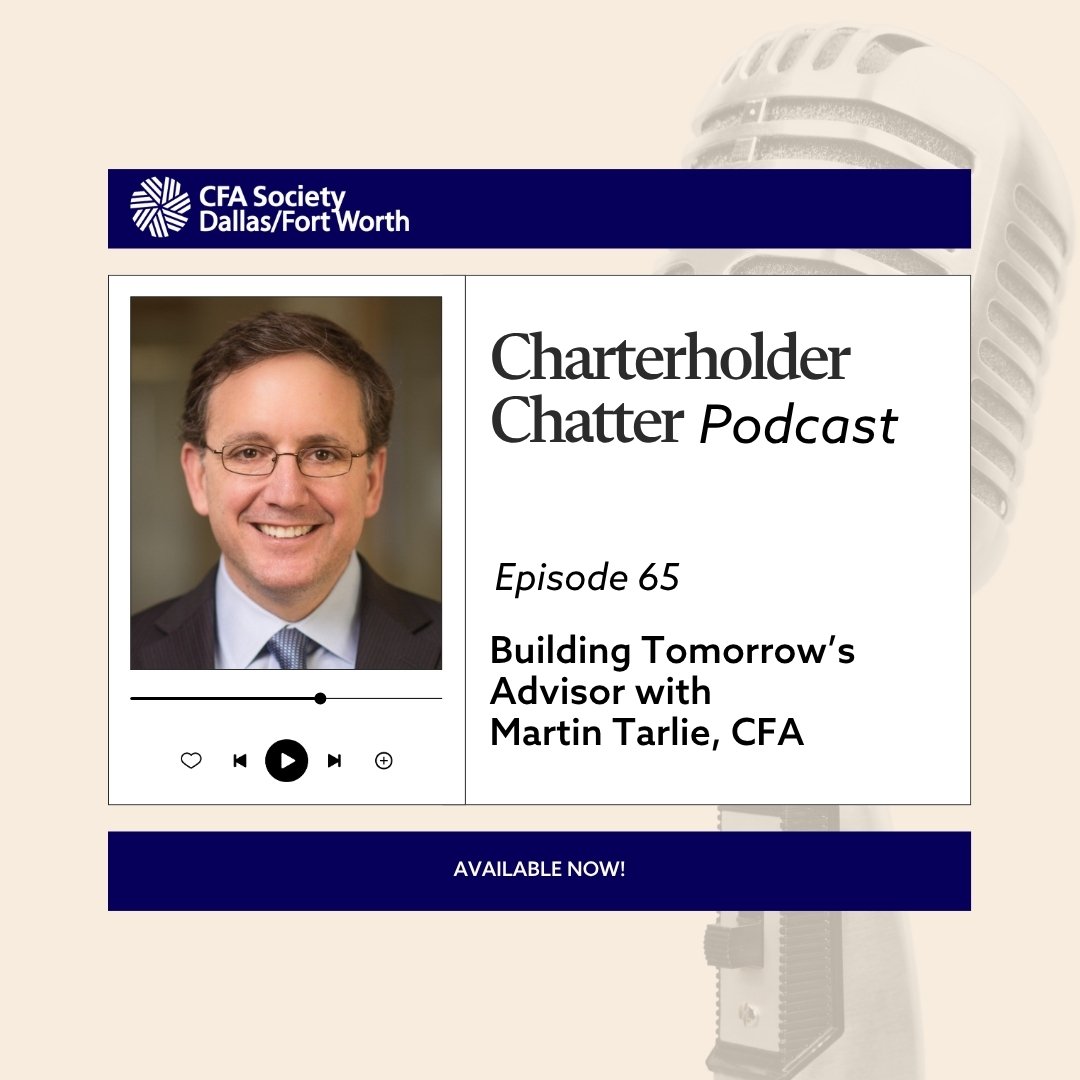
Episode 65: Building Tomorrow's Advisor with Martin Tarlie
35m 11s
The transcription is from a podcast episode discussing goal-based investing and the transition from traditional optimization to probability maximization in portfolio management. The guest shares insights into the development of a fintech platform to align investment portfolios with clients' unique goals. The conversation delves into the challenges of incorporating personal financial goals into investment strategies and the limitations of traditional risk tolerance questionnaires. The guest also highlights the concept of "aspirational goals" and how they relate to investments perceived as gambling assets, like meme stocks or cryptocurrencies. The dialogue includes a mention of the founder of FedEx, Fred Smith, in the context of understanding the importance of volatility in achieving financial goals. The discussion emphasizes the need for personalized investment strategies that prioritize clients' objectives over generic risk assessments.
Transcription
5649 Words, 30740 Characters
And so, as I started to realize that I was seeing this, that what I was seeing was not a calculation mistake that I'd made, because it took me a few days to convince myself that I hadn't made a math error, that this was actually a real effect. - Took me two years, so. - Okay. (laughing) - But you do have a PhD, so that made me. (laughing) - Well, you know what that stands for, Paul Hydeep, so. (laughing) (upbeat music) - Welcome to Charter Holder Chatter, a podcast produced by the CFA Society of Dallas, Fort Worth, and focused on you, the investment professional. (upbeat music) Join our host, Franklin Parker, for a personal and inspiring conversation. All of our podcast discussions represent only the views and opinions of the host and cast. This podcast, in no way, constitutes investment advice and is not an offer to buy or sell any products or services. This podcast episode is sponsored by Trinity Investors, a private equity firm founded in 2006 by Dan Metre and Sanjay Chandra. Based in South Lake, Texas, Trinity Investors drives to earn above average risk adjusted returns through direct investment in real estate and operating companies, utilizing partners who share similar values. Trinity's current portfolio includes 16 operating companies and over 140 real estate holdings, with a combined market value of over $6 billion. Today, Trinity has distributed over a billion back to its investors. To learn more about Trinity Investors and growing your personal wealth using private equity, go to Trinityinvestors.com. - Well, Martin, it's been too long, man, but when you're building big, important things, you spend a lot of time building important things, right? And not a lot of time socializing. So it is good to see my friend. I guess let's maybe just kick it off with a bit of background for kind of the CFA listeners. And I mean, how'd you get into building a Fintech? - So it goes back, I've told this story a lot of times and I know there's a lot of people that are probably super tired of hearing it, but here we go again. It started in 2013. I was actually just in the Quant equity group at GMO, but I've been doing more and more asset allocation work, more and more kind of thinking about how you build capital market assumptions, how you think about how to incorporate valuation into asset class forecasts. There's a lot of work thinking about that. For the people that have a CFA background, we'd appreciate this is that at that time, kind of the dominant model in the GMO framework was really using kind of price to sales-based model, but there was a desire to kind of expand that to include a lot of other valuation metrics. And so I spent a lot of time thinking about how to do that, how to incorporate all of those into a coherent framework into an economic capital-based framework. So really trying to build in some robust thinking about how valuation works, how it should work, what are the underlying economics for the companies that make up these indexes? So did a lot of work that ended up being incorporated into the GMO. So it was like a pretty major influence on the GMO asset class forecast methodology. And through that process, I got to know Ben Inker very well. And one fateful day in 2013, he comes into my office and he said, I just had a really interesting call with one of our large corporate clients. They're doing more and more in the defined contribution area. They're looking into glide paths and they asked us if we had any thought on glide paths. Maybe you want to look into glide paths. So I started looking into glide paths and the thing that became very clear very quickly was they were not explaining how they were building the glide paths. It was as though my three-year-old child had taken a bunch of colored crayons and just sort of gone from upper left to lower right. That's pretty much how they built the glide paths. Right. So Ben and I, we were puzzling over this. And I remember as clear as yesterday, you know, sitting in my office, leaning his chair against the wall as he was apt to do. And we said, well, why don't we go back to first principles? And why don't we think about the risk for the asset home? And what was intuitive to us was the risk for the asset owners. They don't have the money they need when they need it. Makes sense to me. Yeah. It's very intuitive, right? So we said, why don't we build portfolios to minimize that risk? And that was really what got it started. It does actually a lot of stuff that I did subsequently ties back to the original work that I had done in the asset class forecast. So we can talk about that later because I think that is a distinguishing feature of what we do, how we model returns and the return generating process and how you account for mean reversion of expected returns and things of that nature. So that work that I described that I had done prior actually has ended up having a pretty significant influence on how we've built out some of the inner workings that are not just technical details, but they do have an impact on what the portfolios look like. And how you run your Monte Carlo simulations if you want to do that, what we do doesn't require that. But if that's something that's attractive, and it is definitely attractive to a lot of them. But basically, what happened was make a long story short. Ben and I wrote a light paper kind of exploring some of these concepts in the context of GLIDE PASS. And we put it out, I think, in April of 2014. And we knew we'd struck a nerve 'cause it was one of the most downloaded white papers on advisor perspectives, which was a big website for advisors that year in 2014. The Wall Street Journal picked up on it, interviewed Ben and myself. And that's really, yeah, that's really how it got started. It was just kind of a question from a client. - Yeah, yeah. It's interesting how you came from, 'cause I've always divided goals-based investing, which we'll talk about in just a second. Maybe you can give people just a high level view of it. But I've always kind of divided it into two worlds, right? It's like you have what I call the big world of investments and interest rates, and political risk, and is Apple a good stock, right? And then you have your world, your personal world, of what you're trying to do in life, trying to send kids to college and buy a second house, and all of those things that we're all trying to do, to retire, and where those two things overlap is, in my view, goals-based investing. But what is unusual is for someone to come from the kind of big world side of investing, and as quantitative and in depth as an institutional, as you were, to then make the leap over to the other side, and realize that there's a gap on the planning, which I think a lot of times people go the other way, but it's really hard for a lot of institutionally-minded investment managers to go down to the individual's world, as it were. Yeah, that was a painful journey. I got to tell you. So if you want to hear about that, I'm happy to-- I'm happy to-- I mean, need some therapy along the way. [LAUGHTER] We could all use some of the talk, too, for sure. Well, I could open a bottle of wine if that's where this conversation is going to take place. Yeah, so what you call the big world, I mean, that's sort of the investing side, and then the real world, so to speak, is like, that's the world of the client, what matters to them. And that sort of gap between the two worlds, the way that we describe it now, that's sort of the gap between the planning, which is about that person and all the things that make them unique and individual and things that are relevant to them. So what happened in our case is we're sitting here in an institutionally focused asset management firm, and we're getting all this positive feedback on this framework. We're saying, OK, well, there is a business that has to be run here. Is there a way that we can commercialize this idea? So the initial thought was, well, let's go and talk to the retirement plan sponsors and see if they would-- and there was a couple of them next there. Probably the most significant is-- and it took us an embarrassingly long time to realize this. Like, we would go talk to them, and they love the concept. But when it came to actually doing something, they weren't really open to being an early adopter. And the reason they're not only open to being an early adopter is that their primary objectives to not get sued. No, it is amazing how much of the industry is driven by that one metric, or to not have regulators breathing down your neck, right? Well, the regulator stuff, I think, is important in fiduciaries, because we'll come back to that in a minute. But basically, what we beat our head against the law for a long time trying to understand how we might be able to incorporate this into the retirement plan. I think that market is actually opening up now, because I think we have enough traction. And there's enough of, I think, a recognition that the goal's based approach is a lot of benefits to it. And the more closely you can align the plan and the portfolio, or sort of what you call the big world in the small world, the better it is for the people that you're trying to serve. So I think that as that becomes more recognized, I think the retirement world will open up. And we're definitely starting to see, getting brilliant indications of that. That's what I'm saying. Maybe before we get too far into the forest here, just give us like a high level of what goal's based investing is, because it really is a buzz word these days. And for those who aren't aware, that's kind of what we're talking about here. So give us just a 30,000 foot view of what goal's based investing is and how it's different, than, say, regular investing. So the way I would frame it is the industry-- so I think there's a couple ways that you can answer that question. And I'll start with almost a technical one. So in the financial planning world, people distinguish between a goal's based approach and a cash flow based approach. And you have different financial planning tools, some of which are put into the goals bucket, some of which in the cash flow bucket, and it can depend on how you treat taxes or not taxes. To our, I would say, more naive way of thinking, if the cash flow is in bed, the goals of the investor, then that is goal's base. And however you've kind of modeled it or the degree to which you've incorporated taxes or not incorporated taxes is really a secondary component. The question is, do you have a set of cash flows projected cash flows into the future that reflect the goals of the client and do have you incorporated their long-term legacy goals? Do they want to leave a family legacy? Do they want to make charitable contributions? All those kinds of things. So we take, I would say, an expansive or a non-technical definition of a goal, this is what the client wants to achieve. So that's kind of how we think about what a goal's based approach is. Now, when we talk about a goal's based approach, and we go on, we speak to a lot of different people, they say, the goal's based thing has been tried. And it never lived up to whatever expectations of people have. And I think my sense is that that stems from a goal's based planning approach and kind of ties back to, listen, there were some financial planning tools that were goal's based and some cash flow. But it was really about, do you have a planning orientation that is capturing the goals of the asset loan? We distinguish between goals based planning and goals based investing. The goal's based investing says, OK, I'm going to take all of that information, that planning related information about the client. And I'm going to build an investment program that maximizes the likelihood that that client achieves their goals. And that's the investing part. So the investing part, the goal's based investing is a coherent, clean alignment between the goals of the asset owner and the investment program that they need in order to maximize the likelihood that they achieve those goals. That is, in our view, different than a process that starts with a risk tolerance questionnaire. So that's sort of the second-- so that's kind of the first answer. The second answer is, well, how is that different from what people are doing now? What people typically do is they do a lot of planning, a lot of goals based planning. And it's amazing, right? They get all of this information about the cash flows and the legacy and all this stuff. And then they have to give them a risk tolerance questionnaire. And the risk tolerance questionnaire generates a risk score. And the risk score says 63. And that is what defines the shape of the portfolio, because it's like you should have 63% stocks. And then generally, they'll put them in a model, which is a 60/40. So yeah, the risk tolerance questionnaires are a-- this is my high horse that I will ride all the way home. But I liken it to going to the doctor and you fill all those people work out at intake. And you go to the doctor and you explain your symptoms. And she says, OK, we'll run all these tests. And they run all these tests. And she gets the tests back. She looks at the tests and she says, OK, I know what's wrong. I know how to fix it. But unfortunately, the pain tolerance questionnaire you filled out at intake doesn't let me treat you, right? You'd be like, what? No, fix the problem. Clearly, we need to talk about my pain tolerance, but that shouldn't be the only metric a doctor uses to treat my ailments, right? And I feel like that's what the financial industry has done with risk tolerance questionnaires. It's a really good analogy. All this great financial planning work, we know all the solutions. We got it all in the-- well, sorry. Your risk tolerance questionnaire says that we can't give you the portfolio that you really need. I find it just maddening. Well, we are definitely kindred spirits, which we've known for a long time. But we're trying to fix that or at least be a part of the solution to that. So one other thing I want to point out is that, as you mentioned, the way the business is mostly right now is that everyone runs these model portfolios, which makes scaling easy. So as intuitive listeners may have picked up on, the goal-based approach is a much more personalized approach. So we're taking all of the information about your plan that is unique to you and then aligning your investment portfolio with that plan. But that means that I have to manage 1,000 portfolios by hand if I'm running a firm. And clearly, that's not a way to any sort of profitability in the financial business. So that's why you're here building a fintech. I take it because we need the technology to be able to do that at scale. And that's really where the rubber meets the law. How do you take a concept that's very intuitively appealing and make it practical and reduce the cost of adoption? Because that's extremely important. People have a lot of invested in existing processes. So you want to leverage that as much as possible. And the model portfolio framework is extremely powerful. And with a few tweaks, we think is highly leverageable. Yeah, so I'm curious, like, what do you take on what I would call a gambling assets? So this kind of like meme stock frenzy or penny stocks or crypto, I hope the crypto people don't come after me for calling crypto gambling assets. So let me back up a step. One of the interesting-- one of the things I think is interesting. And it's a bit scandalous and fun to talk about. Because goal-based investing changes the math of the portfolio optimization problem. We move away from the mean variance kind of traditional optimization that we're all familiar with to a probability maximization, as you kind of referenced earlier. Now, one of the interesting that comes out of that is that if your required return is bigger than the last portfolio on the efficient frontier, then you maximize probability by increasing variance rather than decreasing it, OK? Basically, it says for those goals that are aspirational, that if you don't achieve them, it's not that big of a deal. You're not going to lose any sleep over it. Those are the goals for which people gamble. Those are the reasons people buy lottery tickets, for example, or in my view, why they buy meme stocks or penny stocks. They're allocating a small amount of money to effectively a lottery ticket. But the challenge with that is, as a financial advisor, I have a real hard time recommending to a client that they go invest in a gambling portfolio. But that is a reasonable result of the math, right? And I'm curious what you think about that. And partly because I've got a paper coming out in the journal of investing that they have a special issue on myth busting. And so I'm using goals-based investing to talk about the benefits of gambling, right? And I mentioned the story that you always mentioned about Fred Smith, the founder of FedEx. Maybe give us that story, and then you can tell me what your thoughts are on everything I just said. Yeah, so there's so much packed into what you said. We could talk for hours about it. So this is going back years now. I remember I was writing the white paper that's kind of the foundational paper that has all the math that's involved in here. And I was doing the analysis, and I wanted to show that what I was doing wasn't that different than the conventional approach. So I wanted to show that, hey, listen, if you increase volatility holding all things constant, that's bad. And I remember I was doing this analysis, and I had all these charts and stuff. And I kept finding that there wasn't always true. That there were scenarios where actually having more volatility was good from the perspective of, I've got this dollar-based goal in the future. And what I care about is being below that goal. Now, the way that we formulate the, quote, utility function-- so how happy do you feel if you fall short of the goal versus-- or let's put it this way. How sad do you feel if you fall short of the goal relative to how happy you feel by being above? And our framework allows kind of very generic expressions of how happy you feel by being above and how sad you or how much pain you feel if you fall short. And what we adopt in the default approach is we say, listen, if you fall short of your goal by 20%, you feel twice as much pain as if you fall short of your goal by 10%. And if you are above your goal, you're equally happy. That's sort of a very simple intuitive, easy to understand, easy to explain, not over-engineered approach to the expression of how do I feel. And it's very kind of prospect, very, you know, it captures that. So that was a basic approach. And what you find is the same thing that you think, which is that there are certain conditions where if you have these asymmetric preferences is sort of the way we think about it, where you feel differently if you fall short than if you exceed. And you really would like to avoid being short of your goal. Then volatility can actually be an enormous benefit. And so as I started to realize that I was seeing this, that what I was seeing was not a calculation mistake that I'd made, because it took me a few days to convince myself that I hadn't made a math error. That this was actually a real effect. It took me two years, so. OK. But you do have a PhD, so that made me-- Well, you know what that stands for, Paul Hai and Deep, so. Fair enough. So then I started thinking about, well, what's the intuition behind that? And I don't know how I came across the Fred Smith story. But the Fred Smith story is just one of-- I mean, it's one of the great stories in American kind of entrepreneurship. Was here you had Fred Smith, the founder of FedEx, who-- I think it was a situation where he couldn't be payroll. Like, they had these planes lined up and they had these pilots. And he didn't have enough money to pay them. And he had a few thousand dollars in the bank. And he needed like 5,000. So he couldn't-- like, nobody was willing to lend them the money. There was no financial asset that he could go out and make an investment in a couple of days and actually generate the returns. So what did he do? He went to Vegas and he played Blackjack. And he won enough money to make payroll. And that's why FedEx is delivering our overnight packages and not somebody else. He sought out volatility. And not because his risk aversion changed. His risk aversion before and after was the same. So it's now like it flipped. It was, what did he need? He needed a lot. And when did he need it? He needed it right away. And the rational kind of wealth shortfall minimizing action was to go out and seek volatility. And we find that in the math. Yeah, and what I love about that story is that it demonstrates how poorly I think these orthodox models of investors, let's call it, have captured what it is people are actually trying to do. Yes. People are not volatility averse, per se. They're averse to not retiring. They're averse to not sending their kids to college. Not having the money, as you said, in the beginning. Not having the money there when you need it. That's what they're averse to. And when you-- I think what is exciting to me about the field from just a purely intellectual perspective, beyond, in one sense, yes, I'm very excited about having better results for actual people on the ground. That's, of course, a good thing. But one of the things that really does get me excited is we've really divided finance and economics into two branches. You've got behavioral economics, and you've got normative economics. So normative economics is what you should do to be rational. And then you have behavioral economics, which is, yeah, but this is how people actually behave, even though it is irrational. And I think what's really exciting to me about the ideas that are embedded in goals-based investing is that it's creating a bit of a bridge between the two. So if you model what it is, people are actually trying to do in the real world. Well, they're maybe not as irrational as we previously thought, right? There's nothing irrational about buying a lottery ticket for some aspirational goal while also buying insurance on your house. It's not because you have two different risk of versions. It's because you have two different goals with two different objectives and two different amounts of money allocated to them. And anyway, that to me is something that's very exciting. That maybe in the next 50 years, behavioral and normative economics will start to come back together again in a way. Well, I think that's a pretty profound insight that you just articulated. And I'll see it maybe I can build on it, which is the normative. It says, well, what you should do makes very strong assumptions about how you feel about outcomes. And about the world itself. And yes, and about the world itself. That is right. So it's making-- so the typical assumptions are that to use a very intuitive framing, it's your a constant relative risk of version investor. And nobody really knows what that means. But that's not how people think. And I don't even think it's rational for people to think that way. If you are not achieving what you need to achieve, you feel differently. If you can't pay your basic expenses, you feel very differently than if you have way more than you need in your wealth level. And all of that stuff matters. And it's entirely rational. Yeah. And also the silly academic assumptions about constant leverage and unlimited short sailing. Because in the academic world, now we are getting pretty technical. There is no limit. It's a CFA audience. That's kind of OK. Suck it up, guys. 10 gals, not to be one-sided here. But in the academic world, there is no end point to the efficient frontier. Because it's assumed that you can borrow and leverage your portfolio and short sail without constraint, which is not a real assumption. Though in the real world, there is an end point to the efficient frontier. And as we talked about earlier, then you get into the realm of gambles effectively. So that's why in the academic world, then gambling is always irrational. Why would you do that? Well, but in the real world, maybe if you model what it is, people are trying to do. It's not so irrational after all. Yeah. So I think what I found is that-- and this may hinge on the asymmetric preferences, right? So if you care about being below whatever target or targets you have more differently than you care about being above, right? So this asymmetric preference idea, very much a prospect theory thing, which is, if I'm below target, I'm much more unhappy than if I'm above target. And then you layer in. And the investment opportunities available to me are such that my odds of achieving my goal are less than 50%. And depending on how far below 50% they are, the more attractive volatility becomes. Yeah, that's what I found, too. There's another component of volatility, which is that when you put things into a portfolio, the volatility drag or the excess growth of the portfolio is impacted by volatility in ways that can be very counterintuitive. So we had a new client come on, he has a client that came to him or a prospect that came to him, that already owned a crypto asset, like that already owned some Bitcoin. And so wanted to use Nibbo to help understand what is the role of a high volatility asset, even if you don't assume much of an expected return. And high volatility low correlation assets, because of the way volatility can enter into the total return of a portfolio and how it can impact compounding, can actually be a desirable asset. And that just comes again out of the compounding math, especially, remember, as wealth compounds, it doesn't compound like returns, right? Wealth is law of normally distributed, not normally distributed, as it compounds, the results can be like our human brains are not used to kind of thinking about things that way, can have a big impact. - Now that was, there's a great paper called Volatility Harvesting by Paul Boucher. And he talks about that exact concept. And the story he uses to illustrate this that has stuck with me is a game. So let's imagine a coin flip game. So heads, you double your money tails, you cut your money in half. So it has a zero expected return on average. So if you're flipping the coin, you're expecting over time to have the same amount of money. But if you keep half of your bankroll in reserve and rebalance after every flip, now the game has a 6% expected return per flip. And the only thing you've changed is how you've allocated between the risk asset and basically the safe asset. And that only happens because of this concept of volatility harvesting, which is what you're finding with Bitcoin, high volatility low correlation asset. It was really, really eye-opening super, super good paper. - I should read that, I've not read that. So I wrote it down and I've read it. - I think I, I may have a copy of it, I'll send it to you, but okay, I got two more questions for you 'cause we're coming up on an hour. And I can be here all day with you, Martin. - Same here. - I'll try to keep my answer short. - Okay, these are super important questions. All right, what book are you reading right now? - The Bible. - Okay, any particular book of the Bible or are you just going through it the whole thing? - No, I'm just fascinated what it may reveal about the human condition. Like the, just, you know, story of Canon Ablehole is pretty. It's the first story about humans. Because Adam and Eve don't really seem like they're human in a way, and so Canon Ablehole are the first about humans and it's, you know, when you're a kid and you're exposed to these, it's a little different than when you're an adult. So I, you know, I find that, I find that insightful. - That's very interesting, because to your point, there's a lot of archetypes that are coming from these stories that have been with humans for a long time. I remember somebody told me once, and I loved this quote about literature or really anything. He said, you know, there's a lot of very good stories and music and things that have been long forgotten, that should not have been forgotten, but nothing is remembered by accident. Because it's very culturally expensive to remember things. So the fact that something has stuck with us for a very long time probably means that it has something important to tell us. And I really, I think that's, it just feels true to me, you know? - Same. - Yeah. - Feel the same way. - Okay, last question. My playlist is getting a little stale. Do you have any good music recommendations? - Oh man, I have a, so for many, many, many years, I listened to the same bands over and over and over again. And the music that I liked was, you know, the Rolling Stones and the Hulu and some of Pink Floyd stuff was, you know, was really good. And I love Bruce Springsteen's old stuff up until about born in the USA. Old defensible choices. No one can make money. - And then the clash, big fan of the clad. So like that kind of like, you know, rock, yeah. Of course, Led Zepp, like all of that kind of stuff. But then actually my boys, they're a big baseball players and that part of that culture. So we live in New England, but they, they really kind of exposed me to some of the, some of the country singers. So like is extremely popular, but like some of Zach Ryan's stuff is amazing and like, like oh, Treaty Oak Revive. - Yeah, I agree. - Like some of that, some of that kind of stuff. So I've started getting into really enjoying some of that, which has, some of it has kind of a rock flavor to it. It's kind of rock, Jason. - True. Well, Martin, hey, I'm very grateful for you Spin some time here. - It's my pleasure. - Yeah. - Always a pleasure for you. - Yeah, and listen, I, you know, I'm not getting any sort of promotional fee for this, but I'm genuinely excited about what you guys are doing at Nibo. I think you are, I think you're building the next generation of finance. And it's, that's exciting to see. So keep it up, I know it's, it's, as we talked about, it's a labor of love, but it is still a labor. So keep it up. - Well, thank you. - Really appreciate it. And it's always a pleasure. - Yeah, all right, we'll talk soon. - All right, take care. - We would love to hear from you. If you enjoyed today's episode, please rate or review the podcast in Apple Podcasts or your favorite podcast app. And consider sharing with your friends, investment colleagues and family. Again, thanks for listening. [MUSIC]
Podcast Summary
Key Points:
The transcript is from a podcast called "Charter Holder Chatter" produced by the CFA Society of Dallas, Fort Worth.
It features a conversation between Franklin Parker and a guest about goal-based investing and building a fintech.
The guest discusses the shift from traditional optimization to probability maximization in portfolio management.
Summary:
The transcription is from a podcast episode discussing goal-based investing and the transition from traditional optimization to probability maximization in portfolio management. The guest shares insights into the development of a fintech platform to align investment portfolios with clients' unique goals. The conversation delves into the challenges of incorporating personal financial goals into investment strategies and the limitations of traditional risk tolerance questionnaires.
The guest also highlights the concept of "aspirational goals" and how they relate to investments perceived as gambling assets, like meme stocks or cryptocurrencies. The dialogue includes a mention of the founder of FedEx, Fred Smith, in the context of understanding the importance of volatility in achieving financial goals. The discussion emphasizes the need for personalized investment strategies that prioritize clients' objectives over generic risk assessments.
FAQs
The podcast focuses on the investment professional and is hosted by Franklin Parker.
Martin's journey into building a Fintech started with his work on asset allocation and capital market assumptions.
Goals-based planning captures client goals, while goals-based investing aligns investment programs to maximize goal achievement likelihood.
Goals-based investing shifts from mean variance optimization to probability maximization, accounting for aspirational goals.
The story of Fred Smith, founder of FedEx, illustrates the benefits of taking calculated risks to achieve goals.
Chat with AI
Loading...
Pro features
Go deeper with this episode
Unlock creator-grade tools that turn any transcript into show notes and subtitle files.
 PodcastTranscript AI