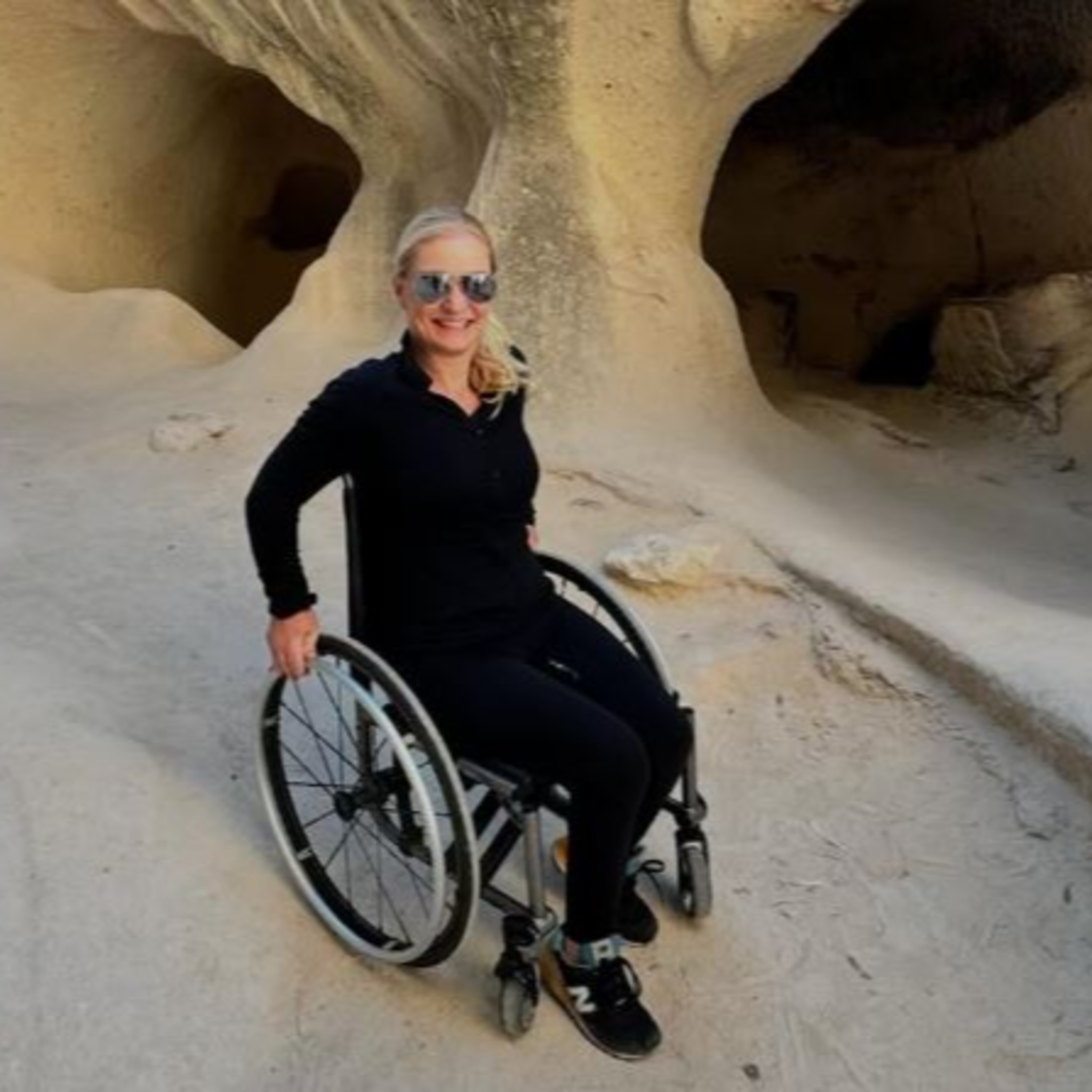
Episode 58: Guinness World Record Wheelchair Traveler Renee Bruns
32m 23s
Renee Bruins, born with a skeletal disorder impacting her lower body, shared her journey on the podcast. She discussed her upbringing in Ohio, where she embraced traveling with her family to medical appointments and later visiting all 50 states. Renee, a Guinness record holder for visiting 66 countries in a year using a wheelchair, highlighted the challenges faced during solo travels, especially in regions with limited accessibility. She expressed gratitude for the kindness of strangers who often assist her during trips. Renee reflected on memorable experiences, such as camping in the desert, and candidly shared moments of frustration due to lack of accessibility. Despite the hurdles, she emphasized the importance of embracing both the highs and lows of traveling with a disability.
Transcription
6748 Words, 35772 Characters
Alright, hey everybody, welcome back to Life After Paralysis.
I'm Tiffany and I'm your host and it's been like three months since we had a show and
Renee is our guest today, Renee Bruins, right?
How do I pronounce your last name?
You got it.
Bruins is correct.
Very cool.
And I just am excited to talk to you.
You're probably the first Guinness record holder we have had on the podcast.
So that's a cool thing.
So there's a lot I want to talk about with you.
But I think anyone that's seen you online has a million questions too.
But I want to start from the beginning because I don't even know too much about you.
And I know you don't have a spinal cord injury, but you have a disability obviously.
So let's go from the beginning and I know your name is Renee, you're from the USA.
But yeah, tell me a little bit about where you grew up, where you're from and your disability.
Yeah.
So I, first of all, thank you for having me.
Super excited to be here and share my story and hopefully empower some people to go live
some adventure in their life.
Yes.
That's my big mission in life.
So I was, I was born in Ohio in a very small town in Ohio.
I'm 41 years old.
So 1984 for all of the, those 80s people out there, when I was born, this was a time in
the world where ultrasounds weren't super common.
So I came out of the womb, no ultrasound, no expectation of any sort of a disability.
And when I came out, I had some deformities in my feet and my legs.
Okay.
So I was born with a condition called autosomal recessive, multiple epiphyseal dysplasia.
Don't even try to remember it.
It's taken me years.
It's so long.
It's so long.
That's right.
Nonetheless, basically different than paralysis, but it impacts my skeletal system.
I have really bad knees and hips.
I can't straighten my legs.
So I often just say, if you want to think of it as though I'm stuck in the seated position,
I can't really straighten my body out.
And so if you think about somebody trying to walk with their knees bent at a 90 degree
angle, it's pretty much impossible.
Yeah, exactly.
So I use a wheelchair, I use the wheelchair for pretty much my whole life, and it's really
all I know.
Can I ask, is there any pain from that situation at all?
Oh yeah, absolutely.
And it's a skeletal disorder, so it impacts my whole skeletal system.
Oh gosh.
A lot of pain in my knees and my hips, and as I'm getting older, I'm seeing it creep into
my lower back, which is scary, and also just, I think, a reality that I'm trying really
hard to just accept, and I think as many of you can probably relate, we have good days
and bad days, and I try to just let the bad days come, and I know they will pass, and
then when the good days come, I grasp onto them, and I'm like, oh, I feel great today.
I'm going to go do something cool.
So that's great.
It's all about attitude.
Well, yeah, we could talk about aging with a disability.
That's a whole other podcast, OMG.
But yeah, I'm so excited to talk to you about, you know, well, you grew up with a disability,
so you kind of, from the get-go, we're using a manual wheelchair everywhere pretty much,
right?
Yep.
Awesome.
And so when you're family, I imagine as a young girl, you went on like family trips,
right?
Oh yes, absolutely.
So, well, first of all, we spent a lot of time, when I was very, very young, traveling
around the country, trying to figure out what was going on with my body, and then trying
to find doctors who could potentially treat me.
Yeah.
So, I'm the oldest of four, so I like to say that my disability has been the silver lining
to a really interesting life, because I started traveling for medical reasons, and then after
that, I was, I think it was around third grade, so maybe 10 years old or so, I was in school
studying the U.S. Geography, and I thought, oh my gosh, there's 50 states?
Like, who knew there were 50 states?
That's so cool!
And I went home and told my mom, I thought this was like the world's biggest impossible
goal, to go visit all 50 states, and not diminishing that it's not, it is a huge goal.
Yeah.
But by the time I was in my early 20s, my entire family and I had visited all 50 states.
No way.
Yeah.
Your whole family loves to do the travel thing, man.
Yes.
I know.
It's so bizarre.
And you know, I'm the oldest came home, but who would have thought a little 10-year-old
girl that's like, I want to go to Utah someday, and their mom makes it happen.
So I am blessed with an amazing family.
That's so great.
Wow.
I'm so jealous.
Man.
So, okay.
So, as a child, were you guys like road tripping?
What was, like, I was going to say, like, your first vacation, but you went on so many,
so there's probably, was there one in particular that stands out as a child that was just like
super, like, I don't know, that kind of changed you at all or anything like that that was
super memorable?
I mean, there's quite a few.
I mean, first of all, as a child, a Disney world pops out, you know, and I remember as
someone with a disability getting to cut in the lines, I think they may have, I, it's
been.
I changed the policy.
It's been a long time.
Yeah.
I think they've changed it.
Yeah.
Yeah.
Which I, I don't know enough about it to speak to it.
Yeah.
It's a whole thing.
I was a little girl.
I got to just go to the front of the line and I felt really special.
That's amazing.
I know I got to just get the line in 2001 at Disneyland too.
And I'm afraid to go back because it's not going to be the same.
That's so funny.
So, okay.
So as you grew up and you said you were traveling and stuff, I know, how do you become someone
like yourself that has the means and the ability to travel?
Because a lot of us have to work full time and do whatever.
How have you managed this life that you have where you're able to travel so much?
This is a common question that I get all the time, probably the number one question, and
it's a complex question because I, I think there are two things.
I work really, really hard and I save everything I can.
I, I don't have a car.
I live in a tiny one bedroom apartment with my, my life partner, my family makes fun of
me because I'm wearing old clothing to a point where like we'll go out to dinner sometime
and they'll be like, would you like to borrow one of my shirts, you know, implying that
what I have on is just a little too old and pattern and I, you know, I, you start to become
very accustomed and comfortable with just, you know, the things you have.
So I'm not a material person.
Things don't bring me a lot of joy.
I recognize that for a lot of people it does and this is not a judgment at all.
I buy your, buy your things, you know, my mom has Amazon packages coming through her
house every day and it makes her happy.
So if that's what it does, great.
But for me, I, I've always chased the experience.
So it's a big part of it is just how I'm spending.
And I think the other piece is I, I went to university.
I was fortunate enough to get an education.
I built an amazing career and again, there's a lot of fortune that comes with that and
a lot of privilege and, you know, I hope I'm not naive to that, but, but your career and
degree and stuff.
I didn't even ask you that.
Yeah.
I have an undergrad in psychology and an MBA master's in business and I spent, I mean,
spent 20 years working in corporate insurance.
Okay.
Okay.
Well, that's, that's a great field to get into because it probably has a very good salary.
Right.
It does.
It does.
It's pretty recession proof.
Most people need insurance, you know, at some point in their life.
So that's, that's a tip for people with disabilities out there.
That's what's your field called?
Corporate insurance.
Property and casualty insurance.
Yeah.
And you know, the great pain.
I will say this.
You know, I worked in it before the pandemic and then during the pandemic and, but I really
loved about the pandemic and I'm sure many people can relate to this.
But I suddenly was sitting behind a computer screen and no one could see my wheelchair
and this like, I didn't even know that I had this, this piece of confidence that was missing.
But I was like, maybe whoever I want, like I'm no longer the disabled employee at the
company and that was really, really cool and a lot of insurance jobs are still remote.
So.
Cool.
Anybody's looking for a job.
Check it out.
So that's amazing.
So, okay.
So you probably, did you get this job in your twenties and then you kind of figured out how
to travel and then work?
Is that kind of what you do?
Yep.
Yep.
You got it.
Nice.
Yeah.
That's so great.
And you know, a lot of times people wish they had more vacation for their jobs, you
know, like you get maybe one or two weeks per year and stuff like that.
And how often are you able to travel now?
So right now I am not working in corporate insurance right now, I'm on sabbatical right
now.
Okay.
But when I was working, I did a lot of traveling while I was working and I, little tricks,
I, instead of being at home with the family on Thanksgiving, I was in Europe or wherever
I wanted to be.
That's amazing.
Wow.
So it's just like in you.
Okay.
So I'm going to get back to my question list because I kind of went off there, but it's
very interesting because I think that, you know, as a person that, you know, is you have
to figure out, you know, balance of life and I think that's really interesting too.
So, okay.
So I know that you have a Guinness record for exactly what now?
It is for number, most number of countries visited in one year using a wheelchair.
In one year.
Yes.
And what's the number?
66.
66.
66 countries in a single year.
Yes.
That's astounding when you think about, you know, there's 12 months in a year and you're
traveling often.
I can't even imagine.
Was it, was that a record that you were trying to reach or did it happen to be a record that
you reached?
Or what was that goal?
So it didn't, I actually wasn't, when I started traveling, I had taken some time off of work
and I was just going to travel, um, post pandemic, just needed a reset on life and I just started
traveling and then as I was going through it, I realized there's not a lot of solo disabled
travelers in the world or at least I couldn't find them online.
It's nerve wracking I think for a lot of people to do it alone and you have to be super brave
because there's a sense of vulnerability, you know.
Absolutely.
Absolutely.
A sense of vulnerability that I don't think most people in the world can truly understand.
So anyway, I was doing a lot of research and I thought like, there's not a lot of people
doing this.
I couldn't find anyone at least.
So I thought, I wonder if I can get a world record and on a whim, just send a message to
Guinness World Records thought, we'll see what they come back with.
And they said, well, you're on this year long trip around the world, you know, taking some
time off work, why don't you just go ahead and see if you can see how many countries
you can get to.
We have to get to at least 40 for us to give you the record.
No way.
Yeah.
I said sure.
So.
You smashed the record.
I did.
I did.
Okay.
I'm not going to ask you to list every country because that's 66 countries, but were you
able to achieve this goal by going to regions where there was a lot of countries nearby
and then you could kind of like hop in and out, that kind of thing?
Yep.
I was very strategic once I found out I was in the running for it.
So I visited most of the Caribbean islands because I could go and I didn't feel like
in the Caribbean that if I wasn't spending a whole week in an island that I wasn't getting
the experience.
Yeah.
So a place like, I don't know, India or China, they're so big, I would feel awful just going
for one day.
But that doesn't count really.
Right.
Exactly.
So I did a bunch of islands in the Caribbean, I did a bunch of islands in the South Pacific
and then there were some places in Europe where you can just easily get around without
having to fly.
So flying solo, you know, I have a friend who's paralyzed and she did a solo trip one
time to Paris and she talks about it and it's very, it was hard for her, but she managed
it, but it was hard.
I know for someone who, are you able to stand at all or do you have to like stay confined
mostly to sitting or are you able to do any stairs or as a, like if it's curious.
If I'm doing stairs or like moving without my wheelchair, I'm usually on my hands and
knees or on my butt kind of driving myself along.
That's crazy.
So when you're solo traveling and you have to ask this people to help you and you have
to like, is there a sense, you just look for hopefully nice individuals to, you know what
I mean?
Yeah.
Yes.
Some of both I have found myself at flights of stairs saying, all right, how am I going
to do this?
And you know, you just kind of wait around and look, I will tell you what I have learned
around the world is that lo and behold, someone will always show up and there's always a
bad egg.
There's always somebody who just kind of bulks and turns their head, but for every bad person
there are 10 good people and they're like willing to help you.
Right?
Yeah.
And then, you know, I try to give them money or, you know, buy them a drink or, you know,
whatever something and they're like, why would you do that?
Like I was just, I was just being a good person and it's so refreshing.
Man.
Right.
What countries do you think have the most helpful people that you've run across?
I think that the most helpful people are in Cambodia, Thailand, Vietnam, that part of
the world.
Have you heard about those people?
Yes.
Right?
Yes.
They're very kind.
What I would say though, kind of the caveat to that is there is very little infrastructure
for someone using a wheelchair.
Okay.
I've contemplated this and I've talked a lot about it publicly, but does a culture that
has a lot of regulation and have all of the ramps and the elevators and the bathrooms
and all the things that we need in a public space, do we lose some of that kindness with
humanity or is it the other way around?
I don't have the answer.
It's just an observation that I feel that in those places in the world where there's
less infrastructure are the people trying to make up for it, not even knowing it.
So it's an interesting thought.
It is.
I think because this is a culture, a history of just helping those who need help and these
cities that have been around for hundreds of years and that's just how the people are.
And I think in advanced cities like United States or Berlin or wherever, you see all
this accessibility and people probably kind of lose that a little bit, don't they?
Yeah.
Yeah.
I don't know.
Nonetheless, they're amazing people.
There's amazing people here in the United States.
Yeah.
That's so awesome.
Have you ever been to one of those accessible resorts in Thailand where they have the beach
wheelchairs and all of that stuff?
I haven't been in Thailand, but I did try a beach wheelchair.
It's been many, many years ago.
It was super cool because, I mean, as you know, you can't really bring a wheelchair into
the sand.
Yeah.
Yeah.
They're hard to find around the world.
I know that they do have them in Thailand as you.
There's like one.
I see them on Instagram once in a while.
Yeah.
I can't remember their name though right now.
I think there's another one in Portugal.
I know that Portugal has an accessible beach where they have paths going around.
Yeah.
I've heard Spain.
Yes.
Spain too.
Yeah.
Spain has a bunch of barrier-free beaches or whatever, right?
Yeah.
Yeah.
And how about, you know, I was also going to say, because a lot of people say Europe
is not very accessible, but Spain seems to be the standout, doesn't it?
Spain and Portugal have done really well.
I would also say the Nordic countries, so up near Norway, Sweden, Denmark, those countries
have done a really nice job also.
The cobblestone, I think, is what makes it inaccessible and, yeah, it's beautiful but
makes it hard.
Oh, man.
I know that the term barrier-free is used like in Japan often to describe like accessible
things, and we don't use barrier-free in the United States that much.
I kind of like the term, right?
Uh-huh.
I think it's interesting.
Have you been to Japan and have you witnessed any of the barrier-free architecture or services
there?
Yeah.
I have been to Japan not too long ago, actually.
It is a very accessible country.
Okay.
The trains are accessible.
There's elevators.
It's a very modern country.
Okay.
I mean, there's some differences compared to the United States, but I would say in general,
it's pretty comparable.
Were you able to go through those tiny little alleyways, though, that everybody wants to
visit those tiny little bars?
I always, that's like one of my favorite areas when I watch travel videos of Tokyo.
Yeah.
It looks very inaccessible.
It is very inaccessible.
I was able to, I was with my partner on that trip, and so he was able to help me.
We navigated through the alleyways, but getting into those little bars, like, I think an average
person is just going to have a hard time, so I observed from the outside.
You did.
Have you ever been piggybacked anywhere just to make things easy and drain your travels?
All the time.
All the time.
All the time.
You know, I used to fight it, too, to say, like, I'm not getting on some strange man's
back.
He's all sweaty and gross.
And now when they offer, I'm like, here I am ready to go.
You're going to help me, then.
I am in.
It's amazing.
If you, if anyone listening here, go to Renee's Instagram.
I honestly don't even know what country to talk to, to talk to you about next because
I, I know you recently, you were at Meritwana, how do you, Meritwana?
Mortanya.
Mortanya.
That is in Africa or where is this located?
It's in Africa, in Northern Africa.
And it's amazing because you were in a tent in the desert, right?
I was.
And it was one of my most favorite experiences, but, you know, one of the things, and I write
about this in my blog more, but on Instagram, you know, like anything, you see the bright
side of it.
You don't see the hard part.
Yeah.
There was, and I share this because I think everyone that's interested in this can relate,
but I was, I was with my sister, so she's very used to my disability.
She grew up with it, you know, with me.
She was helping me, and there was one day where I was just so frustrated with the lack
of accessibility and.
Because they're in sand, right?
That's right.
Yeah.
It's in sand.
Yeah.
And like, I can't go to the bathroom unless she helps me.
I can't get water unless she or somebody else helps me.
And there was one day where I just, I lost it.
I started screaming, I started crying, and it was just like my whole freedom had been taken
away from me.
And it was like, I did this to myself, you know?
So it's like, here I am living this beautiful life and I'm so frustrated, like, I shouldn't
be allowed to be angry and sad when I'm on vacation, but I am, and that happens on every
trip.
I think that's human nature, you know?
Yeah.
Yeah.
How can you not get frustrated?
You see everyone else walking around as easily, easy peeing?
Yeah.
Yes.
So I share that because I think it's important for people to know, like, first of all, let
it out, scream and cry, and you're going to feel a lot better afterwards and shake my
sister just looked at me and said, you know, tomorrow's a new day.
That's really cool that your sister travels with you.
How about the freewheel attachment for manual chairs?
Have you, do you have one?
And would that even have been usable in the desert sand, I wonder?
Probably not in the desert.
I don't, I don't have one.
I have, in the past I have it, but I don't have one currently.
Is it hard to travel with or something like that?
I, you know, I think it's probably, it's probably not super hard to travel with.
I do know a few people who do travel with them and I think it's just, you know, it becomes
a part of the process.
Just traveling with a wheelchair is difficult.
So it looks great though.
It's like a front wheel for anyone listening.
It's a front wheel attachment that can get you over cobblestones easier and certain curb
cuts probably.
And but it's hard to get into stores and you got to take it off, right?
So that's right.
There's that part of it, but it seems really handy for a lot of other travel and wheelchairs
that I've seen online.
So curious.
Are there any other tools or anything gadgets like or things that you bring with you that
are like a must when you travel, because I bet you with your chair breaking or things
that you need or what kind of things do you have to have on you when you travel?
I have definitely spare parts for wheelchair, you know, flat tires, a couple of screws.
I once had a axle break in my front wheel.
You know, so just, you know, you can't obviously bring everything along.
It's to be too much and too heavy, but just a few things.
Have you ever gotten the gel filled tires instead of the air filled ones?
I have not done the gel that is next on my list when this current set wears out, I want
to try those.
Yeah.
I've been using them for 20 years.
Yeah.
I'm in a power chair, but I don't worry about popped wheels anymore, but that's crazy.
So what kind of what wheelchair do you even use?
Like what's your preferred wheelchair style?
I have a Thai light.
Thai light.
Very light.
Yeah, it's very light.
Can you bring it with you in the cabin when you fly or do you have to check it depends
on the airline?
So in the United States, it's a federal regulation that fits in the closet.
You have to.
So I have that law like memorized and I'm probably intimidated to fly with it sometimes.
Right.
Don't fight you on it.
They will.
And I'm, and for no good reason.
So I'm my best advocate on that front, but outside of the country, you get to places
like Europe and they don't have the same regulation.
So it really just, it just depends on the airline, the flight, who you have working, but I can
always to get it in.
So do you run into any like discrimination then at certain airlines while you travel?
I don't know if I would call it discrimination.
What I have learned with the airlines around the world and more so outside of the United
States, and there's a handful of other countries who have good regulation, but I think they
just don't know.
I think it's ignorance and that's easy for me to say right now, cause I'm not in the
middle of it, but that ignorance can be degrading, it can be demeaning, it can be hurtful.
But they just don't know, and they don't often have, have disabled passengers flying.
Right, right.
That's a hard thing to get past, but you just got to just prove to them that you're capable
and I'm a happy traveler just trying to get to the next destination, right?
I think it's interesting.
I think a lot of times you run into different mindsets in other countries too about how
they view disabled people and what they should or shouldn't be doing, right?
Absolutely.
And that's a cultural thing and it's hard, it's really hard to embrace and open your
heart to a culture when you're getting the vibe that they really don't want you there
because of your disability.
So it's, it's, I always, I try and again, moments where I have tears and frustration,
but I try really hard to just take a step back and kind of remove myself from my body
and my situation and just observe.
Okay.
What countries have you encountered this behavior?
Different countries.
It's really kind of a spattering.
Some of the Middle Eastern countries and I have a hard time pinpointing whether it's
because I'm a woman or because I'm disabled.
That's a hard one there.
It's a hard one.
And you know, the reality is it's probably a little bit of both.
Yeah.
I've been to Abu Dhabi.
I have been.
Yes.
Yeah.
Wow.
Yeah.
They have those signs there that say specially determined people.
That's how they have their disability signs.
Have you seen?
Yeah, I have.
I have.
What do you think of that?
It's kind of cool, right?
It's kind of cool.
And it's like, well, if you want me to be determined, I will be determined.
[laughs]
Care for what you wish for.
Okay.
I imagine Dubai's pretty accessible, right?
Because it's so new.
Yeah.
Yeah.
Yeah.
Yeah.
Do you have a favorite place in the Middle East that you would recommend at all to
people who are?
I haven't been to all of the Middle East, but I really like Qatar.
Qatar is also very accessible.
The UAE, obviously, Dubai, Abu Dhabi.
I haven't been to Saudi Arabia yet, but I have heard and read that they are really trying
to build up their accessible travel.
So yeah, they are, I think.
I just saw a job fair for people with disabilities in Saudi Arabia and YouTube the other day.
So I think they're trying to do a lot of outreach to the disabled population in their
country and obviously tourism, but it's, hey, I would go there when it's not hot.
Yeah.
Fair enough.
I'm not sure when that is.
Fair enough.
That's so crazy.
I mean, it's so awesome.
You travel.
Let me see here.
So, okay.
When you fly, have you, do you do anything with your wheelchair where you put signs on
it or like package it in bubble wrap when you do have to check it to make sure nothing
happens to your chair?
I don't, I do not package it in bubble wrap.
It's titanium.
So, and it doesn't have a battery.
I will tell you that.
Do you put any signs on there though to let people know, do not touch your chair or do
you have to, do you feel, have you ever done anything in that nature or do you just give
it to them and hope for the best?
I have in the past put, you know, return to gate, do not touch all of those types of things.
I, I'm trying all different tactics all the time to try to get what I want.
The number one thing I do do, and I recommend this to anybody is to put an air tag onto it
or some sort of a GPS tracker.
That's a good idea.
Yeah.
Because I have had times where they'll say, oh, it's been sent to baggage claim and I can
see that it's right there, you know, underneath the airplane or, you know, that kind of stuff.
So it's your legs, right?
Right.
Yeah.
Okay.
On your legs if they're going to be taken away from me.
A hundred percent.
A hundred percent.
Oh, I know that one thing I hate about flying as a wheelchair user is waiting after everyone
leaves and you're just sitting there, you know, and I just, I just hate that part about flying.
I, I don't know that you can, it's so frustrating because you're right.
You're waiting also, you likely haven't used the restroom while, while you're waiting on
everyone else and it's just, it's frustrating.
I don't know how to get over it.
For me, I, I just, I kind of pout in my seat.
Okay.
I think it's, it's one of the things you got to deal with because flying is still pretty
convenient, right?
Compared to train travel and bus travel.
Fair enough.
I know.
So have, do you ever take trains ever anytime when you're overseas in any, any countries
that have you tried the trains?
I haven't done them in Europe.
It's been many, many years.
Not, how are the accessibility of the trains there?
It depends on the train, depends on the location, but it's difficult.
And there's a window if you don't make it on you and miss out.
Yeah.
It's crazy.
I think there's a lot more accessibility in Europe, but it would be fun to try.
I like the idea of going on a train.
Honestly, it sounds fun, but I've never done it.
So, okay.
So I think, you know, you're, we kind of touched on any resorts, but I was going to say, how
do you make inaccessible locations work?
You know, when you're traveling all these countries, obviously a lot of them aren't
accessible.
You have people, strangers, like we talked about that help you out, but or is there anything
else that you do to make it work?
Do you try to find like, you know, hotel rooms on the first floor?
Like what do you do when you go to these locations to kind of just make it work?
Definitely having a decent hotel or, you know, an accessible one.
So, you know, emailing or calling the hotel ahead of time and explaining what you need.
That is huge because you're going to get worn out.
I mean, emotionally and physically and just having, knowing that you can go to a safe
place that's comfortable is number one key.
I think the other thing, and this is a harder one to eventually come to terms with, I still
grapple with it, but accepting the fact that I'm not going to be able to do the things
that everybody else is.
It's hard.
It's really hard.
You know, you hear their stories and you see their pictures and sometimes I tell my family
or friends, go off without me.
I don't want you to miss out.
That's not fair either.
But I try to do something different than maybe climbing a mountain, for example.
And I might go find a local coffee shop or go to an orphanage or go to a school and something
else.
A church.
Exactly.
And, you know, try to fill my soul with an experience that not a lot of other people
get.
I think that's such good advice.
You know, just because you can't do that doesn't mean you can't find something else
that's just as great.
Right?
Yes.
I know.
And it's going to be sad, but I always try to remind myself too, at least you have breath
in your lungs and you're here on this planet and, you know, you can't be mad about everything.
It's 100% true.
My sister tells me all the time when we're traveling and I get frustrated and she'll
say, you know, be glad you weren't born into a country where you were stuck in your home
or you were killed at birth because you were born or, you know, no, it's it's a good reminder
of the privilege and the lack of privilege that we all have.
So I know that you've been to like seven continents, right?
Yes.
That means you've been to the cold ones, right?
Yes.
Okay.
South is Antarctica, right?
Antarctica.
Yes.
I heard it's hard to get there because it's very planned, baked trips for people because
they don't let people to come there willy-nilly.
Were you able to plan an accessible, did you go on a regular tour?
What kind of tour?
Yeah, I went on a regular tour.
It was very difficult and emotional for me to convince them that I was able to do it.
I was going with my whole family, a lot of legalities and things like that.
Things that I thought were unnecessary, but I was also like, I want to do this out.
I am going to fight through this.
Yeah.
I did.
It was beautiful.
To my point earlier, I wasn't able to do everything.
That's okay.
I mean, I was on a ship floating around Antarctica, like enough there, like that's already super
cool.
So what if I can't go snow trekking up the snow bank, you know, it's just kind of coming
to peace with that.
Were you able to get off at all down there?
I did.
I did.
I had a young man.
His name was John.
He piggybacked me a couple of times.
He was probably 25 in super great shape and he helped me and he was like, you're not going
to miss out on what you can see.
So, you know, that kindness in people.
That's great.
That's cool.
And that's just how you make it work.
Right?
That's right.
That's so cool.
I know that when you go down there, there's a lot of like seals and stuff, right?
Or did you see a lot of wildlife?
We saw a ton of wildlife, a lot of penguins.
Yeah, penguins.
That's what it is.
Yes.
Tons of penguins.
Super cool.
Some seals, a couple whales.
And then they smell weird, right?
You wouldn't imagine the smell.
No.
And then, you know, they waddle like little penguins.
It's so cute.
That's amazing.
You know, God, that's great.
Do you think you will ever go back there or was that a one and done thing?
I'm never going to say never because I just don't know what the future holds, but it
is probably a one and done.
It's expensive.
It's hard to get to.
It's, there's so many places in the world I want to visit.
That's the question I have next for you.
Where do you want to go next?
Yeah.
What's next on your agenda?
Next on my agenda, I'm going to be in the U.S. for quite some time and definitely through
the summer and good weather here.
And then I am heading over to hopefully some places in Africa that I haven't been to yet.
To be determined, I don't have any definite plans, but hopefully in the fall.
Yeah.
Africa can be, I mean, it's crazy big.
There's so many places and some are accessible and some are not, I imagine.
That's correct.
Wow.
Okay.
So any, okay.
Have you been to the Egypt in the pyramids?
I haven't.
There's one that's on my potential for this fall.
Yeah.
Okay.
So we're going to almost be done here.
We got just a couple of minutes left, but I just wanted to ask, so are there any, like
any accessible tour companies at all that you recommend or do you like to do solo?
I don't know for you, some of you, but is there any, any establishments or places you
would say like check out?
The one that comes to mind who has quite a bit of experience is Wheel the World.
Okay.
Wheel the World.com.
They do.
It's all about accessible travel and fantastic organization.
I know some of the folks over there and they're doing amazing things and really fun trips.
So all international stuff too, right?
Yes.
Yes.
They may have some domestic stuff too, but I think their big focus is international.
That's great.
And you know, it's, it's hard to travel to a power chair especially.
So sometimes it's good to hook up with a company like that.
And they, they will help with the power chair.
So, you know, they're not saying it has to be just a manual wheelchair.
They do have a lot of power chair trips.
Did you hear they put an elevator at the Acropolis?
I did not hear that.
I was there.
I, you know what?
No, I didn't know that.
I was there and the elevator was being.
New.
Yeah.
It's kind of new.
I'm like, that's cool, right?
There's, they're trying it all around the world, little by little, right?
It's so cool.
I mean, it sends a real signal to the world that, hey, we can make this happen.
I'm so jealous of you, but I'm, I need to travel.
I haven't gone on any vacation like in three years, right?
And I was just to Las Vegas.
That's it.
I watch people travel online.
So you're inspiring me and I know you're probably inspiring a lot of people who are listening
to this.
Good.
Plan a trip.
You won't regret it.
So if people want to reach out to you, what's like the best way to get in touch with you
if they have any questions about travel?
Yeah.
So my website is renebrans.net.
So, yeah, renebrans.net has all my social medias on it.
It has a contact form and kind of the catch all of everything.
So cool.
Oh my God.
Well, it's been a pleasure to speak with you.
And I can't wait to see where you end up in Africa and I'll just be stalking you silently
on the internet.
Well, go out and get your own trip plan.
Yeah.
And maybe I'll, I'll, I'll pin you for some questions later on because I might have some
myself.
You go for it.
All right.
Well, it's been a wonderful conversation.
It's been so inspiring and I will just hopefully talk to you one day in the future.
Okay.
You got it.
Thank you, Tiffany.
Yeah.
Thank you, Renee.
Have a good day.
Podcast Summary
Key Points:
Renee Bruins, a guest on the podcast, shares her story of living with a skeletal disorder since birth.
Renee holds a Guinness record for visiting 66 countries in one year using a wheelchair.
She discusses the challenges and experiences of traveling with a disability, including the lack of accessibility in some regions.
Summary:
Renee Bruins, born with a skeletal disorder impacting her lower body, shared her journey on the podcast. She discussed her upbringing in Ohio, where she embraced traveling with her family to medical appointments and later visiting all 50 states. Renee, a Guinness record holder for visiting 66 countries in a year using a wheelchair, highlighted the challenges faced during solo travels, especially in regions with limited accessibility.
She expressed gratitude for the kindness of strangers who often assist her during trips. Renee reflected on memorable experiences, such as camping in the desert, and candidly shared moments of frustration due to lack of accessibility. Despite the hurdles, she emphasized the importance of embracing both the highs and lows of traveling with a disability.
FAQs
Renee Bruins has autosomal recessive multiple epiphyseal dysplasia affecting her skeletal system.
Renee Bruins mentions that she can't straighten her legs and often uses a wheelchair for mobility.
Renee Bruins has an undergraduate degree in psychology and a master's in business administration (MBA).
Renee Bruins achieved her Guinness record for the most number of countries visited in one year using a wheelchair by strategically visiting regions with multiple countries nearby.
Renee Bruins found the people in Cambodia, Thailand, and Vietnam to be the most helpful during her travels.
Japan is known for being a very accessible country with features like accessible trains and elevators.
Chat with AI
Loading...
Pro features
Go deeper with this episode
Unlock creator-grade tools that turn any transcript into show notes and subtitle files.
 PodcastTranscript AI