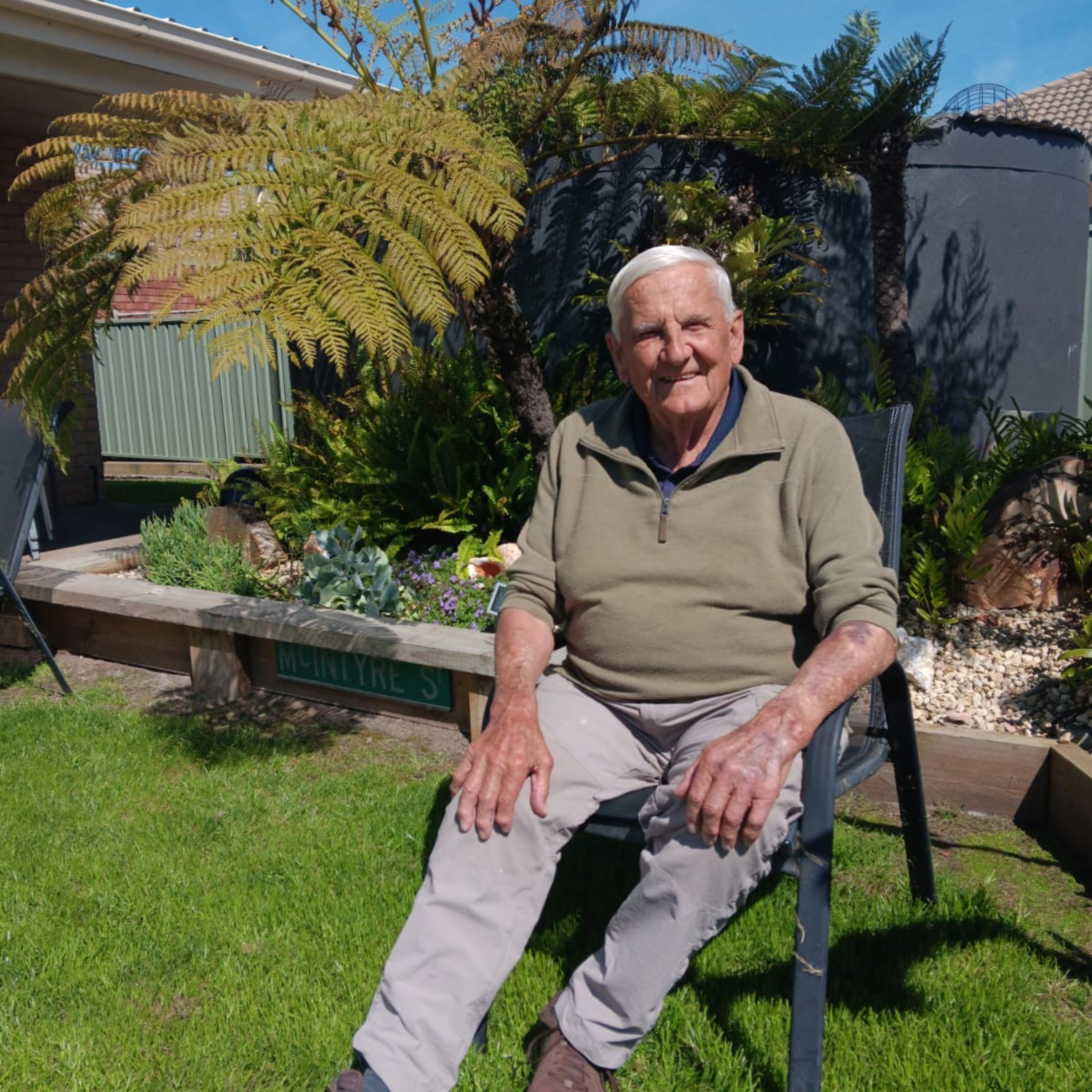
Ian Lewis, affectionately known as "Bozo," shares a deeply rooted life story rooted in Casterton, where he was born, raised, and remained a lifelong resident. From his early days working at the Kinmont sawmill and Davis Brothers tyre factory to his decades-long commitment to the community through the fire brigade and Country Fire Authority, Ian has consistently demonstrated dedication, resilience, and strong local ties. His formative years were shaped by family, cycling, and football, with memorable experiences including winning a cycling race in 1981 and a football premiership in 1968. He met his wife Nancy during a football match in 1965, and together they built a family and a home in Casterton, eventually contributing to local culture through gardening, volunteering, and supporting small businesses. Ian’s passion for sailing, including a harrowing but life-saving incident involving a friend, highlights both his adventurous spirit and responsibility. Over the years, he has remained active in community service, with over 50 years of volunteer work, and continues to appreciate Casterton’s character, calling it a place of deep personal and social significance. His story embodies the values of community, family, and lifelong engagement that define the spirit of the town.
Hello and welcome to Casterton Connections. An initiative of Hands-Up Casterton where a group
of enthusiastic locals have come together to capture, preserve and share stories of people
who have a connection to Casterton.
Welcome to Casterton Connections. I'm Gavin Low and today I have the pleasure of talking
to a lifelong treasure of the Casterton community, Mr Ian Lewis, more affectionately known to
most of us as Bozo. Good morning, Ian. Good morning, Gavin. Thanks very much.
Ian, can we start with the early days when and where were you born? No problem. I was born
in the 15th of June of War Baby in 1942 at Casterton Hospital and the hospital I was born in as
50 murders from my place. Your parents heritage and your siblings, Noel and Wayne? Yeah, well
parents heritage, my father was, first name was Colin. He came from Mount Gambia, the Lewis
as well-known Lewis family in Mount Gambia and with a brother and father Ernest and his mother
was called Maggie in those days, very old name. They worked very hard all their lives and my mother
was a cultural from Pennshurst who back in those days she was the oldest of 14 in the cultural family.
Her name was Ida Grace, absolutely beautiful. She was one of the greatest poems ever.
Yes, I affectionately remember your mum and dad from the swimming pool days when they run the
local swimming pool when it was first opened way back in the 60s. Yeah, certainly was in the early
60s. Yeah, he was the first manager of the pool down there for some unknown reason he took
it on. I could never, ever know why but after we got the first few Saturdays and Sundays,
I found out why in the summertime because I don't think there was any of my friends that were
going to even jump into the pool a little down and run. He was right on him. It was rather an
interesting time. No diving off the high diving board young low. That's right, no jumping.
He did a great job. No running on the wet deck. Exactly. And your brother, Wayne and your sister
Noel, where have they got to their lives? Can you tell me a bit about that? Yes, well I can, Wayne,
he went to cast in the high school, stayed school and casted in the high school and when he turned
15, he joined the Navy at 15 in those days as though you could do that and he joined the officer
school and subsequently became a flight engineer with the Navy when they had an Air Force and that
was a HGMA's NARA in New South Wales back when we had carrier days like the Melbourne. Yeah, Wayne
was tied up with engineering with Wisex helicopters and phantoms later in life with the phantom jets
in there of course. Very clever man and he stayed in that job for around I think 33 years,
retired. I think he was a lieutenant commander when he retired and then he went into the I suppose
you call a diplomatic corps and he became the high commissioner to India for Victorian business
for quite a number of years and lived in Bangalore. Okay, very exciting, the exciting time for Wayne
and now he's of course retired and I think currently at the moment he's on his way back to London
to see his grandchild. And his sister Noel? Noel, Noel's currently 88, a little bit older than me
and she lives in Ballarat. She sold her home in Melbourne and moved to Ballarat where she's got
some friends from the nursing days and she started enjoying the the twilight years of her life
and remonning very healthy at this stage. So early memories of the Lewis family living around at
the end of Gazzard Street. It was here where the active corner of Gazzard Street was a sandy street
it was full of scrub very few houses when we first got there there was no sure server or anything
like that and you could just about go shooting rabbits next door that's what it was like
back in those early days no power just rainwater no fridges.
My dad worked very hard at the sawmill as a as a miller and mum was sort of looking after the
house and which sawmill did your dad work at? He worked at Kinmont sawmill which is at Tip Road.
Oh yeah I'll build Kinmont. I'll build yeah. Yeah it was we used to call him and beg out a
mechanic. That's right yeah you could fix anything give him time. Yeah so by the time those
formative years and going to school where did you start school? I started at Kastan State School
I still remember the numbers 2.0.5.8 was the school and my first teacher was a mislaid
LAID and with a knee on the end for French she was very strict and if you walk past her in the
morning she used to always get me to come in the main hall and I was to look at the clock which was
in you know a Roman numerals I think in those days and she said to me Lewis tell me what the time
is I had no idea how to read a clock I'd still remember it and she'd whack me on the back side
with this wooden ruler right go to your class now and I would go to the class now
she was an institution and I was lucky enough to meet her many years later after her husband
and passed away and she came back here to her back to it was wonderful conversation I had with her.
It would have been the old school then. That was the old school. Big quadrangle in the middle.
That's it. Yeah with the wooden buildings for the junior school and the brick buildings up
the McPherson street end for the the higher grades. Yeah that was that was the elementary
I met from the grade five I think of something too higher elementary which was over that
end of the school and you're a sloidmaster I can't think of his name a little chap with dark
air but he was very very good with the steel ruler he gave you a whack and you knew you had it but
I had a maiden school called Winston Kim who was a bit of a character with one of my Chinese
friends and he he came up with this thing of a rub onion on your arm and if you went to get the cuts
for playing up your arm and swelled up you got two days off school he had it all worked out.
Poor old slooy must have taught him that true. Slooy slooy taught him a lot of tricks.
He was our fruit and vegetables operator in town. That's right yeah.
Your early years in sport and you know once you know you would have got into school you would have
went playing a bit of sport. I was big for you. Start off was bike riding. I went into bike racing
into competitive amateur bike racing. My father taught me to that he in his early years
from about 1936 to 42 he rode for healing cycles in Victoria which most of the reasonably
good riders didn't ride for different manufacturers of bikes. He rode for healing and had quite a
number of trophies to prove that as well. Quite a good rider and it was nothing for him to ride.
He was painting houses at the time. He used to ride a marina with a can of paint on the
handlebars and the brushes and paint a house. Okay so for training what did you do?
Ah well most every weekend I had to do a long ride. I can remember quite often my father would
come and get me out of the Essela Goon when we were swimming with some mates on a 40 degree day
and he'd say right come get on the bike I want you to go over to Nana's at Mirngambia.
Have a cup of tea in a GM sandwich and I'm going to ring her next door neighbor because Nana
didn't have the phone on and make sure you're there and he used to do that and then he
I didn't know he used to and it was all a better for me really. I turned in a bit of a reasonable
sort of a rider. I came home and you know that was the whole day. It was every Sunday almost to
Mirngambia back and it used to do that with the other blink of an eye. Yeah. It was quite
regular at the island park around the existing football arena now where the bike track was
always there. It'd nearly be every Sunday in the season that there'd be a cycling event on there
or training with it there. I can remember when I was a kid. Yeah that's right. It was one of the
fastest tracks around it was White Loomstone.
and it was swept, watered and swept, and it was very, very fast.
I believe it was not a lot faster than a sealed concrete or bitumen track.
And I believe it was even faster than some of the board tracks.
A lot of records broken on that track down there.
And I was lucky enough to win one, I think in 1981, which was a pursuit race.
It was probably the honey, really good one that I ever won,
but no one's ever broken it since.
And I haven't got the figures with me, but it wasn't too bad.
Okay, well, that must have been pretty exciting.
The cycling in cast it in those days.
I do recall my family and the house that we live in belonged to mock ridges
and mock ridges were big bike riders.
That's right.
The Forbeses.
Forbeses, yeah.
I rode with Jack John and Barry Forbeses' dad and both those boys.
And Jack used to say he was a big man, well built.
And if you were learning the race and you wanted him to come up and take a turn in front,
he would say, if I win the race, I'll give you a 10-bob.
I still remember in 1953, I'm still waiting for the 10-bob because I haven't got it.
I later got to about the last kilometer and Jack took off like a rocket and won the race,
but I never got the 10-bob.
Okay, so now in the formative years, you know, your first job.
Where was your first job?
Yeah, great memories.
My father always told me and said to my mother, it's probably a good thing in life
whether it's that if you work hard, be honest as much as you possibly can and work hard,
you'll be rewarded later in life.
I used to work seven days a week and after school when I was 12 years old,
I worked at Goody Harris's or Donald's after school and my job was to feed the horses.
There were two well-known local families that came into town to get their groceries on Thursdays
and come in in the horse and gigs and park them at the back of the tables at the back of the store.
And my job was to feed the horses and brush them down and make sure they were ready to go
when the customers were ready to drive home.
There you are.
That's a different sort of job for a first job for us.
Then I finished up when I left school, Bob Donald said you'd better come and work for me so I went over there and I worked for,
I think five p.m. the week was my first salary, five p.m. I think I've still got it somewhere.
And I've never spent it.
And it was a wonderful job.
I used to bottle the wine in the cellar and lick the labels and put them on
and constantly cart groceries left right and said it was a very busy store.
And I was looked after very well by Bob, a lovely person.
From there, where did you go to work? Do you stay at Donald's?
I stayed there for a while and then I discovered things like motorbikes and so forth.
And I thought I'll need a change in jobs so I went down to Davis Brothers at the time with the local tyre factory,
which is the same building that's there today.
I stayed there for many, many years.
I started off as a salesman, a fitter.
And when I started there, it was around 22 on the staff.
I still remember it, I remember a lot of their names, all great purple, a lot of them gone near days.
I'm one of the very few of the originals that I left.
Yeah, it was wonderful.
So Davis Brothers, were they actually brothers because they had a Haywood store as well, didn't they?
Yeah, they had no one's stores.
They were both brothers, the Ellicon Col.
They were people to work for. They paid you reasonably well for the day.
I was provided with a new vehicle every year, wonderful thing.
I thought I was home and home, Christmas it was, big V8. It was a wonderful thing.
When you were doing the travelling around the farmers and way up north from here towards Eden Hope,
on site, tyre changing and repairing and stuff like that, you must have met a lot of people.
Yeah, I did.
On farms.
Yeah, exactly.
I had quite a large clientele.
It was one of the biggest businesses that was around in those times.
The turnover was immense.
I had a lot of contracts.
When I retired, I had the contract for the Wimra Show at Eden Hope.
I also had the part contract or three-quarters of it at Horsham as well.
I also had a lot of bus contracts.
It kept me going seven days a week at times and particularly in cropping season.
I worked seven days a week.
Yeah.
That was big for the town of Castivan.
That bought a lot of money in the town of Castivan in those days.
It employed, like you said, 22 on the staff at one stage.
There wouldn't be too many employers in town now that would have staff like that.
No, no.
The thing we had down there was we had a factory at the back of the building.
We used to do a retraining there and there were a couple of fellows that were one in particular still around.
He was a retreader.
They'd work out the back there, retreading the ties, etc. back in those days when we recapture them out.
Very popular.
Okay, you'd be there at Normie Lam's day.
Yeah, I was there at Normie and when Normie retired, I became manager there.
Then I stepped back and they bought in another manager, which became Barrie Pirs, of course.
Yes.
It was a generation-wide company and they took over and Pacific Dunlop took it over.
But since then, now it's gone back to privately to another company, which is well known.
Moving on from that about this time in your life, you must have been about the stage of getting married and meeting up with a lovely lady.
Yes, it turns a lot of people to better.
I was playing football at Seinfeld.
I went to Seinfeld early in my football career after I gave up the boat riding.
I wanted something else to do so I went down there playing football and absolutely enjoyed it.
Loved it.
Lovely people at Seinfeld and they still are.
And I've got some good friends there.
And I played there for many years about, I think about 14 or 15 years at Seinfeld and absolutely enjoyed it.
A couple of premierships and some funny, funny times.
Yeah.
So I've got the little bit of an inkling that you met Nancy with something to do with Sanford.
Ah, yes, there was a football match in 1965.
I'm just not sure of the month.
And I got hit by a well known player from Pigeon Ponds, dropped me on the cricket pitch.
So I went up for a mark.
It was strangely enough and he dropped me flat and busted my spline and I finished up in the back of Kate Tomkins' FB hold in the station wagon to hospital because there was no ambulance available.
And the nurse reading me up there was Sister Butterfield from New South Wales.
And there was my lady.
That was the start of a long and lasting relationship.
Fifty-nine years.
So you married Nancy?
You were Nancy married and where were you married here in Castleton?
No, no.
We were married in New South Wales.
Nancy's hometown of Coulombin, which is indigenous for whatever.
And we were married up there by a river and smith was his name in the Presbyterian church.
And while we were away on our honeymoon, our house was completed.
We'd already planned to build a house and I'd bought the block and the buildings had been employed and we had the house three quarters finished.
And when we came back from our honeymoon, we walked in when you heard.
It's beautiful.
I'm very familiar with this because I lived across the road from your place.
And as a child, I recall that being a little red brick house that if I'm not mistaken, the pavits lived in it all wrong.
Pavit and his Steve and went to school with me.
And it was just a tiny little home with a front door in the middle and a window or other side.
It must have been a four-roomed cottage.
Red brick.
Yeah, it was.
It was derelict when I bought the block and I bought it from the estate of Levyx back in those days in 1965.
I think it was about £5,000 in money in those days, which I suppose today is not very much.
but uh. And I sold it to brick by brick to a local farmer for his cattle yards.
It was an evil at the end, removed it, it was rather interesting.
So that was your first home.
When did the kids arrive on the scene?
Oh, well, our first child, Michelle was born two years after we were married.
Michelle, but prior to children, we traveled a lot.
We got around everywhere and we did a lot of sailing in those days.
I was very keen to sail and I think I had a collection of about seven yards all together
over the years.
I think it drove a lot of people crazy but absolutely loved it and so did Nens and the dogs.
But we did all that sort of thing and it was just a wonderful start.
So Michelle was your oldest?
Michelle was the oldest, yeah, Michelle's in the 50s and then one came, another couple
of years later, came Glenn, my son, he was a very tall lad, a big fella and a lovely
young man.
His purpose in life is to always provide for his family and he certainly does that the
best he can.
Okay.
I know Glenn Will.
The England played football at Sanford a long time.
The Glenn's in Mount Gambia, Michelle's in Melbourne.
Michelle's a teacher at Taif in Melbourne and she's got her own painting company.
And one of the few female house painters and office painters and she's going to come
to me and the people work for her.
Okay.
Natalie.
Nat.
Nat.
Where's Nat?
Nat's in Melbourne as well.
Yeah.
She said Chelsea, and Nat calls herself a household engineer.
She does the house cleaning, she's got quite a large clientele of houses that she goes
around cleaning and that's on a weekly basis and she's got a pretty smart who has been
Glenn as a fitter and turner at a factory so he does quite well too.
So as the kids all grew up and left the nest and you and Nancy lived on there till you
lost her in the last 12 or 18 months.
Yep.
Yeah.
So to fill in the time, you volunteered for the local fire brigade for umpteen years.
Yeah.
I wouldn't be going to estimate how long you put into the work before the game.
Yeah, I did.
It was, I think overall 50 years, I want to be in 51 or too much more, but I have a 50
year, some of my decorations are 50 on them, I think, or 52.
I'm not sure, but yeah, I have a number.
But I actually loved it, I started off in the in the brigade as a volunteer like everybody
else.
You always do your bit for your talent, it's important to do that sort of thing.
And then I started off in the ear wing and then went to Grand Ops with Captain Perter
and the rest of the crew, which I absolutely enjoyed my time there, and made some very,
very good friends.
Yeah.
And provided a great service for the community and the area, the fire brigade and cast
into a wonderful job.
Thank you very much.
Yeah.
So, your tournament Sanford playing football, I'm very interested in that being, you know,
an X Sanford footballer myself, and you played in our last premiership in 1968, but you
had already played in premiership there previously.
Yeah, so I had it, that was in 1958, it's going to be enough, and it was wonderful.
I had the pleasure of playing in at least two different leagues back in those days, so
I think it was far south west and south west or something.
We used to play one of our vial and Kononga Tongue of all places.
The Gnogleague.
In the Gnogleague, yes, some funny stories up there, but it was wonderful, good people
to play with, good people to play.
Yeah.
You must have, I know about the time we got to the 1968 Grand Final, and you know, I spoke
to Bruce Elijah, a great mate of yours, a great team mate of yours, and he always speaks
of you very highly on your football career.
You must have met, you know, in the '68 teams, and by that stage, I feel that the competition
was getting a lot stronger, because there was in the Portland Port Ferry League then in
your playing teams around Warnable and Portland, and that, so that was quite an achievement,
'68.
Yeah, it was, the football had changed, it became faster, quicker, you had to be super fit,
and if you missed training, you just didn't get a kick.
I think in the 15 years that I played at the 7th, or had the pleasure of playing down there,
I never missed a game that I was picked in, I always played, it's best I could and always
turned up.
It was a wonderful thing, and played with some real characters.
Yeah.
Would you be there in Brusa Lailie's time?
Oh yes.
So yeah, Brusa was a well-known local legend, the well-known local legend, Brusa was quite
a relaxed sort of a player, quite often, leaning against the goalposts and have a smoke while
the game's coming, it was so funny, and yeah, yeah, lovely fella.
Yeah.
The, you know, some of the great players that come out of Sanford, you know, Denny Harvey,
Rex Harvey, and Bob Marl, the Miles, yeah, you know, yeah, all well-known, I'm a class
two players, Ivan Tompkins, and Denny is probably the best two players I ever saw, Denny
could mark over the top of anybody who was just so clever.
He always, he was a bit, had a bit of an ablut in him, if I may say so, he had the ability
to work out where it was going to be and how he would do it, and he would do it, there's
no doubt about it.
Okay.
Well, you love of boats.
We did touch on this a bit before, we'll regress to that.
You know, we imagined sailing around the Bay of Port on and out further, you probably
had a few trials and tribulations, yeah, we sure did, over the years.
We had some very good boats, and I had one in particular that I always classed as a dog
boat because the thing wouldn't go over a wave, but it goes through it, and it took something
like five of us to sail it, it was an 18 footer, she was a carvel planked, built in Brisbane,
absolutely beautifully built, the Queensland Mahogany boat, and a very heavy steel centre
board, a weighted ton, but it was a bit like China God as some ruin on top of the water,
very, very awkward, and I had on board one day a good off into mine, Terry Baker unfortunately
is passed on, Terry's sitting on the stern in an overcoat, no life jackets on, we didn't
wear them in those days, and we trusted luck, and we came out through the entrance at
Portland heading across the Bay, I think we were trying to head towards Port Ferry for
lunch and then come back, which was a bit of a feat, anyway, I got out about the quarter
of a mile, I looked around and Terry's gone, he's back up, I'm off loading in the water
with an overcoat on, so I had to promptly try and get everybody to work and turn around
and go back and pick him up, we never thought of a thing about it, you know, when he got
in and he shivered, while he's shivering, I said, well, we better call out the emergency
supplies to help out, and I always kept the bottle of green ginger, worn up in the forward
hatch, just in case of accidents at sea, and you'd be surprised how well it revived Terry
on that day.
Well, how did he fall out, well, he was, not enough to sleep, so he said, and he just
slept back over the stern, missed the rail and went straight out the back and I didn't
do no, he's gone, were you the captain, apparently, okay, right, with all your boating and I know
you love that, but after you retired, or really then you retired, you took on a lot of working
for the CFA, our local CFA in different roles, can you just go in a little bit of that for
us for a while?
Yeah, sure.
We're always finding to get money, we're still the same today with the governments that
have been around, they still find it difficult today to raise money for specialised equipment
they need, in particular for road rescue, which you started many years ago here, and it
because. been very successful at it.
And we were helped along the way with other people
in the CFA that had an interest in it.
And I remember working very hard in some Sundays
instead of off-sailing or somewhere
would be out cutting firewood and selling the firewood
and either ranged to a lot of places
where we could cut wood and it was wonderful
that the people donated that for us.
And we raised a lot of money and we're able to buy
and proceed with new equipment,
which we wouldn't have been able to.
- Yeah, well, you served with the CFA for a lot of years.
Yeah, a lot of years, you know,
looking to your retirement years, 50 altogether there.
But I'd spent, and then when I retired from work,
the country fire authority come and knocked on my door
and said I would like to offer you a job in the office
in the Moans Street of Castan.
There's a, still we need a storeperson there, so,
and that was initially one day a week,
that turned out to three, four days a week.
And then they moved out to the new office in Begella Road
where I finished up there.
I was there 20 years and absolutely enjoyed it.
It was wonderful work with four or five girls out there.
We were all very clever and lovely people to work for.
They're really enjoyed it.
- So, in just about the warning up stage,
if you've got any other stories you'd like to share with us
before we close off?
- Oh, well, I don't know.
I don't think so.
- We've covered a fair bit of your life.
- We've covered a fair bit of it.
- I think you've just about covered most of it.
I'm at the stage now where life is very quiet for me.
I still go fishing quite a bit.
I'm fishing back to fishing again.
And I travel up the Murray every year
with some very good friends of mine.
I absolutely enjoyed it.
Down in that for 30 or 40 years, I really enjoyed it.
But I guess sooner or later, I'll be finishing that too.
That's the way it goes.
- Your gardens are credit to you.
Your gardens are always looking perfect condition.
You must put a lot of work into that.
- Yes, thanks.
Yeah, I enjoy the gardening.
I like that just, you know.
- Nice and neat utility.
And in finishing off, we always ask people,
what does the town of Casted and really mean to you?
- Ah, it's fairly important. I've been here all my life.
My wife and I, we traveled a lot.
We did a bit of world traveling in the early days.
But we always come back to this place.
It's just beautiful.
I was born and bred here.
Know everybody as well as I can.
Got some very, very good friends.
And I always try and support the local business
as much as I can.
- Okay, well thanks Ian for spending the time with us today.
We certainly appreciate the effort
you'll put into the township of Casted.
And thanks very much, Ian Moose.
Thanks again.
(soft music)
We hope you've enjoyed today's episode
of one of our homegrown heroes.
Jump over to one of our other episodes
to continue the Casted and Connections journey with us.
Please don't forget to follow our podcast
and share it with your family and friends.
Thank you for listening.
Podcast Summary
Key Points:
Ian Lewis, known affectionately as "Bozo," was born in Casterton in 1942 and grew up in a close-knit family with parents from Mount Gambier and Pennshurst.
He began his early life working at the Kinmont sawmill and later at Davis Brothers, where he spent decades as a salesman and fitter, building strong community ties and earning a reputation for dedication and skill.
Ian was a passionate cyclist, winning a pursuit race in 1981 and participating in local cycling events at the island park, which was a key social and sporting hub in Casterton.
He met his future wife, Nancy, during a football match in 1965 and married her in New South Wales, going on to raise three children—Michelle, Glenn, and Natalie—many of whom have continued to contribute to local communities.
Ian volunteered for the Casterton Fire Brigade for over 50 years, served with the Country Fire Authority for many years, and supported local initiatives such as fundraising through firewood sales to acquire essential equipment.
He remained active in local sports, notably playing football at Seinfeld for over 15 years and winning premierships, and admired legendary players like Denny Harvey and Brusa.
A lifelong sailor, Ian had memorable boating adventures, including a near-tragedy when his friend Terry Baker fell overboard, which led him to emphasize safety awareness and emergency preparedness.
Ian considers Casterton his lifelong home, praising its close community, personal connections, and the enduring role of local pride in his life and legacy.
Summary:
Ian Lewis, affectionately known as "Bozo," shares a deeply rooted life story rooted in Casterton, where he was born, raised, and remained a lifelong resident. From his early days working at the Kinmont sawmill and Davis Brothers tyre factory to his decades-long commitment to the community through the fire brigade and Country Fire Authority, Ian has consistently demonstrated dedication, resilience, and strong local ties. His formative years were shaped by family, cycling, and football, with memorable experiences including winning a cycling race in 1981 and a football premiership in 1968.
He met his wife Nancy during a football match in 1965, and together they built a family and a home in Casterton, eventually contributing to local culture through gardening, volunteering, and supporting small businesses. Ian’s passion for sailing, including a harrowing but life-saving incident involving a friend, highlights both his adventurous spirit and responsibility. Over the years, he has remained active in community service, with over 50 years of volunteer work, and continues to appreciate Casterton’s character, calling it a place of deep personal and social significance.
His story embodies the values of community, family, and lifelong engagement that define the spirit of the town.
FAQs
Ian Lewis was born on June 15, 1942, at Casterton Hospital.
Ian Lewis's father was named Colin Lewis, and he came from Mount Gambia.
Ian Lewis's mother was named Ida Grace, originally from Pennshurst, and she was the oldest of 14 siblings in her family.
Ian began with bike riding and competitive amateur cycling, often training on a track near the football arena in Casterton.
His first job was at Goody Harris's, where he was responsible for feeding and brushing horses.
Ian worked at Davis Brothers for many years, starting as a salesman and fitter, and later became manager after Normie Lam retired.
Chat with AI
Loading...
Pro features
Go deeper with this episode
Unlock creator-grade tools that turn any transcript into show notes and subtitle files.
 PodcastTranscript AI