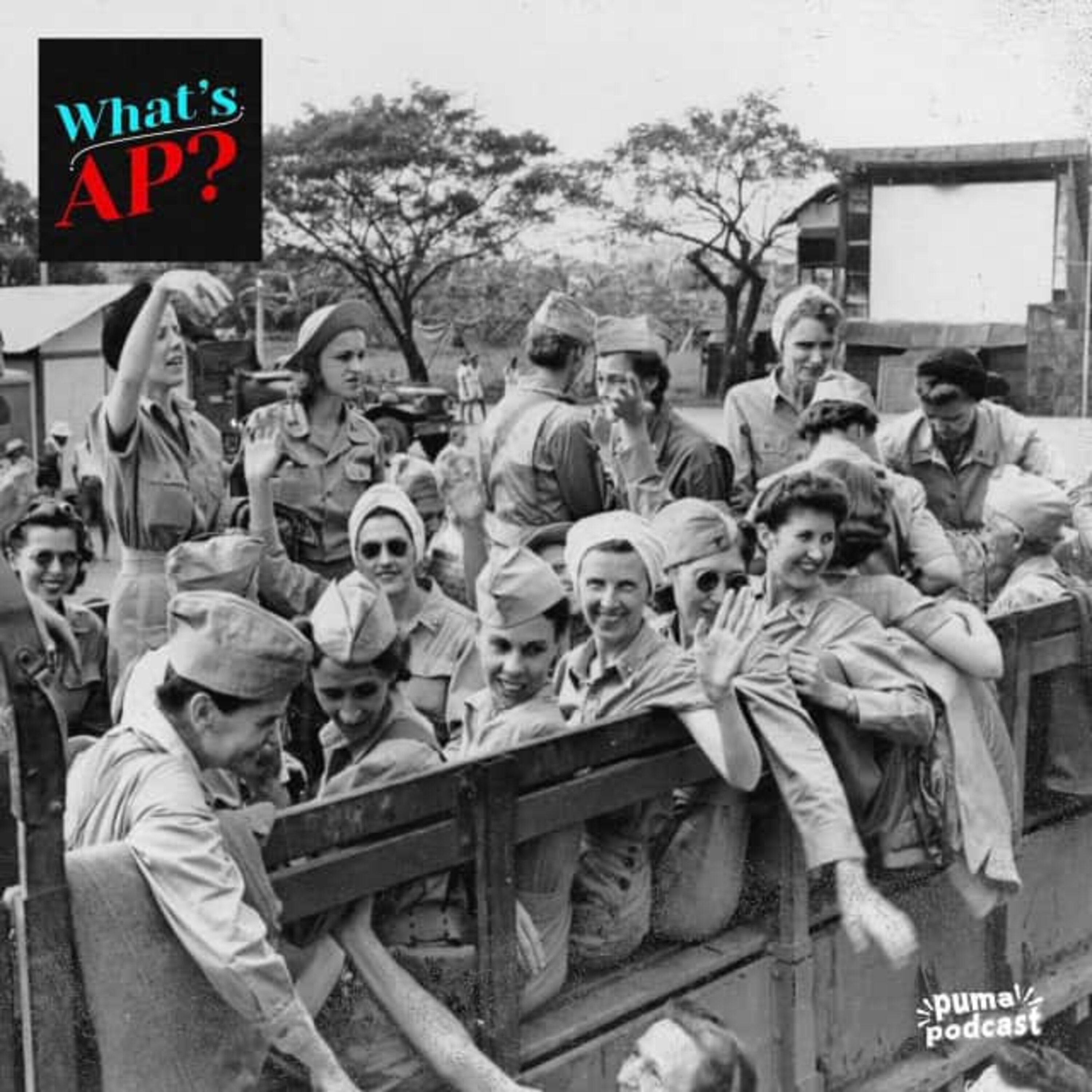
The episode pays tribute to front-line nurses during the COVID-19 pandemic and delves into the heroic acts of nurses during World War II. It sheds light on the forgotten stories of the "Angels of Bataan," 77 American women nurses abandoned in the Philippines. These nurses faced extreme challenges, from setting up field hospitals in the line of fire to enduring deprivation in Japanese prison camps. Personal stories of these nurses, their sacrifices, and resilience are shared, emphasizing their human qualities and extraordinary actions. The role of nurses in wars and epidemics is highlighted, stressing the importance of acknowledging their significant contributions to society. The episode concludes by sharing a personal anecdote about a grandmother's involvement in the resistance during the war, underlining the idea that heroism can be found in everyday people. Through these narratives, the episode aims to honor the bravery and fortitude of nurses and inspire appreciation for their vital role in history.
Transcription
3575 Words, 20370 Characters
Before we begin, this episode about heroic front-line nurses was recorded before the lockdown of Luzon.
In light of recent events, we dedicate this episode to all front-liners protecting us from COVID-19.
We will greet you on the day of the pandemic.
When we think about World War II, we think about soldiers.
You might think about valued heroes and tragic battles and General McArthur.
I shall return.
Yeah. When we hear about war, media and propaganda makes it look appealing.
There are all these stories of glory winning battles and taking cities.
But we don't hear a lot about the casualties, the payment for this glory, the gore.
That gets shoved in the back.
Propaganda has no use for gore because it shows the ugly reality of war.
And if you see what really happens in a war, you know there isn't any glory.
It's all tragedy on both sides.
But there are some moments of heroism and goodness amidst the atrocities.
And many of these come from people who are relegated to the background of war stories, the nurses.
Yep, and we're going to go ahead and prove to you that nurses might be the most badass people of all time.
Especially the 77 American women who were abandoned in the Philippines by the U.S. armed forces
and left to surrender to the Japanese in World War II.
I'm Siji Shantango, History Nerd.
And I'm Sab Shnabel, a historian and a comedian who has worked for Carla Seldran,
the National Museum of the Philippines and the Guggenheim in Venice.
Today, we want to talk about the unsung heroes of our front lines, our nurses.
These women have been lost to history, their names have been forgotten, and that's a dang shame.
So we're going to do something about it.
Today on What's App, we're talking about the angels of Bataan.
As always, we're going to start with Pearl of the Orientation.
We wanted to talk a little bit about what this corner of the world looked like before World War II.
The early 20th century was a period of transition and growth for Southeast Asia.
The turn of the century saw a massive shakeup in the world's powers.
Evolts were popping up all over Vietnam, Burma, and of course the Philippines.
The West was also grappling with sudden economic freefall,
not just because of World War I, but because of decolonization and self-determination.
The U.S. was struggling with the Great Depression and isolationism was on the rise.
The 1930s was a period of great instability because these older powers started to topple
and they left behind chaos, and that means the new empires could muscle their way into the power vacuum.
Like the Japanese Empire, but we'll get to that later.
The Philippines in the American period was a pretty baller place to be, all things considered.
The U.S. set up public school systems and sanitations.
All the nurses were going to talk about thought of the Philippines as a place to find adventure and
romance. It was the jewel in the crown of the U.S. Empire, all controlled from Manila.
The Paris of the East.
The Manila of the early 20th century was where we got the title of Pearl of the Orient.
Carla Seldron used to describe the Manila of this period as the perfect melting pot of cultures,
the decompression chamber between the East and the West. 1930s Manila had exotic Indian
bazaars, Chinese porcelain, gemstones from Indochina, German trams, yes, trams, and American jazz.
You could grab an ice cold, gin and chronic and a club sandwich at the Manila Hotel before
catching a Pan Am clipper back to California. Remember in Indiana Jones where they show
the travel between cities? Well, in Temple of Doom, Indy has to go through Manila to get to India.
Manila was a glittering art deco city by the Bay. It had graceful mansions, wide avenues,
and some of the best urban planning in the world. Malata and the older districts of Manila were
designed by Daniel Burnham. He also designed Chicago, Washington DC, and Baguio. And that's
where Burnham Park gets its name. But unfortunately, that glorious city had an expiration date.
And that date was December 8, 1941. You might recognize that date as a day after the Japanese
attack Pearl Harbor. America was in the war and so were we. A war that would change the face of
the Philippines forever. What's up would like to acknowledge another female badass in this story,
Elizabeth Norman. Norman is a full-time nurse with two kids and somehow managed to find the spare
time to write the book on the nurses that we're going to be talking about today. She interviewed
them. She met about 20 of them to get their stories. The book is called We Band of Angels,
and it's the definitive work on this subject. It was Norman who really began compiling and sharing
these stories, so we only hope to continue that work. Norman came to the Philippines to study
these women and ensure we know their names. But before we talk about them, we need to talk about
their struggle. Before that fateful December day, being stationed in the Philippines was a pretty
sweet gig. The nurses who came out here were not the battle-hardened veterans already in
train for a war that you might expect. They were wide-eyed and inexperienced and all in all just
excited to be in a new part of the world. And they got to have about five weeks in the glittering
city of Manila before the bombs fell on Pearl Harbor in Hawaii and it was all over. We've been
saying Pearl Harbor a lot and then mentioning December 8. Now any grade school history student
knows that the bombs dropped on Pearl Harbor December 7. Didn't that mean we had a whole day
to prepare? Not really. We're not taking into account two things. One, we're on the other side
of the international date line so it was already December 8 for us when the bombs dropped in Hawaii.
And more importantly, number two, the U.S. was very overconfident. They did not think the Japanese
would stage an attack. We had very little time to properly prepare for the Japanese. In fact,
two men at Clark Field, Leon Long and his colleague George, were returning to work from lunch after
hearing about the attack when they saw planes fly overhead. They thought those planes were theirs.
Leon recounted in a piece for the Fort Worth Star Telegram. George said, "Hey look, it's nice to see
that the Navy is out protecting us. About that time, the earth began to erupt at the end of the runway."
What a way to find out the enemy has arrived. It didn't help that the Philippines was considered
something of a luxury posting. Pictures of the nurses show them in sunsuits, the sun dresses of
the 1940s. In the book "Pure Grit" by Mary Farrell, Farrell describes what nurses' lives were like
before the war began through the eyes of Ethel Thor, one of the nurses who arrived. The pictures she
paints is that of a tranquil island paradise far removed from the war in Europe. Their duties were
light and their accommodations were described as resort-like. Lieutenant Colonel Madge Ullaman
in an interview with Michigan State University describes Manila as a choice assignment. And
then the Japanese attacked. Manila had to be declared an open city. The U.S. armed forces retreated to Bataan.
It was there that the nurses had to set up a field hospital. They thought they would at
least have facilities, but they didn't even have that. In an interview with C-SPAN,
Elizabeth Norman details what it was like. There was no physical hospital. There were no buildings
to put patients in. Their latrine was just a hole in the ground. They didn't have clean laundry.
They had to eat cavalry horses and shoot monkeys. Supplies were limited and anesthesia ran out.
They resorted to treating people with ether, which is what we used before modern anesthesia.
So we regressed back to civil war technology. Their position was also precarious. They were
right in the line of fire and there were often dogfights overhead. When the Japanese inevitably
came after them, the nurses had to be evacuated to Corregidoro. They were given 10 minutes notice,
like grab a shirt. We have to go now. And even a half of a century later,
every nurse interviewed wept about having to leave their patients. They would have rather
stayed in the jungle with them than retreat to safety. I can't even comprehend the kind of
nerve you need to be able to do that. Yep, and we're only at the beginning of the story. They
were brought to Malenta Tunnel, where they had to work in cramped, dark spaces dealing with paranoia
and uncertainty. And when Corregidoro fell, they were at the mercy of the Japanese. So you know
how MacArthur is so famous for his "I shall return." Yeah, to return, you would have to leave to begin
with. And MacArthur and the U.S. military machine left behind 77 nurses, still the biggest group
of female prisoners of war in U.S. history. So what happens next? Well, Santo Tomas interment
camp, of course, more after the break. So the Japanese come thundering in,
all ready to trounce the Americans, and suddenly there are a whole bunch of women? What?
The Japanese military at the time did not allow women to be at war,
so the presence of these nurses utterly flabbergasted them. Thankfully, because they
didn't really know what to do with them, they just let them keep working.
In a way, they were saved by the Japanese decision to put them in these civilian prison camps,
because they were leaps and bounds better than the utter depravity of the military
camps in Cabanatuan and Belibid. Santo Tomas was a camp of enemy aliens,
so foreigners who were living in the Philippines at the time were rounded up and imprisoned.
The Japanese put 6,000 people in that camp. Again, there were 77 nurses for 6,000 people.
For a while, life was settled, if not great. The Manila resistance would smuggle in supplies and
food and money, and our heroines did the best they could. They weren't mistreated because they
were considered valuable, but improper bowing was an offense, so it's not like the Japanese were
friendly or anything. A woman named Faye Bailey wrote a daily log of her activities in the camp.
It was so overcrowded that she and her family were given a pass to set up their own little
shanty house. She paints a picture of a community struggling as hard as they could to keep up some
sense of normalcy. At first, prisoners were allowed to print pre-auticals, play music at night,
but as the war dragged on, conditions got worse and worse, and their captors also got
worse and worse as US forces turned the tide of the war. As the Japanese began struggling themselves,
the prisoners' food rations dwindled and dwindled until everybody was surviving on less than a
thousand calories a day. Santa Tomas was liberated in 1945 when a tank plowed through the gate,
and an American GI popped out to say, "Howdy folks!" So that's the story, but we'd like to take some
time to talk about the personal stories because it's a dang shame we don't know these women's names.
Like Major Maude C. Davison, who insisted that these scared, inexperienced women keep up their
purpose as nurses. Her leadership was credited as the reason they made it through, and she was
awarded the Distinguished Service Medal on August 20, 2001. She kept them going even as their
captors cut their rations to 700 calories a day. Lieutenant Mildred Dalton Manning said,
"I have always known that if I could survive that, I could survive anything." Lieutenant Colonel
Madeleine Olam describes the experience to give you an idea. The people were dying, and we were
having to keep their bodies in the hospital. There were loads and loads of rats. Some of them
were footlong. Some of them were even bigger, and that's not counting the tales. Lieutenant Laura M.
Cobb was a Navy nurse who served as chief to 12 Navy nurses in the Los Baños prison camp.
She was a World War I vet and served in Guam during the interwar period.
First Lieutenant Josephine Josie Nesbitt, known as Mother Joe by her nurses, requested permission
to remain in Bataan with her patients. She was denied. Once in Corridor, she was offered a place
in the submarine sent to take U.S. troops to Australia. She denied them, saying her skills
were needed in the Philippines. Two other nurses were also offered that space, and Miller and Ann
Works. They also refused because they wanted to stay and take care of their patients.
Nurse Beatrice Chambers recounted a time at Santa Tomas when she was in line for the bathroom.
She decided to come back another time, and as soon as she walked away, a bomb obliterated
the line and the bathroom. Nurse Mary Bernice Brown entered Santa Tomas internment camp weighing
a hundred and thirty pounds. She left it weighing seventy-five pounds. Nurse Rita Palmer survived
the entire ordeal, went home and then refused to be honored by the Philippines because of her
stance against Ferdinand Marcos and Marshall Law. Ma queen! We are acknowledging the names of all
of the women who have been coded in various articles. But really, to hear their stories,
we recommend reading "We Band of Angels" by Elizabeth Norman. She interviews twenty of these
nurses over a number of years. She really got to know them and hear their stories. Their names
are also listed on a memorial of the Battle of Bataan. They are altogether called the Angels of
Bataan. The term angel is common for a nurse. Nurses are often called Angels of the Battlefield.
Clara Barton, the woman who started the American Red Cross, was called the Angel of Antietam because
of her care for the soldiers at the front line. But here's the thing. Although the nurses enjoy
the nicknames and honors given to them, the term angels makes them seem otherworldly.
Elizabeth Norman would like to remind us that they are not goddesses. Nurses are not supernatural.
They are human. They do things just as well or as badly as anyone else. And we are doing anyone a
favor by putting them on a pedestal. In fact, the women thought it was the soldiers who were the
true heroes and saw themselves as just doing their jobs. I think the takeaway here is that anyone
can be a hero. Sometimes the world gives you extraordinary circumstances, not because you're
some chosen one or a superhuman. Sometimes shit just hits the fan and all you can do is react.
And these women reacted with bravery and fortitude against impossible odds.
It wasn't some divine right that made them special. Their determination,
their sacrifice and their resilience did that. It was their qualities and actions that made them great.
And we're just honored to be able to tell their stories.
Nurses are at the front of most wars. They keep morale up, they tend to injuries. Many of them
did more for the soldiers than any doctor by sitting with them and holding their hand.
Bear in mind bombs are going off around them and the injuries they're seen to
are not just horrific, they're traumatizing. And these women had very few resources.
There were 60,000 people in the American nurse corps during World War II. All of them were women.
They were shot at, bombed out, taken prisoner. And remember, they were not armed. They couldn't
defend themselves. Some were recognized, like Lieutenant Annie Fox, who was awarded a purple
heart for her. Fine example of calmness, courage and leadership, which was a great
benefit to the morale of all she came in contact with. For her work in Pearl Harbor.
And some were not, namely the angels of Bataan. The nurses were left behind by the Americans
and were taken as prisoners of war. They were the largest group of female POWs in the history
of the United States. And we barely know their names. Back home in the U.S., Hollywood romanticized
the nurse's situation in patriotic movies such as "So Proudly We Hail" starring Claudette Colbert.
Which is basically Captain America punching the Nazis in Captain America, the first Avenger,
but like the nurse version. The reality was different. Nurse Helen Cassiani Nester said
in a 1999 interview with Associated Press, "Let me tell you, there was nothing romantic about it."
Our group proved women could go into the field and carry on and do a good job. People need to know that.
We couldn't agree more, Ms. Nester. We are doing the best we can.
Even today, nurses are at the front lines of not just our wars against each other,
but also our wars against epidemics and disease.
With all the fears and global panic surrounding COVID-19, we need nurses more than ever.
And we need to start acknowledging how big their contribution to our society is.
So your homework today is to go hug a nurse because they deserve it.
Or maybe just wave because it's flu season.
Also please wash your hands. Everybody wash your hands.
This being Philippine history, which is so wild and weird and wonderful,
we tried to end each episode with something cool we found about the story.
And this time, I wanted to share something extra special and personal.
When it comes to history, women tend to get shunted to the side.
On one hand, it really sucks. But on the other hand,
that makes us really great spies and resistance fighters.
Because who's going to suspect a little old woman?
She can barely lift a finger, let alone run in those heels.
We complain about it, but many of the spy heroes of World War II were women.
And one of my personal heroes was one of them.
Her name is Yolanda De Assis. She's my grandmother.
Soplola!
Sam's grandma should really have her own show.
She's 97 and she still tries to take the bus to Divisoria.
Like, I don't even go to Divisoria.
Soplola's cooler than you.
Oh my god, she's so much cooler than me.
So anyway, one night at the dinner table, I asked her about the war.
I was not disappointed.
Back in 1943, she was a Portuguese girl in occupied Manila.
Her Portuguese citizenship meant that she had a little more access to rations and food
and information as Portugal was a neutral state in the war.
And let me tell you, Yolanda De Assis is not the kind of woman
who can sit still if she can do more to help other people.
Through the Catholic network,
she was recruited to smuggle messages into Santa Tomas Prison Camp.
She was 19.
19! Can you believe that?
What are you doing at 19, Sam?
Oh god, I was drinking, I think.
I was in college.
I was utterly useless.
But I was a pretty good baker.
I'm still a pretty good baker.
And my grandma is a really good baker too.
In fact, her job was to bake little pieces of paper with headlines and news into Pundisal
and then hand them over to the prisoners.
Her handler would call at the predetermined time.
If the phone rang once, all clear.
Go ahead to Santa Tomas.
If the phone rang twice, stay home.
Danger.
Did she meet any of the angels of Bataan?
I don't think so.
That wasn't really cool though.
But like, she wasn't too too high up in the resistance.
I just know that that's the one part that she was given.
Well, just goes to show you.
You might have a hero of your own in your own family.
So ask your lolas, ask your lolas,
ask your titas and your titos.
Because history isn't something big and nebulous that we just read about.
It's a story of something that happened.
And World War II happened to all of our families.
It changed the world.
But it didn't change how we look at history.
Only we can do that by asking our elders what happened.
What was it like?
What were your experience like?
You might just stumble across your own heroic lola or lolo.
Until then, we can all just share Sab's Lola Yoli.
Until next time, I'm Sab Schnabel, granddaughter of Yoli de Assis.
And I'm Siege Tantenko.
Gusta kong magpampon kay Lola Yoli.
Class dismissed.
We've got more episodes coming your way.
Subscribe to WhatsApp at a link panlipunan rebooted on Spotify,
Anchor, Apple Podcasts, Stitcher or wherever you listen.
Join the discussion and check out our favorite history memes.
Follow us on Twitter @historyrebooted on facebook.com/historyrebooted
and on Instagram @history.rebooted.
I'm on social media @SiegeTheDay.
And I'm @SabSchnabel on Twitter.
That's S-C-H-N-A-B-E-L.
My last name has been a problem throughout my high school life.
This episode of WhatsApp, Arlene Panlipunan rebooted,
was produced by Josa Quinones and edited by Nina Torralba of Puma Podcast.
Podcast Summary
Key Points:
The episode is dedicated to front-line nurses amid COVID-1
Discussion on heroic acts and sacrifices of nurses during World War II.
Personal stories of nurses showcasing bravery and resilience.
Acknowledgment of the essential role of nurses in wars and epidemics.
Highlight of the unsung heroes, the "Angels of Bataan," left behind in the Philippines.
Summary:
The episode pays tribute to front-line nurses during the COVID-19 pandemic and delves into the heroic acts of nurses during World War II. It sheds light on the forgotten stories of the "Angels of Bataan," 77 American women nurses abandoned in the Philippines. These nurses faced extreme challenges, from setting up field hospitals in the line of fire to enduring deprivation in Japanese prison camps.
Personal stories of these nurses, their sacrifices, and resilience are shared, emphasizing their human qualities and extraordinary actions. The role of nurses in wars and epidemics is highlighted, stressing the importance of acknowledging their significant contributions to society. The episode concludes by sharing a personal anecdote about a grandmother's involvement in the resistance during the war, underlining the idea that heroism can be found in everyday people.
Through these narratives, the episode aims to honor the bravery and fortitude of nurses and inspire appreciation for their vital role in history.
FAQs
The nurses were known as the Angels of Bataan.
Elizabeth Norman interviewed 20 nurses and wrote the book 'We Band of Angels' to share their stories.
The nurses had to work in harsh conditions with limited supplies, resorting to using ether for anesthesia.
The nurses were considered valuable and were not mistreated, but improper bowing was an offense.
The nurses showed bravery and resilience in the face of impossible odds, providing care and comfort to soldiers in war.
Nurses played a crucial role in wars by providing care, comfort, and support to soldiers, often with limited resources.
Chat with AI
Loading...
Pro features
Go deeper with this episode
Unlock creator-grade tools that turn any transcript into show notes and subtitle files.
 PodcastTranscript AI