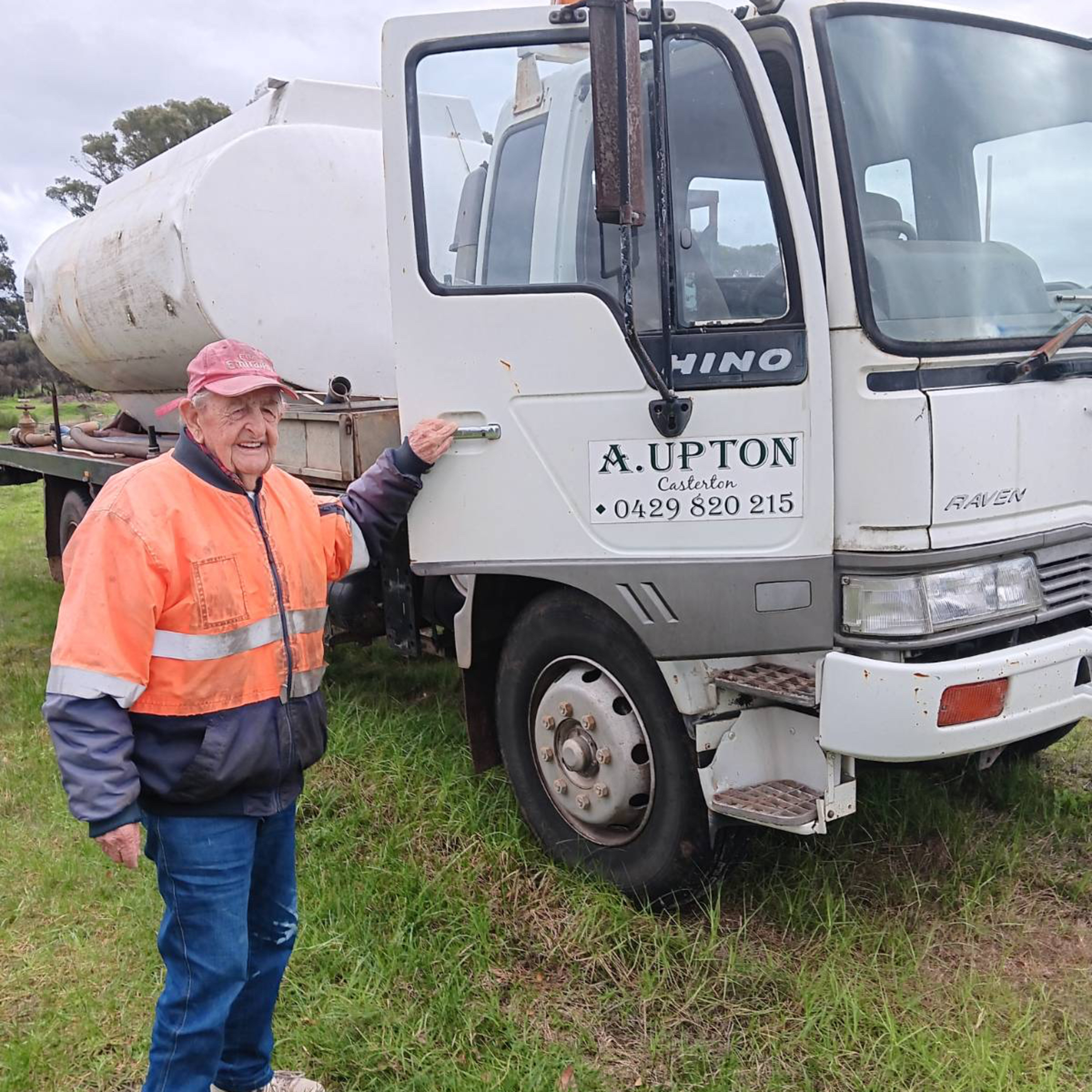
Alan "Pod" Upton, born in Castedon in 1938, is a cherished local figure whose nickname came from his father's childhood. He moved to Wanda Vile at age 11 and began working early, driving tractors at 10 and later becoming a skilled fencer. His fencing career included major contracts, such as at Myerin and for John Walde at Coulomb it, where he worked until retiring in 1995 due to arthritis. Alongside fencing, he carted hay and water, a business he continues today at age 88. In 2001, he ran a takeaway shop in Castedon, providing meals and bus tickets while maintaining his water carting. Alan was an active sportsman, playing cricket for Wanda Vile until 68 and football for Sanford and Wanda Vile. His lifelong commitment to the Castedon Racing Club began as a child helping his grandmother cater, and he has attended every cup since 1946. For his dedication, he received a Racing Victoria award for services to country racing. Alan's diverse work and community involvement reflect a life of hard work and deep local connections.
[Music] Hello and welcome to Casted & Connections. An initiative of Hands Up Casted & where a group of enthusiastic locals have come together to capture, preserve and share stories of people who have a connection to Casted & Connections. [Music] In the latest episode of Casted & Connections, I'm meeting you this morning with Alan Francis Upton, local identity and better known affectionately to most in the community as Pod. First of all, Alan, where did the name come from? It came from my father. He learned his name as Pod when he was about three and a half. When they were there he would just go when the cows were in the bil, he'd just go up and squirt the milk straight from the cows' teeth straight into each mouth. They named him Pod after a potty calf. Okay, well that solves that problem. First of all, where were you born, Alan? I was born in Casted & Hospital on the 28th of 1938. So that makes you this year you'll be 88? Correct. Okay, so your parents and family? My parents, mum was Agampa. She was Catholic. Kathleen, they called her a Catholic Ampa. That was Euridgene Upton from Wanderbale and he did not like that Euridgene part one bit. So he stuck with the Pod business. Okay, were you the only child? Yes. Okay, of the family. So where was home for you? Home, for that stage was Colerone Road, Casted & my grandfather had a butcher shop where Reddens Field Depot is now. He had a butcher shop there. My grandmother was a cageer and I was the runner-back boy. So your mum being a gunthus, she would have been Pat Gunther's sister? That's correct. Where were they born? Were they casted in people? The gunthus were all born out of Mauree, a fairly large family. Two of them, Roger and Yui, they took off when they were about 18 and joined the police force in Melbourne and both went to very high-ranking offices. Billy and Ernie were two other brothers. They bought the Chippewen store in 1884 for £480. But they got 10 acres with the Chippewen store and they held that for 48 years. Okay, so your early years of schooling, where was that? Sacred Heart. So you were still living in Casted & my? I never moved to Wanda Viol until my 1950. Okay, so your school, how long were you at school? Well, I started at four and a half and I was educated to what we call grade 8 by the time I was 13 but I couldn't leave. I had to stay another year, had to be 14 before you could leave. But mum picked up plurse and I missed the last term. When I was 13 so I'd do it all again the next year. Okay, so in those early days, can you remember people, local people, it would have been your friends? Oh, I had had something. I've always said I had a great time from the time I was about three till four and a half. I seem to learn a lot of things because I would be with my auntie, Neil Gumpa, who married Lail MacAury and she would be delivering meat to Santa for various places and I'd be with her. And I seem to learn a lot in that 18 months. Okay, so your association with Wanda Viol, so you must have moved to Wanda Viol at some stage in May 1950. So did your parents buy some land out there? No, no. One of the dad's brothers had bought another block, another house, a couple of caves up the road and he said to the grandfather, he said, "I bought Dunstons." That was the name of the property. The grandfather said, "And what are you going to do? I seem going to rent it out." Grandfather says, "No, this is grandfather up there." He said, "You're living it, and Pod Cate Nellon can come and live in the farm." So that's how I finished up at Wanda Viol. Okay, so at that stage moving to Wanda Viol you were around about 14 then? 11. Okay, so those years you were still going to school? Yeah, I was still when you were at Wanda Viol. Yeah, so as I was passed the Wanda Viol sixth grade. So I had to stay and finish my education at the conference. Okay, so you come into the conference to school? Yeah, well I stayed with my grandparents. Yeah, so from your schooling days how old were you when you started work? Well, officially I suppose, 14. Building a set of stockyards for dad's brother. But when I was 10 I was driving the tractor to when they were carton in Stu Te, tow on a trailer. I was learning that way and I had to learn quick. Okay, yeah, 10 years old, tractor driving, tow on a trailer that was a fair old effort. So then after that you told me you got into the rouse to batting? Yeah, I went into the shed work then. I branched out at Dad and Myself. They were infencing and in 1968 I won a contract down at Myerin for Saffer as it was called then. South Staidon, perpetual forest. And it was 17.5 Ks and that really set me up for more. Yeah, continuous work. Okay, so at that age you told me you were regularly driving around. I was driving around at 15 and down. Yeah, the, well there's the wastes by scene amongst there where that night will make a bridge for George Mar. Okay, up behind the show grounds. I do remember that. It was George Mar. Yeah, where the old plaster factory was. Yeah, it was, would have been more uncle. Yeah. And I can remember him making the concrete bricks out on the sun dried. On the big sligh. Yeah, a lot of your fencing in the early days when you were getting starting. I assume you're done a bit for Kevin Upton, the late Kevin Upton. I probably fenced all the one the way up properly. Probably there wouldn't be a fence there I didn't put up. Okay, so that would have been a bit of a big contract for a young fencer. every
Yeah, you did probably, or maybe a mile, fence down at the marina property. So those fencing those days, not like it is today, you'd be running barbed wire and split posts. Yeah, it was proper fencing. So did you do the, well, you wouldn't have a hydraulic post driver? Well, we did finish up getting a post holde, and put it beyond the foggy, but by the hill she used to be tough going. Proviled to that, would you hand-deag holes for posts? Yeah, crowbar and shovel. Oh, that'll be a bit of work. Yeah, that was the first job I got when I went home from school. Okay, so from the array of jobs that you had, you started about this time when you were going in the fencing contracting to water carving. How did that get started? Oh, well, pretty simple. I was sitting on a seat down where Newtry and he is now. Charlie Anderson's garage was there beside the old theatre. And Pat Tanger was going past with a load of water on the comes back and he said, "What are you doing?" I said, "Well, not a lot, just a present." Right, oh, he said, "Get any of us, man, we'll go for a drive." He was working for the chry. So I finished up that's where I started on the water carving. And in 1975 Pat went to interpubs and I bought him out. Okay, so that was a fairly early start here and apprenticeship in water carving that lasted a long time. Oh, yeah. Yeah, I got no idea much over the garden. So your association with Pat Tanger must be a big one because he got just started as a shed hand in shearing sheds. So you do that when you weren't cutting water. Yeah. Okay. Well, my mister baby said the Tanger Kedgewin a cheer and a ton. Okay. So, hay carving small squares, or it was all small squares in your day. So who were you in your hay carving days? Who did you work with? There. Oh, well, there'd be Jack Phillips, Tommy Le Mans, Bungload, Bob MacArthur, Dick Cooper, Barry Hillier, Murph Goodson was another one. Anybody that wanted to work got a job. Two of those people that you mentioned were local policemen. Yes. In the thing, and Ian Carlin told me in a previous podcast that the policemen would go out and do our jobs on the days off they had from policing the town. Yeah. Is that the way it worked? Oh, yeah. You gave me a bit of an indication that the amount of bills is carted one year or how many you'd carted. Well, I didn't actually add it up or anything, but Mick Tarranty, Pat Brother. He got hold of Pat's books and went through them. He said, "I would have handled two million." Fair old contract down. Over a long time. Yeah. On a job you were doing, you got a clue on a job from John Walde at Coulomb it. Yes. The cart, hey. Yeah, we'd had a pretty long season and we'd had to cut out. So we're all pretty well worn out. The phone rang that night that was John Walde. Seeing if we could come up and do some hay carten for him. Pat said, "Oh, the boys are pretty worn out." Well, he said, "Look, give them a week's holiday." He said, "There's 28,000 up here to do." Oh, well, we thought, "Motor shall we go and do it?" So we had two days off and away we went. And I worked there for 20 odd years, 26 years, I think. Okay, well, that was going to be my next question because your time with John at working at Coulomb it, when you were cutting the hay, you got introduced to hay to fencing for John Walde. And that went on for many years. Yeah, that was here. That went right through to 1995. So when you were fencing up there for John Walde, the stool would have been split posts those days. No, he got. He used sorn red gum posts. And he got dutted by a mob from reading, though, when he went overseas to see his mother. And he came back and he said, "Do you know somebody that could cut good posts?" I said, "Yeah, I can get you one tomorrow." Ray closed. So I rang up Ray that night and told him to come up next day. And he cut the posts there for a fair while. Okay, that'd be put cloth. Yeah, put cloth. Yeah. Okay. So how long did the fencing keep going? Your fencing career? I retired in '95. So that gives you a fair idea. That's when my hands were arthritis. I was having trouble holding the hammer, the drive staples and all that. So I pulled the pen, looked around, finished up behind it, Brian Murrell's take away. Well, that'll be a change in occupation for you. It was, but it was no. It was part education, but I had a good history behind me as my grandmother was a caterer for 31 years at the race club. I was catered for the opening of the town hall here. So 750 seated and all the meals were prepared upstairs and had to be carried down by hand to the 750 people. This was for the opening of the accident town hall. When 1937. Wow. So the Murrell shop you bought was a takeaway. Had fruit and vegetables. It was a bit of delicate test and a lot of things come out of that shop. I think about it as those days. Supermarkets weren't open after 5.30 at night or Sundays or Saturday afternoons. And the local delicatessen or takeaway shop was a big business in those days. It was. And then Bill Malone came along and opened up the co-op. That took the shine off for a bit. Was that longer hours? You would say, "Open for longer hours." I still had longer hours because I was open at 6 every morning. I can recall you saying about meals, pre-prepared meals. You don't add the shop for the, you know, different groups around the town. Oh, yes. How the fire brigade, the auctioneers, when the big sheep, sails and cattle sails were on, looking after them. There was a group at the high school every Thursday. They just bring up an order and had the likes of Mrs Kim, who had her orders permanently twice or a week. And we sometimes delivered. Had a bit of a problem at one stage, the police were pulling up straight opposite the shop under a light. And nobody wanted to come down the street or come up the street to get their meals. They were all sending
messengers to get it. So I walked over and I said to the cops about it, "Oh yeah, but the safest place for us." I said, "Yeah, but I said you're better than me business." Fair enough. So I can recall that from your business there, you actually sold the bus tickets for the insulates, roadways those days. How did that work? Yeah, I got 10%, which didn't mean much on tickets to Hamilton or anything like that, but who some people retired couples. The nuns up at the convent, they take off on school holidays. I'd have to plan, say, 10 days, travel forum. It was a private people that would do the same thing. A 10-day tour, which was a fair bit of money to me, is like 10%. Okay, so the Landsets Roadways was like V-line R today, it was all red jeans, that's business, mainly out of Hamilton. So the bus would have been quite full coming from Mount Gambia to Hamilton lots of days, wasn't it? A lot of people on the bus. So this staff must have been running the shop because you were still water-carving or you had the shop. The water-carving business was still going. Yeah, I had some good staff there that they'd take over 7 o'clock in the morning or a bit before and then there'd be another change at 2 o'clock and then when I'd come in, I'd work through it all half past 9 and that'd be it. So your water-carving business, which is still going to now, you're still carting water now at your right young age of 88. So you sold the shop and keeping the water-carving business going. So when did you sell the shop? 2001. 2001, the shop sold and then since then you'll be free-lancing. Free-lancing. We could say. So now your association with sport in Castedon and Wanda Vile, so you're well-known for your cricket and football at Wanda Vile and your volunteer work at the Racing Club in Castedon over a long period of time. What about the cricket days? What can you recall about that? Oh, when did you start off out on a playing cricket? 10-year-old. Was it Sanford? I've actually got the Sanford schoolbook of that day. Have you really? Yes. Did you score any runs? I faced three balls and Bill Murrell better known as Big Sonky. Yes. He looked at me another Wanda Vile left hander. He looked at me and he said, "I won't hit you." He bowed one as I couldn't reach. Anyway, we got the bat on the second one. He said, "I won't hit you." That was the start of it. Okay, that was a start of cricket. When you mentioned Sankey Murrell's name, my uncle, Bill Lo always talks about Sankey Murrell always did really was alive. He said, "I broke Sankey Murrell's heart." He said, "I just let it go past the offstump and it go past the offstump." Sankey said to him, "Can't you hit the damn thing?" And he said, "Can't you hit the wickets?" So cricket was a big part of your life at Wanda Vile. Big part everywhere. Yeah, played on for a long time and would have seen some good times at Wanda Vile. Oh, yeah, seeing some good times. Some good cricketers come through? Yeah, yeah. We had a letter sent a few weeks back from a boat called Neil Bahta. Now Neil Bahta was a terror away fastball. He was quick. And he had seen a report of the Wanda Vile's 100 years of the cricket club and he could not get over the number of Wanda Vile players that are still alive that he played against. Well, Neil Bahta was a school teacher at the primary school. Yeah. Tought me at primary school in a grade three, I think. Yeah. And he played for Bagallon, didn't he? Yes, he did. Desi Wumble told some stories about Neil Bahta and what a great baller he was. He could be fiery too. Okay, so your association with the Wanda Vile cricket would have lasted till they amelgamated with the casted district club. Yeah, I was the other but before then. Yeah, I retired when I was 68. Okay, so football, your time at football, was all your football played at Wanda Vile? No, well, when we moved to Wanda Vile in 1950, went down to the first game and I got the job of running the boundary. And I run the boundaries for about three years or so. And I was getting ten ball match, a dollar. That wasn't bad pay. That was good pay. And I got paid monthly. And anyhow, one sat the morning, two brothers, I went to school with Brian and Kevin Hurst. They said, "Why don't you come and play it under 18s?" I said to Mum and Dad about it. So they go and buy me a pair of boots. And I thought they were playing for casting. So I go down to the park. They were playing for Sanford. That's how I finished up being coached by Jack Poler. Yep, the great Jack Poler. Yeah. So I had two years there and then I went to Wanda Vile. Okay, so how long did your football career last? I was gone at 31. Yeah, the Wanda Vile folder. One of the premiership in 1959 and foldered in 1969. Okay, the good players that you could remember from out there? Oh yeah, there were a few good ones over the time. Bill Milben, who was probably the best. Les Brant was a really good player. Most of them were pretty handy players. Last time? The last few years, a lot of school teachers were playing football out there. I recall, more days at the secondary college, or high school, when, that teachers coming out of teachers' college would have to come to the country. Yeah, they had to come out for experience. Yeah, for experience. And a lot of them were not married. There were single men that were all sporting. They played all the sports around the town. Jeff Pears for his fun. Yeah, there was a lot of them playing out at Wanda Vile in those days. Yeah, and just growing them necklace, packed them wide. He was handy player, more than handy. Yeah, we had some good players out there. So that all finished at Wanda Vile in 1969? Yeah. Your association with the Casted and Racing Club. Now that has been pretty much a lifelong thing and it still carries on today. Can you just explain how you got started with the Racing Club? What was the attraction there? Oh, well, all the grandmother was the caterer there. I always had two days of school when I was Wednesday and Thursday racing because I was the runner who would do this and do that, you know. And I've seen every cup since from 1946 on. I'm looking at the CME 81st, Nick Foy. Oh, you don't. That's a great achievement, Alan. I haven't missed one. That's good. So when you say that with the Racing Club.
The award you received from the racing Victoria in the last few years for your services to country racing. Can you talk us through that? Well, I got set up there, John Donnelly, I see. He started to question me. I said, "What's all this about?" He said, "Are they doing a bit of a history on. " People are serviced of the clubs and that. I wasn't on committee that long. This night the award came out. When we got down to the pub where we were staying, Donnelly said to me, "I think you better go upstairs and have a cup of tea because we were having a couple of quiet drinks in the bar." This was about half past four. He said, "I want you to lead the pack and show them how to behave here at night." I said, "What? You've been normalised to behave yourself and show the others how to behave." That's all I knew about. I actually went upstairs and changed my clothes and lay down and then I got the call. I had the buses going to the convention centre and I was sitting up there and the CEO of the country racing started breathing out a bit and this bloke worked, what he'd done and so forth. I'm starting to think, "Can you want?" And sure enough, it was me. They set me right up. That's a huge achievement. Oh, it was. For the country racing and being nominated and inducted into that, that's feathering your cap, Alan, for a long time of service. Well, actually I was part-time working there prior to ever getting on committee. Ivan O'Connell took over the saddlecloth Stuart's job from Lario Connell. And Larry died. Well, Ivan bought a dairy farm down at Wilkin and he had to go at three o'clock each. See, we were racing midweek at times and sat these. I would go and do the saddlecloths for that afternoon to finish it off. And anyhow, sitting in there after one meeting and the president of the club at the time said to Jim Kent, he said, "What's the roof right doing in hell?" And Jim Kent looked at this president, he said, "Harry." He said, "If you didn't drink so much whiskey in the committee room, you should know who does the work around here." This bloke's been working for four years doing the saddlecloths. Oh, never said any more. Okay, that's quite an even down a bit. Oh, quite an even down. Yeah. Alan, with all that time you spent at the racing club like you were though, the bits of the manory on the club, you had done grass cutting, you know, the hay that brought in a lot of money. Yeah, I did the track for two or three years. And that Jackie Reese came along and they could go, "Yeah, I've been, I was first in, I was first in, and I've been involved for a long time." Yes, yeah, yeah. Yeah. It's a great honor for you to receive that award for that. It was. Well, it's been great talking to you this morning, Alan. I'm sure there's tons of stories that we haven't even touched on yet, but thank you very much for your time. And I'd just like to ask you and just get your thoughts on what does Kastaden really mean to you? I was home. It's as good a thing as any, isn't it? Well, I was running into a bloke here just a few weeks back. He lives in just up the road from me, actually. And he said to me, he said, "He introduced himself." He said, "You know my brother." And he said, "Tell me his name." And anyhow, we talked on. He said, "You know, I didn't realize how good a town Kastaden was until I moved into it." He said, "No, he moved from where he left." So it's interesting, isn't it? Yes, it's interesting, but it takes that you get from people on the township of Kastaden. Yeah. Well, thanks very much, Alan, for talking to us this morning. I appreciate everything you've done for the town. Thank you. We hope you've enjoyed today's episode of one of our homegrown heroes. Jump over to one of our other episodes to continue the Kastaden Connections journey with us. Please don't forget to follow our podcast and share it with your family and friends. Thank you for listening.
Podcast Summary
Key Points:
Alan "Pod" Upton, born in 1938, is a well-known local identity in Castedon, with his nickname originating from his father's childhood habit of drinking milk directly from cows.
He grew up in Castedon and later moved to Wanda Vile at age 11, working from a young age in fencing, hay carting, and water carting, often with local figures including policemen.
His fencing career spanned decades, including a major contract at Myerin and long-term work for John Walde at Coulomb it, retiring in 1995 due to arthritis.
He later ran a successful takeaway shop in Castedon from 2001, which also sold bus tickets and prepared meals for local groups, while continuing his water carting business.
Alan was deeply involved in local sports, playing cricket for Wanda Vile until age 68 and football for Sanford and Wanda Vile, and has a lifelong association with the Castedon Racing Club, attending every cup since 1946.
He received a prestigious award from Racing Victoria for his services to country racing.
Summary:
Alan "Pod" Upton, born in Castedon in 1938, is a cherished local figure whose nickname came from his father's childhood. He moved to Wanda Vile at age 11 and began working early, driving tractors at 10 and later becoming a skilled fencer. His fencing career included major contracts, such as at Myerin and for John Walde at Coulomb it, where he worked until retiring in 1995 due to arthritis.
Alongside fencing, he carted hay and water, a business he continues today at age 88. In 2001, he ran a takeaway shop in Castedon, providing meals and bus tickets while maintaining his water carting. Alan was an active sportsman, playing cricket for Wanda Vile until 68 and football for Sanford and Wanda Vile.
His lifelong commitment to the Castedon Racing Club began as a child helping his grandmother cater, and he has attended every cup since 1946. For his dedication, he received a Racing Victoria award for services to country racing. Alan's diverse work and community involvement reflect a life of hard work and deep local connections.
FAQs
He is known as 'Pod', a name given by his father when Alan was about three and a half, after a potty calf.
Alan was born on the 28th of 1938 at Casted & Hospital.
He started fencing at age 14, hand-digging holes with a crowbar and shovel, and later used a post hole digger.
He started in 1975 after Pat Tanger offered him a ride and later bought Pat's business.
He bought Brian Murrell's takeaway shop, which also sold fruit, vegetables, and bus tickets.
He has attended every cup since 1946, served on the committee, and received an award from Racing Victoria for his services to country racing.
Chat with AI
Loading...
Pro features
Go deeper with this episode
Unlock creator-grade tools that turn any transcript into show notes and subtitle files.
 PodcastTranscript AI