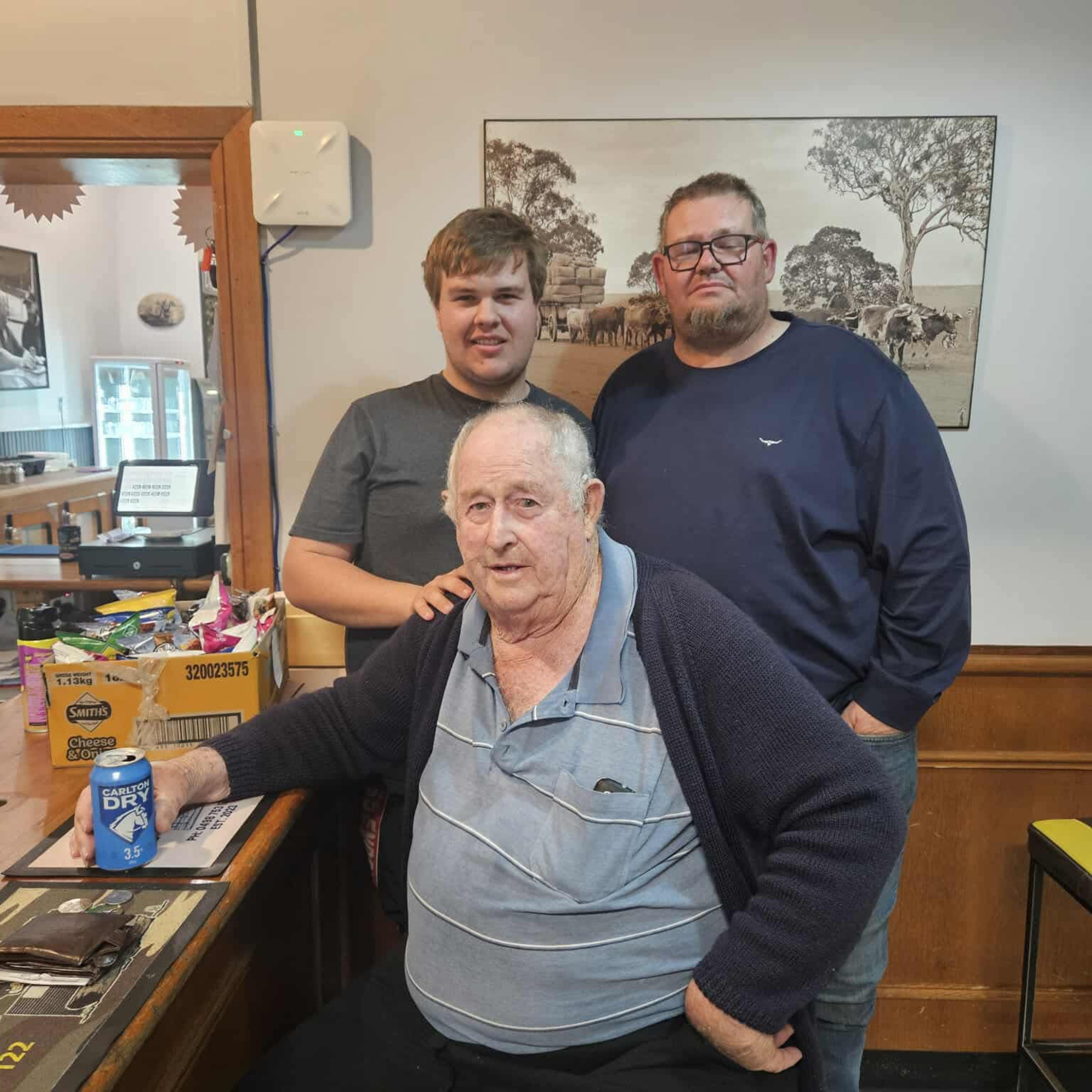
Never Wombel, a longtime resident of Castan, recounts his life experiences in an interview. He begins with childhood memories of attending school in Bagawa, where he walked daily and participated in local events like annual shows and sports. His passion for football is highlighted, detailing his early days as a boundary runner, his progression to playing for Castan, and his involvement in premiership teams from 1961 to 1969. He also shares personal milestones, such as meeting his wife at a football game in the early 1960s, marrying in 1965, and raising three children. Wombel provides vivid descriptions of Castan's past, listing numerous shops, pubs, and businesses that characterized the town, emphasizing its once-thriving community. He reflects on family life, including his parents' hardships and his mother's piano teaching. Later, he discusses his career as a truck driver, spanning 22 years, and notes economic changes, such as the decline in local employment. Throughout, he portrays a life of resilience, community spirit, and fondness for Castan, despite the challenges of earlier times.
[Music] Hello and welcome to Casted and Connections. An initiative of Hands Up Casted and where a group of enthusiastic locals have come together to capture, preserve and share stories of people who have a connection to Casted and. [Music] Hello I'm James, I'm here with my father, and we're interviewing my grandfather, Never Wombel. Never is the youngest of three children to older sisters, Beth and Merleine, and has three children, Judy Susan and Lee, and is a well-known member of both the Casting community and the Bial community. Where do you want to start? Where do you want to talk? You want to know? Well I know, just start. What do you want to talk about? Do you want to talk about springback moving through the Bagawa to schooling? Yeah well just what you remember about Bagawa, because it was when you were a little. For you we went to school at Bagawa, we used to walk in Marl, school, and I. Each day. Yep, and then a lot of things sort of went on in Bagawa there at one different years. They used to have a car in the middle of the year, and then we had a flash out, and it was held each year. And that was in the Bagawa Hall, and across from the hall, they used to have a gun shoot, a climber shoot. Yeah, but yeah, a lot of things went on there. We used to have best 30-odd kids go to the Bagawa school years ago. We had one teacher, and the sound mistress, that's all we had here. Yep, pretty good. And I remember you telling me stories of the old Bagawa football grand and the football team. Yeah, well they all were going to football grand, I'm not sure what the old one was, but it was down, grammar throughout, so somewhere. And day and time, Peter Wombel was flying, and the grand had a tree on it. And he had the ball, and he ran behind the tree and came out the other side, and the young boy blew the whistle. He said, "You run two hours of the ball." He said, "Begin," he said, "up against the bus to be on the tree." Yeah, but the lighter football grand was up where we played cricket, in Mitchell's paddock. A sort of a top was blind out of the tree, it was just a barrel. Stand there, and they got rid of that before the football started. We used to play cricket, it was on the ground, but when football started they blew it out. And then we played football, that started. I don't know, 1955, '56 something was. Yeah, but yeah, we had a good side, we got on the previous year, on the choice. Yeah. And what was the colour to the team? Rotten gold. Yeah, I thought it was that. Rotten gold, but yeah. And then what do you remember of Castan during those times as well? Oh, Castan, we used to come to town, in the Elhorz and Cuth. It's not been a, that before we were a youth, it was pretty hard times. In 1946 we had to be fludgy. We sat at home and listened to the cricket roar down and saw it as a house. In that, yeah. But I remember we went to a show one year, and that was up until our showrooms. Clowns come up, we were bad, and we, dad said, "Well, we better get going." So we have now a cart. Way we went home. And yeah, we beat the right home, but there was a big storm that year. Yeah, but when we used to come into the cart, we used to park the cart behind Donald's shop. And then used to tie them under a big fig tree. Yeah. But yeah, it was pretty interesting times. It was hard, but we got through it. Do you remember teachers' names and that's from the school? Teachers, my first teacher was Lynn Christian. Then we had a Tony Solomon. Brian McDonald, he taught there, and he pulled out of the teaching. For a while, and went out to Rose Nielsen, worked on the farm before he came back. But two other teachers, well, I can remember them, before I went to high schools, when I went to high school, I should say. It was a mulligan and another black company. And they bought it at high-end kids' bread. They bought it at high-end and another fellow brought it at high-end too. I can't think of what his name was. But yeah, it's, it was hard, but we used to get through it. But as kids write, we lived in the same paddock. And we used to come out from school and they had an Uncle Cecil beer. He'd have fence snores, been posted, or doing something. And we'd have to get the cows in and start milk. Boy, hey, at that time, early stages. And then we got the milk and we showed him. That made it a bit easier when they finished them with the time they got home from work. Yeah. And then later on, as well as you aged, as you got older, you began to get better at football and began to come more recognised. And you eventually got interest from us. And what you was at 1962, was it? But yeah, I started running the boundary for the Gala. When they formed up, I was too small. I couldn't get a game. I used to feel in there. Now I get and playing for the pocket. I'd kick a couple of girls or something. And then back right on the boundary. And I think it was 1960. We played in a final over Cavendish. I mean, I was seedable. He broke his legs that day. Yeah. And '61, I put in, I know 1960, I put in for a clearance. It's gassed them, but they wouldn't leave me. And they cleared me in '61. And then I played in the first game in the second. Second game, I was 90 or 20, no needs for the seniors. I know you're not on before half time. And I never really missed a game after. It's uh, and I played in the premiership side that year. And then 1962, I got a little mess in the train down there. Because we had bridge burges. It was the coach here. And he was an escenorman before he came up. And yeah, but I never made the final this, I come back here. Were you playing with some of the one? John John's some of it was? I know, that was after I, I played in the four premierships in 1961, 1962, 1963, 1969. And I played in the cast of Wisconsin in 1970. Now when the young coach sampled '71, '72, well '71, I missed out on playing me '72 and it was going with the cast and we finished before the cast and that year. And they got me back on permit and I played me a 200th game. A cast and a player I played.
on that day was a jolly sum of all who played for SNN and I played on him in both practice matches to SNN and I played me two hours game on him. And correct me if I'm wrong but one day playing for Kastan you kicked a goal from the backside of the center square didn't you? Something like that. Oh yeah, I've played one year, I've played one day. I am playing full back and I got beat badly and they switched me from full back to SNN I forward and I kick four goals. I'm saying I forward. Hey, old drop kicks. Yeah, yeah. You talk about some of the characters you played with? I talk about some of the characters you played with. Oh well. Some of the characters like Johnny Gill, Barry Gill, they both played the captain. I went to school with a high school with Alan Richardson who he played for Richmond. Yeah, but we had some good ones in 1969. We had the Methodist minister who played us four forward. Didn't so clearly. Yeah, it was, yeah, he had his appendix out of us three weeks before the Grand Final. I mean I played the Grand Final. Yeah. It has pretty good. Yeah. Right, so then at some stage in that point you met Nan and you had Judy and Susan and Luke, we met Sue. We met at the Estelle game one year as Eve. That's where we met. And that was in about 1963, '64. And we married in '65. Had three children, Judy, Susan and Lee. And now I've got ten grandchildren and four great grandchildren. Very good. So what do you remember of the town? Shops and so do I. Well, the town that years, well, you had Donald's, it was a grocery shop. You had Stokes' grocery shop. You had Cushing Caching Carry. Ran, Ran and Cato's was another grocery shop. You had about four or five cafes in the town. And a couple of two or three bookshops. Yeah. But even Donald's and Stokes, they had grocery hardware, drapeery and all. And they employed about 16 people in those shops, which was a big thing for the town, yeah. And I think back then two or four pubs. Four pubs, you had the railway pub, Cassan pub, Elvian pub and the Glen Elp. And you had, I had a billboards like paintings. I had the big store there with the hardware, furniture, carpets and all that. And down the back you had the billboards, yeah. We'd like to go back a little bit and talk a bit about your father, mother and your home life, what it was like growing up back then. They'd done them. They'd done it hard, really. We only had the old horse and car, and that was hard when you travel to town on that. Yeah. But they'd done a good job. And it was a good foot runner. And he used to go to car, all that sort of thing. Foot runner. And he won a lot. And I didn't know until after he passed. When my uncle told me that I was at Gunter here in the skin store, I offered to pay for the way to store the run. And he wouldn't go. Yeah. My mom actually was good on the piano. She taught a lot of music and all that sort of thing. Beyond the piano. But she had the Queen's middle piano. And she used to teach kids to say, "Come after school." And she'd teach them on the piano and all that sort of thing. And she had, as brother of a nut, I had the fire on my hand between them. And yeah, his family, half family, we sort of grew up as brothers and sisters, mindly. Yeah. And I know a lot of tankies to get in top of the hill and jump in there and go straight down. We never took her up to her. We had our buggy. We ran to the our buggy and we'd take her up the hill and we'd come down. But we used to wait until we had to go out and grab her to get a few bob to spend. And here we'd go out of a sandy or a sandy, talking with the lunch with us. We'd come back up and carry the rabbits on their back and come around. We used to walk miles around there. But as far as football and the ghosts, they had a big yellow one. They all never played much here. They played a couple of years. Cricket was a good time at cricket and that was big yellow. We won a pre-miss year but two in the cricket when we got to New Barney here. There was a fast ball off the ball, a school teacher and he was quick too. She wouldn't bat against him in practice. But yeah. Wasn't it one of the Humphreys boys facing him one day in that black and blue? That was our big block on the plate for ourselves. He stood up to him and he was black and blue up the side. The police, the other pitchers, went up the stairs and then went down the grounds of the chaos you could walk across the country. Yeah. But yeah, it was good times. It was good times, it was hard times. Yeah, I wouldn't get back to it but. Yeah. You used to have some good stories to tell me about cricket and big yellow with food clod. Some of the things he used to. Oh, that was down in Jigby. He put his line with us in the block here and there. The food was down there and he said, "You can start walking." He did catch it. I might 101 day while I was in my six. So he then laid her on after your cricket and football. What did you get up to? Obviously, as a father. But what else was happening? Well, later on in life. When the kids grew up, Judy and Susan and Leigh were used to getting on the river. In the summertime, in the boat, fishing. Every weekend, we had some good times there. We just get in at least the time, camp at Bridge Arts. And it was good. We have a mountain sister, a gang dancer, a husband come up and we camp at Bridge Arts there and go fishing all weekend. Yeah, you can't beat it. So you went into truck driving at this point as well? Well, you and truck driver weren't. You and I feel like if you told me some stories about that. Yeah, I started truck driving in 1967. Yeah. You and the draft times. Yeah, and what do you remember of the draft? as well. You know what I bet.
There was a lot of stuff. I had the shawaiidog pits there in the scrum. He was fighting. There was sheep taken out of the iron cattle. Were there nothing, and they were shot and buried in the pits. But once it could go, we can't have to work. But I only got there once. I had a bad time. Yeah, but there was a lot of stuff went to work. There were no strong ones. Yeah, it's hard to say, you know, people, people, people, people, people, people, people think they were what was it like. It was hard. You just couldn't say them. You treat them well. Oh, now I got good boy care. You just have to put in the trangy hospital. But yeah, it's like, I'll gladly use the talk of me, I'll have a car rain. I used to drive a truck. You wouldn't even use cattle one day, so yards on the farm. They just about had them in the yards and the poked his head over the yards. It's a surprise, a surprise. I go over a pile. Cattle them everywhere. I kicked him off the place. In our country towns, in places like Begelle, or Sanford, Heddy, or those, they used to have a dance every Saturday night. And that's all worked out. You know, it went round. But now, when the tentacle closed and come in, they finished all that. There was no more dance. I went to the old hell. I started the old, Highland Metry School, which was down. With the primary school, isn't it? That was beside the stage school. Then halfway through that year, we shifted up there. And you used to ride your push-by, I don't think it was. We used to ride the push-by, and I went four more in. When I left school, I used to ride the bike seven more to work at Morden, who the other saw the Sanford. Till and from. With her, no. Do you remember what some of your best friends' names were as a child? Oh, it was a good reason. That's not a good friend. Yeah. She went to school together. She died at 28. Yeah. And when I played football with Gaston, I don't know, friend Ray Humphries. He never had a vehicle. And he had bringing me the football with that. I know, I'm taking him home. Yeah. Johnny Gill was a great mate. And Mary Gill, they were good friends here. A lot of those. Yeah, a lot of cousins. We on Jordan? I worked for Leon. Yeah. He come for me to the book and tell the story. And he said, "Well, actually, I'll start." When I started work, I drove a bloke ran in the bikers' cars because he went point out for I was something. I'd broke his arm. I drove him ran for so long. And then I worked with Tom Cove. And then later on, he son took over. I worked with him for two and a half years or something. Before I went there on the SCC, I never said they were. So how many years did you spend with the show? 22 years with the show. Yep. So you would have sent a lot of changes through the show? A lot of changes. A lot of changes went when they had the American nation because we went from about 42 to 45 out of star for you to 15, which wasn't good for the town. Yeah, that was hard because. I think you've got a great memory. Overall, would you have just in general a great memory of the town? Do you think of it as a great place and do you love it? Oh, yeah. Yeah, I thought you would. Yeah, yeah. I remember the street talking. But then he saw the street and told you who was there. He started. You said, "Well, it's back there." And they big of them. And he shot there. Against his butt shot was next. So he came, our bedroom said, "Shop there." And he went with me. So on that was where Judy shot the cab, right? There used to be a pipe shop that was led on this pipe shop. And next door that was Joe Lake's Sandless Shop. And then you had a machine of goo, right there. Johnny Hughes came us. A cushioned cash and carry and a floor shop. And I don't know what else to go about there. But next door used to be Jeff Gordon. Had a shot there. But beside him was Cliff Campbell's butt shot. And after. before Jeff Gordon was rough extra, he was in there. And then that changed hands too, as we talked after. But Brandon Codos would next. Clary Davis's radio collageal, Marysius Straitbury, which were more than just Gianni Braun. And there was a lady shot next to that. And William's the Schumann, Dennis LaSelle's, and Elder's were, Elder's were, were. He's going, Scott. But now, but before Elder's was in there, it used to be four Gibson's. And then you had. Elder's was next to Jack's house. McCann's. I had the other side of that, was a dentist. Mutant of Dennis. Yeah, a lot of them were there. The jewelers of Benny Shipman on the corner were some pianos, musical, all that sort of thing. Yeah, before a lawyer went in there. So where Elder's used to be? That was Young Hasardson's too at some stage, wasn't it? Where Elder's was used to be? No, neither were they. Young Hasardson used to be over the other side. Where the chemist is now. So I had the electric shop where the hairdresser is. So I had the. I'll run a view of cafe and then Donald's. Do you have many good memories of the old picture theater? No, I never got to the old picture theater much. It got pulled down here. You told me why not? You had a fairly decent night there with a for-all Tom Clod. No, that was at the. in the Cassantown Hall. I thought it was pictures. You used to have pictures every Wednesday night in the Cassantown Hall. All the time when she said these.
Yeah, now we used to go there, but the old picture theatre down the bottom of it, it closed down, sort of all I finished up skating at it on one stage, but it used to be a bike reading down there too. When do you think that would have shot me in picture theatre? Oh, because I can never remember it being night in the middle of the night. Back in the 60s, early 60s, early, oh, like 50s, early 60s, it used to be a witty car made a little shop beside it. And he come up in the one side, Jacksonville, where else used to be? And he got burned out there. But yeah, I was just going to get a shop down there. Yeah, very shes went down there before they went up in the, where Jim Bryan was. Okay, I think that's pretty good. Well, we might finish up there. Thank you. You've talked, you've, under you told me a lot of what you've just said, some of it I didn't even know. And lots of stories that have been unsaid. Yeah. But if we had the time, we'd be going forever. Could go forever, couldn't it? You got to put into the bottom pump where Susan is now. That was used to be owned by a great grandfather. I'll go to the top. And now it's back in the family. Correct me if I'm wrong, but when he died up the top didn't he? And he had to be used to that at the top by a crane because he couldn't fit down the stairs. Yeah, I know what even the hell I was about when he was a ropes. I guess they couldn't get him down the stairwell. It's too big. He was on a hit. He was about 25, 26 times. And he drove it, never drank or smoked. What's that into days? Why in the Kilograms, do you know? I wouldn't ever clue. What? And what do you want to fish? They used to have a saw and a wall, tuck us a tuck along at the boss. Yeah. Didn't you say you could fit five or six big glasses on his head or something? No, that was race. The race wasn't it? He sat. He used to sit four, seven ounce glasses in his hand, pill. Yeah. Yep. He used to barmer the cast iron for years. And he used to be a maroon spider. Yeah. But he had a novel, I didn't see him. "Paidants will light." They had a feudal drink to roll like. And the old bike he has used to be. And he marbles him. And now it's about that jail. But before it went down, the Winston Vinny's is now. The house took it down there. The chair there was a lot of changes in the town. The banks were used to have what? They had four or five banks and they were able to get one. That's true, yes. Yeah. It makes it hard for us or poor old buggers. And most of them ate a car, brains. Yeah. And garage. Not garage is here. Well, they had tapes across the road. There are coxons. Coxons, tapes. And you had cast iron with a baker shop. And now that used to be handset motor, somethings. Garage, hilly use, macalluses, Mabinass down on, or used to be fair-roast. Mabinass down in the first street. She was full on there for a walk. And she was like, "Thank you very much." There's going to be a lot of stories that we haven't said. But we don't have forever. There is. Yeah. A lot of stories. We hope you've enjoyed today's episode of one of our homegrown heroes. Jump over to one of our other episodes to continue the cast iron connections journey with us. Please don't forget to follow our podcast and share it with your family and friends. Thank you for listening. [Music]
Podcast Summary
Key Points:
Never Wombel shares memories of his childhood in Bagawa, including walking to school, community events like the annual show, and playing sports such as football and cricket.
He details his football career, starting as a boundary runner for Gala, progressing to playing for Castan, and participating in multiple premierships from the early 1960s to 197
He recalls Castan's historical town life, listing various shops, pubs, and businesses, and describes family life, including meeting his wife, raising children, and later enjoying activities like fishing.
Wombel discusses working as a truck driver for 22 years, observing economic changes in the town, and reflects on the community's resilience during harder times.
Summary:
Never Wombel, a longtime resident of Castan, recounts his life experiences in an interview. He begins with childhood memories of attending school in Bagawa, where he walked daily and participated in local events like annual shows and sports. His passion for football is highlighted, detailing his early days as a boundary runner, his progression to playing for Castan, and his involvement in premiership teams from 1961 to 1969.
He also shares personal milestones, such as meeting his wife at a football game in the early 1960s, marrying in 1965, and raising three children. Wombel provides vivid descriptions of Castan's past, listing numerous shops, pubs, and businesses that characterized the town, emphasizing its once-thriving community. He reflects on family life, including his parents' hardships and his mother's piano teaching.
Later, he discusses his career as a truck driver, spanning 22 years, and notes economic changes, such as the decline in local employment. Throughout, he portrays a life of resilience, community spirit, and fondness for Castan, despite the challenges of earlier times.
FAQs
Casted and Connections is an initiative by Hands Up Casted where locals gather to capture, preserve, and share stories of people connected to Casted and.
Bagawa School had about 30 students and one teacher, with children walking to school each day. The school also hosted annual events like a car show and flash out in the Bagawa Hall.
The Bagawa football team wore maroon and gold and played from around 1955-56. They had a successful side and memorable moments, like a player hiding behind a tree during a game.
Never started by running the boundary for Gala, then played for Casted from 1961, winning premierships in 1961-63 and 1969. He played over 200 games and once kicked four goals after switching positions.
Casted had multiple grocery shops, cafes, pubs, and employed many locals. Key businesses included Donald's, Stokes', and Cato's, with community events like dances and picture shows in the town hall.
Never married in 1965 and had three children. He worked in truck driving from 1967 and spent 22 years with a show, witnessing changes like reduced staffing that impacted the town.
Chat with AI
Loading...
Pro features
Go deeper with this episode
Unlock creator-grade tools that turn any transcript into show notes and subtitle files.
 PodcastTranscript AI