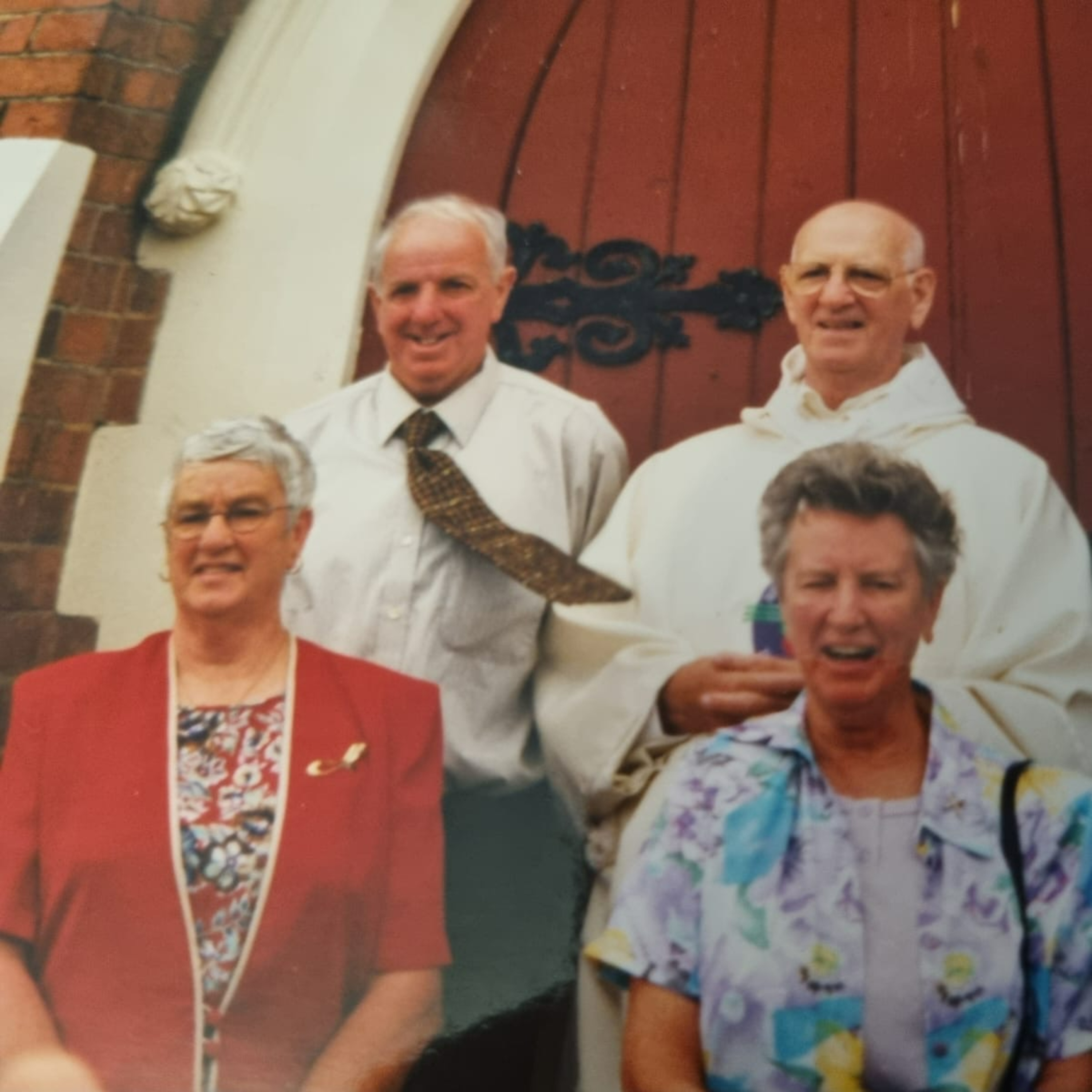
Monica Murphy, a longtime resident of the Casterton district, shares her life story in this interview. She describes her childhood on a farm as one of six children, her education at a convent boarding school in Horsham, and her early career as a telephonist. Monica married Noel Murphy in 1959, and after adopting their son Andrew, they ran a dairy farm at Dunrobbin. She was deeply involved in the local community, participating in sports like badminton, tennis, and croquet. In her later years, Monica became a volunteer with an organization supporting isolated families, completing several stints at remote outback stations. There, she helped with childcare and household duties, experiencing both drought and flood conditions and forming lasting memories. She reflects on her life with appreciation for the values instilled in her and the diverse experiences she has had.
[Music] Hello and welcome to Casted & Connections. An initiative of Hands Up Casted & where a group of enthusiastic locals have come together to capture, preserve and share stories of people who have a connection to Casted & Connections. [Music] Today on Casted & Connections we welcome long time Casted & District resident and dare I say identity, Monica Murphy. Monica's early years were spending Colrain growing up in a large family where she was always a little rebellious. Welcome Monica. Thanks. Tell us about those early days. My mother came to a small area called Konongat-Hong South as a school teacher. She married my father who was a soldier settler and there were six children and I was number five. We had a great life on the farm. We didn't know any different. There were a lot of soldiers there. We thought a couple of families were poor. I don't know what ever made us think that but mainly because we had butter in our sandwiches and they had dripping. But no, it was a great life and we went to school at Konongat-Hong North until my year six and then I went boarding at a Bridgian & Convent in Horsham where my sister was already boarding. When you say Konongat-Hong North there was also Konongat-Hong South. Yes, you wouldn't believe this but they were two schools and they would have only been 10 kays apart. Wow. But of course the family said quite a few children in those days. There was nothing for four or five to be going in the same family to the same school. And obviously families, siblings, you had how many brothers and sisters? I had three brothers and two sisters. Now the oldest sister, Carmel, went off to be a nurse at an early age. My brother Frank went off to be a priest and next was Tony. Tony stayed on the farm mainly because dad did not enjoy good health for a while and he really only went to about grade seven I think. And he was a great help to dad and Tony and I became very close. Then there was Margaret, he came and done. Now growing up at Konong we were quite friendly. When we went to boarding school we couldn't bear the sight of one another. She had all the brains and I think I was behind the door when that happened. But mum would write us a letter dutifully every week. It would arrive on Wednesday. If I was lucky she'd give it to me on Friday. And anyway I stayed there until I finished the old intermediate and then I came home and started work at the teleph as a telephonist at the Carl Raine post office. Now mum would have liked me to further my education but I could almost almost wrap dad around my little finger. And he said I think it'd be a good idea. So she said yes that's all right but she said you wanted to be a nurse. Yes I wanted to be a nurse like Carmel. I don't know why because I can't bear the sight of blood even now. But she said we would order you to get to work at the post office to help you all on the way with monetary help because mum and dad didn't have a lot. And I thought that was a great idea. So I stayed there for six months and got to like it and there I stayed for five years until I married Donald. The post office work would mean quite interesting back in those days because of course it was the old poke the wire in a hole fee. Yes that's right it reminded me of this year. Yes you do that and there were I suppose there would have been ten telephonists there. Some of the Rony part time. I have to laugh when I say this I shouldn't be laughing but one girl came along and she was part time and she said I won't be here next week I'm getting married I'm having a baby. Oh okay at the start at that stage I was monitored. Well I know we fell off the chair but she was she was a great girl and she's still married to the chapter day. So but no it was a good life and during this time Tony took over the farm and we moved into town so I really rode my bike down from perhaps four streets up from the main street to the post office. Was that the time of party lines and all that sort of thing? Yes it was. Yeah so tell us the truth Mon did you ever listen in? Yes. Yes and I could tell you some interesting conversations but just not today. Okay okay we won't go down that track any further than. You bought in school days in Horsham you said that you found it a little bit hard to conform to the rules and regulations? Absolutely. As I said before I was a bit of a tomboy I had three brothers and I came and went as I pleased. My sister she liked to stay inside and dust and keep things clean and but I couldn't think of anything worse. So I was out you know feeding calves and on the sledge as we had in those days with dad and the boys so it was a big big change of life for me going there where you the bell rang at seven o'clock you got up you had breakfast you went to mass you came back at half past eight you had went or you had a bit of a play or a talk you started school at nine and that went through it all to it. It was just so so to what I've been unused to but there was I suppose there were 50 borders well 40 was 40 of us would have been in the same boat we all didn't like it but when I look back on those years the nuns were strict but they were firm and they taught us things that we didn't even think about like respect you had to have respect for people you had to have tolerance now I have fallen badly off that track along the way I can tell you but I often think when I'm intolerant what did those nuns say and they taught us numerous things and I don't think I'd be the person I am today not that that's any great great saying but I think they taught me a lot in the long run so in other words they gave you a lot of moral values absolutely yes that I didn't that I didn't appreciate at the time but looking back and do okay okay so you went on to be the to-liftness and you met Noel in oh I can't air somewhere all those five years perhaps two and a half years along how did you meet on the rice course I was my dad ought to go to the races and mum wasn't terribly keen to go to the races and I went with dad with a couple of times when she didn't want to go and I said to another young fellow in Calran who said fellow over there and he said that's Noel Murphy I'll come and come and all introduce you so I'll meet Noel Murphy now I couldn't say it was love at first sight but along the way we made a girl things and yes we were married in 59 oh fabulous and moved to Dunrobbin then no no not exactly we moved to Murray Street here in Kasson for three months because there were people still living in the house at Dunrobbin so we moved out there after three or four months and that's when we've gone out long journey at Dunrobbin fabulous and then in 62 there was a little bundle of joy arrived I was indeed we did realise of course I went to see the doctor or we both were to see a doctor at Calran who was a great friend and we said you know I'm not fully pregnant and he said I'll give it time girl give it time so I thought oh yes but anyway we went back and to cut a long story short we were unable to have a family so we adopted Andrew and I can distinctly remember getting this telegram in those days to say that our baby boy had arrived and could we come down and get him and I ran over to the when I was working fencing in a paddock waving this piece of telegram paper at him and saying we've got him we've got him we've got him oh how wonderful and how lucky was he to have such great parents well somewhere along the way we sort of made a girl things we certainly did so by then you're out at Dunrobbin we were still in farming dairy farming yes dairy farming yeah we started off with Null's two brothers but they got married and eventually sort of got out of the partnership and we bought in and I love daring at that stage I was my father dairy of course and yeah it was no hassle at all as I remore Null every now and again I read every half a calf on that farm all the time we dared wow I could have killed some of the cows calves but of course you didn't in those and he dared I mean he milked and I milked too so it was it was a good life and we had pigs yep believe it or not we in those days of course it was skim milk and fresh cream the tanker didn't come like it comes nowadays the truck came and loaded the cans of cream and the
and the skin milk went to the pigstown at the pigstown. And I know that you would have had the dairy farm luxury of having fresh bread jam and cream for morning tea. I can't remember the morning tea bit, but we had plenty of cream. And plenty of fresh milk, and yes, it was good. So during those days, what did you do for your leisure time? Well, to be quite honest, you didn't have a lot of leisure time in those days, you. I was clean on gardening, but as for anything else, you didn't have a lot to do. You took when Andrew was getting bigger, you're taking to football, you're taking to basketball. And well, now I didn't go anywhere much. Each year, we used to take two weeks off and go to lawn for holidays. And that was great, because Andrew and I loved the sea. And we had a self-contained apartment, I suppose, you'd call it a bay at only about 100 metres from the sea. And now we used to look at it at us, and we used to go down there and swim in whatever. Yes, that was a great year. And you were always heavily involved in the Dunrobbin community and still are today in that once very famous for her cream cheese and ginger sandwiches, which are delicious, I might say. So at Dunrobbin Functions, she's always one of the first there. She's always one of these people that, if called on, provides us life. And so she's always been very heavily involved in the community. So your life around Dunrobbin and community involvement involved a lot of sport? Well, Dunrobbin had a great sport to name, if I can call it that. They played Badminton. And I would say that perhaps Mervin and what's his name at Marne. They-- Yes, so they started up Badminton around Kesslin, and it became a very strong area for-- we visited Millicent and played Badminton over there. And the tennis was the same. We had two courts out there. And it's a bit sad to see them neglected as they are today. But we had a lot of fun on those courts. And even juniors, the Reese boys, they were strong players. And yes, they were great years. Then I took up netball and basketball in town and played those for a few years. And then I took up Croquet, which I just loved. And traveled all over Victoria, but a lot of area in Victoria with friends from Mornable, Karate playing Croquet. And met a lot of nice people along the way, which took me out of my zone here. Took you out of your comfort zone, so to speak? Yes. So speaking of travel, you've also traveled with a friend from Bell Rand old a lot around Australia? Yes. My friend, she came from Ballarat. And she was English. Lovely lady. When I say lady, I mean lady. We were as alike as talk and cheese, but we did get on very well. She had a knilness which wasn't Parkinson's, but she sort of had slight shakes. And she relied on me a little, not that she would ever say it, to bring her a glass of wine of an evening or to chop up her meat at-- but she was great. And we had a lot of trips around Australia with Brennan's tours. And he eventually died, which I thought was quite sad, because we still had a bit of going left in the sea. But I saw a lot of Australia in those trips, a lot of Outback Australia. So then you were telling me that you've seen an advertisement in the paper for Vice VISC. Can you inform us about that? Yes, I was reading the Herald Sun one day. And this couple had, they belonged to this, vysulated volunteers for isolated student education. And they said what a great idea it was. And now they were both teachers. And they taught Outback families where mum had a new baby or mum had a sick child or mum was out on the station. And the children were perhaps falling a little behind. And they were totally caught up in station life, as well as teaching. So I thought, oh, I wouldn't mind that. Not the number teacher. But they also looked for people that they called angels. And my son jokingly said to me, this will be the closest you'll ever get to being an angel. But those people helped families in the house. They prepared the meals and just did round about jobs. And I was very good at doing that. I might add. And they were always so appreciative of anything indeed. We at the Stockman who came in and, you know, what a what's for two to know. And you might put up five sausages. Aren't there any more? I have a great eaters. Yes, it was great. I loved it. So your first stop was at Regtank Station? Yes. Yes, Regtank Station. And that's up between Koba and Ivan Ho. Miles from anywhere, Jennifer had been a tourist guide for ships and things like that. And he was a farmer through and through. They had two children. And that was the reason that I was there. Because they had William who was four. And he was nonverbal. And a little girl, she was two. And she had cystic fibrosis. So the mother was full-time, as you probably well know. Cystic fibrosis is a very debilitating sickness. And not had it added to the fact that he was nonverbal. And he was frustrated. That was the word. He would bang his head against the window. And oh, I don't know how many times I thought, you'll break that window. And something terrible will happen. But to cut along so we're short in the years-- in the months to come after I left, she took him to Sydney to a one-on-one speech therapist. And within about three or four months, he was speaking well. And now he's 26 or 27. And you wouldn't know that he was nonverbal till four. The little girl has-- they've made great, great steps in treating cystic fibrosis. And she is now 22 or something. And she's out in the world doing her own thing. She's been a barista. She's been numerous things. But she's very much stands on her own two feet. And as her father says, only comes home when she needs to. And during that time there, you had some interesting trips. But the ball, there was no TV or anything like that out there. But I remember you saying about going to Sydney. Yes, they went to a friend's wedding in Sydney. And that would be a good eight hours drive, I suppose. And that's not easy with two small children. But we used to stop at McDonald's now and again and have something. And that kept them quite for a little while. And then we rented an apartment overlooking Darling Harbour. Well, it was a beautiful, beautiful apartment and a beautiful, beautiful scene. And they left me with the children while they went to the wedding. But they came home in between the wedding and the receptions to make sure things were going all right. And they were. And then for the next two days, they took the children and saw relatives and I saw bits of Sydney that I hadn't had never seen and probably won't ever see again. But it was great. I went to an Italian mass. I went to the shops, walked around Darling Harbour. Things should have a dream of doing now. But as I said, this was so full of them ago. So that was a great experience. And when you finished at Red Tank, you came. You were always happy to get home, obviously. Yes, I was. It was a six week stint. They asked you if you could stay for six weeks. And I said, yes, no problems there. And it's always nice to drive in the drive at home, you know. And not that I was home sick at any time, but you miss my sister talking to me on the phone every other day. Miss going over to my brothers who lived in Calran. Miss Null just, you know, saying silly things as we would to one another. When there's only the two of us there. But yes, it was always good to get home. But for all that, I thought, I'm going to go again, away again sometime. And you did? Another stint. Another stint up at Mara Penestation, which was probably 150K north of Broken Hill, up towards-- I don't think it the blouse. And it was a totally different set up altogether. Rainy was a single mum, a husband at left to for the Jullaroo. And she had these two little girls. One was about five, and the other one was about two. And she had a head stockman and a young fellow there. And it's worth talking about him, because he was about 16. Her sister, I ran out from Adelaide and said, I've got this fellow. And he's fallen in with the wrong crowd. Could you look after him for a few months? And she thought, oh, well, yes, I suppose. So up he came. He left school in about grade two, I think. But there was nothing he couldn't do with engines and motors. I don't know where he got that from. But if I motorbike--
or a vehicle broke down, he was the one to fix it. So he stayed there and he's still there. I tried to get him to do school of the year with the girls, but he wasn't having a matter of that. But yes, that was an interesting story. And Blue was the head stockman, and he had an interesting story to tell, too. He's gone now, but he was with her for many, many years. And there I said, they were as rough as bags. I heard swear words there that I'd never heard in my life. And I reckon I'm fairly broad-minded. But two little girls knew the better than I did. But the little girl, the first year they were in drought. And it was beautiful to see the stock that they had to destroy. And you feel for them. There was nothing they could do about it. I think we think of drought as bad, but there's nothing like it is up there. Yeah. And you did another-- you went back up a little while later on, a couple of years later on, they said, would you like to come back again? And I said, oh, yes. And they said, we're in flood. We've been in flood. So that was a total different scenario altogether. Roads or tracks, I suppose you call them, were washed away. It's like you see on TV like they are up north now. The sides of the road would be washed away six or eight feet. And she ended up getting her father who, on a station, apparently, apparently up at Birdsville to buy a scoop for her. And that was a great help in leveling out the roads. But it was perhaps a couple of years before things sorted themselves out up there after this trip. And they dropped hay by helicopter. And they were marooned in the homestead for about four days. And that wasn't-- she didn't mind, but the stockmen found it very hard to stay indoors for four days. So what sort of stock did they have, more? They had a lot of brahmin and a lot of sheep. But they got rid of a lot of the sheep. They adjusted some of them and some of they sold for next to nothing. But the cattle they tried to hold on to as long as they could for breeding purposes. But they really only ended up with a few for the breeding purposes. They had to let the rest go. And what they didn't let go, they had to destroy anyway. And it's very hard for the stockmen who, I say, are as tough as nails. But it's very hard for them to destroy the loves of their lives, more. Yeah. So you had some wonderful times up there and created some great memories. And I'm sure it was a really rewarding time for you. Yes. We went to another wedding, a friend of Rhinies, in Whitecliffs, which is a couple of hours' drives away, I suppose. It was Blue's brother. And I'd never seen the children in anything, but jeans and tops. But she had them dressed up to the nines. And she herself dressed up to the nines. It was great to see them. And we went to the wedding at Whitecliffs. And it was like no wedding I'd ever been to. They had a barbecue where they had about four lots of meats and things. And Lauren B. Holt, who wouldn't read it, but in between the wedding and the reception, we went into the pub. And who should be there but a couple of locals? Alfonk Kastinen. Oh, Kastinen. Yeah. So you really had to sort of be home. And they were surprised to see us. As we were surprised to see them. But he was not in a good place. And she was sort of touring around Australia a bit with him. But it was very good. And then we decided we'd come home about 2 o'clock. And I think if we came to ruin New South Wales as I'd remember, there were hundreds and hundreds. And she beat the horn like man. And they just hop off on another few and hop along. But we got home without too much trouble. So that was another great experience. And I had every Sunday off. And I used to go for a walk. She was terrified I'd get lost. But I always-- when I went through a gate or a track, I'd always put an arrow where I was going with mystic. So that if I got lost, they might know where to find me. She also told me to be very wary of pigs. Because pigs are very protective of the young. And if you get in between the young and them, they will. And they're big pigs with big-- --asks, yes. So I was always very careful of them. A few days after I got there, they have to look at the dams or the tanks as they call them to make sure everything's working so that the stock have a drink. And we came across this cell in about 8 or 10 young ones. And she looked for the rifle in the back. And it wasn't there. And the absent two fellas got to serve, I can tell you. But she got the rifle. No, she was running over them. And I said, oh, don't tell me. I don't want to look at it. And she said, you've got to destroy pigs because in a few months, they'll have more piglets. And they'll be piglets everywhere. So we ran over-- oh, it was just-- even now I get sick thinking about it. But as I said, that's the way of life. There's a little story about brandy snaps that happened when you were-- Yes, there. They rather like my cooking, not that I'm a great cook. But the pantry ahead was big. And you always had fresh meat. They used to kill their own beef, of course. But blue, the stockman said, have you ever made brandy snaps? And I said, oh, I don't know that I have. And he said, oh, I had brandy snaps one day. And they were beautiful. I said, I'll see what I can do. So I said to Rani, I've never made them. And she said, we've got a chap coming out from Boken Hill to do some work, paperwork. And she said, I'll read his wife and get him to send out some. Get her to send out some with him. So sure enough, she sent out about three packets of brandy snaps. So I filled them with cream and whatever. And they looked delightful on the table. And I said to Blue, here you are, here's your brandy snaps. And she said, oh, he said, these brandy snaps there out of this world. And I said, oh, well, I'd said, oh, good cook. So anyway, we had to come clean. And I said to Blue, I didn't make them. Jane sent them out with her husband. And he said, oh, you're a lone bastard. Ask bastard you are. Now, that was fairly time for Blue. I expected worse. But he saw the joke. And we had a lot of laughs, really. There was a lot of laughs. Now, in your latter years, dare I say, at the very young age of 78, you decided to start traveling overseas? Well, having said I didn't want to travel overseas, I saw a documentary on Switzerland and the trains that Chris crossed the area there. And I fell in love with it. And I love train travel. If it's only to Melbourne, I love train travel. So I said to Noel, I think I'll go on a trip to Switzerland on the train to her. And he knows that if I say I'm going to do a thing, I'll do it. So I booked a tour with a local ass who worked for a tour company in Narragut. And she said, it's a long way to go for 10 days. I think you should perhaps take in somewhere else. He sent me home about five options, five or six options. And I chose France. And that's what I did. Now, I went on my own. I have no problems traveling on my own. And it was great. Landed in Paris and took the fast train down to Avignon. And yes, along, right along the coastline there, to Monaco, and up through the centre, and back to Paris again. It was great. That's some lovely people. It was a tour. We had a lovely young fellow, a god. And I was amazed at how well the French understood English. I was good at French at school, mind you. But I was not too good at understanding their language over there. But they were very good. I was amazed. And then the very last day-- or the second last day, I think it was-- we went to the visit the Eiffel Tower. And because the streets are so cobbled in France, I had a walking stick. I have a walking stick now, but I didn't then. But I left it in the Eiffel Tower. I didn't realise till I got downstairs that I had left it there. And I thought, I can't go back up. The coach will lose in 20 minutes. And I don't want to be holding it up, but I won't be able to find the little Nick where I was. So I left it there. And all the people that have been to Eiffel Tower, nobody's ever bought it back. However, going to Switzerland, I thought, I was well looked after by a Chinese American lady who kept me in her arm. And she wouldn't have let me fall no matter what. So the first thing I did when I got to Switzerland-- which I flew to Switzerland from France, which is only about an hour anyway-- the first thing I did was by a walking stick. And I'm never let out of me sight, because if anyone's been to Switzerland, you pay an arm and a leg for everything. So I've still got it at home. And I've seen my bedroom. Should I need it?
Nghei, it was a great trip and the trains, they were wonderful. Not a lot of snow around except on the mounons. Some half way down, but it was probably the wrong time of the year. But I was glad I went, met some nice people and you know the homes there, on the gardens, everything. You couldn't really take anything in a day. It was like postcard, what you'd seen in postcards. Absolutely, yes. And you were 78 at the time. 78 at the time. And this was your first overseas trip. It was, but then I sort of thought, I think I want to go again. (LAUGHS) Now I was having eye problems at the time with corneal ulcers, which Annie had to have a graft. Now the grafts were somewhat successful along the way, but in the end they tried a new, system which worked well and he didn't have any more corneal ulcers. And we had to go down to the eye and to get the okay. And a friend in Cassandra said to me, "I'm going to Scandinavia, would you like to come with me?" "Oh, well yes, but I've got to get the okay for now first." And we were going down to Melbourne the next week. So he got the okay, so off she and I went to Scandinavia. Wow. And that was something different too. All together different. Norway was probably my favourite country there. The fjords and the waterfalls and yeah, it was great. Lapland was great. They have their own ceremonies, they're all say it on Australia, but a bit like the Amerigenis do here. And we went up to the North Pole and did you see Santa? Well, we didn't see Santa. We perhaps you haven't been good. Well, that did cross my mind, but he's there for 364 days a year, 365 I think. And the very day we were there he wasn't there, he was at lunch. And I said a box on him, I was not real happy. But you could post your letter and say, "What are your water triggers?" So yes, but it was just, it was all together different to what I had expected. Not that I knew and not about it, but I should have done some homework before I left to sort of prove yourself up to scratch with those countries. So my friend and I were both very strong-willed people. And the first thing she said when she pulled up at Dunroven when we got home, she said, "We never had an argument." Which I think surprised now. But we weren't rooming together, which is a help, I think. And she was great because she would sit down with, you've got to sit down with other people to know just what they, you know, all about them and they're, "Yeah, what they did in life and what have you." And it was great. So the travel has really broadened your horizons, I suppose? Well, before that my sister and I had gone into Tassie in New Zealand and we'd been to North of Ireland. But then my niece left for a finished work and I turned 80 and I said, "I think we should celebrate together." So we went to Singapore and anybody who's went to Singapore knows all about Singapore. It's a lovely, lovely place. Clean, beautiful garden, beautiful scenery, just here. And that was a great trip too. Unfortunately, I think my days of going on trips are over. I fractured vertebrae just before COVID and I can't stand for any length of time and I can't handle steps. And you've got to be able to, you've got to be mobile for those sort of trips really. I tell people I'm married to Nol and I'm married to a wee walking stick. Perhaps you just need to find a friend that'll take you in a wheelchair or something. Oh, I don't think I'll enjoy it as much. You never know. Okay, Mon, it's been wonderful to hear your stories and I thank you very much for sharing them all with us. Thank you. Well, it's been a pleasure but I'm sure I haven't done a justice but I have learnt an interesting life and it's not finished yet. Certainly, it's not. Thanks, Mon. Thanks, Lou. [Music] We hope you've enjoyed today's episode of one of our homegrown heroes. Jump over to one of our other episodes to continue the casted and connections journey with us. Please don't forget to follow our podcast and share it with your family and friends. Thank you for listening.
Podcast Summary
Key Points:
Monica Murphy grew up on a farm in a large family, attended boarding school, and later worked as a telephonist.
She married Noel Murphy, adopted a son, and managed a dairy farm while actively participating in community life and sports.
In later years, she volunteered in remote Australian communities, assisting families with childcare and daily tasks during stints at outback stations.
Summary:
Monica Murphy, a longtime resident of the Casterton district, shares her life story in this interview. She describes her childhood on a farm as one of six children, her education at a convent boarding school in Horsham, and her early career as a telephonist. Monica married Noel Murphy in 1959, and after adopting their son Andrew, they ran a dairy farm at Dunrobbin.
She was deeply involved in the local community, participating in sports like badminton, tennis, and croquet. In her later years, Monica became a volunteer with an organization supporting isolated families, completing several stints at remote outback stations. There, she helped with childcare and household duties, experiencing both drought and flood conditions and forming lasting memories.
She reflects on her life with appreciation for the values instilled in her and the diverse experiences she has had.
FAQs
Casted & Connections is an initiative by Hands Up Casted & where locals capture, preserve, and share stories of people connected to the community.
Monica grew up on a farm in Colrain as the fifth of six children in a large family, describing it as a great life despite modest means.
Monica worked as a telephonist at the Carl Raine post office for five years, starting after her father supported her decision over further education.
Monica met Noel Murphy at the races in Calran through a mutual friend, and they married in 1959.
Monica was active in the Dunrobbin community, participating in badminton, tennis, netball, basketball, and croquet, and was known for her contributions at local functions.
Monica volunteered with VISE (Volunteers for Isolated Student Education) as an 'angel,' helping families in remote areas with household tasks and supporting children with special needs.
Chat with AI
Loading...
Pro features
Go deeper with this episode
Unlock creator-grade tools that turn any transcript into show notes and subtitle files.
 PodcastTranscript AI