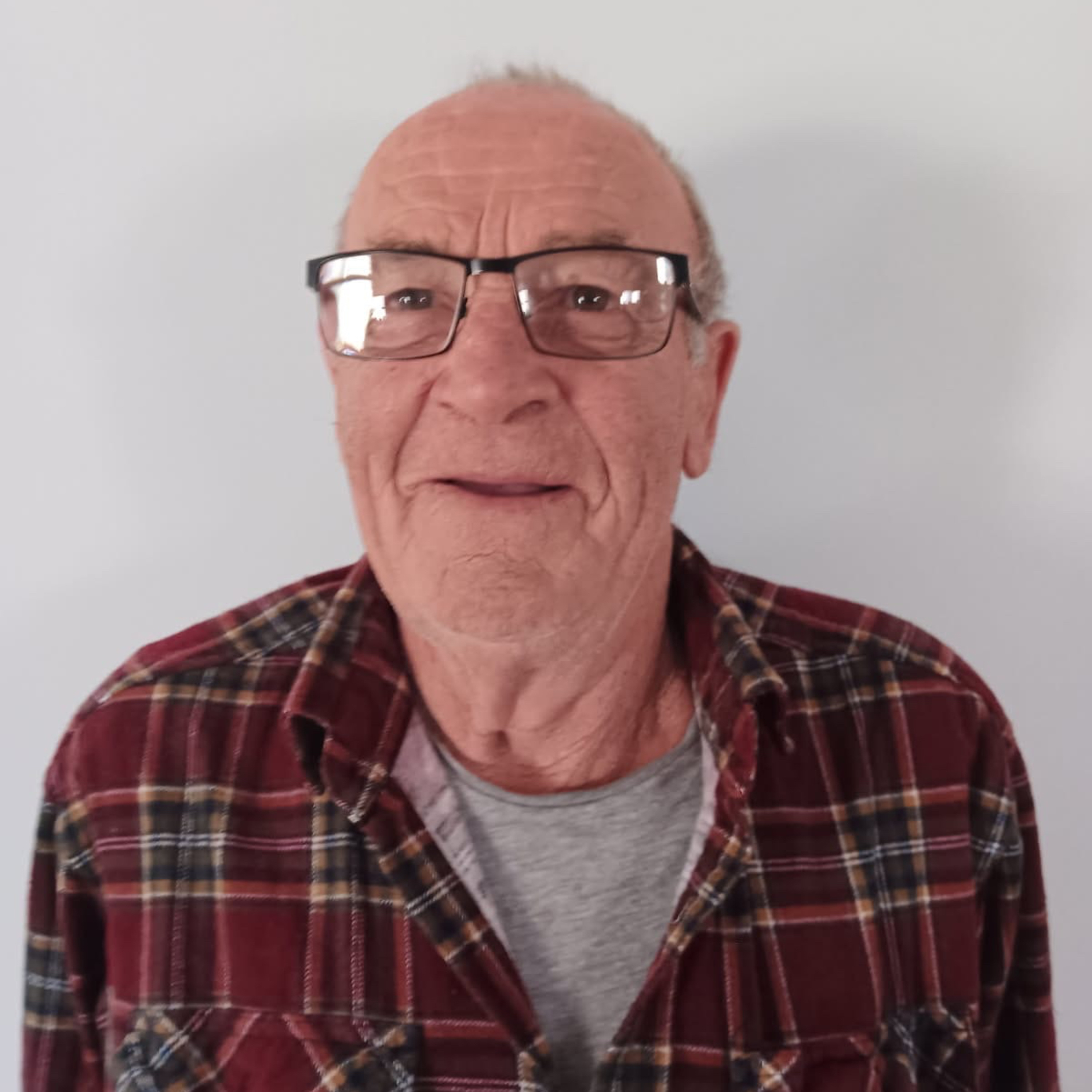
Merv Cowan, a 2024 inductee to the Australian Transport Hall of Fame, recounts his life growing up in Wandilo and Castlemaine, leaving school around age 14-15 to work at the family's grain store and mart, Carlin's Mart. He started truck driving with his father, later working for Jimmy Simpkin and then Leon Jordan, where he drove various trucks, including a notable three-deck stock crate. Merv eventually took over payments on a truck from Leon, starting his own business and subcontracting for operators like Bruce Marks, hauling livestock over difficult routes such as the dirt tracks over Mount Hotham. He also transported livestock for export, including loading cattle onto planes in Melbourne for live export to Japan. Throughout, he emphasizes family, with his wife Jean raising their children, and shares personal stories like painting his father's name on a wall that still stands. The conversation captures his decades in transport, community ties, and the evolution of the trucking industry.
[Music] Hello and welcome to Casted & Connections. An initiative of Hands Up Casted & where a group of enthusiastic locals have come together to capture, preserve and share stories of people who have a connection to Casted &. [Music] Welcome to Casted & Connections. I'm Gavin Low, having a chat with a good friend of mine and 2024 inductee to the Australian Transport Hall of Fame. Good evening, Manic Alons. Hello, Gavin. Well, Manic, I think we should start at the start. Where did your family originate from? Uh-huh, Wanda Vail. Okay, so your dad's family were always Wanda Vail people? Yes. Your mum was a Smith? Yep. So they lived in town here? I lived in Casted & on the Goa Road. She was a sister to Woll Smith and Betty Collins and quite a few other people. I can remember, did you have a big family? Yeah, I think from memory there was about 13 in the family. It was a family that I think Nana had been grandmasmith had been married before Okay. And had two or three children on a personal average. Okay, so I can remember the car on family at the top end of Manic Alons Road right across from the high school. When can you recall coming into town? Or were you born when you lived at Wanda Vail? Yeah, I reckon it was probably about 10 or 11 when we came to Casted. Okay, so up there your brothers and sisters, there was five siblings, do you? Who's the oldest? Joy. Then there was myself, Max, and Ray and Lee. Okay, well Lee was my age so I remember being at school with Lee. So that was where you grew up at the top end of Manic Alons Road. And the school, did you go to school at the primary school here? Yeah, I went to school at Wanda Vail I think for about four years and then finished off at the primary then up to the secondary school. Can you remember any of your mates? Who would you went to school with? Ah, out of Wanda Vail, it was more or less like a little community, Gavin, like there was docker, there was clarees, there was colonels like, yeah, you just. That was who you were with and that's who you mucked around with at the time. So when you got to, well the call at the secondary college now, but it was the high school then. Yep. You never spent too much time there. You were pretty keen to get into the workforce. Nah, it's just a slow learner. Mum thought it was better off away from school than working. Okay, well in saying that, your first job, when you left school, you'd have to have a job to go to to leave school? Yeah, well, I was unbeknown to me at the time, but Mum went and had to talk to him up at the school and said that they'd give me a job at their grain store and if I didn't like it, I could go back to the folder and year and they'd put me up a form. Oh well, you know, that was a different way they sort of run school those days. When you talk about, um, go to work for the family and that was what I recall as car on smart. And it was down the end of Edison Street, he passed the primary school. It was the old battle factory, wasn't it? Yeah, you did right. Yeah, they had a mark there plus the grain store. Okay. All combined together. And you mainly sold obviously grains and different things for farming. You know, that was what that car on the mark was. Uh, the mark was more or less second-hand furniture and all that sort of stuff. Oh, okay, I didn't realize that. Yeah. I can remember always the trucks being near loaded with bags of grain and that sort of stuff. And you did tell me a story about your dad, Jack Cowan, and his name's still on the back wall where can you run through that with us? Yeah, a little here, while back we were down next door having a birthday party. One of them asked me there about the name on the back wall on the old butterfly tree. They were going to take it off and then they found out a bit of history about it. And I wanted to know what happened and what actually happened was I was painting the tree on the truck for me father. So I wrote his name on the back wall on the back tree and it still retains it's still there. That could have been probably back in about sixty-two. So the name that you painted on the wall is still there and every time that now? Yeah, I think they're going to put a glass placard over and leave it there just memorably. Yeah, I must drive around there and have a look one day. So that was it. So you started working at the mark? What were your jobs? Just serving customers and back then dad had a run for me. Danbier three days a week. Back then all the groceries, ice cream, veggies, all that. Most of the veggies come out of the market and Danbier to the manned Danbier Royal and we used to pick him up there and to live him around the town. Everyone? Okay. So how old do you think you were when you were working there? When would you have left school? Roughly 14 or 15 I think I was when. You said that was enough? Now they couldn't take me in and things better off doing something else. Yeah, okay. So and your mum was really the manager of Karlsmar. She ran the business really and your dad had done most of the trucking and work. Yeah, that's how it worked. Yep. But your mum sort of ran it. All the chaff cutting, all that. Done in-house sort of thing and we used to do all that and yeah, mum run the mart and the brain store. How long did you work there? How long did you keep that going? I was there till I must have been 19 and things got a bit quieter and that sort of thing. So I finished there and went with Jimmy Simpkin, carton server for a few months and then ended up going working for Leon Jordan. Okay, so that was just truck driving. That's when you started in truck driving? Yep. I was truck driving when I was with dad. Okay. Well, illegally, or the sand, some of the time. Oh, yeah, a bit then. You get away with it back in those days, can't you? Okay. So when did you meet your lovely wife, Jean? Or your wife to be Jean? Spaceless 18 or 19. Okay, you started courting Jean tape from Wandavale. And yeah. They were dairy farmers out there. So how long did your courtship last before you were married? No, a couple of years. Yeah. Sposed. And you thought you should do the right thing? Yeah. That's good. So and then you were, you know, along the way. I know this is probably jumping along a bit, that your kids come along and Trisha is the oldest. Yep. In Cindy, Wandavale. Yeah. So from then, you know, like when you, this time and when your kids were born and young, you were away driving most of the time. You sort of, you'd started with, as you said, with Leon, wasn't? Yeah. That by that stage. And you were what we were regularly doing Melbourne trips. Yeah. Melbourne. Everywhere sort of thing, yeah. Like probably never home much during the weekend. Yeah. So you're a lawyer, don't, um, Jean pretty heavily to do the parenting? Oh, well. Jean brought the kids up. Yeah. And, um, you have some great kids, so you should be pretty proud of the man. Yeah. I remember one day, I was home and there was a pretty match or something on them. The girls used to play foodie as well. Yeah. And the Blake, I'd known for a few years. And anyway, he said to me, um, did you got some great kids, their nice kids? I said, no, they're Jean's kids. And he said, oh, what's Jean been married before? So I said, no, she's the one that brought them up. Yeah. That must have been a great partnership for yourselves to, um, you know, enjoy your life and bring your kids up. And now your, your grandkids are all running around. And they are a great,
great bunch. Getting to start on your truck driving. When you first started, who did you start with before you went with Leon? Jimmy Simkin. Okay, I was slimmed down there and what was he cutting? Was this all stock or was he cutting? No, no, his was mainly. Super. You were a super spread and contractor. That time when I was with him, his depot was up in Rosson Street. Okay, I'm just trying to work that out. But so you were with him for a while and then you went on with Leon. Leon was a bit of a bigger operator, I suppose, in the day in traveling far and wide. Who else was working with Leon? At the time in how many trucks would he have had? When I first started, he had the one. Then slightly over four or five years, I think he ended up with about six in the end. It was myself, Gary Smith, Meijert Smith, Pat Chapman. I know there's a couple of those. Joe Smith did a bit for a while. Yeah. Yeah. Yeah. Yeah. But it seemed to be by the end of the, when I can remember Leon's trucks, you were the one that always got the best truck. Oh. Were you the bit of a favourite in the company? I'd been there the longest. Okay, that's what it comes down to. I do remember having a big flash white road commander cab overtruck, wasn't it? With an A3 deck stock on it. Was that right? Yeah. I started off drawing an AE 160 interporing with a 2.5 deck on it. Then a couple years later, he bought a new bed put with a V6 GM in it, which I drove that for a couple of years. Then he bought that brand new road commander with a brand new stock crate and everything. It was the first 3 deck actually in the area. Yeah, I thought that, you know, because I can remember as a kid seeing it and people had said, "Oh, there's a 3 deck stock crate coming down the road." Nobody else had seen that around here before. No. 3 decks a sheet, 2 decks a kettle. Yes. Yeah. So you did say to me about the business as in Carlin's Mart and the grain business that in the drought of 1967, your dad bought a silo of grain over in the southeast. Yeah. He bought a full silo of grain corp in Francis and he had two blokes over there, pretty permanent. While it was going bagging, there was an old policeman there that he used to do a bit of odd help and out. Everyone thought that he was a bit cranky when he bought it. Yeah. In those days, there was no bulk carting. No. Everything that silo of grain is bought over there. Had to be bagged. He'll truck back here and sold out to farmers that were in, you know, doier straits with the drought. Yeah. Well, probably back then, I would say probably a good half of that silo went to a mob called Charlix in Mount Gambia who made sheepnuts, cownuts and all that. We just go from Francis to the Mount Humload there at Charlix and then relog with sheepnuts and stuff and bring back home all around the area. That would be a pretty big investment at the time to actually do that, you know, like a whole silo for the grain. And a bit of a risk, I suppose, in the business. Yeah, I just op-ed or couldn't really tell you how many ton it was, but it was, you know, something I'd probably put with a thousand ton. Gee, that's. That then it was massive. Yeah. That would be massive those days. Yeah, when we were talking about 9 and 66, 67. So actually, you did mention a bit of a story about your first trip drive and over there, the first trip you ever drove over there. Yeah, well. Can you elaborate on that for us? Oh, it was probably, I mean, may have been 17 and one of the local police in town, he just did a bit of day work for Dad when they had their days off and that, which they all used to do back in those days, all the local cops that had day off and go out and help out. And first time he picked me up up home to go to Francis and we come down the street and he pulls up opposite news agency and he got out and walked across and come back and I'm sitting in the left hand side and he yells out to me, "What do you think you're doing?" And I said, "Waiting for you. Are you better get in there and drive on, read the paper and you're probably a better driver than I am anyway?" So sort of from there on, probably sneak nod trip or two in on me own without anyone with me, but after that. Oh, so you were doing your grounding? But great experience, you know, like great memories the way, you know, things work those days. That was what it was. I suppose your truck would probably only do about 40 more now, would it? 40, 50 maybe. It's not a good day. Yeah, yeah. So as a life with Leon went on in driving the truck, you know, spreading your wings a bit, you know, further and wider, you know, like you're probably carting, would just cart Leon cart a lot to Melbourne and stuff like that? Yeah, all over the place really, like in Stoffberg, Melbourne, Jolong, Mouljura. Yeah, you name it, we were there. Yeah. So you just stuck it out with Leon until he decided to wind up his business? Yeah, he come to me one day and he said, "Oh, I think it's time we got out." He said, "Do you want to take over the truck that you're driving?" And I said, "Well, all depends what you want for it. I'll ride you. I'll let you know probably week or port night later." He said to me, "Oh, I had a thing a bit of a think about that. You've been here for a few years with me." He said, "I'll probably, "Oh, you're a bit here and there. If you want to take over the payments, I'll let this 12 months left, you can take it." Wow. So I had a think about it and a talk about it and end up taking it. Okay, so that become your own business then? No, that eased it led the other trucks. I just started on the own. I traded in actually straight away and bought a 9,000 worth in the general about six months. Then after that, I went subcontracted for Bruce Marks on livestock. Okay. Bruce Marks was MacArthur or Hamilton. Hamilton, yeah. Hamilton Man. Yeah. Worked for Bruce for Fairwall. I end up buying a road command with a sleeper again. I started with him, he ordered a few and asked me to on take one, which I did. And yeah, I was there for a fair wall with him, rather than everywhere. How does that work, Man? Do they use your truck and they pay you to tow their trailers? Yeah, subcontracted. To tow contractor. Okay. Yeah. You done a lot of work, I can remember you're saying out of the feedlot install, cutting around from there. Before we sort of get to that gap, just when I was with Bruce and everything, we used to cut stock everywhere. I used to do a lot, he had contracted to the middle, but avatars. I used to do a lot at all down through Gipsland then, come back across Domeo and cross through over the top of Mount Hotham, which not many ever did it. In those early days, the roads wouldn't have been too good would they? Well, from Domeo up to the shallow, it was only a dirt track. If you met a bus or something there, tourist bus or something going through there, not many did, you had to find a path to pull over in between trees or something to give one of them, otherwise the ride away, then you'd get up to the shallow and there was probably, you know, back in those days, a couple of mile, a bitchement at the shallow, then you drop down off the shallow, going down to the CRB camp, probably another 40, 50k, it was just all the dirt track again. Okay. It would be a bit scary on the dampness of snow and, you know, the sleet and stuff, you would want to be on the ball. Oh, probably. I had two or three nights there, I decided I was heading over the top and I'd come in foggy, I mean, apart from not being able to see the ground, you get that july and that was that shitty, you just sit there spin and say you just pull up, put the lights out and go to bed, but they're fine. Yeah, there'd be a fair old learning experience on that sort of, you know, of course, like you say, the roads weren't, like they are, well they're not much good today, but anyhow, they're at least that bitumen on the these days, like on the gravel or dirt, a lot of them should be treacherous. So that was with
Yeah, with Bruce Marks, you were doing a lot of that. He had a pretty big operation those days. He's red and blue trucks, weren't they? No, I'm Marks, he was red and white. Red and white. Peaches were blue. Oh, that's correct. That's correct, yes. So that went on for a while, then after the job with Bruce Marks, what did you do then? Leon asked me, "Don't want to buy another truck, "don't take over all these business." Okay, yes. So I ended up doing that, yeah. So getting through that time, how old would you've been then? Were that would've gone through about 10 years? Were you at 30 or so? Uh, yeah, probably around. Yeah, then Adrian, you sort of took over the last of Leon's business, and he, so you have a couple trucks to look after then. Yeah, yeah. Two-road commanders, Pat Chapman drove one for me. Yeah. Did you have contracts or do you just found your own work? Uh, back then, both weeks in Portland, Macau, I'm pretty strong. I had all their work out of the area down there. The, um, brilliant feedlot. If you remember them at all, just export cheap. Okay. Just do people work for them like sheep out of the news, howl from everywhere back down here. Oh, right. They actually go out of the port of Portland. Yeah, they'd bring them back here. They had trevava stems, leased down there at Sanford. Oh, yeah. You'd drop them there, they share them and get them ready. Get them ready and then you'd end up carton of the Portland to a boat. Every couple of months or something or every month. How many sheep have they put on one of those boats? Uh, some, next question. Something I've never inquired about really. Yeah. And, um, a fair few. Yeah, I could imagine when you see anything of them on television, the, um, and this day and age, it's a very contentious topic, isn't it, about lives, livestock, you know, exporting? Yeah. And, and when you're talking about livestock exporting, I don't know whether I might be jumping ahead of myself here, but you told me about, um, loading out to the airport in Melbourne. That was very interesting. Yeah, well, after, um, really unfinished and both weeks finished and that, I end up going over to Stahl, to the Stahl feed like carton in over the air for seven years. And, um, they used to send a lot of their cattle. I've Japan alive. We used to cart them down, put them on a airplane in Melbourne. And, um, they had for, um, Japan. Okay. So, I, I, I, some of the, um, the airplanes that they'd put them on would have to be like the big Hercules planes, like the Army having that, you know what they have, but open up, tailgate or something like that, that fold down or something and how did the cattle go on it? Yeah, big fold down tailgate at the back. When they'd, uh, commendalode, Johnny had a certain time, get the plane loaded, so many hours. And, um, that never switched it off because I reckon it was dearer to switch it off and restarted again when it was leaving the idle with fuel and had a big tailgate dropped down, but under the back of it they had a big ramp thing they used to sit under there to stop a shake and then stop the weight from coming on till they loaded. You used to have to, um, the cattle that you had that unloaded them out of your truck and put them in a, um, that crates they used to put them in big crates, forwards the most, I think you put it in a crate, uh, four or five, then some you'd have to put two in some three in, uh, all the pens on the buoyancy of the plane. Yeah. Yeah, it was very interesting actually. So they give you a much of a look over the planes did when you, when you, you've done that for a fair wall? Yeah, I used to get on pretty well from there. I'm in the airport, I'm late, but I'm not yet, he took me out and went right through it and just, uh, get into the cockpit and have a look around, I was just an experienced, had two cockpits in it. Uh, yeah, it was massive and they did tell me a normal semi-trial load of fuel is what it used to take to get off the tarmac and over to hit the air. Golly. It's hard to believe, but that's what they used to quote. Yeah. Well, you're going to imagine to pretty serious stuff. Yeah, they reckon once they got it up, like, right up, but that may have been off the tarmac and get it leveled out. Yes. Uh, they said once it's up there and leveled out, it wasn't too bad then. Yeah, but to actually boost it off the tarmac. Yeah, get it off the tarmac and get it up the fly and whatever height they were. So all those cattle, where did they come from? Where were you cutting those from? Oh, we used to get a lot out of New South, Queensland, everywhere into the feedlot in stall. Oh, yeah. And then they'd bring them up to the weight that they wanted in the feedlot once they got up to the weight, we'd put them on the plane. Okay. So, who's was the feedlot? Back then it belonged to, like Dick McKinnon, that had to lab row and a, like, young ones from the land. Okay. Okay. So they were in partnership in that set up there. Yeah. Yep. And you mentioned this to me the other day, it was that Brian Corridor's got your lot of work. Now, a lot of people in Castan would recall Brian Corridor's because he was a stock agent here, wasn't he? He was the boss of elders here for a few years. Then he starred on his own in Melbourne at Newmarket. And our memories office, the A Corridor's and Coywood had crossed the winter, future unlimited. He used to give a lot of work to as well. Yeah. I was sort of, I will even, yeah, how silly it's probably with Marx and that. It would bring me now, then, or do I jump sort of work in, you know. Yeah. Well, the Corridor's family, I can remember, they just lived up in Jackson Street, or I can from where we lived. And there was a son Stephen, Stephen I recall, and maybe Anthony, boy, the boy's in the family which were around boy age, I'd say. But then they probably left here, you know, pre-high school days or something. Yeah, well, I just can't remember which one of them passed away with cancer, or that younger. Oh, okay. I've never really heard of him till you mentioned that Brian Corridor's thing. You know, but I'd heard because he was a, they were, the Corridor's family were a bit synonymous with Polar Cross. Yeah. Well, they played a lot of Polar Cross, which you would have been hooked up with, with James family. Never would have went to Polar Cross, not. Well, you wouldn't have, I was never a horse plough like that. No, fair enough, that's all right. When did the time come in, your soul, your, your trucks, you know, you'd gone through that for a long time, cutting and then you started doing a bit of work for a blow-cup in Bell Randall and Houston. Was that, were you making a very jump in your life there? Yeah, a little bit, yeah. After I saw it out and that I went working for a bloke Trevor Bishop. Oh, that's right. Oh, the logs in Mac Gambia, in the bush. Yeah. I don't know how long I was there. It didn't really suit me because it wasn't my. Just short-carding, was it? Yeah, I mainly do maintenance behemoth plus driving. Yeah, I used to do a few trips of an evening and shit for them when the other boys at knock off, you know, and the mills that go all night sort of thing if they'll be eyeing a bit, I used to do a bit of that and card to pay a few posts out of the south-east overnight to up to upcountry anyway, yeah. Or a treated point post or. Used to card them over to both to get them treated. Oh, yeah. Yeah. And load out of there back across. So Trevor Bishop, was he Trevor Bishop, was he out at Retreat? Yeah. Same bloke. You're on there? They had the little area out there at one. So you went to Ferguson Steezell's office? Oh, really? Yeah, just a mechanic in there. Yeah. Yeah. That didn't suit me on the concrete all the time either. No. It's a thing that I can understand that probably truck driver moving around seeing different things all the time. It becomes part of it. It doesn't.
blood that you like to be able to get out there and open air and not be stuck in one's shed all the time. It's probably a bit of a difference. Yeah, and meet different people. That and when I finished the birds I went with Ray Scott doing wood chip out of South East Portland. Okay. At some stage and I don't know where this comes in the job but out there in the shed that Neville Roy uses now was John Monagheri's old shed. You run an engineering business there for a while. Wolding in that? Yeah, Leon was in there for a while. Okay. And Leon used to do a bit and he shed down in the farm, doesn't he? For a while and then it was that after that he come up there with you and done a bit there. Yeah. Yeah. So that went for a while? Yeah. That went you started up with Roblin? Yeah. We're in Harvey Bayard of funeral and I was still with Scott's but they had a four year contract on the chips and it was never going to run out actually. And we're in a Harvey Bayard of theonomy, brother's, boy, general and Jeff Vickery was there. Anyway we got talking at the like sort of thing and that and Jeff said, "Oh what are you up to?" And I said, "Oh still sort of doing chips." And what are you doing that for? You know, getting up at three o'clock in the morning and all this. And I said, "Well, it's never finished on thinking about pulling the pin anyway." He said, "When he gone home?" And I said, "Oh, I'm not sure yet, but we're doing." But probably beyond the port, not at all. But he said, "Call in and say me there'll be a job there." Okay. So I went with Jeffrey for probably three or four years, three years for you. And then I can remember, "Oh, this wasn't that long ago. You were doing like a two up job with Crawford when they first started in. Was that logs or chips? Logs, yeah, too long. Yeah, yeah. That was, yeah, you say, the truck was going 100% of the time and just changed drivers in seat. Yep. Yeah. Down and back, she was doing probably 12 loads a week to two long. Three. Two out of it she would hardly have time to change the oil in it. No, just guess. It was only about one day a week at Godot. Yeah, yeah. I mean, I've done that for a little while helping him out, filming while he hadn't got the driver coming. Yeah. So you're a big, big job with that just cart and gravel and sand and stuff like that. You know, the bins on? Yeah. I was driving the B double 40. Made me grain, super and sand and whatever he dealt in. Yeah, after, you know, driving single trailers for all those years, you know, when B doubles all come into vote, how did that, you know, was that hard getting a B double licence, getting into that? Not real. Not one, mate. It was probably one of the reasons I give away me own. The doubles had come in and I thought, oh, I'm not spending another couple of hours on track and trailers. That was a time to get about it. But now I had me licence before I went with Jeff. Yeah. Three double licence. Yeah, yeah. So you've done that for two or three years or so, did you? With Jeff. Yeah, three years, probably already. And then I said to him, well, when I was finishing, I'm just retired, Jeffery, I'm finishing. Oh, you got another couple of years in your yet? I'll sit on my, put on my mouth. But I said, I'll help you out if anyone wants holidays or anything, I'll go and fill in for you. So I've probably spent, may have been six months there, just off and on. Yeah. Bill Nene. And then that's when I went to Lillianine, a place I knew up there, asked me about going up and giving them hand to do grain at Nullamine and around the place, Mary Wong and Earlston. So I went and done that. And then I was back home and I was filming again for Jeff. And it's like rang me out of the blue. I didn't have a clue who he was or what he was or anything. And I asked me, could I do a bit of part-time work for him. And I said, well, I'm sort of busy, you know. And he rang me about three or four times from the last time he rang me. He said, for the sound of that noise in the background, you're busy. I said, yeah, I'm still filming for Jeff. And he said, do you know, can a book help to do grapes for me? I had a boundary bend in Demo Jura. And I said, when is it, and he told me it was a couple of months or a bit better away. I said, right, yeah, pencil me in and give me weeks and hours. And so I went and done that for him. And that was, I think, '06 then. And I'd become '76 before I left there. Okay. I've been filming for 10 years. Okay. Obviously must have been a good boss. Good luck to draw it for. Give you a good track. His gear was good. He was good black, whatever he told Jeff. That was it. But, to more or less, just took the truck, went to your own boss. Okay. Do the job. What did he actually have there to keep you going for that long? What was the grapes, you see, interest art? We did grapes. They were sort of the start. Then it would be grain. And then you'd go on to cotton. Okay. And then he'd go on to the cotton. And obviously he put that much confidence in what you were doing, doing odd jobs. Maintenance. Yeah, I never ever rang him and winging the listening or that needed doing. I just go ahead and do what I needed. He was a bloke that I think everyone trusted because every town you're in, he'd tell you to go to such and such and just book it up. Okay. And I never ever got knocked back on anything. Griffiths wherever I went to get stuff. Yep. She's right. Okay. I'd just go back a bit. I want to miss this. So the feedlot installed what did it just finish up, wind all out or does that still go these days or? No, it was sold and taken over. And there was another chap there, Blake Billinay, Maton Grills. He'd been there from day one when it opened, probably been around for 20, 30 years, good of being before I went there before Dick and them took over. And the Japs bought it and they had a yank runnut. And before they took over, I had access to get into the office. I wanted to make a phone call with night or ring any of them for some reason. That's because we had no mobile phones and stuff then. Shao, toilet thing, a big broom thing, and the front gate, and then probably. I got there one night and the front gate slot and I couldn't get in and unload and they just didn't trust anyone. I said, "Dale Tom, you wait and see when they get the guts out of us. What have this place runs? We won't be here." But I left people and Tom did end up with the sack too. He said to me, "Bring me one day." He said, "You're pretty right." That was what happened. So that was trying to cut corners and you know, "You know, it's pretty hard to keep a business going like that if you can't trust some people in it." Well, I've told him he was the feed man there. He knew what the feed him and had him up to wait. He'd been there all the time you'd been there? Yeah, I would. If it's been going 20, he was there from day one when it's sad he may have been there, like, given the end for 24 or 30 years. So that you're trucking business and now you're, I don't know whether it's retirement, but now you spend a bit of life doing some farming. Trying to do some farming, sometimes it's tough and sometimes there's good times, but you're a little, well, not little, your cattle farming businesses. Keeps you busy these days. Oh, it's something today. Yeah. And probably we get them slower to, it takes us twice as long. Yeah, I know, but it's lovely to have the interest and be able to do that and do something like that. There's nothing better than going for a bit of a walk around the walk out on the paddocks and have a bit of a look around and you see your young cattle growing and you're doing the right thing. Farming is a bit of a self-indulgent type of thing, isn't it? You appreciate when you see things done right. Well, it's one of those jobs too, isn't it? It's only what you put into it, what can get out of it. Yeah, exactly, exactly. But you're not going to put the time in and do a bit, look out your stock. Yeah, the other thing I think we should discuss at this time and I think you know, like a great achievement for your services to transport in Australia is your induction into the Australian transport. They call it the Australian transport hall of fine. Yep. In 2024, I suppose from our point of view, or my point of view, what a great achievement. How do you see it then? You know, like all that hard work, all those hours in the truck or something, it's just some recognition at the end. Oh, I don't know. What I don't know at all. But I hadn't liked it, I wouldn't have done it. It's a thing, but it was a bit of a shock to me actually because the ticket also had been quizzing me a bit on different things here and there. I said, "Cindy one day, what do you want this for?" Or "What do you want to know that for?" "Oh, we're just writing a bit of a book on the Armani." Yeah. I said, "Oh, yeah." And he was just about to have lunch at home one day and she rings me. She said, "It's my bear." I said, "Yeah, she is. Put your phone on me and I'll speak with you." It's not bad, but I'm gonna tell you. Anyway, she said, "You've been nominated for the hall of fine." I said, "Will you be gone dear?" Or "I won't be." Anyway, it actually turned out a pretty good trip. Man-gene went up in the caravan and the kids, some of the grandies and one thing and other all flew up. Was it in Ella Springs? Yeah. The Hall of Fame's in Ella Springs. Yeah. So, you know, that's a great feather in your cap for the service. That's what it is. What are you done for? You think of the hours and miles you drove along gravel roads, you know, a cart and stock for people and the farming community can't operate without people to shift their stock around. It's a big part of where we've got to in Australia without farming enterprise. The other thing is great support from your wife, Gene, through all these times that, you know, like the state home kept their home fires burning and you were out there and acquitted to keep the family alive. And, you know, I think you've done a wonderful job. I reckon I've just about got to most of the stuff that I need to ask you and discuss with you. Is there anything else that you would like to bring up? Well, the only thing I would say is that I think I would like to say, yeah, I was never one, probably, the talkal boost about what I'd done. Now and then, if I was home, I'd be neither sad, nor I'd be, well, to the top hub and have a beer and that and some of them being there and yapping where they'd been for the week and what they'd done. I just just shaped me here and being, I would have never walked that for the other week. I was true. Yeah, because too many, too many ten answers into one. I was never one to be coming home and you don't have a beer and a bragging about what you'd done for the week and all this. Like even back in Leon's days, nothing made to do to a day of Melbourne. I'd do two one day, one the next, two the next. I'd load you with lambs and that, because you just kept to body over tours. Load, go to cramborne, come home, load a day light in the morning, I'll be home here and load just on dark again, come home and have a shower and have to end then back in Newmarket again, home again. I did googues and them. Most of the time I'd be home again, but I'd only do one new market through the night, I'd be home before them in the mornings. Yeah. So I never used to run around the sky in the bowler door. I just did what you'd done. I did. One week there he said to me, I was on a, I got home on a Friday and we used to start our week, used to start Sunday, because cotton dabber tours and that, you know, they'd be there day on Melbourne on a Sunday. And we're Friday. I reckon I've done seven or something to Melbourne for the week for you and come home and who's a cat sail on here. And I pulled out and went and said, "We got nothing on or what. I've got a warm up for you for your staff." I said, "Well, it's sad." He said, "Just a little short load to Hamilton." I said, "Don't need a warm up, really, legs." He said, "When you do that, this is a load to go to Melbourne." Well, probably because I was someone there, wouldn't mind now. When you're finished, when you do that, it was a long weekend, actually, this weekend. And he said, "When you do that, there's a load to go over to Cal's over on the coast, and I'm poor to guster and then come back down." Yeah. "Wade to go to Cal." I said, "Yeah, right, yeah, anyway, done them." I knew he'd be in the pub ever in the beer on Monday, didn't he? I was at the dinner time, I was walking the pub and telling him, "You looked at me, bad name, you being that quick, I would have got a novel out somewhere for you." We were talking about the other day, you were over in Noursman across the Nullabor, and you were a bit towards a gene drove out, and she drove back across the Nullabor. And all the, when many got back into truck and started driving, the truck started passing him, and he was passing the trucks, and they said, "Gee, you're a bit slow back there on the road, you're going along." He said, "That was me. Wife driving." Anyhow. But anyhow, that's, yeah. But I don't know if you know what I mean. Sometimes you make your choices in your life, what you want to do. And obviously, when you decided you were leaving school at 14 or 15, you were. No, mum was deciding for me. But you wouldn't want any here. Well, thanks very much, Mani. I do appreciate today. You're coming and talking to us, and I hope everybody enjoys your story. Thanks very much, Ian Mani-Karl. Thanks very much, Gav. We hope you've enjoyed today's episode of one of our homegrown heroes. Jump over to one of our other episodes to continue the cast of the connections journey with us. Please don't forget to follow our podcast and share it with your family and friends. Thank you for listening.
Podcast Summary
Key Points:
Merv Cowan grew up in Wandilo and later Castlemaine, leaving school early to work in the family's grain store and mart business.
He began his truck driving career with his father and later worked for operators like Jimmy Simpkin and Leon Jordan, eventually owning his own truck and business.
His long-haul trucking involved diverse routes, including challenging trips over mountain dirt tracks and transporting livestock for export by air and sea.
Merv highlights key family and community support, including his wife Jean raising their children, and shares anecdotes like painting his father's name on a wall that remains preserved.
Summary:
Merv Cowan, a 2024 inductee to the Australian Transport Hall of Fame, recounts his life growing up in Wandilo and Castlemaine, leaving school around age 14-15 to work at the family's grain store and mart, Carlin's Mart. He started truck driving with his father, later working for Jimmy Simpkin and then Leon Jordan, where he drove various trucks, including a notable three-deck stock crate. Merv eventually took over payments on a truck from Leon, starting his own business and subcontracting for operators like Bruce Marks, hauling livestock over difficult routes such as the dirt tracks over Mount Hotham.
He also transported livestock for export, including loading cattle onto planes in Melbourne for live export to Japan. Throughout, he emphasizes family, with his wife Jean raising their children, and shares personal stories like painting his father's name on a wall that still stands. The conversation captures his decades in transport, community ties, and the evolution of the trucking industry.
FAQs
Casted & Connections is an initiative by Hands Up Casted & where locals capture, preserve, and share stories of people connected to Casted &.
Manic Alons grew up in Wanda Vail and later moved to Casted &, living on the Goa Road and at the top end of Manic Alons Road.
His first job was at his family's business, Carlin's Mart and grain store, where he served customers and helped with deliveries.
He started truck driving while working for his father and later drove for Jimmy Simpkin before joining Leon Jordan's transport business.
His father bought a full silo of grain in Francis, had it bagged and trucked back to sell to drought-affected farmers, which was a major investment at the time.
After years with Leon Jordan, he was offered to take over the truck he was driving, which led to him starting his own business and later subcontracting for others like Bruce Marks.
Chat with AI
Loading...
Pro features
Go deeper with this episode
Unlock creator-grade tools that turn any transcript into show notes and subtitle files.
 PodcastTranscript AI