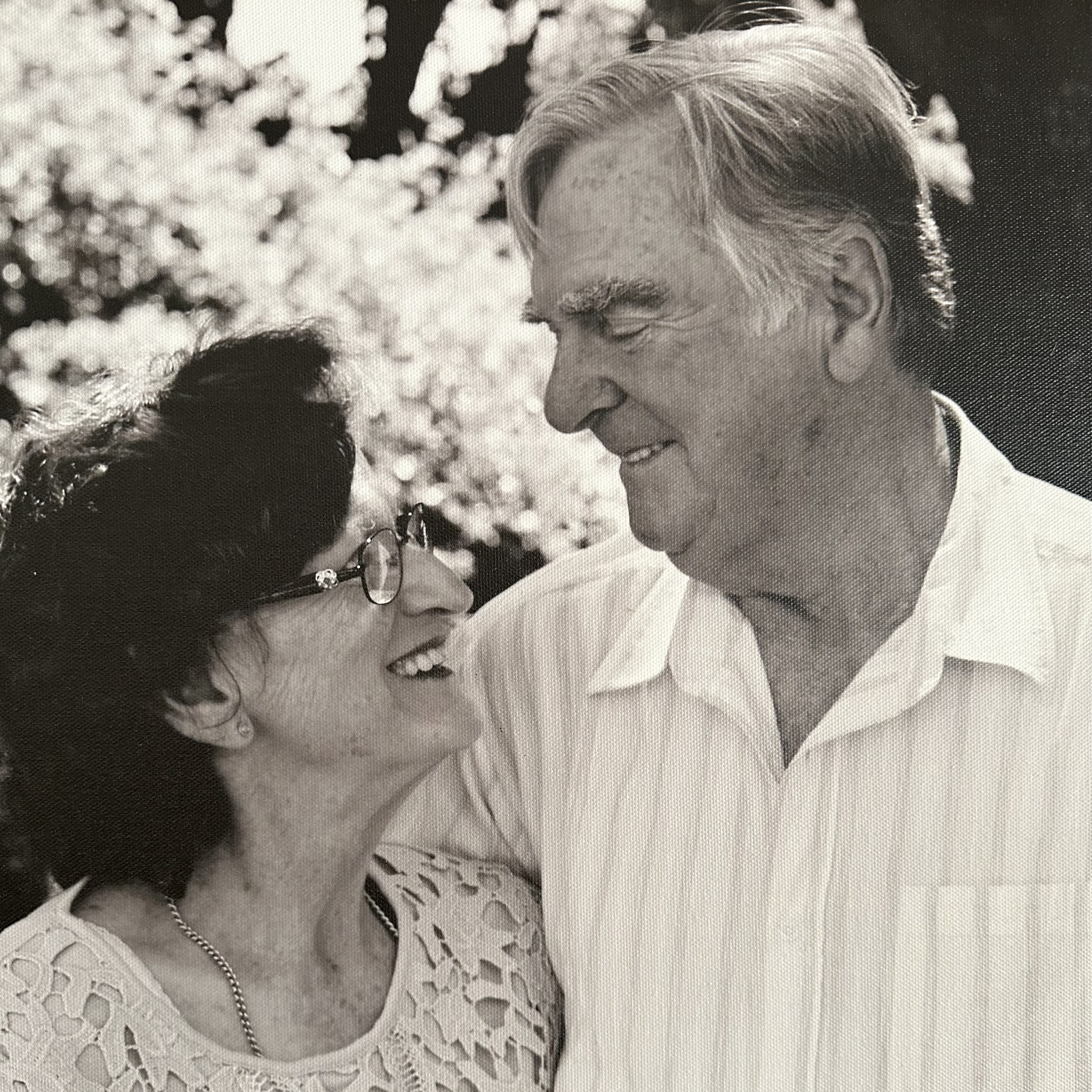
Gavin Larkins recounts his life story, beginning with his childhood in Jolong, where he disliked school but enjoyed fixing things. He trained as a hairdresser, a trade he never enjoyed, and later traveled to England for ten months, immersing himself in culture and history. Upon returning, he shifted to interior decorating and timber work, finally pursuing his passion for fixing things. He met Carol in Benella, proposing twice before they married seven years later. They raised four children and enjoyed ballroom dancing together. Gavin opens up about profound hardships, including the loss of his son Andrew in a car accident and Carol's long battle with cancer, highlighting how faith and family strength helped him endure. The decision to sell Warwick Homestead and move to town was influenced by these events and Carol's desire to be closer to church. Despite changes, Gavin values the Casted community, where he has deep family connections and views it as a place shaped by what residents contribute.
[Music] Hello and welcome to Casted & Connections. An initiative of Hands Up Casted & where a group of enthusiastic locals have come together to capture, preserve and share stories of people who have a connection to Casted & Connections. The Larkins family become members of the Casted & Community back in 1992 when they purchase Warwick Homestead. Those that know Gavin know that Warwick played a major part in his life and his families raising their children out on the farm. To hear about Gavin's memories of Warwick's homestead, tune in to episode 33 of the podcast. In this episode you will learn more of Gavin's journey of life before purchasing Warwick and then life as a Casted & Community member. Thanks so much for sitting down with us to share a bit of your story. We might go right back, Gavin. You mentioned that your mum was born and bred out at Sanford. Did you grow up out at Sanford? Did you have siblings? No, no. She was born. She was the eldest of eight children. And she married my father. He was camped down. So where did Danemeat, whereabouts did Danemeat? A ball of campar down. She went down to visit a friend of hers at work down there and met dad. That was it. So was that then where they continued their life and where you were born up then? I was born in the camp at Ann. Mum and dad were at a wearerite, which is just the bit out of going towards Coalang. But then with the war he was called up and he finished up down at the annex, the Ford annex. And he was working on the detonators of the mines. And by all accounts there was few people who could set these and dad could set them. So he was there all right through war. And how old would you have been at that time Gavin through? Oh, only a youngster. And do you have many memories around that time or not? No, no. Well thanks to your dad and he's service. Much appreciated for us here today. So what happened then? You mentioned that he worked all right through the war and then what sort of happened with. Well, with your family and where were you situated and those sorts of things? Mum and dad settled in Jolong then. They didn't go back to the camp at Ann. And I was schooled in Jolong. So you did all of your schooling in Jolong hot but I'm primary and secondary company. And what sort of student were you? I reckon you might have a real deal. I hated school. Really, okay. My sister, she's three younger than I am. And she was the brain of the family. And I was interested in things that needed fixing even as a child. Where my sister. She was very clueless. And she's still. She's three younger than I am. But no, I was a deal with school, country school. I think all boys are maybe a bit of a deal when they're at school. I think it's just a part of the writer passage, isn't it? Hell. How long did you go to school for? When did you finish and what were you looking at trying to do when you finished? Did you go right through to Year 12 and finish? Or did you finish earlier? No. Year 12. And then. There was a job offering hairdressing. Okay. And my father said, "Oh, you want to hit that?" So I got the job. You're a hairdresser by trade. I didn't know that, Gavra. I did not know that. The hairdresser. And I got my apprenticeship. In those days we had. We were now, there's no apprenticeship now with hairdressing. And I went to Melbourne to get my certificate down in Perane. And the head of heritage said, "Oh, you want to go into the ladies hairdressing? There's more money in that." It was four and six a haircut. And so anyway. I was easily lead. It was not. He said, "Well, there's a job in Colin Street. You'd be able to get that." And I don't know why I did because I didn't particularly like the hairdressing. It was just a job. Anyway, I went in and this chap who had been a male hairdresser and went into the ladies hairdresser. He said, "Yes, you know." And so I signed myself up to another six years. That's a long time. And anyway, by the time that was up, I'd had it. And so there was a position in Benella. And I went up there and I got the job. Still as a hairdresser? Yeah, but that was ladies hairdressing. And I finished up buying the cell on. I had that for what five years I've had worked. Just before we got any further gap. So you do your hairdressing apprenticeship, you get a job, end up in Benella and you buy this place. That's all okay. I'm excused by ignorance. But as a back then, was it uncommon to have a male hairdresser? Or there were lots of male hairdresses? No, it wasn't uncommon. Especially in the city. And you're specialised in either cutting men's hair or cutting women's hair? Well, see being a hairdresser, male hairdresser, you have a bit of an idea what the lady wanted. Now I finished that second apprenticeship and I went to Benella and I was just so I'm. So when you mentioned that you didn't really enjoy the hairdressing, was that just because you're in, you know, in Colourstrate in the city? Or when you purchased your own that you became to like it or you were just doing it because that was your job? Yeah, it was my job. No, I. It's an interesting decision to buy something if you're not actually enjoying it. That's right. No other choice, I suppose. Yeah, that's right. No, and then I had that for about four years, I think, something like that. And I was sick of women, bitching. You know, they used to come in and they'd be bitching on about their husbands.
And of course, he didn't buy into it. He used to say, "You're going to cut your hair or don't want to do it?" Yep. And so in the finish, I decided I was going to have a holiday and a client said about it and she was English and I said, "I'm going to give up." Anyway, Baden, her husband was a bank manager there and we went out to dinner at night on the Thursday night. I remember that. And Baden said, "What are you going to do?" And I said, "I don't care. I just want to have a break." And he said, "Joyce said, "Why don't you go overseas?" And I said, "Oh, Baden said, I can arrange that." "Oh, yeah, that'll be all right. Easy come, easy go." And two days later, he was on the doorstep with my tickets. You know, he had organised it. And so off I went to England and I had 10,5 months travelling around and then I didn't go back in the hairdressing. I went into interior decorating and timbre work. So before we move into that gap, so overseas, how old are you at this point in time? I was 24. And so went to England for 10 months, so seen a fair bit of the countryside. Were some of your highlights while you were over there? I went around all the old buildings. You know, you go overseas. I didn't go to all the night clubs and all of this. I'm usually as a young 24 year old to be going the other way, I guess. But I didn't see any value in that. So you really just took in some culture and a bit of history? Yeah, yeah. And I was making sure my money would go the distance. It will 10 months is a long time to survive over there. Yeah, yeah. No, it was good. So you come back to Australia and you've thrown the hairdressing instead of had enough of that. So talk to us about the next step in life and what your next movements were. Well, I was doing a bit of a job for a cousin. And anyway, he was the first thing I'd heard. The cronies used to turn up for cards on the thirst and I had replaced a tapestry fire place that had been removed. And so you finally got just before you continue to go to Suridh Indira up. You finally got to doing the fixing that you said you loved so much as a kid. You finally get into that sort of market. That's right. Yeah. And that night a lady said, oh, would you come to my place and I don't know how long. I reckon it was the 12 months that family kept me occupied or him. I'll occupy, but doing jobs for them. Yeah. And then when that was over, I went back to camp at Elm. And there was a rooming house there and it was closing down. And back of me dead, I took it on. I would have 2022 in the rooms. It was a two story play. So I took that off. Made a little bit of work on assuming. Yeah. So I took that on and I had that for, I think was about 80 months and I father died. So I gave up on that and went back to Melbourne and then picked up on work and yeah. So I was just a little bit of a little bit of a little bit of work on that. And I was just a little bit of a little bit of a little bit of work on that. Like 20s early 30s. So you've mentioned lovely carol. Where does carol come into the equation? Where do you make carol for the first time and how does your romance start? So when I took the position in Vanilla, C worked at the chemist. And a few, perhaps about four of us, used to go to bulls and that. And anyway, I had my eye on carol. She was three years younger than I am. I asked her would she marry? See, I didn't believe in pussy footing around. But she didn't, she wasn't keen. Her and her mother were very close. And she was 18 at the time. And anyway, that was alright. I eventually sold the business and moved away. And what happened there? Her mother died. And so I had a phone call about the funeral. So I went back and she was still single. And we went to a ball. That night, that night. And I asked would she marry? And she said, "Yes." I think I nearly, what's what I say. I nearly fell off the chair. But anyway, she said yes. And what was the time difference between when you asked her the first time compared to when she said yes? So she said no when she was 18? And it's seven years I think. And we were married about seven years later. Oh, what? Yeah. It took that long in between that as well. Of course, that shocked the family. Mum dying and then Carol. Yes, we had a real happy, happy Lord together. very, yeah. Um.
terci de ♫ Bluetooth Bluetooth. Bluetooth. I've been a mixture. Haven't I been done a lot of stuff. Yeah. And you tried to tell me before we started that it wasn't going to be interesting. You were wrong. Well, my dad think was interesting. He just seemed to be different. He's interesting. But anyway, I never tied myself down to after the apprenticeships. I that was there. And the any other thing that I tied myself down to was marriage. Yeah. And I recommend that to anyone as long as you get the right one. Even if it takes 14 years for it. Yeah. So how did you come to being the shop at Royalytown? Yeah, did that eventually. It was just like a general store wasn't it? Like a milk bar type setup. Yeah. And had you already had the your kids at that stage? Yeah. Yeah. Yeah. So he's got four beautiful children. Yeah. And a fair few grandchildren as well. Yeah, had four beautiful children. And yeah, you touched on just before ballroom dancing. So you and Carol were really big on that? Yeah. We really loved dancing. And we got every ball that was going. And was there much opportunity for that when you come down this way down to Warwick and Stun? No, that had sort of changed by that stage. Young people were going to dances. They were going to the hotels and it was different. Yeah. Balls weren't the thing. And young people were going to the hotel and having a few drinks and enjoying themselves. And it's never changed. Yeah. And they really lost that passion that you had. Yeah. That's right. Yeah. No. No. We had our day. So we might we might talk about Andrew or P. We as I better knew him and the plenty of people around did Andrew to you. Yeah. Obviously, unfortunately, I lost his life in an accident. What do you remember about that day mate and how are you able to say stay so positive? Well, I've got no doubt you would have had dark days. But yeah, I'd be interested to sort of get your thoughts around it. On the Thursday, we were in town and we went around to coxons. Well, that's where he worked. And anyway, we had a few words because he was busy. And so we went home and on the Saturday, anyway, they killed the beast and had a few drinks. And he was on his way home and got to to what's his name's out there. They come up and been in the road. Anyway, he was tired and he come up to Reese's there and they've been there. But what did he do? He kept short and he was driving down the grass on the wrong side of the road. And then must have come to. And he over corrected and went across the road and had a branch on the tree. And they come down on his head and that was the finish of him. That was the hell of a shock. But anyway. How did you cope with that? And how did you help with Carol and the rest of the family and stuff? How did you manage that situation? Because no one should outlive their children. No, no. Our family met a lot to us. And we were just able to cope. We were able to cope. It was a hell of a shock. And to this day, it's to go into the other room there. And he's bad. And he's there and you think, oh, hell, you know, but he enjoyed himself. He was 31 and he always had a smile on his face. How do I think anyone will forget that green? Yeah. And he would help anyone. No, nothing was too much trouble. So in a way, you accept things the way they are. And he had run his length of rope. I think it's amazing the level of strength that you show Gavin. And like, that's a very positive outlook to look on something that's such an excuse a French situation. Yeah, and I can't put it into words to be honest. I think the ability for you to have such a positive outlook on such a terrible situation is a credit to you. I think that maybe has helped with the family and stuff as well. But we had I had Carol. We had one other. And it was a loss. But we couldn't give in. And you had your other kids that you had to stay strong for as well. The other. Bridget and the other two boys. But it's something that you're not expecting to happen. And it happens. And. And it can't get in the corner and cry or. You've just got to sort of. Take it in and. He's gone. Yeah. Yeah. Definitely missed around the place. And I'm sure no more than you guys and the family. So you mentioned about Carol when she had cancer as well. So as you've losing Andrew wasn't enough. You obviously had to go through the treatment stuff with Carol. I guess she had to tear her right over time before she was 14 years. She was having treatment. Yeah. That would have been challenging itself as well. Yeah. It's Hamilton. And. They hear the same sort of. Results each time. And then come to. The next one. And. The same more treatment. Yeah. So. Again, your ability to stay strong in.
such a shitty circumstance is highly commendable. But also with Carol's treatment and her poor health, did that lead to the new wanting to be into, or did that help sway the decision to sell, to sell Warwick and to get into him? Was it to make things a little bit easier for Carol and you as well? - My, Carol, there was no, once Andrew went, he was the one that was interested in the farm and the other two weren't. So, and if the artisans hadn't come, well, I would say we wouldn't have sold, because Bridget, Bridget, a class, a little class, and she really, she really knew her job, the night that they had their class over whatever. The chapter that told her said, oh, I can get to her job anywhere in the world, even at Buckingham Palace. And she was sort of the say, the, Andrew, you need to do sounds, you know, the sheep, but when it happened, young Curtis was Annie, oh, he was Annie, baby, I think. And if he had been older, - Things would have been a bit different. - Yeah, I would have sort of said, you can have, because she shoots sheer, that she loved, you know, and she would, but it wasn't fair with a baby. - Yeah, the timing just didn't line up. - No, no. - No. - Yeah. Yeah, obviously being through as much hardship as anyone Gavin, and I think, yeah, as I mentioned, testament to you. You're obviously a great religious man. Did you find that religion helped you through those tough times? - Oh, yeah, yeah. Well, it means something. It's not a matter of just going there and coming home. It means something. And we were both the same. We both carol like going to church. And she said, oh, it would be nice to be in town so that when they had mass, I could go. The then priest was the Eden Hope, and he would come down in the morning to say a mass. And it might be about six or so. And I used to think, he can come down from Eden Hope, and we're too bloody lazy to get going. So I said, carol, I'll go for you. Unless you believe that the town of De Corny. So I'm still going over Wednesday morning, 'cause carol would have liked to keep her memory. - Yeah, yeah. That's very good. - Carol was a real angel, really. She was a great worker and had a work that was a lot going on. And the thing is, I often said to young ones, marriage marriage is a great institution or whatever you want to call it as long as you get the right one, you won't get anything any better. And I believe that if you think enough of one another, it's not hard. You do it because you love someone. And that was carol, she was, and then you finish up, we sold, and we come in, and I, this house was on the market when I was 18. I bought mum-downs of just her rallies. And I said to mum, I think I'll buy that. Why would you want a house in Kassan for? And then I thought you were why. But of course, that's my way of doing things. I don't think about it for 12 months if it's going to be something I'd do it. And anyway, I didn't do it then. But when we sold, it was on the market. So I thought, here goes. And this kitchen was terrible, home made, covered, it was a bit so. And so I had what's his name? Doesn't matter. He's got a business in Mangambia. To put the new cupboards in and do this up, and she chose the Lionel. It wasn't down, but she chose it. And of course, she went. But she said, when the cupboards went in, she said, oh, Gavin's don't do any more until I'm gone. And I didn't do him, I think more until she was gone. She just wasn't in the right frame of mind to have people coming and going and all that. Yeah, fair enough. Yeah. But anyway. So just on the point Gavin about living at Warwick and then coming into town, what would you say are some of the differences for you and your family compared to living at Warwick compared to living in town? Good, bad or otherwise? Or not much difference, maybe, I'm not sure. I'm interesting. Yeah. The farm, the farm's different to town live. And of course Carol's gone. And what have I got? I've just got a bloody house. It's so many rooms and swimming pools and all the rest of it. But they're not important. The heart's gone. Not the same as home at Warwick, I guess. No. No. So now we were happy. Yeah. And anyway. And the thing is we've never found it hard to entertain people. We always had, when we were in Violetown, we used to have a lot of visitors. A lot of people called again and all of us. That didn't make any difference. That was life. Yeah, what you were used to. Yeah. All right, Gavin. It's been awesome chatting and catching up. I've just got one to finish. So when you make the move from Violetown and your purchase Warwick, what influenced the decision to go from Violetown out to there, to Warwick and to our region? And then I guess what does the Castan community mean to you as well? Well, Castan was always. a holiday destination because of mum's connections out here. So it wasn't hard to move into town. It has changed to what it was when I was younger. But I'm not disappointed. I think castings like most country town is what you put in. Thanks so much for your time sitting down and sharing your story. I just think it's rather boring what you've got there. I definitely disagree and I'm sure our listeners will disagree as well. Thanks HGAB, we appreciate the chat. [Music] We hope you've enjoyed today's episode of one of our homegrown heroes. Jump over to one of our other episodes to continue the casted and connections journey with us. Please don't forget to follow our podcast and share it with your family and friends. Thank you for listening.
Podcast Summary
Key Points:
Gavin Larkins shares his life journey, including growing up in Jolong, working as a hairdresser despite disliking it, traveling overseas, and transitioning into interior decorating and timber work.
He discusses meeting his wife Carol, their marriage after a seven-year gap, raising four children, and their shared love for ballroom dancing.
Gavin reflects on personal tragedies, including the death of his son Andrew in an accident and Carol's battle with cancer, emphasizing resilience and the role of faith in coping.
He explains the decision to sell Warwick Homestead and move to town, driven by family circumstances and Carol's health, while valuing community connections in Casted.
Summary:
Gavin Larkins recounts his life story, beginning with his childhood in Jolong, where he disliked school but enjoyed fixing things. He trained as a hairdresser, a trade he never enjoyed, and later traveled to England for ten months, immersing himself in culture and history. Upon returning, he shifted to interior decorating and timber work, finally pursuing his passion for fixing things.
He met Carol in Benella, proposing twice before they married seven years later. They raised four children and enjoyed ballroom dancing together. Gavin opens up about profound hardships, including the loss of his son Andrew in a car accident and Carol's long battle with cancer, highlighting how faith and family strength helped him endure.
The decision to sell Warwick Homestead and move to town was influenced by these events and Carol's desire to be closer to church. Despite changes, Gavin values the Casted community, where he has deep family connections and views it as a place shaped by what residents contribute.
FAQs
It's an initiative to capture, preserve, and share stories of people connected to the Casted community, featuring interviews with locals like Gavin Larkins.
He and his family became members in 1992 when they purchased Warwick Homestead, which played a major role in their lives.
He trained as a hairdresser, completing apprenticeships in both men's and ladies' hairdressing, and later owned a salon in Benalla before transitioning to interior decorating and timber work.
They met in Benella where Carol worked at a chemist; he proposed twice, and she accepted seven years after the first proposal, leading to a long, happy marriage.
He experienced the loss of his son Andrew in an accident and supported his wife Carol through her battle with cancer, relying on family and faith to cope.
After Andrew's death, none of their other children were interested in farming, and they sold to simplify life, especially as Carol's health declined.
Chat with AI
Loading...
Pro features
Go deeper with this episode
Unlock creator-grade tools that turn any transcript into show notes and subtitle files.
 PodcastTranscript AI