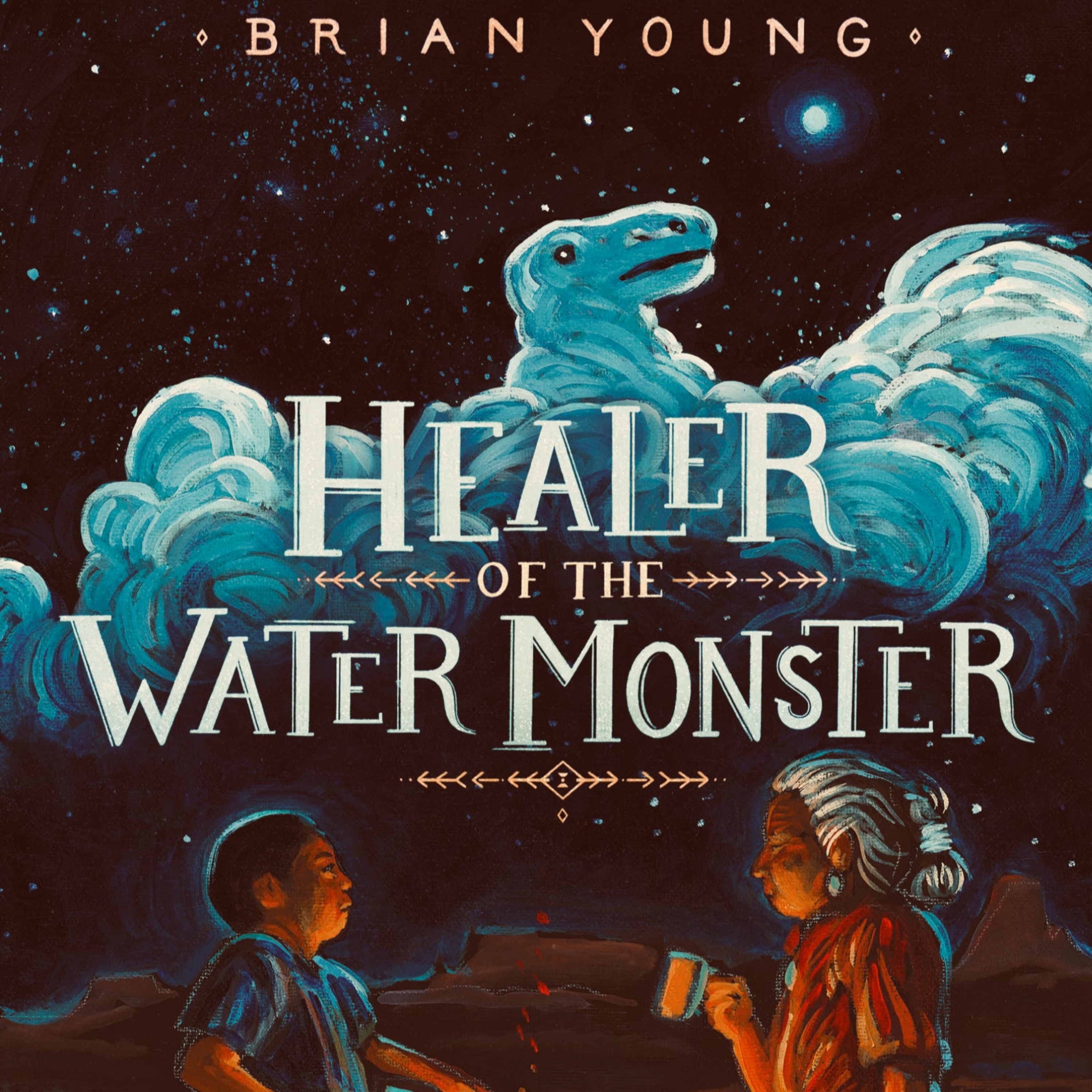
Episode 35: Brian Young and 'Healer of the Water Monster'
from Wósdéé Podcast
37m 17s
Brian Young’s *The Healer of the Water Monster* is a deeply rooted, contemporary Navajo fiction that weaves together a young boy’s summer journey with his grandmother in drought-stricken New Mexico and the revival of Navajo creation myths. The narrative follows Nathan, an 11-year-old boy, as he uncovers a sick water monster from Padjunae Bahaneh—a spiritual being tied to rain and water—whose illness mirrors the region’s 30-year drought. Nathan’s quest to heal the monster becomes a metaphor for addressing real-world struggles like environmental degradation, mental health (particularly PTSD and depression), and intergenerational trauma. Central to the story is Young’s commitment to ethical representation: he consults clan elders and medicine people to uphold cultural boundaries, ensuring sacred stories are not misappropriated. The book challenges colonial assumptions by rejecting the idea of Indigenous people as pre-modern or static, instead showing how traditional beliefs remain alive and relevant in modern life. Brian also highlights the pervasive microaggressions faced by Indigenous authors, especially in publishing, where authenticity is questioned and cultural knowledge is reduced to stereotypes. His work resists appropriation by subtly embedding political and ecological awareness, positioning young Navajo people as vital agents of change and cultural continuity. The story is not only a tale of healing but a powerful statement on Indigenous resilience, sovereignty, and the enduring connection between land, people, and tradition.
(singing in foreign language)
(singing in foreign language)
- Hello there, welcome to The Wishday Podcast.
And in this episode, I talk to Brian Young,
a Navajo author whose book, The Healer of the Water Monster,
was released this year in May.
We talk about how we knew each other prior to its publication.
And Brian tells us about the obstacles he faced
trying to get this book published,
as well as the tropes that tend to still exist
within the writing institutions,
as well as publications.
Halfway through it, we talk about the actual book.
Certain themes, characters, and story plotlines
worth fleshing out.
Some things that I thought were pretty interesting,
were Brian's practices in responsibly and ethically,
writing and incorporating Navajo ideas, philosophy,
and stories within his book,
considering the history of non-natives, writing about natives.
Please support Brian.
If you want to check out the book,
I will keep a link in the description.
I implore everybody to check out the book, read it themselves,
or pass it to someone they might be interested,
or buy the book and donate it to a library,
particularly within the Navajo Nation.
I want to say thank you to Brian for his time.
I want to say thank you for listening.
This is Dorscht, a podcast.
I'm Brian Young.
I am author of Healer of the WaterMonster.
And I am originally from the fortified Somal area,
but currently lived in Brooklyn, New York.
And I can't have, Marley, for having me
on your wonderful podcast in Somal.
Oh, Dev, I mean, I am very, like,
I'm very appreciative of you being on here,
because one, you just wrote a book that I really like,
and I was telling my partner that it's something
a book I'd want to reach to my son.
But it also happens that we have history as well.
We briefly worked in the same way.
We like one.
Yeah, yeah, at DNA Policy Institute,
and you were teaching us, you were teaching me
in a bunch of other co-workers how to get in shape.
We're not getting shape, but to be healthy and more active.
Yeah, yeah, so when you wrote this book,
I was like, wow, I only see this as that dude
who made me get on that half, that little inflated ball.
Yeah, and then you were like, now do squats,
and hold something, and then I was like,
oh, shit, 'cause I remember that,
and my legs were so jelly after that,
because I don't feel like shaking everything.
Yeah, exactly, like, they were like,
'cause for the people listening,
it's like this, what did you call it again?
It's called the Bosu.
There's like a flat portion, like a black portion,
and then there's an inflatable half,
so it's kind of half of a globe.
And it's used for a lot of stability exercises.
It can be a lot of abdominal work as well,
but I love it for its balance.
Yeah, my balance was on point after that summer.
And you made me do squats on it,
and then I was like, this is easy.
But then as I stepped on it, I was like shaking,
and I was like, oh, no, this isn't good.
And then you're like, you need to go lower, bro.
And I was like, I don't think I can go lower.
My legs are getting shaking.
You're like, you gotta do it.
Get lower, and I was like, oh, yeah.
So when you wrote this book, all that I was associated
with you is our work together.
Knowing you from that brief moment,
like that summer, and then reading this book,
I was like, damn, why didn't I ever just ask him?
Like, I knew you were going for like a--
Yeah, I think you guys asked me at various point in time,
like what I was doing, because at that stage
of my writing career, I was just about to go
into Columbia's writing program.
Maroni Benali had contacted me to work
with a group of you guys at DeNec College
to analyze the effects of exercising
in a work environment.
It was a fun time for me.
Yeah, I was just about to go into my creative writing
program and completely rewrite the entire thing
from start to finish.
Were you writing this book, this new book,
around that time, or was it afterwards a little bit?
So here are the water monsters I've been working on
for about seven or eight years.
And when I met you guys, I was still kind of working on it,
but taking some time off from it to give me space
to be able to look at it critically and narrow-quiply.
I really needed to grow as a writer and a storyteller
at that time.
OK, I read the afterward, and you were
talking about how it came to you.
It was like this idea that you had--
well, you were, I think, washing dishes, was it?
I don't remember.
It was like some job.
Yeah, cutting me.
Cutting me.
And I was really like that, because I
too like that.
I daydream a lot.
Can you give us a brief synopsis of the story?
Sure, of course, up the back of my head.
So the healer of the water monster
is about a young Navajo boy whose name is Nathan,
11 years old, decides to spend his summer with his paternal
grandmother, Nali, at her mobile home site just north
of Church Rock, New Mexico, to do a science experiment,
examining the water consumption of heirloom
journals that his Nali has of steed from her family line
versus store-bought journals.
And Nali lives, traditionally, how I kind of grew up
without running water electricity just very, very far away
from infrastructure and isolated.
And the area that she currently lives in
has been in a drought for about 30 years.
And because of that, they have to haul water
and be very conscious of their water consumption.
So one night, Nathan is following something
that has been stealing his seeds and interrupting
his experiments.
And he comes across a water monster from Padjunae Bahaneh,
which is Navajo emergent story or our creation mythology.
And in my fiction, I say that water monsters control
rain with songs and they protect bodies of water,
such as lakes, rivers, and ponds.
And this particular water monster
has been sick for about 30 years.
And because of the sickness, he hasn't been able to sing down
the rains thereby causing the droughts.
So Nathan strikes at the deal.
And to get out of the desert, he will help heal the water monster.
I particularly like the fact that you in this story
were able to bring to life.
I don't even know, because when I say bring to life,
it sounds like I'm playing that.
What you're writing about was dead to begin with.
We're always relegated to the past.
And I think with this story, you do a really great job
of bringing together the contemporary times
with our origin stories and really showing
that they're informative.
And I was wondering when you're writing about this,
the first question being, was it hard to write
about Indigenous people in the present?
Because there's so much literature that makes us sound
like we're prehistoric.
We're pre-modern. We're still just not in modernity.
Well, no. It was super easy.
At least the writing portion of it, I mean,
we are Navajo and we are in modern times.
And that's not a very hard thing to do.
Most of the time, there are some challenges.
But for most of, like I would say, 85% to 90% of our time,
it's easy living in the modern era.
So actually writing a story that does center
around our traditional beliefs, our views
of where we come from, like that was a no-brainer.
Because I was taught that that was how we grew,
that was how we evolved.
And that is where we came from.
And also my grandma and grandpa, who were my main sources
of inspiration for the story and my main introduction
to these stories when I was a very young kid,
would always kind of insinuate that those creation stories
never ended.
That creation era continued into modern times.
So it was always, I say this a lot,
there was always kind of like when we were driving past
like a mountain or a mountain that's in Leda,
Leda is in Tulia, and that mountain over there,
Gubinirunab, that's where the holy beings found
a changing woman as an infant.
So there was always a real tangibility
to those stories to me.
And they'd always say in a traditional listen or watch.
And you'll see the holy beings if you pay attention.
So that kind of belief system and that kind of awareness
of not only the stories, but also the land
was very easy to translate into a book
because that's how I grew up.
But what was difficult about the process was
was when I was pitching it to agents,
when I was in the middle of my writing program.
That was where I found a lot of the prejudices
of natives being stuck in the past.
But when it came to the actual writing process,
it was like, all I could see was the space
where my story could inhabit.
And there was a wide open space
where only my story and very few others existed.
So there's a lot of opportunity in that space
to put natives or natives,
put stories that have natives
in the modern context for younger readers.
- You bring out a lot of things that I really resonate with.
So I'll briefly go over this idea
that the creation story is still ongoing is perfect.
Because to me, that's like a way of countering
this history of us being relegated to the past,
but also looking at like this ongoing,
I'll say struggle because I think in terms of politics,
but like this ongoing struggle,
but also persistence to maintain our presence
within this current political project.
When I'm thinking about this,
I'm thinking about how a lot of our political projects
and struggles are actually tied to the land,
which goes back to what you were saying is it's,
it's almost inseparable.
And in this case, like your story is like the crux of it.
Like it talks about a certain being, a deity,
as you're going through the narrative, you realize that
water and land are almost inseparable.
And I think that's something I'm becoming more aware of,
you know, living in Shiprock and, you know,
trying to grow some tomatoes, like you need both.
- But yeah, I was wondering if you feel comfortable
maybe mentioning some of the tropes that you encountered
when you're trying to pitch these ideas.
I imagine natives still feel like we still encounter
these, I think the term might be microgressions
of how when we talk about ourselves
that people who aren't educated still perpetuate these.
And I was wondering maybe if you were comfortable talking
about some of the things you encountered
when trying to pitch these ideas
that you thought were issues.
- Sure, sure, of course.
I think the biggest thing that became exhausting over time
was the constant need to explain Hajjinaibach
and that to non-Nabaho agents, to non-Nabaho individuals
who weren't familiar with that story, with that history.
So just like I pitch the story to you,
I would have to go into this full kind of tangents
of explaining what the story was.
And, you know, the four worlds and it kind of extended,
what would otherwise be a five minute pitch
into like a 12 minute one.
So, after a while it just became second nature
to also include the traditional stories Hajjinaibach
and that up to the point of where I needed
to get them accustomed to what I was pitching.
But when I pitched it to my best friend
who sadly passed away, he's like Brian,
why are you talking this?
I already know the Haitian story.
And it hit me, it just hit me like right off the head.
Like, oh my God, this is what it's like
to be a minority in the publishing industry.
Because I don't, I have to put in the extra effort
all the damn time when I'm pitching my story,
my book to non-Nabaho's to put myself in that situation
and then to their lack of learning, lack of knowledge.
But more kind of averse of forms of microaggressions
and for those of you who don't know what microaggressions are,
they're like these little annoyances
that you encounter every single day.
And the way I explain them is like a flick
and any given day, like you can just brush it off,
it's no big deal.
Like you have the patience, you have the tools set
to just kind of like go about your day,
having experienced that microaggression.
But living out in the East Coast off of Nepekea,
off of Naval homelands, being the only Navajo
in an environment, in a diverse environment,
it becomes exhausting because that single question
of why do you have short hair?
Why don't you have braids?
You are asked that like at least 50 times a day
for over a month.
And that becomes compounding, compound, compound, compound.
And that becomes really annoying, really frustrating,
really exhausting to have to deal with.
And so like say, for instance, you have a bad day
and then someone asks you, hey Brian,
why don't you have your long hair and braids?
You get pissed off and you, those tools sets
that you have just don't cut it.
And it's not my space, it's not my responsibility
to explain why I have short hair.
And in that line of thinking,
a lot of the kind of microaggressions I encountered
were Nathan's appearance, like the most fresh one
that I can remember, the biggest one I can remember
when I was pitching to an agent was like,
I think you should, an agent said this to me,
I think you should have Nathan with long hair
and a scene where Nully is braiding a feather
into his braids.
So that way the readers will know that he's Indian.
Jesus. And I was like, buy Felicia.
I'm going to deal with you more.
Oh, that's the deal with this.
That's the only appropriate response to that.
Like at that point, yeah, exactly.
At that point, it's no longer like a flick.
It's like a slap in the face.
Yeah.
I think like, I'm surprised because I suspected
that as most native people go throughout the world,
there's this sense of this logic of authenticity
that if you don't look like the authentic native,
that's static in its appearance and practices,
even the way you talk, you are automatically questioned,
your authority to speak on certain things is like questions.
And I kind of experienced a little bit of it.
Not necessarily authenticity, but a different type
of microaggression that has to do more with erasure
when I was in the southeast.
My partner, I would be walking around the neighborhood.
And some person was like, just started speaking Spanish
to us and we were like, I know, right?
And then I'm just like, oh, we're not, we don't speak Spanish.
And they're like, oh, are you not from Mexico?
And I'm like, no, like what?
And then I get, yeah.
And I guess like there's a lot of migration.
So like to hear your experience in the publishing world,
having to deal with authenticity.
The politics of authenticity, like it speaks
to what I think your book does a really good job of showing
that there is no quote unquote authentic native.
But like, and I think the idea of an authentic native
is one that's premised on this idea of native people
not being modern.
Your book shows it's like, no, this is not the case.
Like we're consistently evolving.
We draw upon different things.
So I do like that. And I do think that there's something
about this experience that you have.
When you speak to native, you don't need to like,
devolve everything.
You know, you don't need to like talk about something's sake.
They know there's a boundary that like they cannot cross.
Think you, like, and it goes, I think, to me,
it reminds me of like, Audra Simpson's idea of like refusal.
Don't necessarily have to talk about everything.
This idea of refusal is a political gesture.
It's also, I guess, more of a political act.
- Actually, encounter that in my writing group,
and that's one of the benefits of the writing program
that I went through was that a lot of my readership
were non-navajo, were, you know,
wealthy white people, or like a bit of word.
So I was able to kind of toy with how much I could share
without indicating that there are restrictions.
And when I discovered, when I did say,
when I did have in the story that there were restrictions
that I had to abide by, like, pretty early in the book,
that's when I encountered a lot of,
I don't want to say hesitance, but hyper-awareness,
and a lot more questions to the journey going on at Nathan.
And so that's kind of why I put it more towards the end
when Nali tries to explain what the end of was,
because that's when I needed to kind of explain
that there are four days for it and not,
and that there are certain events going on,
but I couldn't, I didn't want to provide exactly
what was going on.
And so it was a two set first without the explanation
that there are restrictions.
And so that's why I put it there, as opposed to the beginning,
because if you put it at the beginning,
the non-navajo readers just can be constantly thinking,
is what is the author not very looking at me?
So once you bring it up that there's an issue,
that's all they're going to be hyper-focusing on.
- Right, right.
And I think when I first read this,
and I actually liked how you were able to talk about things
in a manner that was not going across any boundaries,
like you did everything very respectfully,
but it wasn't like, what's the word I'm looking for?
It wasn't in your face, you know,
like, and I really appreciate the way you wrote about things.
And I think you chose really pivotal moments
to kind of explain things,
and in a way that felt natural.
And not like, oh, this needs to be,
I need to put this here.
You know, like it flowed really fast.
very well, to me, we're reading as a native and then reading as like things of non-native
because there is a question of, you know, how do you like write about indigeneity without
to, I guess, to a colonial gaze. And I think you did a good job because that's always in
the back of my mind. To me, all this encompasses an ethics of writing. My question to you then
is like, how did you, what guided you in including appropriate content from sacred stories? Like, how
did you know where to set boundaries and not to go too far? Because these things we do talk about
our sacred, but I think you did a great job of just like allowing people to kind of get a glimpse
but not see too much of it. Of course, thank you for this really tough question.
Well, in my initial drafts that I sent out to agents, I didn't shy away from sharing everything.
And in my initial draft, like, I was putting everything down because I knew that those versions
weren't going to be published for the larger mainstream. And so it was a non-issue. It was a
tactic of like getting that huge lump of clay with everything and all those stories and all the
ceremony, all the ceremonial events and activities, but then kind of taking it out and seeing
what is necessary for the narrative. And again, that was one of the benefits of going through
an MFA where I could present the information that is necessary for Nathan's journey,
but also start taking away stuff that, you know, you shouldn't share. In addition to that,
I was also actively seeking out confirmation from my own medicine that I have touchy who
is by clan, my uncle by clan. And I was also asking my mom and people that I knew and reaching out
to various individuals who weren't necessary close to me because I knew that my mom's going to
approve everything because she's my mom. And I knew my tuthy's going to be like, yeah, that's fine,
but you know, in different huthy, you could say, no, Adol, you're not supposed to do that. So
I just want to take a quick moment to if there are people that have issues with what I've shared,
please listen to them because like even just as Navajo's, we are so diverse in our stories,
we're so diverse in the Navajo language itself. There's so many dialects and so many different
variations to those traditional stories and the restrictions imposed upon them. And so if you do
encounter someone in his head, that's, you know, it's supposed to do that, asking how he's been
enough? Why? Why is that restriction? Because there's usually a reason behind it and that reason
is important. But coming back to your question, it was a combination of actively going and meeting
in person and sitting inside a ho-gon with tuthy's and saying, is this okay to share and talking
about it? And having the tuthy say Adol, or Fukushima, that sounds okay. And the non-Navajo
world, the MFA program of figuring out like, what is essential for a cohesive narrative?
It sounds like you engage more with tuthy's in our own government does.
But that's not supposed to be stuff. Anyways, I was thinking about that. But yeah, no, I think
your point about Navajo's not being monolithic is perfect. When I'm reading some of these stories,
I was wondering about all the different variants. It's very leveled. And I think that's one thing
that's great about this is it shows that there is a plurality within the Navajo nation. And unlike
organized religion, you know, where everything's kind of centralized and made to be one legible order,
Navajo's haven't necessarily gone through that. And I personally don't think there needs to be
right now. And I like the fact that there are different stories. I'm glad that you were able to
actually talk about the practices of speaking to these people who are knowledgeable about that.
I don't think that's something a lot of people do. And I think it's a practice that's a very
important thing because literature is consumed just not just by Navajo's. And so like people's
interpretation of Navajo people in general, I'm sorry, and indigenous people in general are
going to be shaped by this. Thank you. That was my huge source of anxiety throughout the entire
process. It's like, how is this? Well, I felt, I don't want to say indifference, but I wasn't as worried
about non-Navajo readers as there was about Navajo readers. And their response and reception
of the book because of how close it talks about things that you're not supposed to talk about,
specifically the diagnosis and thought that any enemy wakes their money.
Right. Yeah, I would rather be criticized by a million non-natives, non-Navajo's,
than be criticized by five sonnies. It would be too much. If I had five grandmas criticizing,
I'd be like, "No, you're right. I'm so sorry. I need to do something else with my life."
This was million people like that word, Navajo. I'd be like, "Yeah, whatever, I don't care."
I don't think that anxiety ever goes away.
Right. For me, it hasn't. I still feel it. Yeah, when I'm talking to non-natives,
I'm very careful with my words as to how I describe it. And if I feel that something a word
isn't the correct way, I really have to describe what I'm talking about so that they know that,
like I said, development. You know, it's a whole baggage of things. And I have to really be like,
when I say this word, I mean this, not this, you know, and I have to like create a whole network
of meaning encounter. I'm sorry, but it has to be deployed so that I don't perpetuate
tropes like that. And I do things respectfully.
Yeah, definitely, especially in this age where like one sentence out of your entire speech
can be warped out of context. It's so very important to be thoughtful about what you say
and how you say it. And yeah, that was something that my professors couldn't understand.
The pressure is of that, especially being like one of the first Native American, especially
Navajo's writing for Navajo's. Yeah, especially being one of the first Navajo's writing for young
Navajo readers that there is an added pressure of this is going to be talked about. This is going
to be reflective and this could potentially guide future books. And they didn't understand that.
They're just like, you just need to focus on the story. You just need to focus on the story.
Like, no, but there is a added level of how it interacts with the community that you guys as
non-Navajo's and non-Navajo's don't have that pressure, you know? Right, right. And it gets
really complicated when you think of the litany of other Native people being represented in
novels or like in work. And like you have this history of why people writing about natives.
And then you have even more recently kind of with this whole like issue of like non-Navajo's
writing about Navajo's, you know, writing a story and incorporating things that, whoa, you
shouldn't be saying this or why are you depicting this? You know, did you ask anybody about this
depiction? I won't say their name, but because that's a whole different. That's a whole
other podcast. But I'll just say like that it caused the whole discourse of like indigeneity
and pretending neonism. But the idea was just like, what is your like relation? And I think this
person was like, oh, yeah, I'm married into the Navajo people that still doesn't gain new access
to kind of write about these things. And I'm speaking about this pressure to really be careful
about what we put out in the world. There's this theme of sickness that is throughout the book.
And I don't, do you want to do spoilers? I don't, I don't, I don't, I won't say, I was, I was like,
I don't want to spoil anything because I do want people to read it. I read it, enjoyed it.
Are you talking about the halfway point? Or like, I'll leave it. There's this theme of sickness
that exists in the book. And I was curious as to what in like, what made you include this idea
of like sickness? Because to me, it doesn't seem, it seems intentional. The way it's attributed to one
person who's going through something as well as just a larger region within church rock.
Well, I don't think it's going too much of just spoiler territory, but there are definitely two
characters that are sick. And Nathan, the protagonist, his goal is to kind of heal both of them.
One is the water monster, whose name is Pawn. And the second is his uncle, named Uncle Jeff,
who is suffering from undiagnosed depression and PTSD and has resorted to substance abuse,
alcohol, alcoholism, he's an alcoholic. I didn't necessarily think of it as terms of sickness,
but things that young Navajos were encountering in their real world,
especially in our era of increased global warming and effects of global warming, like a lot of
indigest nations, not just indigest nations, but people isolated from the larger cities,
like we are encountering the effects of global warming at a much higher rate than our city
counterparts. So it was always a reflection of the area and the people in that area.
not necessarily, I want to set up with a theme of sickness and build upon it, it was more just like, what is the modern experience of a young Navajo growing up and, you know, living on the homelands.
I'm struggling to not say reservation because a larger conversation is moving towards homelands, but that's one kind of hesitating where I'm going to say the homelands as opposed to reservation is just awkward from right now.
But yeah, I think upon further revisions, like the first time that I wrote it, it was mainly like the first drafts I wrote, it was mainly just what are young Navajo kids like me, what I grew up experiencing.
And then as I started getting into further drafts, further revisions and, you know, recognizing the strengths of literature through my program, that's when I started to kind of hear from also my program.
Colleagues that there was this theme of sickness, and once that was brought to my attention, and I started to recognize it, I kind of like just started elevating it a little bit higher, because I think it was more just like a subconscious thing for me in the first drafts, but towards a latter half, not a revisions, it became a little more predominant, and I could purify that a lot easier.
Right, yeah, I think, yeah, I don't, yeah, for me, when I read it, as I mentioned before recording, I read politics and everything.
So when you have one individual suffering from PTSD, and then you have this sick deity, and the reason why they're sick, to me, those two are related, which was this idea of US imperialism, and the function of extracting resources during the cold war, and then you have this individual who came back from war.
And need of a certain ceremony, to me, those were really connected, and that's how I interpreted that these two particular, they're in the same area, it made me think about like the sicknesses, and I'm thinking like the way I'm using the term sickness is like, what's the consequence of an unbalanced world.
And that's what it did with me, that's how I always think I was thinking about the politics that would be rooted in this book, when you're writing this, was there like a politics in this writing to write about things on the Navajo Nation, you couldn't not include this, but these are important histories and politics that are involved.
There definitely is, but because of how many topics the book was already discussing, I didn't feel that it had the space to fully, I didn't feel I had the full space to articulate my thoughts on imperialism and colonialism.
What is the focus, again, was healing, and that would have brought another layer that I just wasn't at that time ready to talk about, and again, my main focus was the idea that this was a continuation of the creation story.
So that was always kind of like one of the main writing goals for healer of the water monster was the idea that the culture was reaching out to young Navajos for help, and that young Navajos could be heroes that young Navajos could have important influence on the environment and the people around them.
And it's not to say, but just even that small statement is political. It's very sad to say, but it's true, a lot of young Navajos don't feel that they have influence or power in their environment and the people around them.
But I can say this, my second book because I demonstrated the importance of the culture is a lot more political and getting into and being a lot more critical of the systems in place that are ravaging our resources, specifically water resources.
No, great. I love that. I think the use of literature that's in fiction is a great medium for like producing politics or getting people to start asking questions.
And to me, this idea of the act of building upon or continuing the creation stories is is is is politics. Imagine what kind of politics we could build if we did pull our pull our values from those stories to also structure our government.
But to this idea that like if you know cellular colonialism isn't just like something that happened to pass its ongoing and there are also other things, other forces that are actually indigenous forces that are also going on like that we shaper environment just as much as this larger project shapes it through extraction.
But yeah, no, I look forward to your next book. I don't want to yeah, I was going to ask you like when's it coming out, but I don't want to pressure you to be like it's going to come out this year or like next year.
Oh, great, great. I'm excited. I'm really I'm like, is my my quite is it going to is it going to continue this story or is it going to be kind of a different one? Oh, great.
Nathan returns. Yeah, it's getting into spoiler territory. So I'm not going to leave it.
But it doesn't just continue his journey. It's like 40 years in the future and Nathan's a council delegate. No, I'm just kidding. Yeah, yeah. I mean one other thing to like the I kind of like sense the a little bit of the politics because of his mother.
She was at a protest and and when particular thing you're like in the background water is life and I'm saying okay, there it is. But that's like kind of like a common experience that most Navajo's have there's always that one relative that's out there anyways.
So I'll end it with this. I just wanted to say my favorite characters are the spiders, all of the spiders. I fucking love the spiders, bro. I I was like I will never look at them the same way again. I liked a chain.
I love how I love them. I love that. I love that arc through your character arc. That actually was supposed to be a horse. I really, really suck at writing horror apparently. No, I mean, yeah.
So I like the spiders. I really like my favorite. The way you characterize the dd's I was like this is great. I yeah, like the way that they had their personalities.
I enjoyed it. My favorite one I had to say was darkness. I don't know why I like darkness. It could be because I'm an emo. Those ones were the ones that come out and I suggest people read it so that they can pick out which their favorite characters are.
My favorite character was completely sea flutter. I did like them. I liked them. I like the way he would. Yeah, I like the way he was written and I like I like his little like quips and I was like this is good.
But yeah, thank you for joining me.
[BLANK_AUDIO]
Podcast Summary
Key Points:
Brian Young’s novel *The Healer of the Water Monster* centers on an 11-year-old Navajo boy who discovers a water monster from Navajo creation mythology during a summer spent with his grandmother in a drought-stricken area.
The story blends contemporary realities—such as water scarcity and mental health struggles—with traditional Navajo beliefs, showing that creation stories are ongoing and not relics of the past.
Young faced significant microaggressions and cultural barriers when pitching the book, including pressure to conform to stereotypes of “authentic” Indigenous appearance and the need to constantly explain Navajo traditions to non-Navajo readers.
He prioritized ethical representation by consulting clan elders, medicine people, and family members to ensure respectful boundaries around sacred stories and practices.
The novel subtly addresses systemic issues like colonialism, environmental degradation, and the psychological toll on Navajo communities, especially through the themes of sickness and healing.
Brian reflects on the unique pressures of being one of the first Navajo authors writing for young Navajo readers, where community reception and cultural sensitivity carry immense weight.
The story’s success lies in its nuanced portrayal of Navajo resilience, modernity, and continuity, resisting colonial tropes by refusing to present Indigenous people as static or pre-modern.
A key theme is the political and cultural significance of storytelling, with the narrative emphasizing youth as agents of change and healers within their communities.
Summary:
Brian Young’s *The Healer of the Water Monster* is a deeply rooted, contemporary Navajo fiction that weaves together a young boy’s summer journey with his grandmother in drought-stricken New Mexico and the revival of Navajo creation myths. The narrative follows Nathan, an 11-year-old boy, as he uncovers a sick water monster from Padjunae Bahaneh—a spiritual being tied to rain and water—whose illness mirrors the region’s 30-year drought. Nathan’s quest to heal the monster becomes a metaphor for addressing real-world struggles like environmental degradation, mental health (particularly PTSD and depression), and intergenerational trauma.
Central to the story is Young’s commitment to ethical representation: he consults clan elders and medicine people to uphold cultural boundaries, ensuring sacred stories are not misappropriated. The book challenges colonial assumptions by rejecting the idea of Indigenous people as pre-modern or static, instead showing how traditional beliefs remain alive and relevant in modern life. Brian also highlights the pervasive microaggressions faced by Indigenous authors, especially in publishing, where authenticity is questioned and cultural knowledge is reduced to stereotypes.
His work resists appropriation by subtly embedding political and ecological awareness, positioning young Navajo people as vital agents of change and cultural continuity. The story is not only a tale of healing but a powerful statement on Indigenous resilience, sovereignty, and the enduring connection between land, people, and tradition.
FAQs
The story follows an 11-year-old Navajo boy named Nathan who spends his summer with his paternal grandmother, Nali, in a drought-stricken area north of Church Rock, New Mexico. While conducting a science experiment, he discovers a water monster from Navajo creation mythology that has been sick for 30 years and unable to sing rain, leading Nathan to help heal it.
The book integrates Navajo creation stories and spiritual beliefs, such as the idea that water monsters control rain and protect water sources. It shows how these traditions are living and relevant in modern times, not just historical relics.
Yes, Brian faced prejudice and microaggressions, including being asked to change Nathan’s appearance to look 'more indigenous,' and having to explain Navajo stories in detail to non-Navajo agents, which extended pitch meetings significantly.
The book explores themes of drought, environmental degradation, mental health, and the lasting impact of colonialism and resource extraction on Navajo communities, connecting them to broader global issues like climate change and imperialism.
Brian consulted with family members, clan elders, and his own medicine person to confirm what could be shared, respecting cultural boundaries and acknowledging the diversity of Navajo traditions and dialects.
Sickness is used both literally—of the water monster and Nathan’s uncle, who suffers from depression and PTSD—and symbolically to reflect the real-world impacts of environmental and societal crises on Navajo communities.
Chat with AI
Loading...
Pro features
Go deeper with this episode
Unlock creator-grade tools that turn any transcript into show notes and subtitle files.
 PodcastTranscript AI