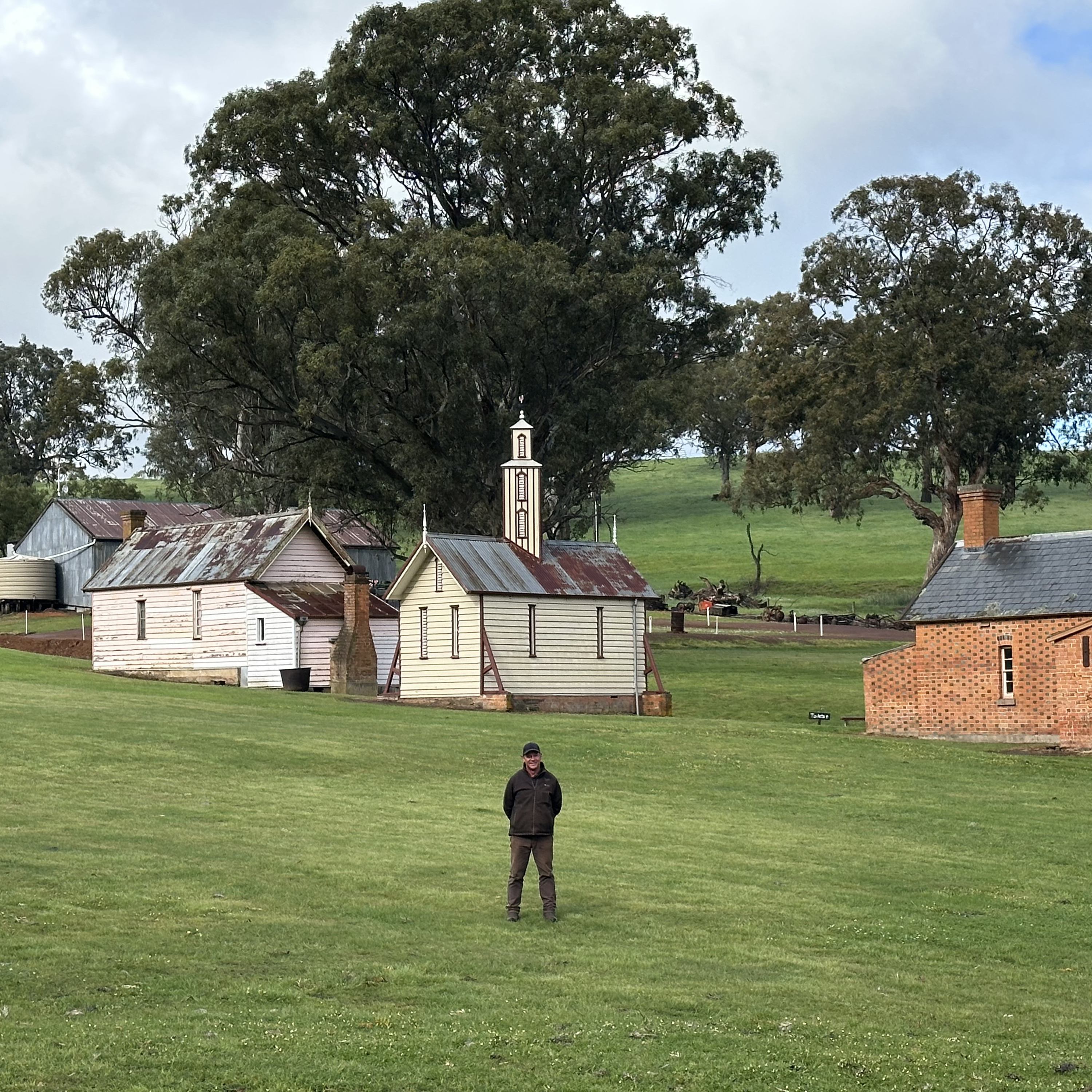
In this interview, Scott Farquharson details his journey of acquiring and restoring Warwick Homestead, a heritage-listed pastoral property. He came to own it after the tragic passing of a lease partner led him to purchase the estate from the Larkins family. The restoration began with an overwhelming cleanup of overgrown grounds and damaged structures, starting with the homestead itself—a 12-month project to repair plaster, replace boards, and install a new kitchen. The gardens, originally designed by notable figures, required a decade of work to restore. Farquharson emphasizes the challenges of preserving irregular, non-standard buildings by using a Lucas mill to custom-cut timber for repairs. The homestead now houses historical collections like early sewing machines and a valuable ormolu vase, while other site features include a century-old weather station, a historic shearing shed with chalked worker names, and museums containing artifacts from the Robertson family and the J.S. Warner collection. Motivated by a desire to preserve Australian pastoral history, Farquharson has transformed the property into a tourist attraction, with ongoing work to restore the remaining buildings.
[Music] Hello and welcome to Casted & Connections. An initiative of Hands Up Casted & where a group of enthusiastic locals have come together to capture, preserve and share stories of people who have a connection to Casted & Connections. Hello and welcome back to another episode of Casted & Connections. Thank you for tuning in once again. We've got part three of our Warwick Homestead mini-series with Scott Farquhousen. If you haven't had a chance jump over to our other episodes, episode one of the Warwick mini-series with Adam Robertson and episode two with Gavin Larkins. But we moved to present time now and got the pleasure of sitting down with Scott. Scott, thanks very much for joining us. Thank you, Kane. Thank you for coming out, mate. It's brilliant. No worries at all. I must say I've just had our walk around in a tour and being the first time being out here. I'm a bit overwhelmed and not really sure where to start. So bear with me and I hope I can do it justice. But I guess Scott the first question to you is made. What was the appeal about Warwick Homestead and what brought you to being an owner after the Larkins? It's a very interesting topic, Kane. Why? Well, originally, with the history of it, to be honest, we were going to, originally, the Larkins family had a young farmer called Andrew. And in 2015, we started a joint agreement that we'd lease one two-thirds and he'd have one-third as he evolved and got bigger. We'd move out of the lease and he could take it over. Tragically, on the second of the May, 10 years ago, he passed away. So that left with no one with the on the other side of the lease. So start leasing the whole property. After a period of time, I approached the Larkins family, Gavin. He had a fair bit of drama going on in his life at the time. And we came to a agreement that he sold me the property. So I bought the property for the dirt and it came with the heritage listed village. So what do you do? You start putting it back together, mate. Yeah, it's an interesting way for it to come about, obviously, tragic circumstances. But to think, yeah, you're looking, obviously, at the farming side of things and yeah, you get this absolute empire. Where do you start? What's your thought process when you get to this side after you've done your farm side of the work? Yeah, well, the farm side was easy. We pulled in and we pulled a lot of stumps and we reparsed and we re-fertilized and we put in a ridiculous water system and we got the grazing management rights. So the farmers were walking the park. And then we come to the buildings. Where do you start? So we came to an idea that we'll start from one building at a time. We won't rush it too many. First of all, we wanted to clean the grounds up. So we started moving large amounts of timber, large amounts of scrap and thought that the first place to start would be the home stead. So we got in there with a rare plasterer and he readied the plastering on the internals. And then over a week we painted all the externals and replaced the boards on the external of the house and then we put a new kitchen in through the home stead. So and then we decided we'll buy some of the old furniture to read your rest of the home stead, hoping that someone would move into it. But now it's turned into a tourist attraction. No one lives in the home stead. We just use it for tourism. So we fixed probably the wrong building up for starters, but it's came up a treat. We polished all the floorboards and got some nice decorative artwork for Australian history. But the thing that probably really gave me the passion and drive is Warwick in itself is a prime part of Australian pastoral history. And I don't think Australian pastoral history gets the recognition it deserves for what it does for the rural economy. So I like it just as a donation in my time and my family supported that we're just preserving Australian pastoral history, mate. As I say, walking around it was absolutely amazing to go through some of the stuff and we'll touch on a few other areas that we did see and hopefully we can get a bit of a visual for everyone listening. But when you start that journey and the cleanup process, you mentioned you started out, so can you describe what that looks like? Like you come in and I'm presuming it's pretty overgrown and grass and stuff everywhere. Like is it overwhelming to start and then yeah, where do you actually start to see the progress? Yeah, it was a bit overwhelming, but luckily we've got a good support family and a large group of staff through our cattle farming enterprise. So we all got down here and we did a bit of a SWAT analysis of where to start and we just pulled him with some lawn mowers and some gardeners and some bit of spraying here and there and then progressed into putting a unlikely there'd been two pretty horrid windstorms going through Warwick in the past. So we got a build at a common help us and we put 5,000 roofing screws back through the iron and screwed it back together and did a bit of drainage work and got some fencing done. So we've made it, you know, we've kept it as close to the buildings as we can with the so the maintenance is easier. So we've refenced the entire grounds to make it stop-proof and we wanted to make it fireproof. So we put in a bit of a articulated water system and we kept the grounds moan so hopefully it doesn't burn down because all the buildings are mostly timber. So yeah, we kind of started start from the start, and at the finish we're not at the finish yet. Yeah, but we're still going. Absolutely. The power of work spent. What about the garden? What sort of state was it in and walking around just a moment ago? It doesn't look like it's not been loved at all ever. It's in fantastic condition. Was there a time and effort that had to be put in to get to where it is now, or was that pretty well as it is as we sit here today? No, there's been a large amount of time and effort have gone into the garden, mate. So the garden itself was put in by William Gilfoil. So he did all the main structural garden trees. So he did the Hamilton gardens and the Royal Botanical Gardens in Melbourne and then the famous Edna Walling she came through when Tiseyduck the garden with little rock walls and hedging and other bits and pieces. So the bones of the garden were there. It just needed to be pulled into line. So we just pulled out a hell of a lot of Elm suckers and there's a few fallen trees after the windstorm. So we pulled those old trees out and we've milled them into floor boards and milled them into tables. So we've pulled out that part of the garden and then pulled them with a couple of lawn nowers and it's taken 10 years to get the hedging up to a Mickey Mouse condition. And I'm very proud of the way the garden is presented today. Yeah, absolutely. It is stunning and I think one of the things walking around seeing the reuse of yeah, trees and using them as floor boards and stuff is fantastic preservation. So in terms of when you are going and preserving the buildings what sort of challenges do you face? Keeping them to code with its history and yeah, any challenges that you've come across in any particular building? All the buildings are a challenge cane. None of them are straight, none of them are level, none of them are square. So it's a build is nightmare. But we're lucky enough that an older gentleman in Castan taught me how to use a Lucas mill and he tried me how to cut red gum timber. So we're able to pretty well, our bunnings is a Lucas mill and we will mill timber to spec for each building. So they'll do the structural bones of the building, the floorpates and other bits and pieces. And if we need to replace all the weather boards, we'll either hand mill the weather boards or hand mill the pickets or you can buy bunnings, bunnings weather boards these days and just smack them on and repaint them. So no building has been easy. Every building has been a challenge. What I thought would take a week would take a month. I think out of the 31 buildings, currently we've done nine and we're just progressing from the next one to the next one, no? Yeah, amazing. So when you mentioned that you started with the homestead first and you mentioned that it taking longer than you first anticipated, what sort of time for you to take you from start to finish to get that to where it is today? The homestead that is. The homestead to where it is today, still ongoing. We've probably got to go through. We've had a bit of a miss out that the paint that we're using at the moment should last 20 years, but it's reacting to the old lead paint that they use back in the day. So it's only last 10 years. So we're going to have to go back on our work and start again. But the original homestead to do the bones of it internal and external took us 12 months. Yes. It's a pair of work and yes, come up an absolute treat. When we were walking through there, there was a few things that really I guess grabbed my attention for like a bit of phrase, but the sewing room, just can you try and describe that for the people who haven't been out here, what it was, how it set up and what it looks like? That's a challenge for me, mate. I know the sewing room itself, but it's full of singer sewing machines from the early 1800s through the early
I think there's five or six of the early sewing machines that are perched up in there on a little school kids' inkwell that the kids used to go to school on. So the sewing machines, I don't know where they've appeared from, but that's the sewing work room where the ladies used to sit and sew. I'll stitch Scott up there a little bit. I actually was hoping Peter the caretaker would come in and help him out, but he's under the other side of the room. What about the awkward vase? Can you describe that to listeners what that is and how you come about having it back in the homestead? The awkward vase was bought out from Scotland back in the early days and it was donated to us by the Paterson family and they were kind enough to leave it at Warwick Homestead and it is a quite valuable piece. They used to propagate their own orchids for show just to live in the house and they've been kind enough to donate that little piece back to us mate. Yeah, it looked like a very intricate piece of furniture, I guess, for like a bit of term and I'd hate to think what it's worth and glad that I'm nowhere near it so that I can't break it accidentally. What about the smoking room mate? Just describe that to people. The smoking room has got a very checkered piece mate. We won't elaborate too much on this one, but the gentleman's smoking room in the evening, the gentleman's used to retire after having dinner and they go into the smoking room and retire with a glass of scotch and a cigar and catch up with some of the women or maids later on in the evening. They used to be a very social event, you could say. Very interesting, we'll leave that one where it is I think. What about can you describe some of the record keeping, we went through some of the stuff like the rainfall records and things like that, just the notations that Robotsons kept and then it's gone right through generations to explain that to the listeners. So Warwick's had a great history with the Bureau of Meteorology which is still ongoing. So they've had a Stevens and Screen here since the Robotsons have had a Stevens and Screen here since day dot they've collected the rainfall records, weather, temperature and other bits and pieces and his weather station is still, we've put it under cover because we've had a newer agreement with the Bureau of Meteorology that's installed a special state of the art rain gauge on top of the hill which is current and alive feed on the Bureau of Meteorology. So we've had the weather going on for years mate, for years. And had all those records going right back. There was also no too, I think it might have even been in the smoking room around the snowfall I think from back in Georgia's time as well as when there was some snow from the Larkin. So that was really interesting as well. So as we moved around obviously lots of different history all throughout the homestead but moving through to the woodworking shop. So have you restored that yet what's that sort of looking like and just describe some of that for the listeners? The woodwork shop mate, you've got plenty of character. Yes plenty of character. So we're lucky enough that it's the woodwork shop has got a Rommelson Tippett 11 horsepower stationery motor still in working condition in it which runs all the overhaigir which runs the chaff cutter which runs the winnowing machine which runs the saw blades. And also in there we were lucky enough early in the days we had an MOU with some of the brewing kids that came out of Hamilton. They came out and they put a brand new floor in part of that room. So we've kept it together, we're keeping it preserved and it's still standing upright mate but it's looking good. Yeah absolutely and Scott mentioned earlier when we were walking around that a couple of the kids that actually did replace the floor actually have gone on to become builders. So I guess really helped them decide their pathway. So fantastic they could get there and I guess try their hand and keep going down that track. What about I think you mentioned about the people who actually were cutting or milling the timber that is sort of two rolls in that, someone on top and someone down the bottom can you explain that to the people? Oh the saw pit mate, the saw pit. So if anyone knows what a saw pit is it's a big hole in the ground where they roll the log above the saw pit and they get a person on the top of it which is called the top dog and they get a person down the bottom which is the bottom dog. So one person has to do all the lifting of the saw for the day and the other person sits down the bottom has to get covered in sawdust for the day. So luckily we've evolved from their name and we've got some better technology but yeah now that would have been a pretty challenging job in this day. Absolutely I'm not sure which one I'd rather be whether you're doing the hard labour or you're getting all the shit put on top of you. I'm not sure which one would be the way to go. As we continue to move around and it's a bit of a shame that we picked the worst day of the year I reckon with the wind and the rain and everything couldn't do it as we're going but obviously we went through buildings after there so the bitches kennel do you want to just give a little bit of history around that? Yes mate. The bitches hell efforts are fetchingly known it's got the plaque on it from the Kelpio Association of Australia to say this is where the birthplace of the Kelpio is out here at Warwick Homestead. The bitches hell it is a little building that is bricked in it's about three metres high it's got a one metre ballast right around the top of it with steel rails it looks like a jail and it was put together to stop the dingos from breeding with the Kelpies back in the day so it was illegal to breed any other imported dog with a dingo and they hunted the dingo out of Western Victoria in 1888 mate so yeah it's a very interesting little building looks like a jail. Absolutely with the preservation of that what sort of time frame and how did that unfold? The preservation of that that had unfortunately with the wind storm they're going through had a tree that had landed on it and knocked over all the balustrate around the top. We're lucky enough to have a gentleman that was just the starter covid anyway he was a very passionate person between him and myself we cleaned up the 133 rods of steel what we taught would take a week took a month and we stood it all back up again but it's still standing nicely today mate repainted and re-breathed it's good. Now looks Mickey Mouse right now as we move around this next part I found it's extremely fascinating look at all the different wagons now can you describe the different ones that you've got parked up in the shed? Roughly mate I can give you a rough idea. We've got a very rare old horse drawn firecart so according to CFA Victoria they want that one down in Melbourne in their museum but they're not getting it's staying here and then there's another two carts up the back of the cane and the weight of measure how much weight a cart can take is you measure their wheels that's how it's pointing out to you mate. So if you're the width of a wheel on a cart is an inch they can take a ton and we've got a three inch cart up there so I can take three tonne mate and then what else is up there in that shed? An old McCormick Deering tractor with a steel like wheels mate. Everyone tries to crank her over but she just won't fire so you know there's a bit of character in there. Absolutely there's plenty of farmers around that I'd love to have a look at that so make sure you pop out during the open times and check it out with the CFA Victoria wanting the cart I believe it's one of two maids so the one they've got's not in the best nick so yeah good luck you don't think you'll pry that one out of here. I guess the history itself around here is unmatched but you've sort of got two museums you've got a museum around stuff that's from Warwick but you've also got another museum did you want to talk around that a little bit? Yeah yeah I can talk about the second museum so Warwick's got its own museum full of old George Robertsons bits and pieces and trinkets and other pieces from the days all the way through which is still in perfect condition and the other museum we're lucky enough J.S. Warner the famous Mr. Warner who got an order of Australia metal from Powers Creek his daughter Anne Warner was kind enough to donate his museum back to us so we've got the J.S. Warner collection and it's from mostly up around Eden Hope and there's a thousand pieces in it from all sorts of other little trinkets. Parts are in the house and parts are up in a whole building full of pieces yeah it's quite good to look at now. They're all fantastic and yeah whether you're in the house in the homestead in the museum or the George's or Mr. Warner's like yeah they're amazing but in the Warner one I was particularly interested around the cricket bat in the corner a little story around it. Well apparently the cricket bat in the corner was bought out by the West Indies when they came over and paid the is it the Queen's 11 or the King's 11? I'm not too sure. Yeah from the Johnny Miller first nation's side I think yeah. Yeah yeah so we're lucky enough the J.S. Warner collection he's got one of the original bats that came out from the West Indies I wish it was signed and dated but apparently it's sitting there in the corner too mate. Yeah amazing bit of history and yeah like Johnny Miller we're keeping that one here. As we moved around obviously we went to the other buildings but the shearing shed is obviously one of the big pieces that I guess people recognise with Warwick. What are some of the key pieces of the shearing shed or what makes it so special? The shearing shed is one monster structure mate. It's a big timber structure. It took a fair while to build. It's all built out of hand cut timber that's put together like a mechanic set. I reckon someone estimated there's over 180 tonnes of timber in their mate and the best part that it's got such a long history and there's so many locals that have still got their names in chalks under all the way through it so if any cast of
locals or shearers. If you want to come and see where your grandparents have probably worked, come and have a look through the shearing shed. That's pretty intriguing. Absolutely. There's also in the same chalk markings, you know, pay rates of rest about over the years, dating right back to the early 1900s. Even just to see the wall press, you know, back then it's a very, very impressive piece of machinery and would hate to think how challenging it would have been to their presser at that stage. They did try and upgrade their technology, am I correct in that, in saying that? Yeah, they did try and upgrade their technology, the Patterson Brothers design, something called the Warwick Box. And they were quite engineering at that time. They tried to bring in some new technology, but it just didn't quite work. It ran off the same over-head gear as what the shearers were used to use Cain. And it slowed the gear down too much, so it was a bit of a failure. But if they had a second remoder, they would have killed the pig, but that didn't quite take off. Yeah, absolutely. As we learnt in the previous two episodes about the Warwick homestead, this place was all self-sufficient. And I guess you've got the mammoth task of getting everything back to sort of where it could be. Is there, in the ten years that you've been here, what have you found the most challenging and what have you learnt the most that you will take forward in the next ten years in the preservation of these historic buildings? Oh, that's an open one mate. That's an open one. Where to next? What do you look for? Well, every day is an adventure, an excitement and a challenge. What are we going to do? We're just going to keep preserving what is here. We're going to keep fixing building by building. And you never know what comes through the gate. You meet some amazingly nice people. That's one thing that's a real bonus with the system. You get groups coming through. You get film companies coming through. You get some very interesting people. And it's a good offshoot of the farm to come over here and get some time off and meet new people, mate. That's great. Absolutely. We're more just touch on the film mate. Can you give you a little bit more information or background about that or is it all hush hush? No, no, no. The film is the film, mate. It's been, it's done, it's done and dusted. So we're lucky enough, we had 16, probably 18 months worth of planning with this film company. Started off with a little thing through Screens Victoria, which just blossomed into something bigger and bigger and bigger. And with a bit of a, well, disclosed that we weren't able to say anything to after it had been filmed and after it had been released. So we had to be silent for a fair while. And we had an Apple TV came out there probably a month ago. They spent two months here. They spent a lot of time planning for it. And they filmed a six part series called The Dispatcher. And hopefully that's coming out on Apple TV, mate, towards the end of the year in December. So I'm hoping it's not a flop, but we get the last two series of it. So that was a very intriguing job to meet how the film industry works. It was a lot of fun, mate, a lot of fun. And a lot of locals were involved. And I think at its peak, it was 600 people here and they're here for a couple of months. Yeah, it was very intriguing. I guess that and I guess just the work you're putting in here at Warwick, the boost in tourism and the economy and town and everything, it's an amazing thing that's been, that you're doing being able to put it back into our area. And yeah, there's lots of places that are going to benefit from that. In terms of the preservation of the buildings, do you have many challenges, whether that be trying to keep it to spec or someone says you should be doing this or that or what have you. Do you find that that is a challenging part of the upkeep of Warwick? It was a big challenge for the start, mate. It was a big challenge. So it's all class one. It's all heritage listed, all the buildings. But luckily, there's been a duty of works or that they've done a conservative study. So every building is documented, top to bottom of how they were constructed. The only issue was that those conservative studies were done in Imperial. And now they're in Matrix. So when Heritage Victoria came out, they came out a while ago. They were originally going to charge me about $300 per per permit for me to touch anything. They came out there several years ago and said as long as I follow the conservative study and I match it like for like, they're quite happy for me to proceed. So that was a good win. And with the metric and Imperial thing, you can buy tape measures, they're still measuring inches, mate. So it's all good. It's all good. It's easy to fix. Fantastic. In terms of people coming out, obviously it's becoming more well known that putting all the time and effort and preserving the place and doing tools and stuff. How do people actually access it, whether it be a school or just someone within the community? How do they go about coming and learning some of the history of our area? It's pretty easy, mate. You just jump in your car between Thursday, Friday, Saturday or Sunday, between 10 and 4, drive out. It's charged $25 per person for admission. We give you a big mat, we give you a spiel, we'll give you a walk around and come and appreciate all the buildings. Otherwise for group bookings, just look up our Warrochome Stead bookings number and we like bookings above 15 or 20 people if we can. Or 150 or 200 like we've got coming this weekend, just make a booking and come and stay in it. And we've also lucky enough, we've got 10 caravan parking sites, mate. So people can bring their caravan out here and come and camp for a couple of days and enjoy the serenity in the silence. Absolutely. Make sure you do check out the website, learn a little bit more. As I say, it's my first time coming out here and I'm absolutely gobsmacked and still trying to learn a bit. Yeah, you'd wrap my head around it and without being here in person, it's sort of hard to fathom, whether it be what George's built by hand or some of the little trinkets that are around the place. It is truly amazing. Scott, we thank you and your family for the time and effort that you guys are putting into preserving Warwick, helping with our tourism and stuff. Is there anything else that you think that we might have missed that is really interesting about the place or something that you would like to get across to our listeners? Oh, that's a very interesting one, Cain. No, no, no, no. I think we all quite enjoy the little part of Warwick that we have floating around out here. And if you want to jump onto our Facebook page, Warwick Homestead or even follow us, we've just launched a YouTube channel as well. We're going to start going more into YouTube, putting some of the farm stuff and exciting bits and pieces we get into. But no, no, we just like to pay it forward to the community. Hopefully, someone gets some benefit out of it. I know my kids love it coming out here and the local community and the kids love bringing their friends and school groups out here and my kids I asked in this morning, I said, "What do you like so much about Warwick?" And they said, "This squeak in this swing dad." They love this squeak and the old school swing. So, it's quite enjoyable, no? Absolutely. And yeah, I appreciate your time today, Scott, taking me around and time on the interview. Hopefully you guys listening have enjoyed it as much as we have going through it. But definitely come out and put your own two eyes on it because it is an amazing piece of history and something that you definitely should come and learn a little bit more about. So thank you very much. Norris, thank you, Ken. Have a good day. We hope you've enjoyed today's episode of one of our homegrown heroes. Jump over to one of our other episodes to continue the casted and connections journey with us. Please don't forget to follow our podcast and share it with your family and friends. Thank you for listening.
Podcast Summary
Key Points:
Scott Farquharson acquired Warwick Homestead after a tragic event ended a prior lease agreement, inheriting both farmland and a heritage-listed village.
Restoration began with the homestead and involved extensive cleanup, structural repairs, and garden rehabilitation over a decade, repurposing fallen trees into materials.
Preservation faces challenges like building irregularities and material compatibility, with progress made on 9 of 31 buildings using custom-milled timber.
The site holds significant historical collections, including early sewing machines, meteorological records, a unique "bitch's hell" kennel, vintage wagons, and the J.S. Warner museum.
The project is driven by a passion for preserving Australian pastoral history, with the site now serving as a tourist attraction.
Summary:
In this interview, Scott Farquharson details his journey of acquiring and restoring Warwick Homestead, a heritage-listed pastoral property. He came to own it after the tragic passing of a lease partner led him to purchase the estate from the Larkins family. The restoration began with an overwhelming cleanup of overgrown grounds and damaged structures, starting with the homestead itself—a 12-month project to repair plaster, replace boards, and install a new kitchen.
The gardens, originally designed by notable figures, required a decade of work to restore. Farquharson emphasizes the challenges of preserving irregular, non-standard buildings by using a Lucas mill to custom-cut timber for repairs. S.
Warner collection. Motivated by a desire to preserve Australian pastoral history, Farquharson has transformed the property into a tourist attraction, with ongoing work to restore the remaining buildings.
FAQs
Scott originally leased part of the property with a young farmer, but after the farmer's tragic passing, he leased the entire property. He later purchased it from the Larkins family, acquiring both the land and the heritage-listed village.
They started by cleaning up the grounds, removing timber and scrap, and then focused on the homestead first. They repaired plastering, painted exteriors, replaced boards, and installed a new kitchen, eventually turning it into a tourist attraction.
All buildings were challenging as none were straight, level, or square. They used a Lucas mill to hand-mill timber for structural repairs and weatherboards, with each project taking longer than anticipated, such as the homestead requiring 12 months for initial work.
The garden, originally designed by William Guilfoyle and enhanced by Edna Walling, had good bones but needed extensive cleanup. They removed Elm suckers and fallen trees, milled wood for reuse, and spent 10 years maintaining hedges to achieve its current condition.
It is recognized by the Kelpie Association of Australia as the birthplace of the Kelpie breed. The brick structure with a balustrade was built to prevent dingos from breeding with Kelpies, and it was restored after storm damage.
There are two museums: one with George Robertson's artifacts and another with the J.S. Warner collection, donated by his daughter. The Warner collection includes around a thousand items, such as an original cricket bat from the West Indies.
Chat with AI
Loading...
Pro features
Go deeper with this episode
Unlock creator-grade tools that turn any transcript into show notes and subtitle files.
 PodcastTranscript AI