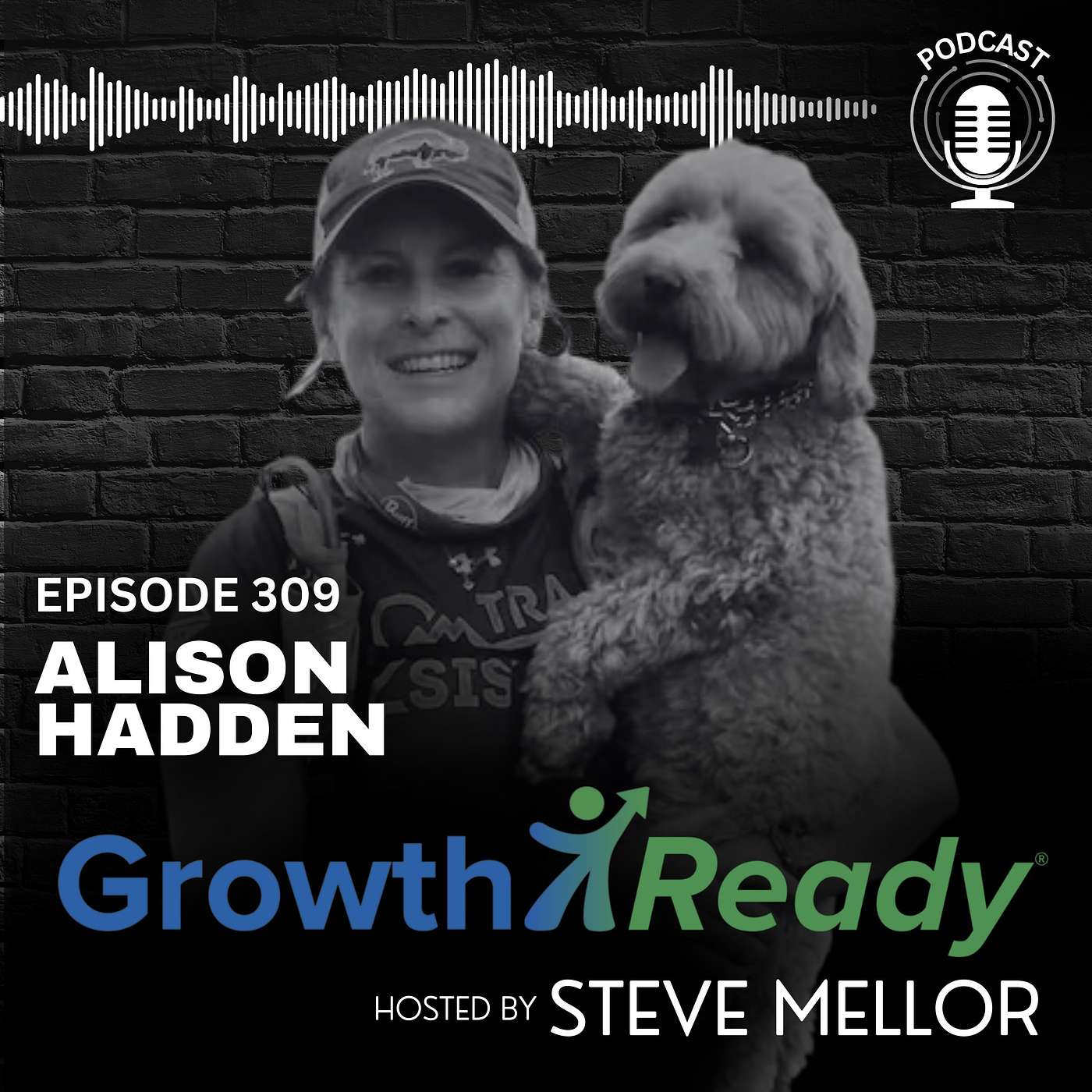
Episode 309: Live With More Clarity Even When Life Gets Hard w/ Alison Hadden
40m 24s
In this episode of the "Growth Ready" podcast, host Steve Mella revisits a 2020 interview with Alison Haddon, a marketing executive and lifelong athlete. Alison discusses her career philosophy, which integrates an athletic mindset—emphasizing grit, resilience, and teamwork—into business, viewing it as a sport. She shares her professional journey, highlighting roles at companies like Active.com and Glassdoor, where she pioneered initiatives and fostered competitive, adaptive cultures. During the interview, Alison does not disclose that she had just learned her cancer had returned and was terminal, a fact she revealed only after recording. She passed away in 2022. The conversation centers on living intentionally, confronting mortality, and using challenges as fuel for growth. Mella reflects on the episode's profound impact, noting Alison's continued work post-diagnosis, including starting a podcast. He urges listeners to reflect on whether they are living life fully, without wasting time, inspired by Alison's example of courage and purpose.
The things that I like to talk about with living life, like there's no time to waste, is first confronting that idea that as much as it's really scary and it's called death anxiety and it's a real thing, tragic things happen and many times lives are cut short and we're shocked and surprised. (upbeat music) - Hello there, it's me, Steve Mella, and welcome in to Growth Ready, the podcast that allows high performers to reveal the reality behind what it means to ready yourself for growth. The personal and professional challenges along the growth journey, while also allowing the high performance executive coach in me to satisfy his curiosity toward what drives optimal performance. (upbeat music) Hello there and welcome into the most recent installment of the Growth Ready podcast. We are bringing you an old episode, repurposing an episode from almost six years ago now. Back when the show used to be titled "Corea Competitor Podcast", it is now obviously become Growth Ready. And during the early years, I would actually create series, 10 to 12 episodes at a time. And this was part of the third series that I made back in the summer of 2020. You remember during that time, most of us were stuck in our houses during COVID. And I actually did a series called "Women Changing the World". The reason why I did it was that my daughter Ella was about a year old at that point. And I was just pro-girl, go, go, go, when it came to women and seeing women be excellent and just I couldn't have be a bigger cheerleader for just women in general at that time. And what was crazy was that when I put this idea out into the universe, I got in and dated with some phenomenal women that wanted to join the show. And there was this one lady in particular, her name was Alison Haddon. And I have never forgotten the day when I interviewed Alison because of the impact that that one conversation had on my last six years almost now of living. Alison actually passed away in January of 2022. And when she joined the show, she had recently discovered that literally 24 hours before recording that cancer that she once had assumed had been removed had actually returned. And this time it would be terminal. What's so powerful about this entire conversation is that she never mentions that, not one time. We went through the entire interview back in that summer of 2020. And it was only when we pressed stop on the recording that she let me know of her recent diagnosis. You're going to hear terminology around what it means to be a career competitor versus growth ready throughout this discussion. But put that to one side and just focus on the content. Focus on what it is Alison brings to this episode and ask yourself, can you relate at all? Because I made it so clear during this interview that I couldn't even relate to the idea of handling such a diagnosis and then to be able to come on and speak so articulately and so intentionally toward what it was that she was experiencing at that point in her life. As I mentioned, Alison sadly passed away about a year and a half after joining me on the show, but she was busy during that year and a half. She started her own podcast. She got people like Lance Armstrong. She got Matthew McConaughey to come on. Katie Curric came on. People that had either experienced cancer themselves or been very close to those important to them who had gone through stages of cancer in their lifetimes. This is such an important discussion for me. I'm so glad that I've been able to not only go back and find the episode, but have this opportunity to now reshare it at this time in my life because what's crazy is I am now of an age that's not too dissimilar than the age that Alison was at the time of her passing. And so I asked that you give this your full attention. I asked that you really hold up a mirror throughout this conversation asking yourself, are you living your life like there's no time to waste? Because the project that Alison began back then that sadly was discontinued upon her passing is something that I have personally kept in mind on at least a weekly basis since that day that she passed away. I hope you enjoy our conversation. I would love to hear from you in terms of how it impacts you. And in the meantime, while we won't learn what it means to Alison to be growth ready, I think that most of this discussion is going to tell you how she would probably have answered that question. Will she hear to answer it today? I hope you enjoy. It is my absolute pleasure to welcome on Alison Haddon to the show. Alison, how are you today? I'm doing great Steve. We're really excited to be here. I'm glad we got to everything working and we're ready to rock 'em all. Absolutely. Yes, there was nobody else will know what we had. An enormous amount of technical difficulties before we started pressing and record here. But like I said, it's wonderful to see you. Pleasure to have you on the show. And your ability to be on the show is so unique simply because you reached out to me. You did something that I encourage all my listeners to do to come up to email me, let me know, hey, I think the stuff you're doing is good. That's always a nice compliment to hear. But then you actually introduced yourself to me. And I had to have you join us on this woman changing the world series. So I am so thankful that you went and took the time to introduce yourself and contact me. And I'm so excited that it's now led to this interview. Before I talk anymore, I would love for you to introduce yourself in more details at all of our listeners. Sure, yeah. And I heard about the podcast after, I think, probably two weeks ago now, I heard Amy, who was the VP at Idea, share her story. And I was on a run. I lived here in Boulder. I moved here in November. And I was on a run nearby in Mount Sinitas. And I love listening to podcasts when I run, unless I need to do some deep thinking in which I put on some solid down tempo beats. And I listened to her. And it was just such a fantastic, such fantastic content. She was a fantastic guest. I thought you were great. And I realized, oh my gosh, this is custom built for me and my story and exactly the platform where I'd want to share it, because I've been, as I say, a lifelong athlete, an adventurer my whole life. And the kind of interweaving of me as an athlete into the way that I have grown in my career and then later led teams to me, as I've said, business has been my sport. So when I heard that you had this fantastic podcast where you were trying to combine, right? The sort of athlete mindset or in many cases, a lifelong athlete like me and how they've applied that into their professional lives, I was like, I gotta talk to this guy. So I did reach out and I'm glad it's been a great fit. I've been super excited to get to meet you. So yeah. - Yes, yeah, well, I am, like I said, it's completely mutual. And as far as, you know, you being a great candidate for the show, you've just alluded there to being a lifelong athlete. - More specifically though, to you, the career woman, tell us a little bit about your background in that area. - Sure. So over the last 20 years, I've really been, becomes sort of a sales and marketing generalist in a lot of ways. I started the majority of my first 10 years of my career at a company called Active.com, which then later became the Active Network. It was known at the time for being the first place for anyone that was running a 5K or signing up their kids for Little League. It was really the first place to do online registration for sports and participatory activities. I loved working active because it felt like my people, probably our people, right? - Yeah, yeah, yeah, absolutely. - Where I told you when I joined that company, you know, on everybody's cubicle was a wetsuit and a surfboard because we were in downtown La Jolla and everyone chose to go for a run at lunch. And it was just, it felt like a group of really smart, driven athletes and it felt like a game and it felt like a team again. And after college, I was really craving that. I then after 10 years there, spent six years at Glassdoor, which a lot of people know now as the place to find, you know, sort of reviews and ratings on different employers. I started there in sales training and enablements, knew that despite having no marketing on my resume and no marketing education formally, that marketing was where I really was supposed to be. And I decided to take the job in sales enablement at Glassdoor and prove my worth. And my goal was to move over into marketing as soon as possible. And I did exactly that. And essentially within a year moved over into marketing. I was there first B2B marketing hire at Glassdoor. I then was given a ton of responsibility over time to really get to try all different types of things and learn on the job in a hyper growth environment, which in my experience is a way to get on a really fast track. It's exhausting and it feels like dog years when you're working for a startup like that. But I really earned my marketing chops there at Glassdoor. And the last few years, I was tapped to go to a company called MindBody, which a lot of people know as the software provider for a lot of yoga studios and boutique fitness studios. and then we moved into sponsor on. It's the software that helps those.
small businesses essentially power everything behind the scenes. I was brought on to help drive awareness around the consumer app that we built, which enabled people to essentially find and book drop-in fitness classes and wellness appointments in their local area at a discount, typically, you know, a kind of last minute. So taking advantage of dynamic pricing. So that was where I spent the last two years. It was an exciting challenge to take a B2B software company and try and have it move into a true marketplace company where they had both the wellness businesses, but then the wellness consumers that were on the platform. But got to lead sort of an advertising test there, expose the company for the first time to mass media advertising. And through a series of local market tests and sort of testing and optimizing and proving the value over the course of about a year and a half, we went with a national ad campaign for the first time under my leadership at the fall of last year, which was really successful. And I'm really, I've come to a place where I'm really proud of my resume because everything I have learned has been on the job in pretty challenging hypergrowth environments with really lean budgets and teams and operational constraints. And I think through it though, I've been able to build that muscle of strategy of sort of seeing the forest amongst the trees of delivering results as opposed to just kind of being busy. And then most importantly, you know, having a real eye for talent and making sure that I hire people around me who are far smarter than I ever will be because that just helps elevate the team. You know, and I think one of the through lines of my career as anyone who's worked on my teams would attest to is, you know, the number of sports analogies that I've believed in, the number of high fives, you know, for me, as I said, business was my sport. And it didn't feel like work, no matter how many hours I put in because as long as it felt like a game, right? It just triggers that the athlete in me that's never going to go away. And I enjoyed it. You know, I enjoyed the hunt. I enjoyed the competition. And I enjoyed, you know, having having different finish lines in my career and then crossing them off. So it's been a really wild ride the last 20 years or so. Absolutely. And the most noticeable thing there for me is there's so many firsts, you know, for you as an individual, but for also for the companies that you were working with, it's noticeable that, you know, you set it yourself when you got into sales, you wanted to try things for the first time. And then you saw that marketing was in your future. You just wanted that opportunity and you knew at some point, hey, this was going to be me for the first time. And then you start and you bring it all up to the most recent and you talk about the first ever national ad campaign, like so many firsts. And I think that says so much about your personality and the ability that you've been able to have in terms of incorporating that into your work. Like you said, business is your sport. That only works if you're remaining completely true to who you are. I think that's what I love about sport is that you get to be completely true to who you are. You get to compete on the level that you want to. You get to do the sports that you want to. It's all about remaining true to who you are. So, you know, just with regards to all of this, tell us just a little bit about your attitude towards your work in over these 20 years that you've now sort of represented to us. In terms of how you've been able to best represent you as a person. I know you touched on there the high fives and the camaraderie and all the kind of thing, but there's probably more of a conscious effort on your part to really instill yourself and your personality into your work. To talk to us a little bit about how you were best able to do that. Yeah, I think first for me, I've only really worked for three companies in my life. So choosing for me, the company that I was going to work for was almost more important than the role that I initially took. Because for the two of the three companies, I moved around. I was given increasing responsibility. I saw little goals for myself as ways to move up and ways to move over. In terms of kind of integrating myself throughout that process, I have to make sure I say like I have to make sure I pick the right team first. Right. So in order to take someone with my personality and that athlete mindset, I'm intense. There is no doubt about that. I have a lot of energy. I have a lot of passion. I have a drive system that is more powerful than most. And as long as it is pointed in the right direction, I can move mountains. Especially when I'm surrounded by or leading teams that all offer skills where I lack or some of my weaknesses. I always think about together as a group, we can move mountains and always use analogies like you can get up the hill if you've got the one rock on your back. But you're only going to move as fast as one person can. But if you're able to have a group of people around you. So having that mindset, so I think it's choosing the company first. I need to be working with other people who, regardless of if they were Olympians or pros or elite athletes or even amateurs, they have to have a kind of hard work. Hard driving, athlete type culture. Yeah, I'm not having like a pedigree almost. Correct. Right. And again, this is just where I found in my career that I gel best. It doesn't mean that other types of cultures aren't super successful in great places to work. But for me, in order for me to really be able to accelerate and deliver as much value as I can as a leader to a company, it's got to be the right culture. So it's got to be the right people, the right sort of hard driving mindset, people, a culture that thrives on competition, a culture that thrives and is adaptable to change. Right. One that is willing to innovate and try new things and place bets. Right. Because that's all of the sort of, I guess, risk taking and the excitement that me as an athlete that I'm always going to be driven to, attracted to. One of the entrepreneur in me, which has always been here since I've been younger, I thrive in an entrepreneurial type environment where I'm given autonomy and ownership to come up with ideas, to come up with plans to build things from the ground up and build orgs from the ground up the right way. And then basically empower those people that are working for me to get the best out of them. And basically bring the athlete out of them. I haven't always hired athletes, but I have always looked for the type of qualities that I believe make up successful athletes, which is grit and resilience. Right. I want to see somebody who, you know, get down, you know, they get knocked down and they get back up again. Exactly. Right. Someone who's told, it can't be done. And they go, let me just give it one more shot. Right. And it's a challenge. mentality. And that's not everybody. And it's also not to say that there aren't tons of accessible people that don't kind of map to those qualities, but when I think about the best people that I've hired, you know, even the less aggressive or dominant personality types, they've all had that inner grit and resilience and desire to play the game and want to win, that has just fueled me and made me feel incredibly engaged in some of the role's rife lead. Yeah, that makes a lot of sense. And if you'll listen to this and you still haven't figured out why it was that Allison's on this podcast right now, you've not been listening carefully enough. You know, for us in terms of what we've now been doing and the existence of this podcast, it's about doing exactly what you're talking about. It's about taking the mindset of an athlete. And that doesn't necessarily mean you have to be an Olympic champion. It just simply means that you have to have these characteristics that are a part of your blueprint as a part of your DNA that make up who you are that given the circumstances, no matter what it may be, whether it's an opportunity to win or an opportunity where there is plenty of adversity in front of you as you were just attesting to. It's about having the tools in your toolbox to take it on and give it a go and want to give it a go more than anything, you know, really relish that opportunity to say, Hey, this could be difficult, but I want the opportunity nonetheless. And like I said, that's all about being an athlete. And in terms of you joining the show, there is another component to you being here as well to first discuss within this interview today on a more personal level. So just to educate everybody, just bring everybody up to speed in terms of your personal story over the last couple of years, Allison. Yeah, sure. So about two years ago, almost exactly, feeling super healthy, fit, was coming off of injury, was ready to start racing. I really fell in love with trail running when I lived in Marin outside San Francisco for that six year period. And I was diagnosed with surprisingly with triple negative breast cancer two years ago. And again, it was super surprising. I don't drink. I don't smoke. I have this sort of athlete mentality. And physical activity is just something that's part of me and something that I do every day for my own sanity and probably those around me. So for people, it was like, you know, my gosh.
You're like the healthiest person we know. This doesn't make any sense, right? And what I've learned is like, cancer doesn't really discriminate, right? And it doesn't make sense. And it's a real shame that we haven't figured it out yet. And so basically for the last two years, I've been on this journey where I went through 15 months of treatment. And while I was sort of wrapping up kind of the tail end in the fall last year of that segment of treatment, I just, you know, I realized through treatment, I was really doubling down on a lot of the athlete-type strategies, the athlete mindset, right? I, you know, when I got the first diagnosis, you know, I make the joke in a TEDx talk that I delivered earlier this year, which was the first thing I did was, well, I need to get some office supplies. And I have to, I've got to get a calendar and I've got to get all my stuff together. And like, basically, I was like, I got to put together a plan, right? What's my training plan? And the reality is is, you know, I was like, this is going to be a really tough block that's in front of me. But I'm not going to get ahead of that. I'm just going to think about what's the next indicated step. But I need to put out, I need to map it out, right? So I put together that training plan and I made it through, you know, five months of chemo and two months of radiation and a mastectomy. And then I went on six months of oral chemo in the end of last year, which was great because, you know, the nice thing is, and I do believe this, like, I believe there is a significant amount of luck that is involved in all of this. But I do believe that a positive mindset undoubtedly has an impact on your mindset and your quality of life, regardless of how things shake out, right? And for me, through treatment, having that athlete mindset and making sure that I was physically active, if not every day, almost every day. And some days it was going in and working with a trainer in the gym. Some days it was a run. I mean, it was like a jog, right? It's not my normal self. Some days it was like, okay, like 10 minutes around the block was kind of like all I could do. But maintaining that connection for me as an athlete to physical activity throughout treatment for me was really, I think, critical to having that hope and that mindset and feeling like myself, even when I didn't look like myself. Yeah. Well, that makes a lot of sense with me because one of the things I stress as a coach, and I know probably hundreds of coaches the world over do the same thing, is they emphasize to their athletes that being at 100% every day is unrealistic to expect. But can you be 100% of what you are that day? And it sounds like you are explaining exactly that, even on the days where you maybe had only the energy to get out of bed and put your workout clothes on and get around the block a couple of times, you had that mindset of, I'm still gonna do that. And in terms of everything that led up to the point of finding out that you were being diagnosed with cancer and then dealing with the last 18 months to two years, can you figure out what it was about the years up to that that best prepared you to have this incredible mindset that you've had over these last two years? Yeah, that's a good question. Again, I think just sort of attacking life with all of its ups and downs. I've had a very colorful past with many other ups and downs before cancer. Sure. I think for me, I have a bias towards action. And it's no better, no worse. But for me, staying moving physically helps me navigate things being up and about. And when people are like, I just don't know how you're doing yet. You're still working because I worked full time throughout treatment. And I really thank my body and my previous boss, CMO, Josh Todd for giving me the freedom and the autonomy to kind of lean in when I needed to and lean out. Working throughout treatment was really important to me because again, working and having a physical regimen every day were like the touchstones to me. Because when you lose your hair and you lose your eyebrows and you look in the mirror and you feel like you're a sick cancer patient, you're like, you want to hold on to the stuff that reminds you. You're still you, right? Of course. So I think, again, having that athlete mindset my whole life, being taught by my parents, to just have that never quit attitude of just the stick to itiveness. And again, I can be a pistol. I'm not saying that it's always a great quality. As I've gotten older, I've learned how to channel it in the right direction. But I think it's even this year have come across other setbacks with discovering a brain tumor earlier this year, which was a total shock. Had successful brain surgery recovered from that and started building again when that happened at the end of April. Just trying to roll with it because I think in sports, I always say sports because I'm from here, but I like here in the sport. So in sport, the reality is it's like, you can only control so much. And you're typically competing against either other individuals or other teams. And sometimes you can train and train and train and you visualize and you've got it. And then on game day, it's just not your day. So I think applying that and just going, I'm going to do whatever I can do that's within my sliver of control in this life or in this situation. And the rest, the rest is that's the role of the dice that I can't control. So I apply those principles now. Any setbacks that I have with cancer, I have to just look at and go, OK, it's just going to be another tough training block. And I have to instead of going down the rabbit hole of future, I have to think about, what do I need to focus on right now? What's the training plan for right now? Let's get out the calendar. Let's buy a new calendar and start fresh. And be like, OK, so here's what we're looking at for the next two weeks. Again, for me, regardless if I'm training or racing or feeling physically strong, I'm an athlete, period. And I do believe it's part of my DNA. And it's been part of my DNA since I was a kid. And I'm grateful for it because if I didn't have this foundational DNA of how to attack things and instead of facing challenges and going, I give up, right? Or I can't do it, right? Instead, it's that you push me, I'm going to push back. And again, usually that's helpful. I mean, I can't help but just hear so much of what you're saying and hear an athlete talking. And that's what's crazy about this whole thing is because for me, when I stumbled along your email and I read it, and I told you this when we first spoke, I was outside of Costco parking lot, ready to go and load up for another couple of weeks on behalf of the family. And I didn't move. I didn't move from my car for about 10 minutes as I read your email. I was just completely stuck thinking and just taking it all in. Because the one thing that I couldn't sort of just let go of was the fact that here is a person that has been dealt a tough hand, a really tough hand. And throughout it, all they've done is say, OK, next day, here we go, let's take it on. What's the plan? What's the process going to be today? And for me, as someone who has lived his life this exact same way without any of this type of adversity over the last couple of years, I was just in awe of it because it immediately made me wonder, would you still be able to do this, Steve, if you were handed this news and seeing someone like yourself doing what it is you've been doing these last two years? It actually gave me the mindset that, you know, maybe I would be capable of dealing with something like this one day. And I think that for anyone listening is something I really want to emphasize is that I think so often we try to shy away from this difficult stuff. And I think what we should be doing is discussing, hey, listen, you know, this is how we should all be dealing with this. This is how we should all be looking at this stuff. And a big part of this as well is the fact that you have been so public about this story as well. And you have this incredible movement called No Time to Waste. And it is an initiative that has presented your story, your life's purpose, so many other things too. And I know that you've already got such a great following through it as well. And I hope this interview obviously does even more for it. What is it about your journey that you feel is so important to be sharing when it comes to what we've just discussed here in the last couple of minutes? Because as you said, you have every right to be quiet and be private about this. But you choose to be public that you want to share this journey with everybody. Yeah, I think it's an even more so. It's like every time I feel like I get knocked down on this whole cancer journey, just freaking wanting a break. I believe everything happens for a reason. I think I've always spent my life. [BLANK_AUDIO]
really grateful for the experiences that I've had, the highs and the lows. I've been someone who has seen incredible things and have been super fortunate to get to travel and do cool stuff and epic stuff and see the world and I've never taken any of it for granted. I've always been hyper aware of the fact that we're all not gonna live forever. And I've always thought about that. Obviously in the last two years, I have probably thought about death dying more than the rest of my life combined. But what I realized last fall was an encourage by other people what I was like, there is no time to waste. When I was facing death, right? And now I have a couple of turns. Everything became crystal clear around what matters and what doesn't, right? And the things that I like to talk about with living life, like there's no time to waste is first confronting that idea that as much as it's really scary and it's called death anxiety and it's a real thing. We're all, nobody's immortal. And tragic things happen and many times lives are cut short and we're shocked and surprised, right? And realizing that I think about everything in terms of 24 hour periods so that we all can kind of assess our lives and when we are head hits the pillow at the end of the night, we can go, man, I really did it today. I really gave it everything I got. And yes, from an athlete mindset, that means I gave everything I could 110%, but it's also, I gave the important things, the things that really mattered, right? And I talk a lot about gratitude. I talk a lot about human connection and relationships and I talk a lot about leaning into joy and finding the things that light you up and having different exercises and tools that people can integrate every day so that they can live like there's no time to waste. As I said, now things are at the forefront again and thinking about doubling down on this idea and getting now positive feedback after being on stages and speaking and being on podcasts like this. I have gotten such positive feedback from people that said by listening and following no time to waste project on Instagram and watching you speak, like I have re-evaluated my life and I have started to think about what really matters to me and I have started to realize I need to live like there's no time to waste. We all do, right? What I want and my kind of personal mission, I think now, they call it mortality legacy awareness when the closer you get to death, the more you think about what you're gonna leave behind and it becomes highly important and that drives system of mine just gets channeled in a different direction. But basically, there are very common deathbed regrets that people have at the end of their lives whenever that is and it's usually about, I wish I worked less, I wish I let myself be happier. I wish I lived life for myself instead of the expectations of other people and a couple other things. And if I can help people not have as many or any regrets when they are facing that day, because they lived every single day, like there was no time to waste, that makes me feel like whatever I'm going through is worth it. - Absolutely, absolutely. And you know, you got me going too. (laughs) The one thing, Allison, is like, I can't quite grasp the way in which you've handled these last two years in the sense that, 'cause I'm a pretty, even though I had this thing in a podcast, it's a public thing. I'm actually a pretty private guy, I would say. You know, if I have my struggles, I try to sort of say, that these are my struggles. I'm not gonna ask for sympathy, I'm not gonna ask for your help or anything like that. And I think what this has made me see is that, first and foremost, that is 100% not what you're doing. You are making this a public thing so that you get the types of response and make the types of impact that you've just addressed there, in that you're gonna have people reaching out. You're gonna have podcast hosts that wanna hear your story and wanna want people to hear it, because it's gonna make people think, it's gonna force people to ask themselves some tough, tough questions. And I personally am such an advocate for that, because life, like you said, it is too short, there is no time to waste. And if you look at yourself in the mirror every day, before you start the day and ask yourself, what you're gonna accomplish? And at the end of the day, ask yourself again, what have I accomplished and feel really good about those two answers. I think there's a lot of joy that you can start to find in life, and as you put it, leading towards joy. And it's just an incredible story. And I think the one thing that I would also just love to add is that we make a big, I personally make a big deal on this show about, I believe in order to be successful in a career and be happy in a career, you need to be you. You have to be you. And a big part of that is dealing with who you are outside of that career, outside of that job. And everything that you've told me here, the consistency of who you are is incredible to me. Like the person that you've described is an athlete, the person that you described in your younger years, in the present, through your career, all these different stages, through what you've gone through the last two years, the consistency of that person is something that anyone listen to this should be aspiring towards. Because that, for me, that consistency in yourself is what's gonna actually make every other component in your life firstly enjoyable, 'cause you're gonna be really comfortable with who you are. But secondly, the likelihood of you being successful is incredibly improved, because you never have to analyze or worry about what version of yourself is gonna be put out there to the universe. And I think just listening to you and the consistency in your behavior and your character and your personality is something that I am truly just incredibly and awe of. And I have to give you the opportunity to tell everybody where they can learn more about the no-time-to-waste movement and all the great social stuff that you've been doing recently. - Sure, and I just wanna say two things. One, like any athlete, you mentioned earlier about, you're questioning yourself of whether or not you would rise to the occasion if you were presented with challenge and difficulty, and I guarantee you would, Steve. I guarantee everybody has the potential to. It's just a matter of if they have the tools and also the support of people around them to have the encouragement to do it too. This has been a lifetime of learning about myself and becoming more comfortable with myself over time. I would hope that I've been myself and I've been authentic since I was a kid, but it's come through a lot of work and a lot of therapy. So I am happy that I'm in a place now where again, I know what matters and what doesn't. And, you know, Wizzy Wig, as they say in tech, which is what you see is what you get. I'm not putting on air anymore. So yeah, I encourage anybody to follow no time-to-waste project on Instagram and feel free to visit my website at notimedewasteproject.com. We also, I'm gonna be having hosting an Instagram Live every Friday, Instagram for the next couple of Fridays. Friday mornings at 8 a.m. Pacific, 11 a.m. Eastern. So I'm excited to share the stories, not of me, but the stories of other people that I believe are living life. Like there's no time to waste, which doesn't mean they have to have battled cancer. It just means, hey, they're living lives with, you know, a highly intentional life and it's focused on gratitude and human connection and joy. And I wanna share their stories with the world. So that's my stuff. - That's great. Well, we have that in common in the sense that we're both using our platforms just to highlight other people. And, you know, I cannot thank you enough for your time, Alison. I am so thankful that your email came across me and we have this opportunity to speak that I get to call you a friend. I get to say you're someone that I've had the pleasure of getting to know. I'm a fan of yours. I have your back, so to speak. You know, I'm excited just to watch you continue moving forwards and kind of kicking butt whenever you need to and being really excited about, you know, just being one of many, many, many people that are gonna be supporting you through that. So Alison, thank you so much. I appreciate you. Thanks again. - Thanks Steve. It's been a dollar. It's been really fantastic. - Hey guys, I want to just take one minute of your time to make a request for you to subscribe and rate the show. For our show to be easily discovered by other potential listeners, we need our current listeners that's you to take the time to not only subscribe, but to also rate the show. Whether you're listening to us on Apple Podcasts, on Spotify, whatever platform of choice, there are typically ways to be rating the show. So go ahead and click something like that fit star and be sure to take that additional time to leave a comment or to about why it is you enjoyed listening to the Growth Ready podcast. Your efforts on this will allow our show to be more discoverable, which means we're gonna find more listeners.
and continue to have that significant impact on the community of human performance and personal development that I know you are all benefiting from by being listeners to this show. Please go ahead, take the time, subscribe, rate the show today, hey and while you're at it, why don't you share it with the people as well. I appreciate you guys.
Podcast Summary
Key Points:
The host, Steve Mella, introduces a repurposed episode from his podcast "Growth Ready," originally recorded in summer 2020, featuring guest Alison Haddon.
Alison was a high-performing marketing executive and lifelong athlete who applied an athletic mindset to her career, emphasizing grit, resilience, and team culture.
Unbeknownst to listeners during the interview, Alison had just received a terminal cancer diagnosis, which she only revealed after recording; she passed away in January 2022.
The conversation explores living intentionally, confronting mortality, and using adversity as motivation, framed by Alison's personal and professional philosophy.
The host reflects on the episode's lasting impact, urging listeners to consider if they are living life without wasting time.
Summary:
In this episode of the "Growth Ready" podcast, host Steve Mella revisits a 2020 interview with Alison Haddon, a marketing executive and lifelong athlete. Alison discusses her career philosophy, which integrates an athletic mindset—emphasizing grit, resilience, and teamwork—into business, viewing it as a sport. com and Glassdoor, where she pioneered initiatives and fostered competitive, adaptive cultures.
During the interview, Alison does not disclose that she had just learned her cancer had returned and was terminal, a fact she revealed only after recording. She passed away in 2022. The conversation centers on living intentionally, confronting mortality, and using challenges as fuel for growth.
Mella reflects on the episode's profound impact, noting Alison's continued work post-diagnosis, including starting a podcast. He urges listeners to reflect on whether they are living life fully, without wasting time, inspired by Alison's example of courage and purpose.
FAQs
The podcast explores the personal and professional challenges of growth for high performers, blending insights from an executive coach with discussions on optimal performance and mindset.
Alison Haddon was a guest on the podcast who shared her story as a lifelong athlete and business leader, recorded shortly after learning her cancer had returned terminally, without mentioning it during the interview.
She views business as her sport, applying an athlete's mindset—embracing competition, resilience, and teamwork—and seeks companies with a hard-driving, entrepreneurial culture to thrive.
Alison had recently discovered her cancer was terminal just 24 hours before recording, but she chose not to discuss it during the interview, focusing instead on her career and athlete mindset.
He urges listeners to reflect on whether they are living life with urgency, as Alison's experience highlights the importance of making the most of time in the face of mortality.
She spent 10 years at Active.com (Active Network), 6 years at Glassdoor, and later worked at MindBody, where she led initiatives like their first national ad campaign.
Chat with AI
Loading...
Pro features
Go deeper with this episode
Unlock creator-grade tools that turn any transcript into show notes and subtitle files.
 PodcastTranscript AI