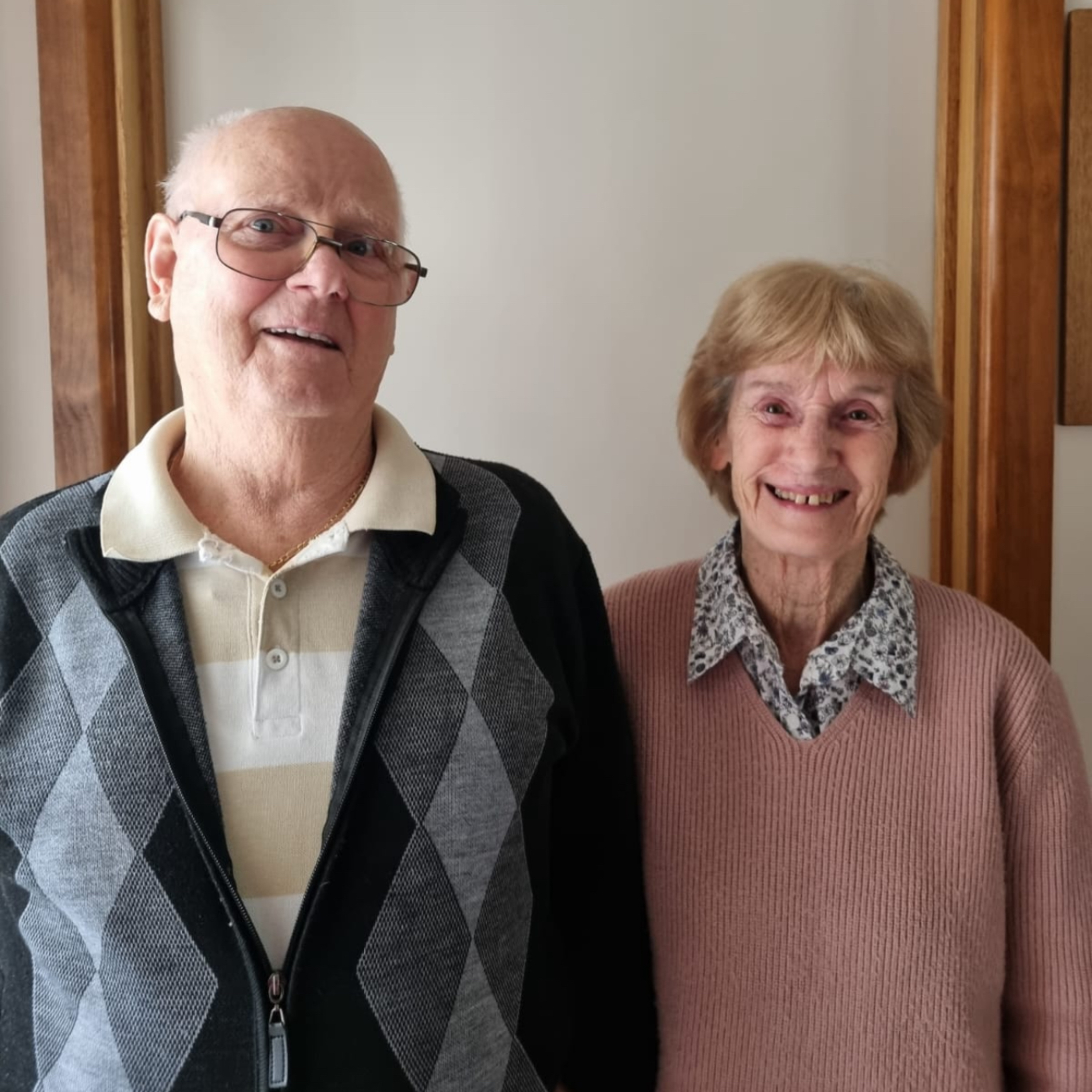
Fran and Brian, originally from the UK, recount their life journey from wartime childhoods to immigrating to Australia. They met in 1957 through a mutual friend, beginning with letters while Brian was in the British Army. Both shared vivid memories of growing up during the WWII Blitz, including family stories of bomb shelters and rationing. Brian's army service took him to post-war Germany, where he patrolled the tense East-West border, and later to Malaya. In Malaya, he described jungle warfare and memorable, initially tense but ultimately friendly, encounters with Australian troops, who even suggested he join their army. After marrying, Brian's long-held desire to move to Australia led them to become "Ten Pound Poms" in the 1960s. Fran initially withdrew their application, but reconsidered, and they hastily prepared to emigrate with their two young children, embarking on a daunting new chapter.
[Music] Hello and welcome to Casted & Connections. An initiative of Hands Up Casted & where a group of enthusiastic locals have come together to capture, preserve and share stories of people who have a connection to Casted & Connections. [Music] Today on Casted & Connections we welcome Fran and Brian Smoky Dawson. Their journey from the UK as 10-pound palms to Casted & with two young children was daunting and full of coincidences. Welcome Fran and Brian. Thank you. Thank you. Your journey together started about 1957. How did you meet? Through a friend of mine I was in the Army in Germany at the time. And this made a mind was engaged to Fran's sister. And a new friend wasn't seeing anybody so he said to me, 'Why don't you write to her?' Which I did do. And that's how it started and 65 years later. Here we are. Still together. It must have been very good pinmanship. If you'd seen it you wouldn't have thought so. It took her a week to decipher what one leader was about. That's that bad my writing. It's Jesus. Oh dear. We got there. That's amazing. So your first meeting in 1957 and prior to that you both were born in the UK. What part of the UK, Fran? What for then, half a year. And Brian? London. And then you went to school? When I was a kid we moved down to Kent. We lived close close to Woolwich which was a main part of the London area that was during the war. Used to produce arms and that. And that's where the Germans used to bomb every night. It was quite howling. That's nice. So you remember those times? Oh jeez, yeah. The blitz and all that sort of stuff. I know. The very first bombing raid they done. We all lived in two story houses but they were commission homes. That's how they were built. And the first lot that came down when we got up in the morning from my mother's bedroom down to the lantern. You could put your hand through the wall where it broke. And it stayed like that all through the wall. Wow. They said it wasn't worth mending. You know? It's going to happen again. All they done was to keep replacing windows. So it would have been tough times it would have been rationing or sort of thing happening then? Oh yeah. Was there ever? Down every member seen a piece of meat when I was a kid during the war. It was just nothing around. But other food, my mother used to trade clothing rations for food rations from what we would call 'yuppies' now. Just man and wife. They wanted clothes more than they wanted food. And they said we survived. Tough harrowing times. Oh yeah. You joined the army in the UK? Yeah. I have all of you then? Eighteen. Okay. So straight out of school or? Oh, and how I finished school when I was four days. Mm-hmm. Yeah. And, um, geez, what did I do? I worked on the farm first. And then I worked for a scrap iron merchant going out and knocking down nissenhuts that people in London were living in during the war. And of course the war was they know of us. So we were knocking them down so that they could build proper houses. And that's what we were doing all the time there. And then from there I went into the army. Okay. So at this stage, Fran, what were you up to? You had been a school. Yeah, we had been a school. We had, um, because we lived just outside London. We also got bond, not a straight, but a straight behind us. Mm-hmm. And it just blew many windows out and shut us, even see off my older sister out of bed. And all broken glass in the bedroom. And we could hear them doodle bugs because they made that noise. And then we quiet just before they were going to go. Wow. You never know where they were going to drop. Would have been just terrifying, especially as children too. We had a road shelter in my garden, but I'll never remember going in it because we had to cover it under the stairs. We lived with my aunt Anne. And we used to go in there just when we heard the doodle bugs come in. I can tell you a couple of funny stories about them. They built them, but what they done, they dug, they took two feet deep into the garden and cemented it. And then they put reinforced concrete over the top. So that when the bombing come, you jumped in there and hopefully, I mean, it wouldn't have saved you, but, you know, it was better than nothing. But trouble was they built it, as I say, two feet down in the ground. So the bombing used to be most times at night time. So the saw would go off, but in the winter time, it'd go off in its pitch black and you'd run out. Well, my elder brother, he run out first and he jumped in there and he nearly drowned. It was full of water. That was funny, that was. And then another time the air raids went and we all let to go into the shelter. My dad picked up my eldest sister and put her on his back. He said, "I'll take her first." Well, the shelter was only about from here to that front door away. So it wasn't that far. And he was gone and we were like, "What's going on here?" Of course, the bomb went off and it all lit up and there's my dad, that bomb of the garden, he'd messed it up. Find his wife and his sister on his back. That was funny, yeah. And I think probably one of the funniest ones of the war was my dad used to do night work in Woolwich Arsenal. Particularly night, that bomb and we was in the shelter and it's still dark and there's terrest houses they were. But for the middle two, there was an alleyway and a cupboard in, alleyway, coming from the front to the back, the only way you could get into the back. And we're in there and we could hear this clump, clump, clump. And my mother, if you knew her, you know. She screamed the Germans, "Come in, the Germans are coming." He was my dad coming up from work. "Ah, you silly son!" He said, "Oh, geez, I think." "Ah, it was funny. It really was funny." "I'm letting it all over again." "Oh, dear." So you joined the army when you were 18. And you went to Germany. "Oh, shit, it's Germany, yeah. To a place called Gosler up in my heart's mountains." And that was an army camp that nobody ever knew about during the war and the Luftwaffe used to fly out from there. And nobody knew until the war was over. That's where we were stationed. So this is in the 1950s after the post-Burbautu. So your job there, if you like, in the army was. Job, now what could you say my job was? I was in the infantry. So, you know, that's virtue, what we don't. We don't. Board of patrol. So between East and West. Oh, yeah, yeah. There was a hundred mile border. And we had to patrol it twice a year, once in the summer, once in the winter. But it was others doing it, so I just. That was what we had to do twice a year. It wasn't the best really because the East Germans and Russians on that side all along it. And they had. I don't know if you know, as Thompson's sub-machine gun, that the Yank set had a B jig, you know. Big barrel type? No, not that all, but told you ammunition in. And I think these were probably rip offs of them because I couldn't see the Yanks selling them to them. But they'd be walking there side the border with them aimed at us. And we had 303 rifles. And the magazine we had to put in that pocket, we weren't allowed to have it any. We weren't allowed to have them that way. They had to be out to all tell us. You know, that's as stupid it was. But we done it. And I think there was two or three camps that we had to pull in too. Because we done it on skews during the winter. Yeah. And marched it during the summer time. So the camps that you talking about, they pulled into, what are they? Huts. Oh, yeah, yeah, they were. I think they probably belonged to farmers. And they were rented out for when we needed them. And that's what we used. Did you see a lot of the country, a lot of Germany? Oh, yeah. Because I was stationed in Gosler for a close on a year, I think. And then that got closed down and we moved to Dortmund, which is a big industrial city. And from there, we just moved all over the place. So that would have been the time, like the Berlin War obviously would have been up then, would it? No. The Berlin War was never thought of then. Oh, it wasn't that. That was later. Yeah. Very interesting. And what about you, Fran? What were you up to at this time while he was in Germany, writing those love letters? Probably. Just working on nothing that was exciting and all that. Just when I left school, I started work at a BIO, which was the British American optical company in Wartford. Brian, you were telling me about your time in Germany and how you had to go to some of the concentration camps? Not some, only one. That was Belgium. And we were made to go to that to see what had happened. You know what they had done. And it was like a fuck. Well, it is a forest. And there was just one track into the camp. But the areas thing about it was you never heard one bird singing anywhere all the way through. And when we got there, we're in, yeah, it was a mess, but there was just big mounds about six of them. And I plucks on them and saying, "Here, lie buried 30,000 Jews killed by the murder of Nazis." And that's, you know, a chain bus with the air and everything. Yeah, it was quite confronting. But, yeah, we had to, they said that was part of your job doing that because you had to see it all happened and war. And who done it? Yeah. Yeah, that was it. But, yeah, I think I had a chance to go to another one, but no thanks. Well, I was enough. Yeah. Very harrowing for everyone, wasn't it? It was. And I think just before you change over, it's camp where we were in Gosler. There was a DP camp next to it. DP was there. Displaced persons? And this is 10 years after the war was finished and there's still a thousand of them in there. One end of it get out. Mainly from where were they from? They're from Poland and all around Europe. They were taken as slave labor, but they had no paperwork. You know, they had no passports, no nothing. So, you know, they could say I'm Polish and I come from South, but add your proof. So, I just kept them there. Wow. Yeah. What would happen to a lot of those people? Whoa. Don't know. I don't know. But I imagine that eventually they all got out of there. But, I mean, that's 10 years later. That's, you know, that's bad. But what do you do with it? I mean, that was only one camp. They must have been plenty more. Yeah, of course. You know, what do you do with all of them? Wow. That's just another part of war. Yeah, yeah. Perhaps we do not. Another part of Hitler. Yeah. That's what it was. And probably something we don't think about. Perhaps as much as we should. Well, if you haven't been involved in it, you really wouldn't think about it. Because you wouldn't know exactly what went on for that. It's hard. But yeah. So, during this time, friend, you were sending these lovely, lovely letters to Brian. And what were you at? What were you doing at that time? Well, first half I was working, like I said, at the VAO, a British American optical company. And then I wanted to do nursing as well, I wanted to do. So I did get into a general, as like a death type nurse at the time. And then when smoking. She doesn't know what to call me because originally my parents named me Brian. But they never ever called me Brian. They only ever called me Mick. Mick, okay. Yeah. So that's all fraying ever new me as Mick. And until we come to Australia and then it become Brian Mick Smoky. There was so many of them. We're good at nicknames, are we? I'm a old Jesus. Yeah, sorry about that. Yeah, so when it was nearly time for you to get involved, you know, before that, I did. I went into an edge where general hospital and started doing a bit of training and that. But when you come here, I just. I wasn't willing to say name. You're down about a year didn't you? About a year. And love got in the way. Yes. Mick got in the way. Mick got in the way. But then when we come to Australia in the trans, I was always the trans a lot when we lived in Melbourne, I used to advertise if you wanted to do training, to be nervous or assist in nervous. And I thought, "Hmm, that would be good." But I didn't want to push it because I didn't know what I was going to do about two kids. Yeah. Because it involved the shift work and all that sort of thing. And at that time, the man's wide was more important than the woman's. So I just know they're going. It sounds like you really regret that. I'm okay now, but I did for quite a while sort of regret that I didn't do my finished training in England. That's what I have been sometimes. That's right, that's right. So after Germany, Brian Mick Smoky. Where did you head to then? We were shipped off to Malayar on active service. That was the first time I had any money because we were on. We got engaged just before you. Oh yeah, I forgot that, geez. Oh, how could you think that? Oh, I don't know. That was a funny thing. I must tell you about this. It was about a fortnight before I left for Malayar. And we were in this little park near where she lived. And we were sitting in the park there and I was just. I said, "Will you marry me?" Do you know what her answer was? What now? No, not now. I talked about how I married Joan. So you got the ring on the finger before you went away just in case she was picked up by some other person? Well, you never know, do you? You don't. And then you headed off to Malayar. Yep. Because when I was in England and Germany, our wages were 30 bubble week, which is $3. But when you go on active service, it doubles. So I was on three quid a week and I thought, "Was it a million?" I flew over at Vance Party and that was to Singapore. Now that was another thing. Back then it wasn't Jetsit. Or they call them when they got the propellers. Yeah, but it's something that Peter just made to me but I couldn't pick up. I was going to give it a plane though. Turbo prop. Turbo prop. So it took a long time to fly over there and we pulled down in India at three o'clock in the morning and they said you can get off because they got a refill. And as you went down the steps, I thought it was the heat from the engine. It was the heat from India. And it was a walk, I suppose, two, three hundred yards and I was soaked in sweat. But a time I got to the land room there. And yeah, anyway, we jumped back in when it was already in flew off to Singapore. And Singapore, if you went to Singapore, a lovely airport, isn't it? It was in the fabulous airport. When I went, it was one runway that was palm trees down both sides and monkeys jumping from them. Wow. Yeah, that's what Singapore airport was when I pulled down there. It probably wasn't very big either, Singapore back then. It was 1950s. That was back in the 50s, yeah. So you arrived in Malaysia and in the jungle, was jungle warfare, I presume? Well, they were communist and they called it a police job, police and all right. A police keeping. Yeah, there was a lot going on there. We had the gurgards with us. And the very first time I went in the jungle, like there was a two of us, British soldiers going in with the gurgards. And at night time, as soon as nightfall, she stopped because you'll get totally lost if you try. And I just put my ground sheet down because I was absolutely ready to sleep. And I just laid on me ground sheet and the next thing I knew, I was floating. And I looked and there's four of these gurgards got one corner each and they left in me and taken me. They put me down and they said, "You all right there, Johnny? We look after you." And they had a ring. They made a ring round us. They knew we'd never been in the jungle in our lives before. One so. Yeah, they just, you'll be so good, mate. Straight to sleep. At night time they could pick the enemy from the allies by the way they placed us. Oh, okay. Yeah. So I think ours were crossed there as well over. And I said they used to pick them during the night time. And they had fantastic fighters. So while you were in Malaysia, oh, Malay at that time, you come across an Australian New Zealand soldiers? Come across them, fall them. Yeah, we had a big punch up quite a few times down there. I was in a town called Epo, which was the biggest town there. The Australians were in a small town that was a small mill town and they wanted our town. So obviously punch up every time they met up, you know. And then I had to spend a week in their camp hours driving our Asian officer. And I had to stay there. So I put him in and this guard sergeant said to me, "That's your basher over there, mate, you go in there and find your bed right on." So, in I went and there was about 10 beds down each side. And there was this one bloke, a huge rape bloke. I don't mean big but huge in size, like, yeah. Tall and. Yeah, well built. And I don't know when he's got this camera and it's all in pieces and he didn't look too happy. So I went in and I looked and I thought, "Oh, which bed's mine?" So I said, "Excuse me, mate." I said, "Which bed's mine?" And he went like, "Hah, just pointing." You know, "Okay, well it's about 12 beds down there mate, which one is it?" So in the end he said, "The third from the end, mate." Right, I put my gear on there and I reckon within 10 minutes that we'll see his empty beer cans hit 'em because it's a tin basher that we was in. He was hitting the roof and I came out to you, probably bastard. Oh geez, here we go. So anyway, it went on for a little while and he's empty beer cans because the naffy I didn't know at the time was right at that chest at the bottom there. And this bloke was getting real mad because he was trying to cut some dirt on what he was doing and all this in the end. He threw it a lot down and he said, "Come on, we're gonna go and have a drink." I said, "No mate, you can't have one of your right." He said, "You'll come in with me and we're gonna have a drink." "Oh, well I'm looking to argue with you here too, mate." So anyway, I goes down to the naffy with him, over the door and he said, "Who wants him?" And this bloke jumped up because there was about 10 of them round around the table and they were making a pyramid of empty beer cans. And this goat jumped up and said, "I'll have him." So he said, "Well, you have me first and if there's anything left you can have him." Well, he's bloke. Just that straight back down the gate. And next thing I was sitting there with him and it never cost me a razoo for a bit. I got full as a boot. But this bloke that jumped up that wanted to fight me, I'll have a word with him. And I found out he was a pumb from Luton. Yeah, yeah. Just said, "Well, there's a big boy." That was my introduction. But after that, I got on so well with him that I spent most of my time with him in the end. And when I come up for demo at the British Army, I don't suppose he wanted me. All the boys said, "Why don't you join us?" Because then you could sign on in Malau if you wanted to join another mob. So I wrote back to Fran and I said, "The Australians have asked me to join them." So I got to let her back from it. So if you do, don't bother coming home again. I thought, "Jeeze, I better go home." That was it. So were you married at this stage or something? No, no, I was engaged. So you went back to the UK and then you got married? Yeah. And I always wanted to come out. It took me years to talk Fran into it. And then when I did, we done everything signed up, paid the £10. And there were immunisations and that, and then she changed to mine. And so we've flown up or wrote, no, I forget what it was to the Australian House in London and said, "That's it. We're not going." But then after about a fortnight, she knew I really wanted to come. So she changed to mine. So we got in touch with them and they gave us a fortnight. They said, "That's your flight, then no change in the mine." So we had to try and say everything in a fortnight and get on this plane and get out of here. We done it, though, didn't we? It must have been really difficult for you, Fran, to leave family and so for all both of you. And you also had two young children, a five-year-old and a two-year-old. So it's a pretty amazing effort to actually even consider it. So you did well, and we're very grateful that you did decide to come. Thanks a lot, right? Okay, so we're going to become one. So, Brian, you were telling me that when you landed in Australia, you had 30 quid. Was it in your pocket? 30 quid and two kids and a wife. Not in that order, I hope. What I didn't tell you was that when we came out, was it January, February? It was Stinking Hot. We'd flown into New York to, that was our first stop. We had to stay there for about four hours. They were shoveling all the snow out to so that planes could take off. And we landed in Sydney because Tullum Roen wasn't finished. They were still building it. And then we caught the plane from there to Estadon Airport. And that's where we came into Melbourne. So what made you decide on Melbourne? A made-amine. It worked with me in England and printing. He'd come out with his wife and kids and he's living in Coburg. So he asked us, I said to him, "I want to go out there." And he said, "Well, if you don't," he said, "You can live with us until you find yourself at close." So was that the Welshman? No, no, no, no, no, this was another bloke. So you lived with these family in Coburg for six weeks? Yeah, and we found a house in Coburg, weren't it? Well, that one in England. More than naturally. Just the end of the hang. But this house hadn't been lived in, I don't think, for quite a long time. When we got in there, the damn place was moving with mice. So, we made out a cat who had kittens. So we took one of the kittens. And I tell you what, it didn't take him long to clean the place up. He cleaned them right out. So we was there for 12 or 18 months, 18 months. And we bought an adult house built in Canberville and moved to there once it was all finished. So at this time, you were both working? Oh, yeah. Karen, your oldest daughter was in school. Yeah. Gary was in kindergarten. Was in kindergarten, okay. So you were working, what were you doing with your work? I was printing, you know, your milk cans. Well, we were the first in Victoria to print them. Wow. Yeah. And we were using Eva's machines, which are a marathon. And Frank Eva's the bloke that owned it. He came over and showed us. Hope was well with them because we had three print machines of his. Huge, great things ever. And he took us out to lunch. And I mean, Eva's real young. It looked after us. And Fran, you were working for Repco at the time? Yeah. Down in Brunswick. So it would have been a busy life for you, you know, young mum, two kids. The hardest part I found, well, first of all, was taking away to Kinder. It didn't like, you know, to start with it, like it. But the hardest part of that was that I couldn't drive then. And we could only afford one car anyway. So I had to, I would know had friends with a lady who used to take Karen into school for me and pick her up. And keep her till I got home about all the past four. But what I had to do was I had to take Karen down to Inga, that was the lady's line. And then I used to have to go to the tram stop, which was a little way up. Sydney Road. And get on a tram and take, get off at the top of Sydney Road, take going into the Kinder. And then I had to retrace my steps, get another tram back down, right through to Brunswick. And then there was a road, remember the name of the road now, I used to have to run, literally run all the way down that road every day. I worked, did for five days a week. And so I could clock in at eight o'clock. Wow. That's a big effort. Yeah, big effort. So Karen was at school and this is where the first casted and connection happened, wasn't it? Yeah, it's right. Not in Melbourne, no. Yeah, yeah. When we said Campbell Field, that was Campbell Field, don't want that. Well, that's Melbourne. Yeah, but it's a bit completely different place. No, area I'm talking about. Yeah, yeah. When we moved to our house, we had Bill. That's when we found out that Mickey Murrell was a headmaster, it was called Karen, he went to. It was really weird. He was a local casted and identity. There you go. So that was the first casted and connection. And then you built the house and then how did you meet Ernie? Well, I've known friends with me. I worked at Repco, Danny Brunswick. So these were people that lived in Melbourne at the time. So what made you decide to actually come to Castan? Ernie Jones made our minds up for us, didn't he? Ernie just elaborated a little bit on who he was. He was a chauffeur for the PMG at the time. Two or three times a year, they had to come through Castan. So they stopped at Mickey Murrell's and stayed there the night. That very much so. And second or third time I suppose Ernie said, "You want to go up to Castan?" He said, "I reckon that's where you want to live." "Oh yeah, where is it?" "I'm up in the Western District." "Okay mate." So anyway, he said about it two or three times. So we had holidays come in so I said, "Fram will go up." "Have a look at this place." So we came up and we got to the cutting and I said, "Is that it?" "Just in few hours before it." And she said, "Just keep going, there might be some order." And of course when we went right through the cutting list of the town. So we just fell in love with it. And while we was up, Jackson Hallett, do you remember Jackson Hallett? "Yeah, yeah, he was a local real estate agent." We went and had a word with him. He said, "You're thinking of coming up there to live?" So he said, "I've got a house you can look at." So he took us around to Pat Tansys where Pat and Gloria were living at the time in my first and third. And he said, "I'm going to go to the next place." And we had a look around, didn't we? And then we had a cup of coffee with her and chat. And well, we were chatting Pat Cain introduced himself. And he said, "Have you seen much at Castan?" And said, "Yeah, the main road and this out." So he said, "Well, come on, he said, "I'll take you for a drive round." And he said, "I'll show you all the different places." Which he did, didn't he? And he said, "We loved it, so we went back and I got out of a state agent." He said, "We want to sell our place and move up." So we sold it within two weeks. And so within a month of coming up here, we were living here. Wow. That's how quick it was. So your first job also bought your nickname, "A Smoky" from your lifelong friend Ray Khan. So your first job, would you tell us about that? Yeah, that was on the Redskoon. And like, you know, government comment Redskoon for, I think it was 20 weeks or something like that. Well, it was a book. So what was the work involved with that? That was. Not a lands department. Yeah, it was the land department, but you had so many different jobs. We were getting rid of rabbits, cutting down a kosher, clearing it. All that sort of stuff, is. Spraying. Yeah, spraying weeds, spraying and all that sort of stuff. So general land care. Planned cricket in between. Planned cricket? Yeah, that's why I was going to throw one in. So you got your ball, but out of bar, but cute. Then you could look. We used to have a bar, but cute. There was Les Jenkins. I don't know if you remember Les Jenkins. He was from Garibot, Peter Martin. Garry Smith. Garry Smith and me, self. We were the gang. And we sent out, Ray had sent us out to wherever he wanted us to go. We had down a six-chain road this particular day, doing a cutting down a kosher. And come lunch to him. We got the bar, but he would come in. We always went into McKenzie's butcher, and got what we wanted for lunch. Come lunch to him. Garry Smith had always had at least two ducks, as well as his ball, the cute, Gigi, as they did that the way. And then we had a couple of hours of cricket after that. And one of us had just keep her eye open to see if Ray was coming. It was good. We had some fun. But on the way out, we was in Les's car. He had a bigger yank tank at the time. And I think it was nine o'clock in the morning. There was this series on the road. So we used to put on the side of the road. It's only on for a quarter of an hour. So we used to listen to this. It was funny that Gigi's we had a good time. It was one of the best times of my life on there. But we really had it. So that lasted ten weeks? Yeah, that was ten weeks. After that, Doug Colter, said to me, he said, "Would you be interested in running us a shop?" I said, "Well, I've never done it, but I'll have a go at it." So he said, "Leave it with me, I'll go." George Taylor's a made-of-mind. So I'll go and have a word with him. Yeah, they used to brace motorbikes together. Wow. Yeah. And so the next thing, I know George had phoned me up. I'll come down and interview you. And he come down home and said, "Right, be at my place Monday morning. You spend the fortnight in Hornable, living in from two of the stores there. And then you take over cast it and store." So, yep, I'd done that. So in the George Taylor store, there was, what is it? A general store with hardware and what other things did you store? Exposing a store, but it had everything you could think of. Yeah, it was just a store that everybody in town used to love going into. You know, it just had everything you wanted. And I suppose most of it being this hardware disposal, it was much cheaper than anywhere else. That was the idea of it. I would imagine anyway. I worked for him for 10 years. And then he had cancer and he was advised to get rid of him and take things easy. So he sold the stores to each other, the managers. Yeah, we all bought our store. Wow. Took it from there, yeah. And I suppose we had it for 20 years, didn't we? Could be, but. Until then, the doctors told me that I got already to that. So Fran, Fran, you're an integral part of the business as well. And you both became very respected business people in the town. And I can remember going in there myself and it was just one of those places where no matter what, you knew where everything was, you guys did. And you just always find what you wanted. I'm sure there would have been times in the store where it was a bit frustrating with certain customers. And I'm sure there's some funny stories come out of there as well. You don't have to name names. Just tell the one about me now. You don't have to name it. No, no. No, this wasn't funny. It was one of them things that I don't like, but it happened. This young fella came in and he's looking around. And we was in the office having a cup of coffee. And it was on a Friday, Joe Blacker. He used to come in from Durgan. And he used to spend the day with us. And he'd even go and do our banking for us, you know, if we were busy. And anyway, we're having a cup of coffee in this young fella. He's going around anyway. Next thing Joe said to me, he's just taken a knife, a sheet knife. Are you sure? So he's gone out the door. So anyway, I went out to the door and this young fella is walking down and he's trying to put this sheet knife into his backpack. And I said, "Do we come here?" And put it back where you got it from and get out and don't have a comeback. Well, I mean, it was scared stiff, but I don't think you ever done it again. You know, he got caught and that was it. Yeah, and he turned out to be a really good kid. Well, man now. Yeah, so just one minute of stupidity. And it could have cost him because, you know, if I'd called the police, he'd add a record. So after many years, over 20 years, managing the place you just mentioned before that you became ill and were advised to slow down, et cetera. So how was that transition for you from leaving work for both of you, really? Well, I suppose, you know, why I suppose it was the best thing we've ever done. Because while we ran on the place and ran it, you know, very, very good. And you really got any holidays because, you know, so one person business, two person business. So you can't afford to be paying out. Wage is taking your own wages from it. You know, it turned out that when we sold it, we had time on our hands and we just travelled and we went overseas and we'd been all around Australia. And we'd still are, you know, when we can move, getting a bit old in the turn now. We used to drive up to Queensland every year to visit family. Yeah. But we don't do that anymore. It's too much. So actually one of the interesting things I found that you were saying how you didn't really want to come out to Australia and that, you know, because you'd miss family. But a lot of your family ended up following you anyway. Yes. I'll come from big families. Me? Nick? Nick Brian Smoky. Yes. So, yes, quite a few of my aunties come out. I brought the Rindy squad and little boy where San Otis Gary was. Came out about six weeks after us. And then over some extra. Richard. My brother Richard. He's a twin but the other one, other, is his brother died in England. Then your mother and father came out? My mother died. And lived in Castleton. And they mostly met up in a few of the eights and then come to Castleton. They were all house down in. They were straight used to be, you remember his name? We bought one and died. No, I'm not. And then Jim is self-monitor, system, older system, her husband and two daughters came out. So you've definitely added to the population of Australia, Ang Teston. But you could say. You became really ingrained in the community with the kids playing a lot of sport and stuff. And Brian you were very much involved with the lodge and the RSL. Well still. I am with the lodge. I don't do much at all in the RSL now. It's, I don't know, just. You're just too old and tired, I think, now. We don't know, do we? Oh yeah. We've got the flags up there free and sector. So you know, you become ingrained in the community and also you've offered the community so much in your lifetime here, in your time here. Just to finish off, I just asked you one question each and each can answer. But does Castleton and mean to you? Well, to all of us are first, if you like. When I was talking to you, well, we were talking to you before. Castleton is like when we go away to Melbourne or Ballarat or even Hamilton. And then we come home, you come over the hill and you're down and you see the town. And every day we do it, we say home, sweet home. It's beautiful. Yeah. And we do it. Yeah. We've met a lot of lovely people, made some really good friends. We would never leave you there. You know, I was telling you the other day that people have said to us, you kids have moved, are you going to follow them? Why would we follow them? This is our home. So, no, if kids want to see us, they can come and see us. Or we can go down and see them. But we're not moving from here to hold down anyway. I joined and was a member of the Street W. both about 25 years at office there a couple of times. And joined, well, went to the Anglican Church and went on to the committee. Well, like ladies, like Zillory. Yeah, that's not there. I'm talking about the Anglican Church. And, yeah, done to a office there. At Gile. At Gile. Yeah. To a office there. Yeah. So. You've been wonderful contributors. Now, to the high school and on the meals, you know, for the kids. When I was little. You've been wonderful contributors to our community. And I'd just like to thank you for telling us your story today. Thank you. Thank you very much. We've enjoyed it. We hope you've enjoyed today's episode of one of our homegrown heroes. Jump over to one of our other episodes to continue the casted connections journey with us. Please don't forget to follow our podcast and share it with your family and friends. Thank you for listening.
Podcast Summary
Key Points:
Fran and Brian met in 1957 through a friend's introduction and began a long-distance courtship via letters while Brian was stationed with the British Army in Germany.
Both grew up in the UK during WWII, sharing vivid memories of the Blitz, rationing, and family anecdotes about air raids and shelters.
Brian served in post-war Germany, patrolling the East-West border, and later in Malaya during the conflict there, where he had notable interactions with Australian soldiers.
After marrying, they immigrated to Australia as "Ten Pound Poms" in the 1960s, a daunting move undertaken with their two young children after initial hesitation from Fran.
Summary:
Fran and Brian, originally from the UK, recount their life journey from wartime childhoods to immigrating to Australia. They met in 1957 through a mutual friend, beginning with letters while Brian was in the British Army. Both shared vivid memories of growing up during the WWII Blitz, including family stories of bomb shelters and rationing.
Brian's army service took him to post-war Germany, where he patrolled the tense East-West border, and later to Malaya. In Malaya, he described jungle warfare and memorable, initially tense but ultimately friendly, encounters with Australian troops, who even suggested he join their army. After marrying, Brian's long-held desire to move to Australia led them to become "Ten Pound Poms" in the 1960s.
Fran initially withdrew their application, but reconsidered, and they hastily prepared to emigrate with their two young children, embarking on a daunting new chapter.
FAQs
They met through a friend while Brian was in the Army in Germany; he wrote to Fran after a mutual friend suggested it, leading to a relationship that has lasted over 65 years.
Both experienced the Blitz, with Brian recalling bomb damage to his home and rationing, while Fran remembered doodle bugs (V-1 flying bombs) and taking shelter under stairs during air raids.
He served in the infantry, patrolling the border between East and West Germany twice a year, facing tense situations with East German and Russian guards armed with submachine guns.
He visited a camp with mounds marking mass graves of Jews, noting the eerie silence with no birds singing, as part of army education on the atrocities of war.
Brian had long wanted to move, and after initial hesitation, Fran agreed; they paid £10 as 'Ten Pound Poms' and hastily prepared to leave within a fortnight for their flight.
He served in jungle warfare against communists, was protected by Gurkha soldiers at night, and had encounters with Australian soldiers, including a humorous brawl that turned into friendship.
Chat with AI
Loading...
Pro features
Go deeper with this episode
Unlock creator-grade tools that turn any transcript into show notes and subtitle files.
 PodcastTranscript AI