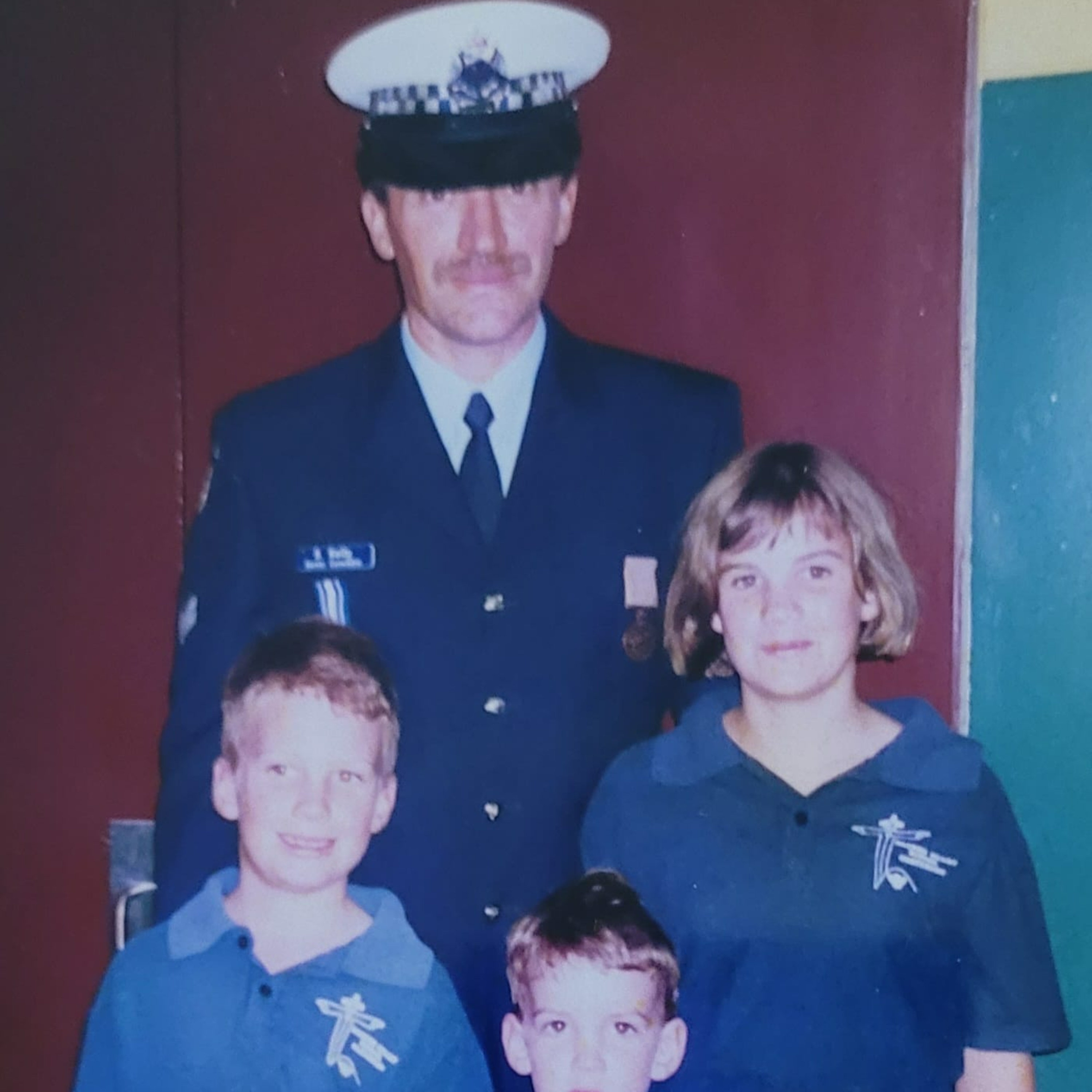
In this interview, former Leading Senior Constable Shane Kelly reflects on his life, family heritage, and career. He recounts his Irish ancestry, explaining how his ancestors fled Ireland in the late 1800s and brought acorns to Australia, where oak trees were planted as a lasting family symbol. Growing up on a farm in Muntham, Kelly describes an idyllic childhood that taught him resilience, animal husbandry, and adaptability—skills he believes are vital for dealing with life's challenges. He later worked in banking before pursuing a career in the police force, inspired by a school work placement. Kelly discusses his training at the Police Academy, emphasizing its intensity and the camaraderie formed there. He also shares personal health struggles, including a diagnosis of inflammatory bowel disease that required major surgery in 2022, and notes how his Catholic faith has helped him cope. Throughout, he highlights the importance of community, family, and the practical lessons learned from farming, especially during tough times like droughts.
[Music] Hello and welcome to Casted & Connections. An initiative of Hands Up Casted & where a group of enthusiastic locals have come together to capture, preserve and share stories of people who have a connection to Casted & Connections. [Music] Present in the interview room today is myself, Flowerslow, Cain Forbes and Leading Senior Constable Shane Kelly. This interview is being recorded. Your place and data birth leading senior constable? Well, I'll just say that I'm a former leading senior constable. Shane Thomas Kelly, first of the second 66 and I was born in Colrain to fame Jim Kelly. So and you were the second eldest of five? Five boys in our family there was Stephen's the eldest, he's 14 months old of the me, self and Jared, who's 12 months younger, pulled his three years younger than me and met you the afterthought. Yeah, okay. So you grew up out at Muntzum? On the property of Kildare at Muntzum, yes. Yeah, okay. So what do you remember of those early days as a kid out there? Well, to be honest, I believe we had a fairly idyllic lifestyle at the time. Whilst we didn't have everything, it was great because you had people around you and there's a lot of small soldier settler farms and little farms and the holes were always buzzing and it was really good. So was your dad a soldier settler? No, he wasn't. Yeah, so he free-hold? Yes. So you finally come to be here in the area? The Kelly side of the family, back in the late 1800s, they were living in Kildare on the carer near the village of Kildare in Ireland. Right, Kildare. Something occurred, dad's grandfather, I believe, was involved for some reason. I believe he has wanted so he's secreted and they decided it was best that him and he's sibling, left Ireland and relocated. So he was, when you say he was wanted, did he have a criminal background or? No criminal background, but back in those days, all you had to do was espouse a few anti-establishment things and you were sort of taken away. So he was wanted by the Red Coats or? I believe so. Which was the British? British at the time. Yeah. So what part of Ireland? County Kildare in southern Ireland. Yeah. And there's a bit of history there as far as that area goes. It's now owned by. Well, half the family farm was the Agakans horse stud. Yeah. So, yes, it was a fairly large property for Ireland. Yeah. Okay. So that's been taken over in recent years by the Agakans, you mean? I'm talking probably long time ago. Oh, okay. Probably mid-large century. Oh, okay. That long ago. Yeah, in the 1900s. Okay. So what is your. What is your connection to Oak trees? The two brothers left Ireland. A few acorns from the Oak trees in the Tansk, the village square of Kildare Township, were put in the pocket. And they were brought to Ireland. They were brought from Ireland to Australia on the ship. When they got to Australia, they settled at. They were friends with the Claries who had settled at Sanford. Okay. And. So which Claries was that? That would be John and Jim's parents. Parents, okay. Over to soon. Yep. Yep. The. Had a house there. They planted and in John's paddock next. Well, James paddock now. Next to. A Jacent to where John's house is. There are three large Oak trees planted there. They were planted by the Kiles when they arrived there. Wow. So that was where they actually lived and settled originally? Yes, when they first came here. And then some years after that, they had other relatives that were out at Muntham. And they acquired a small parcel of land out there. And they moved out. And they moved the main part of the house by sled. Wow. How? Well, with a hole in the bullock's or something? Which shings, I guess. Wow. So they moved it from. From Sanford to Haptham, Muntham. To Muntham. Over the hills. Yep. Good. Going up would have been slow and going down might have been interesting. Yeah. It was. Yeah. Wow. That's a big achievement, really. But bearing in mind, your houses were so much smaller back then and the kitchens weren't attached to the house. They were separate. Yeah, that's true. That's true. Hadn't thought of that. So the oak tree then, the acorns, it's sort of been a bit of a theme through the family? Acorns were taken from the tree when my grandfather Jack Kelly was young. I think he was about five when they moved out there. And him and his three siblings all got together, we were brought together by their father. And they were given an acorn each to throw into the hole that the. You know, he's father a dug. And subsequently, the trees grew. One of the trees, there was four that shot over the years. I'm bearing in mind, it's about 120 something years ago now. The bases have merged. One of the trees died out relatively young and there's two main barrels still there. And one's weathering away slightly. Wow, that's amazing. Earlier it said like to be a family, legacy family tree of your life. Well, it was a family tradition and it sort of echoes on even a little bit more. When my oldest boy, Piers, was young, coming back from down the street. I don't know whether he pocketed acorns from out at the farm or that he picked them up from down there. The snics at the Scared Hall. Oh yeah. We had acorns in his pocket and he posted a couple of them under the front of the house. They were growing. So I actually relocated them in there below the precipetry in the Sacred Heart Church on the Old Running Track. Oh yeah. And there they're about four or five meters tall now. Wow. So if you drive around the place and see acorn trees, it's probably because of the acorn trees. It's probably because of the Kelly family. Well, some of them are. So we're just moving on. So you went to school? Where did you go to school? Skip Tender. Oh, as he, yeah, we didn't go to Tender. Which has quite common back then. We had a school at the Sacred Heart Primary School. What do you remember of those days? We had the mercy nuns were the teachers back in those days. The penguins? Yes. We had some good ones and we had some not so good ones. And Laos is nodding the head from experience. Very true. Very true. And we were, probably when we were coming through, we were nearly the biggest grade in the school. Our year was, even in high school, was the biggest form level. Oh, okay. It was a country. From what I can recall. About how many years you think was in there? There was about 20, 24 or 25 at the Sacred Heart School in my grade that they. Yeah, yeah. And I know in year 7 we had four forms. Yep. So we had 8 of thee. And there was about 28 leads. Each year? Each level. Yeah. Yeah, and we're back in those days like the school. Well, when I was at school, which was a favourite before you, but it was over 600 students there at the high school when we went through. But that was due to the population that was here with the soldier settlers. Yeah, with the small farms. Yeah. Yeah. So it wasn't the Catholic thing. No. No. I think you could put it down to two things that there was no electricity. And there wasn't the contraceptions they have these days. No, that's very true. So do you remember any of your teachers good or bad from school? We had. I can remember one of the nuns or quite a few of the nuns, but one. I think I might have been grade one or grade two, but we had sister Amanda. And she was a fairly young nun. And I can remember we'd have our sports below the press conference on the running track. And she would be there and she'd wake up the skirt a bit and she'd be out running most of the kids. So you have those memories of them and yes, they were a few stricter ones. And you had Old Sister Lucy, which was up there. She was an institution for years. She was. She was a lovely old lady. And. Oh, here's the sister Pauline, sister Bernadette, sister Patricia. Sister Eufraizia, all those ones. Yeah. Yeah. So your education at the primary school formed a bit of, you know, like the religious side of things you're still involved with the Catholic church and staff. That's great. But you're still, you know, religious and so forth. Yeah. So that's been a mainstay in your life, do you think? Well, it has. And it gives you, in my own personal view, is that it gives me, you know, a set of guides where you should be going and how you should treat others around you. And I think in the last couple of years, especially with what I went through with my health wise, it's being reassuring, yes, you don't have control of everything. And you get things thrust upon you and how you deal with it is shown to you. So how much are you around? Yeah. So speaking of your health, Shane, you want to take us on that journey for a minute about, you know, what has happened to you in the last couple of years? Well, the last couple of years probably go back. I can probably say my father died of bowel cancer and it's believed that he probably had colitis, which is what I ended up with. Which is like a disease of inflammatory, inflammatory bowel disease. Yeah. And I got first diagnosed with inflammatory bowel disease when I was about 18 and a half. Oh, okay. And when I was in late 20s, it was changed to, they called it, Crohn's, which is another inflammatory bowel disease. And then later on, it was a toss up between Crohn's and colitis. Okay. And going back October, 2022, at 22, I had the specialist always said if I had a major occurrence of something and there's something amiss, I'd know about it. And I knew about it because I just couldn't pass anything and it felt like I had a medicine ball in the mid-drift. Oh, okay. Okay. And as a result, trip to the hospital, he left it to Jolong and emergency surgery and they removed most of my large bowel. Wow. Subsequent follow-ups, we looked at the options of going back for a reversal, but it wasn't possible. So you find it difficult to cope with? Oh, well, look, I know all the ship jokes. I heard you got some good ship jokes. We got a couple of young people and stuff I'd deal with and one of the ones in the band, which is only quite funny. And our little drummer, nice little drummer, good young lad. We're playing there this night and his music went everywhere because he didn't set the stand up properly. And he grunted and groaned, put it back up. And then he started playing in about 10 minutes later. He lost control of one of his sticks and he tried to catch it and he lost both of them. So he's groaning and moaning, picking them up off the floor. And I just sat in in front of him. I just looked over my shoulder and I said, "Hey Nick, do you want me to go to the U? Can get a bag for you so you can get your ship together?" And he lost it for a minute and he usually lost it next to me. But yeah, look, I joke about it because otherwise you'd cry. So your religion has helped you through this whole experience, the health experience in the way it's been a comfort. Yes. And so forth. It is what it is. My wife said that countless times. So Shane, just back to your schooling days, probably in primary school in particular, what sort of student were you? Just an average bachelor. I quite often used to say English and spelling wasn't my forte. Maths, I was better at, but I had to work out at it. And after going through school, and look, it was an effort to get into the police force. The exams were fairly hard, but I did get through there in the first attempt on entering. And I know a comment I said to my father at the time after I graduated. If I put that much effort into study at school, I might have passed you 12. So do you think you improved through the years as your schooling got on? Or you just sort of knuckled down and made a bit more of a conscious effort to put some time aside to really focus on your education? Well, you just, it was probably more application. Being a young farm kid, there's always distractions. You always had the chores and the other stuff. And you used to watch a little bit of Italian stuff like that, but there's always distractions. Yeah, and from that farming background, no doubt you'd just love to be outdoors and sitting in the falls of a classroom probably wasn't overly comforting. No, it wasn't. And, same in the police force, I like to be an operational policeman out dealing with people, talking to people rather than doing paperwork in the office. Yep, so on the farming stuff, Shane, obviously you're still on the farm now doing bits and pieces. Talk us through that journey from a young tucker and then right through to now. I guess some of the jobs that you're still undertaking and some of the skills that you've developed over time, both on the farm and also at life skills. Well, on the farm, probably the best life skill you'll learn. So, saying that comes from the farm, when you've got livestock, you'll have dead stock. When you have livestock, you'll have shortage of food, shortage of water, carving, landing problems. And because of the cost of the vets, especially back in those days from Mum and Dad, small farm, they couldn't afford to do a lot of things. So, you had to improvise. It was broken if you couldn't fix it with a piece of wire or a barling tie. And I'm sure that was the same with her father. Boundling time was the best, I don't know, the most gused item on the farm I reckon. Probably still is today. Well, you go from animal husbandry, so you learn how to pull cows, you learn how to put animals down, you learn how to mark calves and lambs and all that sort of stuff, dehorning, fix them up with a fly strike, all those sorts of things, you learn how to do it. And do you think the experience that you had as a child and even still today has rubbed off on the boys? Obviously they've travelled the world doing various bits and pieces with farming and drawing and that sort of stuff. Do you think that's had an influence on their life? I will say that the three children, and I'll put bridging into this, love coming back to the farm. They just love getting out and doing stuff. The farm was just a good base. It gave you plenty of room to roam, fish, explore up the creeks, get the filthy come home, get growled out by mum, all those sorts of things. It made you learn responsibility as well because we had jobs. I feed the dogs, do the cows, do the pet lamb or whatever it was, you'd be doing stuff. And you can see a stark difference in between kids who have lived that lifestyle compared to kids that haven't, and are a bit sheltered and maybe spending more time indoors and things like that, which is quite sad to realise that maybe they don't get those opportunities to run a market and get out in the mud and open spaces. I'll probably, this day and age, especially a lot of your kids in town, they don't learn how to deal with life and death. I'm a farm you're dealing with every day. And sitting there watching a calf being dropped out of a cow, and that's the sort of things I can recall, young Connor, and we all go around the paddocks, and young Connor was there, and one of Jared's cows was having trouble getting the calf out. So he relayed a story and I bet I'm not going to fall details on my wife, clip me on the ears, she hears it. But it was through the phases of what Dad had to do to get the cow in the yard to pull the calf and what happened when the calf was pulled out dead. And what happened to the cow afterwards and all that sort of stuff, and what you did with the carcass, and it was emphasised by one little comment that he kept coming out was. It wasn't nice, it wasn't. And you just laugh because that's what they learn. It's reality. That you've got to keep on going, keep moving. And just one more quickly on the farm shame, obviously going through a drought here at the moment, how are you finding that around our community? What are you seeing with fellow farmers and how it's impacting them? Well, they've been a couple of good things. They had a night down at Finley there, which was attended to Hannah, basically, it was for farm and mental health. And it's good to speak with others. You're not alone. You're going through the same circumstances. If you've got a small farm, it's on a smaller version of the big farms. Just the big farms might have some more finances behind them. But yes, your main issues is your food, your water. And if you've got a good source of water, your home and house pretty much. So rather than farming, the major part of your life, of course, has been taken up with your career as a policeman. You started, you graduated about 88? I graduated 88. I went in in November '87 to the Police Academy at Glen Mifle. Prior to joining the police force, I worked in the National Bank for nearly four years. Prior to that, yes, was hay carting and doing farm jobs, fencing, all those sorts of things. But when I worked in the National Bank, I started in Portland. I was moved to Port Ferry and then from Port Ferry, I actually got put back to Castan. I spent just under two years here. And I applied for the police force. I didn't make it any secret that I was applying for it. And a few of the customers learnt and I weak. I was leaving. One of the older women of the community came into the bank and said, "Shane, I hear you're leaving us. You're going to be a policeman." I said, "Well, I hope to." And she said, "You can't be a policeman. You're too nice to be a policeman." Guess what? Quarter career change, shown, from going from the farm to in the bank. What inspired that decision in your life? Well, growing up and on a small farm, I knew there wasn't enough land there to split between five boys. We had to go and source income elsewhere. And being, I did work experience when I was in the high school, which was at the secondary college here in town. And as with the nuns, had some very good teachers, had some average teachers. But in year 11, I did work experience with the police station here. It was something that had been there quite early on that I wouldn't mind to be a policeman. Who was the police here then? The Gigi Work Experience. That was Terry Carly, was the sergeant. There was Bob Pritchett, Phil Newsom, and I can't think of the other one. I think there was a couple of the top of me here. So, did you think their influence helped you make that decision to go into the force? That was Harold Jacobs, the other one. Chris Jacobs, I should say. At that point, they were in a reaffirm. Yes, this is the sort of thing that I wouldn't mind doing. And it was interesting. You go from here to the academy. It was four and a half months of study, practicals, and that it's all changed now. It's a degree. It was something that, it was a vast change. I've got friends there. One of them, in particular, I was a roommate of his in the old main building at the academy, which was the old Corpus Christi College Seminary. Did you stay on campus? On campus. You lived in the academy. You had to live in the academy back in those days. You lived in the academy and you were trying to gather you, wait together you. So, it's a bit like a defence force type thing. So, you make those more or less comrades for life. And just talk us through what a day in training and what a day, what a week looks like when you're in the academy and learning your way. Back then, you would have, as I said, it's all changed. You would have your various, you'd have your time table set out and you would have your PT sides of it, physical training, your drill. You would march and do all that sort of stuff. Your law classes and just, yeah, just get impractical experience on going through the law. The amount of law that, and this is one of the things that I used to say when I was going through there, it was about equivalent to about a year and a half of a law degree. Wow. And it was just intense. On top of everything else you've got to do like the physical stuff. Oh yes, yeah. And I went in and one of the drillies that I had was a former Richmond Premiership player, him it done. And because my brother, Gerard, had done six months earlier, I was a FACI recogniser because we do look similar. And of course, yes, you've got a few other clips and the clips from him that were comments that come back from one to the other. So it wasn't a benefit to have a sibling already gone through? Probably not that close. But it was entertaining. There was a lot of camaraderie with the crew and back in those days, I think we only had four girls out of a squad of 28. And I think it was only about five in the other squad. And do you get much downtime when you're there and socially, do you have social outlets while you're training? Back then, you were pretty much nose to the grindstone. And you were studying, you'd either be training or studying or getting your washing down and that sort of stuff. So yes, they would go on the weekends, they'd head out, being the distance from casten to glimauvely. And over five out of our trip, you didn't head off on a Friday night to come back here. I stayed in my only comeback at Christmas time. So did you ever feel like you were secluded or isolated and felt like you missed out on things shame while you were away for so long and not really having any social outlets? No, probably growing up on a farm and being out of town, he got used to doing what you had to do. And it was something that I had always wanted to do. So you had to put your nose down, do the study. And it's no different from, I suppose, it's a little bit different from going to university these days because it was so intense and you were living it nearly 16 hours a day. And probably more common these days that people get home a lot, like transports a lot easier access to people who come home a lot more often than what you mentioned. Training to be a policeman, you're living there, you're not getting home very often. How long are you in glimauvely for and undertaking the training before you move into the next stage of your life? Just to have a four months. And then once you graduated back then you got sent to city traffic, you had a week off then you went to city traffic. Where you got put out on the points that are through the centre of Melbourne giving directions to traffic. And one of the more comical sides of that, you'd have a group of, you'd have two senior connies or a sergeant or a senior conny. And they'd have about half a dozen trainees as what we were known as them. You would go out and they would show you the ropes of how to direct traffic. Now there was a key which the police members would have and you'd have to put into the bottom of the traffic light to turn it on to flash so that they could control the intersection. We had a couple of the height requirement of being reduced. We had a couple of fellas that were on the shorter side. And couldn't reach the thing. And this senior conny says, "Come on, there's been an accident, you've got to shut the light, I figure something out." And he looks around and he bolts down about three shops and in a milk bar and comes out with a milk crate, stands on it and reaches up and turns the traffic light over. They're the sort of things. So you've got to do the duties there. Then you spend some time at the community police, well, community policing, the highway patrol, the blood alcohol section, the roadtaste, safety testing and all that sort of stuff. Bearing in mind, back then, your alcohol tests are a hell of a lot different than what you do now. You used to have a little green case and it had about ten tests in it. But you hear the tune of blowing in the bag. There was a little inflatable, plastic bag and you cut the end of this little vial off. You had an arrow on it, you put it in and they had these crystals in it. And there was a line in it and the mouthpiece went on the other end when you cut the glass off the other end. You slot the mouthpiece in, they blow the bag so it was inflated. And then you would see a change in the colour of the crystals. And if it passed the line, that was an indication it was over '05. Well, what a process. So, showing off those few early tasks that you undertook when you were first out. Did you have a preference of what your favourite was to do or you were just excited to have the experience to do all of the different tasks? There were different tasks. It was my first coseted station, it was my training station and I got coseted to it. So, I was there for a period of up to two years. And the funny part about it, it was a little bit of a large number of constable scene, you constable on the roster. And I think there's a 120 or whatever, and I went from second last on the roster in the time I was there for the fourth most senior out of the senior conies and conies. Wow. So, it was a hot change, it was just a rotating training base. And working at Russell Street, did you general duties policing, say you were attending your domestic, your nightclubs assaults, all those sorts of things, checking licence premises. And then you had the side benefit of being in Melbourne there, you get a lot of the sporting events. And back then they didn't have the private security. It was a police for me and them. I worked two grand finals, 89, so it was a Hawthorne Jolong. Happy days. So, probably one of the most amazing games by an Ivalpaya Gary Abbott-Scenia, who won the Norm Smith. And then you would, the next year I worked at Collingwood and Estadon. A bit different clientele. And Collingwood broke the drought. And we were all, you've seen all the police and security line up inside the fence on the arena to stop them going in. I think we're going to have a long night here. Well, my evening got longer because the senior sergeant from East Melbourne, the senior sergeant of its Patrick, said Kelly Anderson over here. And that fella there from the Collingwood Change from the Collingwood Club, he was the steward on the door. And he requested two police members. So we went up the players race through the change rooms. And we got posted on the door to prevent all the supporters that they didn't want in there in a crush. Wow. And restrict them. And we were told only let the people in that he says to. So it's almost like draft and cattle again. It was worse than draft and cattle. We had a tunnel. And you know what the tunnel is like in the middle of the MCG. Full of, fairer or Collingwood supporters. All wanting getting into slap the players on the back and have a piece of the action. And it was that tightly packed when they were pushing you trying to get somebody over the top. You push off the wall behind you. And it was like dominoes until they got to the other wall and they just went. So you're a Russell space Russell Street. But it was post the Russell Street bombing. Yes. But you did encounter the wall street. I was on leave when Wall Street occurred. Yeah. The night. And I went back on the night shift, which was a ledily post the shootings. Yeah. And I was just explaining to people what happened. Wall Street was, some say it was payback for police action against a certain family. Steve Time and Daimie and Air were ambushed in Peran, which is just adjacent to Russell Street's area. And they were shot and killed. There was huge ramifications afterwards. The Stalin car that was dumped was dumped the same way that the one they were called to. So doors opened quite area, dark street headlights on. Wow. And yes, I attended two on the night shift. Well, what do you mean scary times? Was it scary times for you fellow officers and so forth? It was. You just didn't know whether there was going to be more reprisals or whether it could happen again. So is this part of the like underworld or those TV series that were on? Under underworld war. Yeah. Yeah. It was all part of that. Yeah. Yeah. You had crime families that were, you know, involved and it's no different today. So the family still happens. Yeah. Still get into it. Unfortunately. Yeah. So that a generational crime stuff, I mean, it happens even in local police, like in London. You will have there are families that you will have dealing with the grandparents, the parents and the grandchildren. And unfortunately, sometimes it's a vicious circle, a spiral. You'll get some kids that will break away and they will do well for themselves. But a lot of them end up just being in the same cycle in and out of jail. And what relationship after relationship, they haven't got that stable steady influence in their life. It's almost, sorry, Lose. It's almost like going when we were speaking earlier about the farming, what you know and what you learn. Like, again, to break that cycle is just near on impossible because that's what you know. Yeah. Might you see monkey do. Yeah. Yeah. Yeah. It's like the, you know, sometimes you see the generations of kids that don't have work, you know, just seems to keep going. What do you think helps to break that cycle, perhaps? If I knew that Anttruck would make a lot of money. Yeah. Yeah. Look, it's people having standards and values and unfortunately a lot of the laws these days have been relaxed. So you should drugs. Your drugs are fine. Even though they're illegal. We'll set up an injecting room. But should we be doing it? It's not helping the kids that are involved. Okay. Yeah. My personal view is that they come in there. They should be referred to drug rehab. Yeah. Yeah. Get help. They're a lot better off at the moment. Yeah. I know a lot of, like speaking to people at headspace and stuff, they've got specific employees that talk about harm, mental, and liarsation. I think, yes, okay, you can use whatever. But let's make sure you're safe doing it. But again, are you actually preventing? Yeah, it's, I don't know. Same thing. It's not breaking the store. You like the drug testing, drug testing at Festhawls and stuff, you know? I don't know. I don't know what the answer is. You want your kids to be safe and your grandkids to be safe. But it's again a sat-lood experience. You know, and how do you break the kids out of that? I'm supposed to improve as we progress, not go backwards. Yeah. And I think, you know, the way certain things are these days, it hasn't improved. Yeah. Okay. I come from, you know, a mum and dad that was stable. They had a relationship for the duration of their life. And, yes, they've produced the family. And the family got installed with their values and standards. And you pass it on to your kids. And you hope to pass a better future on to your kids, rather than, you know, people running around with firearms, machetes, all that sort of stuff, that's low in age. It wouldn't have been heard of, you know, 30 years ago, 40 years ago. Yeah, it's those role models, isn't it, having people that, yeah, and what's right and what's wrong? And, I mean, they're still going to be, some kids that slip through the cracks, you know, they get mixed up with the wrong crowd or try something and then end up down with spiral. But yeah, the role models, I think, is what the key message there is. So speaking of family values, we'll just go back to your, you've got three children. Two boys and a girl. Well, we should have been the first girl in the, how did you go handling a girl in your family, like? We only had boys. Dad was a not only child, and so you got to go back to dad's, aren't 98 years earlier. Wow. To, first female. One in that line. Yeah, she was. So, you and Suzanne, how did you meet? I was working at Russell Street. I used to do a night shift every four weeks. Because at the end of the night shift, you'd work seven nights straight. So you'd start on the Sunday night and work through, finish the Saturday, and you would knock off at, whether it was six o'clock, seven o'clock, and you'd do a quick change over. Now they have a rest day or a recovery day. But you'd do a quick change over, which is a minimum eight hour break between lost and shifts. And you would start back at, and you'd do two afternoons than a day shift, and then you'd have seven days off. So it was your weekends that the team united. And I'd come back here, and you'd get back into the routine. At the farm, I'd go and watch the mid-tennis or whatever it was on. And I'd go to band practice, which I've been involved in the band since I was 11. So this is the cast and voice-rebel band? That's correct. And Suzanne, Suzanne, down in the band room, and she came along there with another family, which I was known as well, the Harvies. They have a look, and she got given a flute, and she had applied a single note. And she started in the band, and I went back to Melbourne. She'd come back, and we got to a stage where we were going to I come home, and they would go into the winchersia's on leave. They would go into the winchersia band first. We were a number of bands when Suzanne was looking for a lift, and that was the present at the time, and he said, "Well, you go with Shane." Bad choice for Suzanne. No. So it was sort of nearly an arranged marriage. Not quite. Suzanne was a kinder teacher here when I got here, and lived at the back of the old kinder in the flat there. And when I first met her, she's quite a nice girl, and look through work, and my social contact, she met a lot of people, and she had all the right. ticked the boxes, so to speak. So you were in still in Melbourne, and you were still in Melbourne? Yeah, okay. And then moved to Hamilton in '92. So why did you move? Because of Suzanne or.? No, after the training phase, I'd done about two years at Russell Street, and I wanted to go back to the Western District 24-hour station, so first station, Hamilton, Warnable or Portland, I was going to apply for, get back in the Western District. They had a two-year moratorium on transfers, so you couldn't go anywhere. Okay. So two years had become four and a bit, and I come. When the moratorium was lifted, I applied for a vacancy at Hamilton. I spent 12 months at Hamilton. That time Suzanne and I got engaged, and I ended up having vacancy come up in cast, and I put in 14, come over here, and about May '93. Wow. So with that hold on the transfers, what do you think they had that in place, Shane? No idea. Because you'd think like getting people to the country, like, train. It was probably trying to keep people in positions for a period of time. You get a lot of people getting trained from an area, and if they're in there, I wouldn't hold them in. I couldn't tell you why they had it. I guess probably the advantage of staying there longer, you get a bit more exposure in bigger places and experience wide range of things before you venture out, and they probably have less support in terms of fellow colleagues. Well, the interesting thing about Russell Street being a training station, and I can remember going to Jobs Down there, and you were heading to domestic between people my age now, so in their late 40s, early 50s, late 50s, you'd be going to do the domestic between them, the sort of problems out, and you'd be the senior man on the crew, and you've had three months' experience. Yeah, well. And you're telling them what they've got to do. Yeah, it's. That would be challenging. Yeah, it was challenging, and some of the things that you see, you never ever forget, I was more fortunate than some of the others. I didn't actually encounter a sudden death until I got to Hamilton. And that was, yes, when part of our training back then was when we went through the academy, you had to learn all the different phases of how to do all the paperwork and stuff, and part of the training was to go on view on autopsy at the mall. And back in those days, it was in the old morgue, so you were actually in the room with all the disinfectant, the smell. So you'd never forget, hold on, I don't know. But you don't forget, but saying that it was quite interesting to see where things come out. And especially, you know, they weigh various organs in the body, the brain, the whole lot, and you can see the nerve connections coming out through where the spinal cord and all that sort of stuff. So that was, it was interesting, but just got you able to deal with the deceased. But unlike my brother, who had heard, he was known as Dr. Death at City West for a station that had, I was like, 50 deaths, sudden deaths they had to investigate for the year. He was involved in over half of them. Wow. And I picked up, I'm missing them by these diaphragm. That many times, you know, we're here. How about you go this way? No, we're going this way. No, we're going that way. You go this way. And they go up there and less than two minutes later, they're calling for assistance and somebody's collapsed in the street. Another one I missed. Great. How do you go, you know, like, I suppose you learned to cope when you get trained to do it. But like informing family and stuff when there's been a death must be pretty difficult. It is, it's dealing with the actual deceased is the easier side of it. Yeah. Going to inform the family that their loved ones not coming back is the hardest part. And I can remember the first one as if it was yesterday and the sergeant who was working with at the time, Zinn Hamilton. He said, "You've done a death notification before? No." He said, "Well, you're doing this one and it's all on you." So he didn't show me how to do it. Get there and bumble through it. Yeah. And so you get there and this one, it was an elderly fella who had been loading, a load into a back of a vehicle and he was coming, he collapsed at the back of the vehicle. He's got the angina tablets in his hand so it was obviously a hard turn. And so natural cause is nothing suspicious. So off to the mortuary hospital, remove the valuables, go and notify the family. And there's the granddaughter, the daughter-in-law and the wife. And when they got there, the granddaughter was playing happily because she was only about two or three. And the daughter-in-law started sobbing when we turned up. Because she knew something was wrong. Yes. And then the wife said, "I'm looking for my husband. You know where he is?" And quick, long and short of it is that, "Yes, we know where he is." I said, "He's all right. Can we come inside and have a seat and have a talk to you?" "Go in, sit down. Dinner's still simmering on the stove." And I just, if it looks, it appears he's been go-thing these items. Put him in the back of the thing, it appears to have a heart attack in his past or my. The daughter-in-law is gone from sobbing to hailing. And the wife, it did something unexpected to me, has just turned and said, "Oh well, I better take the spuds off." That was my first notification. How people deal with things are different. But some of them go into shock, I suppose. When you deal with one's, you know, it's. can be more comforting for the family, having that notification coming from somebody they know. And know that you've looked after them. Yeah. So it's a bit like, you know, someone nursing someone that's dying. So within a local community, when everyone knows everyone, a new is the local community policeman, are involved with so many people and so have got other interests as well. How do you go coping then with tragedy within the community, you know? You offer all the support to those involved. There's certain things that you've got to focus on, make sure that you've covered all the requirements as a police member. But you still don't forget being there as a friend, to comfort them. And offer them some assistance. It is awfully difficult with some of the ones that have done over the years. You go there and they just look at you and say, "Look, I'm afraid this has happened." Yeah. And over the years, I learned from another police member, not about the. Yeah, one of the book deaths. The direct approach is the best one. Don't beat round the bush. And I said, "Look, I would come and say, "Look, sorry, Lois, I've got some bad news. I'm afraid in this circumstance, I just say, "Gauffin's been in an accident. I'm afraid he hasn't made it." And the direct approach is that anybody can contact. Is there anything else if you need to contact anybody about what's going on? This is this. And you have a stick to the line, but you're still offering that support. So, sort of, you're training kicks in to a degree. Yeah, you've got to be focused. So, community policing versus, I suppose, you know, your bigger stations, benefits and disadvantages? One of the things I liked about country policing is that when you get a job given to you in Melbourne, say if it was a crime of a burglary or something like that, you do the initial investigations, you would tick the boxes, the crime screening, all those sorts of things. And then it would pass across to the criminal investigation unit. In the country, quite often, your criminal investigation are tied up at another location. And you would start at the start, you would do the investigation, you would get chip statements from your witnesses, you would find an interview, your offender, you charge them, take them to court, and you're going to give the evidence in court. So, you have continuity right through the whole investigation. A lot of the other ones, the bigger ones, quite often, it was quite nice. If it was a more serious crime, the criminal investigations would come across, and you would handball it across to them. So, you do all the initial stuff, and they take over and conclude the investigation. But it was always nice to get a result from the beginning to the end. When do you think the worst, worst, or the most crimes committed in our area? I don't know if it's so worse, but what it was the most often. Unfortunately, being a general judge's policeman, you deal with a lot of family violence. Now, that can be financial, it can be relationship issues, it can be mental health issues, and unfortunately, your mental health and your drug issues are intertwined so well. And you don't know whether they're just off the track because of what's going on between the ears, or because of what they've ingested. It's chicken and egg stuff, isn't it? It is. And you learn to deal with people and talk to people now. So, his aunt quite often used to say to me, and I got criticised by one of the former sergeants here that a 20-minute job taught me an hour and a half. And Susanne would say, "But that 20-minute job, you borrowed them into submission and you didn't have to fight them." So it's a good result. Yeah, like, I mean, unfortunately, family violence and violence against women is pretty rife, Australia-wide, currently. And this area is not, we're not immune to that. The statistics in Glen Elkshar is actually quite damning. Yeah, okay. I haven't got them off the top of my head, but. Yeah, it's quite scary. So, you know, if you've got, I don't know, suppose advice, any advice on perhaps firstly, how people can deal with that, if they're in that situation. It comes back to your moral values and your own principles. And if you've got good guidelines that ascend you on the right path, and you're doing the right thing generally, you're not going to have arguments with the other half. Yes, you'll have disagreements over various things, and there's still certain things that Susanne does. What the heck do you do that? And it doesn't make sense to me, but then you go and visit her mother, and you see her doing the same stuff. I know why you do it, but I don't understand it. But that's the way she is, and I'm lucky with Susanne. She's one out of the box. We just. You try to say, this is the way it should be done. If you're violent towards your partner, yes, you should face consequences. The guidelines and the restrictions, when I first went there, oh, that's what they do every week. So yes, go there, make sure there's no serious injuries, and tell them to get the right together. Did it work? Probably not. These days, they refer for counselling, their intervention orders, and they can exclude one of the parties, generally the male out of the house. But it's not always the male that is the aggressor. Sometimes it is the other way around. The statistically it is an amali's, though. But the one which I would say goes back to the primary school yard, or kindergarten. What the girls do when they're having a disagreement. They go, "Yak, yak, yak." And it's bad names and words at them. What are the boys doing as you were growing up? They'd have a disagreement, "Oh, you idiot." And they'd go, "Wake, wouldn't they?" So there was two different ways of looking at it. And when they get to older, you get a relationship going. The female quite often. And the boy goes, "Bop!" "It's a little behaviour." "Is it right?" "No, it's not." And one of my sayings would just say to people, "Sometimes it's better off not said than said and regret it." So if a person is in that situation where they are being abused, etc. What's the first point of call for them? Well, the first point of call is you don't have to pull it up with it. So you go and seek some help, whether it's speaking to family friends, if there is violence involved or intimidation or even controlling behaviours, just go to the police station, make the call. Don't sit on it and let, "Oh, well, yes, it's been like this before, but it's got better." Yeah. Don't sit on it. Get in and get the problem resolved. Because the local police are there to help. Yes. And bearing in mind that that's going on in the house and there are children in the house, it's making their life in this area as well. So just to digress a little bit, Shane. So you said you took the position in Casterline 93 and you were engaged with Sudan. How are we at that stage? And I guess what you recall from the first month, year at your first shifting, Casterline? First shift, the biggest difference when I've got to Casterline was you're working by yourself, you're working one up. And I grew to love working one up because it meant I could put my fold and stuff on the seat next to me, not in the seat behind and having to turn around and, "Oh, fish it out every time you need it." But working one up gave you the opportunity to do the patrols that you wanted to do, speak to people up the street, do all those sorts of things, intercept vehicles, attend the crimes that are reported or family violence or mental health stuff. But there are the drawbacks with working one up as well. You haven't got that back up with you do assist when you get to a major incident. So when you say one up, are there other policemen doing other roles in the area or you are the sole person keeping the community safe? Up until about five years before, probably five, seven years ago, a lot of the small stations you worked one up. You had other stations working around you. You worked on a, what I call a cluster system, so you'd have somebody working a car or maybe a marino or Dart more. And you'd go north was a different area. So we sort of stick to your areas pretty much. We had Harrow, Epsley, all those sorts of things. But they were in the other side to the room, different district. Yep. And you just mentioned like walking down the street, what level of importance do you put on creating community rapport rather than just attending when there's an issue? I say to Paramount that you're out and be seen. And it's amazing the amount of information you gather by just talking to people and even when you're off duty, when the kids are little, push the push it down the street. So as Amber, we'd be heading to the supermarket. And I'd get bowed up once or twice. Quite often, so as Amber do the shopping, she'd be going back past me. Give me a wave and keep going. Because people want to talk to you when you're off duty because they've got issues. That's the difference of working in a small town. You're never off duty. Yeah, always got to be switched on, which again would have its challenges. No doubt. So about five years working one up by yourself, when that change comes in and you've now got a partner again, how did you adjust to that lifestyle? No, it was only about five years ago. Oh, five years ago. Right. Five years into the, well, probably about seven years ago now. You'd be working more two up. Yep. Two up was good. And the only times we used to work two up was when we were working to rule through pay discussions with the government and the association and then make us work two up. And a couple of times there were incidents that occurred and we were actually two up. And unfortunately, one of our worst crimes in the time that I was in cast was the Milistreet Stavings, where three people were stabbed, two were fatally stabbed. And there were people everywhere. There was a high rate of alcohol and substance consumption. And you just, you're trying to deal with people with angry, emotional, not wanting to listen. And you deal with it and then you have all the other comments that come back after the incident that you should have run them out of town. You should have done this. You can't do that. I replied to them and said, "Well, what section of the Bush and Brackenites that come under?" They can't run people out of town with their own their house. They can't run people out of town without a valid reason. The only way you can do is deport them if they're not a citizen. Yep. So from Noonie 3, how long were you at the station until your health battles sort of took over, I suppose? Yes, it was in 2022 in October, I think it was about the 8th, that I got airlifted. The Inflamature Bell had a major blockage and to the point of it was actually the bell had perforated. So, airlifted to Jelong and emergency surgery on sick leave. I had over two years of sick leave up my sleeve. But when you come out, you go down the plane and you come out and you've got a stomer in the bag. It's not what I wanted, but it's what I've got. So, do you think you didn't have that health complication that you'd still be working or how do you see that? My probably goal was, I always said that I'd get to 60 in RSS. That's next year, but I probably would have gone 62 or 63. So, it really cut your career as a policeman short? Only by about five years, I would say. And then back again on the social side of thingshane, how did you sort of wind down and try and turn off and do things socially around town? Obviously the band was a big part, but where there are other ways and means? You sport going out doing the jobs at the farm, dad died 16 years ago. So, I've been running the farm with Jared and going out and doing that. It was always a good release because you're doing nuts and bolts things that you used to doing. And get you back into routine. I was fortunate that I got to a stage where you'd come home, whatever job you were doing, you'd leave it at the front door. Go out the front door and you pick it up again and get back into it. So you could switch off? I could switch off. Susanne used to go crook because I would come home after being out to a serious job. Come home and I'd come home and say, gee, that was the shit of a job. And it wakes Susanne up. I'd jump into bed, and less than two minutes later I'd be at cold. That wouldn't wake up until the alarm went off. She's probably lying there one during a mary. It was the same with the kids crying up. Susanne breastfed the kids. She'd get up for the kids. Nine times out of ten I wouldn't hear when they were crying. She did a wonderful job with the children and raised them to what they are today. And yes, you had an input, but she was the main care provider for the kids. She was a state-owned mum. Up until they were late primary school. And that ability to switch offshanes, is that something that you developed over time? That you think you got better with or is it something that you felt you've always sort of been able to do? You just sort of do it. You either can do it. There was another colleague here. And he actually said to me after one of the serious jobs we had, he said, "Oh, he got about an hour and a half sleep last night. I was tossing and turning." You idiot, what are you doing? I said, leave it at the door. I said, get into your routine. Toilet stop, teet stop, check the kids. And you get into bed, go to sleep. How hard is it? And he said, but I just can't switch off. And I said, well, I can. And I'm lucky that I could. One of the funny things you were telling me the other day about when you were in the force here and you went to the Commonwealth Games were on in Melbourne. And they were doing a promotional thing down here at the local school. The, my kids were going to the Sacred Heart School. They had the travelling circus with the Carrac, the mascot. And this bloke got in there and he's given the dress. And I was asked to go up and be up there with them. And be present. Got introduced to this fella when I went in. He's in his or he's a parallel. G'day, how are you going? I was shown Kelly, one of the local police members. And he goes, oh, right. So he's finished his talk with the kids and he had drink bottles and novelty prizes for kids. And he says, I'll ask a couple of questions. And whoever gets the questions right, we'll win a drink bottle. So I said, who here knows, shown Kelly? And all the little hands shot up. So he points at one of the kids. And the kid said, he said, what's shown Kelly do? He's a policeman. This other fella was thinking to show Kelly from our rat. He's a cyclist. And he said, no, he's not. And all these little voices, yeah, he could. Yes, he's a policeman. He said, no, he rides a bike. And this other little voice pikes up. He's a policeman. He's pierced his dad and he also rides a bike. And then the penny dropped and he just said, out of all the schools, I could have asked that question. So you didn't quite make Commonwealth games within your sporting career, Shane. No. And you weren't actually an official cyclist, although you did pebble a bike. What were your sporting achievements, if you like? Well, young, young, we just applied, had, had, had tennis and bad men. And back in those days, you had all the soldiers at La Farns, the small farms in the outlying areas. And you had, most families then had families of about four and above, up to the mason's, which was a dozen. Yeah. And so your community halls, with the lifeblood of the area, there would be the monthly dances. They'd have there and you'd have everybody there. And as young kids, you were left in the car after 11 o'clock to go to sleep. Yep. Don't play up. Mum and dad would go back in and they continued dancing until after they finished their supper and then they'd head off for home and then be up for work the following day. So at the halls, they had tennis teams. They had badminton teams. And I played tennis at Carapook for a number of years. As a junior, and then when I come back, I didn't, I went to Carapook, but we didn't have enough for a team out there. And I ended up at Sanford for a couple of years and then they went from two teams back to one. And I started at Catholic and I spent many years on the Catholic tennis court up here. I knew the likes of Alan Elijah. Alan Elijah, great tennis player. The biggest difference between Alan and myself was. You were a bit quicker, maybe? I was a bit quicker, but Alan could hit it and put it where he wanted it. So I hit it and hoped it went in where I wanted it. And my wife would say when I was heading out the door, don't hurt yourself or anybody else. Because I'd love to get into the net and the overhead smash. Yes. And I've been known to put a few dots on people every now and then accidentally. Yeah, you actually accidentally aimed at them. No, I didn't. Oh, come on. No, you aimed at their feet. Just hoping it would go in somewhere. Yeah. And Simon Bamitton, the biggest difference between tennis and Bamitton. Bamitton, Bamitton, Bamitton, Bamitton is the most physically demanding of the bracket sports. You've got all the shots of squash plus the overheads. Yeah. And the funny part about it was Bamitton is quite acceptable to hit it into the body. It just makes it one of the harder shots to dig out. But a shuttlecock doesn't hurt as much as a tennis ball. Oh, I don't know how to do that. Depends on how hard it's it. Yeah, true. You get a watch your maximum serving speed with smash speeds with tennis balls. It's about 226 or 246 Ks. Bamitton off the record with lead levels, it's over 300. Really? Yes. Okay. I'm not playing you in Bamitton then. And if you use the feathers, they travel quicker and they sting a lot more when you come home and you'd have welds on them. Yeah. Hmm. I'm detecting a rather violent streak. No, no, no, no. My, um, Bridget was saying that she plays socially over at university when I had the thing and she doesn't play all the time. But she learned off me and her comment the other day was, "Oh, we had this social event." And they hit it up and this girl's come in towards me and I just gone, "Chunk." And got a fair in the body. And they say, "You can't hit it at people." Well, that does. Yes. [laughter] Hmm, yeah. So, um, sporting community distance, you know, got a fantastic sporting community and has done for a long time. Do you think it's such an integral part of our community? Do you think that's a good thing? It is a good thing, but, um, and I'll go back to the AFL when I was growing up. I was just growing up. All the football matches were on a Saturday afternoon. And if you want to know what your team was doing, you had to wait for the around the grounds comments to come over the top. And you'd go away, "Mom and Dad were a very anti-football. Mom had seen too many injuries come in through the hospital and they just didn't like it. He was into his motor racing and other things." But that is a great because it involves kids getting in and they've got to be disciplined to get into the team. And if they don't apply for themselves, then they get sort of left behind. It's a good value. It's a good way of burning up some of the excess energy that kids have. And it's a great way to set standards for them. So you played tennis in Bambi? Did you play cricket at all? I did indoor cricket when I was in Portland. I did a social cricket at a cracker book. Do you know there's a cricket ground at a cracker book? I did not know that. You know where the hall is at Carapagall? Across the road was the reserve area. And there's a concrete pitch there. I like the tent. I don't know whether it's still there. So it's in Parta Cleary's paddock now. But we did a social function out there where they had Carapagall month and people come together, all the locals. And they had the young and first of the oldies. And there was a very social max there. There was stubbies and bottles and stuff around where they were feeling. And some of them could play cricket. It was quite comical, some of the things. I have to try and reignite that one with a few younger families coming back to the area. Well, the fun part was that they couldn't use the concrete pitch because it would crack them all up so much. So they got a piece of timber and just dragged it up and back on an earth patch. So that would become the wicket. Ah, perfect. A bit different from the Royal Academy. A little bit different. A little bit less time bearing. So your kids all play sport and quite good at it. It's sport. And also they've done very well for themselves too in there. Can you just talk a little bit about what the kids are up to? Bridget went from high school and she always had a fascination in the science shows the telly, the CSI. Friendsic stuff, yeah. Friendsic stuff. So she did a friendsic science degree over at Murdoch University. Bridget's version of it is that it off the best opportunity post graduation. Dad's version of it was she couldn't get much further away from home without leaving the country. So she graduated from her course and she did friendsic science and microbiology. And graduated with that. She's also doing a degree I believe in archaeology as well. But she got employed by the University after graduation. And she's because the forensic science fields within forces are very restricted and basically to get into it. You got to wait for somebody to die. Okay. Yep. We'll get out of it. And she manages international students coming to Murdoch University. Oh wow. She's over there recently married. And Pierce, well, Pierce, when he got convinced to do his year 12, which he passed, he went down and he did his building apprenticeship with Aaron Espert down in Turkey, which mainly had work around the long area. He come back home. He was here for a short period of time and he decided that he was going to Canada to work over. No, he did time up in the high country. He went up to Ford's farm on a cattle muster up there. And he liked it so much. He actually went back as one of the volunteers and the employers. And he's been up there and he's good friends with the daughter up there, Tup. Tup is a very farm yard girl, a stock yard girl. She's on the horse and she's into butt jumping and that sort of thing. Pierce went from there, he went to Canada and at the same time, Connor went to Canada as well. So Connor was in Saskatchewan province and Pierce was in Alberta province and they worked on different properties. They dealt with Grizzlies. They dealt with all sorts of things over there. So Connor, so Pierce has come back. He has recently, he was doing farm work. He's gone to Perth, he's back into building. So he's just gone over there, really. He's located there and he's planned as to get into the mines for a couple of years and then return to this area with a bit of kitty behind him. A bit of cash. Connor did school here, he did a couple of things, he did one of Sean Brown's cricket tours to England. They're involved in the cricket club with Kane and I think speaking experience my two boys learnt to ball and play in the backyard here. And when they were doing the Sean Brown cricket academy, the comment that Sean says, one of the coaches said, they haven't got to follow through. And I said, it'll laugh to me. He said, why is that? Where they learnt to play was off the concrete area bowling up towards the Gazebo in the backyard. And there was a two foot retaining wall. So you didn't follow through it. That's right. And so, yes, you've got to follow through and I'd say young Connor and Kane would have faced him when he was bowling properly. I called him a slippery baller. He just sharpened off, that's for sure. He'd able to amble up to the crease, it was only a jog, wasn't it? Her next thing was on ya. Definitely. And Connor's in, he did university up in a waga. He did animal science. And he's currently over at his principal working on a cattle station over there, which focuses in embryo transfers and other things. So there's spread over place, aren't there? They're all in Western Australia at the moment. Yeah. So what's the future look like for you Shane? You answer that and you think? Well, keep plugging away what we're doing. You know, I'm still doing farm work. Well, that will be sorted out eventually. And I've got my little block out in Badaghan, you're right. We've got chaos out there and calves. So I've got one waiting to be fed still. Oh. But the funny thing is that involve with the band doing stuff with that, involve with the church maintenance and the grounds and all those sorts of things. And just generally around the town, helping the neighbours out, we are an elderly town. And at one stage there I was doing six bins in and out of the driveway, so the mornings and the following day. So you just can't put them in for them, it makes their life a little bit easier. But yes, unfortunately we've had a real spate of sudden deaths recently, but the oldies and we've lost two of the neighbours nearby neighbours. And what do you do? Yeah, very sad. So you're still so involved in the community and the community is very grateful for that involvement. And just wondering, what does Castan mean to you? I say Castan is God's garden. Why would I want to go anywhere else when I'm in the best place on earth? Wow. It's a nice way to put it. Yeah. Pretty good way to finish. I guess the thing that maybe rebutts your statement is all the kids in WA. Like you said, nearly the further edge part of WA. Unfortunately, and as of the kids are growing up, we always knew that they'd go away for study and yes employment might take them away. Unfortunately with the dwindling numbers in the districts with fans getting bigger and there's not the industry here to support the kids. Our schools are suffering, our shops are suffered. Yeah. It's still a great place and you look at the likes of the Kelpe weekend, you get all these people come to the area and we have a lot of people that just log in here because we thought it was such a great place when we come to the Kelpe Festival or when we were passing through. And it is a great area to live. You see the sunset, you see the nice hills. Yeah, we have the occasional flood, put stuff up, put it back down. Yeah, you get on with life and life is good. I think one of the things when Peas got the joy winner of the Shire's youth of the year one year. And he got asked down at the town hall here at the ceremony. He said, "Why do you volunteer or why you're involved in so many things?" And he just looked and he said, "It's what Mum and Dad do. That's that example you've got to sit and my motto with a lot of things is, life's journey's a difficult one at the best of times. Why make it harder for others when you can help them on the way?" Yeah. And that's what I just try to do. Fantastic. Well, thanks for your time, Shane. Much appreciated. Thank you. We hope you've enjoyed today's episode of one of our homegrown heroes. Jump over to one of our other episodes to continue the cast of connections journey with us. Please don't forget to follow our podcast and share it with your family and friends. Thank you for listening. [Music]
Podcast Summary
Key Points:
Shane Kelly shares his family history, including Irish roots and the symbolic planting of oak trees from acorns brought from Ireland, representing a family legacy.
He discusses his upbringing on a farm, highlighting the values of hard work, resilience, and practical skills learned from rural life.
Kelly details his career transition from banking to joining the police force, inspired by early work experience, and describes his training at the academy.
He opens up about his long-term health struggles with inflammatory bowel disease, leading to major surgery, and how his faith has provided comfort and perspective.
The interview touches on community and family, including the impact of farming on his children and the challenges of drought on local farmers.
Summary:
In this interview, former Leading Senior Constable Shane Kelly reflects on his life, family heritage, and career. He recounts his Irish ancestry, explaining how his ancestors fled Ireland in the late 1800s and brought acorns to Australia, where oak trees were planted as a lasting family symbol. Growing up on a farm in Muntham, Kelly describes an idyllic childhood that taught him resilience, animal husbandry, and adaptability—skills he believes are vital for dealing with life's challenges.
He later worked in banking before pursuing a career in the police force, inspired by a school work placement. Kelly discusses his training at the Police Academy, emphasizing its intensity and the camaraderie formed there. He also shares personal health struggles, including a diagnosis of inflammatory bowel disease that required major surgery in 2022, and notes how his Catholic faith has helped him cope.
Throughout, he highlights the importance of community, family, and the practical lessons learned from farming, especially during tough times like droughts.
FAQs
The oak trees originated from acorns brought from Kildare, Ireland, by the Kelly ancestors and planted in Australia, symbolizing family heritage and continuity across generations.
Growing up on a farm taught him practical skills like animal husbandry and resilience, dealing with life and death, and fostered a strong work ethic and sense of responsibility.
He was diagnosed with inflammatory bowel disease at 18, later identified as Crohn's or colitis, and underwent emergency surgery in 2022 to remove most of his large bowel, using humor and faith to cope.
Inspired by work experience at a local police station and the need for income beyond the family farm, he pursued policing to engage with people operationally, graduating from the academy in 1988.
His Catholic faith provides moral guidance and comfort, especially during health struggles, helping him accept circumstances beyond his control and treat others with compassion.
It involved intense training over four and a half months, including physical drills, law classes, and living on campus, fostering camaraderie and equipping him with skills equivalent to a year and a half of a law degree.
Chat with AI
Loading...
Pro features
Go deeper with this episode
Unlock creator-grade tools that turn any transcript into show notes and subtitle files.
 PodcastTranscript AI