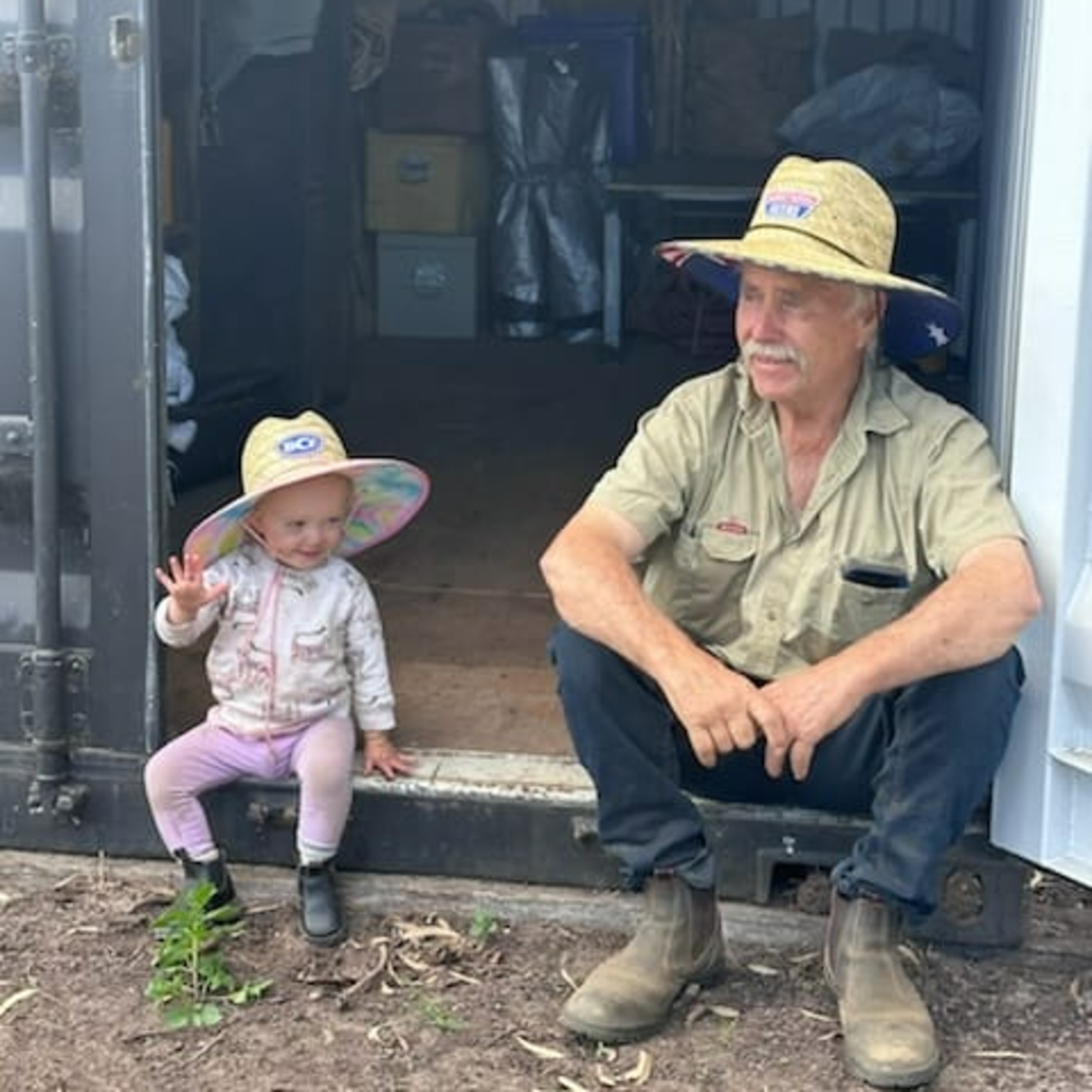
Peter Chanchant recounts his early life of moving frequently due to his father's banking career, attending schools in Queensland and Victoria, including a stint as a boarder at Bendigo Grammar. His time at Castlemaine High School was socially focused, with strong memories of teachers like the disciplinarian Trevor Rhymes and a group of close friends. He humorously recalls a minor legal issue from his youth. After finishing school, he worked in fruit picking and as a jackaroo in New South Wales before deciding to pursue agriculture, attending agricultural college. This led to a farm exchange program in Alberta, Canada, where he lived with a host family, drove an old Chevy, and met his Swedish partner, Nellie. Instead of returning to Australia, he traveled with her to Sweden and England for farm work. They then embarked on an extended hitchhiking adventure through France, Spain, and North Africa (Morocco, Algeria, Tunisia), often camping and immersing themselves in local experiences during the late 1970s.
[Music] Hello and welcome to Casted & Connections. An initiative of Hands Up Casted & where a group of enthusiastic locals have come together to capture, preserve and share stories of people who have a connection to Casted & Connections. [Music] Born in air in Queensland, Peter Chanchant has led an adventurous life. From hitchhiking in Europe and Northern Africa, you're sharing in the outback. Chanch's colorful life has had its challenges. Welcome to Casted & Connections, Peter. Thanks, Lars. You don't work in the bank and this lead to your early life of travelling all over the country side. What do you remember of those years? I was born and bred up in Queensland with my sister and they got transferred around the place up there up in Queensland. We went and ended up going to a lot of schools up there. And then from central Queensland out to southern Queensland, in Guimpy and North Queensland. And then dad got transferred down to Quambe Island in Swan Hill. And we spent a little time at school there, the consolidate the school. And then they sent me, thinking it was a better idea to go down to the battle out grammar for a few years. So I was packed off there and there, my sister stayed, I think she went to Kareng for a little while. And after that stint of her two or three years there, they got transferred down to here in Casted & Connections. So there's a set you were a border at Banner Hill. Yeah, yeah, yeah. How did you like that? I loved it, out of all. Yeah, didn't do me much good, but I loved it. So academically you excelled? I'm not sure excelled is the right word. No, I really enjoyed it, but you know, I had more good time than learning. So the parents got a bit sick of pain, the fees for that. So they brought me back up to Casted and where they'd been transferred in the meantime. Yep. And the sister ended up in Hamilton and I ended up here at the high school for the last couple of years at high school. Yep, okay. And during that time, parents got then transferred away from Casted & Connections. They ended up boarding and they were doing your 11 or 12. Yeah, the first year they were here, the first year or 11 they were here, then year 12. They got transferred to Teralgan at the start of the year and they thought it'd be better off for me to stay here. And so they're changing schools again. So I thought that was a hell of a great idea. So they went off to Teralgan and I ended up, they organized a for me to board with Ruby Gill. Oh, yes. And a son, Papa Dave, who was a good mate of mine. Oh, that doesn't sound like a very good combination. It was a great fast but not real. Yeah, no, I had a good time but it's academically, it was a waste of time really. But I wasn't a great scholar, wasn't that keen on it but we had a good time and Ruby was really great. Yeah, so you got some life skills, let's say. Yeah, yeah, life skills. Yeah, it was early days. Yeah, but I went up to school there and did the time and everything but I wasn't that keen on it. I do remember talking to someone that you were always telling me that in the Cobbard arse, which was the local cast in high school magazines that used to get put out every year and they were still put out. And they were flicking through and they're all in this sport team or achieving academically and doing all these things. And what was the picture of you, do you remember? Oh, there was a couple actually. We were in a drama class at school and there was one of me lulled in front of everybody on the grass. And then there's another one that the sports day was trying to get over the high jump, went to take a enormous great leap and slipped and went underneath the bar and didn't knock it down. But I went under and stood over it. So you weren't, your sporting prowess wasn't hadn't been achieved at that stage. No, no, no, hadn't achieved it. We hadn't had a fan jaw niche. We played a lot of golf actually during the school. Yeah, during the school days, it was quite often we'd go up to the couple of somebody, I think Jeff Cooper had a car, so we'd go up to him class that we could get out of and play golf. And a couple of times we were going around there and we'd see Rhymesy on the other side. He was coming around the other way, so whether he was hiding from us or not, but we were certainly hiding from him going around there. So Rhymesy was Trevor Rhymesy, who was a teacher at the high school at the time, who was probably what we would be classed today as a disciplinarian. Yes. And I think there was a child in the school at that time that wasn't scared of him. No, he was a good teacher. You were a great teacher. I never had him as a teacher, but he was a good friend with my parents, but nobody ever marked around in his class. No, no. He didn't take any rubbish from anybody. No, he was a man who'd be walking down the corridors and he always used to have coins in his pocket. Do you remember? He used to jingle those coins in his pocket. And if you'd hear the juggling of coins coming, you'd go and hide in the laundry or somewhere. All the rackets would stop in the washroom. No, but he was a fantastic teacher. Yeah, he was good. If they didn't have him up there, it'd be bedlamuric and stuff. Yeah, so what other teachers do you remember at the time? Oh, there was Scotty, John Scott. Yeah, yep. Rudger Bailey. I made him mentally, he was the head there at the end when I was there. Mark Winknaut, as a few of Rod's Fag. It was a good, we got on really well with our teachers up there. So, socialised with them too. Yeah, because at the time, those teachers were all not that much older than the year. 12 kids, anyway. Yeah, yeah. They were sort of fresh out of teachers' college, most of them. That's right, because when I came in from Queensland, Queensland education standard was below Victoria. So, I came down half way through the year, and I had to repeat that form one again. Oh, okay. I started form one in Queensland, and then I had to repeat it at Bala at Grammys. I was a bit older than the others anyway. Oh, okay. And those teachers, you know, we did socialise with them. Yeah, so you were the mature one and your group of friends. Yeah, yeah, the sensible mature one. It's to the point that I hear you've actually got a criminal record. It's been a sponge. Isn't that correct? Did you hear a whisper about some incident that happened over in the car park across from the copper wood room? Who was this person you said you were talking to? Right, because I can't divulge my sources, but. Yes, but probably not a good idea to speak about that. Oh, come on. Come on. A couple of friends of mine were making a round. They had a good night at the copper wood broom. Could you just put me on the spotty of yours? I believe you needed to relieve yourself. Yes, I did. I did. Back in those days, the car park. It was not elders. There was just a car park across the road. Yeah, and Lallus, Brooker and Janus Morrow, may have been speaking to you about this, but anyway. And what happened? You were caught, were you? By the local policeman? Well, I just abandoned the bum at him. Yeah, but. I thought it was hilarious, but the copper didn't. And what was the result of that? Other than having a criminal record? No, no. Did you have to do time or.? Oh, no, god, no. No, there's no record there. It wasn't put down, but the judge who came to. Also, it did go to court. Yeah, it went to court. Yeah, in cast it on. We're only going to be embarrassing for mum and dad. Yeah, it was a bit. But they knew the next morning before he even told them. But the judge. This is the worst part of it. He got caught for flashing young kids. Really?. couple years later, yeah. And that awkward. Cap quiet went to court. Oh, there you go. That was the end of him, so. Yeah. He got his just rewards. Yeah, that's true. I hope you haven't got too many more of these stories, Lallus. No, I haven't. I'll have a few, at least. So you had a great group of friends at that time who all gone on and. All over the world, and so forth now. But they often seem to come back to Castan and still, don't they? They've had that connection. Yeah, we're just a bit of a union. Or not a big reunion, but Castan Cup weekend. Quite a few, Dawn Lallian, Janice and Eker, and. There's a few of them can't get back now, but sometimes Bondy comes back. Well, those come back in a couple of days, and then they're all for Spud's Memorial down there. So we're key to catch up with quite a lot of them then again. So it's interesting how sort of stating contact and remain quite close over the years. I suppose it was time she drifted apart. Yeah, yeah, yeah, yeah. It's a summer drifted apart, but we sort of. There's belly-oven, the west, so we catch. Or not catch up. We might catch up every two or three years or something like that. Smithy, he was up in Sydney. We haven't seen him for a while, but we sort of get a phone call down again, so. Yeah. But everybody knows what everybody's doing, and we're pretty tight and casted. Yeah, pretty tight. Even after school finished, and we hung around for a year or two, and we all sort of did stuff together. Speaking of which, you. I believe you went fruit picking with belly and pedicule. Yeah. I think that was just after you left school. Yeah, absolutely. We were going to make a million dollars picking fruit. That was our big plan. plan. Yeah. They went up to
One hill. My parents had been in the mean time and been transferred to Swan Hill. So they were living there in the bank. Yep. Billy had a combie, so Galpon Island, Billy headed off up there and went into the employment office, I forget what they were called. And it's a heap of fruit picking up there. Yeah. But it turned out to be one horrible year because all the, you got to pick in the grapes and all the grapes just fell off the bunches and we weren't making any money at all. Oh, okay. And we went from one place to another and it was pretty horrible if they'd ended up capsicking, picking an Aero full of birds and then we went watermelon picking and rock melon picking. But and then we decided rock melon picking and watermelon picking wasn't for us. So we filled up the combie and took off from that place and went and camped in the Murray River for a couple of weeks as fishing and eating watermelon and rock melon drinking beer. So that was your diet? Yeah. You got melon more than melon beer. Yeah, it wasn't bad, it was fairly healthy. Yeah. Galpon Valley decided that was no good, so they came back here to cast and then I stayed up there and got a better job out on the fruit blocks. Yeah, we were trying to track this and that sort of stuff. From there, did you have Jacarouin? Yeah, yeah, yeah. Yeah, yeah. I decided to go do something a bit more substantial. So I went up to Rianne Hay in New South, Jacarouin. Yeah. So I went up there for a couple of years and I really enjoyed that. So what did the Jacarouin entail? So what we're actually doing? They had sheep and cattle and irrigation and a little bit of cropping. So we did a bit of everything up there. The cattlework, sheepwork, drive and tractors and that sort of stuff. The place was next door to another big place called Eordry, which is since been sold. Yeah, we worked there for a couple of years doing that and that was good fun. It was really good fun on the Moran Bidji River. And then I decided that I'd go to ag college after that Dan and Glenn Hormiston. So you sort of decided then that like after all life was what you liked or? Yeah, yeah, yeah, because it always, even though the Alman was in the bank, I sort of had my first horse up in Queensland and went out of ride up there and then we came down here and we were always in little country towns. So we lived out there and I was always going to go work at the Alman asked if I wanted to work in the bank and not hope for that. So I went to ag college and did two years there, which was good at a good time there, learned a bit. And then after that I went on exchange program. I saw it at the Canada Agricultural Exchange, the Canada for 12 months, which was fantastic to it. Went and lived on farm over there. It was cattle and cropping farm in Alberta, just north of Calgary. Instead of the people there, it was really fantastic, a really good family, really good family. Yeah, so you just did farm, like as an extraceative farm, was it? Yeah, yeah, they'd pay us. We got paid. Hi, up. And spent, went over there, well, we didn't go in the winter, but it must have been the end of winter, I think. We spent the summer and it was just starting to snow when we left. I was supposed to come back to Australia, but I'd run into a Swedish girl who was, she was on the same program because they had girls and likes on us as well. She was on a farm in the next town, so and we'd stayed in that town. Instead of, they had a big orientation week there when we first got there, 40 of us went from Australia and 400 from all around the world, turned up this little place as a cast of them and we had a week's orientation. I was lucky enough to stay in that town. So we'd already made a few local friends and whatnot. And Nelly, the girl I met, she stayed in the town, too, and we'd meet up. During the week, we'll go to the pub during the week and if we weren't working on weekends, we'd go camping up in the hills or up the ramp, up the Rockies, because we were, you could see the Rockies from where we were working. Wow. Yeah, it was, oh, it was one of the best things I've ever done. Yeah. And the family I had were really good family. So you lived with them in the house? Yeah, yeah, they had kids and they were younger kids than me, but you lived, you became part of the family. And they gave me a car, it was now 56 Chevy, it was a beautiful, it was an old Calgary taxi, like a white taxi. Wow. And they gave me that. I had to buy it for a dollar on the understanding. I sold it to him for a dollar when I left it. Oh. Yeah. But it was great. Big seat. You get six across the front seat just about and six on the back. You wouldn't have done that though, would you? What? That wouldn't be legal, would it? Oh, I might be exaggerating a bit, but there was no, there weren't too many rules back then. But driving on the other side, that was the first time I'd ever driven on the other side of the road and that was horrendous for a while. Bit scary. Yeah, the first night we went into town, first time I drove it into town. I came to the first intersection, I didn't have a clue what I was going to do, so I just stopped and waited there was no more cars. And then drove off on the right side, all the side of thought was right anyway, but you get used to it afterwards. Yeah. And I hope it was because it would be left hand drive. Left hand drive too. Left hand drive too. Yeah, yeah, yeah. But it was automatic, so you know, they were all automatic, so at least it was, it wasn't that hard, driving a manual. Some of the farm vehicles were manuals, just because everything was on the other side, it took a bit of getting used to it. Yeah, I mean, yeah, I'd imagine it would be pretty difficult. Yeah, yeah. You know, we got there in there. So you, when you were in Canada and so you and Nellie then started travelling together? Yeah, yeah, we went back to Sweden because instead of me coming back to Australia, I just so go back to Sweden. She was going back there, so we flew back to Sweden and stayed there for a while. I ain't up spending about two years in Sweden, but we went over there, did a little bit of work, worked on a horse stud, big riding complex where they teach riding instructors. So what did you do there? I just muckin outstage and stuff like that. Yeah, and we lived over a little cafe and I sort of cleaned it. No, I didn't have a work per minute, you know, like that. You were an illegal. I was a, no, I was allowed in the country. It wasn't allowed to work. I'd Sweden, we talked about it. But, yeah, we worked for a while and then she'd already worked in England years ago. She had contacts there and we ended up going out to Devon in England and worked on a farm there for whatever, six months or something. So what sort of farming there? There's a sheep, cold and bloody horrible horsemen. Yeah. It was a good job, but it's just, you know, cold and miserable and snowing and all they sheep, they kept in barns. Oh, it's in the same shed, yeah. Yeah, and they slammed them down in shed, they didn't have the numbers like we got, but everything was slammed down. They had a few cattle as well. But it was, yeah, farm houses are a big old stone farm houses and the only home was a stove in the kitchen. Yeah, sort of, I don't know how they did it myself, but. So did you work, like, was it hard work? Oh, no, no, no, no, no, but when we used to farm work, so it wasn't, wasn't sticky out, but it was a good fun, you know, you'd go there in the pub on the weekend and, you know, they're pubs fantastic over there, not on every corner in the little country towns and so. Yeah, it's beginning to be a bit of a theme here. They carried on that theme for quite a while. That's okay, that's okay. It's the way to meet people. Oh, yeah, yeah, yeah. No, that seems the idea pretty much these days. Yeah, it has, hasn't it? Yeah, yeah, yeah. So, yeah, so you worked on the farm in Devon and then. Yeah, we had it off to Europe. We decided to hitchhike, so we. So this is when, this is about the late 70s? Yeah, it's early 80s or? Yeah, 77, 78, somewhere there. Yeah, yeah, 78. Then we hitchhike went across the France and hitchhiked all through France, Dancery Spane, down to North Africa, across North Africa, Morocco, Algeria, Tunisia, wow. Well, up through there, it was great. There was back then there wasn't a lot of tourists around. Yeah. There wasn't very tourists. Probably especially in North Africa. Yeah, yeah. Europe would have been. It was plenty, but North Algeria in particular, we were hitchhiking, but you went on, certainly went on land to hitchhike in Algeria. So we had to sit back a few caves off the border and hitchhike there and we got a ride with some people, some French people. Yeah. We were going across the border, so we became part of their crew and went across the border there. But Morocco was, we got to end up with a couple of Australian, another Australian couple out of Kombi, so we traveled with them for a few weeks around there, and the Sahara and back up the coast and just camping and then back in Algeria. So what did you do for food instead? Did you carry food and stuff with you when you were? No, just picked it up as you went. Just, yeah. Yeah, yeah, yeah. No, you could buy it. It's, we camped on a little beach then where it was a place called Tara Zoo on the West Coast of Morocco. We heard about it. Because people just camped there, you weren't supposed to camp places that weren't official, but there was quite a few people camping there and the locals that ended up putting some cops down there just to keep everybody in order. Yeah. And we camped there for long. It was about two Ks out of town, so you could walk into town and buy bread and food. So you had a tent? Yeah, yeah, yeah. We were just camping in tents the whole time. And then when you went to the towns like Maracastin those sort of places, you could find accommodation and people have come.
kids that come up to you, oh, come and live with our place and you go back and give their parents a few dollars to camp at their place. They were room for you. Yeah. And they were pretty friendly, but they would just start to get the idea that tourists had money. So they sort of had a lot of the time to try and get money, not take it from you, but they're trying to sell you something or whatever. But then Algeria is a complete opposite. We went through there and didn't see many tourists at all. In one town, probably the size of Mount Gambia, and we didn't see one foreigner the whole time. We'd walk along the footpath in the bigger towns and people just call you in and buy your coffee and they're really friendly, but we also got robbed in that country too. Oh, God, what happened? No, that was only pickpocketed, luckily. But we were getting on to a bus and we just stand, the bus was crowded and somebody said, "We've dropped something and now he looked down and she had some notes rolled up." She dropped them, but then she realised the rest had gone from a pocket. Somebody had just put the hand into her shoulder bags she had. And we realised it had been knocked off. So we had to get off the bus and we went out of the cop station and they couldn't have cared less. They couldn't speak English and now French was pretty ordinary. But they sent us down to these two French women who worked there for the airlines, that's right. And they came up and helped and translated, but in the end the cops didn't bat in care. But it was back in the days when they had travellers checks. Oh, yes, yes. And we lost all of our travellers checks. Oh, God. But we ended up getting them all back later on once we'd got home. But these French women took us home and put us up and got us going again. And then we headed off to Tunisia, Hitchhike again at the border. We got a ride, we got a camera, we did it. We got a ride with these two Egyptian blokes and got to the border. We ended up getting stuck on the border because their paperwork wasn't right and they had to leave us here and go back and get their paperwork. We were stuck there for a couple hours waiting for them. Wonder if we're ever going to come back or not. But they came back and picked us up and we got through all right. And a few Ks over the road, over the border we got to a town where we were going to separate and they stopped and what's going on here and got out and opened the bonnet and they pulled all this money out. They'd been smuggling cash across the border. Oh, God. Unbeknownst to us. It's out of being caught. Everybody would have been in trouble. In trouble. But anyway, they got away with it and we were fine. Closing counter. Yeah, we were in a separate ways and they were really good people. Yeah. You meet so many good people when you travel there. Yeah, yeah. Majority of people are friendly, nice. Yeah. They want to help you especially. They want to help you. Especially over there when they don't see many people like us. Yeah. We really had a good time and then travel up through to Newsy year and then across to Sicily, got a boat across to Sicily and heading up through that country, cross Sicily, Italy. Just heading north in Europe, still travel whatever, buses, hitchhiking, whatever. Just however you can get there. Yeah. Yeah, it was all pretty free and even. So did you work at all while you were away? No. You just didn't earn your money saving six times. Yeah, yeah. We had a savings, so we weren't working at all. And of course, no size. There's no ATMs. No, no, nothing like that. No, no mobile phones. No mobile phones. We'd send a postcard home every few weeks. That's our mum and dad. New where we were. Yeah. And I still got those postcards, say, Captain and SNS, still got them in their name. But then we got to Germany and Nelly had to go back to Sweden. And I was, I don't know if it's taken a welcome up there the last time, so I wasn't allowed back in for a while. So I hope. What with Nelly's family or with the authorities? The authorities. No, appearance of a fight. But no, I had to spend another four or five months out of the country before his eligible to come back in. So I went and stayed in London and stopped at a boarding house, seeing a job running and boarding house. How did you manage that? It was easy. How did you manage to get the job? Oh, I got into London off whatever it was, the boat, or. Coming from France and I was standing around at the train station in London looking lost and weary and this bloke came up to me and gave me a bit of paper and said, "Oh, you want somewhere to stay?" Or sure. It gave me a dress that was in Kilburn in London. So I went out there, got a bus or train or whatever it was. And there was one, there's an illegal boarding house, there's four story terrace houses. Oh, yeah. I got in there and the bloke, it was running, it was a American bloke. And he said, "I know we're full, but you know, I've pleaded." Anyway, he said, "We've got a bathroom downstairs. You can sleep in the bathroom, but he's using it." Until the bed came. So anybody, people came and went every day. So there's a bed, a couple of days later, nice day there for, or there was about a week then. And then the owners came, they'd come along every day and collect the money and whatnot. And the American bloke was leaving. He said, "He didn't enough, so they offered me the job of looking after the place." So I took that, it was pretty easy. He just took money and she was pretty rough joined. So did you have to do any maintenance or. No, no. No, just it can. Just take the money. Take the money, show them my bed and everybody did their own cooking and that sort of stuff. So I had an upstairs there sharing a room with a bloke who was doing some maintenance if in exchange for rent accommodation. And isn't it the level of floor that wasn't at the cheap. Oh yeah, yeah, yeah. There was, on the bottom of those, the bottom two were travelers. And the next one up was, I forget what they were, but slightly better than travelers, or worse than travelers probably. Then the top one were down and out. So they had to look after themselves up there and they. That was pretty rough. We didn't have much to do with them, but they were just paying a weekly rent. The rest were, first travelers just might stay a week, two nights, two weeks or whatever. That was good. The place was full by lunchtime, so. So there was a lot of work, it's like people there were. There was a few. Immigrant workers? No, no, no, no, no, there was none of that. Because that sort of wasn't on that back in those days. Yeah. It wasn't a thing. Back there was just mainly travelers in the bloke's upstairs that had nowhere else to go. To go. Yeah. No, they were right, but they just had nowhere else to go. And it was just us travelers. So did you see a lot of London while you were there? Not a lot, because I sort of had to be there every day. It was mainly just in the morning. It would get around a bit and do a few things and socialise a bit, but there wasn't a lot of travelling all over London. Because there is pubs in London too. Yeah, there's one just around the corner by chance. And I was just around the corner. Oh, that's the pubs. Well, there's a pub around every corner over there. Yeah, that's true. Yeah. They got fantastic names, haven't they? Oh, yeah. They can't remember them, but they were good. Yeah. They were. Lots of character. Lots of character. They were good fun, those pubs. Yeah. And we really enjoyed that. So you did have an incident, I think, before you went to London, was it in Sicily with the Green Mercedes? Oh, I was trying to bypass it. Oh, no. Oh, no, no, no. No, no. Yeah, that's right. When we went from. Sicily to Italy. To Italy. And we got across. We got into Italy. And not long after we were there, we just hitchhiking on the road. And there's this big flash. The city's Benz pulled up beside us. Officers arrived. Oh, yeah, brother. So there's an old bloke driving. Another young bloke, sort of, early 20s, real thuggish looking sort of bloke. Another one in the back. We jumped in there and actually Nellie had jumped in the middle. And I was outside and this other bloke was on the other side. And they started to get fairly suggestive about Nellie and the old bloke in there. We were in the middle of nowhere and all that gear was in the boot. And anyway, we pulled up a bit of a roadhouse and got out. They said they couldn't speak English. Once again, our Italian was. Not great. Not great. They got out. And as they got out, we just noticed all that handguns in their belts. Jesus. This is not flash. So they went into the roadhouse and had a couple of whiskers and came back out. And then when we got going again, they were suggesting that I should, for money, let Nellie go with the old bloke. They didn't say it, but they were making hand signals. You can imagine what was going on. Nellie and I said, "We just. Next chance we do, we get, we got to do a run area, just jump and run when they stop. Forget our gear." And we came to a tender section just off the main highway and they stopped. I've wrote it easy at chance, so we jumped and got out and started to go. But they stopped and they all bloke, got out and opened the boot and grabbed a gear and just chucked them all out on the road and left to see. So that was fairly lucky. But then we got another ride, not long after that. This truck driver who was a really nice bloke, he took us home and put us up and his wife cooked meals for us and so. But that was the only bad incident we had. That could have gone. Could have gone awry. So really for all the years of hitchhiking, which was what would have been a couple of years. Yeah. You really haven't had those two incidents as. You know, when you might have been in a bit of strife. Yeah, that was an 19-inch cycle like in Australia in the early days. There's no way you'd do it now. But yeah, we're very real.
I had no incidents over here really, and that one in Italy was the only bad one. Luckily nothing happened, but it could have gone. Yeah, pay a show. And the rest, everybody was fantastic. Yeah, it was fantastic. Or we wanted to help. Would you hitchhike in Australia? No, no. No, not unless I was broken down or something like that. Like, lucky, you know, I'm saying even if you were young again, would you? No, I don't think I would. You know, you very rarely see a hitchhike at these days. I mean, you don't do it. It's illegal, I think, too. I don't know. Could be. Oh, no, no. Yeah, I'm not sure myself. Yeah, no, it could be. But you see the odd one now and again, and you can pick them there, there foreigners, there, you know, backpackers. And I've picked them up too. Yeah, it's up with. You got to pick your mark. It's. It was a much more common back in the 70s and 80s. Yeah, with Jimmy Casey. We jumped out there when we got out of the aid one weekend. We hitchhiked across the aid lane. We hitchhiked across the aid lane a couple of hours there and came home again. I can remember his hitchhiking in the magambi for a pizza and dinner, you know? Yeah, yeah, yeah. But no, she's not a thing you're doing now. No. You probably be alright, but you just never know. Yeah, yeah. So you come back to Australia after London? Yeah. After London? No, no. After London, I went back to Sweden. Oh, I can't, yeah. I had two windows over there and Sweden. Oh, I stayed over there. So what were you doing over there? Oh, not a lot. They had an Ellie's parents had a summer house up on one of the lakes up in central Sweden, so we stayed up there a few bit. Oh, that would have been hard to take. Yeah, it was fairly hard. Yeah, fairly hard. Was it a pub there? Well, they're different. They don't really have pubs. They have sort of a type of bars, just a bar thing. It's not a bit, more back then, it wasn't a big pub thing. It was, you know, we drank, but, you know, it wasn't a pub scene like there was over here. But, you know, we spent another, well, forget, it was tracking time, but another 12 months or whatever it was there. There's two years all up and then we decided to come back to Australia, the two of us, and came back here and left there in the middle of the winter snowy area. I got back here as green and hot 40 degrees day in Melbourne. Had an only coat with that? Yeah, nice. She was pretty tough, really. Yeah, she was good. She was a gala, so she could handle all that sort of stuff. So we came back here and. Back to Castoran? No, no, back to Hamilton and Peltro and Hamilton in the bank and Hamilton National. So I stayed there for a little bit, a couple of weeks or whatever, and I got a job on a farm in Dunkel, at a woodhouse running a farm there. Oh, yeah. So. Is there many farm managers? Yeah, it was ain't fair, Snikers. There's fellow Francis as daily-owned, and he was a pilot for Phenomores, a trucking company. He lived up in Wager, his contact through the old man, through the bank and got that job and. Yeah, it worked there, but then we suddenly did want to live in Australia and I did want to live a full-time in Sweden either, so. We went there separate ways after that. But we're still in contact now, you know? Which is nice. I've been here for three years later, whatever it is. And I stayed there and spent three years doing that. In the meantime, I'd learn how to shear while I was there. I don't want to self-hat a shear. And after three years, I wanted to go shearing out in New South, Western New South. In the middle of summer, in the middle of February, I want to do this. What a great job. Yeah, what a great idea this. You made a couple of strange decisions, really, how are you doing? A couple of good ones, a couple of odd ones. Yeah, anyway. I was just started doing, like, getting a hundred. Yeah. Doing a hundred and then got a job, we went up there and got on to contract and yeah, you know where I say, went up Western New South Wales. Shearing up there, really enjoyed it, really enjoyed it. And then I heard my hand, I cut my hand with the hand piece and came back and. I went to the parents' place for a couple of weeks recuperation and then got to talking to a bloke in Teralgan, who was a contractor of the old man, New over there at a lawyer. And he offered me a job up in Queensland and in the mines up there. Oh, okay. Yeah. I gave the shear in a way again and went to Queensland up in Central Queensland. We were building bridges and culverts for the month. Building. oh, okay. So you sort of worked in construction. Yeah, I just went up as a TA and. What's that mean, TA? Travements assistant. I am. I didn't plan on operating backhows and a couple of loaders and that sort of stuff. Really, I only had a little crew of six, so they had chippies and that and I was just the lackey for everybody. Yeah. Which was great. I was living out in the camps in the bush, big camps and we spent a couple of years doing that. This brings me to another story I heard from a source. Well, that's not the same source. Which was. well, this person said that. What do we mean, nameless? Um, was getting married. Oh. And apparently he asked you to be his best man. Yeah, it's. and this best man is coming back down here on Wednesday. So I have a life-dove award to him. Yeah, well, he was telling me that. yeah, he asked you to be his best man. But you being you, he wasn't sure if you were going to turn up or not. But then you rocked up on this motorbike. I don't know what sort of motorbike was it. It was a. it was a 550. yamaharp 550. It was a sort of on-road off-road. Because I was working in the mines and he was in Gladstone. Gladstone, yeah. Yeah, yeah. Because which my mother's parent. a lot of my family, half my family lived in Gladstone. I came from there. And I was up in my coy and finally asked if I'd be best man. And apparently I didn't let him know I was coming. I thought I did, but anyway. But where I live in the middle of nowhere, we're backing in no phones. Yeah, nothing like that. That's right. So I came down on the motorbike and I got to. It was a roadhouse in the middle of nowhere. And I had my gear strapped on the back and I had a canvas shoulder bag on the back. And I pulled into this roadhouse to get fuel. Now in the middle of nowhere, I stopped and got off. And bug me that bloody canvas bag was on fire, smoldering. I had a can of chain oil spray in the back. And I slipped down onto the exhaust and caught fire. So I must have been trailing a big plume of smoke. Pulled in, dragged this thing off my back and. But McGee, my stuff I had for the wedding was in the back. You suit for the wedding? No, no, no, not a suit. You're good clobber. Yeah, anyway. I ended up with nothing and bondly at the moment. You're all these kids in this choir. Well, his story was just as we were saying. Oh, you think the pre-perparetery exaggeration here. Oh, he said it was just as well. We were the same size, because you know, you ended up wearing his clothes as best man at his wedding. Yeah, yeah. Up here for thinking like. Saved your lot of money. You did, you did. Really? No, that was a good weekend. Yeah. And we still catch up. He comes and stays at home. He's been there a bit too regularly this year, actually. Well, I have heard someone did tell me that you're the odd couple. The way you interact. Oh, you and him, you're like the odd couple. You're a vision pro. Yeah, yeah, yeah. We're sling off a bit at each other. It's all a bit of good fun. And he hasn't got a very good sense of direction either I heard. Is that correct? Like, he gets lost of air, bit driving around the roads here. Oh, yes, he does, actually. Yes, yes. He's been there. Even just from Spud's place to back home. Yeah. Left Spud's place. And he got about 100 metres down the road and he was lost from there. And they were up watching him. It was one of them where the heli was going, but he's useless. Yeah. So, and then you come after the mining jobs, I think you're coming back to Castan and become a trucky. Oh, that's right. Yeah, yeah, yeah. You came back here. And I'd been shooting. Was I shooting here? I came back, yeah, I came back shooting, got in with fish. Started with fish, shearing for a wall and then I ended up. I gave that away after whatever time I came. I got on with Kingsley Peach over in Hamilton. So, I drove him stock trucks for him over there. And I was sharing a house in town with one of the school teachers, Monica Nichols, she's since passed away, but we share the hair, subjacks and straighten. I was driving with Kingsley Peach then. Yeah. So, what was your main cargo stock truck? Yeah, she peeped and calmed back in those days. Every second town had an abattoirs. Yeah. And Peach was just over flat out, they had 14, 15 trucks. And they were just flat out all the time. With Monday morning, or Monday morning, you pick up a load at the sale yards and how long can go to Portland, come back and get on the load to Melbourne, Adelaide or UCNs or. It was flat out, he drove it flat out. So, you'd get during the season, you'd get Sunday afternoon off if you were lucky. Yeah, so it was hard, hard to yak it really. Yeah, when the lamb season was on, but after that one too bad, it was good, I enjoyed it. There's, you know, your single house, I'd know, no cash. No ties, no kids. No ties, no kids. That was okay. Yeah. So then you bought a clara, your place down at clara? Yeah, well, I was here. I'd tell Smithy, Peach Smith, was looking for a place. Somewhere to buy a bit of land. Adelaide at clara is 100 acres on the river, I'm like, I'm going to go and learn it up buying that and had that and just started slowly because nothing on it was bareblocked. Right on the river, really nice big hall.
you've been type of block, good flats, bit of bush, permanent couple of caves are over front. So just gradually doing stuff there, I bought an old house down at Digby and demolished it and built my house out there. Oh yeah, so building a house here. Over the years it sort of just kept building up the farm. Yeah, I used my bridge building skills to build a house here. I didn't know much about building a house, but I always wanted to. So yeah, I built it and lived there. It lasted till what sort of years ago. Yeah. When she burnt down, caught fire and went to heaven. That was pretty scary. It would have been pretty scary. Yeah, it was different. I was saying to sleep in bed. Yeah. Said day not, woke up and didn't use something as wrong. The smoke alarm didn't go off and use something as wrong. It didn't know what was wrong with you. It didn't know what it was. It's just a really eerie feeling. Why can straight up have a deep sleep, went to the lights on, no power, looked out the door, upstairs, upstairs bedroom, looked out the door, and I could see everything. And that's not a real good look. No, we're now not good. So you could see the flames and stuff. Yeah. And it not long started as chimney caught fire through the chimney and must have got a hole in the chimney. And caught fire into the ceiling, which was all pine-lining wards. And it was heading straight from the bedroom. So it had about probably 30 seconds or so before it hit the bedroom. And I got out, grabbed a few things, shoot boots, bag of grapefruit that were on the table. I didn't know what it was. It was full bags. I should have started in the trailer. I'll grab it. Yeah. Yeah. I got a jacket and one of them all, camel racing trophies. Yeah. Grab that and put all that out on the lawn. And meanwhile Grayson Bevin had come out, around then they came out and they organised the fire grade. They came out. All the trucks, there's six trucks turned up from all around the area came out. But it's half an hour away by the time they got the issue was well and truly gone. The stuff I put on the lawn to save the grass caught fire, I went down, burned it anyway. But when it's gone, it's gone. It's a loss. Must have been devastating. Because I mean, you'd built it. Yeah. You built it yourself and built it up. Yeah. All the camel racing memorabilia and all that sort of stuff was in there. I suppose that's the worst thing, isn't it? It's the memorabilia stuff. Yeah. From before the fire, I always said to Jesus, I love this stuff. I hate to lose it. But once it's gone, I haven't worried about it. It's gone. You can't do anything about it. No point fretting over it. No. But it's, you know, it's. You've still got those memories. Yeah. Yeah. Well, at the moment, I was still about that. Yeah. Well, that's true. Yeah. But yeah, I got a few photos. I got a three or four photo albums. Oh, OK. I got them out luckily. But. Yeah. Did you. We were thinking clearly. Do you think when. Yeah, I can remember it. Yeah. Yeah. Like, you know, you just. When you'd action, it was. Yeah, when they tried on. The first thing I did was ring great. They were at a party, luckily, in town. Yeah. So they all came flying out with a few friends and. Right, a water trail over there. We put the grass out. It was. It was in December, but it wasn't real hot. So, you know, it didn't get to the pines. It just burned around the house. But, no, I remember it went and turned the pair off, which had already flicked off anyway. Turned the gas off, got a couple of things out and I said, "Oh, I've got a bit of going. There's a few other things, but I looked in the back door and the smoke was down about a metre off the floor. And, no, I'm not going to. Yeah. Because it was just black, acrid smoke, to. Yeah. So, at least you had the presence of mind. Yeah. Yeah. Well, yeah. You wouldn't go in in your right mind. You could see the smoke coming down from the roof, because the roof had started to. Bits and Peece had to fall down while I was in there. Bits are flaming timber in that sort of, because it was all really dry, timber, you know. Yeah. Bolted pine on all that. But, yeah, no, it's yeah, no, it's all pretty clear. Then all the guys from around town came in the fire trucks and those spent time putting it out and got it all out. It was about half past four in the morning. Both the time was all out and everybody went and all went back up the Grayson Bevins and lived there for three weeks with them. And then friends up the road, GM Edwards, and then Nardibal were leaving. And they wanted someone to rent the house. So, rented their house for a couple of years was getting the new house, but that was perfect. Half-hour between home and Grayson Bevins, that worked out really well. Yeah. So, little luckily, panned out. Yeah. Yeah. Well, we'll backtrack a little bit now to. Well, you also did you go to California as well working? Oh. In a rice harvest. Yeah, yeah, yeah. That was late. That was. After you bought the farm. Yeah, yeah, yeah. I had that block and I had been doing a bit. Oh, come, it's sort of gotten you, it's gone a bit, but been driving. Yeah, I was. Meantime, I'd built this place and I lived out there for two years and a tent while I was building the house. Yeah. And, you know, there's old scalp, 12-12. That's good. It was a bit easier those days than it is now. But, well, what was that? Yeah, you went to California. Oh, that's right. I had a mate who went on another exchange program and he went to Minnesota, Rob Soby. They had Soby's butchers in Hamilton and he said, oh, let's go back again. He had a contact in California, a Sacramento, though we rang him up. Yeah, yeah, plenty of work. So, we went over a few times to go over to the rice harvest, flyover and there's all illegal. We had no work permits but they couldn't get workers. So, there'd be 12, 15 of us foreigners there working. We'd go over for, only six months, work there. And we came home and I decided to go back again after that a couple of times. It was just great fun. Yeah. Great experience. The cropping, the farming over there is just monstrous, you know. It's just huge acreage and stuff. Yeah, yeah. Big silo set up and the bloke I worked for, he did contract laser leveling, contracting after all the rice harvest finished, he'd go, we'd go laser leveling, doing all that. It was all irrigated. Yeah. So, we'd do all that, doing that. I ended up with a girlfriend who lived up in Lake Tarho, up in the hills, up in the snow country up there. Yeah. Ended up some end of it at time up there. Yeah. On weekends or when we finished a contract there on the farm, go up there for a while. Pub there. There wasn't that you mentioned. Anyway, so anyway, back, you had your little adventure over there and then you're back in Australia now, camels. How on earth did you get on to being involved with camels, camel racing, camel trekking? Well, I ended up, you know, once again, when it was, friend of mine asked me if I wanted to, she was working up for a fellow called Rex Ellis, who's only just recently died actually, doing big tracks across Australia and we had a camel business and the Flanders Rangers is a lot of tracking in the middle of nowhere and she was working for him and she asked me if I wanted to come up, well that's what I was struck by, if I wanted to come up and do it during the winter. I said yeah, yeah, yeah, no worries. I asked Kingsley Peach if I could have a couple of months off and he said no, so I said see ya. That was the end of that trip. Yeah, as I went up there and we worked in the Flanders Rangers, down camels seven day trips up there, taking tourists out up in the Rangers and Flanders Rangers there and when I got a bit slow or when I went out on the station, worked in a bit of mastering and shearing on the station and Rex, who had a bigger trips, crossing Australia and all sorts of Simpson desert and you know, places, great Victoria desert. So we went up there to Job Crossing Simpson desert, taking people to cross there and after that I had friends at Coward Springs who, Greg and Peru, they also worked for this guy Rex doing camel trips and they'd bought this old GAN railway siding and we're doing it up. So I rang him up and said I want to get a few camels and start doing a few rides, down here, see if we make a bit of money. So we went up there and we were at the peak station, anacreq station, catching camels. So we got the local bikes on the station to catch them and they'd bring them into the yards out the middle of nowhere, we'd go and get them and break them in and then walk them back to the car. So you actually broke the camels in? Yeah, they're all wild ones they brought in. Yeah, we just picked the ones we wanted and they'd let the rest go. So they may need female or male or doesn't matter? We didn't want the balls but only, only young ones, balls that we'd cut them and had females as well. So we didn't mix it both. We weren't doing tracks at that stage, we just started mucking around and taking friends out and that. I'd go back here to Castan and decide to do rides at Port Ferry. Yeah. Make a few dollars out of these camels I had. So go down there for the summer, do beach rides, spend the summer or an Easter down at Port Ferry doing the rides and then during the winter, head back up to Caird Springs and we started doing the camel tracks up there. Start having a little five day tracks and ended up over the years getting them up to two weeks, one week, two weeks. So what were the people that went on these tracks were just locals? We had a few. Sure, it's a lot of people. We had a website and just advertised and we only did three or four year during the winter. That was that was not.
we'd done it so we enjoyed it. And we'd have, you know, a dozen people with the crew up to, you know, we'd have four work in with us, the four of us, the three of us, and we always have an off-sider. So we'd have 20 people on a track. So what did you took your own food? We'd have to carry it. There was no vehicles. We had to carry everything food, food, water, and we'd go to Lake Air sometimes out there. The first couple of years we didn't, we just walking and then ended up with a wagon. I've got a wagon going and we're pulling a wagon with camels. Six camels on the wagon. We have gear on there and that way a lot of people would come that, you know, they couldn't walk a full day. Twenty-cays in the day, whatever. So, you know, we'd have room on the wagon. People would jump off and on the wagon. So it's a lot easier. And we'd have packed camels as well and people could ride a camel. We'd have a couple riding camels as well as the wagon. But a lot of people just prefer to walk. They'd work all day. Oh, so they didn't. They didn't actually. I thought they rode the camels. Oh yeah, yeah. Some were, they had a couple of riding camels, but they'd ride for an hour or so and that's all they'd want to do. They'd get off then they'd walk or jump on the wagon and, you know, it was sort of. Because I can't imagine it would be that easy to ride or go on a camel ride. No, no, no. It's sort of good heart on your hips. Yeah. Because then you know, camels are in pretty good condition. They're fairly wide, so yeah. An hour was good. It's experience, but yeah, most people like to walk. But the ones who weren't fit enough to walk all the time, jump on the wagon. Wagon anyway. So did you have any funny incidents in these trips? Tricks? Runaway camels or. We, the counter. No, we had, yeah, yeah, actually we did. We, they were really good and all the people were really good. We, as a good, you know, anybody who's prepared to go up there and rough it with swags, wasn't going to be a belly acre. But we, we went at the lake air one time. We'd camp on the edge of lake air, which is about 50 odd caves out of Caled. It's been a couple of days walking out there. And there were wild camels out in that country, not a lot down there, more further north up, out in the dataway, but we do get a few bulls that have come down there and they'd harass, harass you during the night because all the camels will be turned up, no tight up at night, the trees. And there's a couple of times they wander into camp and you'd have to get up in the middle of the night and they'd be screaming and all the camels will be screaming and carrying on. Because the bulls come in chasing the females. Well, they'll be, get aggressive. The bulls can, yeah. And they look horrible. They get all the, they have this big bladder that, when they're in season, they have this big bladder that comes out. It looks, it's the size of a football. There's a big bubble that comes out the side of the mouth and they've got sliver and sliver going everywhere. There's not a pretty look. But yeah, a few times we had to hunt them off. One time we had to shoot a couple in the night because they just, once they get into your camels that are tied up, they've create a lot of havoc and wreck things. But generally, there wasn't that many up there, the wild ones luckily. So most of the trips are pretty frenzy as far as that goes. What about wild lights, snakes and stuff like that? Oh, June, the winter, there was not much. Unless, unless the weather got warm, we had one year, there was a pretty warm winter. You'd see a couple of snakes, but generally the winter, they were all hogging, so you know, there was nasty thing out there was a fly probably, so there's plenty of that. And you did a trip, trip with with your mates at Munstoish, didn't you? A lot of the mates from here? Yeah, yeah, yeah, that bloke who was best man, he's waiting for, came on it as well. So why don't you didn't leave him out there? Yeah, Pete Galpin and his wife and belly and his wife, Bondi, myself. You know, I've got anybody. So that would have been fun? Oh, it was a, it was a really good trip. That one, just a lot of reminiscing and a lot of laughter around the campfire. Yeah, that idiot Peter Galpin just had his rolling in the sand all night, every night. He's just a bag of laughs at the lake. Yeah, no, it was an excellent trip. But those, those trips were always good fun, good, good people. Yeah. We had a couple that had come from Lake Sanctions. They, they did 13, 14 trips with us. Yeah. They were doctors, husband and wife doctors. We've got to know him really well, they sort of good friends now. They come up and it was always good having doctors on a trip. Yeah, yeah. Yeah. Yeah. Yeah. The case and thing around. Well, we had a woman lose a finger on a trip once. She's put it in a, in a, in a knot in a rope that a camel was tied to and the second night out. First day, second day out, pulled her, little finger right off. Oh, good luck. The luck of the doctors were there and they came in. They rang up on the radio back to the homestead where we were. And, and Joe, who was looking after homestead, came out with the car, picked her up and daved the doctor, one of the doctors, took him down to Māori and Dave thought they had the finger as well. They thought they might follow self back on. Got to Māori in Arizona, a little clinic there. So he realised, nothing's going to happen there. So they called in the flying doctor and took her down to Port Augusta hospital. Meantime, Joe and Dave had come back and Joe took Dave back out the camels. The woman went down to the hospital. They saw the finger not on, but they saw it, fixed it up. And she, this woman was tough as all nails. She found herself a ride in the car the next day back to Māori. Joe went down, picked her up in the car, brought her back up and she went back out in the trip. She finished the trip off. She was off her work at Famelbur. I mean, she was tough. There's no way I would end it up there. So I suppose you had that luxury of having the flying, like you had radio contact with people. So if anything happened, you can get in the car. Yeah, we were completely isolated. No, no, no. We had radio's. But in the early days, before fines, when we were doing the bigger trips for Rex Ellis, we had no, we had flying doctor radios and that's all you had. And hopefully we'd, we'd have a scared every night at seven o'clock, but you never, you couldn't always get through to bend on the weather conditions. So you'd try, but if you didn't get through, you'd do it the next day and the next day. But that was only communications. And then later on, when we were doing ours, we ended up with sad phone and all that sort of stuff. But you'd develop, you would have developed like Bushman's type skills too, wouldn't you? Yeah, well, we were doing all this sort of stuff as leaders of the tracks. Yeah, yeah, we were, we were pretty well used to all that. And everything went smoothly generally. Yeah, yeah, they were brought with camels and this sort of stuff, but you're going to get that anyway. But things like rain are probably more dramas than anything. If you've got rained in a couple of times, we've got rained in to a spot. Okay. Hopefully you'd be on a sanger and you could stay on a sanger and then the clay pans would fill up a wall and it'd be right, but we'd never spent more than sort of two days in the one spot because if we got to where the camels had just slipped, they wouldn't, they wouldn't want to go anywhere. So you'd just batten down the hatches and stay there and they were good nights and days. You'd sit up and you know, bacon scones and all sorts of stuff, sit around, yeah, who on and every good time. Yeah. So you did, so that you were doing the trekking and then you got into camel racing. Oh, well, that, well, during this time, Māori always had camel races every July. So it was all a bit slapdash, but it was, it was good fun and there's a bit of money. There's a few thousand dollars on there. So we decided we'd race a few of our camels that never race before. So who's we? Greg and I, my girls up there, Libby and Grace. The two girls, yeah, yeah. You're two dollars, yeah. Yeah, yeah. And we thought, well, we're a bit shorter jockey, so kids are about the right size. But get them to them, they live in. Yeah, yeah, yeah. Yeah, yeah, yeah. Yeah. No, but I trained them up on that. So how old were they? How was Libby? Libby was, Grace had a first race ride at nine. And Libby, she was a little bit older, a few years older, and she was race at the same time. Yeah. But we trained them up on our good camels. They're good steady quiet camels. We had one called Ivan who I ended up, I actually got him here in Castanon from, oh, God, I forgot his name. Byro. Byro had a wild camel that he picked up in the Birdsville track when he was up blind brumbies up there and he bought a back and I saw this camel and had this paddock and sunbroken. I felt sorry for it. I had all my camels over home and I went and saw him and said, I bring this camel over my place and keep him there. Byro said, yeah, yeah, no worries, I got him home and I broke him in. This is a good camel. So I put him 500 bucks and yeah, yeah, yeah, no worries. So we kept him and he turned out my best camel. Yeah. A really good racing camel, a really good nature, good rides camel, just around really good camel. We ended up racing him up in New South Wales. The Arabs put on a race meeting. They have a Derby Cup, the inaugural Derby Cup. Every Derby Cup in New South Wales. Yeah, at least. Yeah, yeah, it was the ambassador that you're a ambassador was there and he was shaking. Yeah. A little gear on there.
And they turned up there and there was a whole heap of camel people. We all sort of gave these races and camp, stayed the weekend and we had Ivan plus a few others. And they had a couple of big races to lead and cup and Abidabi cup. So all camel races? Yeah, all camel's no horse races. Was that the dog track I think it was? There was a hell of a big crowd and we raced Ivan one five races on the day. Oh, so you don't just race once? No, no, no, no, no, no, they were 400 metres and the longest is a thousand metres. Oh, okay. And Abidabi cup was a thousand metres and Ivan won that. After the race they had the big presentation and Libby wrote him in the cup and won. And the shake came down and he was really impressed and he was 'Yahoon and Karyan' on the made a big presentation of the cup and gave us a check of the money and the prizes and then he said 'Out of the blue, all because there's such a good race and Libby was riding and all this sort of stuff, I'll send you and Libby to the UAE, all expenses but 'Geez' that's what I said. You're right. Yeah, yeah, yeah. And. Hey, no pubs in the UAE, don't you? No, there wasn't. I'm not, no, there wasn't. No, I've never got there. I don't know that's the story. Anyway, all these miners came down and asked if I wanted to change the check for cash and I said, 'Yep, no worries'. Oh, I can handle that. That night at the rate where the track upstairs, club rooms, there's a bar and everything there. So I went up there and I was that cock-a-hoop with winning the cup and all this going to UAE or shouted the bar for all the camel people, all night. Put this money on the bar. Anyway, that was fantastic. They all loved it and I was their best mate all night. Yeah. And in the meantime, the Arabs had taken our names and addresses and we saw this out and all the rest of it. And they said, 'Ringers at the embassy just sought out visas'. So, a few weeks later, whatever we did that. We had everything sorted and they were organised and they'd date. And after a while, they rang us back and said, 'We've got to change the date and something's happened'. And this happened two or three times. They came up with some reason about the change of date. And then they said, 'Oh no, we're going to cancel the trip'. We're going to give you $1,500 instead. Because I'd been thinking about oil wells and high-reams and all this sort of stuff. So we got $1,500. I'd spent about that on the bar, shouting all these other clans. All night. But it was a good fund, it was a good experience. So what do you reckon they didn't? Oh, that's right. Well, what was happening in the year? I didn't realise the later on, but they had a lot of camel racing. Camel racing was big in the U.A.E. And very professional. There, camels were a squittalions of dollars. And they were using young kids as jockeys. And I saw four-year-olds, which is a four-year-old, strapped onto the camels. And they were racing them. And at this time, there was starting to be a bit of flak towards them, about treating kids like this. And I put it down to that plus there was no girls. There were no girls. So I put it down to, they didn't say it, but I put it down to, because there was a girl, and they haven't all this trouble with kids and public image. And now that they have no jockeys, they have dummies on there. They look like little monkeys, but they're little mechanical dummies they have instead of jockeys. And they drive along, and I've, jeep, beside the track, all these big flash vehicles, and they're all got a little electric dial in there. And the jockey can, the little. Oh, the controls, the actual. Yeah, they control the whipping. They can. The jockey, the robot. Yeah, the robot on the back. And this thing. Oh my god. That's what. It looks weird. It would look weird. But there's no prize money, right? They have this one race meeting I saw on TV. They had 70 land cruises, brands back in New Land Cruises, in the middle of the track, and they were the prizes for the day. So, it's a big money, that's it. So you missed it. You missed our. We missed it, I don't know. But anyway. You could have been there. Could have been. Could have been still there. Dressed as a sheep from Calirac. Yeah, I don't think so. So, your girls live in Grace. So, Libby went on to be a jockey, as in her. Yeah, she became a horse jockey. Horse jockey. She went to the mount and started with Michael O'Leary over there. There's a apprenticeship. She worked there for a while, and then she went to Adelaide, got in with one of the jolly blokes. The trainers over there did her apprenticeship and became a professional jockey. And she traveled around Victoria and. It was very well known. No, she was doing. Did very well. Yeah, she was doing well until there was a big race for. She was involved in a Murray Bridge. Four horses went down, and one girl, Caitlin Forest, was killed, and Libby was injured. Two other blokes went down. And she was all right, but she'd been. She was knocked around a bit. And she lost a bit of short-term memory, which is all come back. She's fine now, but she tried to get back in, but the stewards and doctors said she tried for a couple of years. She'd get a license back, but they wouldn't give it to her. They said, "If you have another fall, then hit your head." It's not gonna do any good, so. Yeah. Did you do it when you were about scared when she was riding? Not really, not really. Because I'm involved with the racing now. I work on the barriers now, and we sealed all the jockeys over there. So you know racing pretty well now? Yeah, yeah, yeah. Grace is a clerk of the course in the CLC. Oh, okay. And I work on the barriers, loading the barriers in the races and the CLC. So we know what's going on. You know that the risk is there. They know the risk, because the jockeys know the risk is there, but everybody takes and you don't worry about it until. That's what I mean. That's what I mean scary, though. Well, it was, because. When you're seen as four, did you see it? No, I didn't see it. Oh, no. I was in the main street of Castanon. Yeah. And that's what Grace rang me up and said, "And anyway, we got on the stewards and they said, "Oh, she's been flown to Adelaide Hospital, so Grace and I went over." She was, you know, she was knocked around, but she was out in a week or something. Yeah, yeah. And took a while to come good. But she's back fine. She's lives in Sydney and working in the horse industry up there. She's got a therapy business for horses and a partner's a horse vet. So. Oh, yeah. So that horse. The animal horses, camels. Yeah. Equine things sort of gone down through the kids. Yeah, all graces, clark at the course and she's got a off the track rehoming centre out here at Begallon, where she rehomes X-rays horses that are retired. She takes some people, the trainer's given to her. She works them for a while, gets the bit of the fire out of them from racing. Yeah. And then on the cellism to sort out someone who wants to buy a horse she pairs them up, the rider with a horse. Yeah. That'd be really rewarding. Yeah. Yeah. And she must. She obviously knows animals very well. Yeah, yeah, yeah. No, she's good horse woman. So she's accredited with Victorian, Vic racing. So they've got off the track, rehoming scheme. So all the race horses go. There's different rehomas in Victoria. There's quite a few others around. I think there's 40 or 50 or something. So X-rays horses go to all these and graces the only one around here in the Western District, rest are sort of a bit close to Melbourne. She's got. I mean, she's got it. She might have several and eight out there at the moment. Wow. Just trying to pair up with someone else to go on. Live her lives after racing. Great thing to do. Yeah. He who shall not be named Mr. Ian Bond. Well, it's also said to me to ask you about your. Well, he said that you've been involved in horse racing, but haven't had. You have had little success. Now, is this true? No, we've had success. He hasn't had any success betting on horses. It's more to the point. Oh, okay. So in other words, you've given him bum still. No, we're not up there with Bart Cummings or anything like that. But we only got one or two horses going. We're doing it for fun. We've. We've gotten a few winners. We've got a reasonable horse now, the Octa Headron, who's heading off to where we'll be next Saturday, actually, to have another run. So, shall we get some money on it or. I'm not betting on him. Okay. But he's bringing him a check. He's in the top four or five. Oh, okay. Pretty much every race. Yeah, okay. And he's won in Hamilton and, you know, good second place in a 3,000 metre. We were a couple of months back down in Tarrang. So, no, he's doing all right. He's painting his way. He was given the grace to re-home, actually. No, well. From trainers up at New South Wales. Yeah. And they said, "If you want to give him a go, try him. Try him." But otherwise, just find a home for him. So, we tried him and. Yeah, he's done really well. Yeah, that is a beautiful horse, too. So, now you're sort of into. Later years, I suppose we can say, you're still involved. You've been kind. We're farming and so forth, you know. You're clashed yourself as a Western district crazy, I do? I don't think I'm a Western district.
- No, not really. - Was it a garb look? No, no, I just got a block out there. We got a few cattle and. And your love and life? Yeah, life's good. Grace and I have been breaking in with camels, but oh, not camels, horses. But she's got a baby now, good young Delta. So we've sort of backed off that pretty much. Yeah. So that must be a joy, haven't we? Yeah, no, she's great. Good value. She's got a pony. Oh, she got two pony's now. Already, how old is she? Two next month. Oh. And she. Good job, two point panties. Yeah, she's got a little saddle this. That's going to be in her too. Yeah, well, we've band-made a bike, so she's. Well, that's a horse or nothing. I think that's a good idea. Yeah, no, she loves it. Every time she comes out home, she races him and grabs a helmet. Grab the helmet, helmet. Indie, indie. Oh, thank you. Yeah. So, you're. And you're other little. Well, it's a bit of. I don't know whether it's a secret or not. But. This bed not being eaten. Another one for me and Bond is it? I'm not. I can't say. But you've taken up music. I've got friends that are musicians. Simon Barker. He's very talented musician. Yeah, Richard L. B. Poes, David Rhodes, who's in Adelaide now, but he comes across occasionally. And I'd watch these blokes play. They've been playing for 25, 30 years. Well, David was in the Detroit Blues. Yeah, yeah, yeah. Competition last year wasn't he? Yeah, he's been to the States twice. He went in competitions. They sent him across the play over there and he's played on cruise ships. He's a. Very good music. Yeah, yeah, yeah. Top music. Brother to Robin Rhodes. Yeah, yeah, yeah. And music, too. Yeah, yeah. There's things to be in the family there. I think it might be. Because wheelplays as well. Oh, yes. New play strums. But, yeah, I'd watch these blokes. We'd have a play on a weekend or something like that. Or they'd have a play and we'd be out there giving them advice and drinking. And I'd always say, "God, I wish I could do that." Because I'd look at it and I'd say, "How the hell do they do all that?" And they'd say, "Let's play. " We'll just make up a song and they'd play it. It's sort of spun me, because I couldn't work out Adelaide. So anyway, I bought an old bass and Simon and Ricky and that, and it helped me along the way and I'd practiced and go around when they were practicing here and town and they'd hum for me for a couple of songs and I'd sort of try and do my best. And it picked it up over the years and yeah, now it's Ricky and Simon and I. We, most weeks, we play. Yeah, so we're going to ever get a public performance out of music? I doubt it. Simon used to play bands in Melbourne, really good bands. And he sort of just all the preparation, you know, you're packing up drum kits and amps and all that sort of stuff. So, but we just do it for the fun. We'll play on a weekend for friends and that sort of stuff. But I didn't start to move mid-50s. I didn't know what I was doing, so I sort of picked it up and learnt and it's a great challenge. Yeah, really. I love it. So, you seem to be a bloke that you haven't had formal training in really anything much. I suppose, except your ag stuff. Yeah. That ag school. You said yourself that you weren't academic, but you've done a lot of life and you just seem to be able to work out how to do things. Yeah, also, there's been a lot of variety. I couldn't stand one job from our life. Yeah, okay. You drive me mad. But opportunities have come up and taken them. And you've taken them? Yeah, yeah. It's not that I've wanted to change so much. I thought, "No, I'll give that a go." I'm going to do it. There's not a lot happening now. They're out in the farm with Delta and that. And we're doing our stuff. I'm just trying to build the farm up and get it really easy care at the moment. So, spend a money on that. That's because I've done all but traveling, I won't do much traveling. I did all that when I was younger. Yeah. Yeah, yeah. And you keep coming back. We can't get rid of you. You keep coming back to Castan and day up. Yeah. Over the years. So, with that, I'd like to just finish with a question I'd like to ask most people. Is what does Castan mean to you? Because I've done a lot of traveling and been around, been all over the place, it's ended up here, started here back in when I was late teens. And it just became a base, really. Especially after I bought that block of land, and I'd head off for a year or two. There's always somewhere to come back to. There was a steady base. Somewhere it's not so much felt safe. But it's just a base to come back to. And then once I had a bit of a house here, I could leave everything, go away, come back for six months, come back. And there's a lot of people I knew. There's lots of people, most people know me, but I see people in the street. And I haven't got a clue of their name. It's like I remember their name, but they all know me. But it's just a good, reliable base to be. And I feel comfortable here. But I like, also I like to get away. Not that I do much traveling now, but it's just somewhere to be. Thanks, heaps for sharing your story with us today, Pete. No worries. Been great. Not a problem. Well, thanks a lot. Thank you. See you. We hope you've enjoyed today's episode of one of our homegrown heroes. Jump over to one of our other episodes to continue the cast of the connections journey with us. Please don't forget to follow our podcast and share it with your family and friends. Thank you for listening.
Podcast Summary
Key Points:
Peter Chanchant's early life involved frequent relocations across Queensland and Victoria due to his father's bank transfers, leading to attendance at multiple schools including boarding at Bendigo Grammar.
His school years in Castlemaine were marked by a focus on social life and friendships over academics, with memorable teachers and humorous anecdotes, including a minor legal incident.
After school, he worked in fruit picking and jackarooing before participating in a farm exchange program in Canada, where he met his Swedish partner and subsequently traveled through Sweden, England, and hitchhiked across Europe and North Africa.
Summary:
Peter Chanchant recounts his early life of moving frequently due to his father's banking career, attending schools in Queensland and Victoria, including a stint as a boarder at Bendigo Grammar. His time at Castlemaine High School was socially focused, with strong memories of teachers like the disciplinarian Trevor Rhymes and a group of close friends. He humorously recalls a minor legal issue from his youth.
After finishing school, he worked in fruit picking and as a jackaroo in New South Wales before deciding to pursue agriculture, attending agricultural college. This led to a farm exchange program in Alberta, Canada, where he lived with a host family, drove an old Chevy, and met his Swedish partner, Nellie. Instead of returning to Australia, he traveled with her to Sweden and England for farm work.
They then embarked on an extended hitchhiking adventure through France, Spain, and North Africa (Morocco, Algeria, Tunisia), often camping and immersing themselves in local experiences during the late 1970s.
FAQs
Casted & Connections is an initiative by Hands Up Casted &, where locals gather to capture, preserve, and share stories of people connected to the area.
Peter Chanchant was born and raised in Queensland, Australia, moving around various towns in the state during his childhood.
Peter loved his time at boarding school, though he admits he had more fun than academic success, leading his parents to eventually withdraw him due to the costs.
Yes, he remembers teachers like Trevor Rhymesy, a strict disciplinarian, and others such as John Scott and Rudger Bailey, with whom students socialized due to their similar ages.
After school, Peter went fruit picking with friends in regions like Swan Hill, but it was unprofitable; they later camped by the Murray River, living on melons and beer.
Peter went to Canada on an agricultural exchange program, living and working on a cattle and cropping farm in Alberta, where he also met his Swedish partner, Nellie.
Chat with AI
Loading...
Pro features
Go deeper with this episode
Unlock creator-grade tools that turn any transcript into show notes and subtitle files.
 PodcastTranscript AI