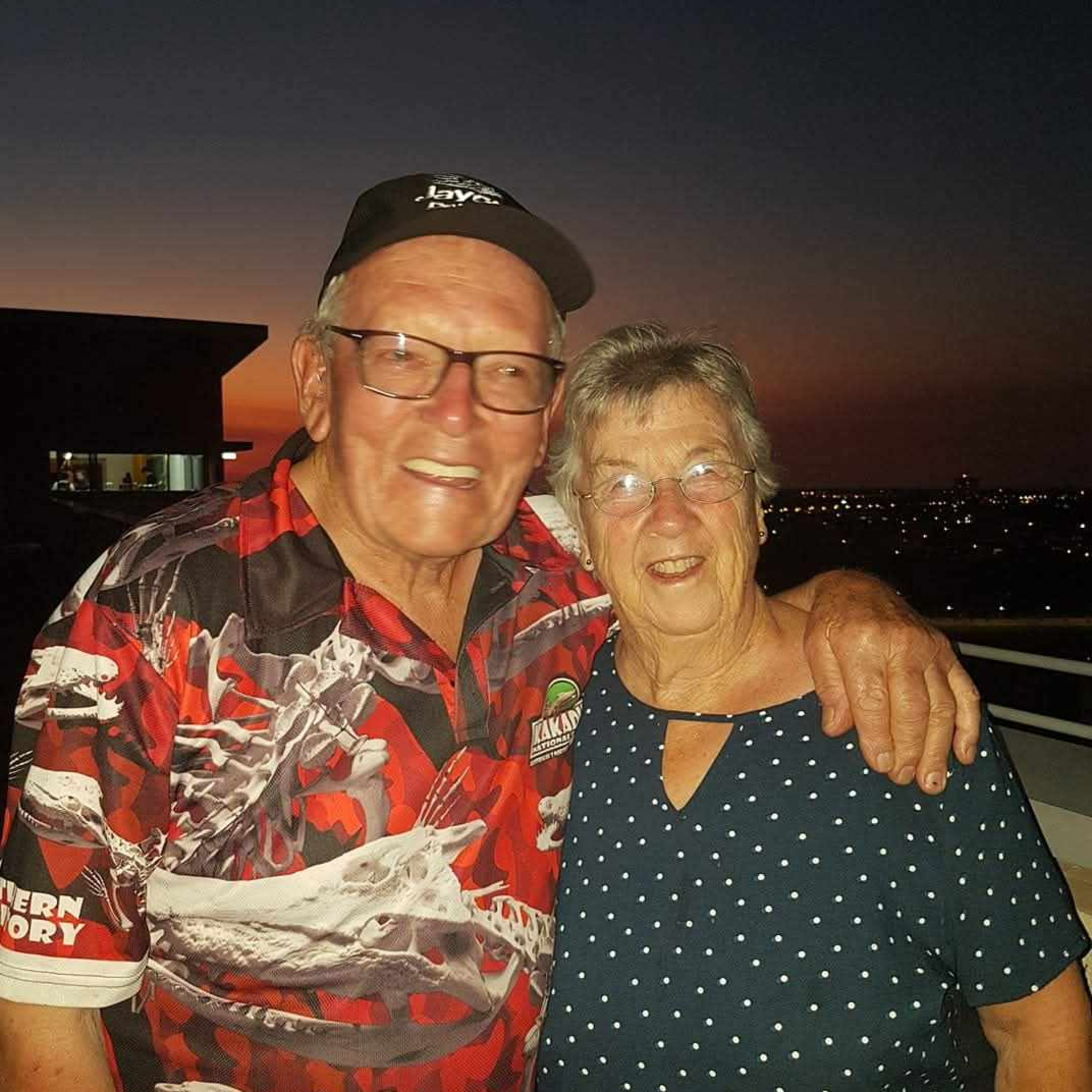
Irene and Arnold Hornybrook share their life stories, beginning with their childhoods in rural Victoria. Irene recalls idyllic farm life at Terriukan, moving to a homestead with electricity when her father managed Narene station, and her difficult adjustment to boarding school, where she struggled with homesickness. Arnold describes his schooling in Strathfieldsaye and Springbank, leaving at 14 to work with his father in fencing and rabbit eradication, later taking a job in a boot store. The couple met as teenagers in Castlemaine, with Arnold noticing Irene as she cycled to work. Their courtship involved clearing land Arnold purchased, leading to marriage about five years later. They discuss family challenges, including the sudden death of Arnold's father, which left his mother widowed with four children, and how they later supported his siblings while building their home and life together in Castlemaine.
[Music] Hello and welcome to Casted & Connections. An initiative of Hands Up Casted & where a group of enthusiastic locals have come together to capture, preserve and share stories of people who have a connection to Casted & Connections. [Music] A partnership that has lasted over 70 years, Arnold and Irene Hornybrook are our guests on Casted & Connections today. Irene grew up in the Nareem Terriukan area, the baby of the Brown family, Arnold, the eldest of Charles and Monty, grew up at Strathdani Springbank and Petri Street Casted & welcome to you both. Thank you, Lowe. Thank you. Let's start with your childhood Irene. What are your memories of that time? Living on the farm of Terriukan, which I loved farm life, just wandering around the street, the creeks and rounding up the sheep and having a lot of fun learning to ride a bike. I just loved being up there on the farm. You had a pet dog? Yeah, a ginger. Ginger? I used to put ginger when I learned to ride the bike. I put ginger in the basket on the front and where we go down the paddock. Yeah, we had great times. My cubby hut was an old bird out hollow tree. I put curtains up on that and ginger used to come down there with me. If my brother sort of was sneaking up on me, ginger would start barking and I would say, "What's wrong, ginger? What's going on?" I would have a look out and he would be Jim's, so he could down the paddock too. So you had a brother and three sisters? Yes, I did. No, it was the oldest man, Joan and then Jim and then Audrey and then myself. Okay. So Dad also was a farm-hand marine. Is your station moved from Terriukan to Narene? Well, we were still living at Dufka, at Terriukan and then Dad and Jim both worked from the Narene station. When Mr Lane, Charlie Lane, on the property then, that was before Fraser's boarded. Mr Lane died very suddenly, so Dad was put in then as manager. So we went to live over in Homestead then until Fraser's boarded. That was like a big palace that we went to because where we were living at Terriukan, we had no electricity and to go over to the station, he sort of had electricity in all the modern cons and it was just like paradise. So did you actually live in the, in the big house? Yes, we're in Malcolm and Tammy Fraser. Oh, yeah, we did. When they came up to look at the property, they were sort of in one end of the house and we were in the other end of the house. Okay, yep. Interesting times. It was, yeah. So you grew up there and then at the age of eight, what happened? Oh, we're set off to boarding school then. The first year I went to Carrain to come and front over there in Carrain and lived with my grandparents and my auntie. I suppose, probably because there was no vacancies up here at the boarding school here. So the boarding school here was at the Convert? Convert a mercy, yes. So where the old building was beside the church? Yes, that's what it was. That since then, the mom was still in the church. The mom was still in the church? Yeah. So we had the first 12 months, I had the first 12 months of schooling over there. Audrey had already been to the Narene school, which all the others had gone to Narene and I thought when my turn comes and I wanted to go there too. It was a great fun rotting the horseback with the cords every day, but it was six and a half mile. But no, it'd been the baby of the family. I guess I had to go away to boarding school. And then after the 12 months there, we came to Kastan to the boarding school there. And I had the rest of us, nice to my schooling there until my mother died, so I had to farm up at the rain. And then they bought a house here in Kastan. I'd become a day scholar for probably a couple of years, until I finished school. So that's boarding school, Jace. It would have been pretty tough when you were only a little taker. I hated it. I was just so homesick. Yeah. Was there many kids there? There was 21 voters. Yeah. And we were the Catherine Peeleau, Jacee Sullivan and I were the three youngest ones. So we were sent up to bed early of the night, probably before dark. And then we'd sort of get up to a few tricks up there and what sort of tricks. Well, I can remember getting a big blanket, Catherine was on end and I was the other end. So we got Jacee Sullivan in the middle of it and we were swinging backwards and forwards in the passageway and we dropped her. So of course, Jacee squealed and the thing that nuns come running, what was going on. Well, that time we were all back in there, but I didn't know what was happening. Very innocent. But I hated boarding school because I was also homesick. Yeah. It was just, I looked forward so much to the holidays coming out. And I suppose you never got home. We were all out there. None of the days came down once a fortnight to just take us there after the afternoon and we were only allowed to go home for school holidays. But you looked forward to those holidays. And dreaded having to go back to school. I mean, I was still learning off there, but I was just so homesick I hated. Yeah. So at the same time, Arnold, you were out at Strat, you were out at Strat. Your mum and dad lived out there. Yeah, I left school at 14. But what about the school days? I want to get back to the mischief at school. So you were at Strat and then you moved into Springbank. And you used to walk to school from there? Yeah, deep. And I suppose you told your kids those stories of how tough you had it back in the day? Oh, of course. So what, you used to walk? How far was it to walk? Oh, two par. Two. It was quite some distance because we used to walk across the aisle, used to tell them that I walked across the aisle. Oh, the aisle. So we're up in the snowy mountains. In the wintertime. Yeah. The aisle, what, the river, the glider, freeze over to you? It was a creek that runs down through the backyard. Oh, yeah. Down through the. When we were up there, my mum always called it 'Misery Farm'. Okay. And then we moved down to Keston, into the Keston. Yeah, to Peaches Street. Peaches Street? Yeah. Yeah. Number one, Peaches Street. Right on that. And of course, everyone, dad bought that place for £250. Yeah. And it was everyone said that it slipped down the hill. Oh, okay. And he said, "All right." And he said that it was feasible, but it wasn't going to happen. So, so it was number one, Peaches Street wasn't so that's right at the very far end. Right, it's the far end. Oh, okay, yeah. Where there is that big hill down there. Yeah, it is. We used to milk a cow, which Mrs. Sparrow used to leave us, let us put the cow in there. And over the road was Murray Pickham. Right. He had the other one. We weren't going to put that one over there. Was he a bit, a bit, a mean or a real? A unreal, I would say. A unreal, huh? Okay. Yeah. And he, I know when dad, when dad, seen, he used to make it up with a little bloke in the name of Tommy Lauren, he's up in the cemetery. Yeah. When dad, when, when Tommy was, he used to come and ran, we used to say when Murray Pickham was around, we used to say, hang on.
When we got running or run down, we used to get in and tell me he's bad. Oh, I don't know that. And I don't know that Aaron, we used to say he wouldn't. And then of course, when we got to all those ridiculous things we used to do, it's right down the hill and all the rest of it. So when you say, "Where are you talking about yourself and your siblings?" Which there was yourself who was the oldest? Yeah, almost. And then, it was right from the next. And then Aaron and then Kees. Kees was a baby. Yeah. Born on the first of January. Yeah. Do you remember how your mum and dad met? No, yeah. I do remember that. Right, I remember that. What happened? And mum used it to, she'd be sitting over at the lunch table. They used to work out at Lindsay, at his friend's house. Yeah, your dad was the farmhand? Yeah. That dad was a farmhand. And then dad used to come in for lunch because he'd sit there and just wink at mum. And then they got something else to have and say, "I don't know." You don't know, you know what I'm saying? And then they got married. Oh, okay. Yeah. Okay. Then they moved to misery farm. Misre farm, right? And then they. They had the four kids. You being the oldest. I'll be in the oldest. And then we went from there to one preachy street. And that was when we used to slide down the hill when Murray picked it and he guessed it. Catches. Yeah. And then. So you went to school down at. But we're in my first and street, which was the primary and secondary school at that stage, wasn't it? Yeah. So what sort of a scholar were you? I wasn't a very good scholar at all. No. What would you be? No. I wish you were a teacher. So your reports weren't great? No. Your reports weren't great at all. So? No. And I wasn't very educated. So how old were you when you left school? I was 14 when I left school. And what did you do then? My father. He had. He had. Let me have a job with. At its stress? With. Fencing. At its stress. And rabbit. Ding. Rabbit. What they call it? Rabbit riffing. Rabbit riffing. So. Just explain to people what rabbit riffing is. Rabbit riffing was a little thing on the back of the. On the back of the little foggy. And it was. You just. You'd go one mile on the. On the. With the riff out. And then you'd go another wave with the opposite wave. So it was like a. Type of play how he typed. Play off type thing that you put on the back of a tractor. Yeah. And just. And ripped up the burrows. That's what you did. Okay. And I. I put the ferritin. But I. Oh, you had ferrets. Yeah, we had ferrets. And I don't know whether they had ferrets or still there or not. What? Didn't they come back out? They didn't come out. One. One burrow. Yeah. They didn't come out. And the. Because it was. There was all the snake. For the snake he had out. The other end of the burrow. Oh. And what you took off the left of rabbits. And I left the. I left the ferrets in there. Well, never to be seen again. And never. Never. I didn't. Go back from. Yes. Oh, the idea. So you left school at 14 and started and did a bit of work with your dad. Yeah. And then you got a job with McCanns in the boot store. Yeah, they'd give me the job in McCanns. I was there for 13 years. Yeah. And I went over and said Mr. Dutt. And he was out of the cage. We used to call him. He was the engineer at the time. Oh, on the show? Yeah, yeah. Yeah. And he was the engineer of the show. And Mr. Dutt, as we had to call him, to his face. And we did that. And then I got a four months job. On the show. On the show. So I had a little rumor about how you and Irene met. Now Irene, is this correct? I think our Lord might have been sitting outside waiting to go into work at McCs boot store. Sitting on the windowsill there. Yeah. And you come peddling up the street on your bicycle? Very gracefully. I have no doubt about that at all. And you locked eyes. Now is this true or not? Yeah, it's true. Oh, it is true. Okay. Well, it was actually true. That was the first match. So you were 14? Yeah, I was 14. You were 14? No, Irene was 14 and you were 15, right? Yeah. Yeah. Oh, okay. Okay. So what did you think about this old man? I went to Gentland at the time. I was working at Jack Ceeley's at the time. And sort of peddled on down there. And then a lunchtime on my pedal back again. And he sort of is still sitting out the front. He's getting clean this fellow. So we just sat at the front right of where. So you were working at Jack Ceeley's who was in account? In town, yeah. So you were doing his clerical stuff? Yes, I love that work. That's probably one of the last couple of years at school. I did commercial course, which consisted of short-hand bookkeeping and typewriting. Yeah. And one of the non-steadily, oh yes, you're doing that instead of going on to doing your what was I described as a matriculation of everything. Yeah. And but I still think that what I did in the commercial course probably did me better through life. Yeah. Because I was going on to high education. You sort of learned a lot of skills through that. Yes. I've always done work work. Yeah. So you an anal met then as a 14-15 year old. And anal was working at doing shoe repairs. It was basically what your job was, yeah. And then you bought Arnold's, oh no. You had a bit of a tragedy within your life, Arnold. Didn't you? With your dad's car. Oh, yeah. Well, it was 16. 16? I was 16. I was 16. And there was a family that sort of suffered everything. And dad had died. He fell off the year. And Rossi always said, which he's now passed away. And that's your brother Ross, yeah. Yeah, brother Ross, yeah. So do you remember the day that it happened that your dad passed? I'm a sad day at happen because I rode home from work. And then Mom said, your father has died. And because Rossi was home. And your father has died. And poor our mom had to sort of face everything. So your mom was Bonnie, was left with yourself at 16. And then Ross. Ross at 12. 12. And then Eve on it at 12. And then the case was at 6. Yeah. Yeah. Yeah. Yeah. So she was left with a young family. So you probably took over the father role, I suppose, in a lot of ways. I did. And, you know, I can't remember. I do remember certain things. I went down to, I used to take the bushings, used to do washing.
for the raw waste, for the raw waste. - Oh, as a, to get some income, yeah? - Get some income, 'cause she wasn't on a big pension or anything. - No. - Well, was there a pension then? - Well, I wouldn't have been. - No. - No, but they, I remember taking washing down on my push-by, down to the home to take the washing back. - Take the washing back. - Yeah, yeah. - To, and then Charlie May used to bring it up. You used to bring the washing back. - Oh, yeah. - And Charlie May being the taxi driver. - I thought. - At that time. - Yep. - And he was, he was used to bring the washing up. - And then I had to take it back. - Take it down. - Yeah. - So, Raine, do you remember, do you remember this time about when? - Yeah, I certainly do, yes. - Yeah. - I'm a little young together then. And yeah, I can remember it was a stinkin' hot down that Saturday that he passed away and then he had to be buried on the Sunday because there was no refrigeration or anything back then. - Oh, okay. - It had to be very quick. - Yeah. - So what actually happened? He was counting hay. He was up on top of that. It was sheatht hay. - Sheatht hay, oh it's hay, yeah. - Sheatht hay and he was right up the top of the stay on the truck. And Russ says, "All he heard was. " - Of course he was with him. - He was with him, yeah. And he was with him and then all he heard was the thump. - When he landed on the ground, it was because he was left on top of the truck, a second sheatht hay. - Yeah, yeah. - That must've been really tough for the whole family. - Well it was such a shock to everybody and it happens that quickly that we died on the Saturday morning and then buried on the Sunday. - So before you could sort of comprehend that he was gone. - Yeah, yeah. - So then a couple of years later was that you decided by a block of black, "Well your mum said you're not to buy a car." - No, no, no, no. - Like you wanted. - I wanted a motorbike. - I'm motorbike. - And mum said, "You'll get married one day and I think if you better off putting your money into buying a block of land." So this is a block of land here. - In Robert Street? - In Robert Street. - Yeah. - Yeah, that we bought. I bought and then I sort of forgot about the motorbike. - Well you had more important things on your mind, I think, didn't you? Because I think there was a young lass around at that stage called I-Rink. - Yeah, yeah. - The block of land was covered in ferns and tea tree and it was just the real, it was on the corner of an acre, but it was a bush block. - Yeah, yeah. So there would have been any other houses and stuff around there. - No, the house next door was there. - This block was there. - Yeah, so it was just wrecking fern and tea tree. And so you speak, you're courting days clearing the block. - Yeah, yeah. - Pulled them out until my fingers were bleeding and I got a bit wise after a while and sort of got some leather gloves and got a bit cunning then. - Well, if you didn't marry her after that rye rainy, was a bit of a scam, really, wasn't it? - Yeah, yeah, well I thought after that that should be billed alright. - I thought you were spending it, man. - Yeah, I reckon that she was fairly good. - So you got married five years after you met? - Yeah. - What time? - About five years after you met, you actually got married, okay? And because your dad's death too, when you first, I don't know, when you first live here, but your mum actually was making little trips to Hamilton and you couldn't work out why. - She was making trips over there and there. - Couldn't work out why? - We couldn't work out why. So then she came home and said nothing and we used to say, "What did you get at Hamilton for, man?" And she wouldn't let on. Because she used to, baby, because he used to collect bottles in those days. - Soft drink bottles, or? - Oh, well it didn't really matter. - Oh, any bottles, yeah. And he'd take him down to the cordial factory. - Oh, and Jeffrey's brother's family. And he was dead he didn't mind a beer. - So this was what was happening. Your mum was making these trips to Hamilton because she'd met this gentleman over there called Ted. - That's how she met, yeah. And she went over there and Ted came home one day and there was all these bundles there and he told all, "Get a beer here." And then he didn't get offered to be. And then he said, "Oh, that's not good. That's not good. I can't guarantee you." So he then left, of course, and he went back to Auckland where he came from. And then eventually they got married. - Yeah. - Mum and Ted married. It was quite an exciting time. - Yeah, it was. - Yeah, he's a lovely man. So when your mum and Ted got married, even on a Ross moved in here with you, so you had a pretty busy little household with those two and also you had a border. - Yeah, we had a border, right, Glamant Farm was boarding with us too. - Yeah, yeah. - So it was quite a household. - Yeah. So that would have been busy times. - And fun times probably, too. - Oh, we had a lot of fun times, yeah. - Yeah, I asked. - What did I pack to the rafters? - Yeah. - And then we sort of added on to the house. - Because it's a house with only long parts. It was the baby. - Oh, because you'd built the house yourself. I hadn't used it. - Yeah, well, it hasn't built the house. - I am. - And he. - That was Bill and Livick. - Yeah. - And he moved around a bit and then he went, he started in gelong. And he fell in it, lovely being home down there. - Yeah. - And. - But we just had to, what Bill built was just the bedroom, bathroom, kitchen, laundry, the toilet was down the backyard. It was just sort of the bare essentials that we had in the start. And then we built on the other part, the other bedroom and the other couple of bedrooms and the lounge room. - Just funny. We used to sleep on the back granite. - And. - And used to get asthma. So the doctors advised him to be better to be sleeping outside. - Oh, I see. - On the bed. - On the bed, friend. - Oh, okay. - So we slept out on the other, friend of some. - Yeah. - Who married in the August and then we sort of. - Oh, as you bit, Chili. - I was just. - Come the next winter. I said, "Well, I'm going in solid. You can do it. You want to do it?" - So he followed you. - Did he follow you? - He didn't do it. - And his asthma was never better. - No, but you're really soon to grow out of the asthma then. But when I saw we were on an open foranda, we just sort of had a blinding day on my solid. - And. - For all of Bonnie Vaxter. A lot of people with no Bonnie Vaxter and he came along and he sang out. - This is the first morning that we all had from a honeymoon. - No, no, no, no, no. - Oh, okay. - Yeah, yeah, yeah. - We were by a sail to sleep. - And he came ten and said, "You want milk?" and we sort of. he woke up. - And he said. - Milk could be the last thing on your mind. Wouldn't it? - Oh, Ricken. - We said, "No, no, no, no, we're all things, we're all. " and then we thought afterwards, "Well, we're all all milk." So at that time there was Jack Stroudness, he was the other milk when there was he. So when Jack came along, we got the milk from him, which we continued on. For all of Bonnie didn't speak to us for years. - He didn't. - He didn't. - To all of Bonnie. - Oh, and he. So for a year into your marriage you were blessed with your first.
- First, Sandra. - Yes. - And at that time, you were still working for Hakes? For Mr. Hake? - No, I mean, no, you'd bought the business of Mr. Hake. - Yeah, I walked up the street one night and Hake, - Albert Hake, yeah. - Albert Hake, was standing at the door, leaning there talking to someone there and there, it said, "I think you better come in and take your over." - Yeah, and that's what you did. - And that's what I did. - So you built that business up, the built the shoe repair business, did you sell new shoes as well then, or just shoe repair? - No, we did sell new shoes. - New shoes as well. So you're both working in the business together. - Yeah. - And then it sort of grew a fair bit. So you bought the building old, Maranagatado building of Bill Norlin and Brian Perry. - And Brian Perry, exactly. - Yeah. - We were in that for how many years were in that, and then eventually we sold that to Betty Speed. - Oh yes, sort of. - Oh yeah, we were in the bigger, in the old Maranagatado store. - Which is, where was that? That was up there. - That was the middle of the, - We're in Millies. - That were Millies, Millies Shoppers now. So in the middle of Hinges Street basically. We had Colley Gill on the side. - So he had the menswear store. - Yeah, well the first little shop that when we bought Malbert Haye, it was part of Colley Gill's shop. - Yep. - And we used to pay $5 a week rent. - Yeah, yeah. - And then there was Colley Gill and then Clary Davis and Jeff Gordon's Mill Bar. - And then Johnny Euse and so forth. So that would have been about 1970s around then. 60 70s. - Yeah. - 60, I think we bought the shop for Malbert Haye. - Yep. Okay. So during that time also, the Lions Club formed in town and Arnold, you were one of the, what he called one of the first members anyway. When it formed. - Yeah. - What's the foundation member? - The foundation member. - The foundation, don't you remember? - So that was 1972, where you were president and zone chairman. - Zone chairman and president, yeah. - Yeah, of the Lions Club. So there would have been a few, I did it in the Lions Club then, would there? Do you remember who else was in the Lions Club at the time? - Rollie Cooper and Jimmy Gouffrey. - Yeah, Rollie Cooper and Regis Feed and, - Yep. - Almost people. - There did a lot of whoon around the town, but different town stuff didn't do. - Glory to you. - See the Andrews, Rita and Frank Andrews had died. And we took over and painted the house for them. - Okay. - Yeah. - Yeah, we didn't, that was all, you know, that's what we used to do. - That was probably the first project that the Lions Club did was to paint that house, because those children were left orphaned and they all got young. - Yeah. - So then they went to, after the Ash Wednesday fall, it's in 1983. The Lions Club went down to help demolish the buildings down there down to Framley Ham, near Waldenham. - Yep. - And then, then it was involved in the next, pulling down the building. - Yep. - And it was, it was another hop day. And it was in the San Francisco Hospital, where he stayed there for about a week. - And Brachey's pelvis. - And then he was brought back here to the hospital as they found another three weeks. And then he sort of still carries the burden of the injuries that was done at that time. - Yeah. - Is the arthritis and that the 13th stride away? - Yeah. - Yeah, it's like it, see, arthritis. - So that ended your 40 career? - Pretty, pretty, yeah. (laughing) - It did. - Speaking of which, you did actually play 40. - I did. - And the thirds of cast it in, didn't you? - And the third, I did. - Yeah, but not only very briefly. And then, and then you became the, so I'm presuming you weren't, and there I say a star, is it true? - A star, I wasn't. - And then you became the actual boot starter. - A boot starter, yeah. - So what did that involve to be a boot starter for the 40 club? - Later in years, that was. - Oh, was it? - Yeah, so what did you do at home? - What's a boot, what is a boot starter? - Yeah, we went, we used to get the boots. - Yeah. - Come along every Saturday and that's a. - Well, depending on the weather, what length stubs you wanted, wasn't it? - Yeah, oh, yeah, so it was either. - So if it was wet, they were longer. - Longer. - So were they stuck, what, you said something about two inch nails? - Yeah, three nails in them, with a tough one on about the size of your finger now, and they had a tough one on them. - So they're actually nails? - They are. - They're nails with a little plastic tip on them. - Yeah. - And then I had to drive them down through the, an inch nail, then through the center. - Yeah. - When it was on the last, like what? So, okay, we're back to you in the shop, you're in the Lions Club. But by now, your household kept expanding to the point that you had, in the end, how many kids? - Six. - Six children. - Six beautiful children, yes. - So this little old house was getting a little bit small, and it added bits and pieces onto it over the time to try and house them. (laughing) - Kids wanted a voice, the girls wanted a horse, and. - Oh, oh, oh, that's one of the things. - Yeah. When I was in hospital with my reader, which is your youngest? - My youngest, yeah. And I came into the hospital one day, and he said to me, oh, I bought a block of land. He said, oh, great. - I said, oh, great. - Where is this? Up, old man can be your own. - And I said, I said, they don't give you something to think about while you're lying, eat. (laughing) I think if I thought I was wasting time, I would have bought a block of land. (laughing) Being the hard workers that I had been doing. (laughing) So, really, what I'd like to say was 25 acres up the Mount Road, yeah? - Yeah, up the old man came here to the road. - So you've bought a house from somewhere, and put it on the top, yeah. - Yeah, yeah, yeah. - Yeah, we've got a house from up up. - How about Gus Lane moves the house from up at how I down on the top floor? - Gus Lane moves the house. - Yeah, yeah. - And I was left, he used to say there was bits of tin in that missing off the roof. And he'd say, oh, just go back, it must have got tangled up in the tree somewhere. (laughing) Just go back in. - Have a look at the road there. - Defined it and bring it back. (laughing) - Yeah. - So up there, so you had plenty of space for the kids to run around, et cetera. - So up there. - And you started doing some upholstery in the shed then? - Well, I still had the shoe shop. - Oh yeah, as well, yeah. - But we sort of thought all, we had a bit of land there, we might get a fair sheet. So, bought 25 sheep. - Yeah, yeah, no. - Ron Dyson, upper checkman. And of course, the try and round up 25 sheep with six kids. But if the big kids go on one way and the sheep go on and other and other, get frustrated. But then we did get them yarded eventually and then the kids had to go off to play football or something. - Yeah, I used to take them to football and then yeah, it was one sheep at the other side. And then I'd get them all on this side. And then that one sheep wouldn't come over. - Oh, they're pretty smartly sheep, aren't they? - Oh, I think, I think there's another word for that. - Yes, it is. - It's super. (laughing) - So we had a couple of calves, young calves, we thought, oh, you wouldn't read these calves. So we bottle feeding them and then one of the sudden they turned their toes up too. And we had the vet come in and he said, there's the bracken firm, they suck on the bracken. - Oh, and of course, it's very slow, painful death for them. - Oh, so your farming enterprises haven't been really successful? - Not really, no. When we did have a check come up and share the sheep. And for the first wall check, we got bought a landless chain. I think it was $30 or something. That was the extent of the first wall check.
…at tekehau, mais tekehau. Ja, mais tekehau. Merea, mais tekehau. So, ya, sehau, sehau. Palstrih, s'il tekehau. Andrew, tekehau, tekehau. S'il tekehau. S'il tekehau. S'il tekehau. Andrew tekehau. Andrew tekehau. Andrew tekehau. And you still had your shop at the same time? You still had your chisual? So, you're pretty damn busy. I was, yeah. No doubt, R.M. was even busier. Yes, I was busy. She had the shop and looking after the children and yourself, which is probably like having another child, anyway. But she's been very, very good. She certainly has. So, then after we sold the chisual, you did the pasta in that up there full time, and then you did carpet cleaning. Yeah, there was a bit of a story. You had a mobile carpet cleaning thing. Wasn't there a bit of a story about a trip to. Absolutely. absolutely pub, wasn't there? Perhaps our ancient till that story. Well, it used to go away for. If you sort of organise more in the area, like you do two or three houses, and then you might. but the sun would no don't say, "Oh, you know, come and do what I was to." So, up at Amsterdam, he was to do the pub sort of after hours on the bar closed. So, of course, it was another fairly warm day. And he did all the bar. And then he sort of had a couple of beers, and then had his tea and went to bed, dead died. And. Well, that's when he told you. He went to bed, and he put his case over and there was two beds, two single beds in the room. He put his case over on one bed, and he was asleep on the other one. So, to get up to the go to the toilet through the night, we'll sort of down a passageway. So, in the morning, when we went up into the toilet, in the morning he got up and woke up, and he looked and he thought, "That window was over there last night." And that suitcase was on that bed. No, the suitcase wasn't there. He was going on, he looked around, and he's stupid and tiredness. When he came back from the toilet, he'd gone into the wrong room. Fortunately, there was no other person in the other bed. Or no one in the bed where he got into. They'd quickly gather himself together and. and made that bed and got out. Yeah, I got out of there very quickly. You also had a landing down at Nelson per time. I believed it was called a horny hut. She was that correct? No, only because it was known because of the hoary books and the hutches. Oh, and right. That's a good idea. A lot of rude remarks made about the horny hut, but we sort of said it was quite innocent while it was known. Oh, yeah. It was just been horny books and hutches. When we were a lot of the landing sites, there was no building on it or anything, and so they decided that they put a hut on it. So, of course, I had to sort of make a bit of a clearing to put the hut there. And there was an annoying tree that was hanging into the water, where the water. So they got the chance to worry out and they cut that off. We had an old dad's and you'd at the time. So we sort of put all these bits of what would sort down on the back of the old hut. And anyhow, it was a pile of the kids on the back and we were heading back up the bank. And next thing we met up there by the police. What's going on here? And they said, "You know, you're not allowed to use a child's or a national park." And we said, "Oh, well, we're building a landing." And we were a lot of to put it. There was a gum tree down into the water, so we cut it off. And they come and that and look at it. And they said, "Oh, yes." And we can see that that bit of the tree is still definitely wet. You were right there, so going your way. He talked away. He talked to his way out of that one, too. Talks his way out of a lot of things. No, no, it was his dumb. So you would have had a lot of fun times down at Nelson. And you also later on bought a house down there as well. We bought a house. So there was a bit of a story about Andrew. Down at Nelson, wasn't there on the stage driving a boat or something? Yeah, the boys. And Andrew used to go, he was the whole little one of the two, of course. And he used to get in the boat. It was probably about 16 at the time, yeah. And he'd go down to the pub and he'd by beer. And of course he'd hit him down there and they'd probably still. He'd bought it back in the boat and then put it up, took it up on the bank. And he'd have said that we wouldn't know anything about it. He'd be very good. He'd be very good. And then he'd say, "I'm very very good." So there's a boxer, but he'd be buried down there somewhere. Or if he'd be foxy, but I don't think he'd be a bit foxy, but. Dear idea. So this time you'd sold the shop to Betty's page. The space here. So your next little foray into business was a second hand shop. Yeah. A second hand shop. I used to go to Melbourne, that. Oh, Jalon, whatever. And then by furniture. And of course people come in through to wait and that ask you, "If you got these and all that, you got that." And then you'd know what to buy when you went down there. And of course, and then the new furniture become cheaper and cheaper and cheaper. And then it wasn't worth buying. Second hand stuff. Because there was that much cheap stuff over there. And it was only made out of chip wood. That sort of thing. Yeah, not a good quality stuff, but the old stuff. So there was a bit of sort of sitting around the normal side of it. It would be a good idea if it was auctioned off. Right. So he thought, "Well, I reckon I could become an auctioneer." So he got his. So he used to sell them home before we got home. Drive and home. You do your own auctioneering on the way home. Instead of having a rodeo and thinking you'd be auctioning off when you were selling them. You could give us an example of how you did that. How you auctioned? No, I don't think so. That was all experience. Oh, dear. So then in about the early 1990s you also decided that you might start restoring cars. You were storing cars, yeah. I bought a Morris, wasn't it? A Morris minor. No, I did buy the Morris 10. 10.4 was the first one that you restored. I rode it on Vitching Faces and I just looked at it. And shook her head and thought, "What's he doing now?" I thought that was getting lost straight to her. Keeping an eye on Mr. P. Yeah, yeah. And then he did restore beautifully. Yeah. And the first rally that we went to was that was to Bellrad. Yeah. So that sort of started your. Your love of cars and vehicles. So it was you? Well, before that rally it used to. When we lived up. Springtime? Miss Reefar, when they called it. And that used to drive an old dog, just something. And we had the lights cut out. They used to block the lights off. And they just had a little. It was during the war. Yeah, just a little slit. Yeah, I remember seeing stuff about that. I wasn't here at that time. Of course, it was nice to meet you. Yeah. That sort of. I got the love of old vehicles from. That's probably. Yeah, from his dad. Yeah, so then just. Well, Graham Perry, he brought up a. What was the car that he brought up there on the drive? And dogs. And he brought it up on the. Well, Darren brought it up and he said, "See what you can do with that?" So I'll restore that. And Tommy Blad did all the mechanics on that. And then. their daughter had a wedding car. - Oh nice. - Yeah, Susan. So then you started going to swap meats and doing all that stuff, traveling around. So that took a lot of your time. - Yeah. - So the kids still around then, or are they left? - They were still around. - The girls were the boys, the girls on their own. So then in 1989, you formed the casted and motor enthusiastically. - Can you tell us about how that started? - Yeah, well, I got. I lined everybody up, I went around and seen them all, seen like Jim Kent, Fanny Miller, and all those that had old cars. - Yep. - I went around and seen their bloats, and then I asked them what they come down to, the bottom hotel, because they used to have a run from doggom. - A raft race. - Oh, there was a raft race. - A river, yeah. - Down the river? - Yeah. - Down the river. And then they, under the new bridges in the school, they used to have the purse under that wood. - Be the winner. So they used to get rafts from doggom, come all the way down the river. Yeah, okay, it would have been a bit more water in it then. - Oh, yeah. - Yeah, so I lined them all up down there and he's. - Line the cast, or up for something, for people to look at. - And he said, "Wit and said to them, "well, do you think that was. " - And of course, I couldn't tell when front of people those days. - Don't. - Or don't believe that for a minute. - He said, "Lad, I couldn't tell them, "I'm gonna get down to the bridge." - Really? - A little bridge, so I would do that. - I'd get into the edge of the river and I'd come back up and think, "I've got to do it, I've got to do it." - Yeah. - And then I asked him, was there anyone interested in setting a car club? And we went up, "Oh, maybe we'll ride the next weekend "and form the club and the. - Form the cast and the club. It was beginning in the cast and murderances, it's called. - Yeah. And over the time, you both have held held positions as President, Vice President, Club Captain, Relic coordinators, Treasurers, you've actually done nearly the lot. - Yeah, yeah, yeah. - And you're still currently involved with the car club. - Still currently? - Yeah, with the, sorry, I'm not even serious, Club. - But by going to Relic and that, we've made just some wonderful, wonderful friends, people that would never have ever met have had to be into the old vintage movement. - Yeah. - Makes wonderful friends, they've been great. - Yeah, and a lot of people are in the cast and club from away and from other places, from around South Australia and Victoria. - Yeah, well, yeah. - They're in Portland, they're on. - They're not in their club, but they're, but they're, you know, friends. - Yeah, they've, oh, I see, yeah, yeah. - They're like, they're like, - Friends, friends of the club. - Friends of the club. - But members of their club do extend to South Australia and Portland. - Yeah, that's fantastic. - All around the district there. - Yeah. - And you're quite often, it's seen at different events around the place with your old cars, you know, which is lovely to see and you can help me weekend and different times that the cars are about. How many people do appreciate it? - Peravans, teedrock caravans, tell me about them. What they're gonna like. - We bought, we bought, this is in, - We bought. - And he's returned, but he thought he'd do something. - Okay. - Yeah, I bought a little caravan, it was an old jelly maze caravan. - Bondwood. - It was an old, bondwood one. And I come home and I said, "Darren, I might make one of these things." And he said, "Don't be so damn silly." (laughing) And I said, "Oh, I'm like. " - Should have done better. - And I said, "Oh, I'm, yeah, I'll see what happens." So I went down to the city, down the end. For a shape, shape of it, to somebody to get the inch by inch steel, to bend it, and a fan of locomotive on the mound that would do it. And he said, "Oh, yeah, I'll see what I can do." So he bent it, and then he shaped it all right. All that happened. And then. - He said, "Oh, where's your planes?" And I said, "Up here in my head." (laughing) It was nothing written down, just a bit by a bit making pit together. That's pretty damn amazing. - It went in and it went on and built certain of those. - So he ended up building seven caravan. - Seven caravan. - So what happened to them all? - They were all told. - They all ran to just you? - Yeah. - One woman she was just traveling around Australia in it. She saw, 'cause we yourself, the kilpi bride, and she came up this time, she said, "I want one of them." And they said, "Oh, yeah, okay." So she took her phone number and everything about, got one month later. - You could have, you could have any sleeping at. - No room for anything else. - No, so you just slept in it. - Yeah, we had a room for the henky-p henky. - No. (laughing) - No, there was no room for that sort of thing. (laughing) - There was a kitchen area out the back where you had all the, where you'd lift like external walls. - There was a lot of the kitchen there. - Yeah, yeah, yeah. - So you're right, did you get a paint in it? Like did you? - No, I never paint it. - Sure, but I had this one who would say that it was at the kilpi festival. She rang us a couple months later and she said, "Is not Caravan ready yet?" (laughing) - Right, well, yeah, I said that day, kilpi parades that, oh, one, one. So the one that we had was sold her and then they did to buy another one and so it went. But she traveled around Australia and that. - Wow. - There you go. And you probably did a family traveling here at yourself. - We did, yeah. - Oh, we did, yeah. - The first little bomb would one that I'm a book from, when Charlie and my style was the backup and the style of that up in the old factory, another. - You love factory? - The up on the main, man gave me a ride, the factory that was up there. - Oh, feet were? - Yes, that's right. - And that's it, yeah. - Yeah, that's it. - If I had the old Charlie and my bits and pieces on up there and this bond would two drop Caravan must there. And I was doing the book works that day and sort of taking the sheets as they came in and I see either Bumblewood Caravan was sold. And I said, "Oh, yeah, who bought that?" Number two. I said, "Oh, no." I said, "That was ours, number." I said, "All right, how much was it? $2." - $2? - Thanks. - There you go. - There you go. - We took it home and pulled it all to pieces and restored that and we went to the build's rural rally and then went on to Broken Hill and we did quite a trip in that. - Wow. And it's what even went right up to Cooktand, didn't it? - Well, not that one, but, no. - Yeah, no, we took the chance. - In a little van, or you went up to Cooktand. - Oh, can I van with it up to Cooktand? - Oh, okay. - Thank you. So, I went by the year 2000, all the kids had gone and you decided that the house out, McAmbia Road was a big big for you. - Yeah, yeah. - So you started looking around for housing town. - Yeah. - And what house came on the market? - Yeah, so the house that we built, we moved first. - The very built one, we first married. - It's back on the market, well. - So it was back on the market after, till it was rebelling in us. - It's how they went, I thought, all well. And I said, "Darren, oh, the house is back on the market." And she said, "I'm not counting back there, "I'm not counting back there." (laughs) I said, "Oh, give me a careful month, "it's 12 months." And I said, "No, have it back to what we, "what it used to be." - Yeah, it would be just like it was when we first married. Oh, that sounds good. (laughs) Do you really want that? - Well, after a lot of renovations and otherations and so forth, the time eventually come for us to move back into it. So we thought, we were so full of Christmas. And we got to the front door and I said, "Well, I better carry you over." - I said, "I'll walk a little to the first marriage." - So we, here's our input on it at White's, I'm saying. - Oh, yeah.
So you attempted to carry me over the threshold, fell over, and I sat down on the floor. I obeyed. I. And. Looking around the sea, if the neighbors were watching us. So it didn't quite make an over the threshold. No, it just kind of scrambled in here. It's okay. And he still are. He still is here. I was saying that, Joe. I don't know. I don't know. I don't know. So what. What's your. What do you say? What's your tips on a long relationship like you both had? I mean, 70 years, you've been together over 70 years. So what's your advice to people out there about how to keep a relationship. Oh. Relationships fresh and. Well, we always work together, we're not located from pulling out the phone and seeing on the block. We always work together. People say, "Oh, when the husband's going to retire, I don't know how I'm going to put up with him in the house." But we just love being together, and we sorted out a lot of problems together, and we had ups and downs, of course, like every marriage. But we were doing, knowing that it was for good. We loved each other, and we just wanted to. We made it work. Yeah, no. And I think Irene, as I said, she's been very good. She's been fear-dencom. And she's been fear-dencom. And, you know, it's been lovely to. Well, we've had a wonderful life together, and still looking forward to a lot more, yeah. I can remember your mum telling me just before I got married, which I've taken this with me my whole life, this bit of advice about marriage, she said to me, "Lawis, never ever let your husband know that you know how to start the law in Mawra." It was good advice. Well, that was pretty damn good advice. Yeah. Just probably one more question before we go. What does Castor and Mean to you? Castor and Mean to home. Lovely little place where we can get in the street and have a talk to anybody that we know. Because there's a lot of strangers in Castor and there. And we get to know them. And it's just a lovely little place. It's a good safe place to live. Sometimes you can go down the street and talk to anyone, whether you know them or not. And people are not suspicious of how they are in the city. If you go and speak to a stranger in the city, well, they're looking at you so advice and wonder what you want. You just sit in the street and somebody comes along to say, "You just travelling through." "You live here and somebody will say, "I've been living here for 20 years." "We're out of touch a bit." And now it's just a friendly safe place to live. I think we live in the best part of the state. I think we live in the best part of the world. I think we do. And people like yourselves make Castor and what it is today too. So thanks, Heaps, for spending time with us today. We really appreciate it. It's been a pleasure. Thank you. [Music] We hope you've enjoyed today's episode of one of our homegrown heroes. Jump over to one of our other episodes to continue the Castor and Connections journey with us. Please don't forget to follow our podcast and share it with your family and friends. Thank you for listening.
Podcast Summary
Key Points:
Irene grew up on a farm in Terriukan, enjoyed rural life, and later lived in a homestead with modern amenities after her father became manager of Narene station.
Both Irene and Arnold attended boarding school, with Irene experiencing homesickness and Arnold leaving formal education at age 14 to work, including rabbit eradication and shoe repair.
They met as teenagers in Castlemaine, married after a five-year courtship, and built a home together while supporting family through personal tragedies, including Arnold's father's sudden death.
Summary:
Irene and Arnold Hornybrook share their life stories, beginning with their childhoods in rural Victoria. Irene recalls idyllic farm life at Terriukan, moving to a homestead with electricity when her father managed Narene station, and her difficult adjustment to boarding school, where she struggled with homesickness. Arnold describes his schooling in Strathfieldsaye and Springbank, leaving at 14 to work with his father in fencing and rabbit eradication, later taking a job in a boot store.
The couple met as teenagers in Castlemaine, with Arnold noticing Irene as she cycled to work. Their courtship involved clearing land Arnold purchased, leading to marriage about five years later. They discuss family challenges, including the sudden death of Arnold's father, which left his mother widowed with four children, and how they later supported his siblings while building their home and life together in Castlemaine.
FAQs
Irene loved farm life at Terriukan, where she enjoyed wandering the creeks, rounding up sheep, learning to ride a bike, and playing with her dog Ginger in a hollow tree cubby hut.
Irene hated boarding school due to homesickness, but she recalls mischief with friends, such as swinging a blanket in the hallway, and looked forward to holidays.
Arnold worked with his dad on fencing and rabbit ripping, using a device on a tractor to destroy burrows, and later had a job at McCanns boot store for 13 years.
They first met when Irene, age 14, pedaled past Arnold, age 15, who was sitting outside McCanns boot store, and they locked eyes, marking the beginning of their relationship.
Arnold's father died suddenly after falling from a truck while shearing hay, leaving his mother Bonnie to raise four young children, with Arnold taking on a fatherly role at age 16.
They built a house on a bush block in Robert Street, starting with basic essentials and later adding rooms, while also hosting family members and a boarder, creating a busy household.
Chat with AI
Loading...
Pro features
Go deeper with this episode
Unlock creator-grade tools that turn any transcript into show notes and subtitle files.
 PodcastTranscript AI