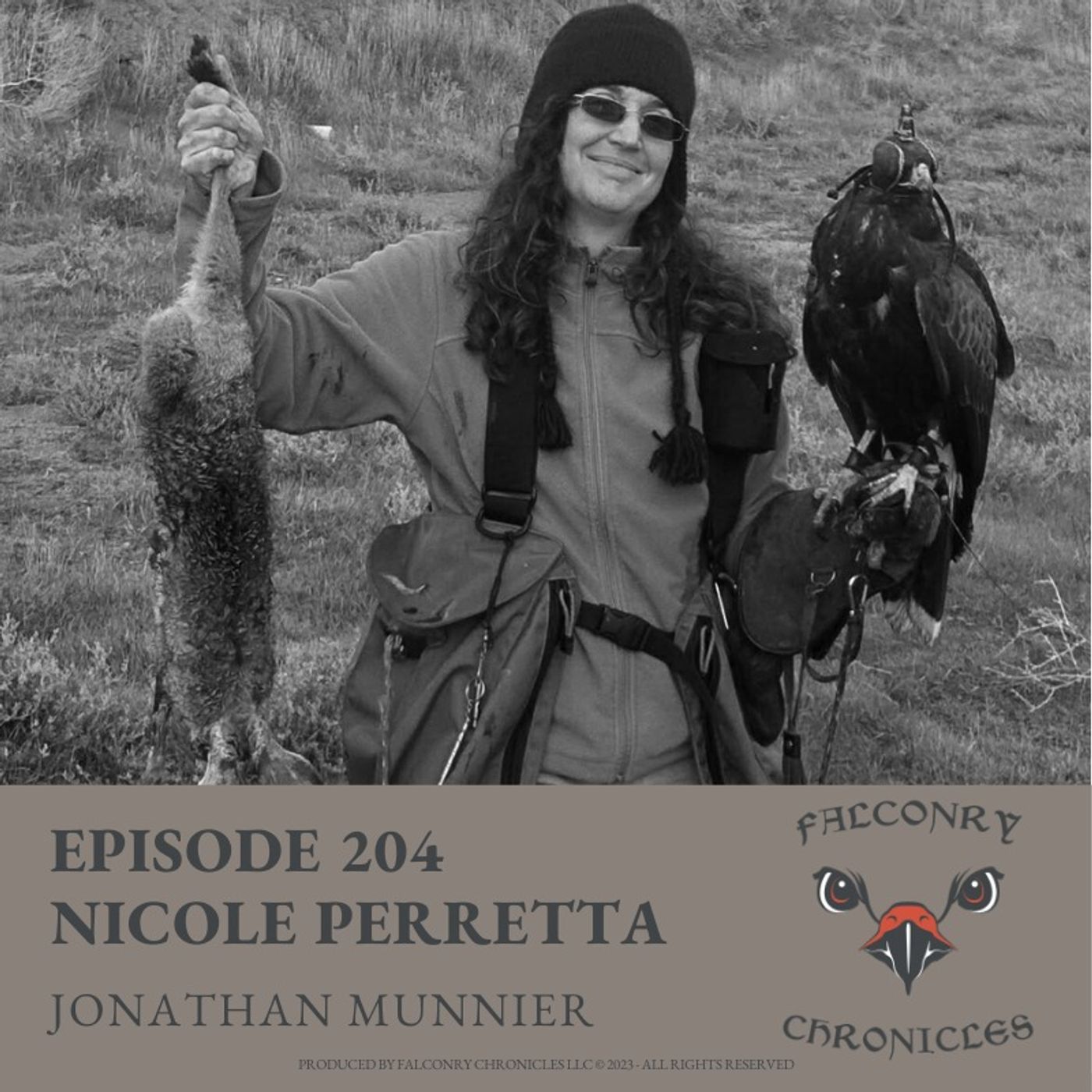
The transcription is from an episode of the Falcon Chronicles podcast, where the host announces this will be one of the final episodes due to an inability to continue funding it personally. The main interview is with falconer Nicole Perretta, who discusses the significant challenges facing falconry in her area of San Diego. Key issues include extensive habitat loss due to development, a severe decline in game populations like rabbits (exacerbated by disease), and the resulting difficulty in training and entering new birds. Nicole explains how she has adapted by using lure machines and game launchers for conditioning, and by shifting from flying accipiters like Cooper's hawks to a passage Harris's hawk, which can spot game more independently. The conversation also touches on the emotional impact of losing long-time hunting fields, territorial politics among falconers, and the increased hurdles for newcomers to the sport. The episode includes promotional ads for the podcast's sponsors, which offer dog hunting gear, pet nutrition products, and quail for feeding raptors.
Check out Cajun Lights, your complete dog hunting outfitter, tracking equipment, leashes, collars, dog supplies, and much, much more. You can find it all at kjilights.com and don't forget their outstanding lineup of lights. You can find it all at kjilights.com. Elite nutrition products are the hottest thing on the market right now for dog and horse owners. EnhoundsmanXP is a dealer. You can find all their products on our website at houndsmanXP.com. Over the past five years you've turned into this podcast and I don't take it lightly. We have built a mutual trust and when I recommend a product it's because I believe in it, I use it, and I'm giving my seal approval for that. I'm putting my name on that. And with Elite Nutrition products, I do trust it. I do use it. I've seen great results with their essential dogs, their pre-improbiotics, their tick-borne disease treatment. It's all natural. It's a great alternative to pharmaceuticals when used appropriately. If you expect extreme performance, you need Elite Nutrition, available from houndsmanXP.com. Hey everyone, want to let you know about a new sponsor of the podcast being Johnson Quail and for nearly 30 years they produce premium Caternix Quail for Falconeurs across the US and Alaska. They're a small family-owned business trusted by the Raptor Center at the University of Minnesota, the Minnesota Zoo and the Cornell Raptor Program. I've now used these Quail to feed my own birds and they're pretty nice size and they're aged around 35 to 37 days and around 8 ounces per bird. So they're nice, good quality birds and they are fed with custom formulated feed and frozen with dry ice and packed well for shipment. So whether you need 60 birds or 6,000 they've got you covered, if you want to put in an order call Kevin at 507213-9005 or go to johnsonquail.com and if you use the promo code chronicles who get 10% off your first order. Johnson Quail trusted since 1995. One of my favorite hunts was I was in Arizona with a friend of mine and I had my male gauze hawk and we happened to hit a patch of bunnies that had that you know there were a lot of bunnies in the patch and so we got out there at first light and just you know one bunny after the other flushed and my bird just scooped every single one and I caught 5 bunnies in 10 minutes before the sun came up and these weren't just like these weren't like pike bunnies, these weren't like no these are these I mean these bunnies were like in in the wild field in the bushes and they actually ran pretty far. Hey how's it going everyone welcome back for another episode of the Falcon Chronicles podcast and as I will probably end up announcing officially soon on social media this will be my second to last episode at least for the foreseeable future possibly forever just kind of depends on what ends up going on in the future but as of right now as I announced a while back I just simply can't afford to continue this completely out of my own pocket right now and I have so many other things I have to catch up on financially and personally and otherwise but I was very happy to get this episode recorded though with Nicole Peretta before I officially hang things up for the foreseeable future in this episode we talk about all kinds of great stuff. Hawking in her area of California how she's had to adapt things to that and of course all kinds of exhibitor stuff particularly some of the things that she's noticed in her vast experience with Cooper's Hawks and of course Goss Hawks stuff as well so for you exhibitor fanatics out there I'm sure you'll get at least something out of this episode but there's also all kinds of other great things discussed in this episode as well. I was very happy to have Nicole on before I officially hung things up here and I really hope that you get something out of this episode and enjoy the last couple that I put out for you here especially next week the one that I published next week for my last episode is one that you will definitely not want to miss it's a great note to go out on and I'm really stoked that I was able to get that one done too so anyway we're going to jump right into this episode with Nicole and here we go. How far do you have to go then to take your kid to school? Like it what's oh this was just this week cuz uh he didn't have his bus pass yet so he's also on the autism spectrum even though he's 19 he he doesn't drive he may drive some day but I'm not sure but he just started class at junior college this week so he's getting his pass today so I don't I don't have to drive him though that being said I I raised two sons and I drove kids to school for 20 years. I didn't know I didn't know how older kids were I didn't know if this was kind of like a moving situation or like a new new area acclimation situation. Yeah just the just the first week of classes at junior college so so he just asked for ride until he got his bus pass so we're all good so I'm done with that so it it was like a brief interruption in my schedule. Yeah well that's good yeah no that's yeah anytime I know like I was kind of faced with that to a degree once my situation changed last year and even kind of before that a little bit we had a couple instances where you had to grab my kid a couple times and you know the biggest punishment once they start driving as you know is is sometimes can be you know taking away those car keys and stuff for a little while and then you know one of those things was like well you realize though if we do that we he can't he can't ride the bus ride I'm like what you mean I'm like well you have to you know tell them at the beginning of the semester or the beginning of the school year if they're going to be riding the bus and if you don't they can't I'm like since when did that become a rule like you know so so many things have changed you know since well anyway without dating ourselves too much I guess right yeah well that's cool I just you know I wasn't really sure how I in other words I hope this wasn't too inconvenient of timing for you or anything no it's fine and normally you know I work at home my husband and I own a small business here I'm in San Diego and we're artists and so you know we sell crafts and things and my husband's from Peru so you know I work at home and we work on art at home and of course I do all the books and and my husband does a drive so I drive him around and do all the business there and so I'm basically always in the car yeah I then have to drive to fly so you know add that on top of it so yeah completely sympathize there I mean from 2020 to 2024 I was doing the whole travel deal and and drove cross-country multiple times and so I understand the whole kind of living on the road out of your car kind of thing it's it's not always fun so yeah well how long you've been in San Diego then well my life actually yeah I mean I've lived in different parts of San Diego it's big you know I think it's like a hundred square miles or something so it's pretty big lived in different parts you know I've done a lot of traveling I've done I've done work and stuff out out of the state but I've always actually lived here so a lot of changes have happened here in San Diego and I started Falconry in then and 92 so you know just like everyone else around it we're having I mean the fields are almost gone you know they're all houses now and the last bit of natural habitat that you can see you can't even step on it now because there's some endangered species of some sort and so places that I grew up flying you can't even step food on they've got 12 you know reams of Bob wire fence around the whole thing places where I used to fly marlins I can't even walk into now it's just it's really crazy how much they've destroyed and because there's no habitat in the game is really hard so I'm having to drive further and further out to to find fields and yeah it's it's it's I'm definitely lamenting because I feel like I'm like one of those old people going well back in my day well yeah it's it's a running theme it's a running theme on it seems like every at least once every episode or once every other episode it's like there's a there's always a segment where we talk about habitat loss the good old days so to speak and yes you know I mean even and and as you probably know by now I mean I've been in this relatively short amount of time being just almost 11 years now and even the amount of of spots that we've lost even since I've been in this and I mean it's it's so it's so sad it really is that's all you can really say yeah and you know and then the rabbit virus for us out here in the west really knock things down it is really incredible to to to spend so much time in the field and you get to know your fields you're like oh yeah there's that bush you know there's that area there's that wash there's this and you're like oh yeah there's gonna be a jackrabbit bus you're not right here and the jackrabbit never bus up and so it's it's really it's really difficult nowadays to do what I used to do um there's a lot of changes I've had to make and how I work with birds how I train birds because back in the day here I get a soldy-n-old you could take a bird a chamber race bird or an imprint or whatever you're very minimal training with it you could just go out and the game was gonna teach your bird you go out there you're gonna get you know five to ten flushes an hour and your bird's gonna learn the skills just by being on the wing now it's very very difficult to enter any new birds um at home because you may only flush one living animal an hour and I'm talking anything whether it's a bird or any the just I'm just living animal um so unfortunately there's a lot of tricks that have you know I never thought in my life I'd have to rely on lure machines and game launchers and things like that just so I could keep my birds head on straight and well muscled just until we start game-hawking and then uh I end up traveling you know going somewhere else where there's games so I can enter the bird and it used to be I mean again everyone has done this long enough you know you always you have that time where you catch a lot of game you know where you can't you just enjoy it yet there's so much game you're like how much can I catch today how much can I catch in a season okay I'm gonna do three four a day of rabbits or jacks or whatever or sparrows or whatever well now it's not like that anymore now I've shifted the way I think and I say it's the catch it's the flush uh to catch ratio so I want my bird to catch everything up because that's all I'm gonna get so I have to really really work hard to get my bird really fit so if that one rabbit in two hours a hiking flush just my bird's gonna catch it so that's involved some really high-tech weight management you know again lure machines and a lot of travel to get them really fit in different areas so when I do fly at home they're ready to go um and so I can't rack up those numbers anymore like it used to it's not gonna happen but at least like we have to challenge ourselves so it's like okay I'm gonna get one thing up and I'm catching it so that's all things have changed for me yeah I completely get that and you know once again even in our area there's only so many spots and especially once you start going dividing certain spots by certain what certain spots will cater certain species and things like that too you get even worse because then you've got to start kind of partitioning okay well we're gonna fly your bird here because you know that this is a good goss-hawkspot and well we only have a handful of goss-hawkspots anymore when we fly you know so on and so forth and like and it got for bid one of those gets mowed over then it's like you know especially with the uh you know with my ostringer buddies here um you know god forbid one of those spots get lost and it's like you know all of a sudden you know it's uh yeah it's almost like you got to go to a spot and have your own funeral procession and and eulogy following it that's how big a big deal it is you know I my last goss-hawks because I've been you know I've mostly flown exhibitors I flown everything but my first general bird was a imprint Cooper-hawks and so I've been flying exhibitors for I don't know 30 years I mean I've had other things too alongside that but I generally always have at least one Cooper-hawks or Sharpie or a goss and um you know the last goss-hawks I flew I flew in as a male North American I flew in four seasons and um the last goss-hawks field I had it got mowed down and I went to the field getting ready to fly I literally sat down in bank and cried I know I mean it's because I've been flying that field for 20 years and it was a big giant field and it was like so dynamic that you don't have to fly the same spot like you can just work this one little section so you can go over here you could go over there and with a goss-hawks you know you can you flush it up and they catch it you're done I can you know wake up really early in the morning catch your rabbit or two um you know go home take my kid to school I mean it worked out it was just so nice and um it's gone now so you know oh my goss-hawks are up for reading now um and it's sad because you know that's what I like to do I do have a female Cooper-hawks she's eight years old she does um she does fly bunnies but again if you don't have enough game for an extyptor to keep their head on straight they're you're gonna get in trouble so what am I doing with her I'm doing learn machine work and I really hate it because I'm just hoping that the bunnies get better uh we have a really you know our uh bunny season goes until for falconry until um around the 20th of March and we usually get a bunch of rain in January so usually February and March it's just we get a lot of young crop coming up so I kind of do my falconry and bulk because uh with with the Cooper-hawks because you know she she's a really like sparrows but uh but she likes the bunnies so hopefully um we'll get a good crop up I'm just uh conditioning her now I let a friend borrow her and I just got her back and uh she didn't like my friend so she I'm like okay so I'm conditioning her again so hopefully I'll have a little bit of that um but I've had to shift um I've uh I've gone back to find a passage hair sock I've flown um a couple of them um I had one like 15 years ago that was just amazing um I I had a lot of game I had a lot of fields but um I mean she caught a hundred jacks her first season 150 her second and then and my seasons are short because I used to do trade shows so my so I was doing you know 150 head between December and April so she just she everything up she caught I just had piles of dead rabbits that I gave to my breeder friends and anyway so I don't have that anymore but I thought okay I gotta have a bird that is going to see the game you know with you with the with the acceptor you gotta flush game for it you gotta walk around kicks and up boop boop boop boop boop boop I just can't I those those slips uh yeah I can't do that anymore so I kind of gone kind of old school and it's not really what I like to do but I rather do something else than not practice falconry at all so I have a passage hair side trapped at Tucson and she rides the glove really good actually when there's no places to take a pitch but if there's a tree or a pole so fly right up to it and they're like dogs themselves they can see everything so something flushes right out right you know way out show go after and get it and she does have a really nice catch a flush to catch ratio um so at least I have that um and then I've got a little sharpie that um was given to me it's a first year bird that the person didn't have time for and it hasn't been entered yet so I've been managing a little bit of behavioral issues with her but uh but she's just about ready to you know start being bagged and um and we do get a nice little crop of spurs coming up so um I kind of have to do that now I usually only fly one bird but I kind of have to start some birds and work with them and get okay what game am I gonna have and uh because I have many times I have gone and trapped a marlin or something like that and then there's no spurs you're like really and then there's bunnies everywhere so I try to have one of each you know something that'll take birds and something that'll take bunnies because that's what I have here and so I'm ready to go whichever crop appears you know in our spring hockey season so um anyway so we'll see we'll see what happens and then um if I don't have more bunnies I probably end up releasing the passage here or so um you know this is their second season she's great but if I don't see you know an end of this rabbit drought um I just let her go because I just I know there's no reason to keep her around if uh if I don't have the game for so this will be kind of the the last season with her to you know either yeah or nay with her we'll see yeah so yeah so anyway so that's you know uh it's just uh you know just gotta keep going you know I a lot of people have quit in my local area um I'm one of the few practicing um game hawkers in my area uh most people have either moved away or just do a bait man a lot of people do a bait man I would say 80% of the licensed hawk hunters do a bait man we have a lot of resort work we have a lot of uh landfill work in military contracts um it's a big place with a lot of pest birds and a little that's a lot of a bait man people here a lot of young folks I feel bad for the young folks because you know they want to get into the falconry they want to practice and it's so difficult because it's so hard to enter new birds here you know you get a nice passage red and end up having to travel you know even to try to you know but it's very difficult to be successful here anymore and I feel I feel for anyone starting I was lucky because I started when there were a lot of fields um though that being said you would think oh there's so many fields but when I started there were a lot of falconers lots and lots and falconers and they were extremely territorial so even though there were a lot of fields and a lot of rabbits you would show up to this field and you get kicked out what are you doing here they were all that friendly uh I had some great mentors but there were many people that I got kicked out so even though there were there was a lot of game I felt like I was in the fringes for a long time you know until people moved away or retired from the sport or whatever then I can quote and quote inherit these fields from you know the long standing falconers yeah inherit quote yeah but they they don't belong to them but you know they're very territorial man you know I mean falconry politics in general is just a never ending roller coaster but whenever it comes to people in their spots and and certain degree of ethics being yeah I mean we've we've dealt with that here too uh or kind of still still always dealing with it I think I think anytime you have more than you know one group that hunts together uh in a kind of uh semi close range you're gonna have some issues at some point in time and even if it's uh you know even if more people are indoctrinated into a particular hunting group in this particular area and everybody gets along and and all that you still start to eventually have issues where you start to outgrow what you have available and and so we've kind of had to make adjustments in the time that you know ever since you know I got into it we've had a few more handful more guys in our kind of sort of semi close area get into it and it's it's it's a never ending it's a never ending battle I mean you're always it's only gonna get worse it's only gonna keep it worse and so then of course the the joke comes into play well it's always gonna be starlings always and it be sverals you know you know what and I'm going to tell you a little story about how that might not always be true go for you know um I hunted uh kestrels um quite a bit in my 20s um and I had a lot of fun uh with them I did more of the parking lot um style hunting where you put them in a little tree and then the little bushes underneath and you kick it and then they chase the men catch him before they get to the other bush it was a lot fun I enjoyed it a lot did some carhocking too um but with all the droughts that we've had and um our increase in temperature like it doesn't like it's okay guys it's 84 today here um it doesn't freeze anymore and starlings and house spares really like the cold actually I don't know why they like the cold like whenever I go somewhere up north and it's super cold I'll be out getting a coffee or whatever and then like there's everywhere there's starlings and sparrows I'm like why do you guys I guess because they're from England right I mean it's really cold there because they like that so it's gotten really warm here also too because of the drought they've gotten rid of all those little bushes you know that the sparrows used to hide in they got rid of all the Spanish tile that they used to breed in you know all and then the huge bikestries that used to support man I remember as a kid it was a cacophony a sound if you stood next to these bikestries it was so loud and don't park underneath them I mean it was it was bad there were everywhere and just and I don't know if there's any other pathogens or environmental issues why they disappeared but we don't have starlings and house sparrows anymore I'm not really like if I go to like there's ones Walmart parking lot that has like some of those old bushes I think they're Hawthorne and I saw a couple sparrows I'm like wow sparrows you know our starlings have because we do have a lot of fruit entries they have switched becoming a boreal so they don't go to the ground to feed they go into the trees to feed and the only time you'll ever see them on the ground is if it rains and they take a bath somewhere um there still are some house sparrows and some of the neighborhoods where people will feed and things like that but in a public setting like all the you know McDonald's and stuff and all the places I used to fly they're going so I always thought oh I'll always have that but I don't have that and I don't know if that's gonna so just by the way because I'm so I'm in southern San Diego so everything that's ever happened to our country I get it first so the heat and everything else the the asperer and all the things that kind of are creeping its way north it's hit me first and I sure hope it doesn't follow because I know a lot of people rely on that but you know as everything's changing so yeah I can drive two to three hours and I'll never see a starling so I had to give up the car the car the carhawking stuff and you know switch I used to really enjoy flying male Cooper socks they were a blast but I the last one I flew I drove around three hours a day to try to find a slip form and I said well nope so we're done so fatten them up let them go that was it yes especially with the way gas prices are oh sure yeah oh my gosh yeah that's like four bucks four bucks a gallon right now it's you know and then they want to add more taxes and uh like that's one of my favorite things about traveling out of state is filling up it's like a buck 99 always take pictures and send it to my friends here because they don't believe it yeah it's uh on the high side here lately it's been like 27280 but on average here lately it's been 230s 240s and and even if you just go 20 minutes from where I live across the border in the Kentucky it's even usually a little cheaper so but I remember visiting a friend uh down by uh he lives in Topanga but um I remember going through coming from Wyoming into LA a handful of years ago and almost just started that was just like I how am I even going to afford to get like a like over the border of California to his place and then back again because a gas at that point I think it was like seven something whoa I mean it was it was bad you feel like right at the border like out of state because even though it's always higher it's still like a little bit it's definitely cheaper like like when I when I go to the southwest I always stop over in Yuma like the furthest point out of Yuma there's a maverick there and it's always like two bucks or three bucks where I was paying like five at home so I just you know it's only what is it for me like three hours to get there so it's like okay I you know I look at my gas tank I'm like okay I'm halfway I'm good so I fill up there and then on the way home I fill up so a little tricks because I do I fly a lot in Arizona and so but yeah it's ridiculous so yeah no more driving around aimlessly looking for slips that's not happening no no I don't blame you one bit and honestly like I wouldn't probably do that I mean fortunately where I'm at we still have you know starlings and stuff galore especially from early March to early June you you can drive hardly any any time at all and come into them plenty of of slips if that's what you're want to do that's great you have a Kestrel back there so that's your springtime buddy right there yes the plan as of right now it all it all just depends I mean after we stop recording I'll fill you in more on some other stuff later but but yeah I mean that's the plan as of right now my season just kind of well it took a massive dump you know towards the beginning and and so I just finally was just like I threw in the towel on on my season for the rest of it and it was just like all right I'm just gonna occasionally help my buddies beat for their birds and then you know in the spring I'll just do this because once again as you know goes without saying fighting the going against the grain and fighting the the current when it comes to falconry and time and just everything it's just it's pointless because it stops being fun yep yep it's not fun why do it you know so yeah exactly yep you have to adapt you know that's kind of the name of the game lately for me is adapt you know it's hard to change your whole outlook on how you do things sure but I think that's what we have to do in falconry you know we have to we can't do the same things I I think that's like something that we all have to think about is just because we used to do something a certain way does it mean we can continue doing that and as we lose our fields and our game we have to really think about because you know the the standard you know in the past like I was saying before is to cut weight a little bit and then go out and go hunting and there's a lot of a lot of people who still want to do that here where we live and we just don't have the game for that anymore so then you end up having birds with a lot of behavioral problems and aggression and stuff because you've got this bird out of lower weight with no game and it's like well time to buy a lure machine if you want to keep doing it imprets exhibitors anyway you know I mean it's best probably not to do it all I mean I always say if you can't produce 10 slips an hour easy slips an hour you really shouldn't do an imprint and that's asking a lot and that's just the easy way I mean you can still do it with five but then you're gonna have to play some tricks like lure machines and stuff for a while but if you only get one slip an hour like I do can't do it anymore I'm done I can't I mean I've been flying in print exhibitors since what 94 and yeah I mean yeah I can't I'm not doing it just not until I move somewhere one day maybe I hopefully y'all can move somewhere but you know I'm tied here with family in our business and stuff so you know family comes first you know I mean I've always integrated falconry with my family I've never skipped a season I was flying when I was pregnant nine months pregnant running around flights get slips up for a merlin with my belly bouncing around it was hilarious you know I carry kids in a backpack when I went hiking you know I switched species you know and flew things easier I flew some I flew harisocks too harisocks are great when you have toddlers and stuff and you have to juggle work and everything because you know you you know I used to get off work at three I was before our business started I was a zookeeper at the San Diego Zoo and so you know I would get off work early at three run home grab my harisock go catch a rabbit and then go run over to the afterschool program pick up my kid you know it's just something I did I just you know I adapted to the every situation but I've always I've always flown I haven't skipped any seasons but that being said for me how the family comes first you know our business our livelihood all that comes first a lot of people tell me and just move well you know my husband doesn't drive he has to live in the city um you know he you know he has a disability he can't drive so you know I can't move you know I wish I could I would love my I'm a dream oh I'd love to buy a ranch somewhere where with a bunch of property where I can just walk out my back door and you know I if I sold my house now I can do that because I wouldn't say Diego my house was worth the fortune just sitting here yeah I bet um so I could totally do that but I can't do that because I have a family I have a autistic son and I have a husband that you know we take care of each other and you know they come first um my eldest is uh 28 and uh he just moved to Ohio he's an electrical engineer and his wife and he just bought a house for like two hundred and thirty thousand dollars which is awesome because the median price here is eight hundred for a house right now which is crazy um so I'm really proud of them and so you know I look at that and said you know I did a good job you know I worked hard I sacrificed everything for them and uh you know did I drop everything and go fly no I didn't you know I flew I've always flown but I you know did I go out and you know keep flying species that didn't match my area no and I've always switched around and and um I'll continue doing so that's why I have a passage here and I will say this you know it's been really nice because my son's been coming out with me a lot he loves you know he'll wake up early uh he loves to go hiking with me and the hair sock is just so conducive to that doesn't matter what you wear what you're doing don't swing the stick so high or whatever stupid little things that a goss hawk might not like you know I don't have to worry about it um when he was younger he can come with me with a goss hawks because they took such long slips and I didn't want to leave him in the dust you know because you know my last goss would take you know 200 yard slips after a rabbit and uh catch it and then I have to run before the coyotes or the ravens get to them and you know I can't leave a kid in the field so he couldn't come with me so he could never come with me with he had to stay home with the goss hawks so it's really nice uh to kind of switch things up and just have some enjoyable falconry you know and um and he's you know picking up on it he really likes it um I think someday he might even become a falconer if he you know once he you know gets his life in order and stuff like that he really he does like the haris hawks out of all the birds that we've had just because you know have to tiptoe around him or do this and you know sneak around the corner in the sharpie baits and you know that's sort of thing it's just like the haris hawks just said they're with the foot up he's like yeah okay it's he likes this so much better because of that yeah well and and so do most falconers period you know I mean yeah yeah I really I really love though I really love Cooper's hawks a lot I mean I worked with them quite extensively and you know for 20 years I took just about every Cooper's hawk from the rehabbers um so you know I did 10 to 20 a year and um you know it's because they just couldn't handle them they couldn't do with it you know they would just they just immediately put them down oh it's just going to kill itself and this I use falconary methods you know um hoods and tip jess's and and um you know training you know basic training a lot of hacking out I did a lot of hacking it was a lot of fun I used to take all the young birds and hack about here so yeah it was amazing to hack out all these Cooper's hawks at once and really watch the behavior I didn't realize how social they were until I started hacking out multiple birds together um and I and I have an diverse body language um something that you know I observed and kind of copied it a bit um here's something really interesting now the the older birds that are outhack will feed the younger birds so the ones that have been outhacked for a couple months when the new ones come out they'll actually the new the new ones are a little scared don't come back into the hack area and to eat so the older ones will come in and grab food and fly up to the trees and actually feed the younger ones I never thought they were that social um one of the things that they do which I find fascinated is and these are Western Cooper socks by the way um they'll be a bird with food uh eating on the platform and another bird will come in and they both start to lower their heads what they bow one will bow the other one will bow um and then the one who wants to food will stare at the other one now if the one who has the food starts bowing their head then the then the other one will come over and shimmy and they kind of put their wing down almost like a rooster will put their wing down and they'll shimmy over and they'll take the food and then the other one will just kind of look turn its head away and then fly off now if a bird comes in who wants the food it'll stare it down and then the one who has the food who wants to keep its food who says no I'm not done eating you can't have this it'll stare it down too so they'll have the showdown where they stare down and then the bird that has the food will lunge and attack the other one just kind of fist bump it and displace it and then make the other one fly off and i'm like wait a minute you know and you know how you know how we've always like considered like Cooper socks like face grabbers like oh they're face better they go to your face well i'm just wondering if we've just been you know sitting in the wrong signals all along so for instance i have actually gotten my own imprints to start eating by bowing my head so they're sitting there kind of you know how sometimes they hold food and they're being a little possessive and you're like would you just eat well i start bowing my head and i look up at them and i bow my head and i look at them and they kind of look and they kind of do this mechanical motion with their head and they bow down a couple times and then they start eating i'm like what and then and then another time i was at a falconry picnic and this gentleman had a passage Cooper sock who had not eaten in four days and i said well let's uh because i had used this method myself so i said you know let's let's go in the house and you know let's see what we can do so i get the bird i pick her up out of the box and unhitter half food weight on the glove and she's looking around we're in a quiet room we're sitting on the on we're sitting on the then the couch there and i and i i i look at her and uh oh i also cheat you know i do bird calls you know so i go like that and and she looks at me and i go and then i lower my head and i look at her again i kind of look at the food lower my head again look at the food and then she does the same thing with her little mechanical look like this and the two looks up at me and then she starts eating and the guys like what and i said well you know i learned this by observing the the rehab birds that i was doing and i said they have this crazy body language and i certainly don't know it all but it worked and it's worked for me with my own birds that i've trapped and um and so there's something to that you know something to that and so i'm wondering if all these years too where we've got a Cooper sock you know sitting on a kittle or sitting on the lure and we're staring you know we're primates right so we look at them like this who you know and that means to them you want their food so i know a lot of people instinctively look away you know when their birds on a you know we just kind of learn to do that let people say don't stare at your bird don't stare at your bird so you know i don't think you know if you do this you know i have that problem but i'm just wondering if we just yeah i don't know i don't about you i like watching birds eat i just i enjoy it i like watching them pick and i don't know it's just a thing but i so i have to consciously like think like peripherally watch them so i'm not actually like staring at them because i think with the the Cooper sock is the sensor wrong signal so anyway um it is really it's it's fun to to have opportunities like that to work with the species in bulk like that because you know i i don't know i probably rehab like 400 of them and um you learn a lot that way through feather care how to take care of them their diet the illnesses that they get because you're working hand in hand in invets and you see all the illnesses that get from the wild you know all of them and so it's really changed my own falconry one of the things down here where i live is just keeping things alive um because it never freezes here it's always warm here and um everything gets sick here whether it's a Cooper sock or a harry sock or something like that so you know it's changed the way i do things because you know i noticed all these birds are coming in they're coming with france they're coming in with ass but these are wild birds they're coming in with all these diseases and i'm like and then i had you know 20 years ago i had my own bad luck you know i lost a Cooper sock to aspirat i lost a Cooper sock to frounce um and uh so i said you know i got to change the way um i do things because a lot of times i would do is i get a new bird either it's an imprint or an ice and then i'm you know i'm chugging along in the season and then boom the bird gets sick and chugging and then it gets better and then boom it goes down so i said i'm tired of it i'm tired of birds always being sick and going down so i'm a real proponent of uh uh treating birds preventably so every bird down here it gets treated they they have to right off the trap asper france coxidia um worms um because i found now that when i do that before i reduce their weight i just treat them uh for everything i don't run into that uh you know three or four months later they go down again so um that's been kind of a major change in my falcon and i see it every day down here i mean i i i a lot of apprentices will bring me sick birds you know they they've trapped them and had a different sponsor that you know it doesn't know the area so they don't know that you have to treat the birds and um you know i i've had birds over here that are on the brink of death that i've had to save this year because uh um actually um capillary uh capillary has been really really bad this year so um a lot of our birds have gone down um this is a really horrible place to keep birds alive by the way um it's just it's like why do i do this i i don't know but i i i because i you know i think you know when you when you start falcon as a young person your kid it's just part of your blood you're not getting rid of it but sometimes i sit back and go man this is stupid like i'm treating my hair for a coxidia right now even though i already treated her earlier in the season but she really went down and um you know started burning hot and it's just like this is the best time of the season and now you're getting sick it's just so annoying so and i have a bunch of my other friends down here doing the same thing with their birds so we have a real big struggle down here um but it's okay you know we'll we'll get her done you know she's almost better and uh we'll you know um i'm still flying her i'm just flying her you know lightly but anyway so it's just you know so that's kind of in the biggest change of uh of my falconry is it's become so much of uh of medical thing and it ends up being because of that experience i probably spend two hours a day helping people throughout the nation with their sick birds it's like what i do like when i'm not working you know uh whether it's a blood sugar issue would try to get a crash bird going or some other issue a lot of people don't have vets i'm helping people around the world who don't have access to vets i'm not a veterinarian by any means and if something really critical i said you got to go to the vet but if it's just something simple like coxidia or worms or something we can take care of that but um i do spend a lot of time with that and then um you know the imprint season's coming so i'll be doing that um you know uh there's a lot of people i have written a lot of articles on raising imprints and um training and kind of the the the methods that's required when you don't have a lot of game um there's a lot to be you know little formulas i guess you can say or just uh routines that you have to do and schedules you have to hold in order to make an imprint without a lot of game and um i got my first thing i always say to people is how much game do you have and they'll tell me and i said you shouldn't do it don't do it i'm telling you don't do it but you can't i'm also not in the market of shattering people's dreams you know you you want to fly a goss you want to fly a coup it's been all the thing you think about who am i who am i to shatter that dream i'm not doing that so you know not exactly you know it's so it's so it's a challenge though because now we're dealing with the situation where someone doesn't really have the game for it and so um you know so it makes the job a lot harder to help someone along with that but i could at least stand on the articles and be there for them when they run into issues and it usually ends up being though at the end of it you really have to travel if you're going to keep this bird you're at that pinnacle point where you need slips now you know and so if you want to continue with this bird you're you're going to have to go somewhere else yeah yeah for sure yeah so anyway so you know this it does kind of end up being my quote busy season of of helping people online and that's fine it's i'm here to do you know i'm here but um i just wish it was easier for all of us you know i just wish we all live somewhere where there's a lot of game and people can be successful you know it's i feel bad you know because these people are trying so hard and um you know you you falconry so personally you you don't want to fail you know and we tend to blame ourselves so much if we fail but sometimes it's just not meant to be where we are no no not at all and you know there's there's the old saying you know wish in one hand you know and what the other and you see which one gets filled first i mean unfortunately that you know reality is reality no matter how we want to slice it sometimes and and you know as far as the whole crushing dreams thing you know i know we as falconers have this tendency to still kind of lean towards doing what we want to do anyway regardless of the advice that we get but the way I look at it anymore is I don't I don't go out of my way to do I give un-solicited advice or anything anymore because of that usually not that my opinion matters a whole lot anyway but like people that that do uh become apprentices within our group or whatever and that kind of stuff if they ask opinions and stuff i i don't look at it as crushing dreams i look at it as sometimes as just trying to save someone from themselves occasionally because you know there's there's sometimes people that that get an idea in their head they want to do this and you know it's a terrible idea and i don't have a problem anymore really just if if if they ask my opinion and i think it's a terrible idea you know i there's been times where i know that someone either has or should have told me that i had a terrible idea you know and you know maybe possibly things might have turned out differently i don't know hindsight obviously as always 2020 but you know i i look at his look i mean you can do this you're gonna do what you want probably but you're going to have issues most likely if you do this and you know try and do your best to to save people from from themselves sometimes because because ultimately it not only is it not going to be good for the bird but it's also not going to be good for that person like you said we're so self-critical and we're so well and Falcuners in general just sensitive anyway and you know quick quick to bruise and and oftentimes we are our own worst critics and there's a lot of times where someone chooses the path of the most resistance and doesn't even fully comprehend to realize it but afterwards they beat themselves up over something that happens so much it's just like the self-defeating prophecy and if you can if you can help someone avoid that yeah then sometimes their life in general is just going to end up being better right exactly yeah and you know i i've written a lot of you know i do i'm an artist so i do a lot of illustrations and one of the things i've been doing lately and i'm actually going to write an article about it is um you know the capabilities of every exhibitor that we have available to us a lot of people will think sometimes they can make something into something that isn't for instance a Cooper sock isn't a gau sock no matter how you shake it there's some great Cooper socks out there you can make them great you can work really really hard to make them catch birds on the wing requires a lot of time a lot of effort a lot of bagging you can do it but it's be a lot easier just to get a gau sock because they'll do it anyway you know that's what i think you know but a lot i that's like the thing that happens most often is people really have this idea of what they want to do with one bird or another and i'm like it's not going to do that like where you live you know i'm i'm sorry i know you want to do that but that's not how they fly that's not how they work and it's just not going to happen and um it's you that's probably the hardest thing to get through especially like two of the first year general that you know what i think when we're young you know or just young in the sport we just want to get everything when i do everything and things like that and um it's really hard to kind of put that reality stop there and go well it's not going to do that you know i want to catch you you know i don't know whatever species that they're targeting and i'm like it's not going to happen you know you're not not going to do it you know yeah yeah for sure and yeah so yes i yeah so it's i do a lot of that um again like i'm saying i don't want to crush dreams either but at the same time like you i do i do have to kind of put the brakes on some things and say it's probably not if it's mostly about the game though it's mostly about like oh well you know i might see you know one rabbit a 30 minutes and i'm just like i just get something else don't try to fly and accept it or with that it's not going to work um it's just it's going to be really frustrating and then you'll get bad behaviors it's just not worth it you know so um it's tough to you know it's it's tough what we we're doing right now i mean there are some folks that have good game good slips and are living the life and i enjoy it i enjoy watching i'm so happy for them it's like that's good that's good but there's a bunch of other places around the country you're like that's not the reality for everybody you know and i think it'll be our job as falconers if we want to keep doing sports like how how are we going to adapt to that what are we going to do it's unfortunately in a lot of instances the same Burger King we don't get to have it our way yeah i mean as as that old saying goes and and yeah i mean we it's as you said at the beginning of the conversation adaptability is everything sometimes it's either you have the choice of okay well this is what you got to do now or you just need to not do it at all and we all have those kind of self come to Jesus moments you know i mean i'm going through one right now myself and other people that i know we're going through one um sometimes things just don't go your way and sometimes you just have to understand that whether you like it or not you know sometimes it's okay you know i mean this is once again this is supposed to be fun you know i joke with my buddies all the time that you know no matter what we think as falconers sometimes it's not like we're out in the field cure and cancer you know we're not coming up with a cure for AIDS or you know um you know we're not you know it's i mean this is something that we just do but but we let this consume us so much that we think like you said we're so afraid of failure we're so afraid of being look down on for this out of the other and whatever you know and and sometimes it's okay to just take a step back and realize okay just because i can't do this now doesn't mean i can't ever do it it's just you know it patience is yes it's everything sometimes yes yes and uh you know and sometimes we're lucky enough to change our circumstance and move you know a lot of people have sure most of the falconers the old timers they moved out you know they saw it you know because they had been flying here in the 60s and 70s and they saw what was happening and they're like no and they packed up moved to Idaho and Utah and all these other great places and some of them are still around and still getting it done and you know they they they did it you know they were able to do it uh you know will that be a option for me in the future for retirement maybe hoping that's you know you have to have dreams and goals and what have you and and then you know get back into some different kind of niche falconry you know it'd be fun to do that you know just change it up you know um you know but you know i still want to do the sport so like you said i've got to change what i do might not be what i want to do but i still want to fly i still love being out there sure sure 100% 100% now but uh well before we get too much further let let's um let's go ahead and get the rest of of your you know how you got into it you know when you discovered it you know were you a kid where you know how you know what how hard was it for you to get in and and kind of cover that some and then i do have a couple other questions that i want to ask you before we do the usual stuff but um but go ahead and and just oh sure um well i think uh i'm a i'm a i'm a i'm a burdener so you know i've always lived birds um kind of my passion for birds started about eight years old and my grandma had wild birds i used to you know catch them in the backyard and pet them and whatever and i used to draw them and it started a passion for birds i just read every book i could about birds and then you know i started you know doing the bird calling stuff which is my other persona at least used to be but um and then um and you know my mom used to work at a library so like a lot of us you know um she brought home the book she brought home a falcon's return by a hines main and i read that and i don't know what happened it just kind of sunk into me and then of course i read my side of the mountain like so many of us and wanted to live that life and um and then on top of that my father has has a friend who had flown Cooper Sox in the 60s so i remember probably being six or seven years old of this of of this friend of his telling me stories of flying um Cooper Sox on quail and i don't know why that intrigued me so much you know and over the years he's worked with my dad for like 30 years and um he would come over and he showed me how to make traditional jesses when i think i was you know 12 or something and um taught me how to make ball-shot treat nooses which i still use to this day um but he had never flown again i think he flew before he had kids and then once he had kids he stopped and never flew again but he obviously contaminated my brain because you know the first thing i could do when i was gentle so get a Cooper talk oh boy yeah the the old stereotype you know but but i had a great mentor with that bird and um i actually caught game with that bird and the bird was great and had good manners and everything so it's all about that mentorship but um and uh you know i actually met a falcon around was 14 and and you know you have to remember this is back in the time that there's no internet um you it's really difficult to meet anybody um and so there was this old old guy here um his name was Frank Todd and uh friend of mine from school yeah i don't heard that like falcon and i went over to his house and he had a cast roll um that was in movies and stuff and he let me hold it his name was Clark and his house is what my house is now well full of books and hoods and feathers and all the things that falconers have statues and art and you know but i just remember just being enamored by that just looking at the scenery around me and just oh my gosh this is amazing he bred haris hawks he was like one of the first people is a breed haris hawks i couldn't see them because it was breeding season but and then unfortunately he passed away um and um that was kind of the end of my contact to falconry and you know when you don't know about fishing game or you don't know about what to do or where to be if you you can't it's really hard to become a falcon you don't know what to do how do you do it how do you find someone because they're not the phone book you know so many yellow pages you know and i didn't even know about fishing game when i was a teenager i just had no idea um and then i was with a friend of mine in a recording studio and i met dam milner because that's what he did uh was a recording in san diego he was he's lived in san diego and i don't know i think i saw a picture on the wall of him in a bird and i said are you a falconer and he's like yeah i am and this was when i was uh 20 years old and um i said i want to be a falconer it's what i want to do and he's like well let me help you out so he got me in contact with the california hawking club um the prince chair at the time was the mic fair class and um and then i got a chance to talk to cred culver on the phone for a while and these are you know some old old-time you know really great people here in san diego and um and you know back then you had a list of books you had to get from nickleson books you know everything you had to buy from a bookstore and i got and they didn't even have a california study guy back then they had the new york study guy so we had had to you know so i was told what i had to do and all the steps and things like that and um it worked out really well for me because i met dan in august of that year study for my test took my test it had my first bird by october um you know i had my inspection it all was there dipitus it worked out i remember going into the federal building where i took my uh falconry exam and i looked up and there a paragon flue over that i go that will that had to have been you know a good sign anyway um and so uh yeah so that's uh that's how he started and um you know i've been flying ever since cool awesome well now that we've got that i mean i i do want to ask a couple of questions about you know especially with you know being as you've had so much experience with exhibitors and and all that i am curious because you know while i've only flown you know a couple or so myself and and came to the determination early on that juice just wasn't worth the squeeze for me especially being where we're at here although that doesn't stop some buddies of mine you know they they're die hard goss hawk guys and that's behind teach their own whatever um but now that i've seen goss hawks in particular fly for you know a little over a decade now and and have heard kind of how they imprint and how other people imprint and you know all this stuff i mean once again for the million bazillion of time falconers and their opinions you know whatever but you know out of curiosity though as far as you're concerned what's your favorite a method of imprinting and i mean there's there's different theories that people have as far as you know it works what doesn't i want to find that out from you first what your favorite is or what your preferred method is and then ask a follow up question to that because i am curious about another thing that that seemed to work for a buddy of mine but we're all kind of still TBD as far as whether or not that could be repeatable or not so go ahead and go ahead and have your personal you know a favorite way of doing it and then we'll go from there you know i've tried all kinds of different methods i've had some incredible mentors uh Jim Bryan being the one that helped me when i was young now Jim Bryan has a totally you know non-food association 100 percent surrogate rearing i've used it it's quite interesting it's very very labor intensive it's basically and this is not the method i use i just kind of want to explain it because there's so many different ways but i have used it and it does work and i might use it again for certain species so that i just want that's why i want to kind of mention this but it's a surrogate method which basically what you do is you have another hawk whether it's a haris hawk or whatever and the bird imprints on that other hawk so it's pretty elaborate because every time you feed your eyes it has to be fed in front of that hawk it can be pretty elaborate because you have to build what you call an imprint box which is like a four by three box with a plexiglass front with a food shoot and the bird has to be old enough to eat on its own so you basically have to you know cover the front with a towel be very very quiet let the bird sit by itself for about an hour and then you know you feed your the haris hawk or goss or whatever you have that sitting on a you know table or whatever and it's in its eaten its food and then you walk behind the imprint box you lift it up and then the bird sees the other bird eating and you know it works really really well um i actually the last one i did was a a breeder friend of mine the female haris hawk died she was very very old and she died so i imprinted the eye as i pup it reared it i made a puppet for it so and i had a a breeder that was one way mary glad this is all stuff that used to do at the zoo i made a puppet puppet reared it and then it only saw the you know for whenever there's food it's all the other haris hawks so i've done prairie falcon with this method i've done some goss hawks i've done lots of coopers hawks lots of rehab coopers hawks with this method and it does work really well if you want a very tame ish because you take it with you so you let it chill out for a while um after it's eaten then you you know close everything up let it rest and then you take it out and then you bring it everywhere with you so it doesn't see with food at all and then from there you you know raise it like anything else you do a lot of bagging and what have you um it's interesting it's extremely time consuming i'm you have a job or so it's really hard to do but i will say this i raised my very very first coopers hawk with this method and that bird was solid there was no screaming no manzling well he'd manaled a little bit here and there but for the most part he didn't mandle he just was so easy going i had no aggression yet he was tame as a dog so there's something to that method i i don't use it too so much now because i'm purposely making imprints for my friends breeding project so um all the biases that i've raised lately i want to be fully imprenet so um i've used the the you know the mcdermott recipe before i've used that i you know you have to be very very consistent with that method i do a little bit of that but the the main difference between what i do and maybe what what the mcdermott method is is i don't lower weight at all so i'll tell you what i do and again it's extremely time consuming um it's again an ice uh you know fuzzball and as soon as they're able to be thermo regulated um so you know you feed i do the plate method of feeding so they're eating through a plate or a dish or a bowl throughout the day you know just like um like the mcdermott method will do i do that and then um but i pull food what about when we go to bed about ten o'clock right and the is is going to be the most hungry the first thing in the morning so i wake up in the dark um you know i usually use a kitty litter pan as a nest and then i set that kitty litter pan into a plastic tote um it keeps that you know when i travel and everything it keeps that um keeps the meats from going everywhere so what i do is i cover it with a dark like sheet pick it up in the dark go to the field it's still dark i go out in the field i take the nest out i walk in the field it's barely light i um i cover the the food dish with the handheld and i walk away and when i say field i mean i'm usually somewhere different every day i do go to different fields but i'm also a lot of gossal have phobia is the stupid things later in life so i want to make sure i expose it with everything so i'm next to the trolley i'm next to the train i'm next to the buses i'm next to the water the bay a creek a river every you courses dogs every you're seeing it we're going to the dark park today that's what i think so they're learning to eat in extremely quote stressful environment they're very very hungry um and they're not fed at home when when they're the most hungry so there's no food association with your house when they're hungry so their first meal the day is out the open the sun starts to come or the day light starts to come up i kind of walk away kind of hide pull the string the kind of look around oh oh it's squeaky and they'll start eating like that then i'll let them i'll let them you know relax and things like that now as they get older when they get more mobile they have to work for their food so i'll put their dish is easier to do at first so they're they're still half down just getting some feathers but kind of wobbly i'll set that dish you know a few inches away from their nest ball so they have to jump out go out and eat it they can jump around flap their wings and then when they're tired they just crawl back in and then you go home and and so as they get older that their job gets harder and harder you know i'll introduce the lure um you know i i do a multiple transfer system that's in an article i wrote in nap fun 2019 i have that article if anyone ever wants it i'll consent it their way via email but it's it's a it's a multiple tradeoff method i adhere to when i says they're in that baby stage when they're really young that you don't want them to have anything they can hold in their foot they become possessive over it so you know all whether it's a rabbit lure or a bag or whatever i usually trade off to like a golf disc with tidbits so they'll get tidbits and i integrate a call recall lure into it as well so they get there like they're really really hungry when they first grab something for their first time whether it's like you said a bunny lure or whatever so i want them to have like an instant reward of a pile of tidbits of moistened tidbits that's easy to eat so they feel that satisfaction right oh okay this feels really good i'm good and so they're less a climb to be possessive when i present the lure so i do this whole thing where when they're little they they have to work for their food so they have to jump to the plate and then run over and get oh there's a tidbit on the lure run over there and then i'll put like a little perch out and i'll have a tidbit over there oh chip on the perch so they're actively thinking oh what am i going to do my next step i got a good this this this that they're not seeing there with one solid food i'm going i want this and you can't have it you know they're actively engaging so i do that and i train them to jump up to a little perch this is a jim Bryant taught me this jim Bryant um because when they're elevated off the ground and that's their last stage they're easier to pick up now there's lots of other methods you can use to pick up um it Tyler Sladen um he picks up with the plate that's very innovative um i had never thought about that you know he does use my the plate method to to transfer off but he he just picks the bird up to transfer and then backs him up on the glove i think that's very clever um i haven't tried that yet but i might in the future but for a really young ios i kind of want to stay kind of hands off um you don't want to force a young ios to step on the glove before they're ready because they can develop glove fear because they're wobbly so i do a lot of training and hands-off so because a lot of early things that we can do can affect their fear level later so um so i just make them work and i take them everywhere um they're with me all the time um and um i you know i in a perfect world you know i'll do an afternoon um outside thing as well but you do with the kids and stuff picking school i haven't been able to do that so much so after the initial training session in the morning um at that point a day they just have free feed the rest of the day so when they're sleeping i just take a fresh dish of tidbits this kind of people do with the McDermott met the same thing you know and then but they have to work from early age so by the time they're branches i'm walking around with this nest you know and i'm walking in the field i have the whole setup in the field and i take them to it they can't fly they're too young to be tethered but they're working so i go out and let that put the thing down they jump out and do their whole routine so they're learning to work and eat in a really crazy environment there's construction workers going on they're in the field and they're learning that when they're the most hungry the field is where they're going to be fed not at home and i have um i've raised several um imprints of doing that quite a few of goss hawks and zero they don't screen at all zero nothing only in the breeding season they'll kept kept kept kept you know everybody has a project and you know they'll they'll sound up during the breeding season which is normal but they do not screen at all and um yet what that means though is is is your going out at first light like like my german goss hawk that i have 270 days in a row without a day off that i took that bird to the field yeah yeah that's that's um yeah that's intensive yeah so it works but there's you can't have to do it at all you have to be really committed with that but it does work it um i don't have the fear so there why why why why would you do that well the reason why i have to do that is because i can't use weight loss methods here a lot of people it doesn't get cold here so my winners are 60 degrees maybe and goss hawks don't like that you know they don't like like a goss hawk there there's a whole other gear to them when it gets cold and the colder it is the more I have to have this like everything inside them says I gotta eat or I'll freeze over a night and I'll die i mean that's what's it but when you're here we're in southern California they don't have that but hey i don't need that so they tend to if you don't do that sort of thing with them they tend to develop a lot of phobias and fears and things like that and then you have to lower their weight and when you lower their weight then they get sick and then they die so it's like this is a method I use and what I found at the end of it is that I have birds that have great behaviors because they're a lot heavier they're being trained on routine versus weight loss i mean my it's a it's a five month training process of lormachine and bagging intensive tens of stuff but they're eating and doing all this with keels that are round there's no keel to these birds and so I just keep going and going and going with this it's so boring and hard to do this okay i'm not lying it's hard but when September October comes it gets cool-ish and then I can travel you know honey seasons are over and I can go places where it's cold and all of a sudden that round fat weight that my bird just trains that now it becomes a hunting weight because they're they're keen and so you've got this powerful strong bird that has been um exercised all season long i give the same courtesy to a gossalk as i would a juror falcon or any other falcon we would never expect a falcon to go you know fly up a hundred you know a thousand feet right away we train them incrementally every day right they go well i did the same thing for my gossucks they are going further and further and further every day the game launcher is set further and further every day the the the game that i launched is harder and harder and bigger and bigger every day and so you know i mean i say every day but i mean it's like a four month process it's very long but by the end of it you know they're catching fast hard flying things that were raised in game pins far away and grabbing them in the air bringing them down i do a lot of anti carrying training um and they're just pumped up so when i can finally travel they're ready to go and i don't have to do any weight loss and so because of that i don't have that screaming i don't have that man's leg all my birds eat tight wind completely tight wind uh blood sugar has a lot to do with the tube down here because of the warm i can't give a big crop like everyone else kids you guys all can do these big crops and and because it's so much colder your birds are burning more grams per hour well they don't do that here so i had an order to keep them in line their mind in line i have to feed twice a day so i do a three quarter one quarter split of their daily intake and i'll tell you what it works really well um having that blood sugar always going through them it's the same thing if you guys are feeding out there you know 150 grams a day your birds gonna have this big crop and it's it's gonna poop it all out it's never gonna be green but our problem is here is that you know we only can feed maybe you know 60 to 80 grams a day you know and so um so how do you even do that well you've split it up so you know i give like a little snack you know i feed my birds in the box in the dark i pull them out i have a puck light i have a uh ascitor from the bottom of the box i have a puck light with a remote and so it's dark you know i away the bird in the dark bird doesn't really notice me that much um and pick it up you know put some food in the back of the box they jump in eat it and they're done turn off the puck light we're done now you can do this their first season i usually do this i can agrarage or something far away from where they'll ever see your perch i you gotta really think about that like where are you feeding this bird and he's gonna associate this area with food later so i work really hard if i do you know when i do give a snack to make sure it's never in a place where he's ever gonna see again and that's usually my garage so i have the box in the garage um so those little tricks have helped me so i live in the city i have neighbors so my birds have to be quiet i can't i can't have a screaming bird i can't use let's cut the weight method see what happens i can't do it so that's the method that i use basically and it's really really hard but it works though it works really well um it's really kept our behavior and their health you know all all our birds my friend of our you know where birds are all they're all old you know these are birds that my friend Randy west and i we've raised and now they're in his breeding project but you know they're all 12 11 10 9 8 years old you know they've they all flew for some you know a few years and then went to breeding projects and you know it's kept them alive you know in i'm 85% humidity and 84 degrees right now rub it in yeah jerk yeah no i yeah i can imagine i mean we my buddies especially early season always have issues i mean there's there's one buddy in my in particular that you know kind of had to stop flying as one bird while he had it um you know it until almost like he could almost start flying until mid to late October just because that bird it did not matter i mean that bird would not act right at all until it got cooler and yeah i mean i just yeah i'm always curious to find these things out from people though because like like long wingers who are their own level of uh you know whatever you know opinionated in a lot of ways yeah yeah um acceptor people are right up there oh yeah and yeah and so to follow up with that though so another buddy of mine inherited a second year second year goss hawk we we jokingly called it all season the first year gray bird because that because the the the other mutual buddy that had it before the whole first immature year did pretty much nothing with it kept it the mu uh dropped live quail and stuff and we all thought that once our other buddy got this goss hawk that it was just not gonna probably turn out well yeah that bird actually has turned out very well it's actually a really well well-mannered bird hunts well and so there's uh there's running theories now you know but it's our in our little group you know as to whether or not that could be repeated again i mean my one buddy's just like there's no way in hell i'd ever let a goss hawk sit through its first year no matter what you know i don't care if it was proved to be you know useful or not or whatever but but that's basically what what our one buddy did was he let this goss hawk basically stay in the mu just basically you know tube didtered or tossed it you know live quail throughout its first year didn't hardly do anything with it and then once it got melted out and everything my other buddy took it over and kind of did the normal thing somehow magically it turned out okay um i mean i know that there's probably little details that i'm not privy too because i obviously was not there through the whole process and stuff but i'm kind of wanted to see what your thoughts were on that and you know without obviously you knowing many details either what your gut instinct would be or just you know your your overall tape on that you know i think um you know i that's really actually very very happy for him that he was able to get that bird hunting um that's good my my experience has been with second like second year birds uh or even further that have never hunted before is there is that a male was that a male by the way male female female um especially with females um females tend to be a little lazy as they get older if you think about it the tirsals of kitchen food farm and feeding them throughout the breeding season and they so once they kind of learn that food comes from somebody else or like hey feed me you know what it means so they get that mentality and it's and it's really really hard to get them out of it i mean your friend must have worked very very hard um i have had friends that have um taken birds like that um and turn them around but it's very very difficult because there's some kind of disconnect sometimes if they sit in a chamber and they don't learn to kill that first season at all that later on they don't want to kill anymore they just won't they have no prey drive now i don't think i ever want to do that here i've seen it fail too many times but maybe maybe maybe you guys have it cold enough that that cold weather kicking in kind of stimulates them that kind of gets that primal like i got to kill now so it might actually work for you guys you know we're you know we might as well be in two different countries by the way just that how our methods are and that's why like like that's why it's like you we always have to be an open-minded about what other people do because we don't live where they live and experience what they do and so like i'm looking at that situation going that's really cool because i bet that cold stimulates that bird enough to go like yeah let's get it on let's go kill stuff you know but i could say down here it hasn't worked because it's just so warm there's never anything to kick that into gear though that kind of plays on another thing though um other people have done this before and i i have kind of done it um not flown a bird myself but other people have raised other people's birds so so when you raise a bird the bird will imprint on you really really hard and any of those aggression kind of a noisy sort of tendencies will be on you you know that that's the way it is but it's i don't know if you've heard the stories but there's been many stories over the years will some will raise a goss hawk and the bird you know they go through a dispersal especially the North American male say go through a really bad period dispersal um it's it's a migratory thing i kind of get it you know if you're on migration you have to become more heightened and aware of your surroundings i really feel like especially male North American gossucks there's like a veal that's lifted over their eyes and they see things for the first time and because if they're on migration everything wants to eat you and kill you so you have to be hyper nervous and aware of everything so like that orange hat that never bothered him before after dispersal august september oh my god it orange hat i mean it's the way they are and so some of that unfortunately can make a bird phobic on another person uh i've seen it happen many times i even had a bird become phobic of me and it was just one instant too during the dispersal period where the bird bay i don't hold my birds back but i was in the house weighing the bird and he baited off the glove and came back and all the said i had two heads like he hated me forever after that so i gave him to my buddy and it was fine like with him i have a goss hawk that um that i flew for four season that went through dispersal and absolutely hated his original falcon just phobic like i saw a video of the bird spinning upside down and screaming out of fear i've never seen anything like it and i felt bad for the bird i'm like and i think i had just uh released a bird and i was without a bird and i'm like okay i'll take it and i had to do a lot of work because it was fearful i had to do a lot of operative conditioning and no it was just a mess but that being said i went on to catch a lot of game with that bird and had a great relationship with that bird over the years because i wasn't him and i remember one time um uh my bird saw him in the weathering yard at a meet and completely went ballistic like he hated that person so like to avoid like that crazy dispersal uh and any kind of like crazy aggression it i don't think it's a bad idea to have if you have someone you trust that doesn't look like you at all to raise like you could raise j others bird i know that uh Jeremy Bradshaw and a buddy of his did that one year because they blended a void that uh that uh uh uh dispersal and any kind of aggression and they looked dissimilar and they they traded birds i think a little bit after hard pinning and they went out it was like having a chamber raise bird i i kind of look at a lot because i don't look like most goss hawkers so so so someone so so someone can just you know have a hard time with the bird and i'll get it like hi how are you you know and the same thing like i raised a goss uh my friend made a goss last year i hatched it out for him weirded um and i do all the you know incubation and hand-rained for his project and so um i hatched it out for him and i reared it for 30 days used my method took it around everywhere like this and then he got it um you know just right you know he wasn't a hard pin but just like an older brancher and that bird just amazing with hand just sweet as pie because he didn't look like me at all and he hoods and just a great bird there's something to it you know open mind there's something to it i wouldn't you i though um about the whole leaving on the chamber thing i have done a hybrid of that um i raised a um east-earl Siberian uh albatist cross female for the future breeding project so um and i did the whole methods that i do and i did the lore machine work for her up until october and i put her up and in october in the chamber in fed her down the food shoot and then i gave her to a friend of mine um because he was without a bird and the bird was going to need a few years to mature anyway so so okay i'd loan it to a bird and um he took that bird out and started catching jackrabbs with it and it didn't have any issues and well she got too low she definitely would get mad i mean she's not perfect but um as long as she was up at the higher weights uh she was great with him um so i mean it was like a hybrid method the bird had not caught any game that's that no game at all just the lore machine and then i put the bird up but the bird learned how to chase you know learned how to work for her food the first jackrabbit she ever saw she caught so i don't know it's time to be sad about that yeah i was curious i mean and every bird i know every bird's differ in every yeah situations differ in every you know but you know who knows i don't like the i'm not worried about anything other than the risk of it becoming lazy yeah you know because the the goss hawks and the breeding chambers that my buddy they're they're great you know they're easy going their mellow because they're heavy and they're fine and and i've taken those birds out but they all were game hawks so that's the difference you know they all caught lots of game before they were put up a chamber so but they still were able to come out you know and fly um but i i don't think i never purposely put a bird out without ever hunting it first like but just just because i just would worry about them being lazy well i mean overall i think that's still the general consensus yeah yeah with with my buddies too but yeah anyway well that's cool i mean we could i we could go on and on and on and on and on and on of course forever but but i mean we're i think at a good point where it's probably a good idea to go ahead and get your favorite memory hunting story you know experience the bird whatever you choose and then you know and with our piece of advice and then you know go ahead and call this particular recording good and um oh of course yeah so um you know i've had a lot so i've been around for a little spelt but i think one of my favorite hunts was i was in uh Arizona with a friend of mine and i had my male gauze hawk and we happened to hit a patch of uh bunnies that had that you know that there were a lot of bunnies in the patch and so we got out there at first light and um just you know one bunny after other flushed and uh my bird just scooped every single one and i caught five bunnies in 10 minutes before the sun came up and these weren't just like these weren't like like bunnies these weren't like no these birds were at these i mean these bunnies were like in in the wild field in the bushes and they actually ran pretty far and my bird just pounded out he was just in prime it was 30 degrees he just went you know just one after another and that for me it just it was i don't know i've had a lot of great hunts and flights and lots of things but i just i guess again it's so personal and i don't know about you but i kind of like i like to i just like to set little goals for myself or do different things and to catch five bunnies in 10 minutes before the sun came up in a wild setting was really cool you know for you know i just that that was because that's my that's like my best um now i've caught a lot more game than that in a hunt but that was my best time you know my best game game flush the game caught to the time so you know i was by the car with my buddies and bunnies in hand and the sun handyman come up yet like yeah that was that was a fun time that's a good day that's a good I mean in one and it's kind of hard to beat that time too just by default i won't i won't do that again unless i move so where because after the rabbit virus we just don't have the bunnies so well i don't i don't think very many people no matter what nowadays you're going to be able to do anything like that hard leave all anymore you get your rare exceptions there's always exceptions to the rule but yeah i think that's definitely the the more in the unicorn realm yes yeah it was yeah it was definitely a unicorn day very nice cool well i mean i guess we can go ahead and get your piece of advice and then you know go ahead and and part ways for the day but um but yeah i mean um you know what um my you know because i um you know talk with a lot of people about exhibitors i think i'll talk about in my piece of advice will be towards exhibitors is to find a local mentor in your area i i will always enjoy helping people but i don't live where you do my circumstances aren't yours and my game is it yours my terrain isn't yours so i only can help anybody so far i could do basic stuff but when it comes to entering and gamehawking you've got to find people who've done it and they're doing it well you know you're going to look at someone who who catches a lot of game very consistently throughout the season and keeps their birds alive for many years that molts them out um because this is something to take away any any one of us can drop weight on an exhibitor in cage catch a lot of game with it but we also have to be able to keep that bird healthy while doing it and um unfortunately a lot of birds are prey will get strung out a lot of uh goss hawks especially will get strung out because they were kept low for too long and then the first little illness that comes around they succumb to it so it takes quite a bit of finesse for the goss hawkers and other folks like that who who can fly their birds catch game with them and have them for years to come those are the people you want to reach out to they're probably going to be reclusive because most people are who fly exhibitors you know they you know they might not want to you know you know it's kind of like a sponsorship really you know every new species requires a sponsor in my opinion and uh but yes find those people reach out to them you know uh be friendly be kind and uh you know and and and listen to everything they say because what they do works for their area they are experiencing know what they're doing you may not like it you might not agree with it but look what they're doing man they're doing good so that's what I say find your local mentor listen to them you know respect them respect what they have to say they've been doing this a while and that's that's uh that's my final piece of advice nice yeah and try your best not to be a an ask hole exactly yeah ask ask opinion and advice and just do whatever the opposite is or whatever you want anyway yeah so yeah well awesome I mean thanks so much for carving out the time to do this and I I know we're probably both bummed about not being able to be at the uh that Arizona meat yeah you know it is what it is but uh yeah I hate it whenever plans and especially when it comes to just unfortunate series of events you know I hate it whenever stuff falls through but um I thanks for joining me on here though anyway and um go ahead and have you stay on for just a little bit until the the file is uploading stuff on this but you know hopefully we'll get a chance to sometime down the road meet in person oh yeah yeah I look forward to it yeah shoot the shit a little bit and uh you know we'll hopefully have a fun time I know this was this was this was a lot of fun though I mean I appreciate the the conversation and just the the transparency and stuff so thank you so much thank you yeah talk again soon all right thank you
Podcast Summary
Key Points:
The podcast host announces the upcoming conclusion of the Falcon Chronicles podcast due to personal and financial constraints.
The episode features a conversation with Nicole Perretta, discussing challenges in modern falconry, including significant habitat loss, declining game populations, and the need for adaptive training methods like lure machines.
Nicole shares her personal experiences adapting to these changes in San Diego, shifting from flying accipiters to a passage Harris's hawk to cope with the scarcity of game.
The discussion highlights broader issues in the falconry community, such as territorial disputes over hunting grounds and difficulties for new practitioners entering the sport.
The transcription includes promotional segments for sponsors
Summary:
The transcription is from an episode of the Falcon Chronicles podcast, where the host announces this will be one of the final episodes due to an inability to continue funding it personally. The main interview is with falconer Nicole Perretta, who discusses the significant challenges facing falconry in her area of San Diego. Key issues include extensive habitat loss due to development, a severe decline in game populations like rabbits (exacerbated by disease), and the resulting difficulty in training and entering new birds.
Nicole explains how she has adapted by using lure machines and game launchers for conditioning, and by shifting from flying accipiters like Cooper's hawks to a passage Harris's hawk, which can spot game more independently. The conversation also touches on the emotional impact of losing long-time hunting fields, territorial politics among falconers, and the increased hurdles for newcomers to the sport. The episode includes promotional ads for the podcast's sponsors, which offer dog hunting gear, pet nutrition products, and quail for feeding raptors.
FAQs
Cajun Lights offers a complete range of dog hunting outfitter gear, including tracking equipment, leashes, collars, and dog supplies.
Elite Nutrition products are available through HoundsmanXP, and you can find them on their website at houndsmanxp.com.
Johnson Quail is a family-owned business that produces premium Coturnix Quail for falconers, trusted by institutions like the University of Minnesota Raptor Center and the Minnesota Zoo.
Use the promo code 'chronicles' when ordering from Johnson Quail to receive 10% off your first purchase.
The podcast is ending because the host can no longer afford to fund it out of pocket and needs to focus on other financial and personal obligations.
Falconers are dealing with significant habitat loss due to urbanization, leading to fewer hunting fields and making it harder to train and enter new birds.
Chat with AI
Loading...
Pro features
Go deeper with this episode
Unlock creator-grade tools that turn any transcript into show notes and subtitle files.
 PodcastTranscript AI