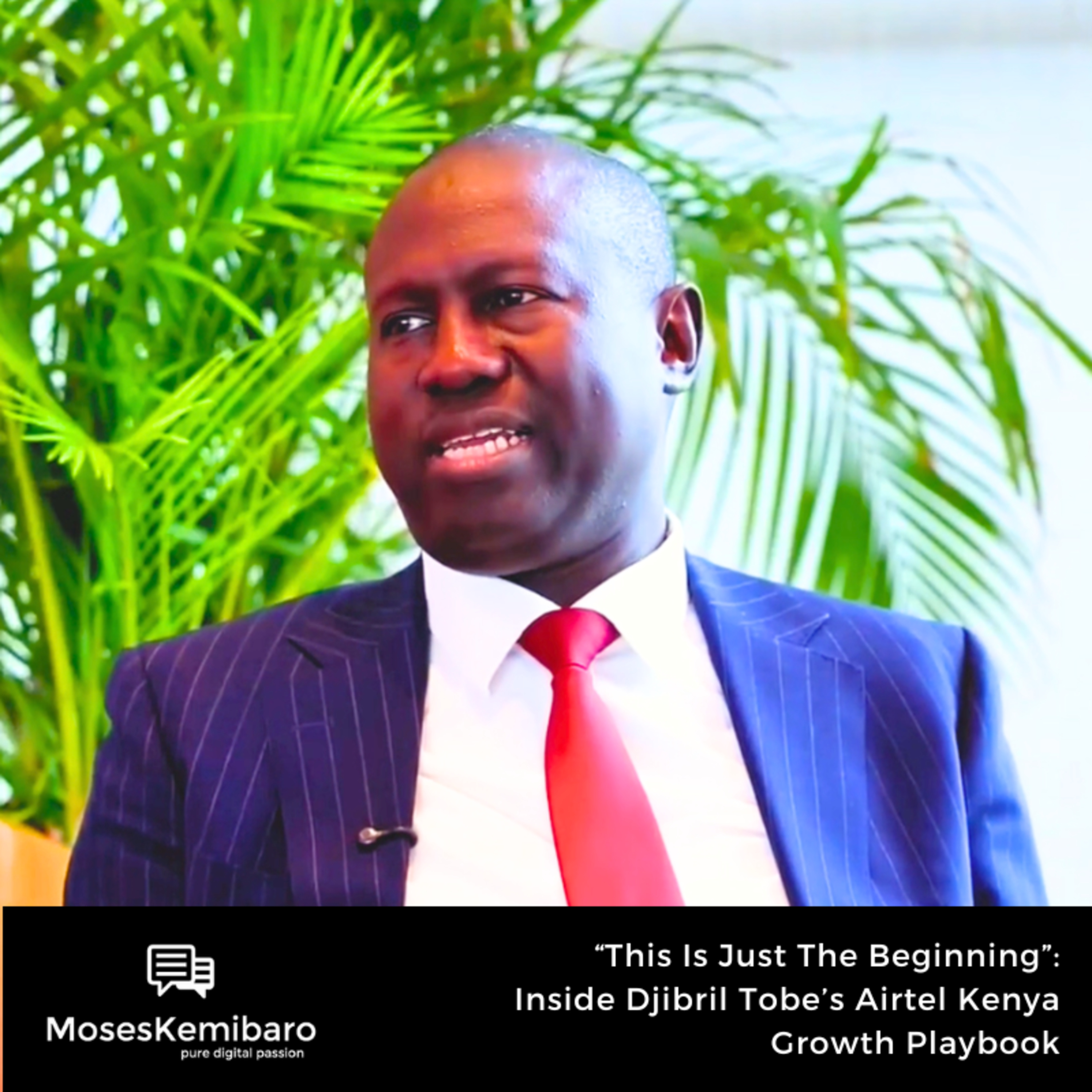
Episode 193 - “This Is Just The Beginning”: Inside Djibril Tobe’s Airtel Kenya Growth Playbook
from Pure Digital Passion with Moses Kemibaro
27m 49s
Jibil Tobe, the new Managing Director of Airtel Kenya, discusses his initial impressions and strategic vision after his first month in the role. He expresses humility and excitement about entering a market he considers far larger and more dynamic than his previous posts, highlighting Kenya's status as the birthplace of mobile money and its tech-savvy population. His immediate priority is to learn the market through extensive touring, but he identifies a significant growth opportunity: converting the 14 million existing Airtel GSM subscribers who do not yet use Airtel Money. He praises his predecessor's success in building the business and aims to fast-track this momentum through innovation, customer focus, and disciplined execution. Key initiatives include launching the "Business" wallet for merchants, offering free transactions and 50% cashback in actual cash on various Airtel Money services, and introducing the "Cinema Nakusho" campaign to educate Kenyans about Airtel Money as a competitive payment alternative. The MyAirtel app is central to his strategy, providing a seamless, integrated experience for GSM and financial services, enhanced self-care options to reduce customer pain points, and an open API platform to attract local developers and startups. He also emphasizes the app's ability to facilitate international transfers, supporting regional integration. In broadband, Airtel is scaling up with outdoor units to meet high demand, creating local jobs, and exploring satellite connectivity with SpaceX to expand reach. Tobe's overarching ambition is to empower Kenyans with accessible, innovative ICT tools to drive entrepreneurship and community value.
[MUSIC] Good morning, good afternoon and good evening and welcome to another edition of the Pew Digital Passion Podcast with me, Moses Camibarro. And today we have a special edition with a very special guest who recently has joined us here in Kenya. His name is Jibil Tobe from Ertel Kenya, the new MD for this market. And we're going to have a chance to speak to him about all the things that are happening within Ertel to date. But more importantly, what he hopes to achieve during his tenure in this new position. And obviously today we got an Ertel money update for Kenya around the business activities. A lot of interesting offers that I believe we'll talk a little bit about in this conversation. But most importantly, we want to get to know the man, his background, what he's been doing, and how he hopes to possibly transform the market here in Kenya. Thank you so much for joining us, Jibil. >> Very well. So you've heard more than two decades building businesses across the African continent from consulting and Coca-Cola to X-E to senior roles in Ertel book in a fast-so-chart and of course Congo Brazaville, your most recent position. After your first month in Kenya, what is the price due the most about this market and what assumptions have you already had to revise? >> Thank you very much, Moses. Thank you for hosting me. First of all, I would like to congratulate you for your blog and the number of followers and the key role you're playing in the ICT sector in Kenya. It's a great honor for me to be your guest today. And first of all, I would like that I'm very happy to be in Kenya. Kenya is a very friendly country. As I was saying today during the launch, I love buying my diploma, eating my nyama-choma. You've got local already. >> Yes, absolutely. I've got local already. As you said, coming to Kenya was a game changer for me because Kenya, from where I was operating in Ertel, Chad and Congo B, the size of the market in Kenya is way, way bigger. Just to give you an idea, Congo B and Kenya is like 10X. >> Wow. >> Congo B population is 5.5 million. Kenya is 55 million. >> You think I'll compare. >> You can compare. >> So it is very exciting for me. It's a market with its particularities. As you know, the market where mobile money has the birth space of mobile money. Where mobile money was launched and created and today it's a big, big thing. It's like two times even the total transaction is two times the GDP of the country. >> Yes, exactly. >> So you know, it tells you how important it is. Yes, I come here with a lot of humility. Also I have spent 20 years in telecom building businesses as you rightly said in various markets. You know, I am very humble. I think I have to learn a lot from this market. >> Yes. >> I've been going around since the months now. I've been going to inside Nairobi. I've been going to coast. I was recently in Kitay Ketengela. I was in Nakuru. I was in Nai Vasha. So I'm touring the country. >> You've seen a lot already. >> Yes, a lot. But I'm giving myself a quarter, three months from end of September. Then I will be better off to reply to your question. >> Yes. >> I've been going so far from what I've seen because I'm not credible yet to talk. I need to learn. But for what I've seen, it's a very dynamic market. >> Yes. >> The opportunities, people are hungry for data. People want better quality of service. >> Correct. >> High-speed internet, internet on the go, internet everywhere, internet at home. >> Correct. >> People like to be connected and people also move money very quickly. And they don't want to be charged for moving money. They are ready to pay for added value services. That's what I see. It's a very uptrending market, very dynamic Gen Z generation. When I walk into the malls and I love these malls all around Nairobi, you have nothing to end with to Dubai. I could even call Nairobi a little Africa Dubai, Dubai, Dubai of Africa. You can feel how connected those youngsters are. They carry their phones, they want to leave, they want to express themselves. And people like you with your blogs are also contributing to building that dynamic ecosystem. And my ambition is just to help you give you the tools to build that ecosystem that will enable any canyons to use the ICT tools, to use data, to use internet, to use innovative products to express himself, to create value, to have entrepreneurship mine and again for the benefit of the communities and the country. >> Wow, that sounds excellent. >> Thank you. >> So you are narrating a business that has more than double its revenue. You've grown from 16 million to more than 24 million subscribers. >> Correct. >> You've rolled out over 2,000 new sites. I think doubling the size of your network recently. You've also lifted a total of money as a business from 2% to 11% as I was confirmed today from the statistics that we have over four years. And really I think at this stage maybe it's harder to acquire more customers. And really what you want to sort of focus probably on better experience, deeper usage, stronger economics. We heard about some of the new initiatives today which maybe you can also talk about. But what two outcomes should canyons use to judge your leadership over the next three years or so? >> First and foremost for me in my tenure is to maintain, grow and strengthen that momentum. >> Yes. >> That's critical for me. You cannot allow that momentum to fade. And by the way it's an opportunity for me to pay a tribute to my predecessor, Ashish Mahatrab who over four years has been doing a fantastic job. He did exactly what Peter Tillie that you know probably who is the founder of PayPal and the leading shareholder of Facebook and etc. Peter Tillie wrote a book called From Zero to One. He said the brand it, fantastic. >> Then you know what I'm talking about. Ashish and the team here, my easy members, valuable easy members, commercial team, all the team, they did that. They moved the needle from zero to one. They were able to move it. Now my tenure is for me to take that needle farther to fast track that momentum. And I can only do so by being more innovative, focusing on the discipline of execution, seamless execution and obviously having always our customers on mind. I never should divert focus from thinking about our customers. >> Customers focus. >> Customers focus. Customers hungry. You said that there is not much more room for more customers. I tend to disagree a bit. Yeah, let me explain because we have various services. You know right now, even this number you mentioned, six million customers using et al. money. >> Correct. >> Out of the 19.5 to 20 million GSM customers we have. >> So moving across. >> If you 20 million minus six, give you 14 million customers that are using GSM, much mean they do voice and data, but they're not using our et al. money wallet. >> Correct. >> I want to win those 14 million customers. We still have a long way to go because we want to claim our fair share of the market. Internally we need to work on those customers that are using et al for calling and for internet, but they're not using us when it comes to money. Those are for example our biggest opportunity for us to grow again more customers into our franchise. And only do so by giving them more better quality of service, more innovative products that what they are getting actually. And just why today with this business wallet, Rudishua is part of that journey. I want to take for my next years here in Ghana, two to three years in Kenya, sorry, my next two to three years in Kenya. Part of that journey is to bring more innovative product and services into our portfolio so that we can win those 14 million customers I'm talking to you about and eventually also more customers that are sitting on the other side of the competition. Maybe you can touch a little bit on the initiatives that were launched today and I know it's fresh, but because we're having this conversation, I think it'll be a shame not to talk about them and how maybe those feed into this longer term strategy. Can we talk a little bit about the business or proposition and then some of the other initiatives around et al. money? >> Yeah. >> And then we have launched business wallet. Business is innovative portfolio design for our merchants to separate their personal friends from their business friends. There was a need in the market for that. And business allows free transaction for both our customers and the merchants who are going to use it. And if you transact in business or in any other services of et al. money like sending from person to person, by paying a buy goods or a pay bill, those things now you will get 50% cash back on the cost of your transaction. If your transaction is let's say 50 bubs to do buy goods or a pay bill, 25 bubs will be sent back as cash back to your wallet. If you remember before, those 50% was sent as et al. >> I remember this. >> Yeah, that you could use. >> Change is today when we launched business actual cash. >> Actual cash. Just to tell again our customers that we've been listening to them. There was this need for cash back. It will help them. And obviously we are also taking the opportunity to break out of big campaign. The cinema Nakusho. Cinema Nakusho is a thematic campaign. And this is the first time we've been doing this in Kenya. We've never launched a thematic campaign and I'm very honored to be the MD with this new era. This will be a big campaign on TV, radio, billboard. >> Yes. >> Everywhere digital to tell and to educate Kenyans that there is an alternative. You want to tell Kenyans there's not only one payment system. You also have et al. Money. And on et al. have 50% of the population.
cash back. That's basically the message you want to send to a canion. You know, there is another payment system, there is another alternative to payments and please try us. As much as most of canions have two numbers, we also like them to have two wallets. Correct. You know, I told you just a few minutes ago about these 14 million people that we have on our GSM portfolio that are not using our money portfolio, our money services. To those ones we say come and try us, come and get 50% cash back, come and experiment at Elmany. You know, because we've invested recently into a new platform and that new platform now is enabling us to offer most of the product and services. Very soon you will have good news coming in the loan side. We've already been offering loans but we will be stepping up our loans offer. And on and on and on. We've been looking at exploring, you know, the particular segments where there was tailored needs for those use cases to be developed and we are working on that. Fantastic. I'm glad we hear about some of these other new oppositions. There's a lot more to come. Absolutely. A lot more. This is just the beginning of the journey because you know, we're breaking out the schematic campaign first to educate people to tell them. And if you look at the video we've had, you see there was a couple of situations, you know, when there is a bank to wallet, you can have a salary on the bank but you are not eager to transfer it to your wallet because you think the cost will be higher. Correct. You know, you also have these, you know, merchant payments that lady who was riding the border offer them another payment but the lady you know was a bit scared because she believes that if she's using it Elmany to pay to the border network that will be costly for her and eventually she realizes that you know, even paying to any network, you will still get your 50% cash back. So that's the education we're trying to do. Yeah. I want to talk a little bit about the myerthal app because obviously we've been using it a lot. True. I personally have been a very big advocate for splatter bundles since early last year. Thank you so much. And transition then and I started using etel money this year. Thank you so much. I will not tell you why or how it happened. I think you probably know the legacy of something that happened a few months ago. Yes, I'm aware of that. And I wrote extensively about the fact that I think etel money is sort of almost like a giant waiting to happen. Absolutely. You know, and of course these are the global moves happening, the IPO, etc. And I think people maybe don't appreciate that. But I think for me, I like to talk a little bit about how the app is sort of central to the etel money experience and everything etel offers. I think it's brilliant. Yeah. You know, I'm using it to buy bundles and things for internet at home. I have the 5G routers as well. And really, this sort of multi-payment pragmatism that I see in this product. How central is my etel to the growth of etel money? Because even I think today you could see even the etel experience is ahead of the USSD, the way you promoted. Absolutely. And the wider etel customer experience for Kenya. You know, something very, very far down in Kenya. And you will probably help me to understand that is you people are still using SDK to do your transactions. You know, as much as we look at you, Kenya, we look up you as most innovative country when it comes to ICT, the birthplace of mobile financial services. But nobody's using SDK in the rest of the Africa. Yeah. But still using it, that tells you what customer will always use the service as much as they see the value. You know, now the my etel app is trying to tell people that it is SDK but in better. You know, SDK is fairly different from USSD, right? Correct. But the app now is the next phase of SDK. And I'm using this opportunity to tell Kenyans, please try the app. Today, if you download the app, you have 1GB free. Immediately. You download the app. You have 1GB free. And the app has been very innovative and ahead of its timing. You know, what you've said, what happened, has happened a few months ago, because they were trying to catch up because we were ahead by offering one app and for both GSM and mobile money. And all seamlessly integrated. You know, our competition, even in Kenya or other countries, because we're in 14 countries, they couldn't catch up before. They are trying to catch up now. But we were ahead of this long time before. And that experience, we are giving it as a benefit to the Kenya. Let me tell you, today on the app, not only you have all these fantastic services, GSM services, products and services, buying bundles, buying airtime, etc. transferring money, receiving money, blah, blah, blah. But you are also able to self-care. Self-care means you no longer need to walk into our rooms, our shops to queue for half day, just for a pin reset, just for reversing a transaction or calling the call center and waiting. Most of these self-care hygiene things that consumers, we call them our consumers' pain points. You know, sometimes you forget your pain, you try three times and your service is blocked, then you can no longer use your money, which is in your wallet. Correct. You have to call the call center, which tells you to come with your idea at the shop for us to check. Now with this app, we're trying to call it as a self-care app. Most of these pain points can be actually addressed for the app. So it's not only just enough for selling product and services, but it's an app also which has a consumer at heart. Yes. How we make sure the consumer, look at the app, the like of Microsoft. When you sell their product, they don't have a shop, they don't have a call center delivery. So everything is digital, everything is in the box, and you unpack your iPhone and the rest is in the box, it's digital. That's the same idea, to say that people have to be able to self-care when they use the app. Now the app is also a very open platform for our partners. With this new app and the new platform, integrating partners is very easy, it's seamless, so APIs. And by the way, I'm appealing to all the Kenyan ICT developers, all those Geek Kenyans who are working hard to create apps, to create services, innovative startups. Please think about integrating now, et al. money as a payment means, because now it has become seamless and easy for them to, you can be an innovator Geek, you can be a developer, you can have your startup app, your startup service you offer. You will still need a payments, right? Yes, absolutely. Now if you integrate et al. money, it is so easy, it's just an API integration. So the app has a 360 holistic view of what the ecosystem should be. The customer at the heart, all the product and services, self-care the customer, and seamless integration of all stakeholders. You know very recently actually, I was sending some money to one of my siblings, based in Tanzania. You're generous. So I was now thinking, okay, how do I do this? And then I confirmed with him that he's using et al. So I went through the app and I was able to send the money to Tanzania seamlessly. I also loved the way it was kind of showing me how the process is going. And that's a use case I've never tried before. But now it's even easier for me, because I'm finally here in a couple of other siblings also using et al. money. And the fact that the app made me do it in a very seamless simple way, I didn't have some looking for a USSD code, I just chose the country that I'm about. Absolutely. And I don't know what the people are well of these things. And I think that's part of the challenge. Yes, exactly. I don't think so as well. I agree with you. They're not aware of it. Yeah. And the part of the challenge, that's why we're breaking this, you know, cinema, Nakusho. Yeah. Cinema Nakusho campaign will really, you know, what you've seen is just the video. Yeah. This is the TV ad, but Spiska and her team, they are now working into multiple digital tactical campaign. Yes. You know, on the digital, you will see a lot of banners will come highlighting all the use cases. And that will include the international money transfer. It's very important, you know, we're talking about Africa integration, we're talking about, you know, cutting barriers. And Kenya, by the way, I have to commend and upload your senior leadership and your government for making Kenya visa free country for Africans. And if the visa is free, why shouldn't we be able to transfer money throughout Africa from your Kenya country? You should be able to send money everywhere. And that's one of the reasons that we've been coming up with this app. Fantastic service. Correct. I want to talk about a few more things before we finish. One is this common business broadband market. It's great. A few months ago, I was at, I think the connected government event. Absolutely. The launch of your new fiber to the whole propositions and I think fiber to the business. We also know that you're working with SpaceX to bring, you know, this direct connectivity to phones. Can you talk a little bit about that both on the broadband internet side and then how this fits in also with this other facility that SpaceX will also provide? The broadband actually was a good example that if you offer a seamless experience to customer customer with value, it will be successful. When we launched the broadband, we started by what we call the IDU. It was an internal device. Yes. And the success was so huge and the need for data was so high that that device was completely overwhelmed in terms of speed and capacity. So then our innovation research will step up now with the audio, which is an outdoor unit. It's an outdoor unit that when you set it up, you have a piece of the antenna that you have to mount on your wall outdoor. Yes. Communicating directly with the tower. And by doing so, we were able to create a lot of jobs because we hired a million.
Yes, thousands of installers, thousands of what we call DSES, you know, sellers, salesmen who will go house to house to sell those products. And we were able to train them to understand how you set up those outdoor units. And we were giving very high speed, download speed with those audio use. And it's a successful business. We're growing it double digit. But again, even those audio users will come to a point that the demand will be so high that then fiber will be now the ultimate proposition. So it's an actual transition. Exactly. So we segmenting, you know, I do you or do you and fiber? Natural transition transition. Now, DTC direct to sell is also another innovation to complement the run radio network. You know, our radio network covers you wherever we have a antenna or some reach. You know, now some places like you just said no, this turn could be a challenge if you have antennas everywhere because sometimes the business case for antenna will not be cost effective. The population density. Absolutely. The population density and then that's where now the satellite coverage, the partnership with SpaceX become critical because satellites coverage with SpaceX is a lot of the world. And they have authorization for Kenya. Now, we just waiting for the regulator to give us the authorization to launch that product, which we have successfully piloted few months ago. And we were among the first operator in Africa to do so. Fantastic. And Kenya, I'm very proud to say this was the first upco within the 14 African up cause of Ethel Africa. The 14 ones to do the pilot. Fantastic. Even me in Gunghobi, I did the pilot after Kenya. Ah, okay. Yes, so that you see, we are trying as much as we can to meet our customer demand. Customers, what they want? Simple things. Give me good network. Give me high speed internet. And whenever I have a point point, fix it. That's it. That's basically our motto. You know, high quality network, high speed internet, and fix my point points. I've lost my phone. I want to reset my pain. I've lost my sim. I want to reverse this transaction. I made a mistake here. Those are the things that we call their point points. Yes. And we want to focus on that. And as much as we can, we will tell them to self-care themselves. Of course, there will be some instances where they will unfortunately have to get to our shops. And by the way, we've been rolling out ambitious contact center programs. This is our shops. Probably you've seen some of them. Yes, yes, yes. Beautiful ones. That I'm going to be able to finish the default shop. Exactly. I was supposed to move this earlier. Exactly. So this is also part of our customer focus. To make sure that all our customer point points will be addressed in a timely manner. Okay. My last question to you is actually regarding NXTRA. Yes. You're currently building a 44-megawatt hyperscale data center in Tato City. I think their commissioning is expected to happen next year. Absolutely. And I just wanted to ask you, what must Airtel Kenya do between now and the launch in terms of securing cloud AI, government financial services, enterprise workloads? And how will Kenya start up an SME's benefit from this infrastructure investment? And the reason why this move is so interesting is that people always see as a mobile network, for being Intel, providing a home, but now this is data center that you're putting up with a very serious investment. What can we expect from that? And how do you see changing the complexion of that market in this space? Very, very good question. Because as you rightly said, people perceive us as M&O's as B2C. Yes. We've been always offering product to the consumers. This is a breakthrough now into our offering products to the businesses. Yes. It's a need to be. You know, this is primarily designed for businesses. Yes. And we want to enable businesses. As much as we have enabled customers to have good voice, good quality data, good mobile money, as much as we've done so with our consumers, we want to do that with the businesses now. And the business is meeting the big corporation, the SME's and even the informal and the little SMEs. Yes. How are we going to do that? We're going to give them the infrastructure for them to host their data and their platforms. They will no longer have to deal with remote cloud housing, cloud suppliers. And that will be also telling us that countries policy to have the data within the country, in terms of DPO. That's a center stays in case. And data governance is a really, really sovereignty. Absolutely. And you know, I wouldn't believe it. Even the big boys, the Google, the Microsoft AI right now coming to us. The Hyperscanner. Absolutely. Because they are interested in renting part of that infrastructure. Because then they make most of the servers locally here so that all the Kenya traffic stays within Kenya and all the data that generates by Facebook users of Kenya, Instagram users of Kenya, WhatsApp users of Kenya will remain in Kenya and will be processed locally. But apart from the big boys, we are talking to the Kenya Corporation and the SMEs to tell them, now you're going to have the infrastructure you've been waiting for, to be able now to really boost your business. Because then you can have enough capacity to do the biggest offers you want to do. You know, look at all the corporations that are dealing with big data like the banks, the banking system here today, we will be able to offer all the banks a really safe, heaven place where they can store their data, process it within a very optimized leader because everything stays in the country. Fantastic. And that it seems to mention a few. I can give you a lot of examples. And even SMEs that are not used to data center, I'm calling to them to say, come and see us, we will have tailor made proposal for you because we also want you to upgrade your capabilities into data, data, data, data management. Fantastic. We want you to say, gone are the days where you are stored on disk, you're stored on USB keys, you will come and we will host you and we will look at a very professional price for you. So you see, it's a great, it's a breakthrough for us and for the ICT sector and for Kenya. And the fact that we've chosen Kenya, remember we operate in Tanzania, we operate in Uganda. But we have, we wanted to show our belief and trust on in Kenya by putting next in Kenya. And that will reinforce and strengthen Kenya position as a digital leading ICT hub in East Africa. And I'm looking forward to it. Well, thank you so much. You've given me much more time than I could have hoped for. And I don't know there's any last words you want to share with our audience before we close. Yes, just first to thank you very much for hosting me. I am really happy to be in your show and I'm looking forward to follow you on your blogs. And to say to all Kenyans, Asant Esanna, I love this country. I like the Yamachaba and I'm looking forward to, you know, big and more innovative products and services and very soon with Etel Stateune, we have a lot more to go. Thank you so much, Jibil. And I'm so grateful for this opportunity and the team at Etel who made it possible. Absolutely. And we want to wish you all the best as you move forward. Kenyans, a wonderful place and I'm sure you will, you will do well with this market. Thank you so much. So thank you so much for joining us for this edition of the Pew Digital Passion Podcast. You've had it from Jibil. One of our first interviews with him and we hope we'll have many more. And of course, we will catch you in the next one. [Music]
Podcast Summary
Key Points:
Jibil Tobe, new Managing Director of Airtel Kenya, brings over 20 years of telecom experience across Africa, including roles in Chad and Congo Brazzaville.
He views Kenya as a much larger, dynamic market (population 55 million vs. 5.5 million in Congo B) and a leader in mobile money, with transactions equaling twice the country's GDP.
His initial focus is on learning the market over his first quarter, having toured regions like Nairobi, the coast, Nakuru, and Naivasha.
He aims to sustain and accelerate the momentum built by his predecessor, Ashish Malhotra, who grew revenue, subscribers (to over 24 million), and network sites.
A key opportunity is converting 14 million existing Airtel GSM customers who do not yet use Airtel Money, alongside acquiring new customers from competitors.
New initiatives include the "Business" wallet for merchants, offering free transactions and 50% cashback on eligible Airtel Money transactions (e.g., buy goods, pay bill), now in actual cash.
The "Cinema Nakusho" campaign is Airtel's first thematic marketing push to position Airtel Money as a viable alternative payment system in Kenya.
The MyAirtel app is central to strategy, providing seamless integration of GSM and mobile money services, self-care features (e.g., PIN reset), and easy API integration for developers and partners.
The app supports international money transfers, such as sending funds to Tanzania, promoting African integration and seamless cross-border payments.
Broadband growth is strong, with the launch of outdoor units (ODUs) to address capacity demands, creating jobs for installers and sales agents, and future plans include SpaceX satellite connectivity.
Summary:
Jibil Tobe, the new Managing Director of Airtel Kenya, discusses his initial impressions and strategic vision after his first month in the role. He expresses humility and excitement about entering a market he considers far larger and more dynamic than his previous posts, highlighting Kenya's status as the birthplace of mobile money and its tech-savvy population. His immediate priority is to learn the market through extensive touring, but he identifies a significant growth opportunity: converting the 14 million existing Airtel GSM subscribers who do not yet use Airtel Money.
He praises his predecessor's success in building the business and aims to fast-track this momentum through innovation, customer focus, and disciplined execution. Key initiatives include launching the "Business" wallet for merchants, offering free transactions and 50% cashback in actual cash on various Airtel Money services, and introducing the "Cinema Nakusho" campaign to educate Kenyans about Airtel Money as a competitive payment alternative. The MyAirtel app is central to his strategy, providing a seamless, integrated experience for GSM and financial services, enhanced self-care options to reduce customer pain points, and an open API platform to attract local developers and startups.
He also emphasizes the app's ability to facilitate international transfers, supporting regional integration. In broadband, Airtel is scaling up with outdoor units to meet high demand, creating local jobs, and exploring satellite connectivity with SpaceX to expand reach. Tobe's overarching ambition is to empower Kenyans with accessible, innovative ICT tools to drive entrepreneurship and community value.
FAQs
Jibil Tobe has over two decades of experience building businesses across Africa, including roles at Coca-Cola and Airtel in Chad and Congo Brazzaville. He recently joined Airtel Kenya as the new Managing Director.
He sees a dynamic market with high demand for data, quality service, and fast money transfers. He notes Kenya's mobile money ecosystem is massive, with transactions twice the country's GDP, and aims to leverage this for growth.
The Business Wallet is a new product for merchants to separate personal and business funds. It offers free transactions for both customers and merchants, along with 50% cashback on transaction costs like buy goods or pay bill.
Cinema Nakusho is Airtel Kenya's first thematic campaign, using TV, radio, and billboards to educate Kenyans about Airtel Money as an alternative payment system. It highlights the 50% cashback offer to encourage more users to try the service.
The MyAirtel app integrates GSM and mobile money services, offering self-care features like PIN resets and transaction reversals without visiting a shop. It also provides 1GB free data upon download and seamless API integration for partners.
Yes, Airtel Money allows seamless international transfers, such as sending money to Tanzania via the app. This aligns with Airtel's goal of promoting African integration and removing financial barriers.
Chat with AI
Loading...
Pro features
Go deeper with this episode
Unlock creator-grade tools that turn any transcript into show notes and subtitle files.
 PodcastTranscript AI