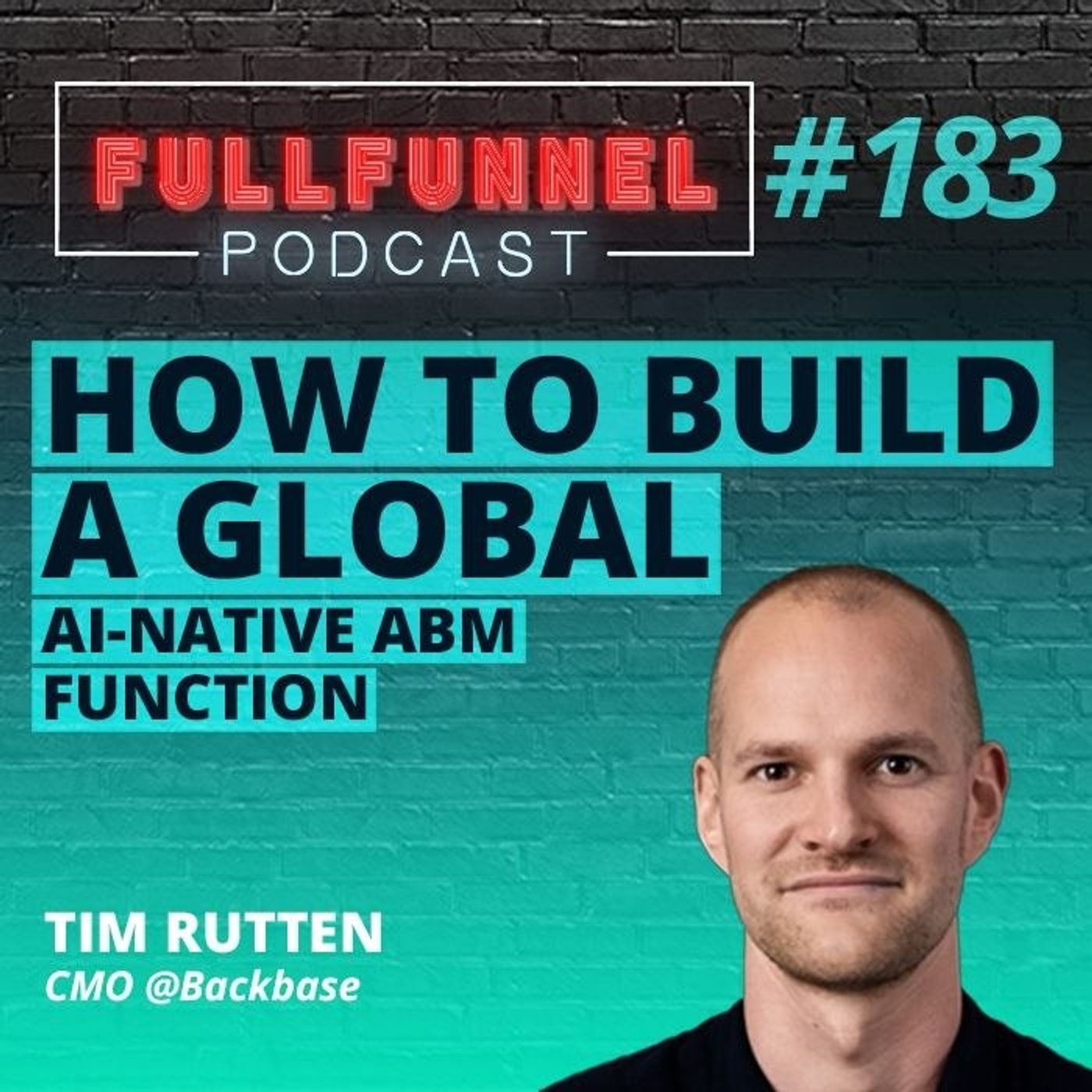
Episode 183: How to build a global, AI-native ABM function with Tim Rutten
64m 29s
Tim Rutten, CMO of Backbase, describes transforming the marketing function into a global, AI-native ABM operation. Backbase sells a complex banking platform to about 3,000 banks, with sales cycles of one to two years. Rutten collapsed siloed marketing teams into a single account-centric engine where everyone shares the same KPI: pipeline from target accounts. Regional ABM managers act as marketing AEs, collaborating closely with sales leaders. The team built a custom AI go-to-market system that automates research and campaign execution, allowing them to run over 50 tailored campaigns simultaneously against 30,000 executives. This replaces manual work and enables a "sniper" approach. Key to success was top-down alignment between marketing and sales, an operational layer driving weekly discipline and accountability, and simple KPIs measuring awareness, dialogue, insight, and pipeline. The main challenge was change management and overcoming sales resistance. By showing concrete results and getting into operational details, Rutten shifted the culture from siloed campaigning to unified account focus, eventually having sales leaders proactively request to join the new methodology. The AI system now provides real-time diagnostics across all account campaigns.
[MUSIC] >> This is the full funnel B2B Marketing Podcast, brought to you by full funnel.io. Let's dive in. >> Hey, everyone, and welcome to the new episode of Full Fun Life. I'm really sorry for everybody who joined us live that we are going late. We'll literally start in one minute as team just has joined us. Anyhow, as promised, we're going to chat today about building a global AI-native A/B/M function. We've been working with Backbase team for more than six months. We're working with multiple regions. During this time, we were really amazed with the way how they integrated AI-native A/B/M process and the way how they are thinking in terms of building the global function. While we are waiting for team, I'm just curious, guys, who has attended team session on our full funnel summit in March a few months ago? Type plus please if you have attended on minus if you haven't. A lot, of course. You've had let us know, guys, who has attended that session. While you're typing, just to give some background, team, Sam, I didn't. Okay. I'm just curious because there isn't my masking because it's just good to know how much we should repeat ourselves, how much it will present from that session. But just maybe to set up the expectations, what we want to chat today is basically go through the process of developing the global function, sharing the step-by-step process, explaining how the team was structured, explained the challenges and how they were tackled. Then the last part touched basically the AI system that's team and he's team created and how we have integrated this into a combat market. I see that what and team are ready. So gentlemen, please join me on stage and we can kick it off. Hello, everybody. And we're waiting for team to find. There you go. Here you go. Good. So we have all three ball to beat the B-market team. That was a special bonus for everybody who is joining us live. It's an eradication. You can at least enter the three ball to beat the B-market team in one place. Our jokes aside, we have the last episode of "Full Final Life" before the summer break. I'm really excited to bring our long-term connection and friend, team Routen, who is CMO, and back base to our podcast. So team first of all, thanks a lot for joining us today. Thanks for having me on the day of love. Long time listener and fans, so very privileged to be here myself. Good. Good. So I think we don't need to kind of prepare a long intro for this episode. We've been working together on building a global A/B/M function, integrating it with the I/C systems, right? Another project that you were building as well in parallel. And so I think what we can do is you can just make a pre-finter of what back base is doing. And who is your target audience, I think that would be beneficial for everyone and then will dive deeper into A/B/M. Yeah, no, happy to. So first of all, good to meet you all. So I am Tim Routen, CMO back base since one of our years at this moment in time. I've been with backbase for 12 years, so it gives me the benefit of knowing the market, the customer, the technology, the value proposition inside and out. And as the first step of the CMO coming in, I concluded I need to be here. I need to really understand the man gen properly and I need to bring a vision to life that really works for our target audience, which is give or take to one of thousand to three thousand banks globally, mid to larger size, not the system banks, but just one click lower, and not the smallest banks because they wouldn't have the budget to actually digest the product of back base. So basically with those three thousand accounts, what we are offering is a white label, AI-dative banking operating system, which is essentially a banking platform stack that allows the bank to completely modernize their complete operation. In the past, it would be to become on the channel, have a nice mobile application, have a nice web application, give it to your customers, clients, members, but also to your bank employees. They all need to operate in the digital world. And in the past five to ten years, there was very much to get into a platform setup. And as we all know right now with the AI hurricane going through the industry, banks also need to embrace appropriately those new technologies, those new capabilities, and it's very challenging for them. And what is really cool and interesting is that for most SaaS players, it's a real problem. The fact that AI is now there and that you can easily build on your own or build certain capabilities and actually de-throne certain applications that you have contracts with. In the goldware to the back base, it's a bit less obvious to do that because self-building a complete banking platform or a banking operating system is quite a heavy lift because the architectural layering is advanced. You have regulatory compliance to go through. You're running literally the bank that runs the country. So it's not something that you fight code, if I may. Nor is it something that you self-build because it's just way to costly. It's going to take you too much time. So as back base we repositioned last year, actually three or four months ago to be honest, all the way into becoming an AI native company on how we run ourselves internally and being an AI native banking OS towards the industry as a first mover. So as a category leader of the previous category, we moved all the way onto the new one, which is quite bold. I think that also is a testament to the work we've been doing together, bold, not bold, to go and completely transform the way we think about our marketing function and how it collaborates with sales, who in the context of back base are of course selling a strategic piece of software that runs the complete banking operation. So that is not a point sell. It is a platform sell, but it's also a highly enterprise, high ACD, long sales cycle sell, which will take around one to two years on average. So that is not something that works with the typical high volume SaaS type of playbooks. If anything, its relationship building is being very aware and creating a lot of awareness all the time, a lot of thought leadership. So anyway, it lends itself perfectly fine for what these fine gentlemen wrote down in the book, which is what I woke up to one and a half years ago and have been implementing ever since. That's an awesome introduction. I think also the way that you are describing your ICP, we have 3000 banks very precisely the bucket or the segment that you're targeting. I think this is a perfect example of somebody of a company that needs to implement a comeback marketing. But I think it will be interesting for the audience context to understand the organization, the marketing team or the function, how it's organized because it is not your standard let's say small to medium SaaS company with one marketing department. You have different regions, you have different functions within marketing and as you're kind of like letting us know how that structure like what is the role of ABM, obviously giving your market, giving your ICP, given the long sales cycles complexity and all that, it's clear that it's a good fit. But how does it fit within your organization, how would you position it as your own ABM for pipe base? Yeah. So, politically, ABM is like a team or a function that runs alongside all of the other parts of marketing and I figured out that that's not very much what you would like to be doing. Why? In a motion that we are running, everything is ABM. Liquid, from start to finish, we just do the work for the accounts that we have in front of us, the 3000 that I mentioned. They're not all in market, they're not all buying but they better be aware of you, they need to have a view on your brands, your thought leadership, your point of view, what have you. So, very directly, whatever you organize for is what you show up with, right? That's one of the typical statements in business you get what you organize for. So when I took over one and a half years ago, we had these little siloed teams that would each do their own thing, having their own KPI and having their own opinion on how marketing should be run or not. That's also some infighting happening, of course, because the crops are not really fully aligned. Fast forward to today and I'm actually collapsing, I have already collapsed most of these functions into running as one.
like really following the full funnel marketing methodology. But even more so, bringing everyone close to the accounts. Like full stop. There's no other entity that matters in the organization that I'm running, but also the engine that I'm running, which is literally an engine. It's a system that runs. The only currency that matters is, are you attacking the right accounts with the right, let's say set of programs, following the philosophy that we believe in, to pull through eventually to get a conversation. And once that conversation happens, the highest possible in the organization of the bank, are we able to capture a potential qualified opportunity, as or no. And everyone has the same KPI in that sense. So it's not brand versus content, versus digital, versus the field who all have a little piece to play in account-based marketing. It's all of them working in the same engine against the same accounts, having the same things to celebrate, which also relates to how we organize ourselves against the sellers. We're organized by regions. We have six major territories globally. They all have a sales leader, have multiple AEs. For all of those, we have one and maximum two ABM managers that run the patch. And they're basically the marketing AEs, and they are as passionate about the pipeline as the sellers. And that's really nice to see, because the moment that that click happens, I don't get escalation calls anymore, as in, hey, your marketing team doesn't understand what they need to be doing, or we're misaligned, or what have you. I get different calls. I get celebrations. I get, hey, you really need to look after the work that this person did, because it's incredible what they pull off. We've seen a lot of these shifts over the past one and a half years, just by organizing the team towards the currency that matters, which is the accounts. And to move very far away of global campaigning, and universal campaigning, and let's just have an awareness layer on. That is how we started, full transparency, but very soon after I figured out that that is not how I buy, that is not how I'm even being influenced, being a clear target to typical marketing platforms that want to sell their license system. Right? Fast forward to today, because of the advent of AI, and because we were able to build our internal go-to-market operating system, which is literally, a complete AI native operating application, I'm able to run campaigns at the level of granularity that was not even possible two years ago. So the vision that you guys have had already for ages with full funnel, I think it only can now fully get to fruition because the tech allows us to do it. I can run 50 odd ICP cluster campaigns against my 3000 accounts, hitting around 30,000 executives exactly in the spot that matters to them to warm them up. And yeah, like it or not, I don't need an army of people to do that every day on the contrary. They think that's massive leverage. Of course, the people I do have, they're allocated to other activities, which are even more strategic and even more human focused. So I think what I'm trying to say, it's a bit of a long-winded answer perhaps, but the lines have been blurred consistently this year. I don't even care as much anymore, which actual team or craft you are part of, you're working in the same engine. And it's more about how do we then organize against, where's the most traction in the market and how do we optimize that allocation so it's not under allocated and hence under performance? I think that's the biggest switch that I've seen over the past few months now, that with this methodology, with the setup, with implementing AI to actually grow, not to replace and reduce headcount, you somehow build a sniper shooter, yeah, at skill. - So basically, touch on the last sentence that you mentioned, you didn't announce how I replaced my six regional teams, so there's a AI department that knows. - I replaced work. So one of the things that I learned very early from my back-end CTO was you have to take the work out. And the work is the silly work where you're manually going through LinkedIn feeds or doing your own Google research to get a view on account. By now, we all know that that is not smart where to spend your time. We also now all know where to go to actually get a decent piece of research from your favorite choice of GPD. I think the next step is to actually have full processes running that do this all the time, 27, in an economical way, you know, overspend their either. But that's the next step where you see these full agenda workflows that actually make you as the marketer, the ABM manager, the content manager, the digital manager, it will make you supercharged and it forces you to become even more strategic. So for some that might be a little bit daunting or challenging, it'll also be something you can think broader in your role and the remit that you have. I think it's the best thing that can happen to marketeers, to be honest. Moving from the tech that goes to the strategic. Obviously I was throwing some of the kind of overhyped, let's say, concepts that were promoted on LinkedIn as all know, right? - Yeah, but if we would believe LinkedIn, on the day we would all not have a job anymore, which, fortunately, is not the case. - Yeah, yeah, yeah. - Of course. You mentioned you, in every region, you have regional VP of sales. We've been chatting with thousands of BWBCMOs who wanted to implement a common-based marketeer in any format, right? But quite often, the main goal is to set up the cross-functional collaboration with sales, right? And what we have heard, that they always faced problems with getting internal buy-in and problems with setting up this necessary cross-functional collaboration. So what I would love to ask you, how did you handle it? And so have you faced any resistance from the regional sales leaders and the FES? Again, how did you tackle it? - Yeah. Yeah, look, it is not easy. And it's also not that we are finished and we have the perfect, complete set up running. Where I do see the success already, or we're getting very close to a tipping point where more than half is running in that new complete philosophy. I think at the end of the day, you need to show results. And you can not be the marketing leader or the marketer for that matter in a region that just, again, ponies up a new framework and a new slide deck with a new inspiring talk and how we're not going to work and change, the pipeline impact. One, it has to start top down. So if we see them out and see our own data gather concludes, we are together collectively going to change the way we go to the market. That is not enough. We step two, you need an operational layer that drives discipline, cadence, clarity, and accountability. Because even with the CMO and CRO concluding, yes, we're going to do this, or in a smaller firm, maybe it's the founder or the market leader on their own and they run the full patch, you still need to day-to-day drive it home. And that literally goes to tracking level. Like every week, have you put in the work to go through all of these different steps, to do the depth, to follow the flow, to eventually get high quality outputs and has make impact? And thirdly, are you measuring it appropriately? Which clearly, full follow has a very nice view on how to measure it, practically very down to earth. Did we raise awareness, yes, no? Very simple KPIs. Did we get it to dialogue with them and did we extract insight that, whether we could pursue an opportunity there, yes, no? Thirdly, did we get a sales conversation, eventually didn't realize it to pipeline? Did that pipeline qualify, get into revenue, and so forth? That is not rocket science. And that's the beauty of the work we've been doing together and also why I really like the latest bootage you released. It's just putting to life the simplicity of the work that needs to happen. But that's not the real challenge. The real challenge is change management, removing old habits, finding sales leaders that are equally bought in to change the game, to change the way they work and their ease, which is not a given, because they have their ways. They've been successful in working the other way or to work the classic way, very heavy ABM, or no, I don't need ABM. I know all of the people in my accounts. No, you don't. They have a multi-thread, they have not raised any awareness in the accounts that you don't know. And if you missed target, all of a sudden is marketing. So I think there's a lot of credibility to be gained by just doing the hard work, like literally getting in there. And yeah, I'm not sure if it's helpful for this conversation, but I think it was you and me writing here in the book, as a note to me, that is quite unique, that you have an operator that can get into the detail. I think that's the main thing as a CMO to walk away with. If you are not in the detail and you don't understand how the operation really, really works, you're not going to get there. You're also not going to be able to eventually really move the needle and get to that tipping point where they're actually knocking on your door. Might he also wants to work in a new way? Can we please be part of the pilot? The moment you get those phone calls, you can start doing an early celebration. You're still not there, but it's a good signal. We got a question from an audience, which is very relevant, I think. [BLANK_AUDIO]
were you able to bring the teams together? - Yeah, to that point, my side, it's myself and the CRO being fully on the same page, then bringing it to the operational leader, which is our VP customer operations, Colin Revaub, it's the same function here in Backbase. And that lady, Joanna, is her name. She completely internalized how we would like to work, also added a few of the flavors that are specific to Backbase, and then drove the rollout in very high granular detail towards all the different regions, all the different territories and all the different accounts with the AES. That translates then into reports, which have accadins, which are all looking the same, which then results into meetings, which are happening on the cadence, they are run all the same. So eventually you get a homogeneous picture where we can literally compare notes of the 40 AES that we have of the 100 ABN campaigns that we are running, if you score all of them, where do we see the gaps? And is that either a team set up, is it maybe a cultural challenge? Is it because we didn't properly enable them? We can literally diagnose across all these little swim lanes, for me, in AES a swim lane of pipeline. Where is the gap? And right now, because we were able to actually build that systemically into our own go-to-market OS, which is the dream app you can go to, we can just analyze completely how the market is opening up to us, is getting into dialogue and is, or is not, that's also the honest, materializing into pipeline. So getting together with the one that runs, or the individual that runs the actual operation day to day, and needs to deliver pipeline inside, to me was key. So basically convincing her and bringing her into the fold. And also, there are some compromises on how your operations team wants to look at the business. Get as close to the view as possible. And once you look at the same picture, all day long, both ends of the spectrum, seals, and marketing, and partners, yeah, you start delivering results together. And then lastly, I think the celebration part is not to be underestimated. I think the moment you start doing ABM well, you get these surprises in your inbox. Like, we're doing lot of letters at a pretty decent skill, about 10 to 20 per week, but they're well prepared, well researched, really targeted at the right ICPs, and they go out there with the center profiles. I think around 30 to 40% converts into a conversation with a set executive from that account, which is clearly a target account. That's an insane number. And people will tell each other, like, the love letter worked, and they're all amazed at the love letter worked, with the risk that they think that love letters is what full follow marketing is, which is no surprise. It's one of the many things to get in there. But basically, getting the breakthrough moments and getting the aha, that is where you start getting that fire going through the organization. And then still, it needs meticulous day-to-day management and looking after to continuously move the org in this direction, because old habits they die very, very hard. - Especially when there is whatever reason why people feel pressure, things might not work as they expect, et cetera, people tend to revert to their old habits. It's very feel safe. And I think also has a lot to do with what you said. It has to do with the incentives, how we measure things. Do we have the same view on the process and the results and the motion and how the accounts are actually going through our motion and pipeline. I think you did a lot of things right, and you started talking about it, and it's something that I would like to zoom into because you mentioned pilots and you mentioned also, starting from the people who, in a specific region and starting with people who might become your change champions that might actually spread the word around inside of the organization. And I remember we actually had quite a long back and forth between us about, okay, should we do the pilot? Should we not do the pilot because you were definitely already doing ABM, you had an internal ABM star who was just amazing at her work and the results that she was able to achieve. And yet we decided to take a step back. I remember you said something like, I want to make sure that we are running this properly before scaling it across the whole organization. And we decided what was it about eight months ago or something like that to actually implement the first pilot. And I think it's maybe interesting for folks who are listening or live or later to break it down for us. Like how did you define, how did you decide which region to pick, how did you define the pilot team, how did you fund that pilot? Like how should we think about setting up a pilot in as concrete ways possible? - For what is worth? The approach that I took was, how do you optimize it for the highest probability of success, right? So the start that you're talking about, she would be in charge of that pilot to begin with. Because you know the type of talent that you work with that will pull through, will unblock it, will give you the right phone call at the right moment in time to make progress. So I think that's a key decision who's actually the one that's gonna wake up every day to drive it home and does not rest until it's driven home and successful, critical. Number two, you have to put your bet on the region where you know the right talent is there until she embrace it fast and then they will also be the amplifier if indeed it succeeds, which you're practically banking on, right? I guess thirdly, you wanna see if you proven people that know what they're doing, be it on the digital side, the content side, the ABM side. And similarly on the sales side, like who's the BDM and the AE that will be in the little pot that's gonna prove the point, that are changed prone, they're aware that the old motion is not maybe the best thing and that there's another alternative to go for, which actually might make them way more successful, although initially investment is gonna be higher. So if you just go through that flow and you literally ask the right people, "Hey, who should we bring into the team?" Because they know they're operating on the ground each and every day. I think in five minutes you have the right people to work with, they're all going to be fired up after a 15 minutes call. And you send them one of these webinars as an example or one of the courses and a few of the examples, and you start kicking off the work, just getting into it. And what I noticed immediately was that none of them was used to such a good structure and rhythm to begin with that really sets the group free to do their best work. I think it's also more lightweight than they expected. Of course, the first lift is hard because all these new things, you need to fill out a few documents initially and what have you. But then it's just logical. It becomes all very logical if you apply the mechanic properly and all of a sudden you get the right result, which also is a bit of a surprise initially. But if you go through the full flow, it makes a lot of sense. You optimize the probability that you're gonna get a return. And the moment that the puzzle in the formula starts clicking, you're actually done because they will continue. You keep monitoring it and one have you. But that's basically the deciding factor that I could in. The way to fund it is, yeah, it's very specific to the context. I had a big change budget last year because I needed to transform the complete org. And I made sure to, let's say, back load a serious amount of funding in my complete budget allocation so that I could make really bold moves. And that was on the ABM side, that was on the brand side, that was on the digital side had to make a few very big changes and moves. And I think my trick so far for what is worth, because it's not gonna have decades as being a CMO. Call the people that know best and just either abstract and extract the right ideas and inspiration and take it forward or put them with your team for a while and see how fast they can change your org. The leverage for those investments that you're making is at least in the way I've seen it so far, second to none. - Makes perfect sense. - Maybe a practical question. What expectations did you set up for the regional leadership and the team and also what were the results of the pilot? - So I think there's one part before this. - Expectations versus results. - Yeah, there's one part before it, one part before it, also towards my regional leaders. - Why change? - Why now and why this methodology, right? Because otherwise you can push it through the team and you can allocate you guys as a full funnel marketing consultant and just push it through, force function. I think that's been the biggest challenge to actually convince people of a different way of working and the biggest thing I was finding on the day of lot was, yeah, but we're already doing this. It's just a little bit different. - Yes. - Yeah, no, we're doing this. No, you're not really doing this. By the way, you can only make the statement if you went through the full course and then you really benchmark the program and then you can tell me, are you fully doing this or just parts of it and you follow the happy flow of thinking that you are. So that was the thing I was fighting. So I had to force function it through. I basically just signed the guys up and I'm really excited.
set to the team. This is the pilot you have to go now. And here are the expectations. What I did, and maybe that's even not the best advice, I didn't appreciate put a target on it. The only target I put on it is I want you to follow the full flow. And I want you to report back every other week. And I want to see the signal that this is meaningful to continue investing in. So eventually you get qualified meeting with target accounts, eventually you get pipeline, and eventually you can say, hey, this is a nice benchmark number. I'm going to put on the next pilot. So I didn't inflate the numbers or the expectations that say, hey, I need 10 million out of this pilot, or 1 million or two opportunities. Who am I to tell you what it should be? I have no idea. But my hypothesis was that this way of working was going to be meaningful. So not putting a pressure on the team, I believe was helpful because they were the right people on the right talent and the right DNA, and they would go for it. And that's exactly what happens. So they deliver pipeline. Sorry, I don't have the number top of mind. But it's been celebrated. It's been a good number in terms of breaking into accounts, getting dialogues and actually leading to, first of all, just pipeline and eventually qualified pipeline, which has resulted now in this is the way we work. Cool stop. Including my CEO making the full call or just supporting the calls that I'm pushing. How fast can all of my teams, all of my regions, all of our territories work this way, report this way, and basically play the game this way? How do we scale that? Most challenging question in the universe of AVM. I really like it that you were thinking about as well. Like, okay, the team has to do the right things. The team can do, let me put it differently, let the team focus on what they can control. And I think you did that really well. And I do remember the first pilot that we ran was in the United States and is a very well known large European brand still. Obviously, especially when it comes to the financial sector, the United States being what they are, and the banks being their larger, having to create the credibility, having to create awareness with those target accounts. And I know like when we started having first conversations, with huge names. Just imagine the biggest banks, I don't want to name the names, but it will be those. And I remember how much we have celebrated that. And that's why I wanted to ask you, because I know that a lot of teams are struggling with this. A lot of teams are struggling with, and you're talking about it at the beginning, going from kind of broad awareness creation to, you know what we need to do is we have 3000 banks and then in the United States, you have these banks. And actually, you know what, we are going to focus on whatever specific segment, banking segment. So we are like narrowing and narrowing and narrowing. We're talking about large organizations, you know, very conservative industry. You're talking about a relatively new brand for them. So what do you think, kind of the best practice of the lessons learned in terms of actually creating strategic, sorry, awareness with those senior buyers in those strategic accounts that you're after, not just let's say, global brand awareness. Yeah, this is such a tough cookie to crack at this level. For the reason that many answers could work. So you have to make a bit of a judgment on what do I personally believe will break through and is also still fundable, right? And you can also just put all these accounts in whatever campaigns have funded for millions, but that's something you have to optimize for. So why am today, I'm just hearing it from my group here, I don't really believe in global segment campaigns anymore. And if you think about the context and backpays, we service retail banks, small meeting business banks, commercial banks, private banks and wealth managers. That's five different types of institutions, whereas one brand can have all five of these lines of business. So the 3000 QQ don't average to multiply them by 304. So there's one 10,000 doors through which we can enter with a part of the value proposition. Now where we started in the, let's say last year, was to have these segment campaigns globally running and allocate those accounts based on the segments where they are active, which means if you are a bit emerald, you service all lines of business, you're actually part of all the campaigns and all the senior buyers and the VP levels and director levels now excluded will be exposed to all of those campaigns for all these lines of business. Quite nice to get started because it's the fastest way. However, it is the proximity to the actual account and the actual person is going to see your audience is not great. It's actually, it's not just not great full stop. So we're moving right now, which I'm really excited about and would love to even demo it in the future once I get it running. I'm a firm believer that within one institution, I have ICP clusters itself. So within one bank, there's multiple ICP clusters where I can knock on the door and have a different entry or different wedge. There's the private banking wedge where they have a relationship manager problem to fix and it's actually a funded initiative. Maybe through the retail door there's a conversational banking investment that they're looking to make. I can also enter through that door. But if those executives are seeing just some random campaigns across all the different segments of backbays, they have no idea that they should pick up the phone. So we're now in the middle of an exercise where we do very high quality ICP scoring, practically 24/7. Then we do very good account research on all of our accounts where we know they should actually be in dialogue with backbays all the time. Based on that, I'm able to build out a whole cluster of ICPs. So I've ICP cluster buckets and there's dozens like 20 or 25. I can then allocate titles to those buckets. So not accounts, titles. And one account can be in multiple buckets, but because it is title driven, all of sudden the individual, let's say CFO in the bank in A/M/R is just getting the operational excellence ICP cluster campaign. And we're warming up that individual just from that angle. And then eventually if that exits it goes to future pipeline and so forth. So what is my current belief? Yes, I will have a global brand awareness layer just for reaching engagement and mental availability, pick friend of Byron Sharp. But that's where it ends. The rest is ICP clusters. And that's how I warm up all the 3000 accounts and all the I think 30, 40, 50,000 contacts that you would like to reach in a very granular and suitable way. Primary channel being linked in. We target in Google Reddit what have you. To raise the awareness and indeed once it exits the bucket, we go to future pipeline and other sequences start. That's my current hypothesis on how I can, in the context of backbays, scale this out. And yes, this is only possible if you properly run this with an AI native setup, which is exactly what we've been able to break through into in the past few months. So it gets us to dozens of ICP cluster campaigns that continuously move accounts and personas across as we see fit for what is happening outside in into the accounts. And on more granular level, if there are signs on that you would add, let's say the ABM team, some marketing and let's say ABM leaders you mentioned and sales teams, are there any specific tactics to that are happening, let's say on one to few or one to one level. Yeah, so one of the, so it sounds a bit harsh, but what really works with getting into the CXO level is just play into the ego of individuals. The majority is looking to build their own brand or to be exposed. In banking, you don't typically get exposed to the executive because you're a bank, you can't really go out there. So we essentially offer the platform for them to look incredible just out there, get the exposure and distribution because we have quite some reach. And your next to this relatively hip brand in the banking space, not FinTech per se, but more big FinTech, more trustworthy, credible. So our podcast program is with a massive success just getting entry by just having CXOs in the conversation and, I'm personally the host, so that means I meet the CXOs all the time there in my show and we have a dialogue like we have here and by surprise it's always with a target account, that's the strategy. Very high leverage, very little investment. The second one that to me really stands out is just classic events. Like if you know who you need to meet, and I also know where these people are, where they are speaking or where they are showing up to a physical setting, and we make sure it to also be there. And there's a whole brief load to make sure that we have a meeting with them or that we have a certain, let's say, opportunity to connect with them appropriately. And then following that, there's follow up. The third one I would like to share is a little bit more recent. There's a program we run, which is called Volt, which is not back-based branded, but it's a community for CXOs in banking, which has chapters. The first chapter is women in banking, where the opportunity there is to actually connect and globally and just create a safe space.
for them to connect, compare notes, learn from each other and what have you. And at this moment in time, the program only runs for three months. We have 38 CXOs, female CXOs that are in the seat, that are in our target account base we have access to. And they're actually grateful for us connecting them. And they have these circles where they can communicate and basically have dialogues all the time. So in a way I'm building communities, in a very respectful and thoughtful way to just connect people with people, which is not a given these days anymore. So if you listen closely, I'm not as much on the thought leadership pumping content and doing a lot of AI Slop on the channels. Yes, we have a content strategy that engine is massively important to just score in the LLMs appropriately. But to get into the door and get the conversation in the future pipeline bucket, it's very little tactics that just get the yes, I'm happy to do a podcast with you guys. Or sure, I'll show off for the webinar without any prep 30 minutes. Just have the dialogue and be exposed. Yeah, I can go on, but there's many of these tactics that, let's say I had to open up the hearts of minds with my team to understand that that's actually more than sufficient. They just can't entry. It's people's business in this case. We have an interesting follow up question from Moisa out of three gay accounts. What they all learned around the way and you have to engage them or you have accounts in future pipeline and active focus. Yeah, Luke, there's already a natural distribution, right? So the moment you would implement it, you score your accounts, you basically see them appear in the buckets. Your actual pipeline is already all the way to the right. And most likely, you're not even activating as much anymore on top unless you need to multi-thread. So there are definitely some some moving there. I would say that the if you look at just the target accounts, so the earmarked accounts within the 3000, don't we need to work against? That's the one that I care about most to raise awareness to bring them into dialogue and eventually into pipeline. When we started the initiative A to measure it for which we build a complete signal engine. That's maybe for another moment, guys. But we basically saw that around 30% was either already in dialogue with us or in pipeline. And the remaining, let's say, 60, 70% was indeed unaware. And those are the ones that you are investing all that, let's say, campaigning and awareness building against to get them in. Happy to report that right now that number is looking very different. So around 60 to 70% is now aware, is showing first signal and/or is highly engaged. There's still 20 to 30% completely cold. There's also some markets where, yeah, the digital strategies don't just don't function. So you also call them measure them. So they need to get into physical events and there's a bit of data entry and then you see it that let's say pop up over time. But yeah, I would say the starting position was 60, 70% was pretty cold, which you then need to warm up and basically get into the next stage. You know what I find fascinating about what you just shared with us. We spoke about awareness and all the tactics just like almost all of them were relationship-based. They were based on creating a community, creating a conversation, peer to peer, or you being one of the executives. I know that your CEO is also participating in a lot of those executive conversations. Yeah, I know that you also have people, subject matter experts who are out there, they're sharing their insights, they're educating but also having these relationships. So in the age of AI, you're seeing a lot of tech for a company that is as advanced as you with AI, you're still talking a lot about relationships and I don't think that's an exit. I think that is actually what you said as well yourself. It's something that we all need. Now, I think we would be remiss not to talk about AI because you mentioned several times, you just mentioned the signal engine, you mentioned research, you mentioned a number of processes that are very important for running ABM, for the operational running of it, scoring, understanding where your accounts are, collecting all these data, many different processes. So could you break it down for us, how your engine looks like and what are the major processes where you saw the biggest bank for your buck in terms of AI investment? Yeah, so I'm happy to share a few thoughts and also experiences to where we are today. So last year around July, we were coming up with a renewal of the ABM platform that we had, six ends or demand base, it actually doesn't matter which one it was. And I realized like I'm not getting the value out of that particular platform because it's like books, it's key or driven, I have no idea what's behind it. Of course you do, but like it's very hard to defend the value. So I figured out, you know what, I'm just going to terminate, and I'm going to use that funding to start figuring out if we could self build a signal engine, where of course a relatively advanced company, I myself have an engineering background, but mostly I have a very smart engineer in one of the teams to work with. And my hypothesis was, if anyone can now do research with at that moment still perplexity or chat GPT, but by now it's of course, XI which is great, firecrulls fantastic. If you combine them well, you get incredible results. But in the early days I felt these are just data pipelines and if we somehow bring them together, we make our own model, we do scoring, we map it against our accounts and you just run it every week. You already get their party signal, you're going to get your social signal which you can also acquire through a few set of APIs. You're going to combine it with your sales signals, which for which we have people AI already running on our sales force, and you combine it with your overall marketing signals, all the campaigns events that will have you. Just bringing that together. It took us two to three months and that was the start of the signal engine which allowed us to continuously score these accounts based on the whole universe of what's happening around them, white box, meaning today I had a meeting to tune one of the elements. We do that all the time. So we're tuning it all govingly to really make sense for the accounts that we are servicing and looking after, which is a pretty unique I imagine, but B, it turned into a saving. Of course, we have to open spend and so forth, but we tune it. I think it's been two months ago where we shaved off 60% of the token calls by changing a few of the parameters. I think that will sink to a very low run rate eventually, which is a few thousand per month, which you cannot license one of these platforms for. Now, why was this the starting point? Because I just created a gap on purpose. It's also the baseline that you need to actually start scoring accounts. You need to get that Intel somewhere collected. Plus, it was my biggest quick win to turn people's mindset into, hey, if we can self build it this fast, perhaps we can do more, which now, let's say, fast forward one year evolved all the way into our own GT MOS, which indeed is a full blown application that runs agentic workflows, that runs our processes, that runs workflows, summer completely human land, summer fully agentic autonomous. I look at all of my teams as engines in the platform, like literally they turn on everything is running. I see all the KPIs all the time. I can roll them up. But even more so, the reporting now that we had on beautiful slides, which is very aligned to the full funnel methodology, I know was able to bring it to life and we are able to bring it to life real time. So I can literally see accounts moving through over time and I can show the actual impact on which moment in time, which campaign, which touchpoint mattered and why and how it then relates into pipeline. So if I take a step back, this is very helpful if you're a startup and you have no bureaucratic stuff to deal with, you can do this very fast and I think you shouldn't go any other way. If you're a mid-sized company, it might be a bit more tricky because of resourcing funding and just getting it off the rails off the ground. If you're at a size similar to ours, which is 300 in revenue, give or take, I think it's a no-brainer because I'm a full believer of go-to-market alpha. Like your go-to-market and the way you go-to-market is IP. Because everything is going to be commoditized, content is commoditized, strategies will be commoditized. So you better have a very unique view on how you drive your full go-to-market motion. From the sellers down to the market tiers that collective engine, you need to have a take on it. And I'm now able to have a very strong vision together with my CRO and the operators around us, which we built in a way which, yeah, it could be a product. It could literally be something we license out externally. We will not. But it gives us a way to go to market that others do not have. And that's the, let's say, alpha. That's the profit between commodity and, hey, we are very unique in how we do all of this. So a little bit of charade for self-build. Well, at the same time, we are investing in tokens. We are investing in other tooling and infrastructure, which displaces a few other applications and elements that we brought together so far. So your overall spend will go up. You don't per se go down in headcount, but the productivity and the quality is 100x and I'm not even. say making up a big number here, it is literally a hundred X. So the 3,000 accounts I was just talking about yesterday I scored all the clusters in five hours for all these accounts with all the stakeholders with all the details in six hours. Total cost around $500. That is a thousand X compared to doing this with human labor and you know actually spending your time there. Now just assume that you can run these workflows assistance all the time. Yeah, you're playing in a different leak and that's my game. I want to play in a different leak. So that's also over absolutely doing with the teams. Thank you. We have touched on multiple, let's say, processes and you also mentioned the signal-based engine that you have created. If I can maybe summarize and maybe you can add a few more processes. What are the typical A/B and processes that you run with AI? Well, let's say maybe we can do a breakdown in that way. What do outsource fully to AI? Right? And what are the key A/B and processes that your team run? Yeah. So we're getting close to doing a council action. Let's say, agentically, meaning there's a whole set of variables and parameters that the agent will utilize to score these accounts all the time ongoingly based on everything that it knows. The technology is very suitable for it. So you just need to really build it appropriately and with proper detail and review internally. So it really delivers as expected. I think in a few more weeks we will have it running practically real time, which is then your input to account research, because let's assume we've got 500 accounts where you really have the right ICD fit for all the variables that we score against. Okay, so those 500 accounts, how do they map to where we could enter? Well, that is account research to me. That you absolutely farm out the AI because it does research at a level that is just completely superhuman. Right? The level of detail, the level of data and context it can digest, external as well as within your own CRM is just second to none. Of course, you need to look at it then, but getting all the intel up to the surface, that is absolutely AI driven. The third one that follows is mapping out the buying community, the DMU towards the clusters that actually matter to that particular institution. The majority of them are already in our sales force, but to enrich them and to really do a few loops of runs of finding the other individual roles. We utilize X4. It's an agent that uses X that to find all these individuals and then ingest them into the platform, no brainer, nobody with like no person should spend their time there. That's just silly. So again, no brainer to do and you can run that practically completely autonomous because we also double check and triple check that Gargfields. I want to have you. Following that, you need to select what actually goes into which bucket. Is it an ICP cluster account and goes into that particular campaign? Is it a future pipeline? Is it an active 101 focus? Right now that is a manual decision. So basically the team decides, hey, which account goes where and how do we optimize that? We are at a stage where we can actually build the strategy of the tactics that you would like to deploy at a timeline. It's also not crazy to do the way they are because it can do it very well and hold true to the framework. However, the execution then is practically the human meaning, hey, with these three stakeholders, comment on one of their LinkedIn posts and make it thoughtful. So you actually go in as an individual, you have an opinion, it's not AI Slope, it's not generated, it's not automated, you basically start that dialogue. Shoot as individual at that moment in time at the end or the connect via your CEO. So all these different steps, some of them, I think we should automate eventually to get a little bit more volume out of it, but to actually engage at this moment in time is all human led. Because if you listen closely, our BDMs eventually will not be doing all that research, all that mapping, all that community cleaning blah, blah, blah, blah, they get pushed to the actual individuals that matter to us and they can start relationship building. And I'm seeing more of that already happening in the pockets where we apply this all the way. And I do not want to replace that. I think that is, you can tell this is AI bullshit, this is a volatile talk into me. I'm actually annoyed and I would decoalify the brand, right? So that's where we're trying to find the balance, scale, clearly in the first part and then the actual relationship building and beach at the right moment for the accounts that matter to us is human. If the accounts are not target accounts, but they are in that bucket because there's enough engagement, that I will probably put on all the pilot very soon. Because you can't have extra BDM power there, you take the AI to actually do a little bit of work there, but keep it nicely meetered. And then lastly, of course, you can generate any tactic as a result because you've got all this context. Love letters, yes, we generate 80% of them and then you have a good, you put a proper reader's eye on it and you optimize it. If you want to build an ICP cluster webinar, of course, we generated exactly based on the pain points. We make a nice deck, we invite the right people and we go. But still there's someone in the driver's seat, there's someone working against a certain pocket of accounts that wants to set up that webinar because it's the logical next thing to do that that doesn't go automatic. So I can go all in all alone, but I think if you distill the principles, it's all the research, all the assimilation, all the context creation, that's all fully fully driven by AI. I'll just very quickly excuse myself after. And also I just want to be mindful as value mentioned, you were back to back. So in the case that you would need to stop in a minute, please let us know so we can wrap it up. But I don't know. One minute. Okay, so thank you so much. I'm just going to have to excuse myself. Thank you. This was awesome. And we can pick up a few questions from our community. As I know, we can continue and for hours. I have like quite a few questions to ask, but maybe for the next time we'll have a good reason to schedule another episode for the next season starting from September. So now let's pick up this one from Karthik with distribution becoming a key mode, how you're doubling down and distribution in the air of AI Slope. Yeah, this is a great question, Karthik. I don't think there's a real full answer today. I mean, there's an answer today. Of course, you got to play nice with the LLM's meaning, recently is very important. PR and media is now becoming more important because it's well scored. I think it represents the representational Wikipedia, read it, LinkedIn is now scored properly. So there's new channels coming together that influence the LLM scores. And you can either buy aero apps or something similar to continuously turn on relevant blogs that allow you to get the highest rankings in the prompts and in domains that matter to you. I think that's a no-brainer at the same time, it's table states. So if you don't do it, that's just silly. Just actually play and go either invest or build or operate, whatever you find is the right way for you, but you have to get into that motion where to continuously be in top of mind in the LLM context, you just have to deliver with a content engine and it has to be systematic. It cannot be human-led. There's just no way you're going to get a breakthrough. That is one, two, distribution to me is more, how do I get access to my audience? And at this moment in time, it's still relatively costly because I don't own the LinkedIn audience. I'm paying for it every time to get engagement and to boost posts and whatever. So one of the major investments we're going to be making right now up until end of next year is build those communities, those close-knit communities that are ours. We own those communities. They cannot be monetized per se by anyone else, by a platform player. I think email is going to be materially more valuable in the coming period because that is the most trusted entry point into the daily life of any individual. So if you have very high quality distribution through email, where you deliver value all the time, you are looking at something very meaningful for your marketing operation. So one of the experiences we're running is called Momentum. It's a CXO newsletter. So for CEOs only. It's one to one invites via our CEOs profile. And every two weeks, we give them a very high quality distribution email that just summarizes all the crazy stuff that happens in AI and banking. And we just, yeah, removes, we do signal versus noise. That already had 70 signups and it's just getting started. So we have 70 CEOs that are in our distribution, which we can talk to every other week. And I'm now more thinking from that angle to get owned distribution, more than, yeah, rented or eventually earned because the cost is just getting out of hand, because these platforms are raising the prices all the time, changing their algorithms. So the moment you've got something going, probably very soon it's going to be killed again. So that's my vision of philosophy on distribution. I think we're at 5% of where we should be, so we have a lot of leeway still to go, which is indeed podcast webinar newsletter, community building, all those things that are for the majority of you, I believe, top of mind, topics. Thank you. And maybe just wrap up our chat.
If I will try to summarize everything that we have discussed today, and let's imagine we have a conversation with a fellow B2B-CMO who wants to implement, let's say, the global ABM, AI-native function. How would you explain the step-by-step process, the core steps that should be taken in a certain order, and how to make it successful? So, that's a good summary. That's a big question to answer still, but I'll try in a few minutes, and I honestly do have an under-conversation to go to. But I think first of all, get the senior alignment at your peer level. That's either your sales counterpart or your partner CEO. And in doing so, you have to be strategic and tactical. And I really get on the same page on how this whole engine is going to work. That's why I really like the frameworks of full funnel because it really specs out relatively tactically what happens in each layer of the framework or in each pocket of activities. What are the things we're going to do? Why do they matter? What is the KPR? We're going to measure to eventually see velocity. So, that first part you need to do is championing, creating understanding and alignment, creating the mental buy-in to then pull the trigger and go and invest and change the way your org organizes and operates both on the sales side as well as the marketing side. Two, my belief is that you need to be very hands on to drive change. Otherwise, the spreadsheet or slide exercise, you give it to a few individuals in your team and you'll just go off focusing on your day-to-day. That's not the leadership I would bring to drive change here. I would argue to actually run one of the paths together with the gentleman for full funnel or at least be very close to it so you understand the deep mechanic. Because by operating you're going to see the limitations. You're going to see where your team finds misalignments. You're going to see where your team is blocked. You're going to see where your team is maybe understaffed or underqualified at this moment. Be very close to the shop that you're running. And thirdly, you need to be the champion all the time to continuously defend the program because you're going to get pushed back and it's going to be delays. There's going to be a whole bunch of standard change management challenges you have to go through. You need to be the strongest player to continuously fly the flag to keep pushing. I think there the visibility you create overall all the time is the thing that will move the needle eventually. And then you will find that other people other senior people are going to start talking about it in a very positive way because you are delivering. You're close to it. You're accountable. You're also taking hit if it's not working or if it's delayed or whatever to eventually think it takes one to two quarters to show some real result to say this is what we've been able to do compared to the benchmark. So let's actually bring the whole work to that new model, which will take you at least six or 12 months on top. So you're buying time with the way you run. Operate stay close and you know, continuously create visibility. Now, I'm not sure if that's what you were looking for because I know you like a more technical answer, but I think this is the difference between succeeding and completely tanking on it next to being tactically involved all on initiative like this. Love it. Thank you so much. I think it was a pre-land answer. And was that being said, I think we can wrap it up because it's just more than one hour of our stalking. Thank you so much for coming and for having a friend conversation with us. And thank you all guys who joined and who has the questions. I think this was fantastic questions and was that being said will pause from a summer break and come back with the new season of podcast. Later this year in September. Thank you so much all team. We're all this success and we're seeing you guys are fantastic summer have a great one. Take care. - Thank you, everyone. Thanks, everybody. Thanks a lot of you here.
Podcast Summary
Key Points:
Backbase targets approximately 3,000 mid-to-large banks globally with a white-label, AI-native banking operating system, involving long sales cycles (1-2 years) and high ACV.
The marketing function was restructured from siloed teams into a unified, account-centric engine where all activities (brand, content, digital, field) serve ABM, with regional ABM managers acting as marketing AEs.
A custom AI-native go-to-market operating system enables running over 50 ICP cluster campaigns against 30,000 executives, automating research and execution for high leverage.
Success required top-down alignment (CMO and CRO), an operational layer for discipline and cadence, and clear, simple KPIs (awareness, dialogue, insight, pipeline, revenue).
Change management and overcoming sales resistance were key challenges; credibility was built through detailed execution and showing results, leading to sales leaders requesting to join the new approach.
Summary:
Tim Rutten, CMO of Backbase, describes transforming the marketing function into a global, AI-native ABM operation. Backbase sells a complex banking platform to about 3,000 banks, with sales cycles of one to two years. Rutten collapsed siloed marketing teams into a single account-centric engine where everyone shares the same KPI: pipeline from target accounts.
Regional ABM managers act as marketing AEs, collaborating closely with sales leaders. The team built a custom AI go-to-market system that automates research and campaign execution, allowing them to run over 50 tailored campaigns simultaneously against 30,000 executives. This replaces manual work and enables a "sniper" approach.
Key to success was top-down alignment between marketing and sales, an operational layer driving weekly discipline and accountability, and simple KPIs measuring awareness, dialogue, insight, and pipeline. The main challenge was change management and overcoming sales resistance. By showing concrete results and getting into operational details, Rutten shifted the culture from siloed campaigning to unified account focus, eventually having sales leaders proactively request to join the new methodology.
The AI system now provides real-time diagnostics across all account campaigns.
FAQs
Backbase targets roughly 1,000 to 3,000 mid-to-large banks globally, offering a white-label, AI-native banking operating system that helps banks modernize their operations.
Marketing is organized by six major global territories, each with one or two ABM managers who act as marketing AEs, aligned with sales leaders and AEs to focus on the same accounts and pipeline goals.
Challenges included internal resistance from sales leaders with old habits, change management, and the need to show results rather than just present new frameworks. This was tackled through top-down alignment, operational discipline, and clear measurement.
By demonstrating results, starting top-down with CMO-CRO alignment, and having an operational layer that drives daily discipline, cadence, and accountability using simple KPIs like awareness, dialogue, and pipeline conversion.
AI powers an internal go-to-market operating system that automates research and campaign execution, enabling 50+ ICP cluster campaigns across 3,000 accounts and 30,000 executives, freeing marketers to focus on strategic work.
Success is measured with simple KPIs: raising awareness, generating dialogue and insights, converting to sales conversations, and tracking pipeline qualification and revenue.
Chat with AI
Loading...
Pro features
Go deeper with this episode
Unlock creator-grade tools that turn any transcript into show notes and subtitle files.
 PodcastTranscript AI