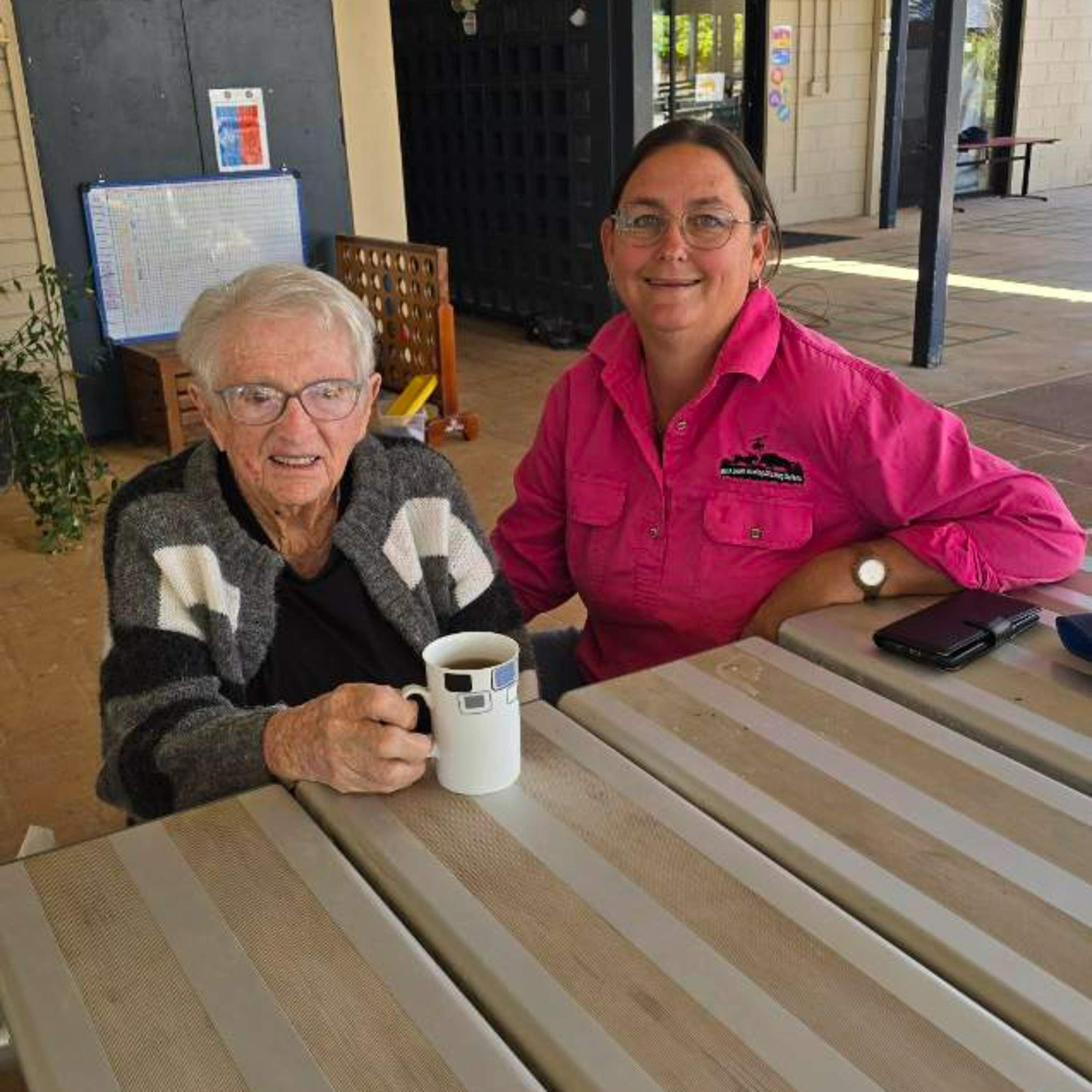
Betty Martin, nearly 102 years old, shares her life story in an interview. She began school at age four in rural New South Wales, where her family's farm was eventually acquired by the government for a road. The family relied on a floating salesman for supplies. At 14, she moved to Sydney, took up ice skating, and became proficient. Later, she moved to the Northern Territory, working in a hotel and marrying Jim Martin. Together, they managed a garage and later a wildlife park she founded, rehabilitating native animals. After personal losses, including her son's death and her husband's passing, she moved to Castledare to be near family. There, she actively participated in community life, helping foster local cohesion and supporting events like the Kelpie Festival. She also celebrated her 100th birthday with a message from the Queen, highlighting her long and engaged life.
[Music] Hello and welcome to Casted & Connections. An initiative of Hands Up Casted & where a group of enthusiastic locals have come together to capture, preserve and share stories of people who have a connection to Casted & Connections. [Music] Welcome to the Casted & Connections. Tonight we're speaking to Betty Martin. My name is Mary Ann Lewis and I'm from the Northern Territory and Betty Martin happens to be my grandmother who is a legend in our family and a connector and a hair connections to Casted & as well as the connections to the Northern Territory. Betty, how old are you? 101, nearly 102. Nearly 102 and so not long ago we had a celebration for your 100th birthday here in Casted & attended by many people. Yes. That's a people. A big party. Yes. Very big. Very big. It's a bit of a special occasion for Casted & and yourself. So nearly 102. Can you give us some reflections on your life as a young child? Oh well that was how young. How have you been? You'd like to share with us? Oh well I was a little child. I went to the local school which was four miles from my home closed because it didn't have enough pupils but because I was four years old the teacher said to send me along and that would make the numbers right so I started school when I was four and then just kept going until I went to high school when I left the school closed, the local school closed because they had to be, I think I can't remember but I think it was nine pupils and they were eight but I made the ninth one so that when I left the school closed again and it didn't ever open again. Never opened again. And so what did Mum & Dad do? Well they were famous. Well my father was a sort of a family. My mother was, she ran the farm really. My father, he liked the city, he was born in Melbourne. So he liked the city, he didn't like the bush. So my mother got him a contract to take the mail in the horse and so he and everyone had a mail bag and leave it at your place today and you'd read what was in the mail bag and then answer those letters and pay the bills whatever. And then he'd pick it up on the next, it was Tuesdays and Thursdays the mail came. And so where was your father's mail run from in two? Well about five miles from our place. It was the local telephone exchange and it was one of those telephone's that when the phone rang, everyone used to freak out the phone and listen and my father was for him and he used to say get off the bloody line. So he didn't last very long at that. So he had to lock in some customer skills maybe. He decided to go back to Sydney and my mother had a share farmer who used to grow all the farm. And where was the location of the farm? Central, Colo. Yeah. So the Colo River was a tidal river and we had a man used to come in. He had a boat that was all sit there like a badass widest this room and it was all sit there just like a shop all the walls on that side room. I had drawers with all kinds of things and all there and all the back. You could buy almost anything from that man. If he didn't have it this trip, he'd have it next to him. He used to come on the high tide to a place and to let us know that he was coming was a little bit my mother though. He had a left glass that was something like this and he'd blow on it like that and it's a dragon always kept the carrying cord away and my mother would hurry down then to get a grocery. Because it was too far to, it was 28 miles to the nearest shop and down the horse and the motor vehicles and the horse and salty. To go, say, "You have to buy all your groceries from the man on the Mr. MacMara." Mr. MacMara was the floating salesman hawker license. And like a hawker license, he had a bit of everything for sale. Well, yes. I don't know whether it was my family, my doing for all of the walkers license. He was a floating salesman. Yeah. So he visited regularly and provided provisions for the family. He had clothing and material. My mother had a sewing machine and she was a good seller and she used to cut clothes for my brother and myself. And later on my father had been married before. He married a young lady and she, they had a baby and she died and he took the baby to his mother who lived in Jolong and he went to the war. So when I was about seven or eight, he brought that daughter to, I'm sure instead of two children, one mother had the two children and then there was Emma who was the third one of the three of us. Well, she was a good be elder than us of course, my brother's annoying. And the government took part of the farm and made a park, a public park and they built a hall made of corrugated iron and church services. We held it in that hall and dances and all kinds of recreation. So that's where you got your connection to being members of social clubs, is it from early days in the hall on the farm? Yeah. And so how old were you when you left the farm? I was 14. We had to leave there because the government found out that they had no, if the Jeppes wanted to take Australia, well they'd take Sydney first if they could and that they had, they had no way of getting the Sydney except over the Hawkesbury River bridge. Well look, the Colour River ran into the Hawkesbury River bridge over Hawkesbury River and they decided that they'd cut through from Windsor and they'd cut through straight to Colour and up the other side and they'd come out near Singleton so that they'd have another access point. Well, well, if the Jeppes took the Hawkesbury River bridge, they'd still have to get up behind the Jeppes. Anyhow, they didn't put it away. We went in the wall and kept us bridges, but the road to the bridge went right through the middle of the farm. So there was no farm left. Well, there still is there. There's a bridge over the river that was quite commonly used there. So you were 14 when you left the farm and where did you head to? Where did you go to? We went to Sydney. Yep. And my mother got a jump cooking because she was a very good cook and I got a jump with the Aegburn in the city, in Sydney, but I couldn't keep it.
that Jim, because my eyes didn't pass the test of wood glasses from when I was just 15 till now. And there's nothing wrong with your eyes, we? Well, I think wrong with the lecture that I can't see. That's true, that's true. So in your time as a young child, you eventually headed north to the Northern Territory. How old were you when you headed north? Oh, well, I was about 15 when I started ice skating. I started roller skating first and then the government decided to open. They had an ice storage place and the ice was on top of the storage, was underneath with all the things. So they decided that they'd make that into a ice skate. Into a skate rink. Yeah, so I used to go there much against my mother's wheel, I used to go there every night or the week, just about. My mother and my father were great. My mother could sing, my father could sing, and my mother could play the organ, my brother could pick up any instrument and get a tune from it after it fiddled with it a bit. But me, I had no. I could skate, that's all I could do. And I used to go skating and I can't remember the name of this sailor that I used to skate with. I used to go every night to skate with him. He came from when he go past England and I, you know, up and up and. He was from overseas. He wasn't an Australian. Yeah, yep. Well, my mother was frightened that anything could happen to me. But he had a girlfriend in his own country and only wanted to have someone to skate with because in their country, that from when they're little kids they can skate before they can walk all night. And he had about six weeks. And by the end of that six weeks I can skate really well. Oh, so those pretty turns that you can do with your wheelie walker came from the skating rink day, yeah, he went home to overseas. He retired. As far as I know, the world at its real height then just when the Japanese, they really tried to take Australia. But they couldn't. The world came right close to Darwin, God Bond. So was that part of your encouragement for you to come to, to head to the Northern Territory? Oh, no. That's another story. Can you share that story with us? Why did you head to the Northern Territory? Well, because I met a soldier and became engaged. But the world was just to put just over and just finishing. And anyway, you ended up in the Northern Territory? No, no, no, yes, I ended up in the Northern Territory. Because his mother was married to a fetler on the railway line between Darwin and Alice Springs. But they never got that far. They, they, the war ended before it got to Alice Springs. It went to Larama. To Burnham, just south of Larama. Remember? Yep, Burnham. Burnham. Yeah. And so he spoke about his family up in the north, on the railway. Well, in the Northern Territory at that time, there were at least seven men to every woman that was there. And so I broke up my engagement to the man because he'd gone to Japan. He, he had promised to go to Japan before. I only went there because his mother was up there. Anyway, I stayed there and I worked at the hotel. What was the name of the hotel? I'm a crew hotel. Alright, fine crew. Yep, so you'd left Darwin and you'd gone to Pine Creek? Yep. And oh, well, I stayed there for a few, few years. And my mother came up there to see what was going on. And she became the cook at the hotel. And I married the publicant. I took her back to Sydney. And I wasn't there long. And the publicant came to Sydney and we got married. Anyhow, he was a brat. He couldn't see that he was drinking. He was into a situation where we we owed the pub money they didn't owe us. Yep. And uh, anyone. So you got out of that one? Yes. And I got went back to my mother. But while I was there, I met Jim Martin and I saw a drink of that. I'm sure he's got more brains than the, because Rusty, as long as he had a beer and he served everyone in the bar. It was a big bar. He never put in any money for them. He would buy a beer and he'd share it with me. He'd buy one and he'd share it with me and he'd share it with me for every so that we were losing money. But I couldn't make him see that. So I went back to Sydney to my mother. But you did return back to the Northern Territory? Well, Jim Martin came after me. This is too mean that a pursued you. So we married and had one child who was killed in a road accident when he was 14 and then Jim died. And now I'm still here. And you're definitely still here. In that time, Jim was the manager at Matternaker Station for a long time. Well, we had the business in Catherine, yep. Garage, because he knew all of it, engines, so okay. Well, Matternaker Station was sold to a doctor in Adelaide and someone said that you should apply, if we want some energy, you should apply for that job. Get rid of this because the garage was right close to the hotel and Jim was a drinker. So we sold it to Woolworth. That's correct. And there is a big Woolworth on the corner of that. Yeah, yeah. In Catherine Territory, these days. And so I went to Matternaker. I was studying there 17 years. He was the manager for 17 years. And in the meantime, Perry and a little boy even went to school. We sent him to Adelaide to King's College to school because when we first went to Matternaker, there was no school. But there was a school teacher that had built the local store and and I've had Perry went to school in Adelaide and he came home from one holiday when he was 14 and that's where he got killed. So we were both upset naturally and so he left the job as a station manager. But we started the PJ wildlife park, didn't we? Yes, but we started that when I always had wildlife. I, on the station, I didn't have a job. So I just used to concentrate on the some animals and mostly car engine animals, cars and trucks and then I'd take them and nurse them back to life and so I ended up having a bit of a trailer.
three different sorts of kangaroos and wildebeests and birds of all kinds. So I said, well, tourists are interested in this world. So I applied to the government to get me a piece of land to build a wild life, which they did and shifted all the animals onto that property. And the doctor who owned the station, the better anacrification, he sold it to some Americans. Well, they kept it. Jim Mahler's manager for, or, I can't remember how many years, but till in the end, then he had Jim died. It made an engine in the war in New Guinea. He and his brother Stan, the war was getting, the Japanese were getting, they were running New Guinea. And we were coming up, and they had another brother who was dead. Yeah, he had been fighting in the Middle East. And when the ships were so close to taking Australia, they brought all their troops back from the Middle East because the war was pretty safe over there at that particular stage. And, I'll be back there. And Texas, I said, I didn't know you came to New Guinea. Oh, you said, you didn't know you came to New Guinea. When he was landed in New Guinea, he was landed right near where they were. He's the other brother, Jim and his other brother Stan. And they made arrangements to meet and 10 good officers came here and ran up here to meet them. And just there he was shot by a Japanese shot then. So that left the two of them in a bit of a bad state. And they were on the bottom side of New Guinea and the Japs were on the northern side, top side. Well, they had to climb big mountains to get to where the Japs were. But anyway, they got there. They beat them and put them back into the water into the sea. And this time Jim was pretty, pretty badly sick and he had to be carried down the mountains. And you know, you might have heard of the fuzzy words in angels. Well, they carried it from the top of that range of mountains right down to the bottom to where the sea was, where we could get back to his own regiment company, a group of men. And then he came back to Australia and was when he was in Australia, he was teaching females, soldiers to drive. So there's a release another male soldier to fight the Japs. Anyway, in the end he got back to Australia and got discharged. But discharged? No, he didn't get, he got discharged in the end. And there was a film made, do you know the name of the film? About the time in the war or the driving film. The other land is. So the driving film in Alice Springs. The man who made the film, he employed Jim then to master a lot of cattle and made the film over it. So I've seen that film, it's been shared since so fairly recently. So Daphne Lawrence was the actress? I think it's an old black and white film. I can't remember a name, but I know that the first day he arrived in Pine Creek, we were having dinner at the hotel and I put on my best dress because I was going to take the food to these people. And when I went in there, he said the time when she's gone on the same dress. So I hurried out and told the kitchen staff, "I hurried to my room and put on another dress." So she was copying you or you were copying her? Well she just comes from the city. So you were up with the latest trends in Betty in Pine Creek. So you spent many years in Madarankha and as I know you were very active within the community on many clubs and associations. And the treasurer were all those. Did the treasurer for all of those associations served on the local council for many many years on the inaugural council? Yes. And actively involved. It's some highlights of your time in Madarankha in your connection to the community? Oh. There were no women in anything. And very few women in the area. There were about seven men to each woman. Well the ratio had come down a little bit. So finally, the thing is changed and women came when the war finished and women came. And I thought myself now this could be a really good business this problem. So if Rusty McCarthy, his brother-in-law, I'm the least at that stage. And I thought this is be a good business. I was so dear. But it wasn't too long before I couldn't make it. It was a nice man but he drank. And he would say he went into the bar here with you two. Well, you'd fall shell in turn, lead shell, lead shell, lead shell. So I couldn't make him see that. I said, "Look, every time you open about a little bit of your year, when it's your shell, you must put a piece of cardboard in the till." I said, "I cut a lot of pieces of cardboard for him to put in the till." But I said, "Oh, he's so dead, there was a lot of rust." And he wouldn't put a thing. So anyway, in the end, I thought, "Oh, I could save Mashnour, I wait you." So I said to my mother, "My mother was there then." And I said to her, "We'll go back to Sydney." So, "Okay, we got. and came back to Sydney." And it was a tow. It was Wednesday, with a couple of towers and they were there. First Tuesday, November, isn't it? Traditionally. Well, anyway, I said, "He loved horses and loved racing." I said, "So, I'll take you to the Melbourne Cup, we'll go to a home that way and home to Sydney." So, we did that. We stayed with my father's brother and his wife in Melbourne. And then we got back to Sydney and well, I wasn't there very long and rustic came. And we got married and she's here. I came back to the hotel. Well, it was the same thing. So, you went from Pine Creek to Madarankar. And in the early 1980s, you went from Madarankar to Castleton. What brought you to Castleton? Good question. I think you came down to a sister and a gene, didn't you? So, Jim's brother Jacks.
- That's why it was on the gym. - He was in the hotel. - Yep, those are. - So you had some family connections down here through Jim Martin. - Yes. - And you came to Castordon and you stayed? - Yes. - So that's a long time ago? - Yes. - I can't be with her. - You've been an active member of the Castordon community since you arrived. - I've done it. - Of course you've been in bowls in Bridge and Church. - Well, because the place was crying out for something divided together, everyone was against, I'd do anything to be against you too. And then you'd be against someone else. But I can see that that was no good that we had to pull together and then we'd all get together. So. - So over the years, that's how has happened in the township of Castordon. There is a very close community network here now. People do work together, clubs and committees. - I was just trying to seek help. You explained it very well earlier today when we were talking about the success of the Castordon Kelpie Festival that we've just attended and all the good things happening in Castordon. - Well, Castordon's a great little place because someone sought up the idea of the don't and gradually grew and grew till now. - I don't know, I'll ever Australian you. But it just started off by two men that had a love for dogs. - That had a love for the Kelpie dog? - Well, they can see how good they were. They began to be, you know, minds better than us and why don't they do this? That's nothing you can see. This one, and so it became what it is today. And it's all over Australia. - And you've attended Heaps of Events this last Queen's Birthday, oh, it's the Kings birthday weekend now. The Kings birthday weekend event, you've just attended lots of the Kelpie Festival. Padded lots of dogs in the street this week? - Oh, yes. Everyone reads their dog now, but they say, "Will be haved." You never see one dog fight, never. That's wonderful. And all the working dogs come from all over Australia. - And they're also sold at the auction and they end up all over Australia as well. But at the auction when they're sold, they then also end up, they go to New Owners all over Australia. - Yes. Well, it's real history there, isn't it? - Now I just want to touch on a very special event that happened a couple of years ago, was your 100th birthday. And you received a message from the Queen, which is proudly displayed on your room. - Yes. - But unfortunately on the day of your birthday was also the passing of Queen Elizabeth. So you're probably one of the last people in Australia to have received a letter from the Queen. That's an honour. Elizabeth received a letter from Elizabeth. Queen Elizabeth. - Yes. - How special is that letter? - Oh, to me it's very special. But the two Bob and Desson, it'll swim probably. But it's special to yourself. - Well, it's very extra special because when even I were on Madaraka Station, and our little boy was a schoolboy, he was only here. - Not very tall, but I think she's just about five, I think, five or six before we went to Adelaide, the school anyway. The Queen came to Australia and Prince Philip. And they visited every state in Australia. And they flew from one place to another. And they landed in Catherine. Very had a big cowboy head. He used to wear it everywhere. He couldn't stop him from wearing it. When the Queen landed on the air strip, all the kids were lying down. And they had a lot of seats. Everyone was lying down, but the kids were in the front. And when the Queen got near Perry, he stood up and clipped his heels together and raised this big cowboy head. And I didn't know he did it there, but he had it hidden under the seat. - And was she impressed? - Anyway, when we went, okay, that happened. And then when this all was over, all the ladies went to out to, what's the station? Anyway, the men stayed behind us, most I think they had a beard, but we had a cup of tea. And the Queen said, oh, a funny little boy, he's shuddy. He raised his head to me. He had a big cowboy head, and he raised it to me and said, welcome to Catherine, your majesty. Who told him to say that? I didn't. Anyway, he showed the dog was embarrassed, I bet. And he said, don't worry, she said it was wonderful. She should be rest of her head after the seat. - Oh dear, yeah, that's a great story to tell. One of the things that I remember, one of the things I remember a few years ago, was she told me that as a child, you'd always heard about that there would be a railway from Adelaide all the way to Darwin, that you would like to travel on that journey. Is Adelaide to Darwin, journey. Now, there is nowadays a train that goes from Adelaide all the way to Darwin. - Well, yes, and you shouted me at a ride on that train. I think you paid for me to have a sleeper on that train. - That's correct, but you refused. - But there was one lady who, she said she wouldn't sit in an ordinary seat with a press step against someone. I said, no, I'll change you. You can have my sleeper, and I'll have this here. So she moved into the carriage where I should be, and I was in here. And why did you give up your sleeper to sit in the chair for the Adelaide to Darwin railway? - Why did you? - You told me that you wanted to sit up and you wanted to see the country. - Oh, I did. I wanted to see that. And this one, another friend of hers sat next to me there, and she said, I thought this was supposed to be cattle country. There's no cattle. Well, I should know there are a lot of cattle, but they're lying down in the shade. They feed early in the morning, and late in the evening. She said, she couldn't understand that they would be out in the feet of the middle of the day. She couldn't understand that. But they were plentiful, but they were lying down in the shade they could get at that time of the day. - So yes, Betty did do the train journey all the way from Adelaide to Catherine. She didn't get to make it all the way to Darwin, 'cause I'm an eye-jactor in Catherine, and she came up. But she told me that there was something she wanted to do as a child with travel at train journey. - Well, because it was a wonderful scene from led to Alice Freeze.
People who lived away thought that the central of Australia was just a barren thing. But Jim, my husband, he had mustered nearly all that country. I leave you the channel later and in the show, I need to be in the day where there's these people on the train and they were going through, you know, just. So if they were asleep on the sleeper train, they had no idea what was happening anyway, did they? So then when I got to Alice Freeze, then we had to go by bus for the rest of the way. That's when you first came to the Northern Territory. When you first came to the Northern Territory? Yes. And you caught the train from Pine Creek to Dow and didn't you back in the early days? Yes, yes. Of course, that was a funny old train too. You used to rock and roll and shabby. You'd be going, you'd never consent still because the train was rough and the train was rough. I have great memories of my childhood growing up with you and Betty, to me, is my mar. And there were always lots of animals. There were crocodiles and pelicans and amuse and it possums and snakes and animals were definitely a part of it a lot. But you had a very close crocodile friend over the years as well. Oh, I had a crocodile. When I had the day of, Sunday was the day of, and I always, I'd come from whatever was in the bush, whatever they call it in the bush. Well, I found this crocodile and she was in a water hole and she had lying eggs there. They wanted the eggs to eat. Whatever they ate in the bush, they, I always ate some of, they saved some of it for me. So they brought me three crocodiles eggs. Well, I held them up, rolled up a newspaper and held them up to the sun like this. Oh, I could see a crocodile in there. The natives would eat that. But me, I thought, oh, I couldn't eat it. It's close to being alive crocodile. I couldn't eat it. I got a big bucket of sand and put it in the sand and covered the sand down in the eggs and put it where it didn't get the morning sun. And after three days, this little crocodile had a boy, Hunter said, what he got into with that. I said, oh, I can't eat them. He said, they'll eat you. I thought, oh, no, they won't. Anyway, he said, you take them down to the river and let them go into the river. So, so, so. Anyway, I took them down and I let two go. And I kept one and I didn't tell him that I kept one and I used to feed it regularly. I had a tank about three times as big as this table and I used to keep, it was half a tank and I had water, it was, and the blacks fixed it up for me so I didn't think it could get out. And it was about that high. And this crocodile that I kept about this long, I gradually grew about this long. And my Hunter said, you got to stop feeding that crocodile with your hands because it will bite you. It might mean too, but it will bite you when you get in the way to get the food. So, he made me give a piece of wire. He made a fork with two songs and then twisted this wire and we had up to here. And I used to put the meat on that tooth and held it down for my girl to get it. I used to call her and she'd come up out of the water and get them. Anyway, he himself got so fond of her that allowing wouldn't touch her or he got a big, a big dam on the station and my girl, we put her in there and I used to go and feed her there, heat, go in the water and sit down, you couldn't see her. And then when it was feed time, twice a day I used to go call her, my girl, come up my girl and she'd come up out of the water and rush up to where I was and she was about as long as from me to you then. And I used to feed her with the boy. Anyway, one day I went to call her or after some months, this was a call and call that she didn't come. And I thought, oh, she's basically dead, oh, big tears. Because she was so lovely you. Anyway, we found that the wire that was at the end of the run, it wasn't a way and she'd just got through it. Well, of course, she didn't know what the bush was or what it was, the wet season and there were pools of water everywhere. But there was food, there was no meat on the stick and one of the workmen from the place where she said, I saw her cry that all day, I saw the weather water runs across the road. And all day she was, she said, because it was time. So I was so, I got to you, get the car, drove down the way, yes, oh, when I called her, come on my girl, up she came and she came. She was starving. He knew that our victory over the days, the black fellas knew that if you put the crocodile on its back like this, it can't do anything with slim, it can't turn itself back in. So he said, you get up in the back of the youth and sit on that drum. And then they grabbed the crocodile and brought her up and put her on my nose, upside down. She said, oh, she'll bite me now, she won't bite you, they said, she's, she'll just stay there. She can't do anything when she's on her back. So of course we took her back to the stage. And then eventually I sold them wildlife back and she was in part of the sale. And they put in a swimming pool, didn't they? Yes, she got out and got in, well, it was a very hot day and she got into this, the lady that bought the wall of fat, her husband, he was a Frenchman and in France he built used built swimming pools, that was his grave barley. And he built a beautiful one and my girl found that she got in and she grabbed around, went down.
the bottom and it could stay out into the water a long time. And all the tours for all that they were terrified. Because it was a motel by this stage. She'd also built a motel so there were a lot of people there. There's a restaurant on a motel. There's a crocodile on the bottom of this room in Port. And so I said, they said, they rang, he rang me and said, come on, get this crocodile and we were so, I came up and I called her. When I called her, she was in the big deep end of the pool and I got up to the shallow end and I called her. She heard my voice and she came straight up, she was straight up. So the lady had told the place to, she said, you stay there and I'll get the one life people from Catherine. I'll ring the motel them to come and get them, which they did. She did and they came down and they called her, I've never seen this. She put her back in her pen. So she must have lived for many years later. They never put her back in her pen. But they did was a long, long, long, long, long, long. They bound it round and was taped. So she couldn't open the mouth. And then they took her back to Catherine or they said they were, but then I heard later that they let her go. The king river, if they did that, she would die because the water ran down into the big river. The king river runs west so it goes into the Victoria River. Yes. So they said, you don't worry about it, she'll be there, but I don't think that happens. I hope. I thought that we had a little loose in the Catherine River. Then I could go and call her. She can't, but no, I never saw her go. So that was just one of your animal stories from your time in Metareka? Yes. Well, when I came in here, I had photos of her. They had a magazine every month. And my girls in one of those magazines. You've always had an affinity for animals, Betty, whether they're people, small, ever since I was this high. Yeah, did right. From snakes called Mahamad Ali. They used to come down in the pub at Pine Creek when I was first there. There was no ceiling like this. There was a ceiling, but there was a space all around before the ceiling during the wall. And she'd lived up in the ceiling at night time. She used to come down and have a couple of goats milk. Just one of the many animals you'd be friended. So 101 years. You've recently been to the doctor and I believe you told them you were going to hang around to your 110 submission. I might, but I can't tell if I died or I hope not, but we need to continue to share some of the stories. Well, I could make pets of any animals. And we should be more caring of the things around us. And they were there for a reason. So, I'd like to thank my friends for that. And you can, if you're kind to a crocodile or a snake, it'll appreciate it. I think anyway. Well done. We thank you for sharing your stories with Castor and Connection tonight. And hopefully somebody will get some inspiration to be a friend to an animal, whether it's a crocodile or a snake in the future. And bring on your hundreds and second birthday in September. Thank you. It's not very far off. Not far at all. Time for another party. If I could make friends with this crocodile, then you could too. But I'm not sure I'm going to test that, but I believe you. But if you had a little one, we could give it a crack. You'd love it just as much as I love my girl. I'm sure that was good. Thank you, Betty. Thank you for your stories. Thank you. We hope you've enjoyed today's episode of one of our homegrown heroes. Jump over to one of our other episodes to continue the Castor and Connections journey with us. Please don't forget to follow our podcast and share it with your family and friends. Thank you for listening.
Podcast Summary
Key Points:
Betty Martin, nearly 102, reflects on her early life starting school at age four in rural New South Wales, her family's farm, and provisions from a floating salesman.
She moved to Sydney as a teenager, became a skilled ice skater, and later moved to the Northern Territory where she worked, married, and managed a garage and a wildlife park.
After personal tragedies, including the loss of her son and husband, she relocated to Castledare, where she has been an active community member, contributing to local clubs and celebrating events like the Kelpie Festival.
Summary:
Betty Martin, nearly 102 years old, shares her life story in an interview. She began school at age four in rural New South Wales, where her family's farm was eventually acquired by the government for a road. The family relied on a floating salesman for supplies.
At 14, she moved to Sydney, took up ice skating, and became proficient. Later, she moved to the Northern Territory, working in a hotel and marrying Jim Martin. Together, they managed a garage and later a wildlife park she founded, rehabilitating native animals.
After personal losses, including her son's death and her husband's passing, she moved to Castledare to be near family. There, she actively participated in community life, helping foster local cohesion and supporting events like the Kelpie Festival. She also celebrated her 100th birthday with a message from the Queen, highlighting her long and engaged life.
FAQs
Betty Martin is 101, nearly 102 years old. She recently celebrated her 100th birthday with a large party in Casted &.
Betty started school at age four to help meet pupil quotas, attending a local school that closed when she left. Her education continued until high school despite the rural challenges.
The family relied on a floating salesman, Mr. MacMara, who visited by boat on the high tide. He sold a variety of goods, as the nearest shop was 28 miles away.
The government built a road through the farm for strategic access, leaving no farm left. Betty and her family then moved to Sydney.
Betty moved to the Northern Territory after meeting a soldier, later working at a hotel in Pine Creek. She became involved in community life and eventually managed a station and wildlife park.
Betty served as treasurer for various associations, was on the local council, and helped foster community cohesion. In Casted &, she participated in bowls, bridge, church, and supported events like the Kelpie Festival.
Chat with AI
Loading...
Pro features
Go deeper with this episode
Unlock creator-grade tools that turn any transcript into show notes and subtitle files.
 PodcastTranscript AI