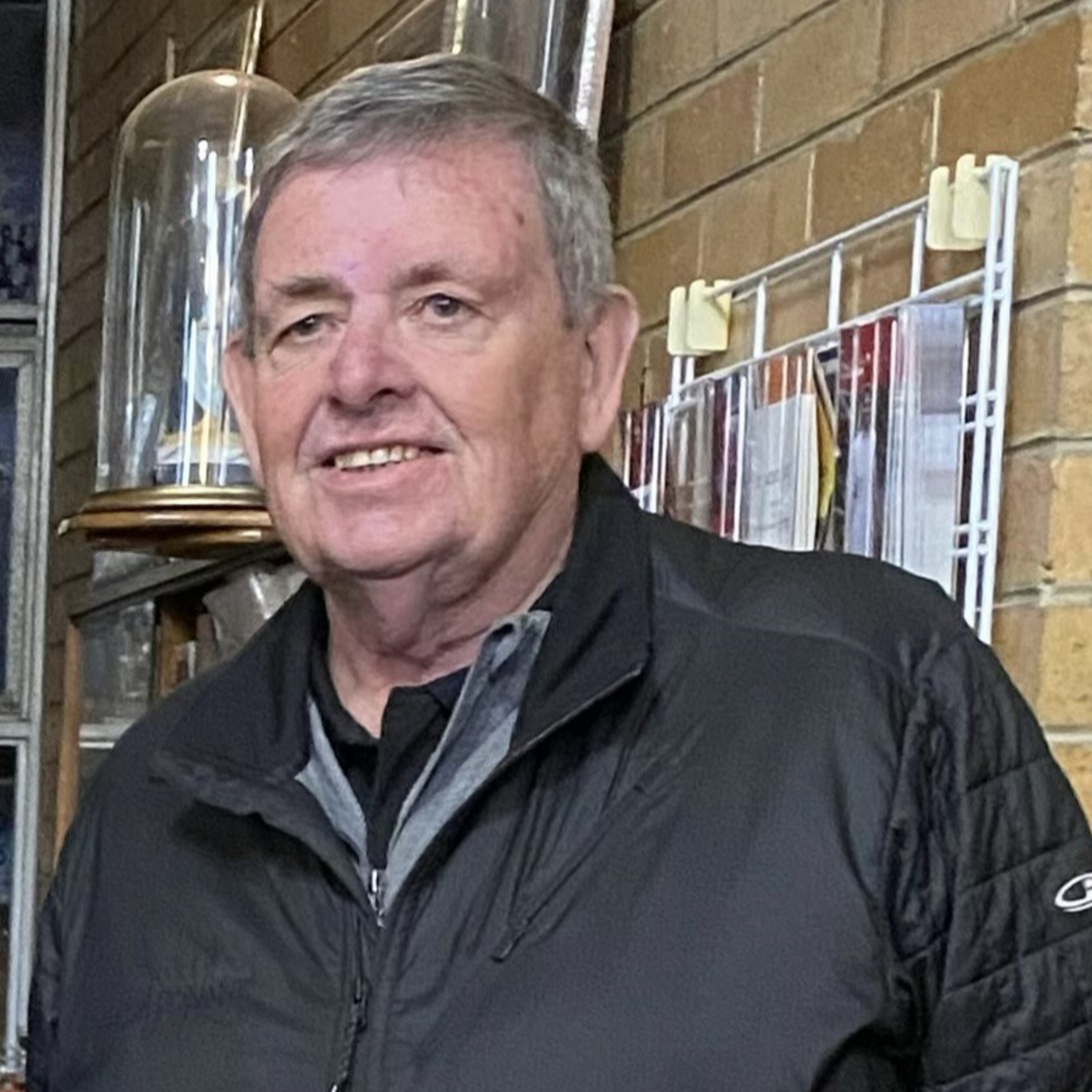
Alan Porter, a pharmacist and businessman, shares his journey from growing up in Perth to becoming a integral part of the Castlemaine community after purchasing the local pharmacy in 2000. Motivated by a desire for rural life and community connection, he built his success on a "community-first" philosophy, actively giving back through sponsorships and support. The interview covers his early life, family influences, career path into pharmacy, and the fulfillment he found in rural towns like Cobden and Castlemaine. Porter reflects on significant changes in the pharmacy industry over the decades, from compounding medicines to adapting to modern regulations and challenges such as rural doctor shortages. Now in a management role, he highlights the importance of succession planning, having recently partnered with a local pharmacist to ensure the pharmacy's future, and views his eventual transition from the business as a gradual process focused on family and community ties.
[Music] Hello and welcome to Casted and Connections. An initiative of Hands Up Casted and where a group of enthusiastic locals have come together to capture, preserve and share stories of people who have a connection to Casted and. Today in Casted Connections we sit down with successful family and businessmen Alan Porter. Alan's name might not be one that comes to mind when you think of Casted and but since purchasing the pharmacy from Ian Llewellyn in the year 2000 Alan quickly became a key member of the community. His success comes off the back of a community first mindset. Sit back and enjoy as Alan takes us through his early years and then he's journey to become a pharmacist and ultimately a Casted and Community member. Today we're here with Alan Porter. Alan thanks very much for joining us. And thank you very much, Kane. It's great to be here with you. No problem at all. For those that don't know you just give us a little bit of background about where you grew up and your life before being connected to Casted. Okay so maybe I could just start by explaining my connection why I'm here in Casted and to start and then cast back to where I know my early life. So in the year 2000 I purchased Casted and Pharmacy. I lived in I live in Sumbry and it was quite a big decision to travel to Casted and 350 kilometres for a business decision which has gone very well for me. Actually going back then I was born in Perth in Western Australia. My father met my mother in Aubrey at the beginning of the second world war when he was there at a camp and after he came home from Africa and Greece and then went back to New Guinea and then came back he then went back to Aubrey and my mum and dad got married and we then went to live in Perth for four years. And were you a part of a big family Alan? The family meaning my mother had two girls, two sisters and my father had four sisters. And I know through personal involvement with you is that you were able to really connect with your dad side and the war by going over to Gleppell and a couple other places like that. Yes we've been fortunate enough to travel it's been something high on our agenda in particularly in the last decade or two and we were very much able to do one of the adversaries of the Gleppell to go and spend a few days in Gleppell as part of a two or through Turkey and everything which was quite a emotional experience on that subject as well. My father's war history my mother has just in the last few days turned 100. My father turned died some years ago but my mother received a very nice letter from the Minister for Veterans Affairs just recently which highlighted the support that she would have given my father during the the war time and congratulated her on a number of facts concerning the changes and the experiences she had. So I raised that now as being part of a pride that I do have that my father was able to serve the country. Absolutely and I'm sure your mother as well would have been absolutely humbled to receive that as well as some recognition as well so that's fantastic. So moving a little bit along what sort of student we like at school. I was a very I wouldn't like to call myself a nerd but I was I think I was a good student. I did get the strap a few times so it wasn't probably that good but I did enjoy school and was able to see both the primary and secondary school through which took me to then doing my year 12 and getting onto pharmacy college but I enjoyed being part of a focusing in club. I really loved marching and probably one of the biggest disappointments in my early life was that I was sat from the marching squad because I was too tall. I thought that was very um imaginary star in age that's right. So I think I was just a basic student I was lucky to be elected a prefect and have some roles in that and just basically had a good good period at school. Yep so moving on then to pharmacy college is that different to how kids would get into the pharmacy industry today through the uni path or is it similar? It's pretty well exactly the same but in that day the pharmacy college was a privately owned institution of the Pharmaceutical Society of Victoria, it was in Parkville and in recent years it's been amalgamated with Monash University but the facilities are still there in Parkville have been greatly expanded so basically it's now a degree course whereas it was evolving into a degree course when I was there. Yep and from what age did you realise that you wanted to be in pharmacy or was it just off the back of an opportunity that meant that you went to pharmacy college? That when I was in year 11 that so when I was around about 15 or 16 I was really enjoying the sciences and chemistry and my father had a friend whose daughter was doing pharmacy and he started to talk to me about it and I just seemed to morph into it and so when I did get my year 12 and was able to get into the pharmacy college it was just a natural progression and I haven't regretted it. Yep and where did you then go to find your first job in pharmacy? When I did qualify I had just met my now wife and we were sort of caughting and we decided that our future would be going to rural, rural pharmacy which would be good for us because we'd enjoy that sort of the life but also financially and I did some relieving for a little while and then eventually got a job in Sumbria which wasn't very rural at all, 2022 miles from the GPO in Melbourne and as far as I got hence I was very privileged in around that so I said in 1999 bought the pharmacy in Cobden and then the year later in Castleton and I was able to fulfil my ambition of going really rural. Yeah I think you finally lived up to the rural side of things I'm not so we can count Sumbria as rural but in those days it was had a population of 3,000 people but now it's 45,000 people. Lucky you've got a nice little private spot away and you can still get some peace. A couple of acres which was on the outskirts of town now it's in the centre of town. Oh how things change. So you touched on your wife Kathy so where did you just first meet? There used to be a dance called Powerhouse it was on the banks of the Albert Park Lake and I went along there one day and with my cousin and then happened to wandering around see Kathy in the crowd and asked her for a dance and the rest is history. Fantastic and you've obviously created your own large family just to elaborate on that for us. We had four children and they've subsequently got married and we now have 24 grandchildren. It's definitely big shindigs when the porters get together that's for sure. It's a big effort for everybody to get together at the one time but recently with my mother's birthday and a few other functions has been quite regular but quite often we get together in small groups because the families as they've got older they're busy with sport and other entertainment so it's very difficult to get everyone organised so it's probably good that we can get and spend more time with them individually. Yeah definitely and knowing your sons and daughters they're all in their own right very successful business people and fantastic family people. What influence do you think you had on their life in terms of the business sort of things and how you developed into pharmacy and then then be able to take their own career paths? I suppose it would really have been mainly by a personal example. By wife and I and Kathy and I were together she was able to be as the family came along to be able to be a stay at home and I was always working and she did a lot of the fatherly duties of going to the sports and things like that but we had a very strict ethic that you had to go to school you know you had to turn up you had to have commitments I was working long hours so I think by personal example it seems to have rubbed off on all of them to be true and they're all quite successful in their [BLANK_AUDIO]
individual rights? - Yeah, absolutely, absolutely. So going back to the pharmacies and I guess how you developed as business man moving forward. So Coblin come first, was that just through opportunity or how did that come about that style? - It was introduced to me through a firm and they were able to explain to me how good it was and I was then, I went down and visited them and could see at that stage the owner was having trouble selling it so it was good for me to have the opportunity to buy in and it was quite successful. It was just my desire. I'd always had the desire to have more than the one pharmacy which I had over a period of time, but to be able to get into the rural community was really important. - And just for those who wouldn't be aware outside of the industry, there's some rules around how many pharmacies pharmacists can own independently? - Yes, to own a pharmacy you have to be a pharmacist and in Victoria it varies from state to state, but fairly uniform now you can only own five pharmacies. The idea being that the community should get to know the pharmacist, that is the owner that is working in the pharmacy. - And I guess with both Coblin and Cassett, what was the real appeal about coming rural? What did you see in the businesses in those towns specifically? - Well I think we just, you know, in our early days I did say we enjoyed the travel, we did enjoy the rural life, the rural community and we'd often just do, I was quite happy to do the driving and then to be able to become part of the community in some way, although we didn't live permanently in these towns, we were able to become part of the town, part of the town and to know them better. So it was just basically that original urge for us to go rural. Kathy, my wife, as I said, we landed up in Sumbury and we treated Sumbury as a country town, population 3000 and even today, particularly Kathy has a life in the community with some friends that she's developed during the school days and things. So it's really just probably an extension of what we wanted right from the beginning. - Yeah, fantastic. And through some of those long trips from back and forth from Melbourne and probably some long stints away from home, how did that impact the family or Kathy was up to the challenge and able to fend while you were away? - Because when I was working in Sumbury and Melbourne I'd be working 70 hours a week. So it didn't probably make a lot of difference, it wasn't home for the evenings and all the meals. But I'd only come to work in the country towns two or three days a week. And we had a good arrangement at the work together as a team. - And just on that fact about working 70 or 80 hours a week, I believe there were some times where maybe the family had to wait in the car while you were running the pharmacy. - Well, the public example of that is my wife wouldn't let me open on Christmas day. But I did talk her into letting me go into the pharmacy in the morning to work for an hour to sort out a few issues and so the family would all be sitting in the car with all their Christmas gifts and everything. Well, I served quite a few customers, but most of my sales seemed to be batteries and things which would be normally for other Christmas gifts. But there were a few urgent scripts mixed up in that. - Yeah, fantastic. And I'm sure as you've told me before it's a great story to tell that one. So specifically hearing casted and how have you seen the evolution of one the community since when you took over in 2000 compared to what it is today? - Well, I've seen the business grow over that period of time, which you know, I did surprise me because I didn't know how the community would take an absentee owner, but they seem to have taken that in stride. I tried to give sort of responsibilities and discretion to the staff, which meant they were able to put their own touch on the business. I think the town hasn't changed a lot during that time, except for the fact that the number of doctors in the town have become a problem, but and that's for the extra pressure on the pharmacy. But what I do see is that the town has remarkable strength and resilience and has the ability and always has the ability to entertain itself and to become quite a center, a set to see a few of the shops around closing and the banks closing and things like that, but the town seems to still stand proud. - And I might just touch on that point you make about the doctors' element. I presume that's not something that's isolated to us in casted and it's pretty well documented that that's across the board. There's a lack of doctors in areas. Wherever you go, whenever you go into a rural community, the story is the same. And as the older doctors that have been in the town for the 50 or 60 years moving on, then you are, it's very hard to replace them. And so we find that the doctor's services are dropping down. In the town, communications is a great thing in that the various, like the hospitals and so forth can be able to, using the new technology, be able to help out, but it is a real drama in a lot of the country towns nowadays. - And in a practical sense, what impact would it have on a business like ours, or the casted and pharmacy, if we were not to have any doctors in the town, how would that actually affect us as a business? - Luckily we haven't been through that, but in some cases that would put even more pressure on the pharmacy to provide extra services. What we have seen is that, and not anybody in casted, and a number of people do go out of town now to see the doctors and the chances that while they're out of town, they'll buy other things. They'll go to the supermarket's out of town. They'll get their prescriptions dispensed out of town. But it seems to be that there is a basic loyalty to the town and that we have, even though the doctors have decreased in numbers here in casted and in recent years, we haven't seen a real decline in the prescriptions that we are dispensing. - Yeah, and in terms of, I guess, pharmacy in general, from the first day you're out qualified in the field compared to now in 2024, can you just run through some of the evolution of pharmacy and how that's changed over the time and maybe something that surprised you, is it now gone and something that's really taken off that you thought might struggle? - Well, I think looking at recent, just recently, there has been a few changes in pharmacy, which from government regulations, such as 60 data-spensing, and a few things like that that have worried the younger pharmacists. But in talking to the older pharmacists, I found that they were more accepting to it because they know that pharmacy has been through a lot of change, because when I started in pharmacy, there was no real pharmacy lines in supermarkets. Supermarkets, pharmacists were the only ones open, allowed to open the long hours, even when through a stage that we couldn't open, but we could have the door locked and open the custom and knocks on the door, we could open the door, so we'd set up an automatic switch that we could open it. So I can remember that the basic vitamins you couldn't buy anywhere else, but now you can buy them in the supermarket. So pharmacy was very big in photo processing with codec and everything, and as everyone knows, that's completely changed now. So pharmacy is evolving, is evolving. Also, we did a lot more exterpraronious prescriptions in the early days, making more creams and nightmares, and we're even trained at pharmacy college to make toothpaste and tablets and capsules, which we never really got into. But because the proliferation of drugs nowadays, the emphasis has moved on to a bigger range of drugs and being able to look for incompatibilities and to advise the patients on side effects and things. And I guess the biggest takeaway from that is, do you still make your own toothpaste at home? No. I made one toothpaste and one can of shaving foam, and because we didn't have the correct preservatives, we had to throw the shaving foam out after two days, otherwise it might explode. Very good. Obviously, your role as a business owner and pharmacist has changed over the years as well. So just give us a bit of a rundown of what your day-to-day or week-to-week looks like in your role now. Well, today I don't dispense anymore. I'm more in the administrative role. As I say, in the old cliche, we're working on the business, not in the business. Because in the past, I found that when I was in Cobden, working, I'd be worrying trying to solve an issue in casted and vice versa. And I wasn't doing justice to anything. So nowadays, I have reduced my hours, but mainly working on the management side, setting a few criteria and trying to work with the, morally with the staff to get the outcomes that I used to do.
do it myself. - And just on that, anyone that knows you, Alan knows that you're one of the most generous people that you'll ever come across. What do you think it is about giving back to the community? You know, you sponsor nearly everything that comes through the door and someone asks for a donation like, yes, 100% you wanna do that. I guess for someone who's not technically a local, why do you think that's so important? - Well, I like to think of it as that fact that I'm not a local, doesn't make much difference. The pharmacy is an important, very important part of the community and it needs to be able to give back to the community and by so doing, obviously the community will support the pharmacy, but it's very easy to be able to give some, to give some of your resources to the needy areas within the community. It's just being part of the community. The same as any other citizen in the town that you would wanna be. - Yeah, it's fantastic and I, it's greatly appreciated by everyone that does come and ask you, we always get fantastic comments around that. In the last sort of 12 to 18 months, the pharmacy's gone through a transition period where we've had a new owner buy into the business, do you just wanna talk through that? - Well, I think that's been a real plus for everybody's concerned. I'm getting to this stage of life that I need to be reconsidering my, although I'm really enjoying my involvement in pharmacy, I need to reconsider that. I can't keep on doing it forever. My idea of succession is to work moving to a partnership situation so I can keep the team stable and then eventually when the confidence grows off the new partner can hand over. So we were lucky to find young back here in Kastanen who did year 12 and went on to do pharmacy training, pharmacy college in Adelaide and we kept in touch with her and we were lucky enough at the end of her course when she graduated and qualified and she had the ability to go on and do anything she wanted to come back and just be a community pharmacist in the old Kastanen where she grew up on the farm just out of town. So to us it was an ideal situation and in recent, in the middle of last year, she took up the godlet and became a 50% partner. This is a wonderful thing for her, for me, and especially for the town. Yeah, absolutely. And I think the way that you're able to support her in that decision has been second and un. So we're grateful for that as well. So what's talking about maybe looking forward a little bit into the crystal ball and that you can't be in pharmacy yet forever? What, once you do retire on, what do you think's in store for you and Kathy moving forward? Well, I don't like the word retirement and consequently I can't, it's a gradual process at the moment whereby I'm exiting slowly and so it'll be a gradual process. I am concerned that my whole life is revolved around the family and the business in that time my wife Kathy has developed a circle of friends and everything that she would want to keep up with and I agree. So I don't really know exactly how it's all going to pan out but it will be a slow process over the next couple of years. Once again, flexibility is the, at the moment in my life, flexibility allows me to be able to continue steadily as we're going. Yep, fair enough. And any more travel planned? I know that you'll have traveling while you still can. Yes, we think that it's important while we've got the health to be able to continue to travel and to make the plans in advance and so we hope to travel to Vietnam later in the year. Have you been to Vietnam before? Not before, no, for. Although I do employ a couple of Vietnamese people and have often tried to talk them into taking me back to show their families to me but we haven't gone around to that so we might have to do it ourselves. Oh, you need to put a little bit more pressure on while the sounds. I believe you've had a few famous neighbours to a couple of your properties. Well, we're lucky enough to have an apartment in the city and when we just after we bought it, we did hear that our next door neighbor was Hugh Jackman and that was a really great, proud thing that I had but he obviously bought it his early days and he subsequently sold it not longer ago and it was written up in the paper that Hugh Jackman sells very modest apartment. That's definitely one to hang ahead on. Alan, thank you very much for your time today. You've got a long drive back to Melbourne as you've mentioned you don't mind but we'll let you get away in good time and thank you very much for your time. Now, thank you very much, Cain, for the opportunity and I'd like to congratulate you on your efforts that you put into the community as well and also what you have been able to do for casted infarmycy. So thank you. Thanks, Alan. We hope you've enjoyed today's episode of one of our homegrown heroes. Jump over to one of our other episodes to continue the casted and connections journey with us. Please don't forget to follow our podcast and share it with your family and friends. Thank you for listening.
Podcast Summary
Key Points:
Alan Porter, a pharmacist and businessman, purchased the Castlemaine Pharmacy in 2000 and became a key community member despite not being a local resident.
His career path was influenced by an early interest in sciences, leading him to pharmacy college, and a desire for rural community life, which he fulfilled by owning pharmacies in Cobden and Castlemaine.
Porter emphasizes a "community-first" mindset, actively supporting local initiatives and sponsoring events, believing this reciprocity strengthens both the pharmacy and the town.
He discusses the evolution of pharmacy, including regulatory changes, the shift from compounding medicines to patient advisory roles, and current challenges like rural doctor shortages.
Porter is transitioning to an administrative role and has established a succession plan by partnering with a local pharmacist to ensure the business's future stability within the community.
Summary:
Alan Porter, a pharmacist and businessman, shares his journey from growing up in Perth to becoming a integral part of the Castlemaine community after purchasing the local pharmacy in 2000. Motivated by a desire for rural life and community connection, he built his success on a "community-first" philosophy, actively giving back through sponsorships and support. The interview covers his early life, family influences, career path into pharmacy, and the fulfillment he found in rural towns like Cobden and Castlemaine.
Porter reflects on significant changes in the pharmacy industry over the decades, from compounding medicines to adapting to modern regulations and challenges such as rural doctor shortages. Now in a management role, he highlights the importance of succession planning, having recently partnered with a local pharmacist to ensure the pharmacy's future, and views his eventual transition from the business as a gradual process focused on family and community ties.
FAQs
Alan Porter is a successful family man and businessman who purchased Casted and Pharmacy in 2000, becoming a key community member despite not originally being from the area.
He developed an interest in pharmacy around age 15-16 due to his enjoyment of sciences like chemistry and encouragement from a family friend whose daughter was in the field, leading him to pursue it naturally after year 12.
They met at a dance called Powerhouse on the banks of Albert Park Lake, where he asked her for a dance, and their relationship blossomed from there.
The town has experienced a decline in the number of doctors, which is a common issue in rural areas, putting extra pressure on pharmacies to provide additional services, though loyalty from locals has helped maintain prescription levels.
Pharmacy has shifted from tasks like making creams and photo processing to focusing on a wider range of drugs, patient advice on side effects, and adapting to regulatory changes like 60-day dispensing, with many products now available in supermarkets.
He believes that as a pharmacy owner, it's important to support the community through sponsorships and donations, fostering mutual support and integration, regardless of not being a local resident.
Chat with AI
Loading...
Pro features
Go deeper with this episode
Unlock creator-grade tools that turn any transcript into show notes and subtitle files.
 PodcastTranscript AI