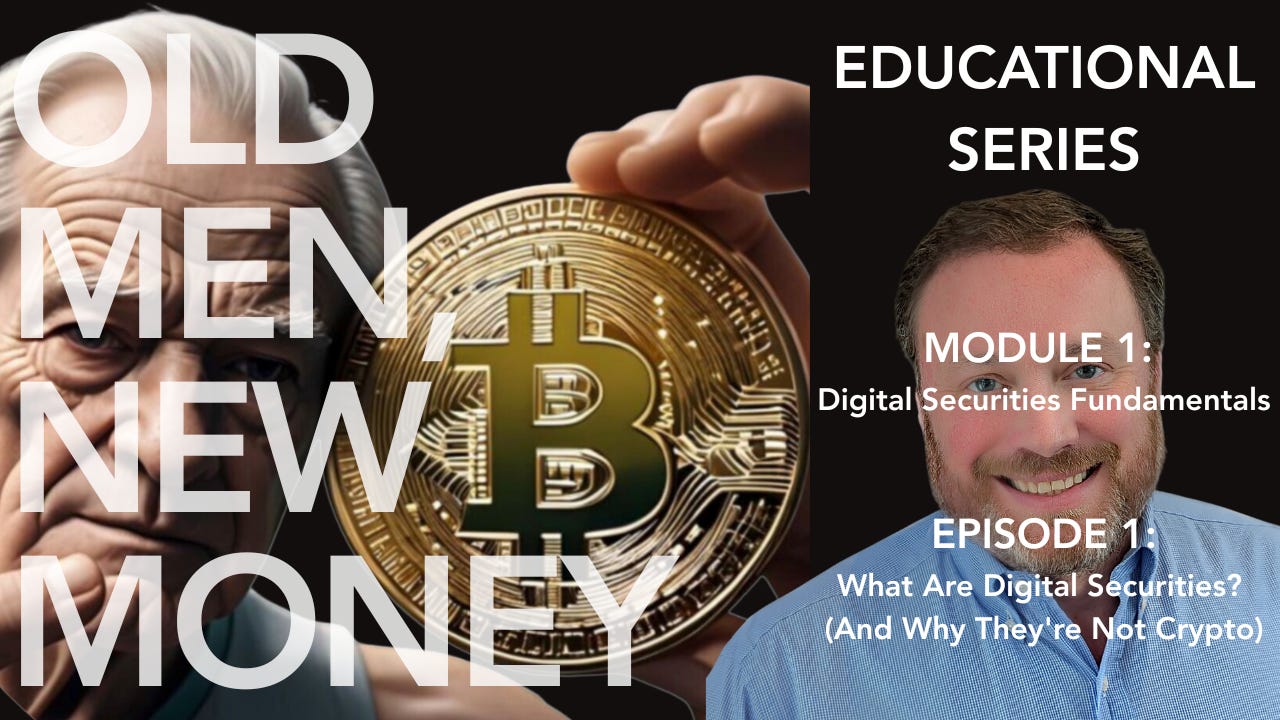
Episode 1: What Are Digital Securities? (And Why They're Not Crypto)
15m 7s
The transcript discusses digital securities, emphasizing their distinction from cryptocurrencies and their regulatory framework under the SEC. It highlights the benefits of security tokens, such as instant settlement and fractional ownership, along with examples of companies embracing tokenization. The text addresses challenges like regulatory uncertainty, technology risks, and liquidity concerns in the digital securities market. It underlines the importance of understanding the differences between digital securities and cryptocurrencies, suggesting steps to educate oneself, explore regulated platforms, and consider tokenization for various assets. The future outlook predicts increased tokenization in public and private markets, potentially impacting traditional stock exchanges. Overall, digital securities are seen as enhancing capital markets by providing improved efficiency and accessibility, requiring a clear understanding of their functionalities and regulatory landscape.
Transcription
2100 Words, 13355 Characters
Hi everyone, welcome to Module 1, Episode 1. What are digital securities and why they're
not crypto? Welcome to Old Men New Money, I'm Douglas
Boorthwick and today we're going to talk about something that Wall Street keeps getting
wrong, digital securities. Here's the thing that drives me crazy. I
spent four years as Chief Business Officer at INX where we did the first ever SEC registered
digital security offering. We raised $85 million from over 7,000 investors across 74 countries
and you know what, people still ask me, "Doug, you're in crypto, right?" No, I'm into digital
securities and there's a massive difference that could make you millions or cost you millions.
So let's clear this up once and for all. Here's your 32nd version. Digital securities
are blockchain based representations of actual securities. Stocks, bonds, real estate, private
equity that are regulated by the SEC. Cryptocurrencies like Bitcoin and Ethereum are not securities.
Their commodities are currencies depending on who you ask. Security tokens combine the
innovation of blockchain with the legal protections of traditional securities law. Everything
else you're hearing is noise. Right now, as I'm recording this in October of 2025, we're
seeing something remarkable happen. BlackRock's tokenized treasury fund just crossed $500 million.
Galaxy Digital has tokenized their equity in Solana. INX has listed tokenized equities
from backed finance so you can now trade fractional shares of Apple, Microsoft and Google 24/7
in a blockchain. And most people on Wall Street are still scratching their heads asking, "What's
the difference between this and Bitcoin?" Well, let me tell you when this clicked for
me. It was 2018 and I was running an FX business at TPI cap. I'd spent years in foreign exchange,
moving billions of dollars a day across currencies at places like Morgan Stanley, Merrill Lynch,
Renner Chartered, and we had sophisticated technology but everything was slow. Settlement
took two days. Counterparty risk was everywhere. Then I started looking at blockchain. Not
because I thought Bitcoin was going to replace the dollar. I didn't. But because I saw how
blockchain could solve the settlement problem, the custody problem, the transparency problem.
But here's what I learned immediately. There's blockchain technology and then there's what
you do with it. And that distinction matters more than anything else. Let me break this down.
In the blockchain world, there are really three types of tokens and people confuse them all the
time. First you have utility tokens. These are like arcade tokens. You need them to use a specific
platform or service. Think of them like airline miles but on a blockchain. You use them. They
have a function but they're not an investment. They don't give you ownership of anything. Second,
you have cryptocurrencies. Bitcoin, Ethereum, Solana. These are designed to be digital money or
platforms for applications. The SEC after years of back and forth has generally said these are
commodities not securities. You don't own a piece of a company when you buy Bitcoin. You're buying
digital gold basically. Third, and this is where it gets interesting, you have security tokens.
These are digital representations of actual securities. Stocks, bonds, real estate equity,
fund interest, private equity. These are regulated. They must comply with security laws and they
offer you the same legal protections as traditional securities. Here's the problem. Everyone lumps
these together and calls it all crypto. That's like calling stocks, concert tickets, and dollar
bills all the same thing because they're all made of paper. Now you're probably asking what
determines whether something is a security. This is crucial so pay attention. Back in 1946,
there was a Supreme Court case called SEC versus W.J. Howey Company. The court established a test
for what constitutes an investment contract and therefore a security. It has four prongs. An
investment of money in a common enterprise with an expectation of profits derived from the efforts
of others. If something meets all four criteria, it's a security period. It doesn't matter if you
call it a token, a coin, or a digital baseball card. If it looks like a security, smells like a
security, it is a security. And this is why Bitcoin and Ethereum aren't securities. No one's
expecting profits from a company's efforts when they buy Bitcoin. There is no company. It's just
digital money. But when you tokenize shares of Apple stock, that's a security. When you tokenize
ownership in real estate property, security. When you create tokens that represent shares in a
private company, you better believe that's a security. Now here where it gets exciting, some
people here regulated security and think that's boring. They think the innovation was an avoiding
regulation, but they're dead wrong. When we were building INX, we spent two years going through
the SEC registration process. It costs us millions of dollars and people thought we were crazy.
Why not just do an ICO and an initial coin offering? Like everyone else, they said. Well,
you know what happened to most of those ICOs? The SEC shut them down. Billions of dollars and
fines, companies gone, investors with no recourse because they had no legal protections. Digital
securities take everything that works about blockchain, instant settlement, 24/7 markets,
fractional ownership transparency programmability, and combine it with everything that works about
traditional securities, legal protections, regulated markets, investor safeguards. Let
me give you a real example. Right now, if you want to buy shares in a private company, here's
what happens. You negotiate the deal, you sign a subscription agreement that's usually 50 plus
pages, your money sits in escrow, legal teams verify everything, transfer agents update the
cap table, you get a certificate or led your entry. Total time, 30 to 90 days costs, tens
of thousands in legal fees. With digital securities, the entire process happens in minutes. The
smart contract handles the compliance checks. Settlement is instant. The cap table updates
automatically. Cost, a fraction of traditional methods. And here's the kicker. You still
have all the legal protections. The SEC still oversees it. If something goes wrong, you
have recourse. And let me give you examples from companies I've actually worked with
or advised. Ion X Limited. That's where I was Chief Business Officer. We did the first
SEC registered security token offering. We raised $85 million by selling security tokens
that were actual SEC registered securities on a blockchain. Investors have all the protections
of traditional securities, but they trade on a blockchain platform 24/7. 7,200 investors
from 74 countries participated. Then we acquired a broker-dealer and a transfer agent. We integrated
the entire stack, issuance, trading, custody, all in one ecosystem. We built the infrastructure
that other companies now use. Backed finance listed on Ion X. They tokenized over 160 different
securities, stocks, ETFs, bonds on the chain. These aren't synthetic derivatives. These
are real securities held in custody represented by tokens. Want to trade fractional shares
of Apple at 3 in the morning? You can do that. Galaxy Digital just tokenized their own equity
in Solana. This is Michael Novogratz's company, a publicly traded corporation putting their
NASDAQ shares on a blockchain. Why? Because they see where this is going. 24/7 trading
instant settlement global access. I'm an advisor to companies like Treasure Experience,
which raised capital through a digital security offering on Ion X to fund treasure hunting
expeditions. That's exciting. Investors get a share of any treasure found. That's a use
case that traditional securities offerings could never have supported efficiently. Magic
Circle Technology, another company I advise, is bringing digital securities issuers from
Asia to US platforms. They're meeting the demand from Japanese and South Korean investors
who want access to US investment opportunities in tokenized form. Let's talk numbers because
this is happening faster than people realize. The tokenized treasury market alone is over
$2.2 billion as of October 2025. Black Rock's Biddle Fund has $530 million. Franklin
Templeton's tokenized fund has $410 million. Over $30 billion in real world assets are
now tokenized. The digital securities market is projected to reach $16 trillion by 2030.
This isn't coming, it's here. Now, I'm not going to sand here and tell you this is all
sunshine and roses. There are real risks. Regulatory uncertainty is real. The rules are
still being written. What's allowed today might not be tomorrow. What's banned today
might be approved tomorrow. Technology risk is real. Smart contracts kind of bugs. Blockchain
networks kind of issues. You need to understand the technology you're using. Liquidity risk
is real. Just because something is tokenized doesn't mean there's a market for it. When
I was at INX, we saw this firsthand. Many digital securities have very thin trading
volumes. Custody has unique considerations. Here's something critical that most people
get wrong. Unlike Bitcoin or Ethereum, if you lose your private keys to security tokens,
you don't lose your securities forever. Because there's a transfer agent who knows your identity.
The issuer can freeze the old tokens and reissue new ones to a new wallet address. This is
actually one of the major advantages of security tokens over pure cryptocurrencies. You get
blockchain benefits with investor protections. But here's my take. These are growing pains.
These are solvable problems. They're not reasons to avoid digital securities. They're
reasons to learn about them now. You want to know why big banks and traditional financial
institutions keep screwing this up? I wrote about this recently in Wall Street's trillion-dollar
blockchain mistake. They're trying to use blockchain technology to recreate the exact
same systems they already have. They're building private blockchains that only they control.
They're creating permissioned networks that defeat the whole purpose of blockchain. They're
trying to force new technology into old paradigms. I've been in meetings with major banks where
they proudly show me their blockchain solution. And it's just a worse version of a database
they already have. They spent millions building it, and it's slower and more expensive than
what they had before. Digital securities work when you embrace what makes blockchain special.
Transparency, composability, 24/7 operation, global access, instant settlement, not when
you try to make it look exactly like what you already have.
Here's what I think happens over the next five years. Public companies start tokenizing
their equity. Not all of it, but enough to test the waters. You'll see more galaxy-digital
type moves. Private equity becomes accessible to retail investors through tokenization.
That $10 million minimum investment becomes $1,000.
Rules 8 tokenization finally takes off, but not the way people think. It won't be REITS
2.0. It'll be direct property ownership, fractional shares, instant settlements. And
the big one, traditional stock exchange start losing market share to tokenize alternatives.
Not because of regulation, but because 24/7 trading and instant settlement are just better.
So, what should you do right now? Well, educate yourself on the difference between cryptocurrencies
and digital securities. Stop lumping them together. They're completely different asset
classes. Open an account on a regulated digital securities platform. INX, Securitized Markets
T0. Even if you don't trade, get familiar with how they work. If you're a company
owner or CFO, start thinking about tokenization not next year, now. Your cap table, your fund
interest, your real estate holdings, these can all be tokenized.
Follow the regulatory developments. The SEC is active in this space. What they approve
or reject will reshape this market. Look at your investment portfolio. Are there
places where tokenized securities make sense? Maybe it's access to private markets. Maybe
it's international assets. Maybe it's just 24/7 trading.
Look, I spent 30 years on Wall Street before I got into this space. I've seen technology
changes come and go. Most of them were hype. This one is different.
Digital securities aren't replacing traditional securities. They're upgrading them. And just
like email didn't replace mail, it just made it better, faster and more accessible. Digital
securities are going to make capital markets better, faster and more accessible. But only
if people understand what they actually are.
So the next time someone asks you if you're into crypto, you can say no. I'm into digital
securities and let me explain the difference. That's it for today's episode. Next time,
we're diving into the regulatory framework. Reg D, Reg S, Reg CF, and how they actually
work in the digital age. I'm Douglas Borthwick. This is Old Man New Money. Subscribe whenever
you get our podcasts. And if this helped you understand digital securities better, share
it with someone who needs to hear it. Thank you.
Podcast Summary
Key Points:
Digital securities are different from cryptocurrencies and are regulated by the SEC.
Security tokens combine blockchain innovation with legal protections of traditional securities.
Tokenization of real-world assets is increasing, offering benefits like instant settlement and 24/7 trading.
Regulatory uncertainty, technology risks, liquidity risks, and custody considerations are challenges in the digital securities market.
Summary:
The transcript discusses digital securities, emphasizing their distinction from cryptocurrencies and their regulatory framework under the SEC. It highlights the benefits of security tokens, such as instant settlement and fractional ownership, along with examples of companies embracing tokenization. The text addresses challenges like regulatory uncertainty, technology risks, and liquidity concerns in the digital securities market.
It underlines the importance of understanding the differences between digital securities and cryptocurrencies, suggesting steps to educate oneself, explore regulated platforms, and consider tokenization for various assets. The future outlook predicts increased tokenization in public and private markets, potentially impacting traditional stock exchanges. Overall, digital securities are seen as enhancing capital markets by providing improved efficiency and accessibility, requiring a clear understanding of their functionalities and regulatory landscape.
FAQs
Digital securities are blockchain-based representations of actual securities regulated by the SEC, while cryptocurrencies like Bitcoin and Ethereum are commodities or currencies, not securities.
Utility tokens are used for specific platforms or services, cryptocurrencies like Bitcoin are digital money or platforms, and security tokens are digital representations of actual securities regulated by security laws.
Digital securities offer instant settlement, 24/7 markets, fractional ownership, and transparency while providing legal protections and regulated markets, revolutionizing traditional securities trading.
According to the SEC v. W.J. Howey Company case, an investment of money in a common enterprise with an expectation of profits derived from the efforts of others classifies something as a security.
Educate yourself on the differences between cryptocurrencies and digital securities, open an account on a regulated digital securities platform, follow regulatory developments, and consider tokenizing assets like cap tables or real estate holdings.
Regulatory uncertainty, technology risks, liquidity risks, and custody considerations are some of the real risks associated with digital securities.
Chat with AI
Loading...
Pro features
Go deeper with this episode
Unlock creator-grade tools that turn any transcript into show notes and subtitle files.
 PodcastTranscript AI